
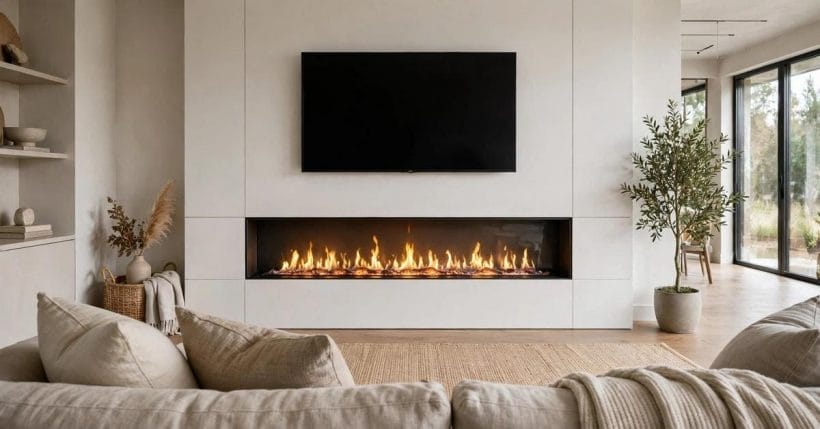
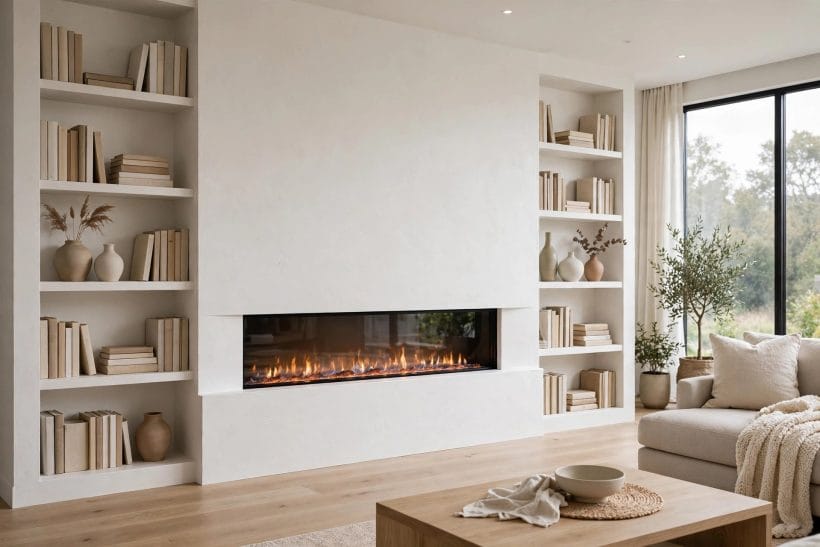
A linear electric fireplace is a long, low fire that sits in a wall like a picture. It is wide rather than tall, and its flame is an effect: light and movement behind glass, not burning fuel. That single difference shapes everything about choosing one. There is no chimney to plan, no fuel to store, and no ash to clear. What matters instead is the wall it sits in, the surround around it, and the wiring behind it.
This post stays on the linear, electric form only. A fireplace wall is a different job, and a traditional fireplace with a real flame is another post again. The links in this guide point to those neighbours where they help, and the sections below keep to what a linear electric fire actually is: a styling feature with gentle warmth, fitted by a professional.
1. What “Linear” Means
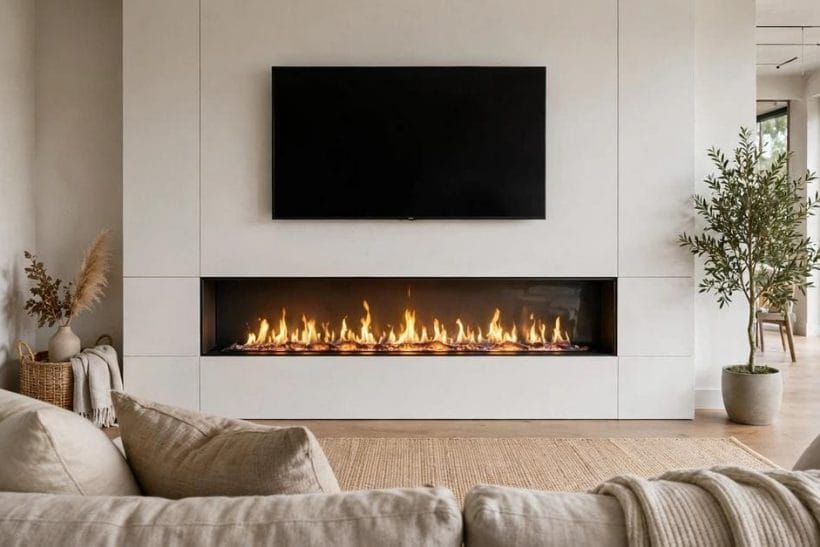
Linear describes the shape. The firebox is much wider than it is tall, so the flame spreads sideways across the wall. In a living room that shape suits a wide wall and a low media unit. It also suits a wall that already carries a television, because the fire and the screen share the same horizontal line without competing for height.
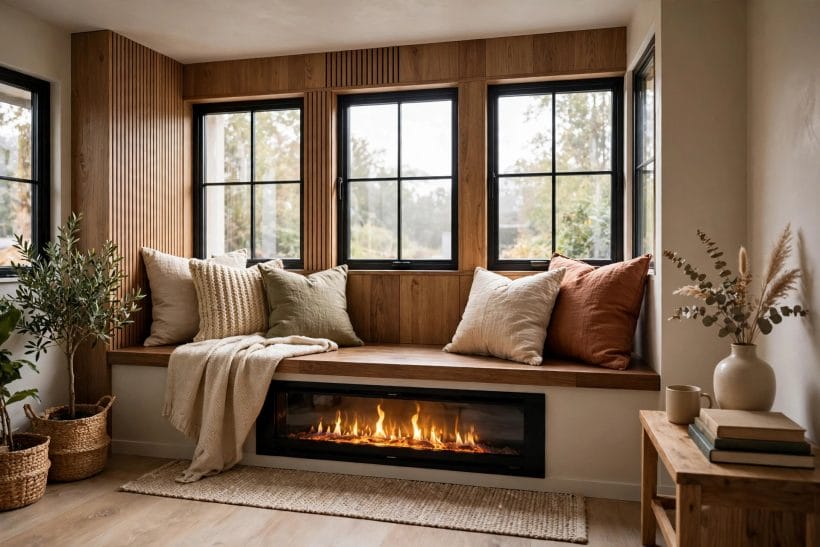
The shape also sets the room’s proportions. A long fire makes a wall feel longer, and it draws the eye sideways rather than up. That is why linear fires sit well under windows, under shelving runs, and in rooms where the ceiling is not the feature. If the wall is narrow, a linear fire can still work, but the fire should be shorter than the wall it sits in, with breathing room at both ends.
Fireplace wall designs cover the wider family of walls built around a fire. This post is the linear electric branch of that family: same wall, narrower brief.
The proportions also affect the furniture around the fire. A long, low fire pairs naturally with low, wide furniture: a low media unit, a long sofa, a wide rug. Tall, narrow pieces beside it fight the horizontal line and make the wall feel busy. When the room already has tall bookcases or a tall dresser, the fire wall should stay the calm one, with the tall pieces kept to the opposite wall.
2. The Flame Is an Effect, Honestly Stated
The flame in an electric fire is made with light, not combustion. Some models use reflections and moving light patterns. Others use fine mist or a screen. The result reads as flame from across a room, and it reads best in softer light, when the room is not flooded with daylight.
That honesty matters for expectations. An electric flame does not behave like a wood flame. It does not flicker with draughts, and it does not change with fuel. What it does is give the room a moving focal point that can run with or without heat, which is why many owners run the effect alone on mild evenings.
When you compare models, look at the effect in a showroom at the light level your room actually has in the evening. A flame that looks convincing under showroom spots can look flat in a bright room, and a subtle effect can look rich once the lamps are low.
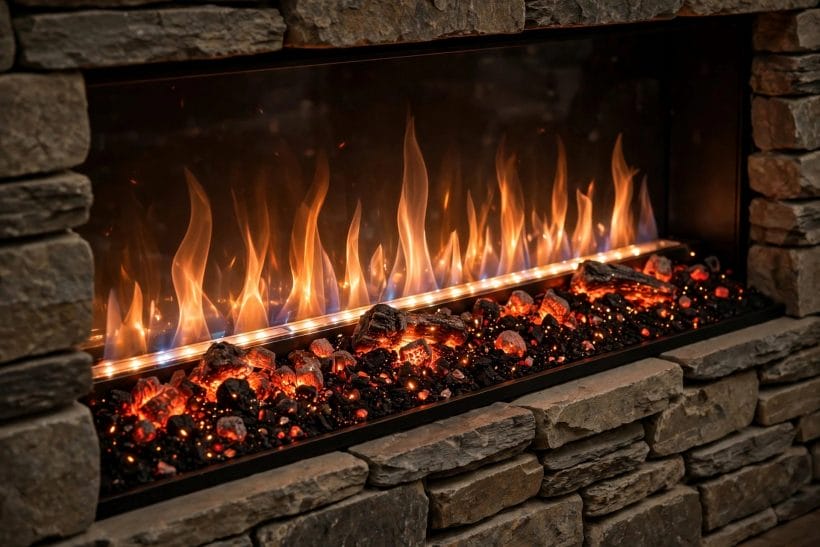
Many models also let you change the flame colour or brightness, which is worth testing in the same visit. A flame that looks orange in the showroom may offer cooler or softer settings that suit your room better, and a brightness control matters more than it sounds: the same effect can feel festive at full brightness and restful dimmed. Ask to see the full range of settings, not just the default, before deciding.
3. Surrounds and Mantels
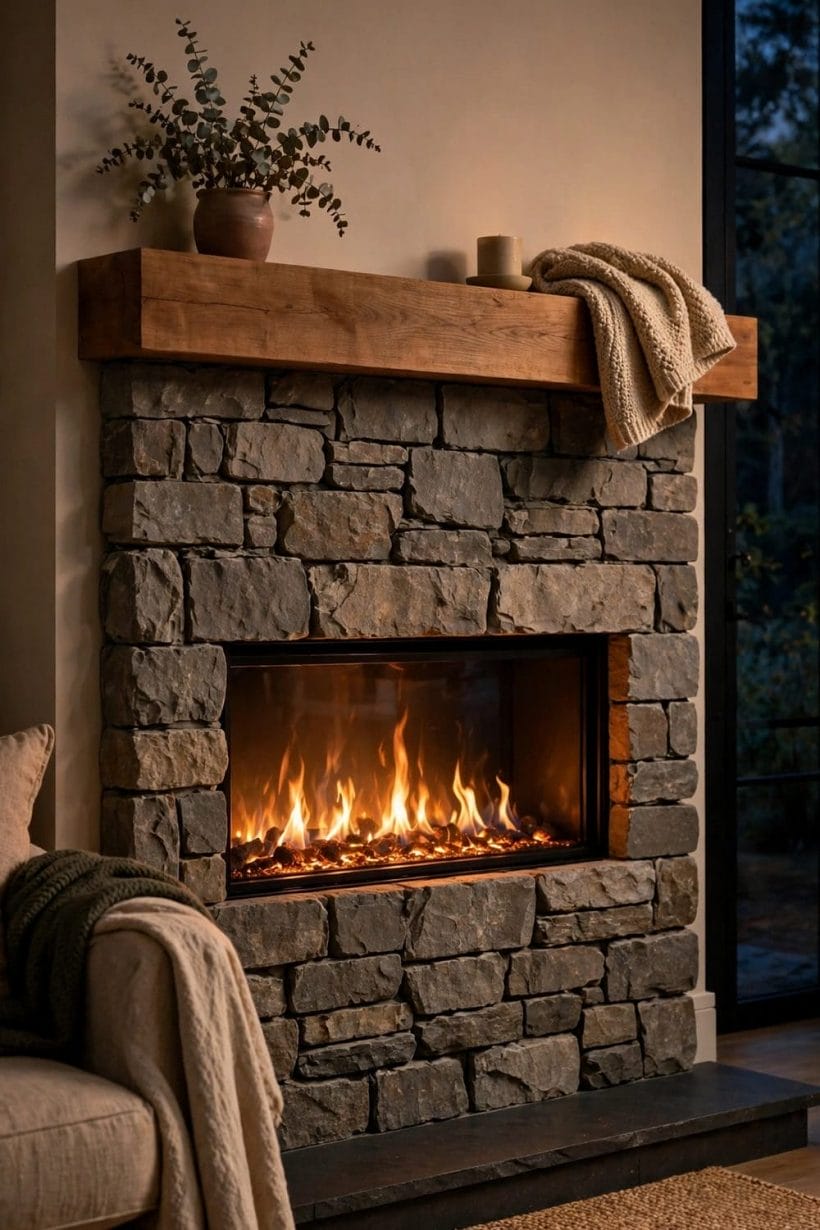
The surround is the frame the fire sits in, and it does most of the styling work. Stone gives a solid, grounded look. Wood warms the wall and suits a mantel shelf above. Plaster keeps the wall flat and quiet, so the fire itself is the only feature. Each choice changes the room more than the fire unit does.
A mantel shelf above a linear fire is a styling surface, not a storage shelf. Candles, a vase, and a framed print are enough. Keep the shelf clear of anything that could fall toward the glass, and keep anything heat-sensitive away from the unit itself. The maker’s guidance for clearances around the unit is the rule here, not guesswork.
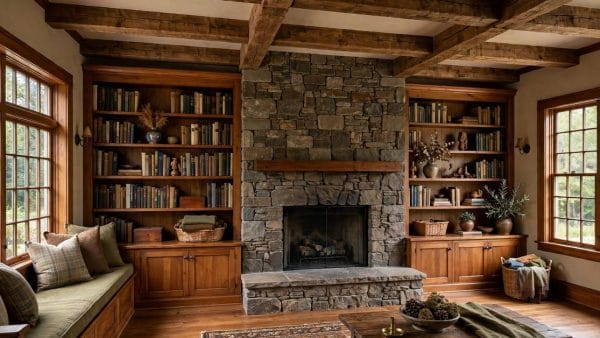
Rustic fireplace ideas show the traditional end of this family, where stone and timber do the talking. A linear electric surround borrows that language in a flatter, cleaner form.
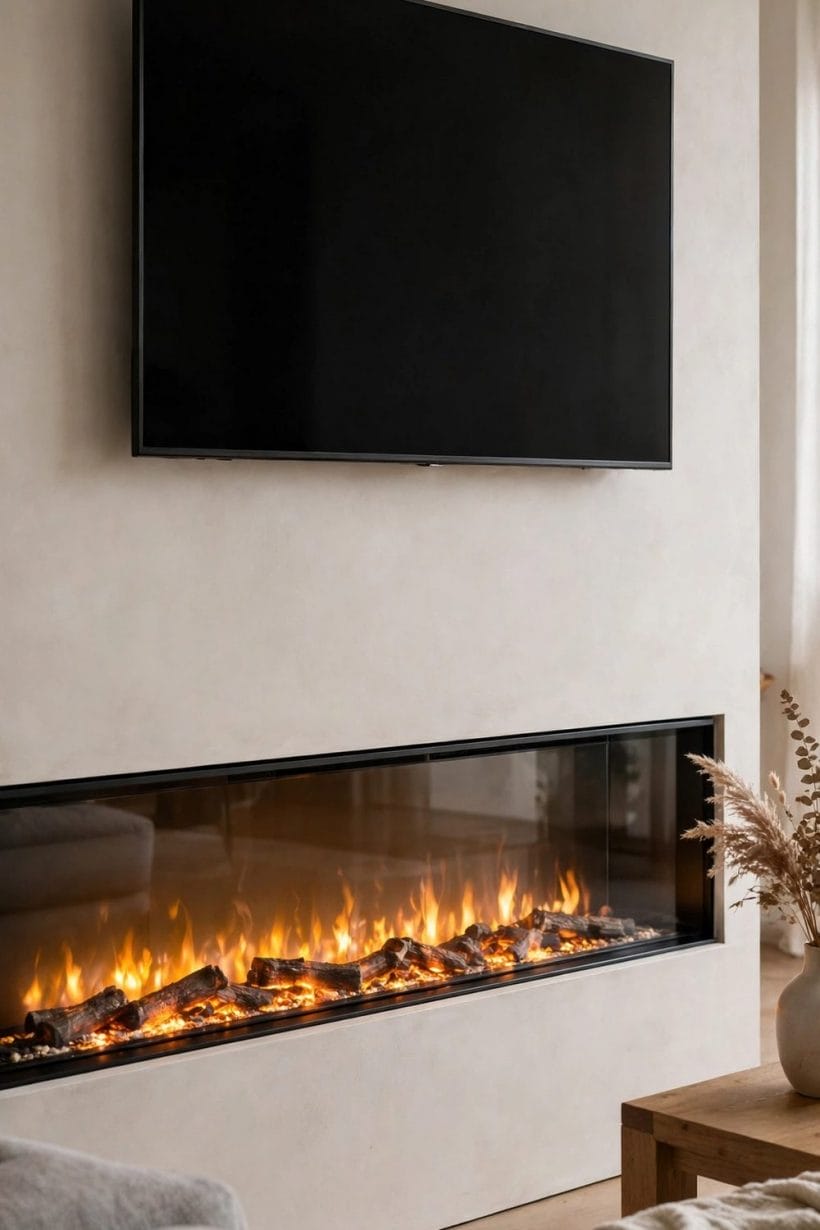
The surround material should also suit the cleaning it will get. Stone wipes clean and forgives dust. Wood needs a little more care near warmth, and it should be kept clear of anything that could scorch or dry it out. Plaster looks quiet but marks more easily, so a plaster surround near a busy seating area will show knocks sooner. Choose the material for the life the wall will actually have, not just for the photograph.
4. The Media Wall
The most common home for a linear electric fire is the media wall: fire below, television above, storage or shelving at the sides. The combination works because both pieces are wide and flat, and both face the seating. The wall becomes one composition instead of two competing features.
Planning a media wall starts with the seating distance. The television should sit at a comfortable viewing height, and the fire should sit low enough that its flame is visible above a coffee table but not so low that furniture hides it. Built-in shelving at the sides should stay shallow, so the fire remains the widest element on the wall.
Cabling is the unglamorous part of a media wall, and it is worth planning before the wall is closed. Power for the fire, power and signal for the television, and any sound equipment should all be routed while the wall is open. Once plasterboard is up, adding a cable is a much bigger job.
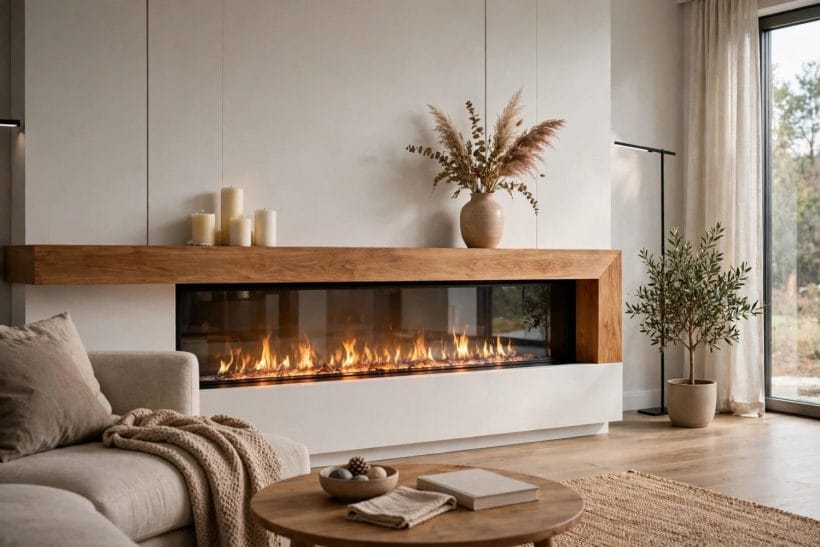
Sound deserves a place in media-wall planning too. A soundbar often sits below the television, which is exactly where the fire already lives, so the two can crowd each other. Plan the soundbar’s home early: above the television, inside a side cabinet, or as part of the shelving, rather than squeezed between fire and screen. A media wall planned for sound as well as picture stays calm to look at and to listen to.
5. The Bedroom Version
A linear fire also suits a bedroom, usually on the wall at the foot of the bed. The flame effect gives the room an evening focal point, and the gentle warmth takes the edge off a cool room without the room needing a full heating change. The fire should be sized to the bedroom wall, which is usually smaller than a living-room wall, so a shorter unit often looks better here.
Bedroom placement has one extra consideration: the fire should not face the bed so closely that its light disturbs sleep. A fire on the side wall, or one whose effect can be dimmed or switched off independently of any heat, gives more control. Check how the effect dims before buying, not after fitting.
Luxury master suite ideas show how a bedroom fire sits inside a larger suite plan, where the fire is one calm element among several, not the room’s only idea.
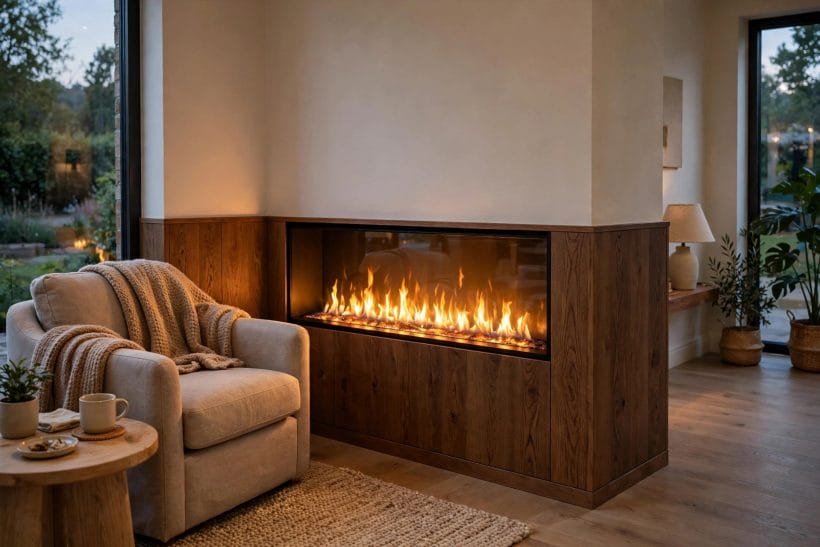
Night-time use brings one more check: how the fire switches off. A timer or a remote that works from the bed means the fire does not stay on after sleep, and an effect that dims gradually feels kinder at bedtime than one that snaps off. Check the remote’s range and the timer’s behaviour in the showroom, and keep the remote where it belongs, not lost between pillows.
6. Sizes and the Wall
Linear electric fires come in a range of widths, and the right width is the one that suits the wall. A useful rule is to leave clear wall on both sides of the unit, so the fire reads as a feature rather than as a wall that happens to be on fire. The exact proportions are a matter of taste, but a fire that runs wall to wall with no margin looks cramped, however wide the room is.
Depth matters too. Some units sit proud of the wall, some sit flush, and some recess into a cavity. A recessed unit needs a wall deep enough to hold it, or a false wall built out to create the depth. That false wall is a normal part of media-wall building, but it changes the room’s dimensions slightly, so it should be planned before furniture is ordered.
Fireplace photos give a broad survey of fireplace forms, which helps when the question is not which linear unit, but whether a linear unit is the right form at all.
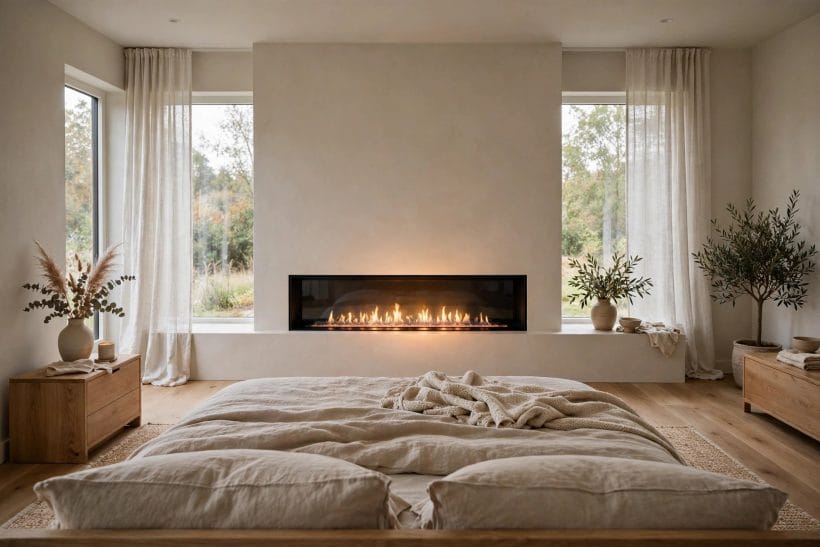
Measuring is the least glamorous part of choosing a width, and the most useful. Measure the wall, then measure what already lives on it: skirting boards, sockets, light switches, and any shelving that stays. A fire that fits the bare wall but crowds a socket or a switch will look wrong once fitted. Sketch the wall on paper with those fixed points marked, and let the sketch, not the showroom, choose the width.
7. Fitting and Electrics
Fitting a linear electric fire is electrical work, and it belongs to a qualified professional. The unit needs a power supply that suits its rating, and the supply should be planned so the cable is hidden and the unit can be isolated if needed. A spur from a nearby socket is sometimes enough and sometimes not; that is a judgement for the electrician, not for the homeowner.
Recessing adds building work to the electrical work. Cutting into a wall, building a false wall, or framing a cavity all need to respect what the wall carries: studs, pipes, cables, and insulation. A wall that looks empty can hide all four. A professional survey before cutting saves the cost of repairing a surprise.
Ventilation is simpler than with a real fire, because there is no combustion and no flue. The unit still needs the clearances its maker specifies, so air can move around it and heat can escape. Do not box a unit in tightly against its own guidance, even if the tighter fit looks neater.
After fitting, keep the manual and note where the isolator sits. If the unit ever needs attention, the engineer will ask for both, and a homeowner who can answer quickly saves a return visit. Test every control in the first week, while the fitter’s visit is still fresh and any fault is easy to report. A fire tested only at Christmas will hide its faults until Christmas.
8. Heat, Honestly
Most linear electric fires offer heat as well as flame effect, and the heat is gentle background warmth for the room it sits in. It is not a replacement for the home’s heating, and it should not be bought as one. Think of it as the warmth that makes the seating area comfortable on an evening, not as a heater for the whole house.
Heat settings vary by model, and some models let the flame run with no heat at all. That split matters: on a mild evening the flame alone may be all the room wants, while on a cold evening the heat adds to the room’s existing heating. Running the effect alone also costs less to run than running effect plus heat, which is worth knowing before the first bill.
No heat-output figure is quoted in this guide, deliberately. Outputs vary by model, and a figure copied from one model would mislead a buyer of another. The maker’s rating for the specific unit, read before buying, is the only figure that counts.
Running costs are worth understanding in general terms, even though no figure is quoted here. Running the flame effect alone costs less than running effect plus heat, because the effect is light and the heat is work. That difference is why the split matters: on mild evenings the effect alone gives the room its atmosphere, and the heat only joins when the room genuinely needs it.
9. Styling Around the Fire
Once the fire is fitted, the styling around it should stay quiet. The fire is already the room’s moving feature, so the wall around it does not need to compete. A few calm objects on a mantel, a rug that grounds the seating, and lighting that can dim will do more than a crowded display.
Seating should face the fire without blocking it. A coffee table between seating and fire is fine, as long as it does not hide the flame from the main seats. Side tables and floor lamps should sit to the sides, not in front of the glass. The test is simple: from every main seat, can you see the flame without leaning?
Coffee table pictures show how the table between seating and fire can carry the room’s styling without blocking the view.
Seasonal styling keeps a fire wall fresh without rebuilding it. In winter, heavier textiles and candles suit the fire’s warmth. In summer, lighter objects and greenery suit the flame effect running alone. Whatever the season, keep flammable decorations clear of the unit and its maker-specified clearances, and treat the mantel as a display that changes, not a shelf that fills.
10. What to Check Before Buying
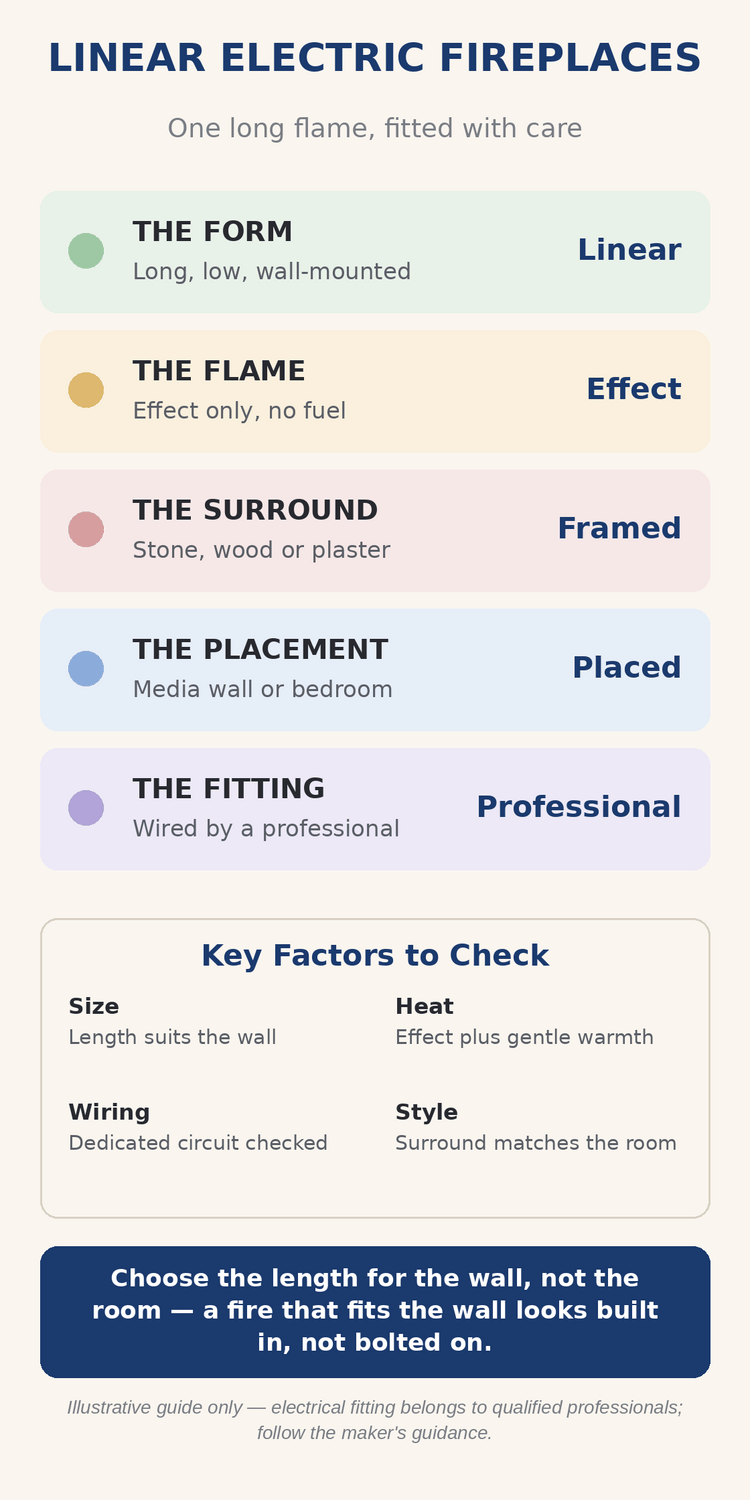
Before buying, check six things. First, the wall: is it wide enough, deep enough, and free of hidden services where the unit will sit? Second, the power: can a qualified electrician supply the unit cleanly, with the cable hidden? Third, the effect: have you seen the flame at your room’s evening light level? Fourth, the size: does the unit leave clear wall on both sides? Fifth, the controls: can flame, heat, and dimming be set independently? Sixth, the guidance: have you read the maker’s clearances and fitting requirements for this exact model?
If any of those six cannot be answered, the purchase is not ready. A fire that cannot be supplied cleanly, or that cannot be seen from the seating, or that overwhelms its wall, will disappoint however good the flame looks in a showroom. The checks cost nothing; the refit costs plenty.
Dream homes show feature fireplaces inside larger dream-home plans, which is a useful final check: does a linear fire belong in your room, or does it belong in a different room’s plan?
When the unit arrives, check it before the fitter leaves: the glass unmarked, the effect running through its settings, the heat switching on and off, and the remote paired. Keep the packaging until the unit is fitted and tested, in case a fault needs a return. A delivery checked on the day is a small habit that prevents a long argument later.
Final Considerations
A linear electric fireplace is a styling choice with a practical tail. The styling is the long flame, the clean surround, and the calm wall. The practical tail is the wiring, the wall depth, and the maker’s clearances. Both halves deserve equal attention, and the second half should be settled before the first half is bought.
Done well, a linear fire gives a room an evening centre without a chimney, a fuel store, or a cleaning routine. It suits living rooms, media walls, and bedrooms, and it suits owners who want the look of fire with the running simplicity of an appliance. Done hastily, it gives a room a cable, a cramped wall, and a refit. The difference is the checks in section ten, made before the order, not after the delivery.


0 Comments