

The modern fireplace has escaped the chimney breast. It runs in ribbons along walls, wraps corners in glass, divides rooms without closing them, and hangs where no hearth has been — less a hole for logs than a line of weather the room is arranged around.
These seventy-five modern fireplace ideas collect the type in all its forms: linear, tunnel, corner, vertical, wall-mounted and outdoor — with the layouts, seating, colours and layered lighting that make a flame line into a room’s centre.
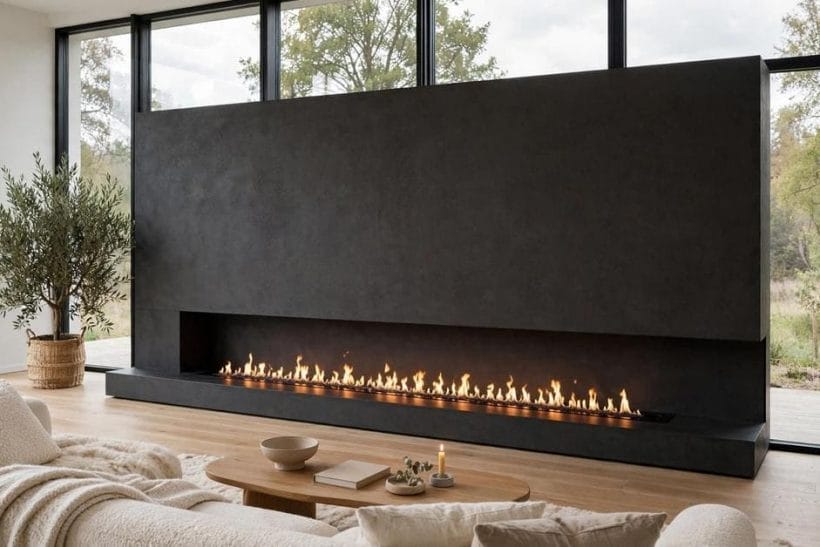
1. Modern Fireplaces at a Glance
Scope first, because the fire family is crowded. The pillar of the whole clan is fireplace living room ideas; this post is its modern specialist — the clean-lined, glass-fronted, largely mantel-free fires of contemporary rooms. Its siblings keep their own ground: fireplace hearth ideas owns the hearth, bookcase around fireplace ideas the shelved surround, and fireplace mantel ideas the shelf above. Here, everything is the modern fire itself.
A note that belongs at the front of any fire post: every real flame in these pages is a heating appliance as well as a picture. Clearances, venting and installation follow the maker’s instructions and local codes, and the work belongs to qualified installers. These ideas are about form, layout and styling — the decisions made around an appliance a professional fits.
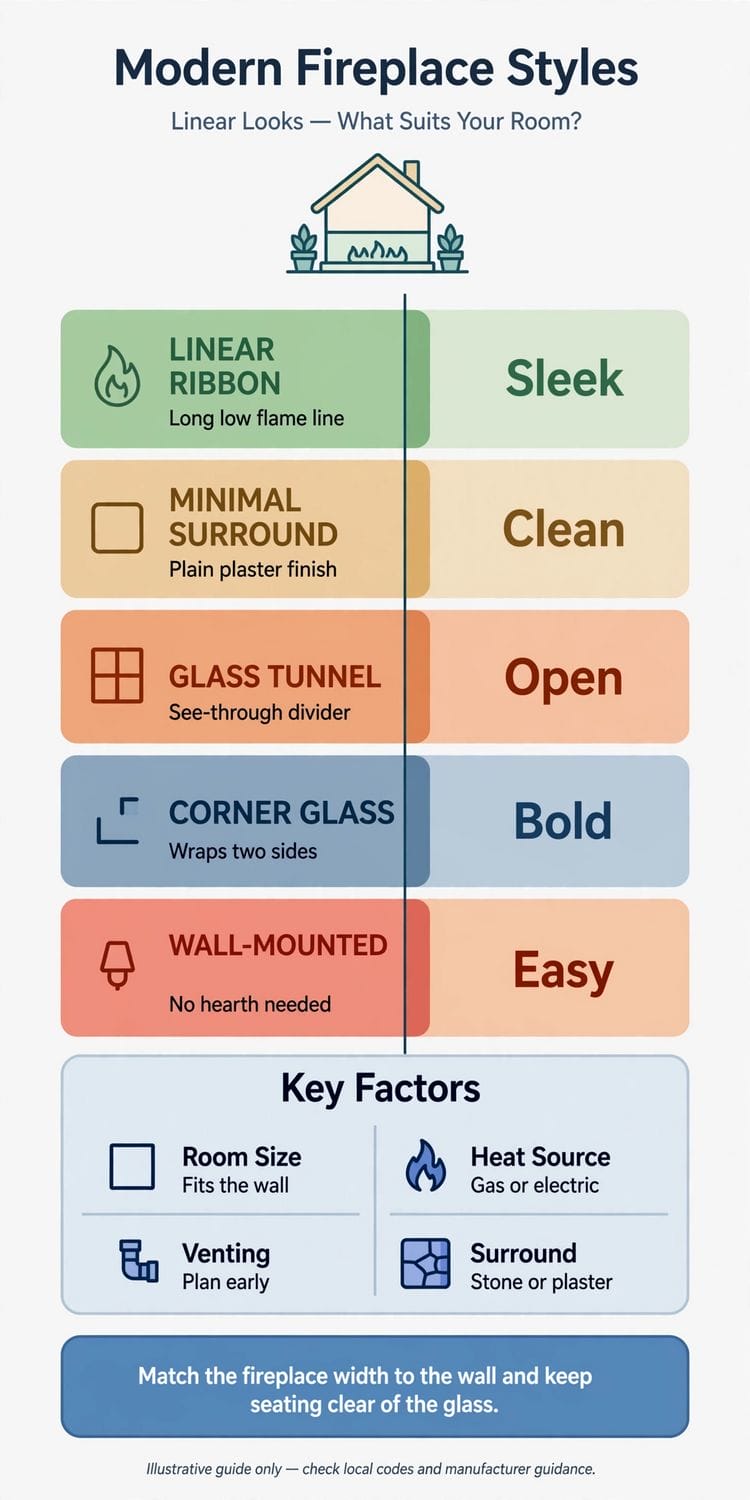
| Modern form | Character |
|---|---|
| Linear ribbon | A long, low line of flame — sleek, wide and calm |
| Minimal surround | Plain plaster or stone; the flame is the only decoration |
| Glass tunnel | See-through fire dividing two spaces, open to both |
| Corner glass | Flame wrapping two faces — bold, sculptural, shared |
| Wall-mounted | No hearth needed; fire at picture height in any room |
2. Glass Tunnels and Room Dividers

The penthouse in gallery-1 makes one fire serve two rooms: a glass tunnel in a low plinth, living room one side, dining room the other, the city glittering behind both. The tunnel is the modern fireplace at its most architectural — a divider that connects.
1. The two-room tunnel
A see-through fire between living and dining spaces shares one flame across both, warming and lighting each while keeping them distinct. It is the open-plan answer to the closed door: separation you can see through, glowing at exactly the height conversation happens.
2. A plinth fire as the room’s spine
Set low in a freestanding plinth, the tunnel fire becomes furniture — a bench, a boundary and a hearth in one object. Rooms arrange themselves along it naturally, and its top doubles as display space.
3. Tunnel under a floating slab
Float a stone or timber slab above the tunnel and the composition gains a horizon: flame below, shelf above, glass between. The slab carries art or nothing at all, and its shadow line keeps the fire’s architecture crisp.
4. The hallway glimpsed through fire
Place a tunnel between a hall and a living room and every arrival crosses a flicker. The glimpse does what a doorway cannot — advertising the room’s warmth before you enter — while the glass keeps draughts and smells on their own sides.
5. Kitchen-to-living tunnel
Between a kitchen and its sitting end, a tunnel fire serves the cook and the couch simultaneously. It suits open-plan evenings: dinner made on one side of the flame, dessert taken on the other.
6. A tunnel at the turn of a stair
Where a plan turns — an L-shaped room, a landing corner — a short tunnel fire marks the hinge. The flame is visible from both arms of the plan, stitching the turn into a destination rather than a corridor accident.
7. Glass on three sides: the peninsula
Open the tunnel’s end as well and the fire becomes a peninsula of glass, viewable from three sides. It anchors island seating beautifully — stools and sofas gather around it as they would around a kitchen island, except the centrepiece breathes.
8. Low tunnels for long rooms
In a long, narrow plan, a low tunnel run along the room’s length stretches the space instead of chopping it. The eye travels the flame’s whole line, and the far end of the room stops feeling remote.
9. The tunnel as art object
Frame a tunnel in a single material — blackened steel, honed stone, mirror-polished metal — and it stops reading as an appliance and starts reading as an installation. Rooms styled around it should stay quiet: the fire is the exhibition.
3. The Vertical Slot and Slimline Fires

Not every modern fire runs wide: the pin shows the counter-idea, a single vertical slot of flame in a white pillar — an exclamation mark of fire in a calm room. Slim, vertical formats solve the rooms that ribbons cannot reach.
10. The single slot
One narrow column of flame, floor to near-ceiling, in an otherwise plain wall. It is the minimal fireplace reduced to a gesture — a gesture that works because everything around it is quiet. Best in white, plaster or pale stone, where the slit of fire draws the whole wall.
11. Twin slots, symmetrically set
Two slim vertical fires flanking a doorway, a window or a piece of art give a room ceremony without a chimney breast. The pairing reads architectural, almost classical — columns of flame standing in for columns of stone.
12. A slot in a room-dividing pillar
Where structure already provides a pillar — a column, a chimney stub, a services core — a slot fire turns the obstruction into the room’s event. The pillar in the pin divides nothing and supports little, yet the room organises itself around it.
13. Slimline fires for narrow walls
Short walls between windows, the end wall of a galley room, the slice beside a door: slimline formats were made for these leftovers. A modest vertical fire gives the fragment a purpose and the room a second focus that wide formats would overwhelm.
14. The corner slot
Set a vertical slot exactly on a room’s corner and the flame appears to fold the architecture. It is a sculptor’s trick — the corner stops being where walls end and becomes where the room’s light is kept.
15. Slot fires in hallways and landings
Passage spaces take fire surprisingly well: a slot turns transit into theatre and greets every arrival. Keep the styling bare — the flame, a bench, a coat hook — and let the corridor feel designed rather than decorated.
16. A vertical fire beside the bath
In a bathroom with the right appliance and installation, a slim slot of flame near the tub brings the spa register home. It is a specialist fitting — wet-room rules apply in full — the vertical format’s most luxurious hour.
17. Reading nooks with a slot
One chair, one lamp, one slot of fire: the modern reading nook needs nothing more. The vertical flame suits the tall, narrow geometry of an alcove, and the small scale keeps the heat companionable rather than commanding.
4. Linear Ribbon Fires: The Long Low Line

Close up, the ribbon fire is a landscape in miniature: flame running over black pebbles inside a brass frame, as in gallery-2. The ribbon is the signature modern format; its variations are a study in what the flame runs across and how the line is framed.
18. Ribbon over black pebbles
The classic bed: matte black stones that make the flame read brighter by contrast and hide the burner completely. It suits dark, moody compositions and photographs like jewellery — the gallery-2 treatment, and still the benchmark.
19. Ribbon over pale stone
Swap the bed to pale gravel or crushed marble and the same fire turns Scandinavian: brighter, softer, the flame a warm accent in a light room. Pale beds show their keepers — they ask for the tidier household.
20. Ribbon over driftwood and ceramics
Ceramic logs and driftwood pieces laid along the burner borrow the campfire’s memory without its smoke. Arranged sparsely, they keep the modern line; arranged generously, they warm the style towards rustic. The choice is the room’s whole accent in one decision.
21. The brass-trimmed ribbon
A metal frame — brass, bronze, blackened steel — draws a deliberate line around the flame — a picture with a gilt edge. Brass warms cool rooms; black steel disappears into dark ones. The trim is small; the effect is tailored.
22. The frameless ribbon
Or remove the frame: flame emerging from a slot in stone or plaster, nothing between room and fire but glass. Frameless ribbons are the purest modern statement and the least forgiving — every edge and finish around them is on display.
23. Ribbon at coffee-table height
Set the line low, at seated eye height, and the fire joins the conversation circle. Low ribbons heat the occupied zone of a room rather than its ceiling, and they make sofas feel gathered rather than arranged.
24. Ribbon run wall to wall
The maximal version: a flame line spanning the room’s whole width, the feature image’s black breast its close relative. Wall-to-wall ribbons turn the fire into the room’s horizon; seating, rug and ceiling all take their alignment from the line.
25. The double ribbon: fire above, fire below
Two parallel ribbons — one at hearth height, one floating above as a lit shelf line — double the gesture for tall rooms that a single line would underplay. It is a hotel-lobby move that scales down gracefully to double-height living spaces.
5. Outdoor Rooms and Terraces
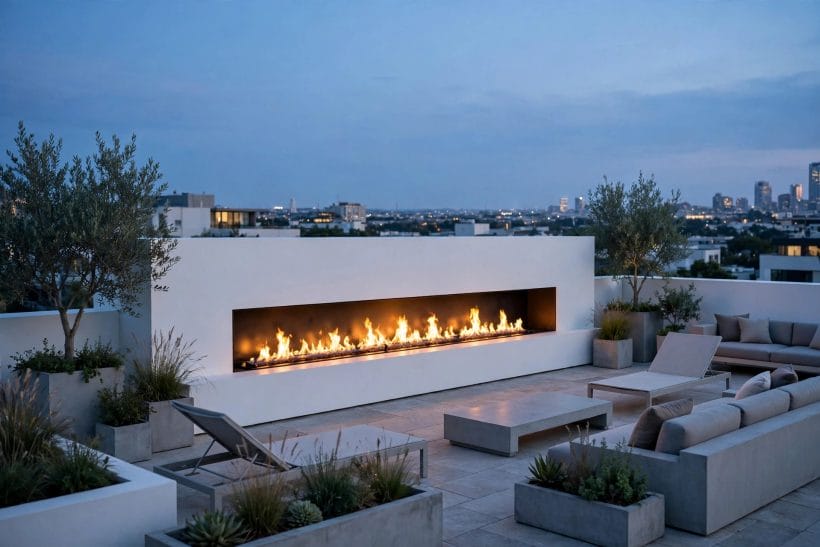
The terrace in gallery-3 — a long flame line in a white wall, sofas drawn up, the city going blue beyond — shows the modern fire’s second home. Outdoor ribbons behave like architecture, not campfires, and furnish a terrace as a hearth furnishes a room.
26. The terrace wall ribbon
Build the fire into the terrace’s enclosing wall and the whole outdoor room gains a lit horizon. Seating turns to face it as it would a view, and the wall itself stops being a boundary and becomes the room’s main event.
27. Fire along the pool’s edge
A ribbon run beside still water doubles itself in reflection — the oldest trick in garden design, sharpened by the modern line. Poolside fires suit the evening swim and the long sit afterwards; keep the composition pale.
28. The rooftop ribbon
On a roof terrace, a linear fire in a low wall gives the skyline a competitor at eye level. It also gives the rooftop a warm wall to sit against when the wind is up.
29. Fire tables for small terraces
Where no wall can be built, a ribbon set into a low table brings the format down to furniture scale. Dining and coffee-table versions gather guests around a flame that behaves — no smoke in the eyes, no sparks in the cushions.
30. A ribbon under a pergola
Under a pergola’s beams, a wall ribbon at the closed end makes the structure a room: roof above, fire ahead, garden on both sides. It is the outdoor arrangement most likely to be used in the shoulder seasons, when open terraces empty.
31. Courtyard fires
Enclosed courtyards hold heat and shelter flame; a ribbon along one wall turns the court into an outdoor hall for most of the year. Pale walls bounce the firelight around the enclosure until the whole space glows like a lantern.
32. The garden room’s fire wall
A garden room or studio gains its hearth wall: ribbon below, shelves or a screen above, doors opening to the green. It extends the working and sitting day at the garden’s end, in months when the house’s fire is too far away to share.
33. Outdoor ribbons in dark materials
Against the pale terrace of gallery-3, set the counterpoint: blackened steel and dark stone outdoors, the flame line floating in shadow. Dark outdoor fires suit wooded plots and evening-only gardens, where the fire should be the brightest object for metres.
6. Bedrooms and the Media Question

The bedroom in gallery-4 settles the modern fire’s most argued pairing: a low ribbon beneath a wall-mounted television, on a calm sage wall, at the foot of the bed. Fire and screen, stacked — the format’s defining layout question.
34. Fire below the screen
The gallery-4 arrangement: television centred, ribbon beneath, both on one calm wall. It works when the fire is wide and low and both are treated as one composition on a single centre line — not two appliances sharing a wall by accident.
35. Fire opposite the screen
The traditionalists’ answer: fire on one wall, screen on another, seating that can turn. It suits rooms used for both conversation and viewing in earnest, and it keeps each focus free of the other’s compromises.
36. The bedroom ribbon at the bed’s foot
A low, wide ribbon on the wall the bed faces turns the bed into the best seat in the house. Flame height stays below the mattress sightline, the wall stays calm, and the room’s luxury is measured in hours spent exactly there.
37. Fire in the dressing area
A slim fire in a dressing room or ensuite passage brings warmth to the morning’s coldest minutes. It is an indulgence with a practical spine — these are the rooms people actually shiver in — and it asks only a short wall.
38. Media walls: fire, screen and storage in one joinery
The full composition: a single built wall carrying ribbon fire, screen, shelves and cupboards in one material. Done well it is the modern living room’s complete answer — every function stacked, aligned and calm.
39. Screen-free fire rooms
The deliberate opposite: a sitting room where the ribbon is the only rectangle of light. Books, conversation and the fire. In houses full of screens, one room that refuses them becomes the household’s favourite.
40. Low ribbons under windows
A ribbon run beneath a wide window doubles the horizontal line and sets flame against the view. It suits rooms whose outlook is the evening sky; the fire holds the foreground while the light goes down outside.
41. The guest room’s welcome
A modest ribbon in a guest room says what spare rooms rarely manage: you were expected. Keep the styling simple and the instructions simpler — a fire a guest can light without a manual is hospitality in appliance form.
7. Corner Glass and Two-Sided Fires

In gallery-5 the fire wraps a corner: glass on two faces, the flame shared between a kitchen and its living end, both halves warmed by one appliance. Corner glass is the modern fire’s most sociable geometry.
42. The kitchen-living corner
The gallery-5 layout in full: the corner fire as the hinge of an open plan, cooking on one face, sofas on the other. It replaces the kitchen island as the household’s gathering point on winter evenings — same centrality, better light.
43. Corner fire in a square room
Square rooms defeat single-wall fires; everything faces one way and the corners sulk. A corner-glass fire turns the seating diagonal, uses the room’s full geometry, and gives two walls a share of the glow.
44. Wrapping the chimney corner
Where an old chimney breast juts into a room, wrap its corner in glass-fronted fire and the obstruction becomes a sculpture. The breast keeps its mass; the corner does the modernising. Old house, new flame, no demolition.
45. Two-sided fire, bedroom to bath
A two-sided fire between a bedroom and its ensuite — flame visible from the bed and from the bath — is the suite’s defining luxury. Privacy is managed with levels and screens; the fire glows on both sides of the wall it pierces.
46. Corner fire under a stair
The wedge beneath a stair is dead space in most houses. A corner fire fitted there — with every clearance a professional confirms — turns the under-stair into the hall’s glowing heart, and the stair’s turn into a viewing gallery.
47. Peninsula fires on room corners
Extend the corner idea: a three-sided peninsula fire standing at the end of a dividing wall, visible from all around. It suits lofts and barns where walls are few — the fire itself becomes the partition’s punctuation.
48. Corner seating to match
Fires that turn corners want seating that does the same: an L-shaped sofa echoing the glass, or two chairs angled across the corner’s diagonal. Mirror the fire’s geometry in the furniture and the arrangement looks inevitable.
49. Glass corners in dark rooms
In a dark-toned room, a corner of flame reads as a lantern set into the architecture. The two lit faces bounce against each other, and a modest fire does the atmospheric work of a large one.
50. The outside corner: fire on a facade
Carry the corner fire to the building’s edge, glass wrapping an exterior corner with terrace beyond, and indoors and outdoors share one flame across the glass. It is the boldest version, and the one guests describe on the way home.
8. Dark Rooms, Cabins and Wall-Mounted Fires
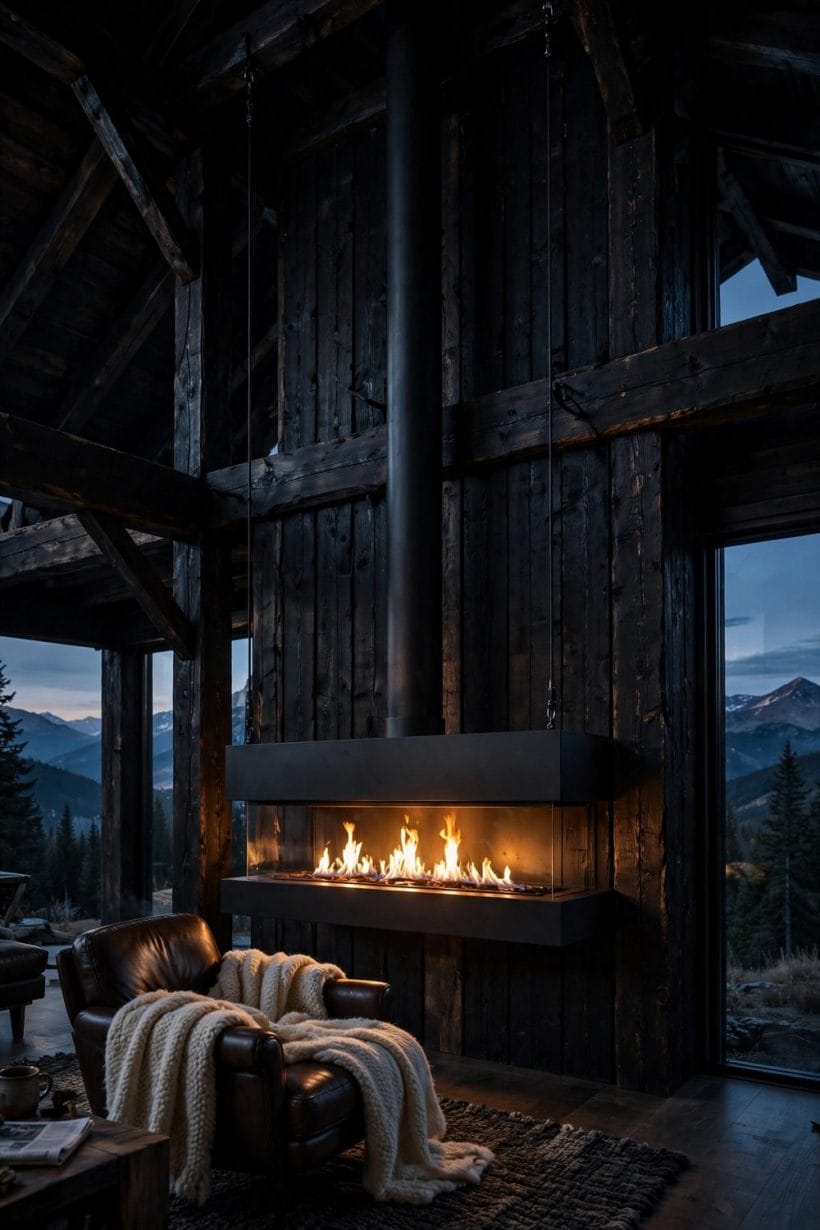
The pin’s dark timber cabin — blackened boards, a leather chair, a wall-mounted ribbon floating at sitting height — is the modern fire at its most atmospheric. Wall-mounted formats free the fire from the floor entirely, and dark rooms are where they shine.
51. The floating ribbon
A wall-mounted ribbon with nothing beneath it: no hearth, no plinth, flame hovering at picture height. In the cabin it hangs over bare boards; in a white room it reads as a lit shelf of fire. The floor stays completely free.
52. Fire at picture height in a dining room
Hang the fire where a painting would go and dinner gains a living canvas. Diners sit at flame height, the table stays clear, and the room’s art budget is spent once, on the object everyone actually watches.
53. Dark walls, bright line
Charcoal, ink and blackened-timber walls make a ribbon read twice as bright — the contrast does the work. This is the cheapest drama in the modern fire repertoire: the appliance stays modest, the room’s colour does the staging.
54. The cabin register: timber and flame
Modern fire and rustic timber are natural partners: the clean line of the appliance against the grain of old boards. It suits barns, cabins and rooms with beams — anywhere the architecture is warm and the fire can afford to be cool.
55. Wall-mounted in a small flat
No chimney, no floor space, no problem: the wall-mounted ribbon is the small flat’s fireplace, hung like a television — or in flueless electric and bioethanol forms where local rules allow. The room gains a hearth without surrendering a square metre.
56. A ribbon above a sideboard
Set the floating fire above a low sideboard and the pair compose like a mantel reimagined: storage below, flame above, objects arranged on the board’s top in the firelight. It is the traditional chimney-breast arrangement, translated into two clean lines.
57. Leather, wool and firelight
The cabin’s palette — worn leather, woven wool, dark wood — is the dark register’s textile key. In pale rooms the same fire wants linen and boucle; the appliance is constant, and the textiles decide which century the firelight belongs to.
58. Two small fires instead of one large
In a long dark room, two modest wall-mounted ribbons — one at each end — can balance the space better than a single centrepiece, and they let seating form two intimate groups. Symmetry optional; the evenness of the glow is the point.
9. Bathrooms and Quiet Luxury
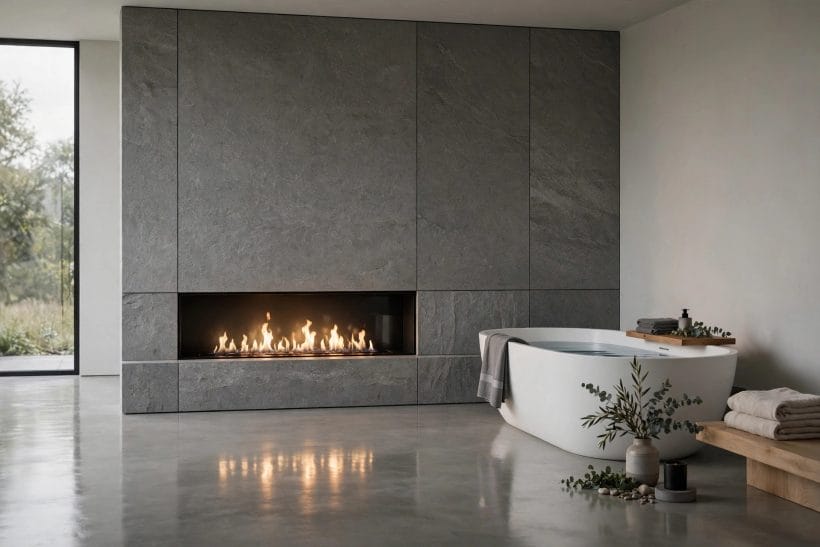
Gallery-6 places a linear fire in a grey stone wall beside a freestanding bath, the flames reflected in polished concrete. The bathroom is the modern fire’s quietest room — and the one where its luxury registers longest, in the hour nobody hurries.
59. Fire beside the bath
The gallery-6 arrangement: tub drawn up parallel to the flame line, an hour’s soak with weather. It demands the right appliance, professional installation and confirmed clearances — and repays all three with the defining image of the spa bathroom.
60. Stone walls around bathroom fires
Bathroom fires live best in mineral compositions — stone, concrete, large-format tile — that take steam and splashes and give the flame a cool, grey foil. Timber belongs in the dry zone: a bench, a bath caddy, the stool for the towel.
61. The ensuite ribbon
A short ribbon on the wall between bed and bath serves both rooms’ mornings: warmth for the shower queue, a glow for the bedroom. In suites planned as one space, the fire is the element that makes the openness feel intentional.
62. Firelight instead of candles
The spa ritual without the wax: a ribbon at its lowest setting gives the flicker candles promise and the steadiness they cannot. For households that soak often, the fire becomes the bathroom’s evening lighting, not an event within it.
63. A fire in the dressing bathroom
Where the bathroom doubles as a dressing room — chair, mirror, wardrobe wall — a slim fire completes the room’s claim to be a room. the difference between a wet cell and a warm apartment of one’s own.
64. Reflected flames: water and polished floors
Gallery-6’s polished concrete doubles its fire by reflection; bath water does the same, moving. Compositions that place flame near still, glossy surfaces get two fires for the price of one — an arithmetic that works in halls and pools too.
65. Cool palettes, warm point
The bathroom register is the extreme: everything cool — stone, glass, white ceramic — and one warm point of flame. The restraint is the luxury. Add a second warm note, a timber bench or brass tap, and the composition is complete.
66. The small bathroom’s single slot
Even a compact bathroom can hold the idea at slot scale: one narrow vertical flame in a tiled wall, professionally fitted, turning a functional room into the flat’s smallest spa. Scale down the format, never the installation standards.
10. Layouts, Seating and Layered Lighting: Pulling It Together
The formats are the vocabulary; this final section is the grammar — placement, seating, and lighting layered so the flame stays the brightest sentence. The calm families of modern living room ideas are its natural ground.
67. Centre the fire on the seating, not the wall
The commonest modern mistake is a fire centred on its wall and seating centred on the room, the two axes arguing quietly forever. Align the sofa’s centre to the flame’s centre — even off-centre on the wall — and the room instantly reads composed.
68. The conversation U
Sofas and chairs in a U around a ribbon give every seat a view of both fire and faces. It is the arrangement the format evolved for: a hearth a whole group can share without turning their backs on each other.
69. Swivel chairs for double-focus rooms
Where a room has a view and a fire, swivel chairs end the argument: outlook by day, flame by evening, one turn between them. The modern fire’s low profile suits the swivel’s theatre — the room changes its mind gracefully.
70. Keep the coffee table low and plain
Between seating and a ribbon fire, the table should stay below the flame line — glass, pale stone, plain timber — so sightlines to the fire pass over or through it. A tall or busy table taxes every seat behind it.
71. Layered lighting: the flame is layer one
Layer the room’s lighting around the fire: flame first, then low lamps at sitting height, then washers that graze the walls — and keep ceiling light for cleaning day. The fire should always win the brightness contest; every other light is its supporting cast.
72. Dimmers are the fire’s best friend
On dimmers, electric light can be tuned down to the flame’s own register, and the room settles into a single-source glow. Fit dimming wherever the fire lives; it is the cheapest upgrade in this entire list.
73. Colours that let the flame lead
Flame is orange; rooms that fight it with saturated blues and greens at equal strength end in a draw. The palettes that let fire lead are the quiet ones — warm whites, stone, clay, ink, timber — with colour arriving in textiles, as the transitions in transitional living room ideas also show.
74. Rugs define the fire’s territory
A rug laid to the fire’s width, seating gathered on it, marks the hearth zone in rooms without hearths. The modern fire’s territory is drawn in textiles rather than stone — redrawable in an afternoon when the room wants a new season.
75. The mantel-less mantel: one shelf, few objects
Give the modern fire a single floating shelf and style it with the old mantel’s discipline at half the population: one vessel, one stack of books, one living thing. The shelf restores the ritual of arrangement the clean wall removed, at exactly the dose the style can carry.
Final Considerations
The modern fireplace traded the chimney breast for a line — and the line proved more versatile than the monument: it divides rooms, wraps corners, floats on walls, warms baths and terraces, and gathers seating wherever it is drawn. Choose the format for the room’s geometry, the bed and trim for its palette, and light the room in layers that let the flame lead. What it must never be is casual: every flame here is an appliance, fitted by professionals to the maker’s word and the local code. Get that right, and the rest is pure pleasure.



0 Comments