

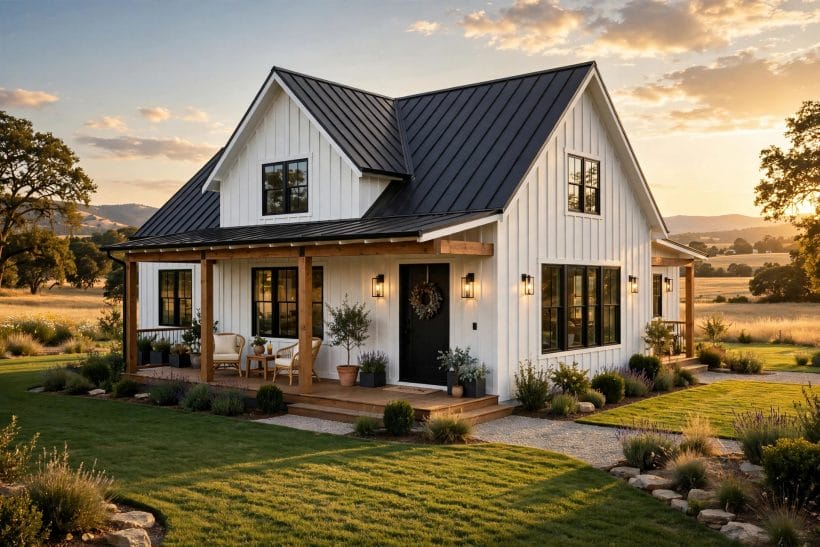
It is the house you can read from the road: white walls, a deep porch, black window frames — and a kitchen inside that works as hard as the land it stands on.
Here is the modern farmhouse whole, as this site’s canonical survey of the style: shell, rooms, materials and upkeep, with modern farmhouse choices ordered from the gate to the back bedroom.
1. Modern Farmhouse at a Glance
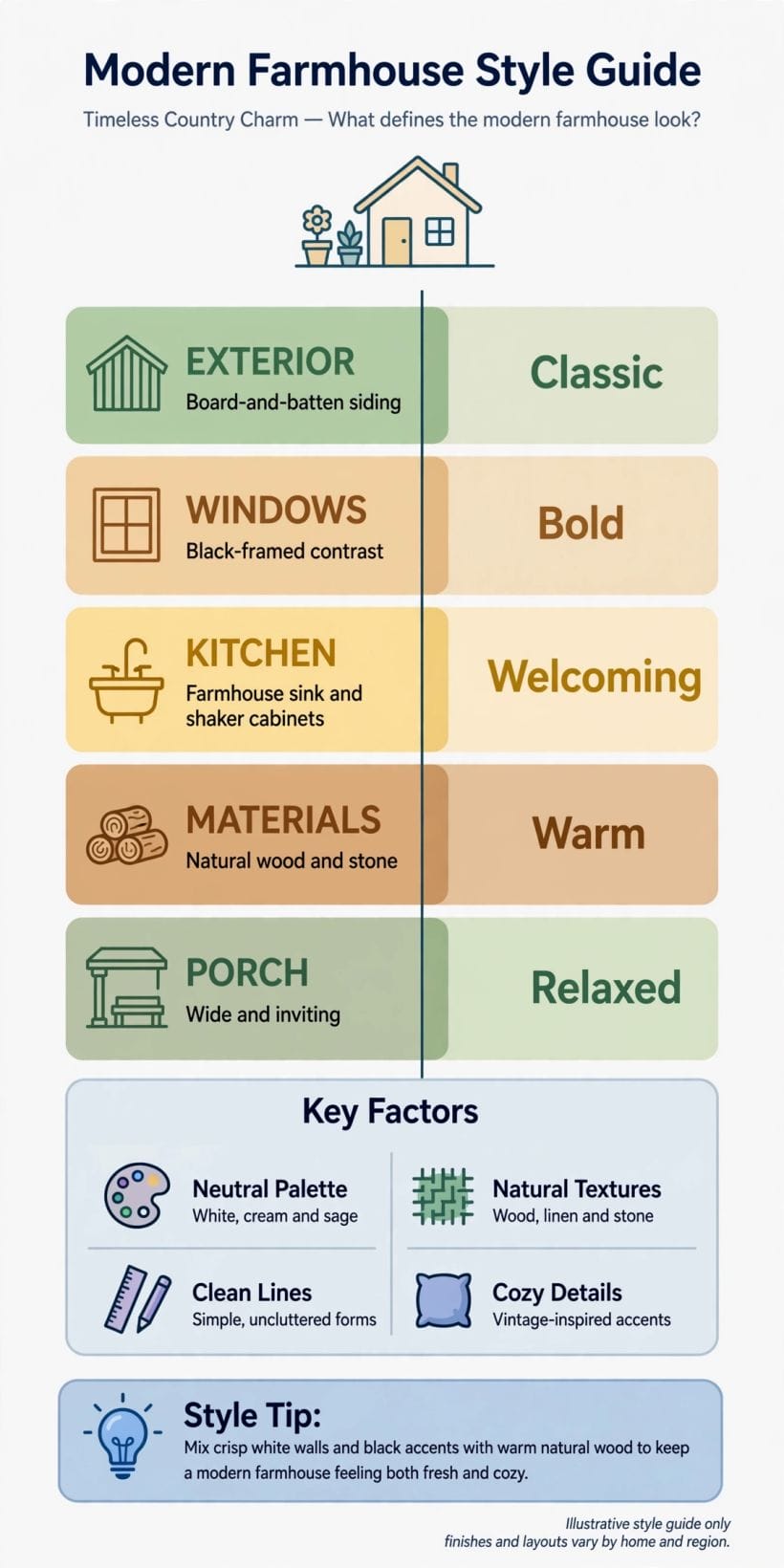
The modern farmhouse is a whole-house style built on a simple gabled form and a strict three-part palette — warm white, mid-tone timber, black iron — with working precedents for every room: porch and mudroom at the front, a range-and-table kitchen at the centre, calm white-bedded rooms at the back. Its attributes are honesty (materials are what they appear to be), washability (surfaces and fabrics survive real use) and accretion (the house improves piece by piece). As the owner of this topic in the cluster, this post covers the style’s complete attribute network and links down to its room-by-room specialists.
| Question | Short answer |
|---|---|
| What defines the style? | A simple gabled shell, white/timber/black palette, working porch, honest materials. |
| Is it a room style or a house style? | A house style — one language from the street to the back bedroom. |
| Does it suit small houses? | Yes — it began small; hold the palette and edit the furniture. |
| What ruins it fastest? | Slogan signs, fake distressing and a fourth strong colour. |
2. The Style Itself: Shell, Porch and First Sight
The modern farmhouse is a whole-house language, not a cushion choice: a simple gabled shell, honest materials and a palette of white, timber and black, spoken the same way from the street to the back bedroom. It sits inside the wider home design ideas survey as that survey’s most borrowed dialect, and its outside face belongs with the exterior home ideas in this cluster — begin there, with the building itself.
1. Start with a simple gabled shell
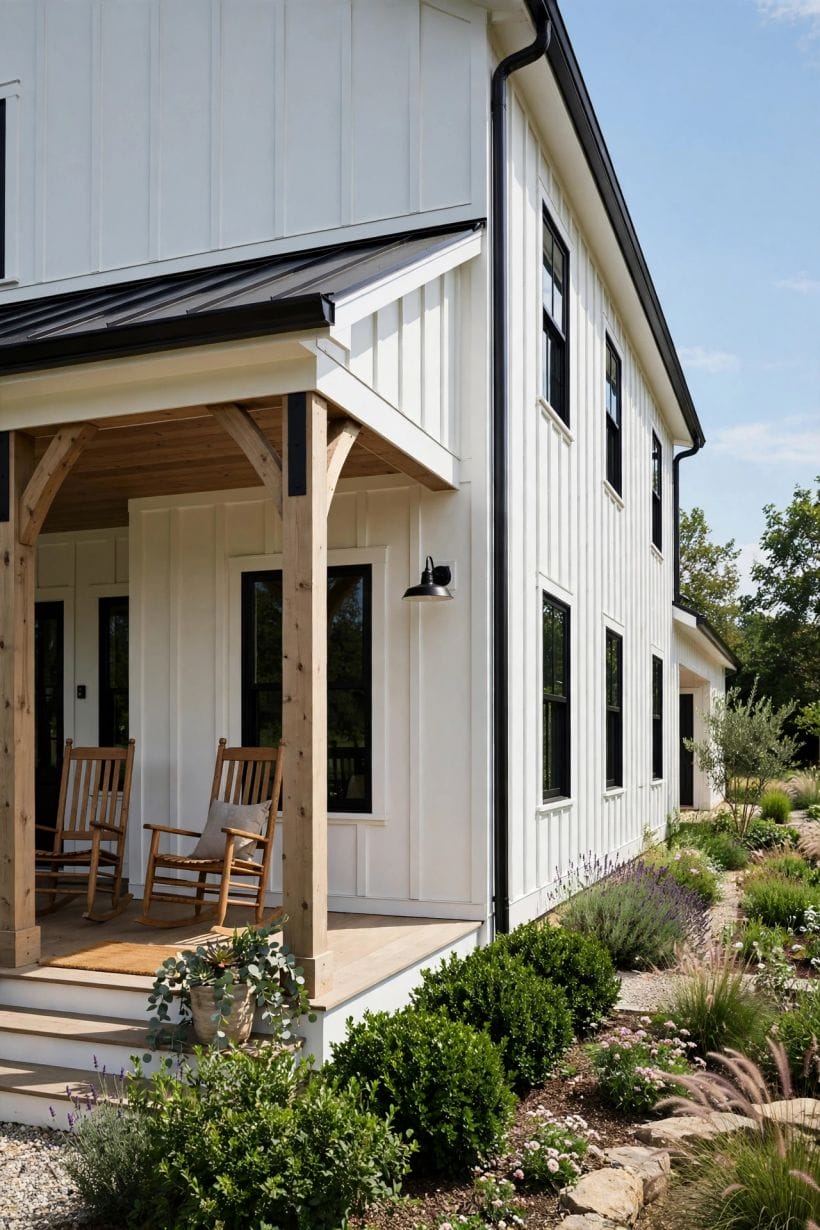
The style’s foundation is a plain, steep-roofed rectangle that reads as built-for-work. Complicated rooflines and fussy footprints fight the language before a single finish is chosen, while a simple shell makes every later farmhouse detail look inevitable.
2. Give the house a working porch
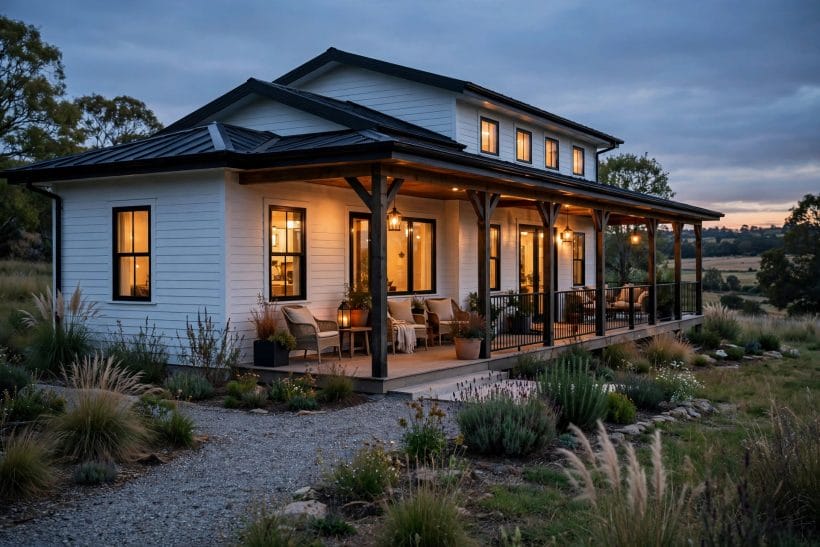
A deep porch on posts is the style’s handshake: shade, shelter and a place to sit that faces the land.
3. Board and batten for the walls outside
Vertical board-and-batten siding is the exterior’s signature texture. Its shadow lines give a plain wall rhythm without ornament, and it suits both a full farmhouse build and a single gabled extension added to an plainer house.
4. Black window frames against white walls
The contrast that announces the style from the road: pale walls, dark frames. It sharpens the simple shell, ties the windows into one family, and carries inside as black iron and matte hardware.
5. A standing-seam metal roof
Metal roofing suits the farmhouse’s agricultural ancestry and its modern cleanliness at once. On a simple gable it reads as one calm surface, sheds weather decisively, and needs less fuss than shingles over the building’s life.
6. Paint the palette before buying anything
White or warm off-white walls, mid-tone timber, black accents: settle the three-part palette on paper first.
7. Let the entry be a mudroom moment
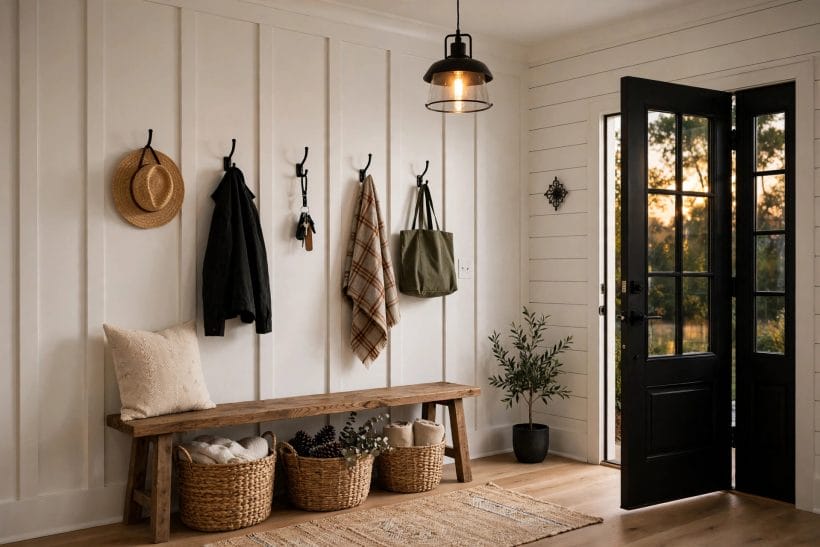
Farmhouses receive work, not just guests. A bench, hooks and a washable floor at the door the family actually uses keeps the style honest and the rest of the house calm — decoration that begins as equipment.
8. Keep ornament structural
Where the style decorates, it decorates with structure: exposed beams, chunky posts, a big chimney breast, brackets you can see working.
9. Light the porch like a room
One generous lantern at the door and low light along the porch make the house glow as a workplace winding down, not a showroom. Warm light against white siding is the style’s evening signature.
10. Plan the view from the road
Stand where visitors arrive and read the house: shell, porch, palette, one tree, one path. The modern farmhouse photographs well because it was composed at exactly this distance — five elements, nothing competing.
11. Let the garden stay useful
Herbs by the door, a vegetable bed in sight of the kitchen, grass where children and dogs actually run. A farmhouse garden that produces something keeps the whole composition believable; pure ornament belongs to other styles.
3. Living Spaces: Linen, Timber and the Big Table’s Sitting Cousin
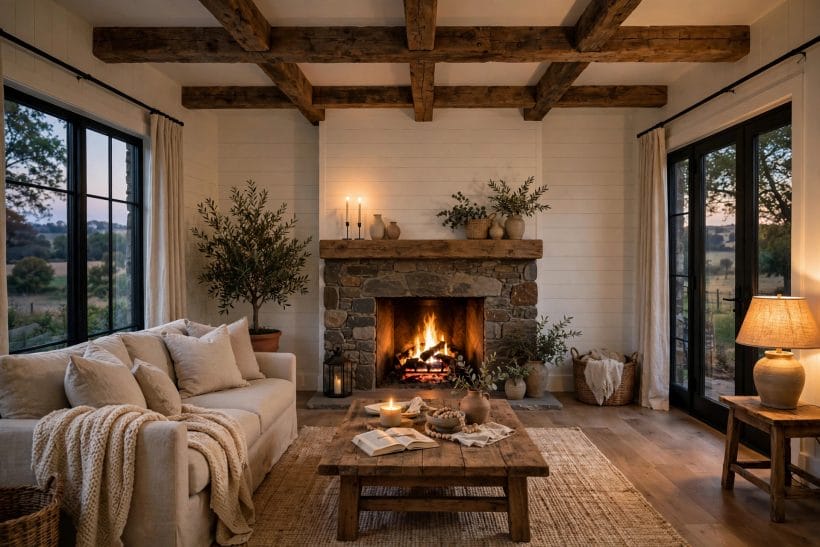
Inside, the living room is where the style proves it is for sitting in, not just photographing. The published farmhouse living room ideas work the room in depth; here it takes its place in the whole-house system, one room among equals under the wider living room ideas pillar, sharing palette and materials with every other room in this post.
12. Anchor the room with one big, plain sofa
A deep sofa in washable linen or cotton is the living room’s foundation piece. The style’s seating is generous and low-slung, upholstered in fabrics that forgive dogs, boots and naps — elegance measured in comfort per hour.
13. Shiplap one wall, not every wall
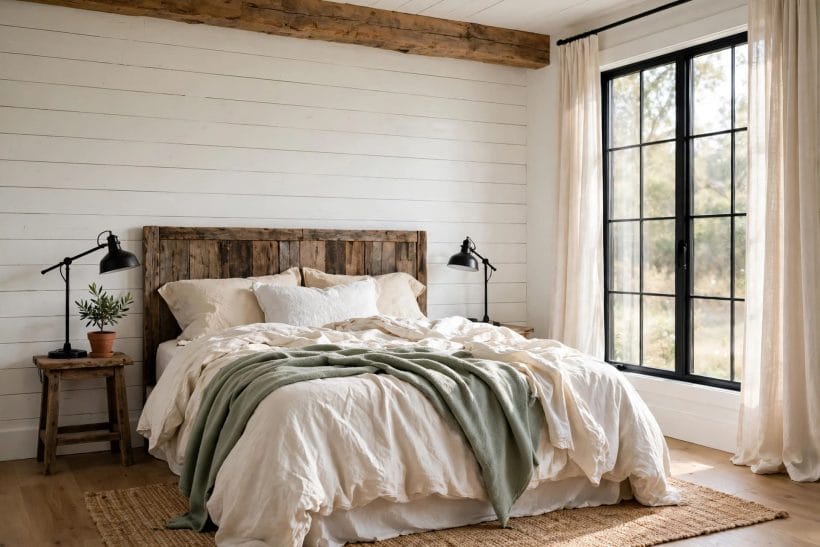
A single shiplap wall behind the sofa or fireplace gives the room its farmhouse texture.
14. Exposed beams, honestly sized
Ceiling beams in the living room should look capable of holding the floor above, even when they are cladding a steel or timber structure beneath. Undersized decorative beams read as costume; generous ones read as architecture.
15. A fireplace surround in brick or stone
The hearth is the room’s second anchor: painted brick, plain stone or a simple timber mantel shelf. Keep the surround’s proportions chunky and its styling empty — two candlesticks or nothing — so the material does the talking.
16. Layer rugs over boards
Bare timber or wide-board floors, softened by one large woven rug, beat wall-to-wall carpet in this style. The rug defines the sitting island, absorbs sound, and can be beaten clean outdoors in the farmhouse manner.
17. Slipcover what gets used hardest
Slipcovers are the style’s quiet technology: washable, replaceable, and honest about family life. Two sets — one on, one in the wash — keep the pale palette practical rather than precious.
18. Use black iron sparingly but everywhere
A lamp base, a curtain rod, the fireplace tools, one picture light: small black iron notes repeated room to room are the style’s punctuation. A little in every space beats a lot in one.
19. Shelves that hold real books and crocks
Open shelving in the living room carries books, baskets, stoneware and a plant or two.
20. Keep the television visually quiet
The style absorbs a screen best on a plain wall, low on a timber bench or inside a cupboard — present but not enthroned.
21. Choose one vintage piece with a past
An old trunk as a coffee table, a worn leather chair, a grandfather’s ladder for throws: one genuinely aged piece authenticates ten new ones. The modern farmhouse is a dialogue between new comfort and old work.
22. Leave the room slightly unfinished
A basket of logs, boots by the door, a throw that lives unfolded. The style’s final layer is evidence of life, arranged loosely — a room too perfect has left the farmhouse and joined the showroom.
4. Kitchens and Dining: The Working Heart
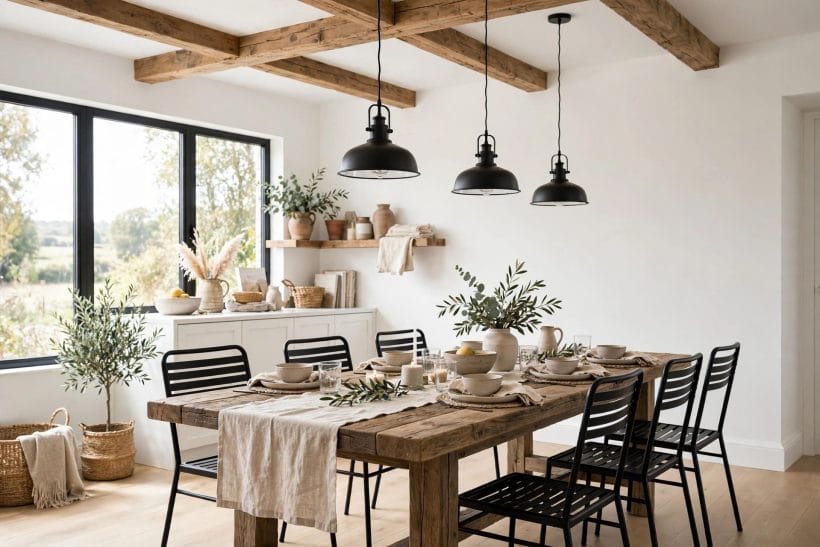
The kitchen is the style’s engine room and its dining table its parliament; plan them as one territory. The eating half of the territory is surveyed in the dining room ideas collection; here the pair are treated together, in the farmhouse manner, where cooking and eating were never separate rooms to begin with.
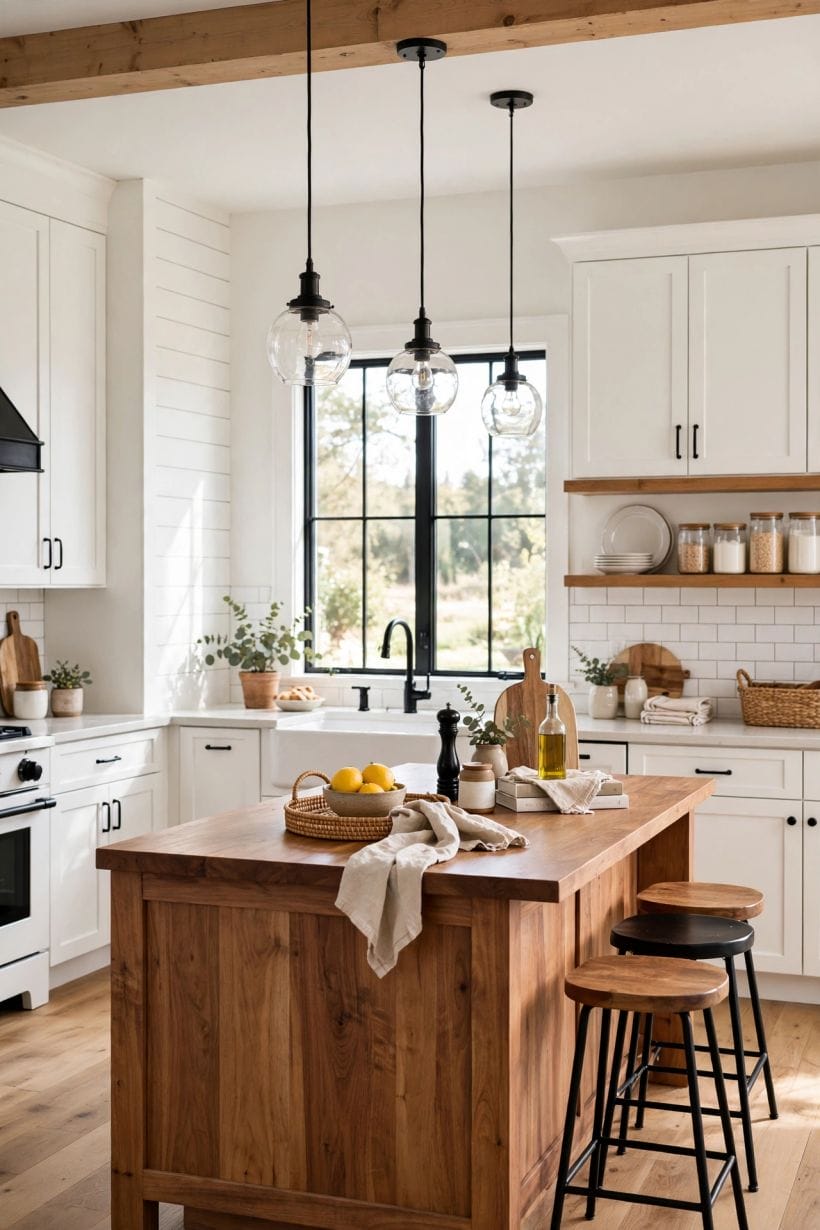
23. Fit an apron-front sink and mean it
The deep farmhouse sink is the kitchen’s emblem because it works: big pots, garden vegetables, a baby, all washed in one basin. Choose it for capacity first; its looks are the reward, not the reason.
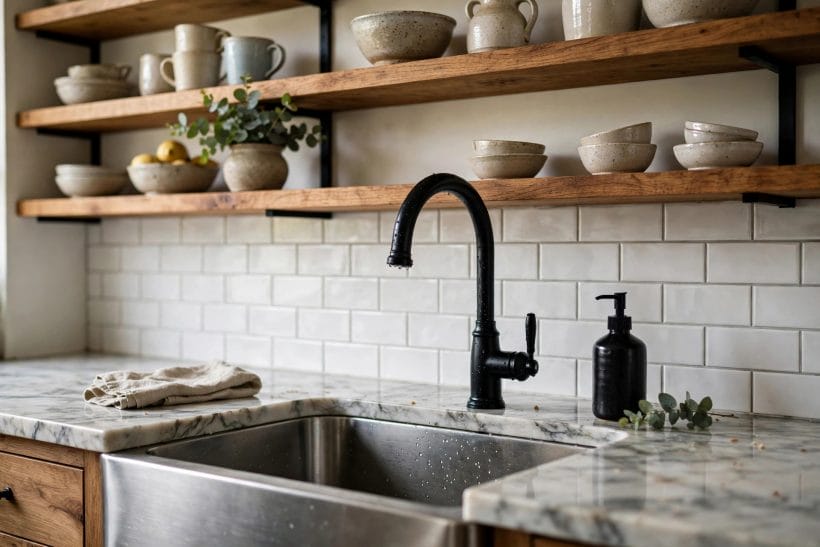
24. Run open shelves where the daily things live
Plates, bowls, glasses and jars on open shelves at arm’s reach of sink and table. Closed cupboards keep the rarely used; the shelf run is the kitchen’s open toolbox, restocked by the dishwasher’s daily round.
25. Build the island like a farm table
A work island with legs or a furniture base, a timber top and room for stools reads as the farm table’s descendant. It should seat the cook’s audience and take a rolling pin’s punishment in the same hour.
26. Choose a range that looks like equipment
The cooker should read as a tool: substantial, simple-faced, in enamel or steel. In this style the range is the kitchen’s range — the one appliance allowed to be a presence rather than hidden behind cabinet fronts.
27. Butcher block and stone, each where it belongs
Timber tops where knives and dough work, stone or steel at the wet and hot zones. Mixing surfaces by task is the farmhouse’s practical inheritance; a single showy surface everywhere is the modern habit it replaces.
28. Hang a rail of pans and tools
Copper, iron and steel on a rail over or beside the range: storage that doubles as the room’s decoration and keeps the best tools fastest to hand.
29. Give the dining table the best light
The long table belongs under the best pendant or the brightest window, because this table hosts homework, harvests, laptops and feasts in rotation. Size it for the biggest regular gathering, not the average Tuesday.
30. Bench seating on one side
A bench along one side of the table seats three children or two sprawling adults, slides away to free the floor, and carries the farmhouse’s communal message in furniture form.
31. Store tableware where the table is
Crockery for daily meals lives nearest the table, not nearest the sink. The farmhouse kitchen shortens the laying-and-clearing loop first and the washing loop second — the opposite of the fitted kitchen’s usual mistake.
32. A dresser or hutch for the good things
One furniture piece — dresser, hutch or tall cupboard — holds linen, serving pieces and the good glasses, freeing the work kitchen from ceremony. It is also the room’s best display: plates racked, jugs in a row.
33. Keep a working corner for preserving and projects
A stretch of counter with no daily job, near a power point and the garden door, for jam, seedlings, dough and repairs. Farmhouse kitchens always had a project surface; modern ones need it more, not less.
5. Bedrooms and Bathrooms: Calm at the Back of the House
The private rooms run the same palette at a lower temperature: softer light, fewer objects, everything washable. The bedroom half is taken deeper in the farmhouse bedroom ideas survey; here both rooms are finished as the whole-house system’s quiet end.
34. White bedding, always, in layers
The farmhouse bed is white or undyed linen and cotton, layered with one woven throw.
35. A bed frame in timber or black iron
Simple, strong and slightly oversized in its members, the bed frame echoes the house’s structure. Iron for lightness in a small room, timber for weight in a large one; both outlast upholstered fashion.
36. Keep bedroom storage furniture, not systems
Wardrobes, chests and a blanket box rather than a fitted wall: furniture can be moved, repaired and inherited. The farmhouse bedroom is furnished, not installed, and feels calmer for it.
37. Hang curtains high and plain
Linen or cotton curtains, hung above the frame and falling to the sill or floor, unpatterned. They soften the room’s geometry, filter morning light gently, and wash without ceremony when the season turns.
38. One chair, one lamp, one pile of books
The bedroom’s sitting kit is deliberately small: a chair for clothes-in-waiting and reading, a warm lamp, a short stack of books. Anything more invites the room to become a second living room and lose its rest.
39. In the bathroom, a trough or apron sink
The bathroom repeats the kitchen’s sink logic at smaller scale: a generous basin, a simple mixer in a black or nickel finish, and a mirror with no frame theatrics. Utility first; the style follows.
40. Shiplap or beadboard to dado height
Bathroom walls in the style take panelling to waist height, painted in a washable finish, with plain plaster above. It protects the splash zone, warms a tiled room, and can be repainted in an afternoon.
41. Freestanding tub where the room allows
A simple freestanding bath is the bathroom’s farm table: sculptural because it is plain. Where space is tight, a deep inset tub with a timber bath bridge keeps the same spirit in less floor.
42. Black taps, or nickel — one metal per room
Mixed metals age this style quickly. Choose the bathroom’s single metal, repeat it on taps, rail and light, and let timber and white do the rest. Consistency is what reads as quality at a glance.
43. Hooks and a bench beat cabinets
A row of hooks for towels and robes, a small bench or stool for clothes, open shelves for the daily bottles. The farmhouse bathroom stores like a farmhouse entry: visibly, at hand, nothing hidden that is used daily.
44. Keep both rooms’ floors bare and washable
Boards, stone or simple tile with one washable cotton rug. The private rooms stay fresh in this style because every soft thing in them can go through the wash and every hard thing can be wiped to clean.
6. Materials and Colour: Whitewash, Timber and Iron
Three materials and three colours carry the entire style; this section is its specification sheet. Its earthier cousin, the rustic survey elsewhere in this cluster, leans on the same honesty with the polish left off — the modern farmhouse is that family’s washed and ironed branch, and the difference is finish, not spirit.
45. Whitewash and warm whites, never blue-whites
The wall colour is a warm, slightly creamy white that flatters timber and skin. Blue-leaning whites turn the palette clinical and fight every wood tone in the house; test whites against your actual boards at noon and dusk.
46. Mid-tone timber as the second colour
Floors, tables and beams in a middle timber tone — neither pale Scandinavian nor dark traditional — give the white its warmth and the black its company. One timber tone repeated beats five woods competing.
47. Black as punctuation, not theme
Black appears at frames, hardware, lights and the odd chair — small, repeated, decisive. Rooms where black becomes a wall colour or a full suite have left the style for a moodier one.
48. Linen, cotton, wool: the fabric palette
Natural fibres in undyed, white, stripe and check are the whole upholstery library. They wash, fade gracefully and feel right under a hand — the style’s luxury is tactile, not visual.
49. Stoneware, glass and galvanised metal
The accessory materials are the farm kitchen’s own: stoneware crocks, clear glass storage, enamelware, and dull galvanised buckets and trays. Shiny chrome and gold have no ancestors here and always look borrowed.
50. Paint lower walls, paper nothing
Walls in this style are painted, panelled or plastered — pattern arrives via textiles and objects, not wallpaper. The discipline keeps rooms restful and lets one patterned rug or cushion sing.
51. Checks and stripes, sparingly
A ticking stripe on a cushion, a checked throw on the bed: the farmhouse’s only patterns, used like seasoning. More than one pattern family per room and the calm that defines the style evaporates.
52. Age new timber gently, or not at all
New wood can be left to silver, oiled to deepen, or painted — but theatrical distressing fools no one and dates fastest.
53. Repeat the palette outside the front door
White, timber and black should greet you at the gate: fence, porch, frames, door. A house whose palette starts at the street reads as one decision — the strongest first impression the style can make.
54. Let green be the fourth colour, living only
Plants, herbs and the garden view supply the palette’s green. Painted green has its own styles elsewhere in this cluster; here, green is grown, cut and brought in — and it changes with the seasons for free.
55. Buy the best plain version of everything
With ornament banned, quality shows in weight, weave and joinery. The style is an argument for fewer, better, plainer things — a farmhouse virtue and a budget strategy in one.
7. Small Houses, Tiny Houses and the Style at Reduced Scale
The farmhouse began small, so the style scales down gracefully — provided the palette is held and the furniture is edited. Its modern sibling in this cluster, the modern living room ideas survey, takes the same rooms contemporary; the farmhouse answer below keeps the warmth and drops the size, which suits the small-living heart of this site.
56. Hold the palette, cut the pieces
In a small house the three colours matter more, not less, because there is nowhere for a stray tone to hide. Keep white, timber and black — and halve the object count instead.
57. One big piece per room, rest small
A small farmhouse room takes one generous piece — the sofa, the table, the bed — with everything else light and low. Scale contrast is what keeps tiny rooms feeling furnished rather than crammed.
58. Use the porch as a room
In small houses the porch is not a gesture; it is the second sitting room, the mudroom and the summer dining room in one roofed strip. Furnish it as seriously as any indoor room.
59. Fit a farm table that seats the house’s life
A narrow farm table against a wall, with a bench, seats daily meals and expands to guests at its end. In tiny plans this single piece replaces dining table, desk and workbench by rotation.
60. Open shelves earn double in small kitchens
Shelves instead of wall cupboards keep a small kitchen’s walls light and its stores visible — vital where every cupboard is also the pantry. The daily-use rule applies twice over: display nothing you do not cook with.
61. Barn-style sliding doors where swings fail
A sliding door on a visible rail saves the swing arc in tight halls and carries the style’s hardware language into the plan. Use it where the arc truly matters, not as decoration on rooms that open fine.
62. A wood stove as the small house’s heart
Where local rules and safe installation allow, a small stove gives a tiny farmhouse its warm centre and its kettle. It is the historical farmhouse’s actual heating plan, sized down — professionals and local guidance govern, always.
63. Sleep in a loft, farmhouse style
A loft bed over the kitchen or living end, reached by a stair with storage in its treads, is the tiny farmhouse’s classic plan. White boards and a black rail keep the loft inside the palette.
64. Keep laundry and mud at the door
A stacked washer by the entry, hooks above, boots below: the tiny farmhouse compresses the mudroom into one wall. The principle — dirt stops at the door — matters more as the house shrinks.
65. Garden like a smallholding, not a lawn
Raised beds, a herb patch by the kitchen door, one fruit tree: at small scale the farmhouse garden returns to production. Even two beds change the house’s relationship to its plot from view to use.
8. Keeping It: Care, Wear and the Line Not to Cross
The style’s last attribute is maintenance: it was designed by people who washed, mended and repainted as a rhythm of life. Keep that rhythm and the house stays itself; chase novelty instead and it dissolves into whatever next season sells.
66. Wash and rotate the slipcovers seasonally
The pale palette survives family life by laundry, not by anxiety. Rotating covers with the seasons — heavier weaves in winter, bare cotton in summer — refreshes rooms for the price of a wash.
67. Repaint one room a year
Painted walls, panelling and furniture stay farmhouse-fresh with a rolling repaint: one room each year, in the same warm white. The rhythm keeps the whole house perpetually almost-new without a single big renovation.
68. Oil timber, wax it, let it mark
Timber tops and tables in this style are maintained with oil and use, and their rings and knife marks are the patina the style trades on.
69. Edit the accessories twice a year
The style rots from the shelf outward: one jug becomes nine. A twice-yearly edit — everything off, only the used and loved returned — keeps the open storage honest and the rooms breathing.
70. Repair visibly and well
A stitched cushion, a spliced chair rail, a re-tinned pan: visible mending is the farmhouse’s oldest decoration. It signals a house that keeps things, which is the entire philosophy in one gesture.
71. Refuse the slogan signs
Word art, farm puns and distressed mottoes are the line not to cross: they announce a theme where the style means a life.
72. Refuse fake materials
Wood-effect, stone-effect and leather-effect surfaces contradict the style’s founding honesty. Where the budget stops, use the honest cheaper thing — painted softwood instead of oak, enamel instead of stone — and let it be itself.
73. Keep animals and work in the picture
Boots drying, a dog asleep on the rug, vegetables waiting on the counter: the style’s photographs always include the life. A modern farmhouse kept too clean for its own inhabitants has kept the wrong thing.
74. Let rooms evolve one piece at a time
The farmhouse was never bought in a day. Add the dresser this year, the beams when the ceiling is opened anyway, the porch when the budget lands.
75. End with the evening test
When the day’s work is done, the house should glow: warm light, clear surfaces, the table ready for morning. If a room passes the evening test, the style is alive in it.
9. Checks and Mistakes: Before the First Purchase or the First Stone
Walk the house with the palette card before buying anything large. The commonest farmhouse mistake is the honourable one: a beautiful object in the wrong family — a chrome lamp, a jewel-tone sofa — that then demands the room change around it. Check colour, material and honesty, in that order, against the three swatches and the one question the style asks of everything: what does it do?
Measure the porch, the kitchen work line and the table for the life you actually live, not the photograph you admire. A farmhouse sized for show fails its own philosophy; sized for use, it forgives almost any other compromise. Professionals govern the structural work — beams, stoves, roofs — as always; the style decisions are yours, and they are mostly decisions to leave things plain.
10. Costs and Pulling It Together
A modern farmhouse is built at three honest price levels. The first is paint, palette and editing: the style declared with a brush and a clear-out, in rooms that already exist. The second is furniture and fabric: the big plain pieces, the washable covers, the table that seats the house’s life. The third is architecture: porch, beams, roof and kitchen built in the language from the start.
Spend in that order and stop whenever the house feels right — the style’s own history says a farmhouse is finished exactly when its owners say so, usually decades in. What never changes the total much is ornament, because there is none; what changes it entirely is structure, so price structure first and let the white paint, as always, come last and cost least.
Final Considerations
This survey owns the style whole so that its specialists can own their rooms: the living room, the bedroom and the rest each have their deeper pages linked above, and later variations of the farmhouse will be measured against this one.
Build the shell simply, hold the palette strictly, furnish it with things that work, and mend what wears. Do that for long enough and the modern farmhouse stops being a style you chose and becomes simply the way your house is — which is all it ever claimed to be.


0 Comments