
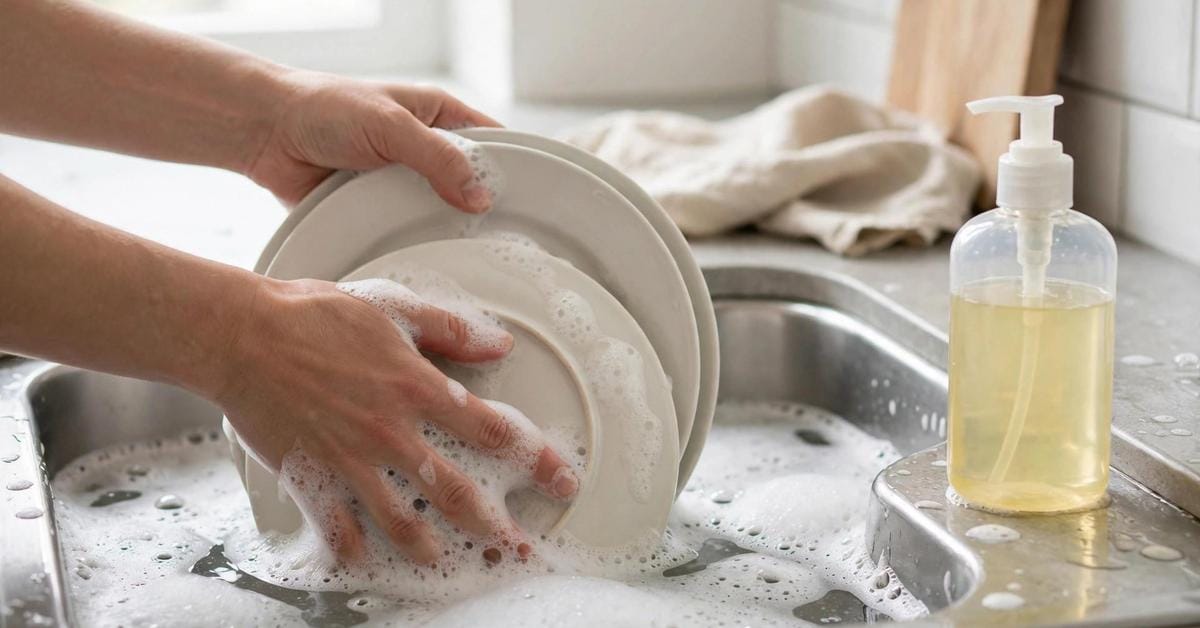
The phrase on the bottle sounds technical, but the question behind it is an everyday one: what does pH-neutral dish soap actually mean, and does it change how you wash up? This guide answers that question in plain language, looking at dishes, glassware, pans, boards, sinks and worktops, and at the small habits that make sink time calmer. It is a general dish-care explainer, not a review of any product, and it makes no claim about any particular bottle on a shelf.
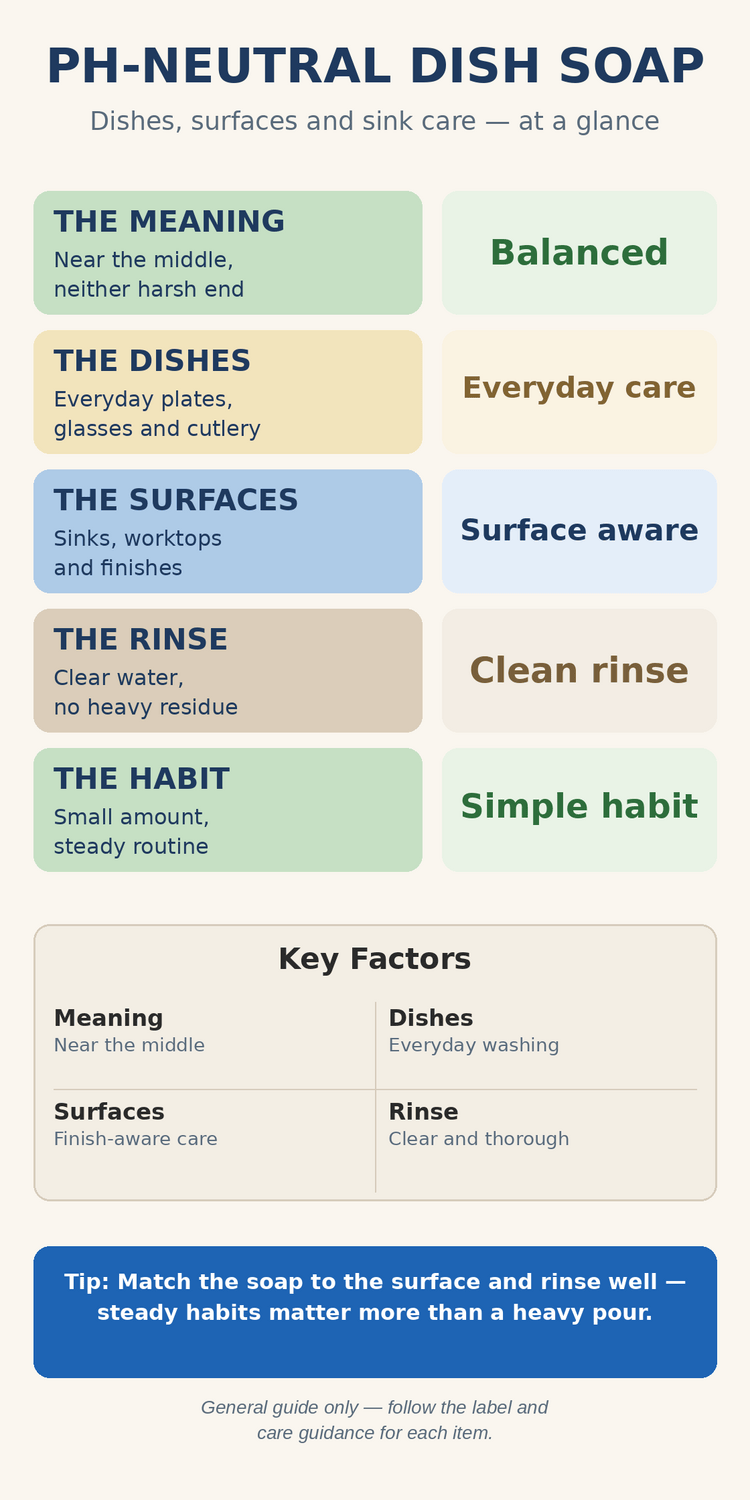
At its heart, a pH-neutral soap is a soap whose character sits near the middle of the acidity and alkalinity scale, rather than leaning strongly toward either end. That middle position is the whole idea. Strongly leaning cleaners can be harsh on some finishes and leave a different feel on washed items, while a middle-of-the-scale soap is designed for routine, everyday washing. The sections below explain what that means in practice, how to read a label, and how to build a sink routine that suits a small kitchen as well as a large one.
It helps to keep expectations modest. No soap, neutral or otherwise, replaces good technique, and no single bottle suits every item in a kitchen. Some pieces need a soak, some need a soft cloth, and some need nothing more than a rinse and a dry. What follows is a way of thinking about the choice, so the soap you reach for matches the dishes in the sink and the surfaces around it.
1. What pH-Neutral Means in Plain Terms
Acidity and alkalinity describe where a substance sits on a scale that runs from strongly acidic at one end to strongly alkaline at the other. A pH-neutral product sits near the middle of that scale, neither strongly acidic nor strongly alkaline. The word neutral, in this context, is about balance rather than about strength or weakness. A middle-of-the-scale soap can still clean everyday grease and food residue, because cleaning depends on more than position on the scale: it depends on the soap itself, on water, on contact with the surface, and on the wiping or scrubbing that follows.
That distinction matters because shoppers sometimes read neutral as a promise. It is not a promise about any outcome, and it is not a ranking. Two neutral soaps can feel quite different in use, one producing generous suds and another producing very few, and both can still be described the same way. Suds are a poor guide to cleaning power on their own: a soap can clean well with modest foam, and a very foamy soap can still leave a film if rinsing is rushed. The useful question is not how dramatic the bubbles look, but whether washed items feel clean after rinsing and drying, and whether finishes look unchanged over time.
Labels use the term in slightly different ways, which is worth knowing before comparing bottles. Some labels state the idea directly, while others describe the soap as balanced or mild without using the word neutral at all. When a label is vague, the rest of the label becomes the real guide: the directions for use, any care notes for particular materials, and any warning about surfaces the product should not be used on. A clear, specific label is usually more helpful than a bold claim on the front of a bottle, and a label that says little may simply mean the maker expects the soap to be used for ordinary dishwashing and nothing more specialised.
For everyday purposes, the middle position is best understood as a starting point for gentle, routine care. It suits the daily load of plates, glasses and cutlery that most kitchens produce, and it sits comfortably alongside the finishes found around a sink. Stronger cleaners have their place for particular jobs, but routine washing rarely needs them, and reaching for a stronger product by habit can wear finishes faster than the food soil ever would. Starting from the middle and stepping up only when a specific job calls for it is a calm way to look after both dishes and surfaces.
2. How Dish Soap Works, in General Terms
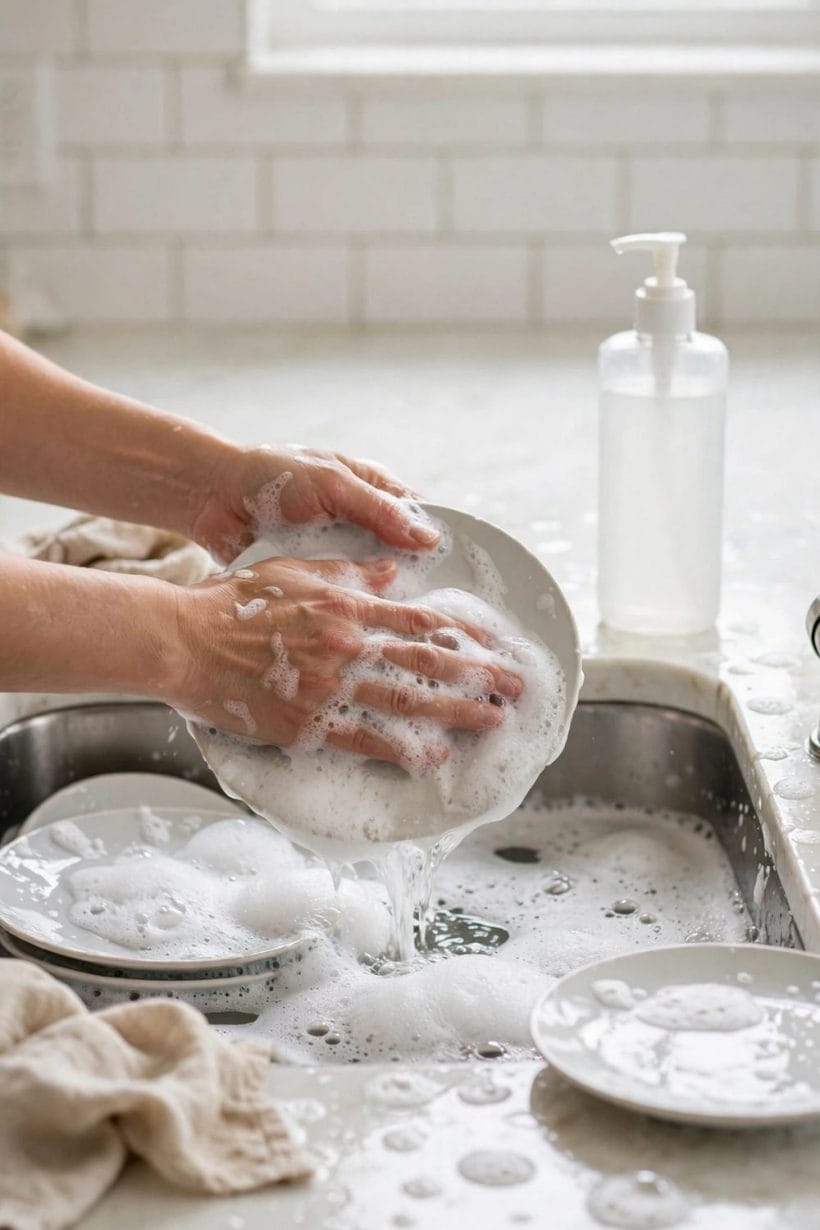
Dish soap works by helping water do a job it struggles with on its own. Water alone beads on grease and slides off it, while soap loosens the grip between grease, food residue and the surface underneath, so that wiping and rinsing can carry the residue away. The soap does not dissolve everything instantly, and it does not need to. It softens and lifts, and the cloth or brush, the warmth of the water and the time an item spends in contact with the wash all play their part. Thinking of washing up as a team effort, rather than as a chemical acting alone, explains why technique matters as much as the bottle.
Warm water helps the process, because warmth softens grease and makes it easier to lift, but warmth is not the whole story. Water that is too hot to work in comfortably is no help, and scalding water can damage some finishes and make handling unpleasant. Lukewarm to comfortably warm water, changed when it becomes grey or greasy, is a better working habit than a single basin of water pushed through an entire evening of washing up. Fresh water rinses cleaner, and a rinse under clear running water removes the soap film that a tired basin leaves behind.
Contact time is the quiet partner in all of this. An item left to soak briefly, where its material allows soaking, often cleans more easily than the same item scrubbed hard straight away. Soaking is not a cure for everything, and delicate pieces should never be left soaking without thought, but for sturdy everyday items a short soak loosens dried food and reduces the scrubbing needed. The same principle applies to the soap itself: a little time in soapy water, followed by a wipe and a thorough rinse, usually achieves more than a heavy pour of soap followed by a hurried rinse.
It is also worth remembering that dish soap is made for dishes and the surfaces around them, not for every cleaning job in a home. Using it well beyond its purpose, on materials it was not made for, can dull finishes or leave residues that are hard to remove. The label and the care guidance for the item being washed are the authorities here, and where they disagree, the item’s own guidance should win. A soap that is excellent for plates may be entirely wrong for a particular pan lining or a sealed worktop, and no general guide can replace checking the specific case.
3. Everyday Dishes and Glassware
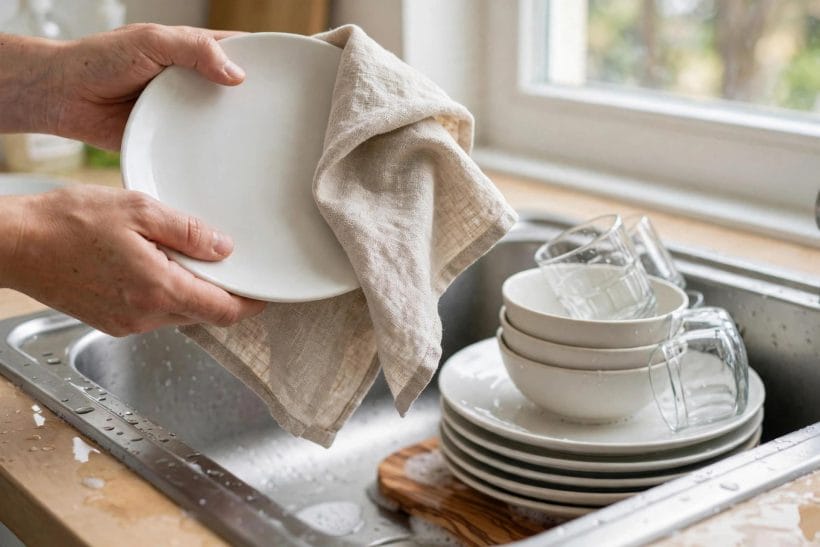
Everyday plates, bowls and cutlery are the natural home of pH-neutral soap. Ceramic, porcelain and sturdy stoneware generally wash well with a middle-of-the-scale soap, warm water and a soft cloth or sponge, and they dry to a clean feel without drama. The routine is simple: wash, rinse under clear water, and either dry with a clean cloth or leave to drain where air can reach every surface. Stacking wet plates tightly together traps moisture between them, so a little space in the rack or on the draining board helps items dry properly and keeps the cupboard fresher.
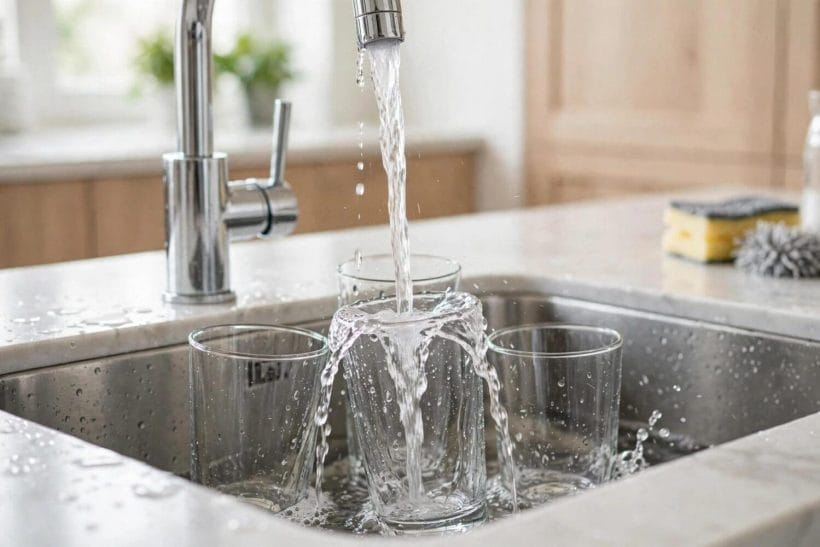
Glassware deserves a slightly slower hand. Glasses show every mark, and a film left by rushed rinsing is far more visible on glass than on a patterned plate. Rinsing each glass under clear running water, rather than dipping it back through soapy water, removes the film before it can dry in place. Drying glasses promptly with a clean, lint-free cloth keeps them bright, while leaving them to drip-dry in a hard-water area can leave spots that look like a soap problem but are really a water and drying problem. Where spotting persists, the answer is usually a better rinse and a prompt dry, not more soap.
Cutlery rewards attention to the details that are easy to miss. Fork tines, spoon bowls and knife handles all hold residue in their curves, and a quick wipe across a flat surface misses it. Washing each piece individually, with attention to joints and crevices, takes only a little longer and avoids the dull film that builds up over time. Knives with wooden handles, and any cutlery with decorative finishes, should be washed by hand and dried promptly rather than left soaking, because prolonged soaking can affect handles and joints that plain steel would shrug off.
There is a limit to what any dish soap can do for chipped or cracked items. A chip in a glaze can trap residue that washing cannot fully reach, and a crack can harbour moisture that affects the item over time. Such pieces are best retired from everyday food use or kept for dry purposes, and no change of soap will restore a damaged glaze. The same realism applies to stained items: some staining is surface residue that washing removes, while other staining has soaked into the material itself and will not wash out, however the item is treated.
4. Pans, Boards and Kitchen Tools
Pans are where a general guide must tread most carefully, because pan materials vary widely and each has its own care guidance. Plain steel and sturdy enamelled pans generally tolerate routine hand washing with a middle-of-the-scale soap, while non-stick coatings, cast iron and copper each have particular needs that their makers describe. The safe habit is to check the guidance for the pan before assuming that the soap used for plates suits it too. Where a pan’s guidance calls for hand washing only, a machine cycle is not a shortcut worth taking, and where it calls for a particular kind of cloth, a harsh scourer is not an improvement.
Soaking helps with pans more than with any other kitchen item, provided the pan’s material allows it. Baked-on food softens with a soak in warm, soapy water, and the softened residue wipes away with far less effort than dry scrubbing would need. Soaking should still be kept within reason: a pan left soaking for an extended period, especially one with a coating or a wooden handle, can suffer in ways that a brief soak would never cause. A soak that lasts for the length of a meal’s clearing-up is usually ample, and the pan can then be washed, rinsed and dried in the ordinary way.
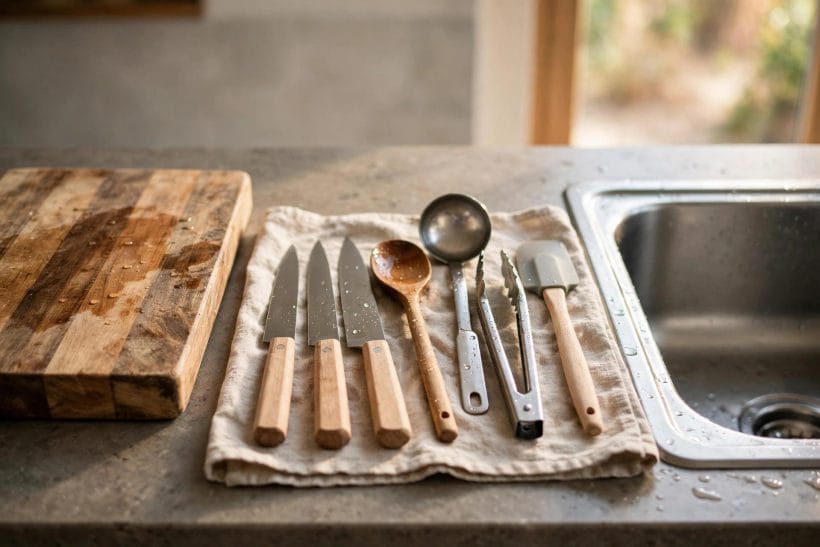
Wooden boards and utensils need a different rhythm again. Wood absorbs moisture, so boards should be washed promptly, rinsed, and dried standing where air can reach both faces, rather than left flat in a puddle or stacked wet against other items. A middle-of-the-scale soap suits routine board washing well, because it cleans without the harsh character that can dry wood out over time, but the drying matters as much as the washing. A board that is washed well and dried badly will still warp, crack or hold odours, while a board that is washed simply and dried properly stays serviceable for a long time.
Kitchen tools with moving parts, such as tongs, graters and whisks, benefit from being washed promptly and dried with attention to their joints. A grater’s teeth and a whisk’s loops trap food in ways that a flat wipe cannot reach, and a soft brush reaches those places without damaging the tool. Silicone tools and spatulas generally wash easily by hand, though they can hold on to odours from strongly flavoured food, and a thorough rinse and air-dry usually clears that. As with pans, the maker’s guidance for any tool with a coating or a special finish should be followed before any general habit is applied to it.
5. Worktops, Sinks and Surrounding Surfaces
The area around a sink sees more soap and water than any other part of a kitchen, and its finishes deserve the same thought as the dishes themselves. A middle-of-the-scale soap is a sensible choice for wiping down the sink surround, because it cleans everyday splashes and residue without the harsh character that can dull some worktop finishes over time. The method is simple: a soft cloth, warm soapy water, a wipe, and a follow-up wipe with clear water to remove the soap film. Leaving soapy water to dry on a worktop invites streaks and residue, and a clear-water wipe is what prevents them.
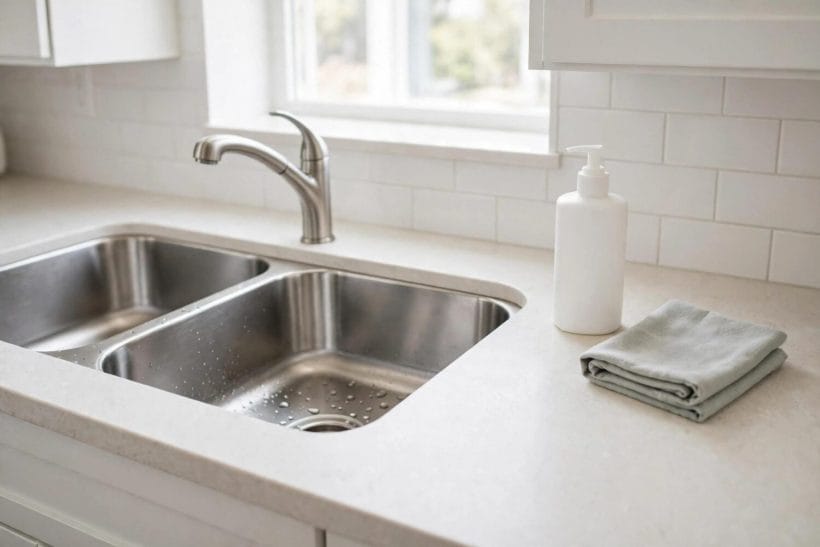
Sinks themselves vary, and each material responds differently to care. Stainless steel sinks generally tolerate routine washing well and benefit from a rinse and a wipe dry after the dishes are done, which prevents water marks from forming as droplets dry. Ceramic sinks need a softer touch, since a dropped pan can chip them and a harsh scourer can mark the glaze. Composite sinks have their own guidance, and the maker’s notes for the particular sink should be checked before any cleaner beyond routine soap is used on them. In every case, rinsing the sink after washing up and wiping it dry keeps it looking better than any occasional deep clean.
Taps and fittings are the small details that show care most clearly. Water marks and soap film collect around tap bases and handles, and a soft cloth with mild soapy water, followed by a clear rinse and a dry, keeps them bright. Harsh scourers and strongly leaning cleaners can mark plated finishes, and once a plated finish is marked it cannot be washed back to new. A gentle, regular wipe is worth more than an occasional vigorous scrub, and it takes only a moment when the dishes are already done.
Splashbacks and the wall behind a sink also collect residue, though more slowly than the sink itself. Tiles generally wipe clean easily with mild soapy water, while grout lines hold residue and need a soft brush to reach. Painted walls near a sink need a lighter hand still, since repeated wet wiping can affect paint over time, and a splashback that protects the wall is worth its place for exactly this reason. Keeping the splash zone wiped and dry after washing up prevents the slow build-up that eventually needs a much harder clean.
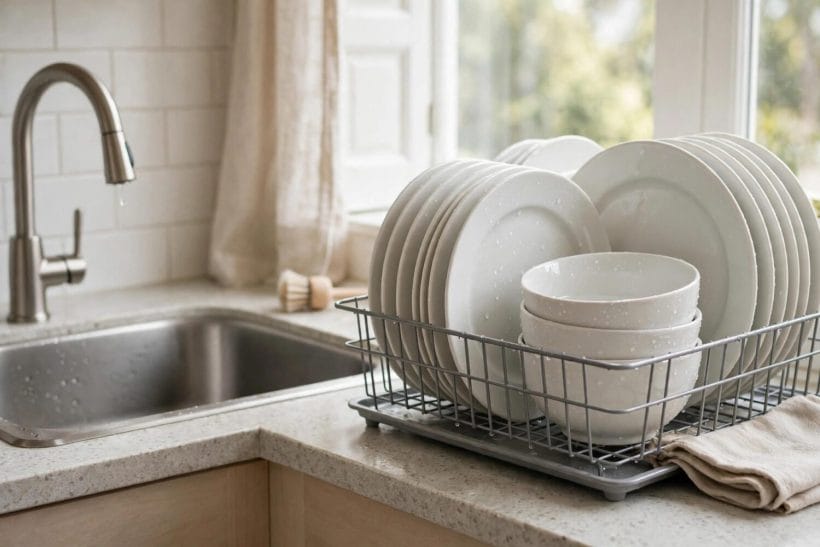
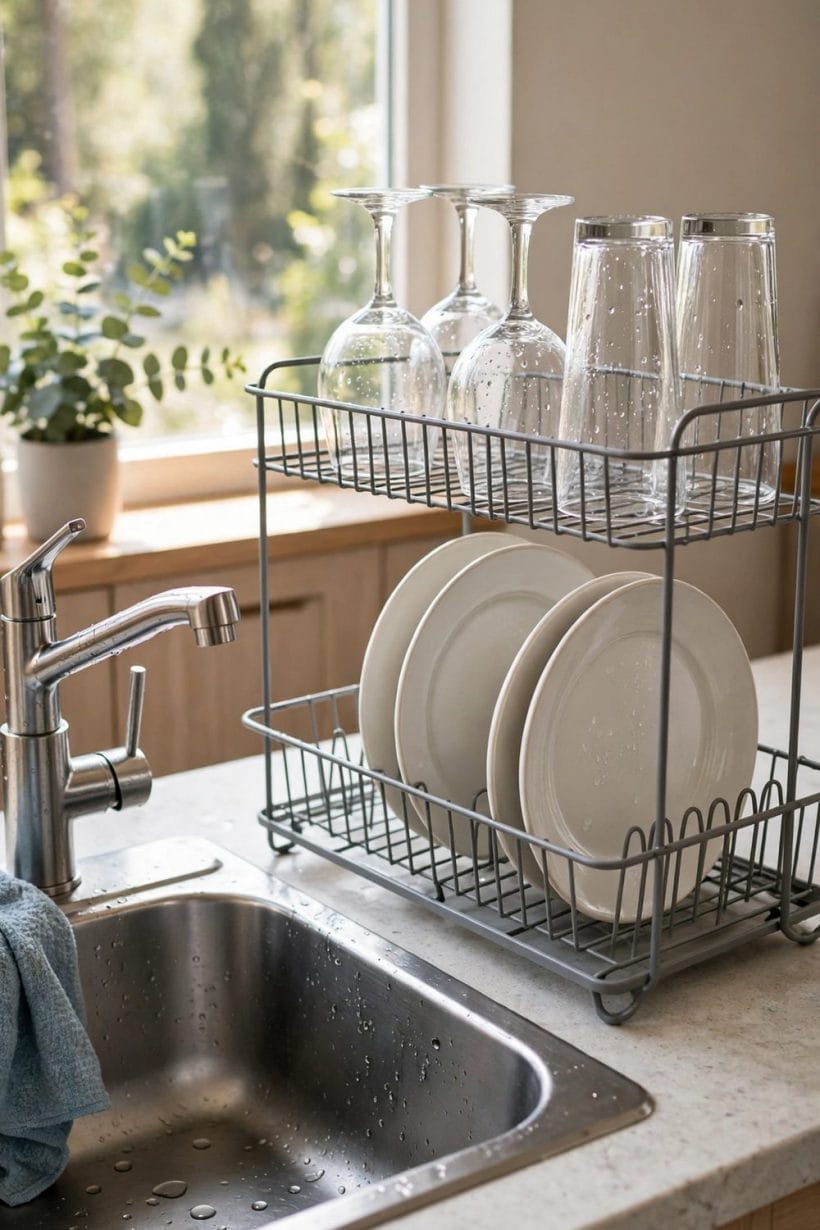
The same thinking extends to the draining board and the dish rack, which are often the last things to be cleaned and the first to show neglect. A rack that is never rinsed collects a film of its own, and dishes placed into it pick that film up again. Rinsing the rack and wiping the draining board as part of the washing-up routine, and letting both dry fully before the next load, keeps the whole system clean. A clean rack and a dry board are not finishing touches; they are part of washing up properly, and they cost no extra effort once they become habit.
6. Reading a Label Without a Chemistry Degree
A dish soap label carries more useful information than its front panel suggests, and reading it well is a skill worth building. The directions for use are the first thing to look for, because they describe how the maker expects the soap to be used: diluted in water, applied directly, or used in a particular way for particular items. Following those directions matters, because a soap used far outside its intended dilution can leave residue or clean less well than the same soap used as directed. Directions are not decoration, and they are the closest thing to a maker’s own advice that a bottle offers.
Care notes and warnings are the next thing to read, and they are often printed in smaller type. A note about a surface the soap should not be used on, or about keeping it away from a particular material, is a genuine piece of guidance, not a formality. Where a label is silent about a material, that silence is not permission; it simply means the maker has not addressed that case, and the item’s own guidance should be consulted instead. A label that warns against use on a surface should be taken at its word, even when the soap seems mild in every other respect.
Claims on the front of a bottle deserve a calm reading rather than an excited one. Words like balanced, mild and neutral all point toward the middle of the scale, but they are not measured in the same way by every maker, and they do not describe cleaning power, value or suitability for every item. A claim is a starting point for comparison, not a conclusion, and the most reliable comparison is still the lived one: how the soap performs on your own dishes, with your own water, over a reasonable period of use. A bottle that works well in one kitchen may work less well in another, because water and habits differ.
Finally, a label’s storage and handling notes are worth a glance. Keeping a bottle where it can be reached easily but not knocked over, capped between uses, and stored away from extreme heat or cold, keeps the soap in good condition and the sink area tidy. A bottle stored badly can leak, thicken or thin, and a leaking bottle leaves a residue on the shelf that then needs cleaning itself. Small storage habits like these are unglamorous, but they are part of the same calm sink routine that the rest of this guide describes.
7. Water, Suds and Rinsing
Water quality shapes washing up more than most people realise. In areas where water leaves mineral deposits, glasses and cutlery can spot even after careful washing, and the spots are often blamed on the soap when the water is the real cause. A thorough rinse under clear running water, followed by prompt drying, reduces spotting considerably, because it removes both soap and mineral-laden water before either can dry in place. Where spotting remains a problem, drying promptly matters even more, and a soft cloth does more good than any change of soap.
Suds deserve a measured view. Generous foam looks effective, and a sink full of bubbles feels like progress, but foam is not a measure of cleaning. Some soaps are made to foam richly, while others clean with very little foam at all, and both can wash well. The useful test is the result after rinsing and drying, not the appearance of the water during washing. If items feel clean and look clear after drying, the soap and the rinse are doing their job, however modest the foam may have been.
Rinsing is the step most often rushed, and it is the step that most affects the result. Soap left on a plate dries into a film that dulls the surface and can affect the taste of food served on it, while a plate rinsed under clear water dries clean. Rinsing each item individually under running water takes a little longer than dipping a whole load through a basin, but it is the more reliable method, especially for glassware and smooth ceramics. A rinse that is thorough but not wasteful, with the tap running only while items are actually being rinsed, balances cleanliness with care for water use.
Changing the wash water when it becomes dirty is another habit that pays for itself. Water that has already carried a load of grease and residue cannot rinse cleanly, and items washed in it pick up a film that a later rinse must then remove. Fresh, warm, soapy water for the main wash, and clear water for rinsing, is a simple division of labour that keeps results consistent. A basin that is refreshed partway through a large load is not wasteful; it is the difference between washing up and merely moving residue from one item to another.
8. Storage, Dosing and Everyday Habits
Dosing is where good intentions most often go wrong, because more soap feels like more cleaning. In practice, a small amount of soap in warm water is usually ample for an everyday load, and extra soap mainly creates extra rinsing work. The right amount is the amount that lets the water feel slippery and the cloth move easily, without producing a mountain of foam that then needs rinsing away. Starting with a little and adding only if the water loses its slipperiness is a better habit than starting with a generous pour and hoping the rinse will cope.
Storage shapes dosing, because a bottle that pours too freely invites overuse. A pump or a controlled spout gives a measured amount each time, while an open bottle can deliver far more than intended with a single tilt. Keeping the bottle upright, capped and within easy reach of the sink also prevents the small accidents that waste soap and leave residue on shelves and worktops. A tidy sink area, with the soap in one reliable place, makes the whole routine smoother and reduces the chance of a bottle being knocked into the sink itself.
Cloths and sponges are partners in the routine, and they need care of their own. A sponge that is never rinsed and dried becomes a carrier of residue, and dishes washed with it pick that residue up again. Rinsing a sponge thoroughly after use, wringing it out, and leaving it where air can dry it keeps it serviceable, and replacing it when it becomes worn or begins to hold odours is part of the same habit. A clean cloth, used with a small amount of soap and clear water, achieves more than a tired sponge used with a heavy pour.
The order of washing also helps. Washing the least soiled items first, and the most soiled items last, keeps the wash water cleaner for longer and reduces the rinsing needed for glasses and light plates. Glasses first, then plates and cutlery, then pans and boards, is a sensible order for most kitchens, and it means the items that show marks most clearly are washed in the freshest water. This order is not a rule, and a small load can be washed in any order, but for a large load it makes the whole job easier and the results more consistent.
9. When a Different Approach Makes Sense
There are jobs where a middle-of-the-scale soap is not the best tool, and recognising them is part of using it well. Heavily baked-on food, for example, may need a longer soak and a more vigorous wipe, and some residues respond better to a soak followed by a soft brush than to any amount of soap alone. In such cases the soap is still part of the job, but time and mechanical action do the heavier work. A pan that resists an ordinary wash is not necessarily a sign that the soap has failed; it may simply be a job that needs soaking and patience rather than a stronger product.
Some items should not be washed with dish soap at all, and their own guidance says so. Certain coatings, seasoned surfaces and specialist finishes are cared for in particular ways, and dish soap, however mild, is not part of that care. Where an item’s guidance calls for a different method, that guidance should be followed, and the item should be kept apart from the ordinary washing load so it is not washed by habit. A separate, deliberate routine for specialist items protects them far better than trying to fit them into the everyday wash.
Machine washing is a separate question from hand washing, and the two should not be confused. A soap made for hand washing is not interchangeable with a product made for a machine, and using one in place of the other can produce poor results and, in some cases, damage to the machine or to the items. Where a household uses both methods, keeping the two products apart and clearly labelled avoids the confusion that leads to mistakes. Hand washing suits items that need a gentle hand or that a machine would damage, while machine washing suits sturdy everyday loads, and the two methods complement each other rather than competing.
Finally, there are times when the right approach is to ask rather than to improvise. A valuable, antique or unusually finished item that needs cleaning, a surface whose finish is uncertain, or a stain whose cause is unknown are all cases where a maker’s guidance, a care professional or a specialist source is worth consulting before any cleaner is applied. Improvising on such items risks damage that cannot be undone, while a short pause to check the right care is rarely wasted. A calm sink routine includes knowing when not to guess.
10. Building a Calm Sink Routine for a Small Kitchen
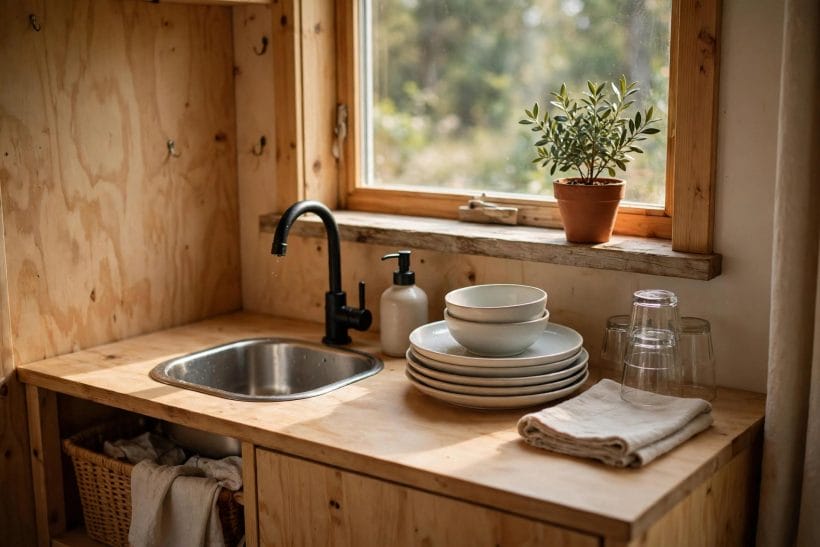
Small kitchens make washing up harder, because the sink is smaller, the draining space is tighter, and every item competes for room. A calm routine matters more here than in a large kitchen, not less, and it starts with clearing the sink before washing begins. Removing items that do not belong in the sink, stacking the load in washing order, and keeping the soap, cloth and drying space within reach turns a cramped job into a manageable one. A small kitchen rewards a routine that is worked out in advance, rather than improvised under pressure.
Drying space is the tightest constraint in a small kitchen, and it deserves planning. A compact rack that fits the sink or the available worktop, a clean tea towel for items that need prompt drying, and a habit of putting dried items away promptly all keep the space usable. Leaving a full rack to sit while the next meal is cooked means the next load has nowhere to go, and the sink area becomes a bottleneck for the whole kitchen. Putting things away as they dry is not tidiness for its own sake; it is what keeps a small kitchen working.
Frequency is the other small-kitchen habit that pays off. Washing up promptly after a meal, rather than letting a load accumulate, keeps each wash small and the sink clear for the next job. A small load washed promptly needs less water, less soap and less time than a large load left to dry on, and it keeps the kitchen pleasant to work in. Where a household cooks several times a day, a short wash after each meal is far easier than a single large wash at the end of the day, and it keeps the sink area ready for whatever comes next.
A small kitchen also benefits from keeping the sink area itself minimal. One bottle of soap, one reliable cloth, one brush for awkward items, and a rack that fits the space are ample, and extra bottles and tools quickly become clutter that gets in the way. Choosing a soap that suits the everyday load, and keeping specialist care separate and clearly stored, avoids the shelf of half-used bottles that so many small kitchens accumulate. Simplicity at the sink is not a compromise; it is the design that works best in a small space.
The same simplicity applies to the end of the routine. Rinsing the sink, wiping the surround, rinsing the cloth and leaving the rack to dry are small closing steps that take only a moment, and they mean the next wash starts from a clean place rather than from yesterday’s residue. A routine that ends cleanly is a routine that stays pleasant, and a sink area that is left clean invites the next wash rather than discouraging it. Over time, these closing steps become automatic, and the kitchen stays calmer for it.
Final Considerations
pH-neutral dish soap is best understood as a balanced, everyday choice rather than as a special solution. Its middle position on the scale suits routine washing of plates, glasses and cutlery, sits comfortably alongside most sink-area finishes, and pairs well with the habits that matter most: warm water, a small amount of soap, a thorough rinse and prompt drying. No soap can replace those habits, and no label can substitute for checking the guidance for a particular pan, board or finish. Used with that realism, a neutral soap is a calm and sensible part of a kitchen routine.
For related reading, see kitchen ideas for the wider kitchen picture, tiny kitchen ideas and tiny house kitchens for small-space cooking areas, small kitchen ideas for compact layouts, tiny kitchen storage hacks for keeping a small kitchen in order, compact kitchen appliances for tiny houses for small-home appliances, and tiny laundry room ideas for another small washing space in the home.




0 Comments