

A small backyard can say exactly one thing well. The lots that try to be everything — a bit of lawn, a bit of bed, a bit of patio — end up being nothing at all: just clutter in search of a theme. Stone gives a tiny lot its thesis, one confident idea carried through every square foot, so that twenty feet of garden feels deliberate instead of cramped.
Small Backyard Rockscaping: At a Glance
Done well, small backyard rockscaping turns the limits of a tiny lot into the design itself. Stone creates structure without bulk, defines rooms without walls, and delivers a finished garden in a footprint where lawn and borders would only fight for space. This guide composes the small backyard in stone, in the order a real build follows: why the tiny lot rewards intention, the design rules that prevent clutter, the single boulder anchor that organises everything, the zones that divide the lot into rooms, the one ground material that unifies it, planting with lush restraint, and the one luxury — water or fire or light — that finishes it. It closes with a five-year phasing plan and the honest budget, so the garden can grow in stages instead of stalling after one expensive weekend. Every rule here scales down to the smallest urban lot.
| Topic | What It Covers | Key Fact or Figure |
|---|---|---|
| 1. The Tiny Lot, Composed | Why stone suits a small lot | Structure without bulk; rooms without walls |
| 2. One Idea, Laid on the Diagonal | The thesis rule and the longest line | The diagonal is the longest line in a rectangle |
| 3. Rooms, Vertical Space and Hidden Edges | Dividing, building up, blurring boundaries | Two 10×10 rooms feel larger than one 10×20 |
| 4. The Boulder Anchor | The one big move that organises the yard | One 3-ft boulder, buried one-third deep |
| 5. Zones: The Tiny Lot’s Rooms | Entry, sitting room, green room, utility, the loop | An 8×8 ft gravel pad as the sitting room |
| 6. Stone Surfaces: The Ground Plane | One ground material across the whole lot | Gravel throughout; flagstone where furniture sits |
| 7. Planting: The Lush Restraint | Tight planting in three layers under one tree | Plant 20% tighter than the tag says |
| 8. Water and Light: The Small-Lot Luxuries | One luxury, chosen with restraint | Pondless water kit $300–500; 3–5 low-voltage spots |
| 9. The Five-Year Plan | Phasing bones, fill, editing and maturity | Year 1: hardscape, anchor boulder and tree |
| 10. The Budget | What the phased rockscape costs in total | $1,000–3,000 spread over five years |
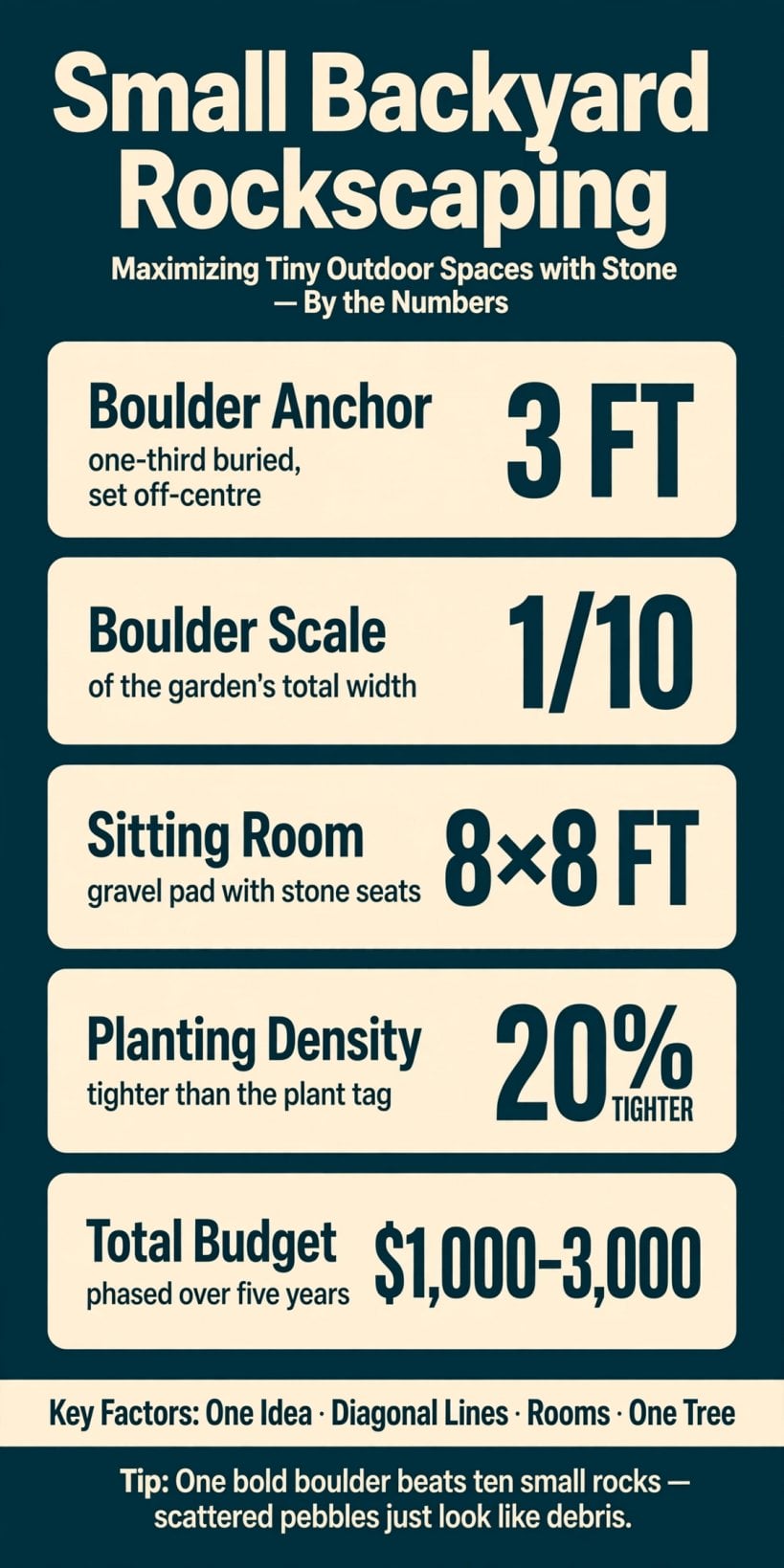
The small lot by the numbers: a 3-ft anchor boulder sized at one-tenth of the garden’s width, an 8×8 ft gravel sitting room, planting set 20% tighter than the tag — all inside a total budget of $1,000–3,000 phased over five years.
1. The Tiny Lot, Composed
Small backyards punish clutter and reward intention: every square foot has to earn its place, because there is nowhere for a weak idea to hide. Stone is the tiny lot’s superpower precisely because it works structurally rather than decoratively. A boulder is simultaneously sculpture, seating and planting backdrop. A gravel plane is floor, path and drainage in a single material. Nothing is carried that does not do at least two jobs, and that economy is what lets a very small garden feel composed instead of cramped.
The same logic governs the ground around a tiny house itself, where the plot is often no bigger than the gardens in this guide. The layouts in our roundup of tiny house landscaping ideas start from the same premise: treat the whole lot as one designed room, not as leftover space around a building. Whether the lot belongs to a cottage or a tiny home, composition — one idea, clear zones, a unified ground — is what separates a garden from a yard.
2. One Idea, Laid on the Diagonal
The first design rule is the thesis: a small garden can only say one thing well. It can be the rock garden, the fire circle or the zen corner — but it must be picked, because the lot that tries to be everything ends up being nothing. Every later decision, from stone tone to plant choice, is tested against that single idea, and anything that argues with it is left out, however attractive it looks at the garden centre.
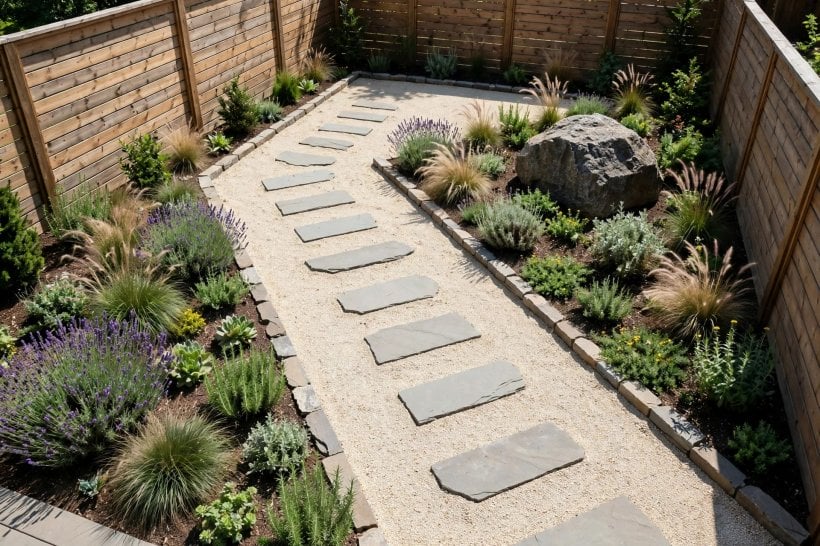
The second rule is geometry. Lay paths and beds on the diagonal, because the longest line in a rectangle is its diagonal: the eye travels farther along it, pauses more, and reads the space as bigger than it is. A straight path down the middle of a rectangular lot is a confession of its true dimensions; the same path swung corner to corner feels like a journey. For a worked example of a single idea carried through with total discipline, our guide to creating a Japanese zen rock garden shows how far one thesis, rigorously kept, can take a small space.
3. Rooms, Vertical Space and Hidden Edges
Dividing a tiny lot sounds like a way to make it smaller; it does the opposite. Two 10×10 “rooms” feel larger than one 10×20 space, because the eye measures a garden by the experiences it contains, not by its fence lines. A boulder cluster or a trellis makes the divider, and the moment one space is hidden from another, the garden gains the small mystery of somewhere else to go.
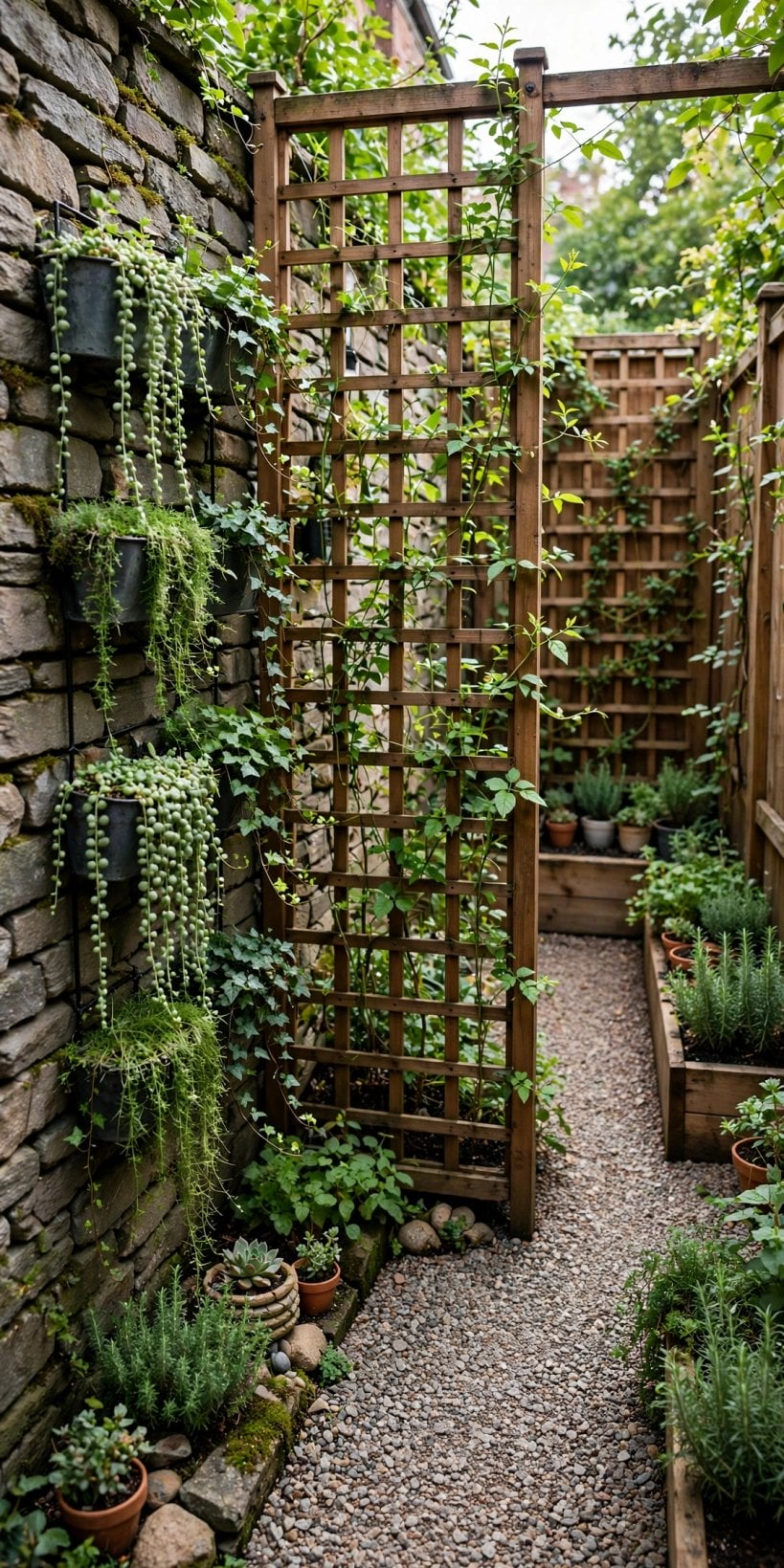
Vertical is the small lot’s forgotten dimension. Footprint is fixed, but height is free: stacked stone, wall planters and an arbor all pull the eye upward while the ground plan stays untouched. A wall planter grows a garden on a fence that would otherwise be dead boundary; an arbor adds a ceiling line and a future of climbing shade without consuming a single square foot of floor. Finally, hide the edges. Plantings set against the fence and a boulder settled into a corner blur the boundaries, and a lot whose edges cannot be seen feels boundless — the visitor stops counting square feet because there is no visible line at which to stop.
4. The Boulder Anchor: One Big Move
If the thesis is the garden’s sentence, the boulder is its subject. The principle is blunt: one large boulder beats ten small rocks. The small garden’s number-one mistake is timid stone — pebbles scattered across a bed read as debris, while a single 3-ft boulder reads as geology. One great stone does triple duty in a small space: it is seating, it is sculpture, and it is the backdrop every planting is arranged against.
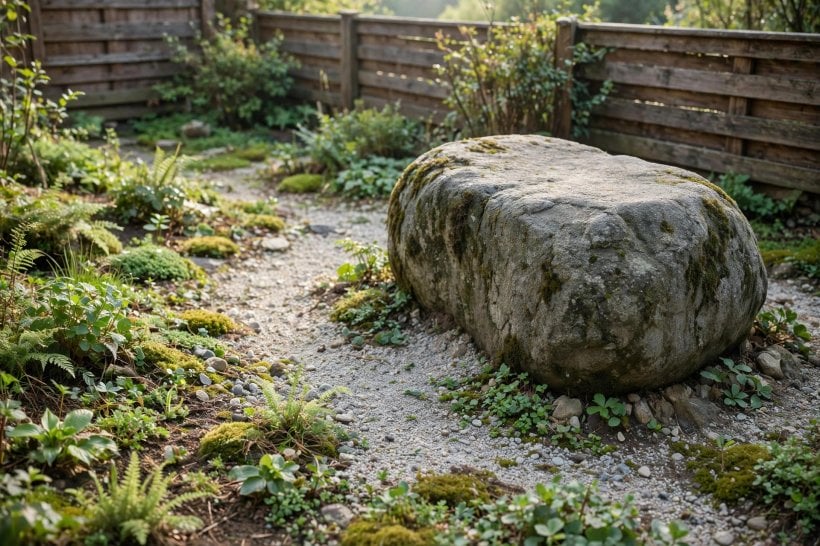
Placement follows composition rules. Set the anchor off-centre, never in the middle of the lot, and bury it one-third deep so it looks grown rather than delivered. Scale it with proportional courage: the boulder should be about one-tenth of the garden’s width, so a 20-ft garden wants a 2-ft boulder as a minimum. The anchor goes in first, before beds, paths or plants, and everything else in the design responds to it. Our guide to laying out big landscape rocks works through siting and settling large stone in detail.
5. Zones: The Tiny Lot’s Rooms
With the anchor set, the lot divides into zones. The entry is the threshold: a stone landing with flanking boulders at the door, where 4×4 ft is enough to make an arrival. The sitting room is the destination — an 8×8 ft gravel pad with two boulder seats or a log bench — because every small garden, however tiny, needs somewhere to sit, and a garden without a seat is a garden only looked at.
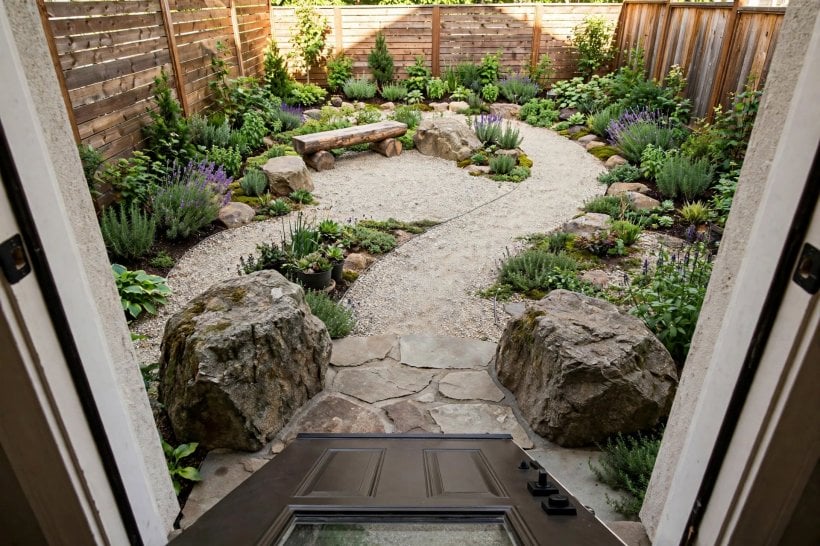
The green room is the planting: one generous bed, 4 ft deep along the sunniest edge — not five tiny beds, because a single bold planting beats scattered pots every time. Depth matters here: a bed with real soil volume grows plants to a fullness that a row of narrow strips never achieves, and one deep bed along the sun is also far easier to water, mulch and keep looking intentional. The utility zone stays hidden: compost, hose and storage tucked behind the trellis or a fence section, since a small garden cannot afford visible clutter — in a lot this size, a coiled hose left in view is a design feature whether you meant it or not. And circulation ties it together as a loop: even a tiny path should curve, making a journey of the route, where the straight dash from door to fence is the wasted opportunity.
6. Stone Surfaces: The Ground Plane
The ground is the largest surface in a small garden, and it must be unified. One ground material throughout is the rule: a small lot surfaced in three materials looks chaotic, while gravel everywhere, with stone accents, reads as calm. Gravel is the default choice — permeable, cheap, and available across a range from warm decomposed granite to cool gray crushed stone, so the tone itself can carry the garden’s thesis.
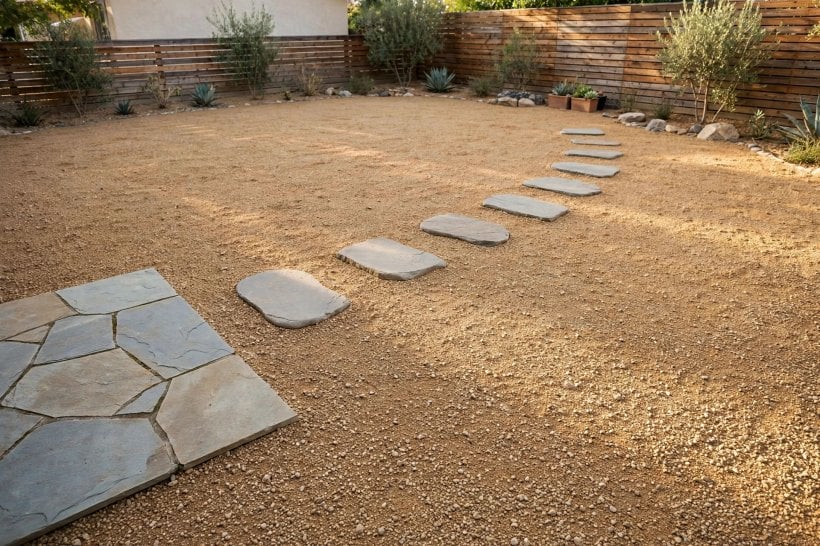
Flagstone earns its place only where a solid floor matters: under furniture, in the sitting area, where 8×8 ft of it anchors the outdoor room. Stepping stones carry the path through the gravel — the stones floating on the gravel sea, giving the walk its rhythm. And the lawn goes entirely: a tiny lot’s lawn is all edge and no use, so the rockscape replaces it, with the mowing-free dividend as a permanent bonus. Choosing between the stones themselves is its own decision, covered in our comparison of landscaping rock types.
7. Planting: The Lush Restraint
Planting in a small garden is dense but disciplined. Plant tight — about 20% tighter than the tag says — because a small garden shows every gap; the stones should show between the plants, not bare soil. Build in three layers: a groundcover, a mid-layer drift, and one vertical. Creeping thyme at the base, a grass drift through the middle, and a single small tree or large shrub above gives the three heights in miniature.
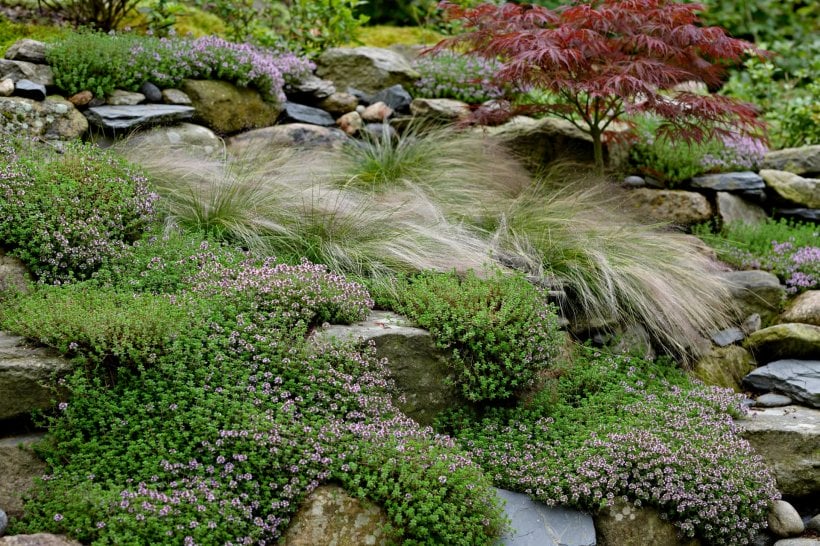
The tree is singular on purpose — a Japanese maple, a dwarf conifer or a multi-stem serviceberry — because one tree is a ceiling that makes the garden feel like a place, while three are a crowd. Containers follow the same scale rule: two or three large pots, not ten small ones, since large containers read as architecture and small ones as clutter; their flexibility is their virtue, letting you move colour and height around the rooms as seasons and experiments dictate. Shadier corners need plants chosen for low light, as our guide to rock gardens for shade sets out. And the boundaries can feed you: espaliered fruit trained flat on the fence takes no floor space at all, while herbs tucked into the bed edges put the most-used plants within reach of the path — the small lot grows food vertically because it has no other way to grow it.
8. Water and Light: The Small-Lot Luxuries
Every small garden deserves one luxury, and the choice begins with water. A mini feature — a bubbling boulder or a small basin — transforms the space with sound alone, and a pondless kit delivers it at garden scale for $300–500. Where water must move across the lot rather than bubble in place, a river rock dry creek bed handles the drainage while reading as a designed feature in its own right.
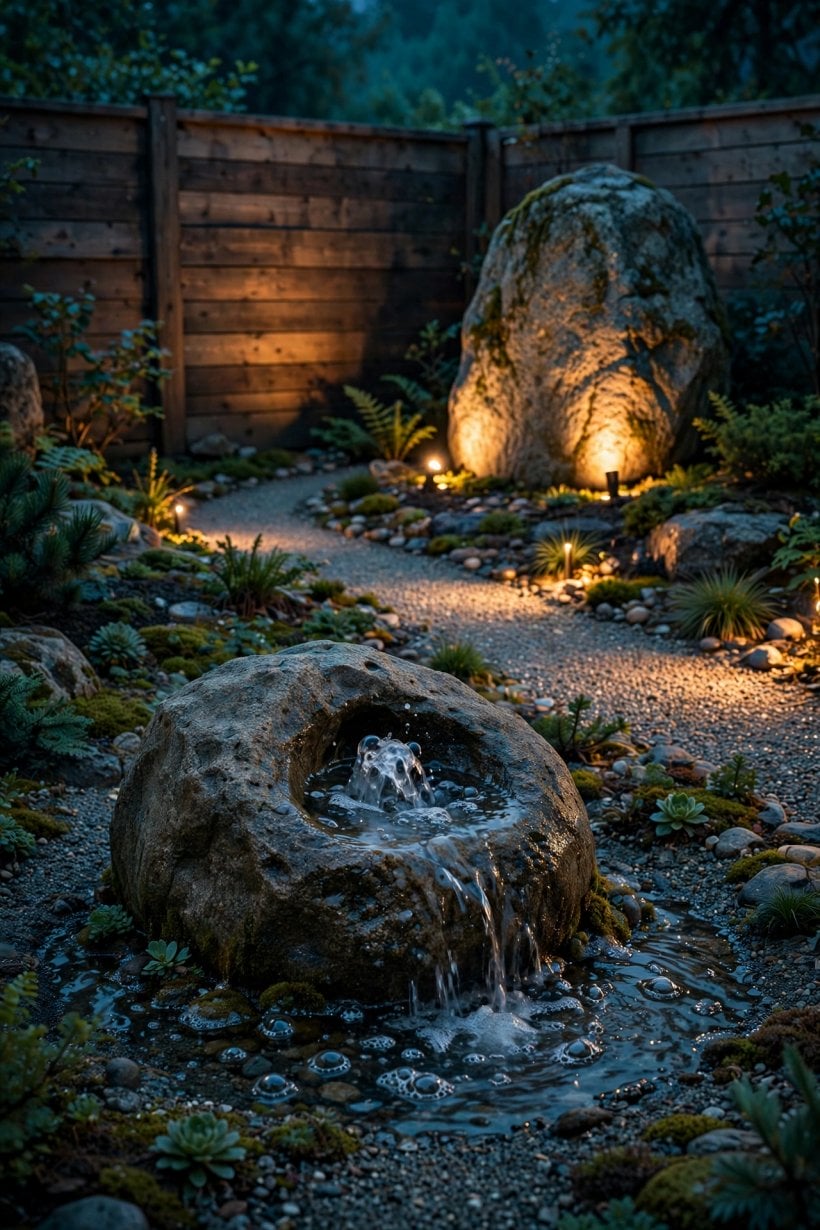
Lighting is the evening luxury: three to five low-voltage spots — one uplighting the boulder, one washing the wall, one lighting the path — and the small garden at night feels like a jewel box. Fire is the third option, a tabletop flame or a small pit, even a portable fire bowl, forming a gathering circle about 6 ft across that extends the season. The rule governing all three is restraint: water OR fire as the feature, never both competing in a tiny lot. One luxury, confidently chosen, is the finish; two is crowding.
9. The Five-Year Plan: Growing Into It
A rockscape does not have to arrive in a single season. Year one lays the bones: hardscape, the anchor boulder and the tree — the structure everything else grows around, and the year where any retaining work on a sloping lot belongs, built by the methods in our natural rock retaining wall guide. Year two fills the beds: perennials knit together, groundcovers spread, and the garden starts to look intentional rather than installed. Getting the bones right first matters, because stone is the one element you do not want to move twice — plants can be edited every year, but the boulder and the ground plane are the garden’s fixed commitments.
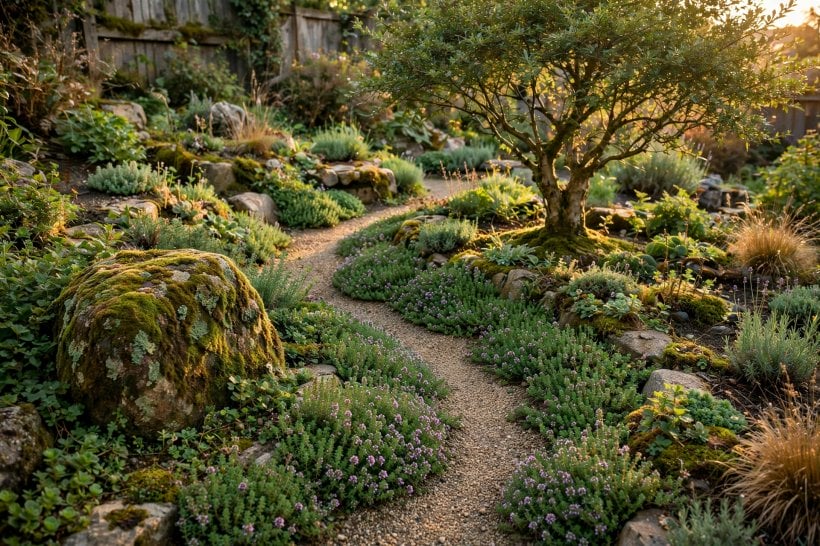
Year three is the editing: move what failed, divide what thrived. The garden teaches you how it wants to grow, and the discipline is to listen rather than to defend the original plan. By year five comes maturity — the boulder has moss, the tree has presence, the thyme has swallowed the path edges — and the garden looks like it was always there, which is the highest compliment a composed space can earn.
10. The Budget: Phasing the Spend
The money follows the same phased logic. The total budget for a small rockscape runs $1,000–3,000 — stone, gravel and plants, spread over the five years — which makes it the cheapest great garden there is. The phasing is the point: year one’s hardscape and anchor stone are the heavy spend, and each later year asks only for plants, editing and small additions, so the cost never lands in a single season.
Keeping the stone spend down starts with sourcing. The routes in our guide to sourcing free landscaping rocks — quarries, sites and giveaways — can cut the single largest line item dramatically, because a small lot needs bold stone, not lots of it. One 3-ft anchor bought or found well is worth more than a yard of small rock bought carelessly: in a tiny garden, the budget buys the most when it buys the few, big, decisive pieces first.
Final Considerations
Commit to one idea, anchor it with a single bold boulder, divide the lot into rooms, unify the ground in gravel, plant densely in three layers under one tree, add one luxury — water or fire or light — and phase the whole build over five years. Small backyard rockscaping succeeds because it treats the small backyard not as a limitation but as an editor: stone gives the lot its structure, and intention gives it soul.


2 Comments