

There are two halves to a noisy street, a thin wall or a lively household: the noise itself, which you rarely control, and the rooms receiving it, which you almost entirely do. This post works the half that belongs to you.
Everything here is design — rugs, doors, curtains, shelves and layout — and everything is stated honestly: soft finishes soften. They take the edge off voices, footsteps and television bleed, they calm echo, and they make a home feel sheltered. They do not silence a building, and nothing below pretends otherwise.

1. Reducing Noise at Home at a Glance
Most people arrive at this page from a search for noisy neighbors, and the honest truth this post is built on is simple: you cannot redesign the other side of the wall, but you can redesign yours. The central subject is reducing noise at home — a room-by-room use of soft, heavy and well-sealed finishes, set within the wider territory of our home design ideas hub.
| Aspect | What to know | In a word |
|---|---|---|
| The Floors | Thick rugs and soft underlay | Hushed |
| The Doors | Solid cores, sealed edges | Sealed |
| The Windows | Heavy curtains, honest seals | Draped |
| The Walls | Shelves, hangings, soft panels | Layered |
| The Layout | Quiet rooms on the quiet side | Planned |
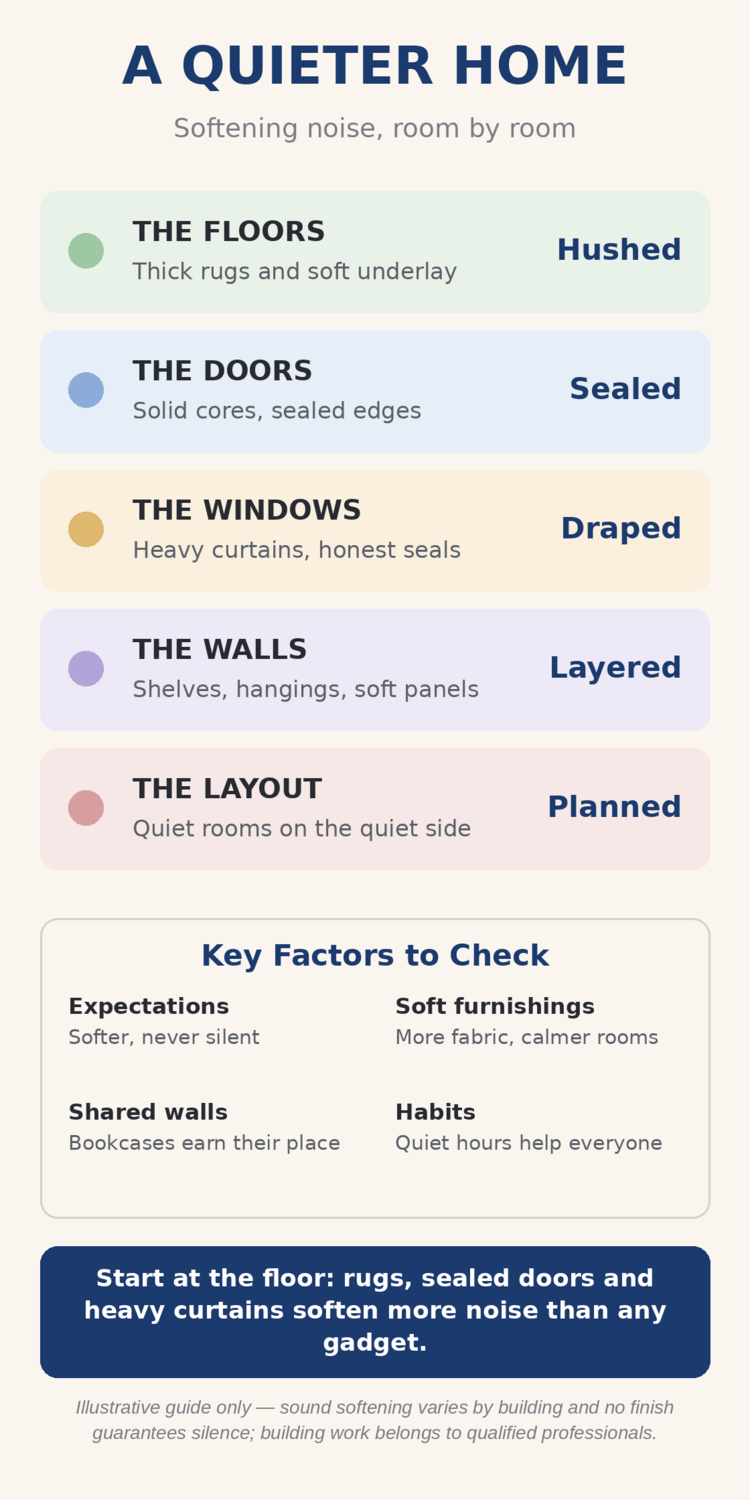
Start at the floor: rugs, sealed doors and heavy curtains soften more noise than any gadget. Four factors govern the work: expectations, because the honest target is softer, never silent; soft furnishings, since every added layer of fabric calms a room further; shared walls, where bookcases earn their place as beautiful ballast; and habits — closed doors, agreed quiet hours inside your own household — which multiply everything the finishes achieve.
The entries that follow are ordered from the ground up: floors, doors, windows, walls and layout. Treat them as a ladder — climb as many rungs as your home needs, and expect each one to help rather than transform.
2. Floors That Swallow Sound
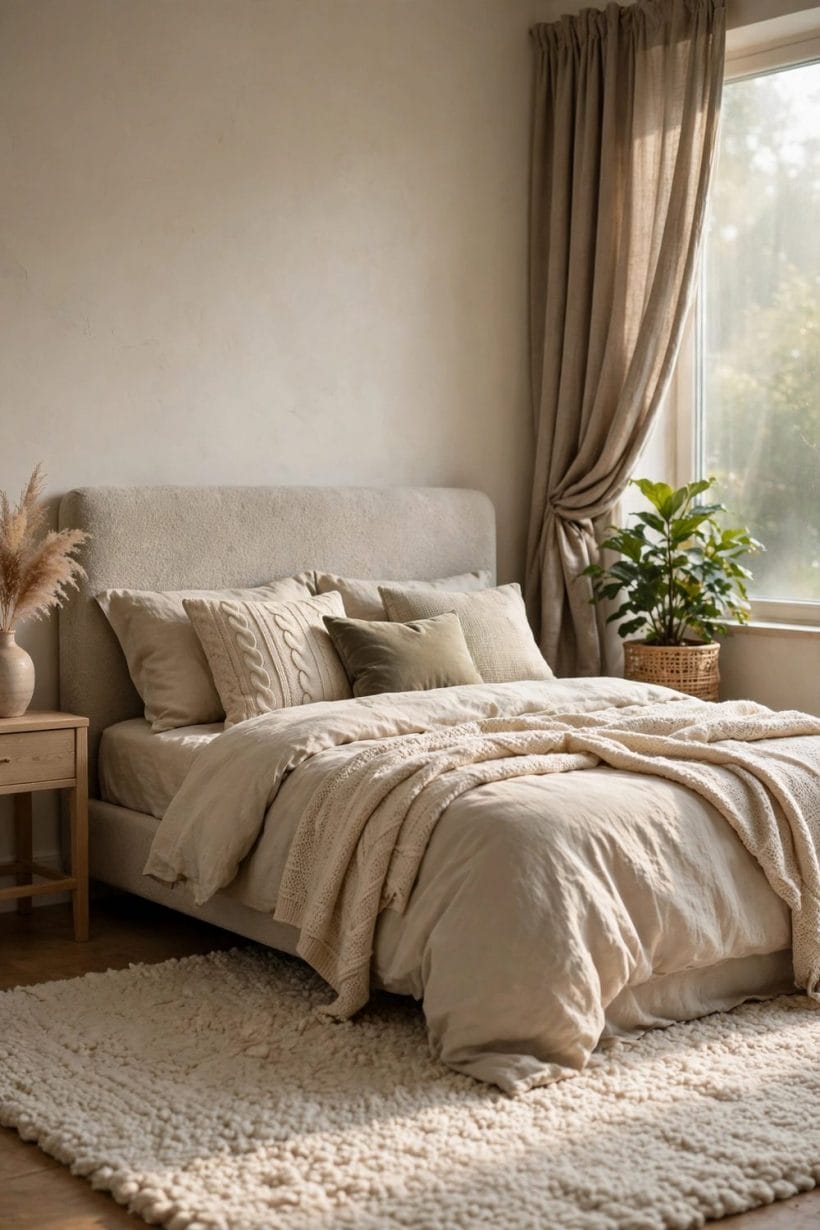
The bedroom in this photograph demonstrates the first principle: layer upon layer, bed rug over floor rug, nothing hard left bare. Bare floors bounce every sound twice — once around your room, once toward the neighbours below — and covering them is the single most effective softening move in the house.

The Deep Rug, Properly Underlaid
A thick rug on a soft underlay absorbs the footfall and chatter that a thin rug merely muffles for a week. Size matters more than pattern: the rug should catch the walking lines of the room, especially the route past the bed and the door.
Soft Floors in the Noisy Rooms
Where a floor is being changed anyway, carpet and cushioned finishes are the quiet choices; hard floors stay live no matter how they are dressed. If a hard surface is the plan, our comparison of luxury vinyl tile and ceramic tile covers the two most-chosen options — and either will still want rugs in the rooms where quiet matters.
Hallways: The Sound Motorway
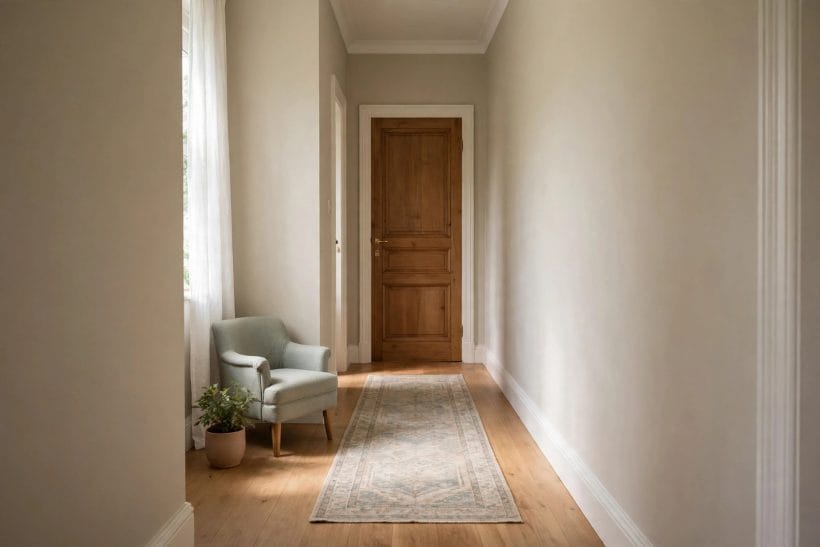
Corridors carry noise between every room, and a long runner changes a hallway from an echoing duct into a soft passage. It is also the finish your own household hears most — softer footsteps at night are a gift in both directions.
3. The Quiet Bedroom
The door standing ajar in this photograph opens onto the room where quiet matters most. Sleep is where noise costs you, so the bedroom deserves the fullest treatment the house gets — and the first principle is position within the room.
The Bed on the Quietest Wall
Put the head of the bed against the wall that shares least — not the party wall if the room offers another, not the wall with plumbing behind it if that can be helped. It costs nothing and it works every night; the complete planning of the room around that choice is the territory of our complete bedroom ideas.
The Upholstered Headboard Wall
A wide, padded headboard — or fabric panels across the wall behind the bed — puts a soft layer exactly where your head rests. It softens sound arriving through that wall and, just as usefully, sound you make yourself.
Bedding as Insulation
Duvets, throws, cushions and upholstered benches are sound treatment wearing pyjamas. A generously dressed bed and a soft bedroom absorb the nighttime noises of the house itself — doors, pipes, stairs — that often disturb sleep more than anything from outside.
4. Doors That Actually Close
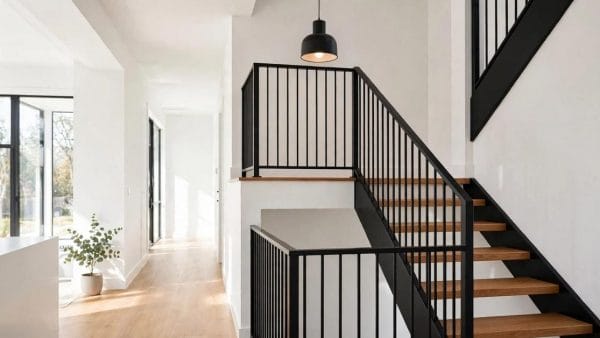
The hallway in this photograph has the right idea: a solid timber door, fully framed, built to shut. Sound behaves like light and draught — it goes through gaps — and most interior doors leak around every edge.
The Solid-Core Swap
Lightweight hollow doors are drums; solid-core doors are barriers. Swapping the door of the bedroom — and of the noisiest room — for a solid one is unglamorous, permanent and one of the few changes visitors never notice while you sleep better behind it nightly.
Sealing the Frame
A solid door in a leaky frame is a wall with a hole in it. Simple seals around the frame and a sweep or threshold at the floor close the gaps sound pours through; it is modest joinery, within a competent carpenter’s morning, and the difference is audible the first evening.
An End to Slamming
Half the noise inside a house is doors. Soft-close fittings, felt pads on frames and catches that draw a door shut quietly remove the bang from the household’s soundtrack — a kindness to everyone on both sides of every door.
5. Windows and Heavy Curtains
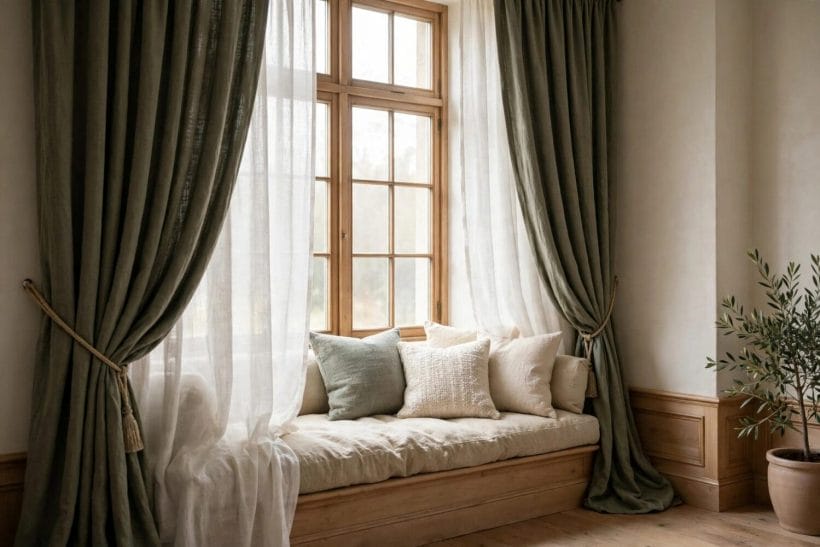
The window seat in this photograph wears the correct uniform: heavy curtains, full-length, drawn against the world. Windows are the thinnest part of most walls, and for street noise they are the front line.
Full-Length, Full-Weight Curtains
Heavy fabric, hung wide and falling long, absorbs a real share of what the glass lets through and calms the room’s own echo besides. The fuller the gather, the softer the result — skimpy curtains are decoration, generous ones are equipment. The wider world of dressing them lives in our window treatments.
Honest Seals and Sound Glass
Before any curtain can help, the window itself must shut properly: worn seals and rattling sashes leak sound freely. Where windows are being replaced, ask the fitter plainly about the glazing’s sound behaviour — it is a specification like any other, and a professional question, professionally answered.
The Layered Window
A sheer for the day and a heavy curtain for the night gives privacy at noon and softness at nine. Between the two layers, a blind adds a third. None of this is exotic; stacked together at the thinnest wall of the house, it is where the softening budget earns most.
6. Walls of Books and Shelves
The reading corner in this photograph is lined with the quietest furniture there is: full bookshelves. A shared wall covered in books is a shared wall covered in dense, irregular, sound-swallowing mass — and it looks like a library rather than a defence.

The Bookcase Wall
Floor-to-ceiling shelves on the wall that carries the noise, filled honestly with books, break up and absorb sound from both directions. Gaps and half-empty shelves do half the job; the full wall is the point. Our living room ideas show shelf walls designed as the room’s glory, which is exactly what they should be.
Wardrobes on the Shared Wall
In bedrooms, a run of wardrobes along the shared wall does the bookcase’s job in clothes: dense, soft, full-height mass between you and the noise. It is often the deciding argument for where the storage goes.
Soft Things at Ear Height
Cushioned panels, upholstered screens and deep shelving placed where sound first strikes — opposite the door, along the echoing stretch — calm the flutter that makes voices carry inside your own rooms. Rooms that do not echo feel quieter even at the same incoming volume.
7. Hangings and Soft Panels
The woven hanging in this photograph is doing quiet work: a wall that would bounce every sound now meets fabric first. Textiles on walls are the oldest softening of all — castles hung tapestries against cold and noise alike.

The Textile Hanging
A rug, quilt or woven panel hung on the noisiest wall softens both the sound arriving and the room’s own liveliness. Hung with a small air gap behind it, it works harder still — and it is the most renter-friendly entry in this entire post. The styling side of the idea fills our bedroom ideas as well.
Curtained Walls
A full wall of curtain — behind a bed, along a studio’s long side — is upholstery at architectural scale. It hides ugly walls, warms cold ones and gives a room the hushed acoustics of a theatre box.
Upholstery Where It Counts
Sofas with real stuffing, upholstered chairs, ottomans and cushions are absorbers placed at living height. Hard, sparse rooms are loud rooms even when nobody is making noise; the cure is furniture you can sink into.
8. Corners Made for Quiet
The nook in this photograph — armchair, ottoman, lamp, shelves — is a quiet machine: small, enclosed, soft on every side. A home needs at least one place where the world’s volume drops, and corners are where those places are built.

The Reading Corner
Choose the corner furthest from the street and the television, fill it with one deep chair, cushions and a lamp, and let books and fabric do the rest. Corners collect softness naturally; a corner arranged for quiet becomes the household’s pressure valve.
The Window Seat Retreat
A cushioned window seat with curtains that can close around it is a room within the room — the daytime version of drawing the drapes. Children find these instantly; adults pretend they built them for the children.
Soft Clutter, Honestly
Cushions on the floor, throws over chair backs, baskets of blankets: the layered softness of a lived-in textile-rich room measurably calms its sound. Minimalism has many virtues; acoustics is not among them, and this is the section where that trade is made cheerfully.
9. Night-Time Quiet
The bedroom in this photograph has done the evening ritual properly: curtains drawn, lamps low, the day shut out. Night is when softening is tested, so the last entries gather the bedroom’s closing routine — the arrangement our master bedroom ideas also treat as the room’s whole purpose.
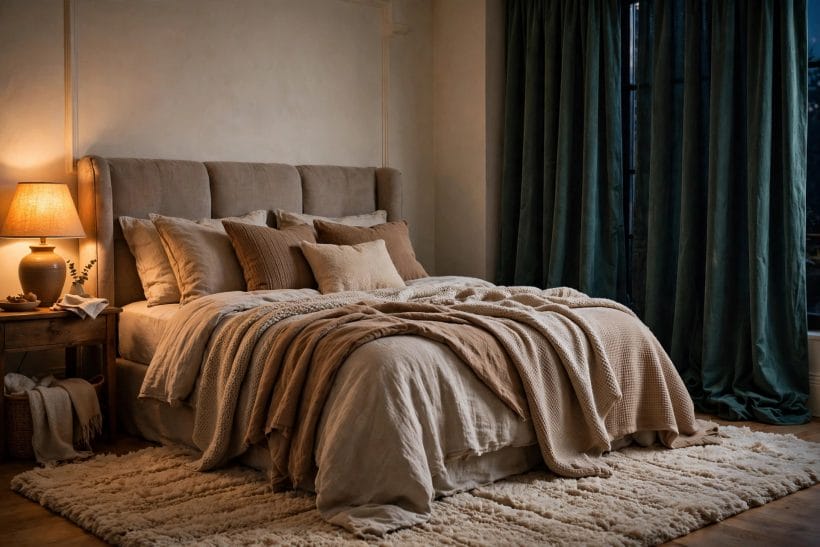
Draw the Curtains, Close the Day
The simple act — heavy curtains fully closed before bed — is the cheapest nightly softening in the house. It also darkens the room, and the two together are most of what sleep asks of a bedroom.
Masking, Honestly Described
A fan’s hum or a soft sound machine does not block noise; it masks it, filling the silences between sounds so the sounds stop startling. For light sleepers troubled by intermittent noise — a door, a stair, a passing car — masking is often the difference between waking and sleeping through.
The Household’s Own Quiet Hours
The last entry is about your side of the wall: soft slippers after dark, the television’s volume agreed, doors closed gently. A home that practises quiet receives it more kindly — and the household sleeps in the calm it makes itself.
10. What Softening Cannot Do
Honesty closes this post. Finishes work on airborne sound — voices, music, television — and they work by degrees. Sound that travels through the structure itself, the thud of footfall through joists or bass that arrives in your ribs, is largely beyond rugs and curtains, and anyone who promises you a silent flat with soft furnishings is selling something.
Deeper answers exist — added wall linings, sealed construction, work to floors and ceilings — but they are building work: designed, costed and carried out by professionals, and in flats they usually need the building owner’s agreement before they begin. This post deliberately keeps to the renter-and-owner-friendly surface, where most of the everyday benefit honestly lives.
Work the ladder in order, because the rungs multiply each other. A thick rug under a sealed door outperforms either alone; heavy curtains over an honest window frame outperform either alone. Start where the household sleeps, continue where it gathers, and stop when the house feels sheltered rather than sealed — a home should stay connected to its street and its neighbours, just at a volume everyone can live with. Softness, in the end, is not the absence of the world. It is the world, arriving gently.
What the surface work does deliver is real: rooms that echo less, sleep that breaks less, a home that feels like shelter. In a noisy world, that is not a consolation prize. It is the prize most people were actually looking for.
Final Considerations
Start at the floor, seal the doors, hang the heavy curtains, and put the books against the wall that needs them. Expect softer, not silent — and notice how much of the noise problem was never the volume at all, but the echo, the gaps and the hard bare rooms amplifying it. A quieter home is built from fabric, mass and small habits, and every layer you add is one the whole household hears.



0 Comments