
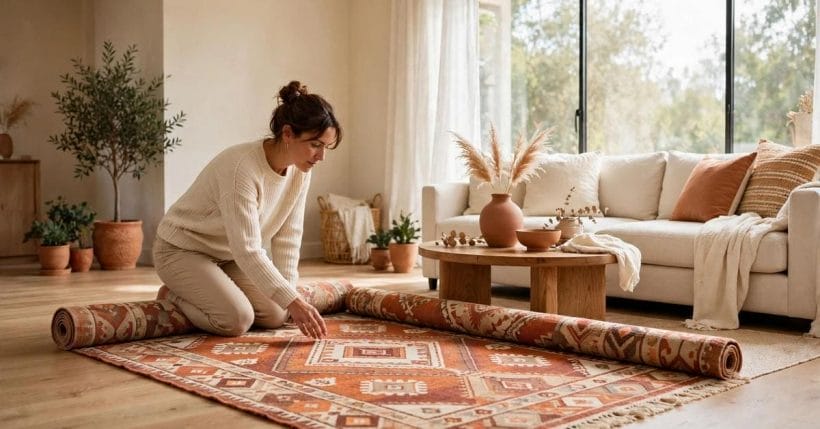
A rug is the largest thing most people ever buy from a photograph — and the one whose size, colour and feel are hardest to judge on a screen. Buying one online is genuinely convenient and genuinely risky, and the difference between a good experience and a miserable one is a handful of checks made in the right order.
This guide is that handful: how to size, choose and test a rug bought online, and how to protect your options — with returns covered as things to check on the seller’s own pages before you order, never as stated terms.
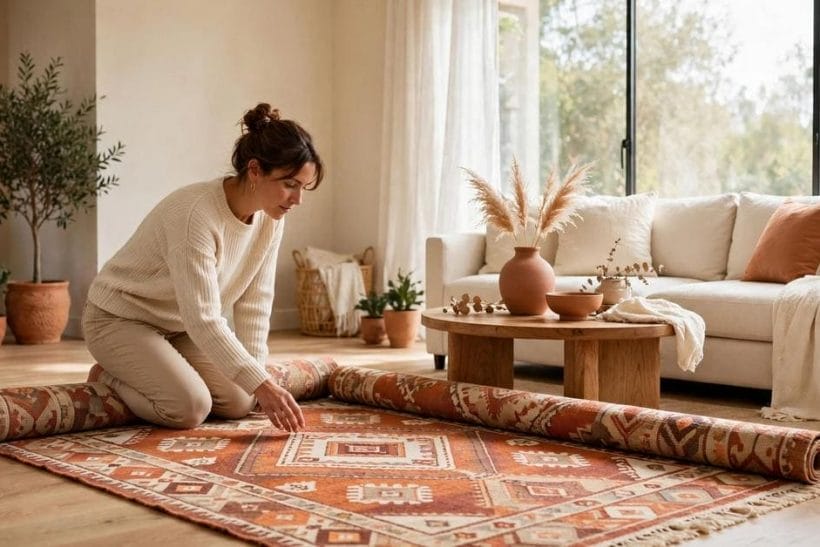
1. Buying a Rug Online at a Glance
Scope first. This post is a what-to-check guide for buying a rug online — size, material, colour and the decision process after delivery. It deliberately states no retailer’s return policy: policies differ between sellers, they change, and the only version that matters is the one on the seller’s official page on the day you order, which is why the guide keeps sending you back to check it. The neighbouring reading lives elsewhere on the site: the online flooring guide for buying floor coverings sight-unseen generally, vinyl flooring wear layers and epoxy flooring ideas for the hard-floor alternatives, buying appliances from a discount retailer and buying major appliances for the same check-first discipline on other big purchases, and tiny house flooring ideas for the floors a rug must live with.
One rule governs the whole guide: everything is easier before the order than after it. Ten minutes of checking at the screen replaces weeks of repacking, photographing and corresponding.
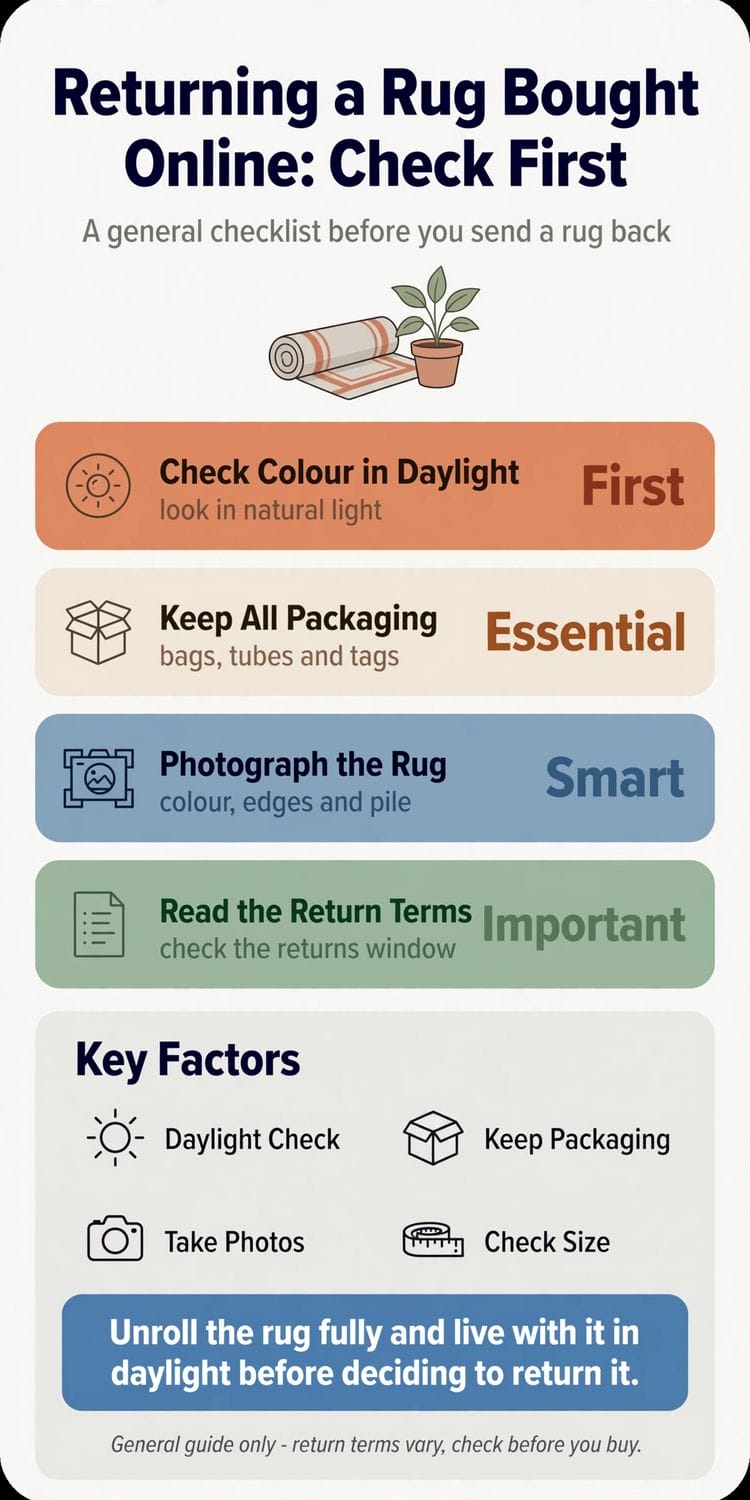
| Check | When | Why |
|---|---|---|
| Read the Return Terms | Before ordering | Terms vary by seller and change — check the official page |
| Check Colour in Daylight | First, on arrival | Screens flatter; daylight tells the truth |
| Keep All Packaging | Until decided | Bags, tubes and tags are your options, kept |
| Photograph the Rug | On arrival | Colour, edges and pile, on record |
| Check Size in Place | Before living on it | Tape lines lie less than unrolled rugs do |
2. Before You Order: Getting the Size Right
1. Measure the room, then the furniture
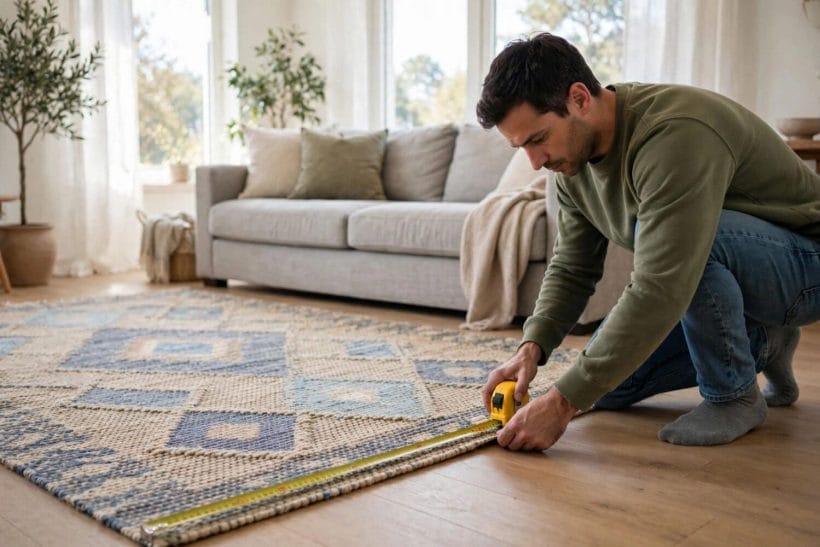
Most rug regrets are size regrets. Measure the room, then measure the furniture grouping the rug must hold — sofa front legs, chairs, table footprint — because a rug’s job is to gather furniture, and a rug too small for the grouping looks lost no matter how beautiful it is.
2. Tape the outline on the floor
Mark the candidate rug’s outline with painter’s tape and live around it for a day. Walk the routes, open the doors, sit in the chairs. Tape reveals what dimensions on a product page cannot: whether the rug crosses a walkway awkwardly or a door swing catches its edge.
3. Allow for the difference between stated and actual
Hand-finished rugs can vary slightly from their stated size, and pile rugs measure differently from flatweaves. Treat the listed dimensions as close, not exact, and leave enough margin in your taped outline that a small variation cannot ruin the fit.
3. Material and Pile: Choosing What Arrives
4. Fibres in general terms
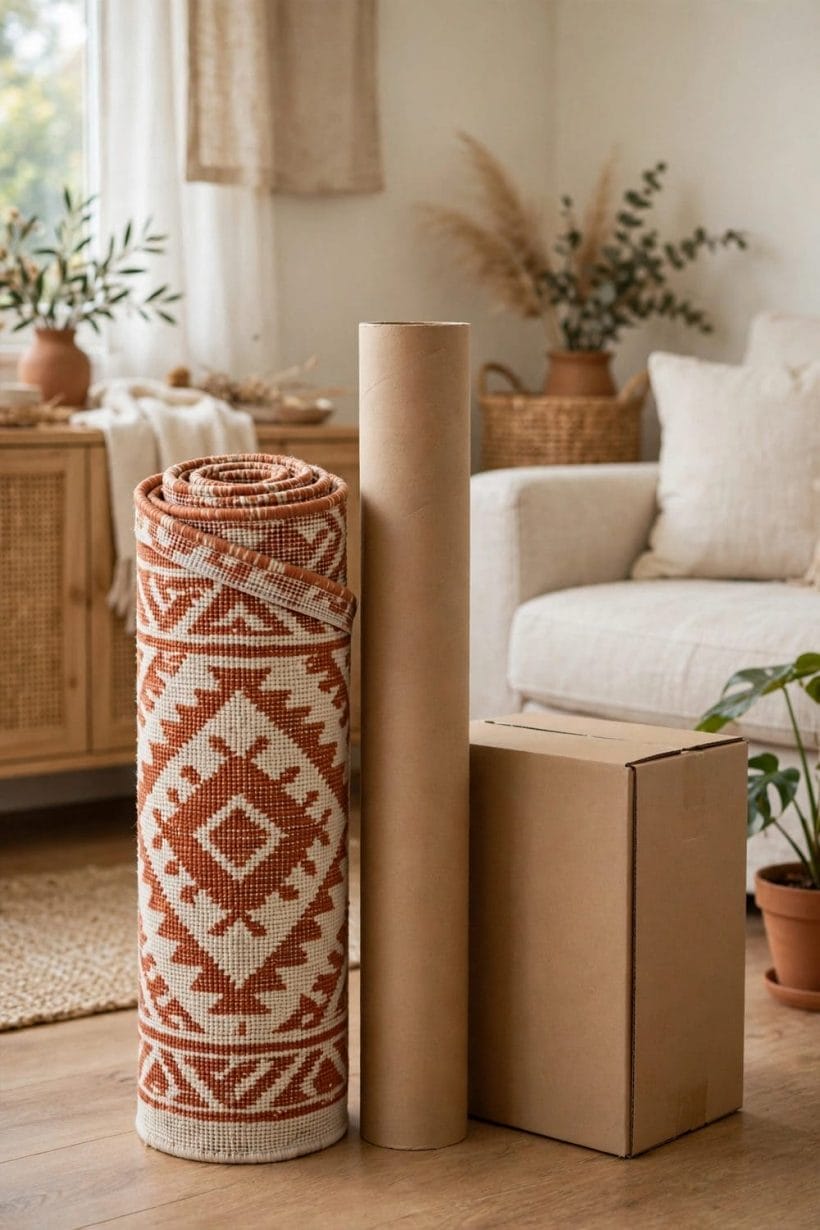
Wool is the traditional rug fibre — resilient, warm, and forgiving of foot traffic. Plant fibres such as jute and sisal give texture and a natural look with less softness underfoot. Synthetic fibres offer easy care and steady colour at lower cost. The right choice follows the room’s traffic and your tolerance for upkeep, not fashion.
5. Pile height and the doors it must clear
A deep pile is luxurious in a bedroom and a daily annoyance under a swinging door or a dining chair. Check the pile height against door clearances and chair movement before ordering — it is the specification most often skipped and most often regretted.
6. Backing, underlay and hard floors
Most rugs need an underlay on hard floors: it stops creeping, softens the feel and protects both rug and floor. Check what the seller says about the rug’s backing and whether it suits your floor type, especially heated floors, where some backings and underlays are not recommended.
4. Colour: The Screen Is Not the Room
7. Why screens cannot be trusted with colour
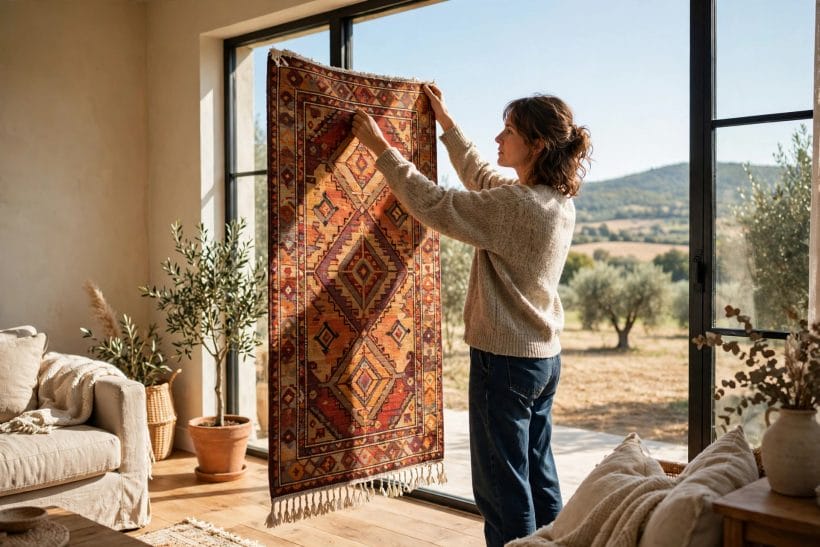
Every screen renders colour differently, product photographs are lit professionally, and a rug’s appearance shifts with its pile direction and the light falling on it. Treat the product photo as an approximation — the maker’s own description of the colour family is often the more reliable guide.
8. Order the sample where one is offered
Many sellers offer a small sample or swatch of the rug. It costs little, arrives fast, and settles colour, texture and pile in your own light before the large commitment. Where a sample exists, skipping it to save a few days is the classic false economy of rug buying.
9. Judge the colour against the room’s fixed points
A rug must live with what cannot change: the floor’s tone, the sofa fabric, the wall colour. Hold the sample — or later, the rug itself — against each of them in daylight. Most “wrong colour” returns are really wrong-partnership returns, visible in advance to anyone who checks.
5. Delivery: What to Check on Arrival
10. How rugs travel, and what that means
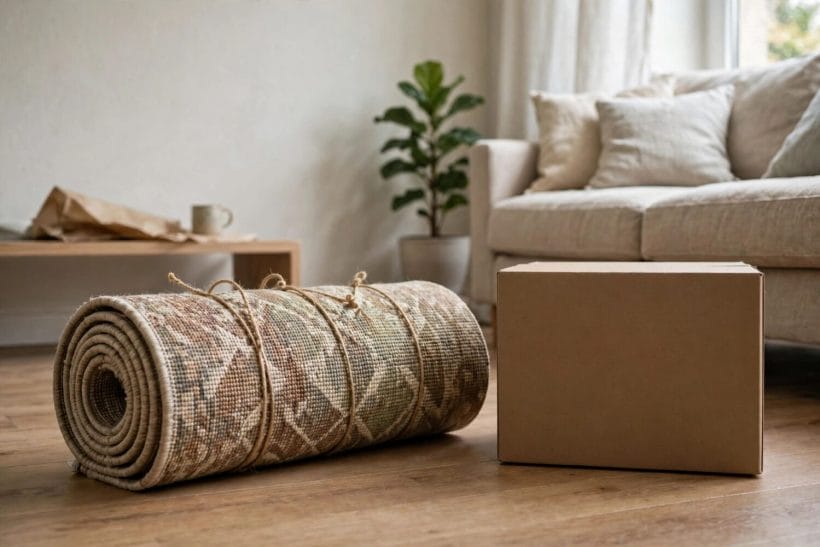
Rugs arrive rolled or, for larger sizes, sometimes folded. Creases, curled edges and a flattened pile are normal consequences of the journey and usually relax over the first days. Knowing this in advance separates the patient verdict from the panicked one.
11. Inspect before you settle anything
Unroll the rug fully, in the room it is for, as soon as you can. Check the size against your tape lines, the colour in daylight, the edges and binding, and the pile for flaws or transit damage. Anything genuinely wrong is far easier to raise with the seller when it is found and documented promptly.
12. Photograph everything, immediately
Take clear photographs of the rug as it arrived — its overall colour, its edges, any flaw, and its labels. The infographic’s advice is the professional habit: a photographed record protects you in any later conversation with the seller, whatever the question turns out to be.
6. The First Days: Deciding Properly
13. Unroll it fully and live with it
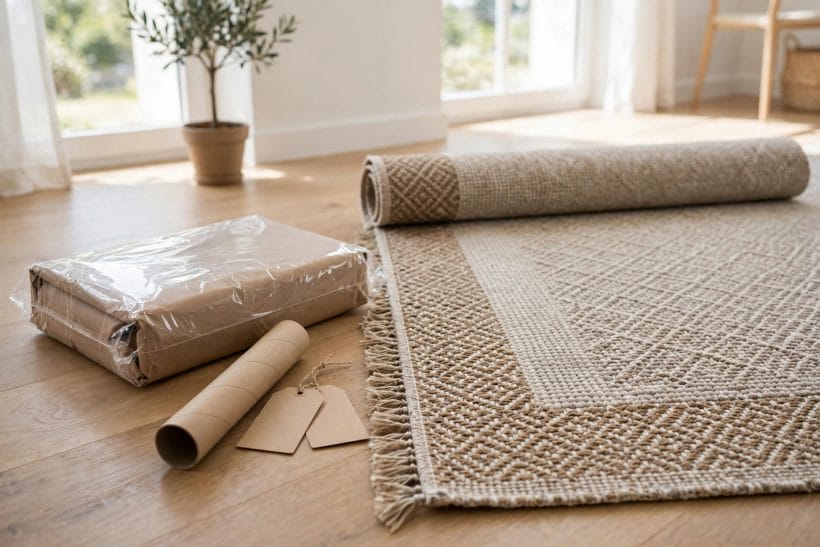
The single most important piece of advice in this guide is the infographic’s tip: unroll the rug fully and live with it in daylight before deciding anything. A rug half-seen, still curled at the edges in evening lamplight, has not yet shown you what you bought.
14. Keep every scrap of packaging
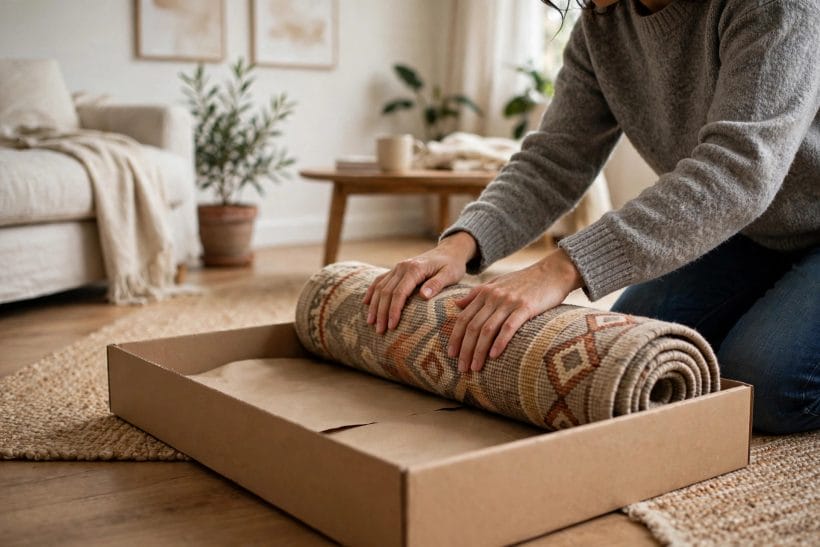
Until the decision is made, keep the bag, the tube, the wrapping and the tags. If a return does happen, repacking a large rug is the hard part, and the original packaging is the difference between an afternoon’s task and an impossible one. This costs a corner of a room for a few days — cheap insurance.
15. Let the pile and the edges settle
Give the rug a few days of ordinary life: vacuum it gently, walk on it, let furniture sit where it will sit. Many first-hour objections — a crease line, a raised edge, a chemical newness in the smell — are transit effects that disappear, and a fair judgement waits for them to go.
7. Returns: What to Check, and When to Check It
16. Read the terms before you order, not after
Every seller sets its own return arrangements, and they are not interchangeable. Before ordering, find the returns information on the seller’s official site and read it as it stands that day. That page — not a forum, not a review, not this guide — is the only authority on what returning your rug would involve.
17. The questions to answer from that page
Work through the page with a checklist in mind: Is there a returns window, and how long is it? Must the rug be unused, or is a trial at home allowed? Who arranges and who pays for the return carriage of something this large? Are sale or made-to-order rugs treated differently? Keep a note of the answers with your order confirmation.
18. If you decide to return, act inside what you checked
Decisions about a rug should be made promptly, while the options you verified are still open. Follow the process the seller’s page describes, use the packaging you kept, and refer to the photographs you took on arrival. A return conducted by the book is a routine transaction; one improvised late is a negotiation.
8. Faults, Mismatches and Fair Judgements
19. Distinguish a fault from a characteristic
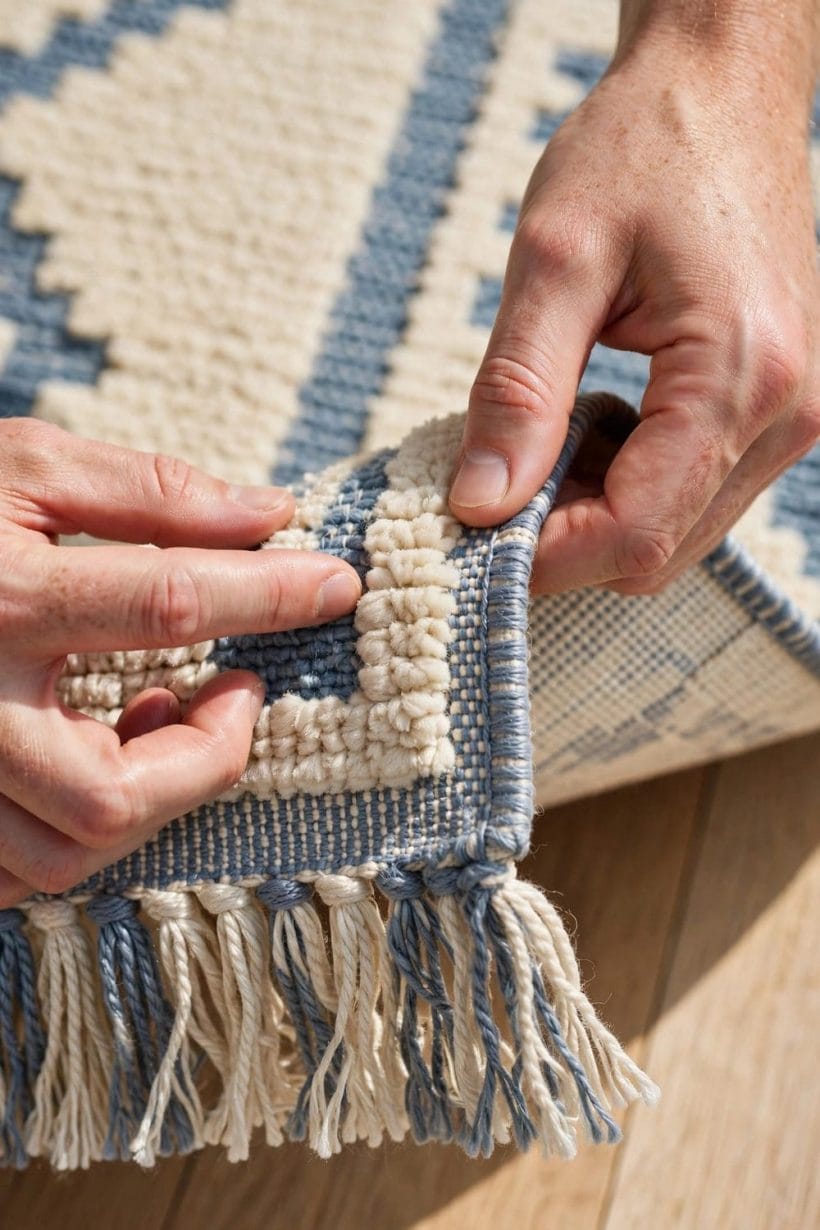
Hand-made and natural-fibre rugs carry small irregularities — a slub in the weave, a shade shift between dye lots, a fringe that is not machined straight. These are characteristics of the type, described in most sellers’ own product notes. A fault is something else: damage, a defect in the pile, a rug that is not what was ordered.
20. Colour difference versus colour disappointment
If the rug that arrived is a different colour from the one described — not merely different from the one you imagined — your photographs, taken in daylight beside the product description, are the evidence that matters. Keep the conversation factual, dated and illustrated; it resolves faster that way, whichever seller you are dealing with.
21. Use the seller’s stated route for problems
Sellers publish how they want problems raised — a contact form, an email, a returns portal. Using that stated route, with your order reference and photographs ready, is simply the fastest line to a resolution. This guide states no seller’s process because processes are the sellers’ own to publish and to change.
9. Making the Final Decision
22. The daylight verdict
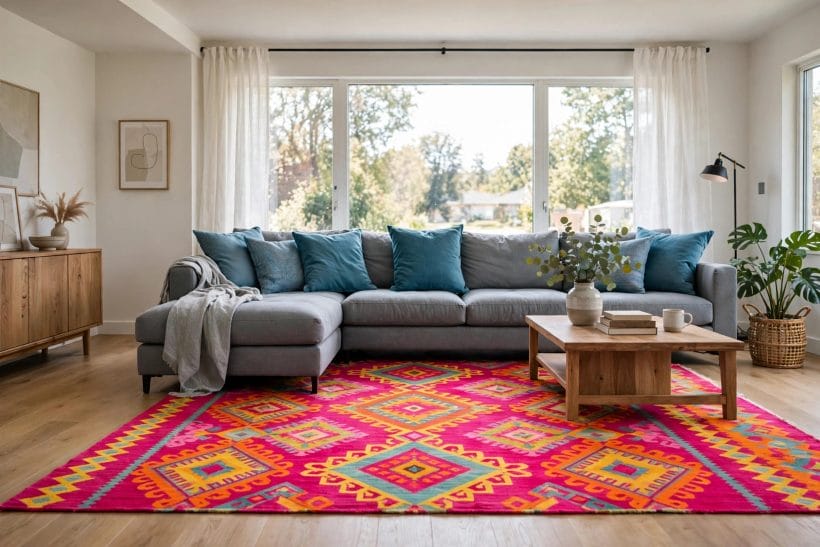
Stand back in full daylight, with the furniture in place, and answer the only question that matters: does the room look better with this rug in it? Not “is it perfect” — no large textile is — but whether the size, colour and texture are doing the job you measured and taped for.
23. The barefoot test and the chair test
Walk on it barefoot, sit in every chair it serves, pull a dining chair in and out. A rug is a working surface before it is a picture, and faults of feel and function found now are the ones that would have annoyed you for a decade.
24. Decide inside your own timetable
You checked the seller’s arrangements before ordering, so you know how long your decision can take. Use the time to judge fairly — days of living with the rug, not minutes — but let the decision land while every option you verified is still open to you.
10. The Whole Checklist, in Order
Everything above compresses into a sequence: measure and tape; choose fibre and pile for the room’s traffic; distrust the screen and use a sample; read the seller’s return terms on the official page before ordering; inspect and photograph on arrival; unroll fully, keep the packaging, and live with the rug in daylight; then decide, promptly and on evidence.
25. The mistakes this checklist prevents
Almost every bad rug purchase fails at one of five points: the size was guessed, the colour was trusted to a screen, the pile fought the doors, the terms were read after the problem, or the packaging was binned before the decision. Each is a five-minute check. The checklist is short because the failure list is.
26. What a good purchase feels like
A well-bought rug disappears into the room’s life within a week — walked on, sat around, no longer discussed. That ordinariness is the success state, and it is reached by process, not luck: the buyers who get it are the ones who checked in the right order.
27. The rug is the room’s foundation
A rug anchors furniture, warms floors, absorbs sound and sets a room’s colour key — it is closer to a building material than to an accessory. Buying it with a builder’s care, and checking the exit before you enter, is simply treating the purchase at the scale it deserves.
Final Considerations
Buying a rug online is a judgement made in stages: tape before faith, samples before size, terms before orders, daylight before verdicts. This guide has stated no seller’s policies because it cannot — they belong to the sellers, they differ, and they change. What it can do is put the checks in the order that makes them useful.
Do those checks, and the large, soft, room-changing thing that arrives rolled in plastic is very likely to be the rug you meant to buy. Live with it in daylight, decide on evidence, and let it get on with its decade of quiet work.



0 Comments