
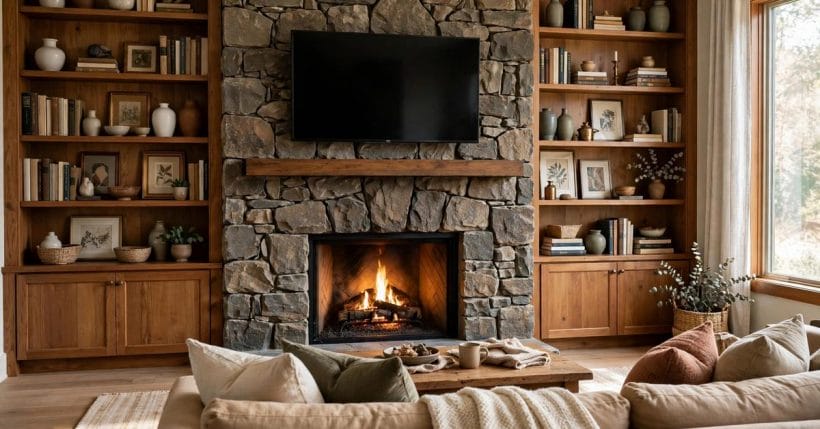
A stone fireplace with a screen above it already gives a living room its centre. The question that follows is what should stand on either side of that centre, and how much of it the room can carry without turning a calm wall into a crowded one. This guide gathers shelving ideas beside stone fireplace with tv above into one arrangement, so the shelves, the stone and the screen read as a single wall rather than three separate features competing for attention.
The arrangement matters more than any single shelf. A wall like this works when the shelves echo the width of the stone, when their finish answers the timber or paint elsewhere in the room, and when what stands on them leaves room for the eye to rest. Shelving here is not a display cabinet for everything a household owns. It is a frame, and a good frame knows when to stay quiet.
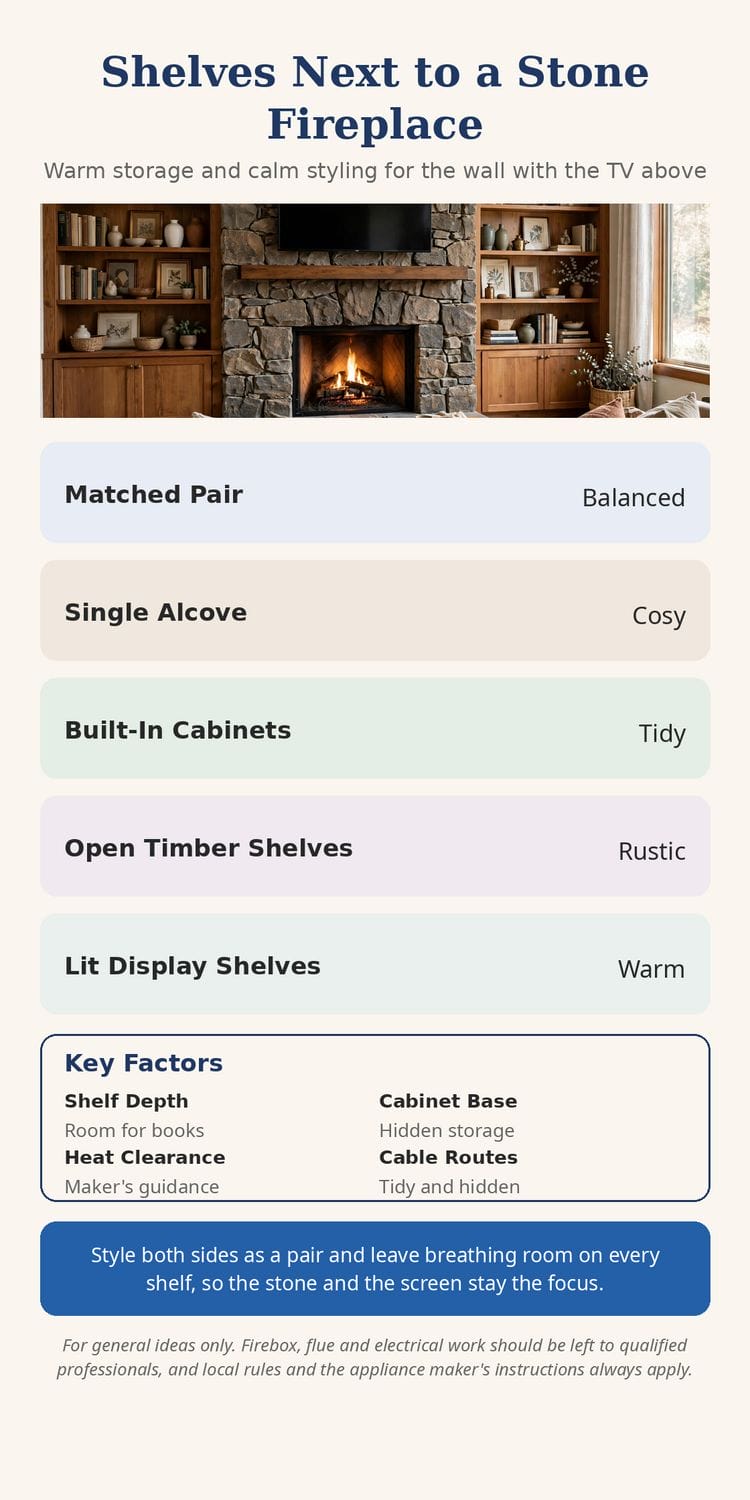
| Item | What it is |
|---|---|
| The Matched Pair: Shelves on Both Sides | The classic arrangement puts a shelved unit on each side of the stone, matched in width, finish and height. |
| The Single Alcove: Shelving on One Side Only | Not every wall has room for a pair. |
| Cabinets Below, Open Shelves Above | The most forgiving arrangement divides each unit into two parts: closed cabinets below and open shelves above. |
1. Reading the Wall as One Arrangement
Start by looking at the whole wall, not at the shelves alone. The stone breast sets the rhythm: its width, its height, and the way its surface catches light all decide how wide the shelving should run and how tall it should stand. Shelves that stop well short of the ceiling can leave a bare band above them, while shelves carried to the ceiling can make a low room feel taller, provided their tops are not crammed with objects that draw the eye upward for the wrong reasons.
The screen above the fire adds a second measure. Its size and its height set the middle of the wall, and the shelves should sit in conversation with that middle rather than rivalling it. When the shelves and the screen share a quiet palette, the wall settles. When every shelf carries a different colour and finish, the wall argues with itself. Stone itself offers the lesson here: its colours are varied but held together by one material, and shelving that borrows one or two of those tones will sit more easily against it than shelving that introduces a whole new palette. The wider survey of stone fireplace ideas shows how that material sets the temper of the whole room, from fieldstone warmth to slate coolness.
Seating completes the reading. A sofa or a pair of chairs facing the fire will show the wall head-on, so symmetry reads strongly from the main seat, while a chair placed to one side will see the wall at an angle, where depth and shadow matter more than perfect balance. Walk the room before choosing anything, and notice where the wall is seen from the doorway, from the table, and from the quiet corner where someone reads in the evening. Those views, taken together, are the real starting point for the shelves.
2. The Matched Pair: Shelves on Both Sides
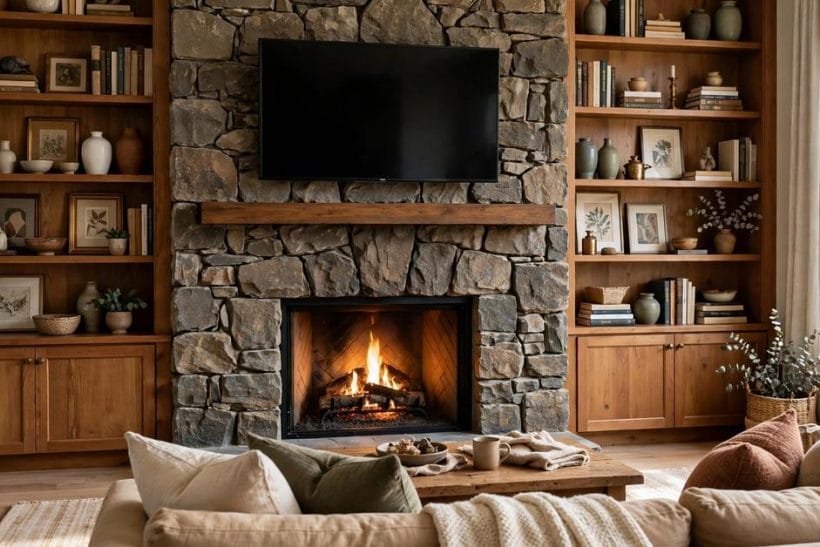
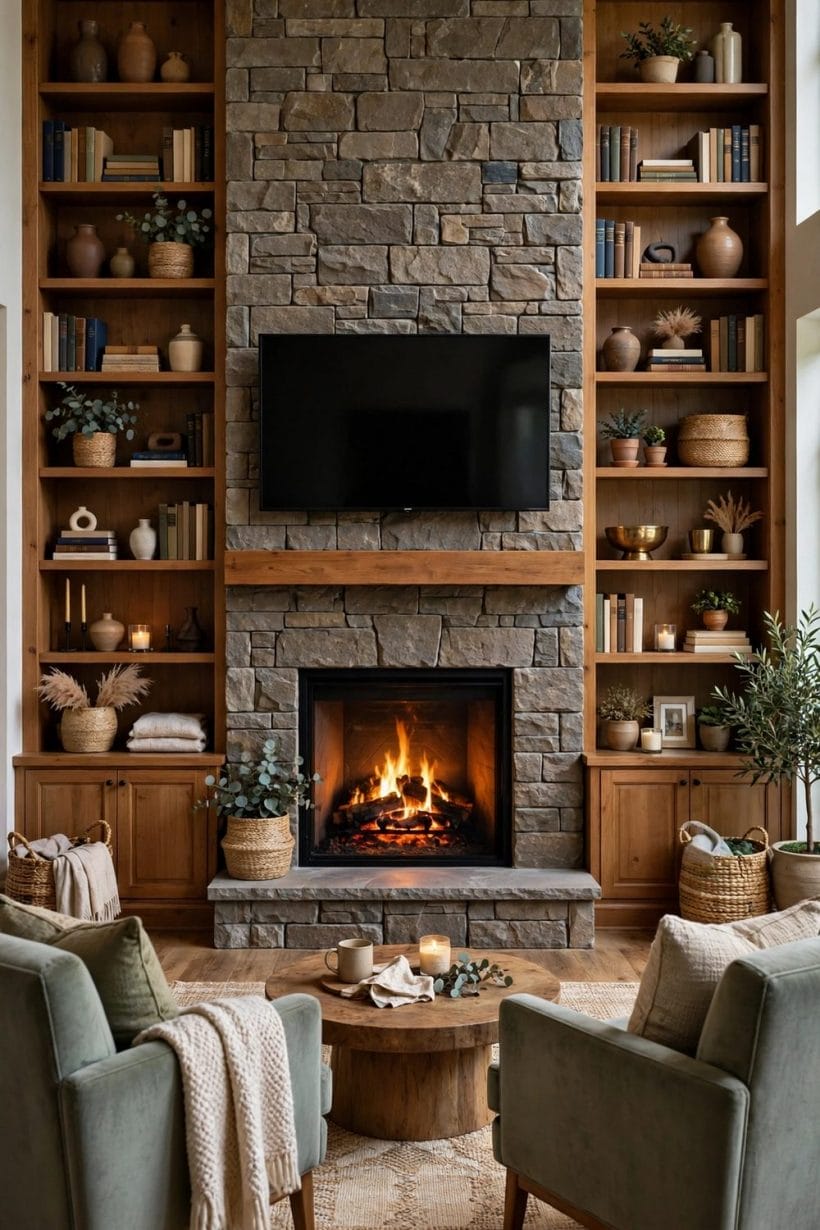
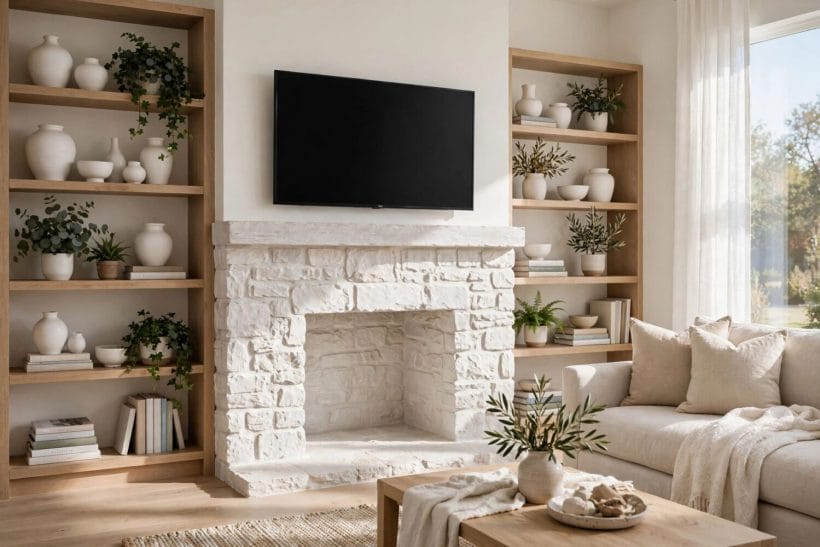
The classic arrangement puts a shelved unit on each side of the stone, matched in width, finish and height. It suits a generous wall and a room that likes order, because the pair turns the fireplace into the centre of a balanced composition rather than a single object with clutter at its edges. Matching does not mean identical contents: the two sides should rhyme, not repeat, with similar shapes and colours appearing on both sides at different heights so the eye travels across the wall instead of stopping at a mirror image.
A matched pair also solves the practical problem of where everyday things live. One side can hold books and reading baskets, the other can hold games, throws and the small boxes that keep a living room usable, and the wall still reads as calm because the doors and frames match. The discipline is in the middle heights, where the eye rests most: keep those shelves lighter than the lower ones, and let the heavier pieces sit low, where they ground the composition.
For rooms where books flank the fire on both sides, the wider family of fireside book storage offers useful company, including bookcase ideas around a fireplace, which treat the shelves as a reading wall in their own right. That cousin keeps its own focus on books and joinery, while this guide stays with the arrangement itself: two shelves, one stone breast, one screen above, held together by proportion.
A matched pair asks for honest measurement. Alcoves beside a stone breast are rarely identical, because stonework is seldom perfectly square, so measure each side separately and let the narrower side set the width if the pair must match. A small difference in depth is easy to hide with a back panel or a slightly deeper frame on one side, but a difference in height at the top line will show from every seat in the room.
3. The Single Alcove: Shelving on One Side Only
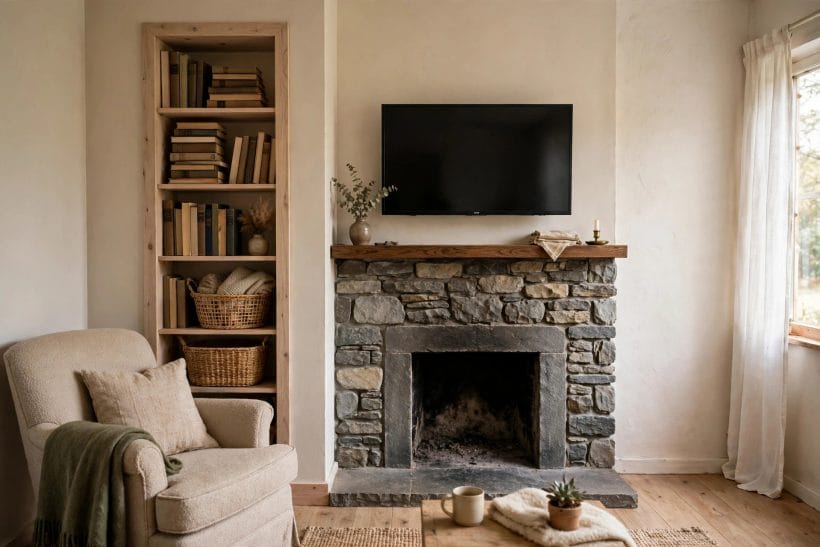
Not every wall has room for a pair. A doorway, a window, a radiator or simply a narrower room can leave only one usable alcove beside the stone, and a single shelved unit, done well, is better than a squeezed pair. The single alcove works when it is given a clear job: a reading shelf beside a favourite chair, a display for a collection that deserves one home, or a tidy stack of baskets for the things a family reaches for each evening.
Balance on a one-sided wall comes from weight rather than symmetry. A tall, narrow unit on one side can be answered on the other side by a picture, a floor lamp, or a plant that rises to a similar height without pretending to be a shelf. The eye accepts an unequal wall when both sides carry similar visual weight, and it rejects a wall where one side is dense and the other is bare. Keep the single unit a little narrower than ambition suggests, and let the stone breathe beside it.
A single alcove also suits a room where the fire is not the only focus. When a window or a view shares the room’s attention, one shelved side keeps the fireplace wall from dominating the whole space, and the room keeps its other pleasures. The shelf then becomes a companion to the fire rather than a monument to it, which is often the calmer result.
4. Cabinets Below, Open Shelves Above
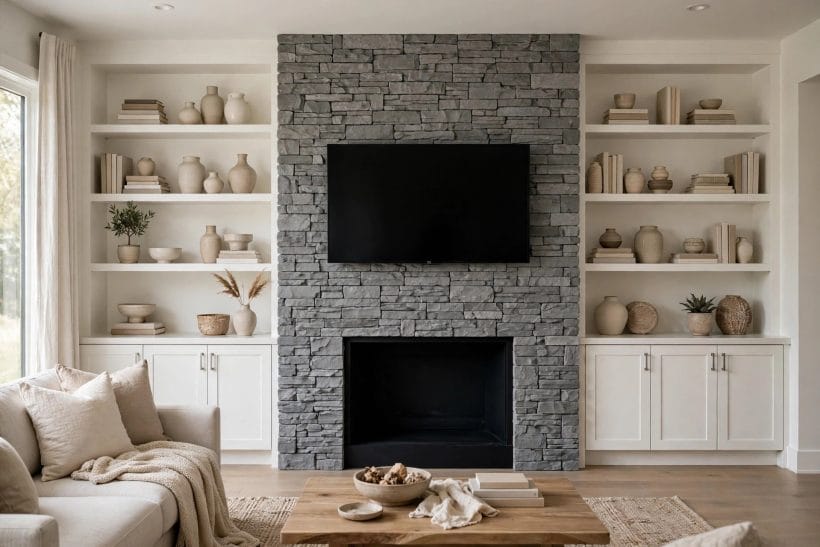
The most forgiving arrangement divides each unit into two parts: closed cabinets below and open shelves above. The cabinets swallow the untidy necessities, such as media boxes, chargers, board games and spare throws, while the open shelves above carry only what deserves to be seen. This division is what keeps a fireside wall looking calm on an ordinary evening rather than only on the day it is styled.
Cabinet fronts should be quiet: flat panels, a single paint colour, and handles that do not catch the eye. When the cabinets match the skirting or the door frames, they read as part of the room’s architecture rather than as furniture that happens to stand against the wall. The open shelves above then have a clean base to rise from, and their contents can be fewer and better chosen.
Built-in joinery around a fire takes this division further, with cabinets and shelves fitted to the alcove as one piece of wall architecture. That fitted approach suits rooms where the alcoves are uneven or where the household wants the wall to read as a single composition, and it is worth studying before committing to freestanding units that may leave awkward gaps against stonework.
Height matters in the division. Cabinets that rise to about the height of a side table leave generous open shelving above, while taller cabinets suit rooms where hidden storage is the priority and display is secondary. Either way, keep one shelf near eye level deliberately sparse, with a single vase or a small stack of books, so the wall has a resting place.
5. Styling Shelves So the Stone and Screen Lead
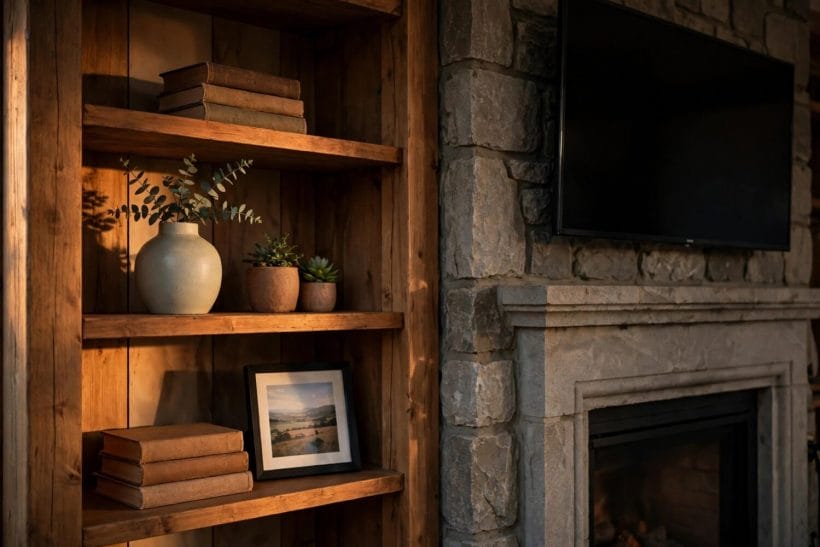
Styling beside stone is an exercise in restraint. Stone already supplies texture, colour variation and weight, so the shelves should answer with fewer materials and softer shapes: timber, ceramic, linen, glass and greenery, repeated in small numbers. A shelf that holds three things reads as styled; a shelf that holds twelve reads as stored, and the difference is visible from the doorway.
Work in small groups rather than single objects scattered across every shelf. A stack of books laid flat with a small vase on top, a framed picture leaning against the back with a candle beside it, or a basket holding rolled throws will read as one composition, while isolated objects lined up like soldiers will read as a shop display. Leave gaps between groups, and let the back of the shelf show through, because that breathing room is what makes the stone beyond the shelves feel generous rather than crowded.
Colour discipline helps more than any single purchase. Choose two or three colours from the room, such as the timber tone, a warm white and one green from the plants, and let most shelf objects stay inside that family. Books will break the rule on their own, since their spines carry every colour at once, so turn some books with their spines inward or group them by tone where a calmer shelf is wanted, keeping the brightest jackets for a single shelf that can carry them.
The mantel line deserves its own restraint, since it sits between the shelves and the screen. A mantel crowded with small objects will fight the screen above it, while a mantel left almost bare, with one long, low arrangement or a single pair of candlesticks, will let the shelves, the stone and the screen each have their moment. The wider tradition of mantel styling, with beams, surrounds and a shelf dressed to suit the fire, is worth reading alongside this guide, since the mantel is the hinge of the whole wall.
6. Books, Baskets and Quiet Storage
Shelves beside a fire earn their keep by holding the things a living room actually uses. Books are the natural first residents, and they sit well beside stone because their weight and warmth answer the weight and warmth of the fire. Mix upright rows with flat stacks, since flat stacks give the eye a place to land and provide a platform for a small object, while upright rows fill a shelf with rhythm.
Baskets are the second resident, and they do the work that open shelves cannot. A basket on a low shelf can hold throws, children’s toys, charging cables or the remote controls that otherwise gather on every flat surface, and a lidded basket hides all of it behind a texture that suits both timber and stone. Choose baskets in one material family, such as seagrass or woven willow, and repeat that material on both sides of the fire so the storage reads as intentional.
Boxes and files have their place too, provided they are chosen for the shelf rather than rescued from elsewhere in the house. A few matching boxes in linen or card will hold photographs, letters and the small paperwork of a household without announcing themselves, while a jumble of mismatched containers will undo the calmest styling. Label them discreetly on the inside or the base, so the shelf face stays quiet.
Leave one shelf in each unit partly empty. An empty stretch of shelf is not wasted space; it is the pause that lets the neighbouring shelves read as displays rather than as storage, and it gives the household somewhere to put a new book or a found object without disturbing the whole arrangement. Rooms that live well have room to change.
7. Light on the Shelves for Evening Rooms
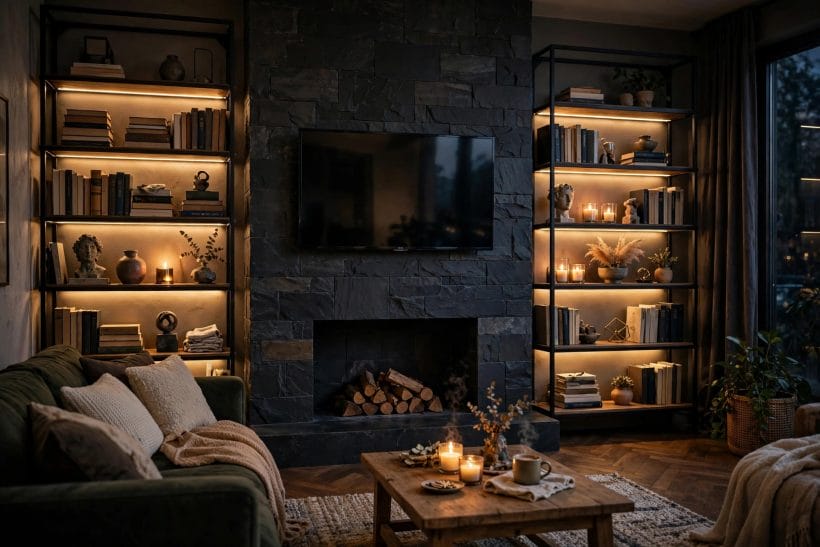
A fireside wall is used most in the evening, when daylight has gone and the fire and the screen are the brightest things in the room. Shelves lit only by the fire will fall into shadow, and their contents will read as dark shapes, so a little dedicated shelf light changes the wall completely. A warm, dimmable light on the upper shelves will let books and ceramics glow without rivalling the fire, and it will make the wall welcoming long after the fire has died down.
Keep shelf light warm and low. A cool, bright strip will make timber look grey and stone look harsh, while a warm light will deepen both and flatter the room. Hide the source wherever possible, with the light tucked under a shelf front or behind a lip, so the glow appears without a visible fitting, and keep the brightest shelf light below the brightness of the screen, so the eye is not pulled away from the fire or the film.
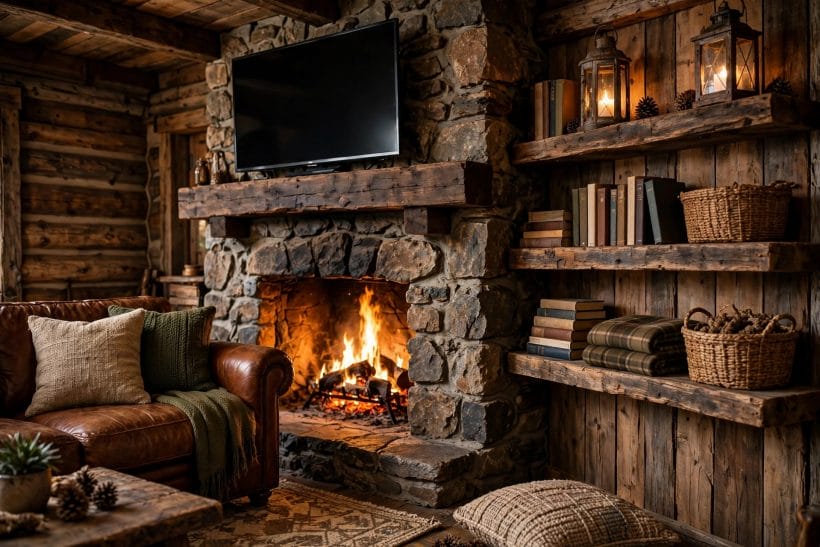
Candles and lanterns have their own place on fireside shelves, but they ask for care. Keep them away from curtains, books and trailing plants, never leave them burning unattended, and prefer enclosed lanterns on lower shelves where a knocked flame cannot reach paper. The fire itself already gives the room its living flame; shelf candles should be a quiet echo, not a second fire.
8. The Mantel Line and the Screen Above
The screen above the fire is the part of the wall most often placed badly, and its height decides whether the shelves beside it feel settled or strained. A screen hung too high forces viewers to tilt their heads and leaves an awkward gap above the mantel, while a screen hung close above the mantel can crowd the shelf dressing below it. The comfortable height is the one that lets the main seat watch without strain, with the mantel dressing kept low enough that it does not block the lower edge of the screen.
Heat is the other consideration, and it should be treated with respect rather than guesswork. Screens and shelf contents placed close to a working fire should follow the appliance maker’s instructions and local rules, and any doubt about clearances, ventilation or the effect of heat on electronics belongs with a qualified installer, not with trial and error. The same caution covers cables: routes for power and signal should be planned before shelves are fixed, with cables hidden inside the joinery or behind the wall by a qualified electrician where the wall must be opened, so no loose run crosses the stone or dangles beside a shelf.
Sound and boxes deserve the same hidden planning. A soundbar, a media box or a games console can live inside a cabinet below the shelves, with its front kept clear for its signal, while spare cables and chargers live in a basket or a lidded box rather than on an open shelf. The wider survey of screens above fires covers surrounds, mantels and cable hiding in fuller detail, and it pairs naturally with this guide, since the screen and the shelves share one wall and one set of decisions.
When the fire is lit, the screen should be able to rest. A dark, blank screen is a large, flat presence on a stone wall, so the shelves beside it matter even more in those hours: a plant trailing from an upper shelf, a picture leaning at an angle, or a row of books will soften the black rectangle and keep the wall feeling like a room rather than a waiting screen. That off-duty appearance is worth planning as carefully as the viewing height.
9. Small Rooms and Narrow Alcoves
Small rooms ask the most from fireside shelving, because the shelves must work harder while taking up less wall. In a narrow alcove, a shallow shelf is better than a deep one: it will hold books, small plants and ceramics without pushing into the room or shadowing the fire, and it will leave the seating closer to the warmth. Depth that suits a large library will overwhelm a small fireside, so let the alcove’s own width set the shelf depth.
Colour can widen a narrow alcove. Shelves painted the same colour as the surrounding wall will recede and let the stone lead, while shelves in a contrasting timber will step forward and claim more attention than a small room can spare. A pale finish beside pale stone, or a mid timber beside warm stone, will usually sit more quietly than a dark finish that frames the alcove as a separate feature.
In a small room, the shelves should also serve the room beyond the fire. A shelf beside the fire can hold the books read in the evening chair, the basket for the throw used on cold nights, and the plant that softens the corner, so the wall becomes part of the room’s daily life rather than a display that must be kept pristine. The broader family of living room ideas offers company for that wider room-making, from seating plans to lighting layers, while this guide keeps its focus on the fireside wall itself.
Floating forms deserve a note here, since narrow rooms often reach for them first. A companion post in this series covers floating shelves beside a fireplace on their own terms, dealing with shelf form itself, while this guide stays with the arrangement: which side, how much, and what stands on the shelves beside stone with a screen above.
10. Care, Safety and Everyday Living
A fireside wall lives with heat, dust and daily use, so care should be part of the plan rather than an afterthought. Dust settles on upper shelves first, and stonework sheds fine dust of its own, so a regular, gentle dusting keeps both shelves and stone looking their best. Books kept close to a working fire can dry and fade, so the most valued volumes are better kept on the cooler, outer shelves, with everyday reading nearer the warmth.
Safety around the fire itself belongs with professionals and with the maker’s instructions. Firebox and chimney work, flue care, gas and electrical connections, and any change to the structure around the fire should be left to qualified people, and local rules should be checked before anything is fixed to the breast or the chimney. Shelves should never be fixed into a flue or a heat-affected lining, and nothing flammable should be stored against the firebox or in a hot zone. Those boundaries are what let a household enjoy the wall without worry.
The hearth at the foot of the wall deserves the same respect, since it is where logs, baskets and feet all meet. Keep the hearth clear of trailing throws and low baskets that could catch a spark or trip a passer-by, and give the fire tools a proper stand rather than leaning them against a shelf. The wider survey of hearth ideas, from aprons and materials to seating and styling, pairs well with this guide for readers planning the whole fireside floor as well as its shelves.
Everyday living will change the shelves, and that is a sign they are working. A new book, a child’s drawing, a plant that outgrows its pot or a basket that fills with winter gloves will all ask for small adjustments, and a wall planned with breathing room can absorb those changes without a full restyle. Revisit the shelves with the seasons, taking one thing away for every thing added, and the wall will stay as calm as the day it was finished.
Final Considerations
The best fireside wall is the one that stops asking for attention and starts giving it back: stone that warms the room, a screen that sits at a comfortable height, and shelves that hold what the household loves without shouting about it. Return to these shelving ideas beside stone fireplace with tv above whenever the wall starts to feel crowded, and take away more than is added until the stone and the screen lead again.
Choose the arrangement that fits the wall as it is, not the wall as it appears in a photograph. A matched pair suits a generous wall, a single alcove suits a narrower one, and cabinets below with open shelves above suit almost every household that lives with its shelves rather than merely looking at them. Measure both alcoves, hide the cables with qualified help, keep the firebox and flue in professional hands, and let the shelves earn their place one calm group at a time.



0 Comments