

A teenager’s room is the first home they ever run themselves, and they judge it like one: is it mine, does it work, can I close the door on the world in it?
These teen bedroom ideas build that small sovereign state properly: a bed that works twice, a desk defended from clutter, storage an owner can run alone, and walls that change as fast as the person inside them.
1. Teen Bedroom Ideas at a Glance
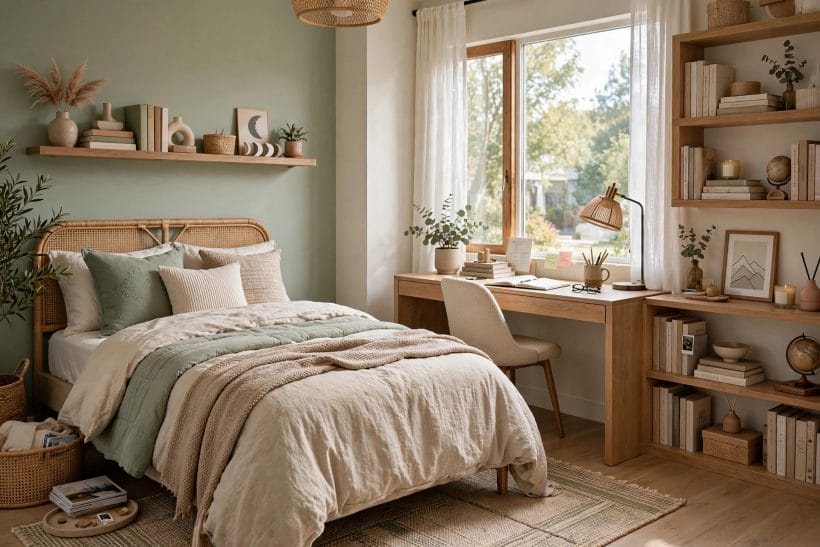
The central entity is the teen bedroom: a single room that must serve as bedroom, study, dressing room and private sitting room for one near-adult owner. Its attributes are the zones and their furniture, the bed in its several working forms, the desk and its light, storage sized to a grown wardrobe and growing collections, walls that carry identity without permanent commitment, and the comfort layer of light, sound and air. A teen room is judged by autonomy above all: everything in it should be reachable, operable and changeable by its owner alone, at the speed their life actually changes.
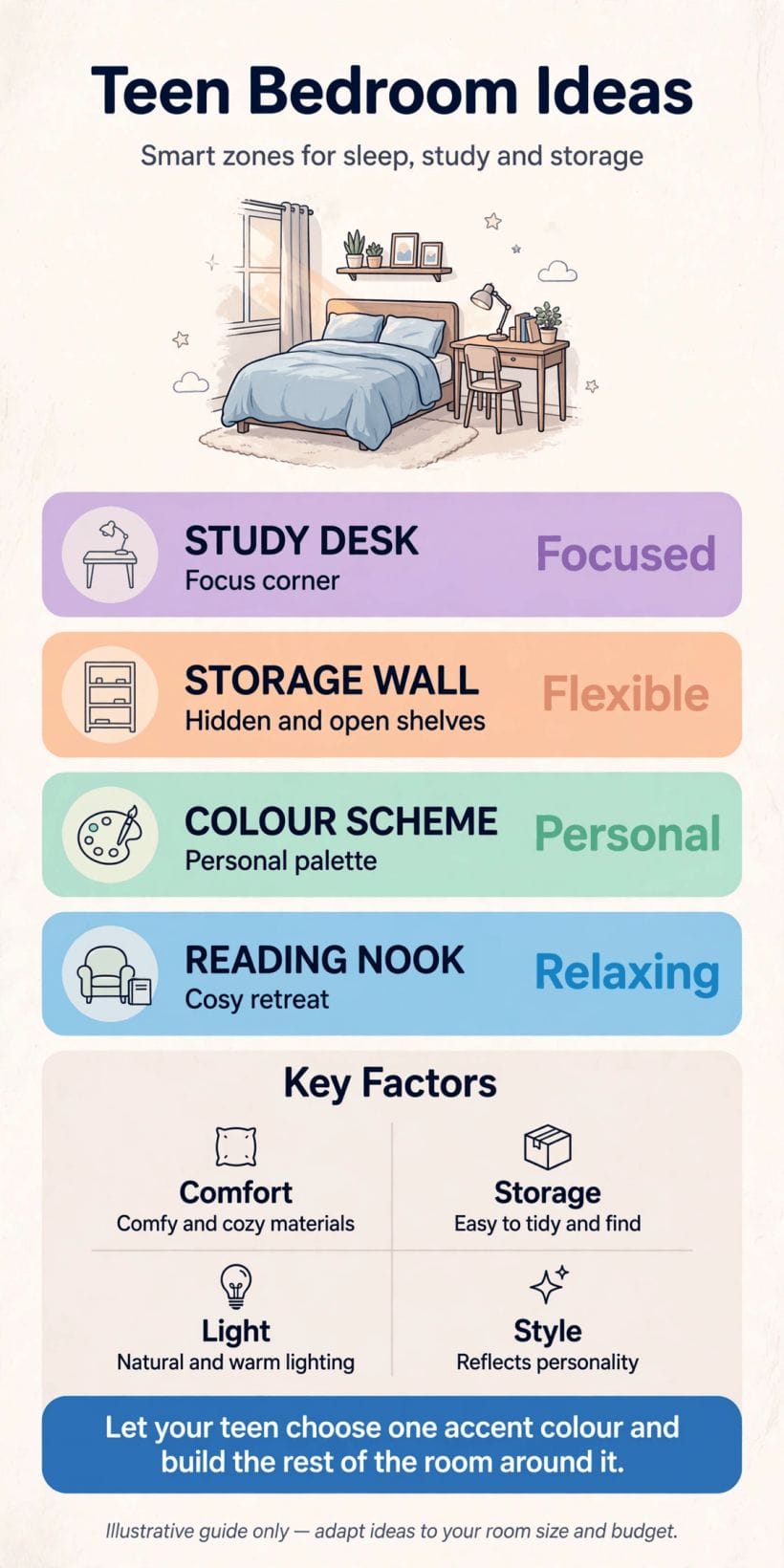
| Question | Short answer |
|---|---|
| What is a teen room’s first job? | Autonomy: one room its owner can sleep, study, dress and relax in, entirely under their own control. |
| Which bed works hardest? | A daybed or lofted bed: both give the room a daytime life as well as a night one. |
| Where does the desk go? | In the best daylight, with storage above it so the work surface itself stays clear. |
| How much display is right? | One bounded gallery wall and one writing panel; the rest of the walls stay calm for rest. |
| What keeps it tidy? | Storage with addresses: every collection, cable and kit given a labelled home of its own. |
2. The Teen Room Itself: Bed, Desk and a Corner That Is Theirs
A teen room succeeds when its owner can sleep, study, dress and disappear into it without asking the rest of the house for space. It sits inside the wider family of the bedroom ideas pillar, but its centre of gravity is different: autonomy. Every idea below serves that centre, giving one person a complete small world with a door that closes.
1. Start with three zones, not furniture
Divide the room on paper into sleep, study and downtime zones before anything is bought.
2. Give the bed the best wall
Place the bed along the longest unbroken wall, where it anchors the room and leaves the window wall free for the desk.
3. Keep a corner that is only theirs
Reserve one corner, however small, for pure downtime: a beanbag, a reading chair, a floor cushion under a shelf. A corner with no job except comfort tells a teenager the room is not merely a place where tasks happen to them.
4. Let the door swing clear
Check that the door opens fully without striking furniture, and keep its arc empty.
5. Plan the walking line
Leave one clear path from door to window that crosses no zone’s working space. Teen rooms collect bags, shoes and laundry in exactly the line people walk; a planned path gives the clutter somewhere obvious not to be.
6. Choose one statement piece together
Let the teenager choose a single bold piece, a headboard, a rug, a chair, while the rest stays calm.
7. Measure before promising anything
Measure the room, the door and the stair turn before any furniture is agreed. Teen furniture is often adult-sized, and a desk or wardrobe that cannot physically arrive is a disappointment that simple measuring prevents entirely.
8. Keep the floor mostly visible
A room reads bigger and calmer when most of its floor shows. Push storage to the walls, keep the centre open, and resist filling every gap; visible floor is what lets one room hold three zones without feeling like a warehouse.
9. Give guests a planned place
Decide where a visiting friend actually sits and sleeps: a fold-out cushion, a trundle, floor space kept deliberately clear. Teen social life happens in this room, and a planned answer beats furniture dragged in from elsewhere every weekend.
10. Agree the reset rule early
Settle together what the room returns to each night: floor clear, desk surface visible, laundry in one basket.
11. Leave room to change
Hold back one wall section, one shelf and some budget for the taste that has not arrived yet. Teenagers change faster than furniture wears out, and a room with spare capacity absorbs the next phase instead of fighting it.
3. Beds and Sleep: Lofts, Daybeds and Room to Grow Into
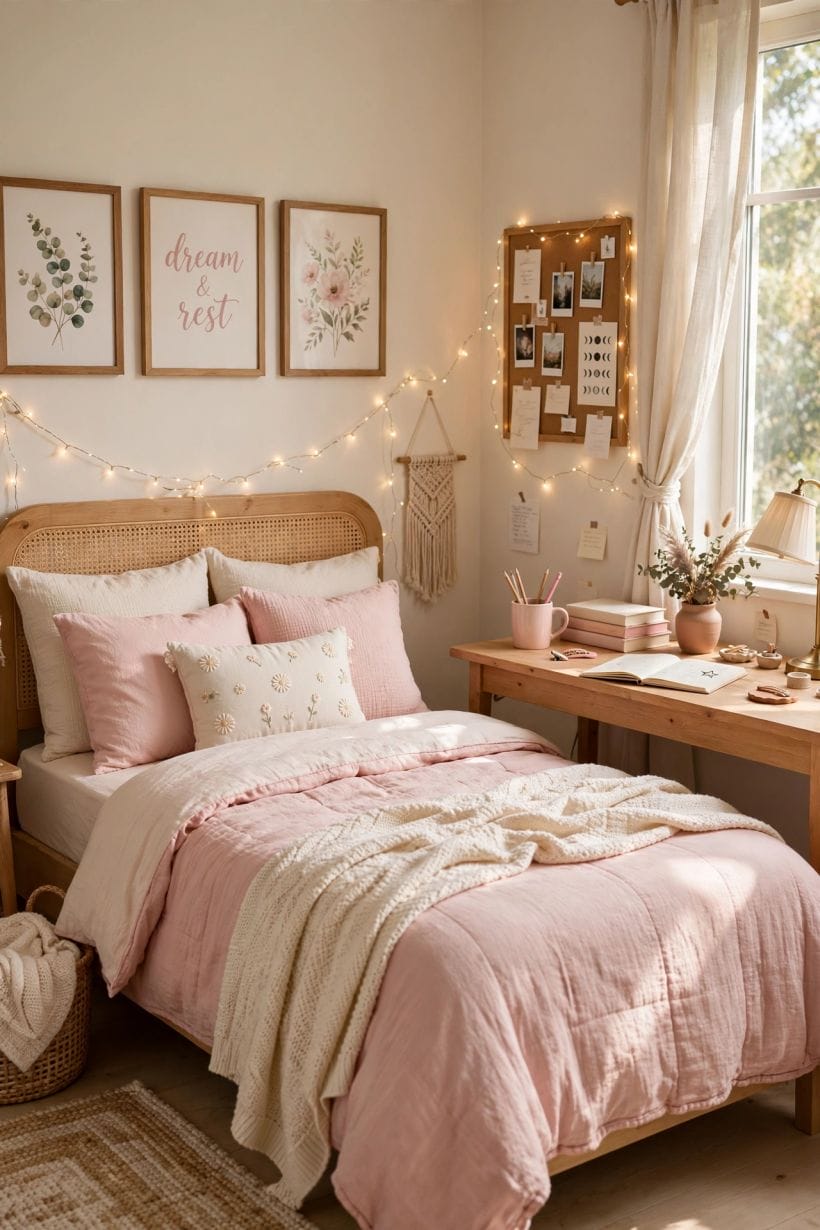
Sleep is the room’s first job, and the bed is its largest object, so this section earns its place early. Small rooms are a close cousin of this one, and the small bedroom ideas post works the same floor plans from the size angle; here the bed itself, and the teenager sleeping in it, stays the subject.
12. A daybed earns its keep twice
A daybed sleeps at night and seats by day, which makes it the hardest-working bed in a small teen room.
13. Loft the bed when the ceiling allows
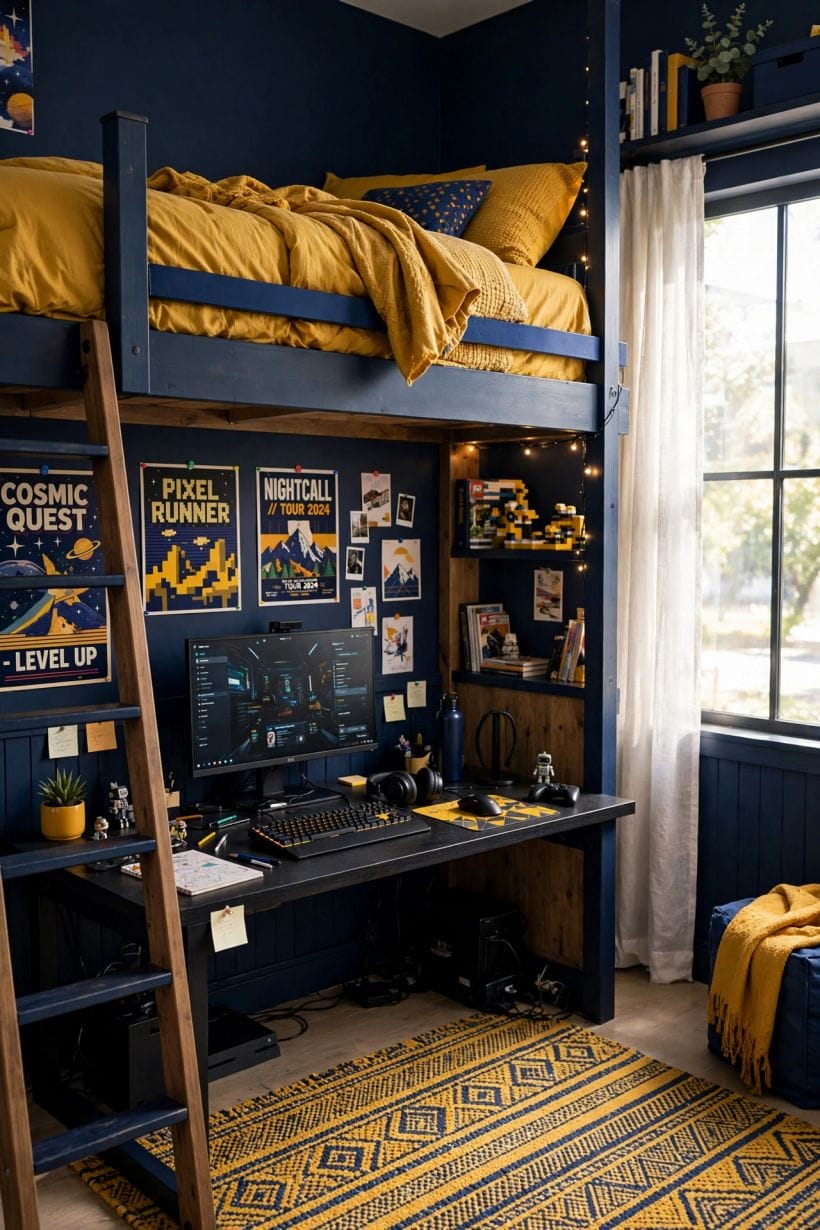
Raising the bed frees the floor beneath it for a desk or a downtime corner, the single biggest space gain available in a teen room.
14. A trundle answers the sleepover question
A pull-out trundle under the main bed stores flat, rolls out in moments and removes the air-bed ritual from sleepovers. It is the guest plan built into the bed itself, invisible on every ordinary night of the year.
15. Headboards that hold things
Choose a headboard with shelves, cubbies or a ledge, and the bed gains a bedside surface without a table. Books, a glass of water, glasses and a phone all land somewhere designed, instead of on the floor beside the mattress.
16. Storage drawers under the bed
Under-bed drawers turn the largest footprint in the room into its quietest storage. Season clothes, spare bedding and sports kit live there in order, reachable daily but never seen, which keeps the room’s visible surfaces free for living.
17. Blackout where sleep needs it
Fit a blackout lining or blind behind the curtain if street light or early sun crosses the pillow.
18. Bedding in layers they control
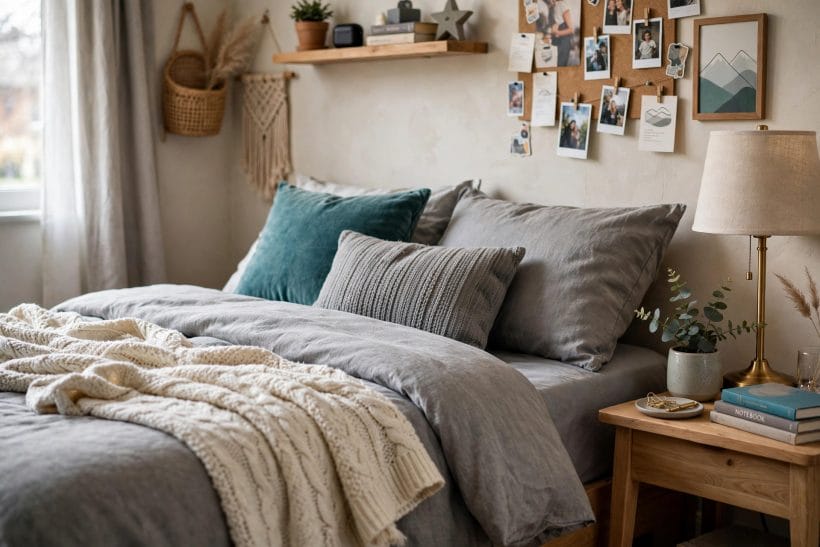
Provide a sheet, a duvet and one lighter throw rather than a single heavy cover. Teenagers regulate their own temperature fiercely and irregularly, and layers they can add or kick off end the nightly negotiation with the house’s heating.
19. A reading light at the pillow
Mount a small warm reading light where the book actually is, on the wall or clipped to the headboard.
20. Keep the bed off the radiator wall
Where choice exists, avoid placing the bedhead directly against a heated wall or under a draughty window. Comfort at the pillow decides how the whole room is judged, and small discomforts there are remembered out of all proportion.
21. Size the bed for the teenager coming
If a bed is being bought, buy for the adult height arriving within a few years, not the child measured today.
22. Make bed-making effortless
Choose a duvet that shakes straight, fitted sheets that stay put, and a throw that hides a lazy morning.
4. Desks, Study and the Screen Corner
Schoolwork needs a defended place in the room, or it migrates to the bed and takes sleep quality with it. The desk ideas here borrow from the room’s compact relatives, and the tiny house bedroom ideas post works the same desk-in-a-small-footprint problem from the tiny-house side.
23. Put the desk in the best light
Place the desk where daylight reaches it, ideally side-on to a window so light falls across the work without glare on a screen.
24. A desk that fits the chair properly
Match desk height and knee space to a chair with feet flat and elbows level.
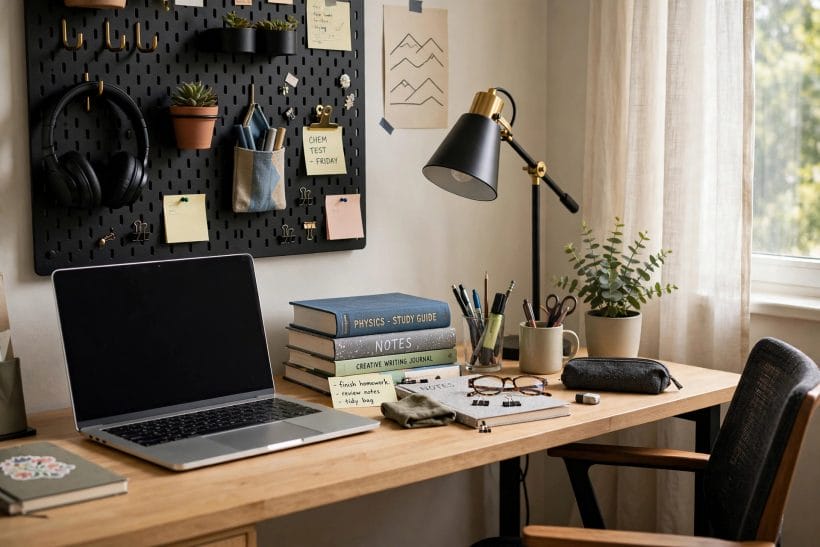
25. Wall shelves above, surface clear
Move books, files and stationery onto shelves above the desk so the surface itself holds only the current task. A clear desk is an invitation to start; a desk buried under its own storage is a reason to work somewhere else.
26. One pinboard, honestly curated
Give wall display a single bounded pinboard for timetables, tickets, photos and the current obsession. Bounded display looks intentional and changes easily; unbounded display spreads across every wall and stops being seen at all.
27. Cable order from the start
Route chargers and leads through one grommet or clip run to a single power point, with the charging spot fixed beside the desk. Cables managed once stay managed; cables left to chance become the room’s permanent floor decoration.
28. A second seat for joint work
Keep a light stool or folding chair that can join the desk for a friend or a parent helping with revision.
29. Separate the screen’s home
Give gaming and video their own small defined place, a corner, a low unit, a beanbag facing one wall, distinct from the desk.
30. Light the desk, not the ceiling
A focused desk lamp with a warm bulb does more for evening study than any overhead light.
31. Keep supplies where the hand lands
Stationery, chargers and headphones belong in a drawer or caddy within arm’s reach of the chair. Supplies stored across the room break concentration at every fetch; supplies at hand keep a study session inside its own momentum.
32. A shelf for the current term only
Hold this term’s books and files on the desk shelves, and archive finished terms into a box elsewhere. Rotating the shelf keeps study material findable and quietly marks progress, which matters more to a revising teenager than any motivational poster.
33. Fold-down desks for the smallest rooms
Where floor space is truly tight, a wall-mounted fold-down desk gives a real work surface that disappears at night. It asks for discipline, the surface must clear to fold, and that discipline turns out to be its second, hidden benefit.
5. Storage: Clothes, Clutter and the Floor Kept Clear
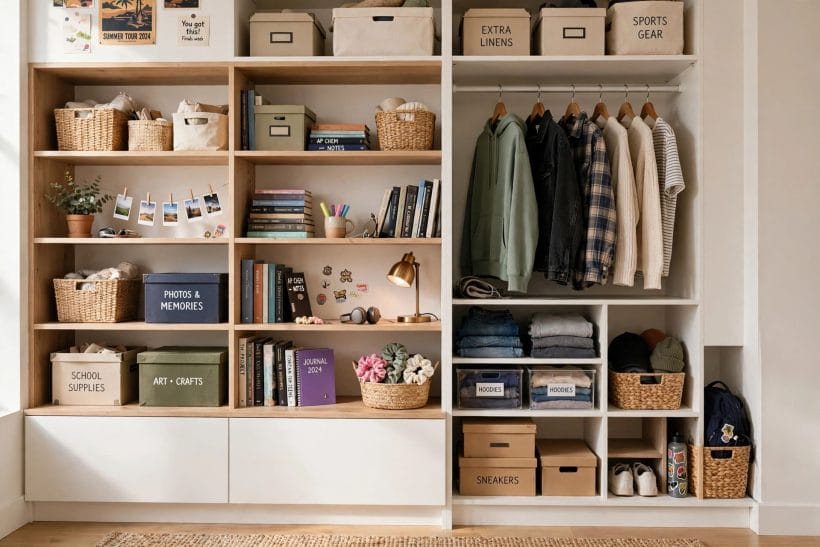
Teen rooms fail on storage more than on any other attribute: the clothes, kit and collections of a near-adult life arrive in a child’s storage plan. The room this one replaces is charted in the kids’ room ideas post; here the storage grows up, built for an owner who manages it alone.
34. One wardrobe, honestly divided
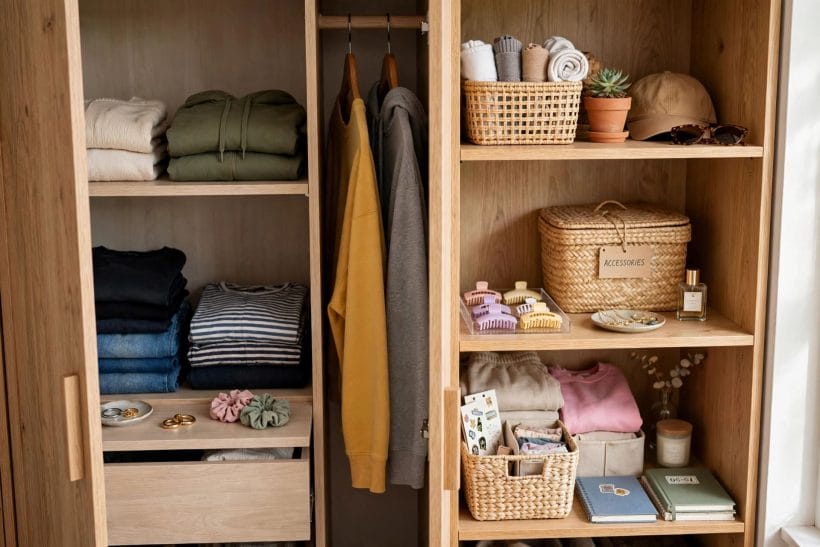
Divide the wardrobe into hanging, folded and shoe zones sized to the actual clothes, not the ideal ones. Storage planned around real possessions works; storage planned around a tidier imaginary teenager fails by the second week of term.
35. Open rails for the daily rotation
A short open rail for the week’s clothes in constant rotation ends the chair-as-wardrobe problem. What is worn daily should be visible and grabbable; what hangs behind doors in darkness is what gets worn never and washed rarely.
36. Labelled boxes for the collections
Give each collection, trainers, cables, art materials, sport kit, its own labelled box on a shelf. Teenagers keep collections faithfully when each has an address; without addresses, collections merge into the general floor drift that swallows rooms.
37. A laundry basket with a lid and a place
Put one proper basket, sized for a full week and placed where clothes actually come off. Laundry systems fail at the point of undressing, so the basket must live there, not in a tidier corner the clothes never reach.
38. Hooks behind the door
Fit sturdy hooks on the door’s back for the hoodie, bag and jacket in daily use.
39. Drawers for the small chaos
Small items, chargers, cosmetics, jewellery, stationery overflow, need shallow drawers with dividers, not a deep drawer of soup. Shallow and divided means visible at a glance; deep and mixed means excavated rarely and abandoned usually.
40. Use the wall height
Run shelving up the wall above wardrobe and desk height for the rarely used: keep-sakes, archives, out-of-season kit.
41. A sports and hobby station
Give bulky kit, skateboard, guitar, gym bag, a defined station by the door rather than a rotating floor position. Kit with a station gets put away in seconds on entry; kit without one is dropped wherever the day ended.
42. Mirror with storage behind it
A mirror cabinet or a mirror over a shallow shelf answers grooming and storage together in the space of one object.
43. One edit each season
Schedule a seasonal sort, clothes outgrown, collections retired, school years archived, as a normal ritual rather than a crisis. Rooms stay workable when editing is routine; they become unusable when editing only happens after collapse.
44. Keep one empty shelf
Deliberately leave a shelf or box empty for the next interest, purchase or collection. Empty capacity is what lets a room absorb change gracefully; a room stored to its limit converts every new thing into a displacement problem.
6. Colour, Posters and Walls That Change With Them
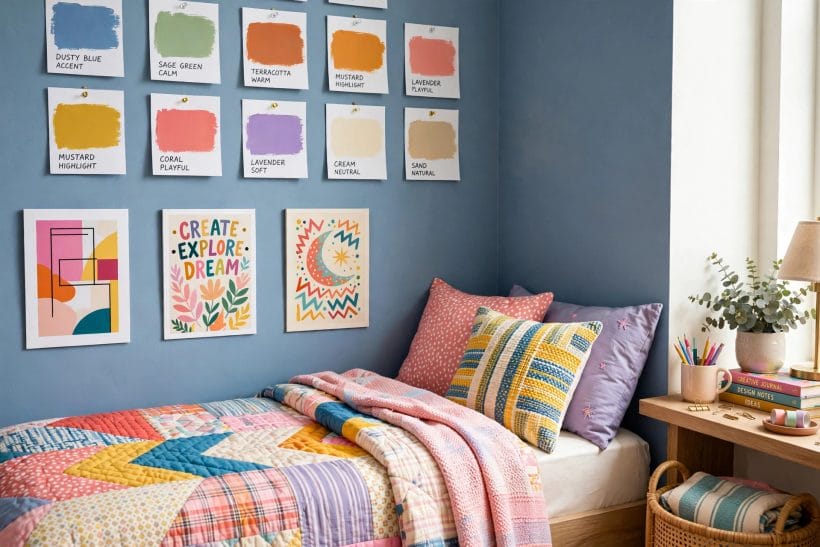
The walls carry the room’s identity, and identity is the attribute teenagers care about most. The wider canvas these rooms sit on is surveyed in the home design ideas pillar; inside the teen room itself, the rule is a calm base that lets changeable things shout.
45. Calm walls, loud accessories
Paint walls in a quiet, forgiving colour and let bedding, posters, cushions and rugs carry the strong colour. Accessories change in an afternoon when taste moves; repainting does not, and this split keeps the room current at pocket-money cost.
46. One gallery wall, properly hung
Concentrate posters and prints on a single wall in a loose grid, framed or clipped evenly. A planned gallery wall reads as a statement; the same posters spread over four walls read as noise, and the room feels smaller for it.
47. Removable everything
Favour removable strips, clips and washi-tape displays over pins and permanent fixings where walls must survive. Teen display changes monthly, and a wall that survives a hundred changes without damage is a wall that keeps its welcome for the next idea.
48. Colour from the bedding up
Choose the duvet set first, then pull cushion, rug and curtain colours from it. Bedding is the room’s largest colour surface and its cheapest to change, so letting it lead makes the whole scheme coherent and refreshable in one purchase.
49. A chalkboard or whiteboard panel
Give one panel over to writing: a chalkboard section, a whiteboard, a painted board for lists and lyrics. Teenagers think on walls when allowed; a sanctioned panel absorbs the urge and becomes the room’s most-used planning tool.
50. Curtains that dress the room
Full-length curtains, even on a small window, soften the room and carry colour vertically where posters cannot. They also give real privacy and light control, dressing the window as furniture rather than treating it as a hole to cover.
51. Lighting as decoration
String lights, a coloured lamp or a light strip along a shelf give the room an evening identity different from its daytime one.
52. Display the instruments of hobbies
Mount the guitar, the skateboard, the camera shelf as deliberate display rather than storage failure. The objects of a teenager’s real life are better decoration than any bought theme, and mounting them honours the identity the room exists to hold.
53. Keep one calm wall for rest
Leave the wall the pillow faces comparatively quiet. Sleep comes easier facing calm, and the room gains a visual rest that makes the expressive walls elsewhere read stronger by contrast.
54. Photo strings over photo piles
Photos belong strung on lines with small clips, changed as friendships and terms change. A living photo line stays current and light; printed piles in drawers are archives nobody opens, of a life the room should be celebrating now.
55. Let them paint one thing themselves
A painted door panel, a stencilled headboard wall, a mural corner done by the owner gives the room an authorship no purchase matches. It will date, and that is the point: the room records who they were, in their own hand.
7. Light, Sound and the Small Comforts
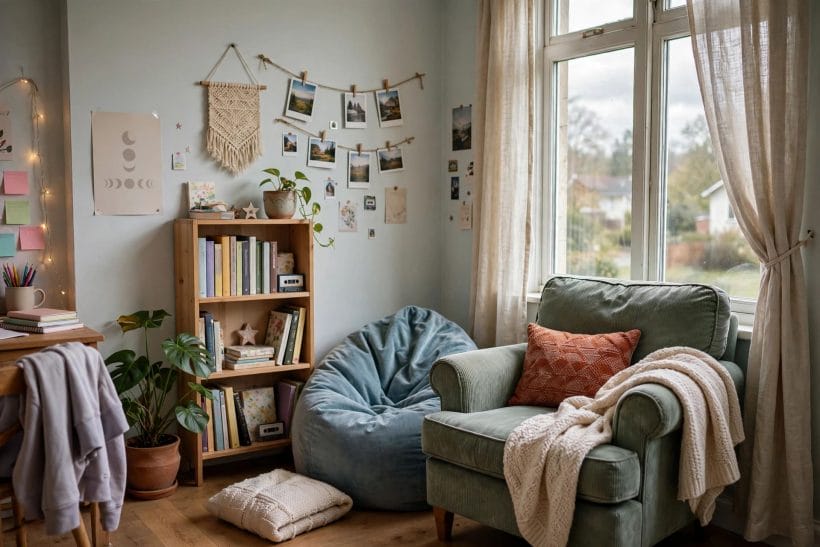
Comfort in a teen room is mostly light, sound and temperature handled kindly. Evenings here lean social and musical, and the game room ideas post covers the dedicated leisure room; this section keeps the comfort inside the bedroom itself, where most teen downtime actually happens.
56. Three lights minimum
Provide a ceiling light for finding things, a desk lamp for work and a low warm lamp for evenings.
57. Dimmers or warm bulbs for evenings
Warm, dimmable evening light helps the room wind down and flatters everything in it. Teenagers are notoriously light-sensitive at both ends of the day, and a room that can go soft at night supports sleep better than any lecture about it.
58. A rug underfoot, sized generously
Lay the largest rug the floor plan allows, under the bed’s edge and the downtime corner. A rug warms the room literally and acoustically, defines the soft zone, and gives friends a natural place to sit that is not the bed.
59. Soft furnishings drink the echo
Curtains, cushions, bedding and a rug together absorb the hard echo small rooms suffer from. Music, calls and gaming all sound better, and travel less through the house, in a room whose surfaces are more cloth than plaster.
60. Headphone hook by the screen
Mount a hook or stand for headphones at the screen corner, with its cable managed. Headphones with a home are worn, charged where relevant and found instantly; headphones without one live under bedding and die young.
61. A speaker shelf, not a speaker floor
Give a small speaker a shelf at seated ear height, aimed at the corner where listening happens. Shelved speakers sound better, survive longer and stop migrating around the room leaving cable trails behind them.
62. Ventilation they can control
Make sure a window opens easily or a quiet fan has a place, and that the teenager can reach both. A stuffy room is abandoned for the sofa; a room whose air its owner controls stays occupied and loved.
63. A proper chair for long sits
Beyond the desk chair, one genuinely comfortable seat, a reading chair, a floor rocker, a good beanbag with back support, anchors the downtime corner.
64. Charging station by the bed
Fix one charging point at the bedside with short cables for phone and earbuds. Overnight charging at the bed ends the morning hunt and the cable across the floor, and a single station keeps every device accounted for in one glance.
65. Blackout plus morning light
Pair blackout at night with curtains that open fully by day, so the room can be both cave and daylight room. The contrast matters: deep dark for sleep, real light for waking, and the teenager’s body clock gets both signals cleanly.
8. Shared Rooms, Small Rooms and Awkward Rooms
Not every teenager gets a standard room alone: siblings share, boxes shrink, lofts slope. The negotiation skills here are the same ones the family room ideas post applies to shared living space; this section applies them behind one bedroom door, where the sharing is closest.
66. Territory before furniture in shared rooms
In a shared room, agree each person’s territory lines first, then furnish inside them. Furniture placed before agreement becomes disputed border; territory agreed first turns the same furniture into two small rooms that happen to share a door.
67. A divider that earns its place
Use a bookshelf, curtain or screen as the shared room’s divider, chosen to store or soften as well as separate. A divider that also works, holding books, muting sound, is kept; a divider that only divides is resented and eventually removed.
68. Twin routines, staggered kindly
Shared rooms survive on small courtesies built into the plan: two alarm solutions that do not wake both, lights shielded to one side, hooks doubled. Designing the courtesies into the room beats policing them nightly from outside.
69. Loft and slope honesty
In a sloped-ceiling room, put the bed under the slope, the desk where heads stand, and storage in the eaves. Working with the slope gives a characterful room; fighting it with full-height furniture in low places gives bruises and resentment.
70. The box room, taken seriously
A genuinely small room needs the full small-room kit: lofted or daybed, fold-down desk, wall storage, door hooks, mirror to borrow light. Done completely, a box room can feel like a cabin, private and efficient; done halfway, it feels like a compromise.
71. Under-eaves and alcove desks
Fit the desk into the alcove, the bay or the chimney breast recess so the room’s rectangle stays free. Desks are the furniture most tolerant of odd shapes, and giving them the awkward footprint rescues the good floor for everything else.
72. Guests without displacement
In shared or small rooms, settle the guest plan so the host is not exiled: a trundle, a floor mattress stored flat, a corner kept clear by agreement.
73. Two colour schemes, one room
Let each sharer run their own colours on their own bedding, cushions and wall section over a shared neutral base.
74. Sound kindness in thin-walled rooms
A rug, soft furnishings and a door seal do quiet work in rooms that share walls with sleepers. Teen evenings run late by nature; softening the room’s sound is the courtesy that keeps the whole household generous about the hours kept.
75. A lockable box each
Give every teenager one lockable drawer or box that is genuinely private, no exceptions. Rooms shared and rooms alone both need one inviolable place; trust in the room’s privacy is the foundation its owner’s whole relationship with the house stands on.
9. Checks and Mistakes: Before the First Purchase or the First Stone
Measure the room, the door and every furniture footprint before anything is bought, and keep the receipts until each piece has survived a full week of real use. Teen rooms are re-planned more than any other room in the house, and the pieces that survive are the ones that were measured honestly and chosen for a job, not a theme.
Check fixings into walls before posters, shelves and rails go up, and use removable systems wherever the wall must outlast the current taste. Check also that lofted beds have firm rails, that desk chairs fit the desk height, and that charging points sit where cables cannot cross the walking line in the dark.
The commonest teen-room mistake is decorating for the child who just left childhood, in themes and sizes already outgrown. The second is filling the floor: a teen room needs visible floor more than it needs furniture. Buy the zones first, the storage second, and the decoration last, and let the owner choose the decoration.
10. Costs and Pulling It Together
Costs in a teen room follow the furniture, not the fabric: the bed form is the largest decision, then the desk and chair, then storage. Money is saved by the calm-base strategy, where walls and big pieces stay neutral for years while bedding, posters and cushions, the cheap layers, change with taste. It is wasted on themed sets that date in a season and on storage bought before the possessions it must hold were counted.
Pull the room together in the order it is used: zones on paper, bed placed, desk lit, storage given addresses, walls last. A teen room finished in that order works from its first night and keeps working through every phase change, because its expensive skeleton was built around how a teenager actually lives, not how a catalogue imagines one.
Final Considerations
A teen bedroom is a rehearsal for a first flat: one person, one room, every function of a home compressed into it and run by its owner. Build it for autonomy, give its zones and storage honest answers, let its walls carry a changing identity over a calm base, and the room will be loved, kept and remembered long after its owner has rooms of their own.
Start with the bed and the desk in their right places, add storage with an address for everything, and leave one shelf empty for the person they are becoming. The rest is changeable, and it should be: that is what the room is for.


0 Comments