

A small living room in a tiny house carries the whole day: the morning coffee, the work hours, the guests, the movie, the last lamp. It is the heart of the home — gathered in daily, multifunctional by necessity. This guide designs it piece by piece: the layout, the seating, the focal point, the light, the storage and the textiles that make a small room live big.
That triple life is the room’s defining discipline. By day it is the lounge — the seat by the window, the book within reach. By the work hours it is the office — the same seat, the laptop opened, the light turned to the task. By the visit it is the guest room — the convertible made up, the corner cleared, the welcome prepared. Three rooms take turns in one footprint, and the design’s job is to make the turns easy: nothing so fixed it cannot move, nothing so loose it never settles.
Small Living Room Interior Design Ideas: At a Glance
The best small living room interior design ideas for a tiny house all serve one small room with many lives: the heart of the home that lounges, works, hosts guests and settles the day. This guide follows the room in its own order — the concept and the layout, the seating and the focal point, the light and the storage, the rug and the textiles, the ten commandments and the TV question, the books and the plants, the fireplace and the rituals, the reading nook and the daily hours — and the cozy payoff at the end of it all.
| Topic | What It Covers | Key Fact or Figure |
|---|---|---|
| The Concept and the Layout | A multifunctional heart arranged around one focal point | The layout serves the living |
| The Seating | The scaled loveseat and the small sectional | Sofas run 48–72 inches |
| The Focal Point and the Light | Window, stove or one large artwork; light in layers | The focal anchors the room |
| Storage, the Rug and the Textiles | Hidden storage, the defining rug, softening layers | The storage is invisible |
| The Commandments and the TV | The ten rules — and the decided television | 10 commandments |
| Books, Plants and the Mistakes | The curated shelf, the living green, the errors | The books are the soul |
| The Fireplace and the Rituals | The stove’s warmth, movie night, game night | The fire is the heart |
| The Reading Nook and the Day | The claimed corner; coffee, light, wind-down | The nook is the sanctuary |
| The Payoff and the Hosting | Guests gathered, the rental made home | The payoff is the life lived |
| The Cozy Forever | The heart of home, kept warm for years | The cozy is the forever |
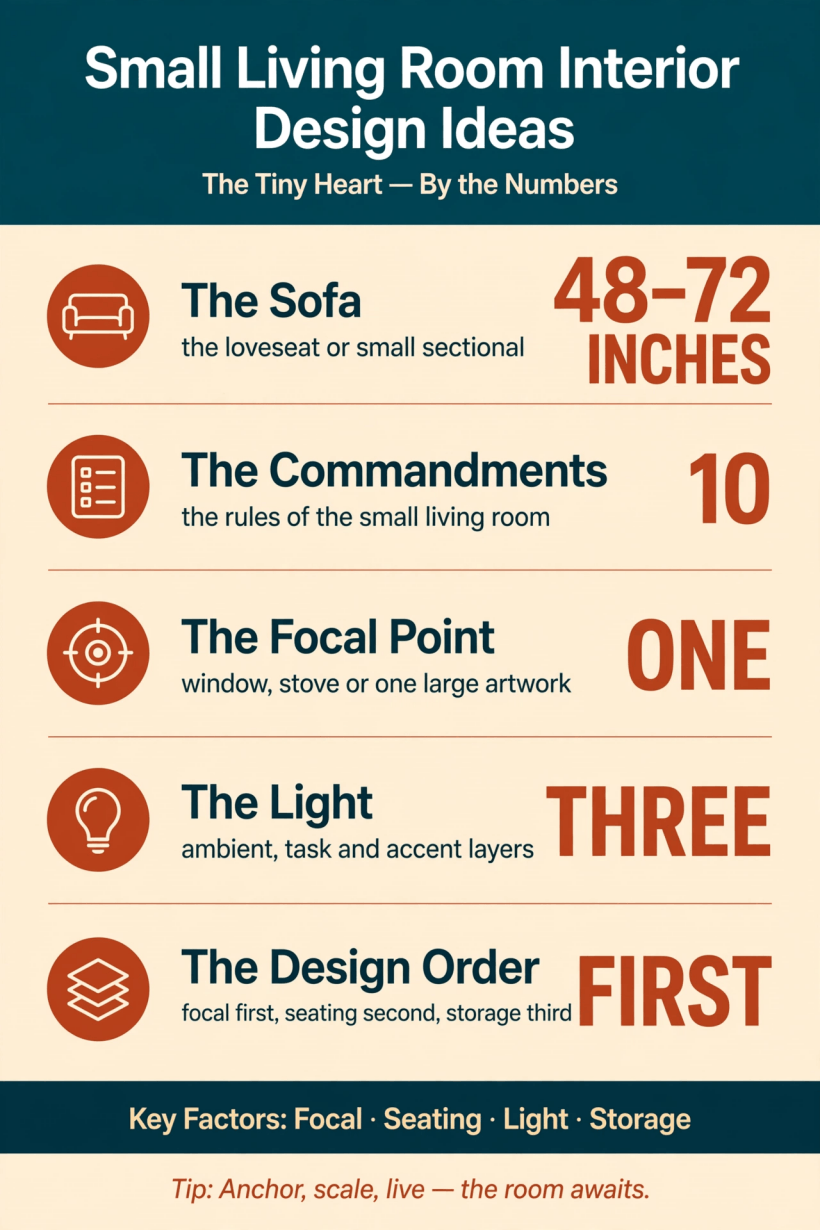
The small room by the numbers: sofas at 48–72 inches, 10 commandments, one focal point, three layers of light — and a design order that starts with the focal.
1. The Concept, the Layout and the Seating
Start with what the room is. The living room is the heart — the gathered, the daily: the place the household returns to between everything else. It is also multifunctional by design: the lounge, the office, the guest room in a single footprint. The rule presides over the whole guide: the small room lives — the big. Everything designed here serves that one idea, and it is the same room-by-room discipline that shapes the whole house in our guide to room interior design for every room in a tiny house.
So how do you design a small living room? The original’s answer sets the order: the focal first, the seating second, the storage third. The small room is the planned room — scale, light and flow decided before anything is bought. The layout itself is built on the focal: the anchored point everything is arranged around, with the flow kept clear and walked, door to far end. The rule underneath: the layout serves — the living.
Seating follows the focal. The loveseat is the scaled piece — comfortable without apology; the small sectional, the L, works the corner where the plan allows. What size sofa suits a tiny house? The loveseat or the small sectional — the 48–72 inches: the sized is the fitted, the measured, the walked-around. And how is the furniture arranged once it arrives? The focal anchored, the seating faced, the flow clear — the conversation, the comfort. Where do guests sleep in such a room? The sleeper sofa, the convertible, the floor mattress: the slept is the planned, the multifunctional made comfortable — the same dual-duty thinking designed in full for a home office and guest room in one. Our companion guide to living room interior design for tiny houses works the same room from the whole-house side.
2. The Focal Point and the Lighting
Every small room needs one place the eye rests. The original offers three candidates: the window — the view, the framed; the stove — the warm, the gathered; the art — the large, the one. Choose one and arrange everything to honour it: the rule is the focal anchors — the room. The art question answers itself inside that discipline: how do you choose art for a small living room? The one large piece — the statement, the uncluttered. The chosen is the bold: the small wall, the big art.

Light does the second half of the work, in layers: the ambient, the task, the accent — the FAQ’s own list runs the overhead, the lamps, the accent. The warm is the dimmable — the evenings: light that softens as the day settles. The rule: the lit room is the lived — the well. How do you make a small living room feel bigger? The light colors, the mirrors, the legs, the uncluttered: the bigger feel is the designed, the small room with the airy impression. And the color question follows: what’s the best color for a small living room? The light neutrals — the airy, the bright; the best is the personal: the light base, the color accents — the same quiet-walls confidence as choosing living room paint for a tiny house. Curtains, if used, stay light-filtering — the privacy, the softness: the view kept, the glare tamed.
3. Storage, the Rug and the Textiles
A room this hard-working survives on storage that disappears. The hidden is the principle: the ottoman, the bench — pieces that swallow blankets, games and the day’s clutter. The vertical is the opportunity: the shelves, the walls, storage climbing where floor space never could. The rule: the storage is the invisible — the used. That is also how a small living room stays tidy: the hidden storage, the daily reset, the edited — the tidy is the habit, the small room with the quick clean. And can you have a coffee table in a tiny living room? Yes — the small, the ottoman-topped, the storage: the possible is the scaled, the table fitted to the room. Readers planning the wider build can go deeper with our DIY-friendly tiny house plans and super-affordable tiny homes guides — the original’s own reading list for this room.
The rug then defines the room inside the room: the anchored — the seating, the defined; the sized — the front legs, the on. The rule: the rug grounds — the room. Textiles soften everything the plan sets up: the throws — the layered, the cozy; the pillows — the mixed, the inviting. The rule: the textiles soften — the small.
4. The 10 Commandments and the TV Question
The original gathers the whole philosophy into ten commandments, and they are worth keeping entire: Anchor the focal. Scale the furniture. Layer the light. Hide the storage. Mirror the generously. Rug the defined. Textile the cozy. Flow the clear. Unclutter the always. Live the daily. Read in order, they are the article in miniature — the anchor, the pieces, the comfort, and the point of it all, which is the daily living.
Worked in order, the list is a checklist rather than a slogan. The first three set the room’s bones — the anchor, the scale, the light. The next three hide its workings — the storage put away, the rug defining the seating, the textiles softening every hard edge. The last four keep it alive — the clear flow, the uncluttered surfaces, the daily living the whole design exists for. A small room that passes all ten rarely needs rescuing.
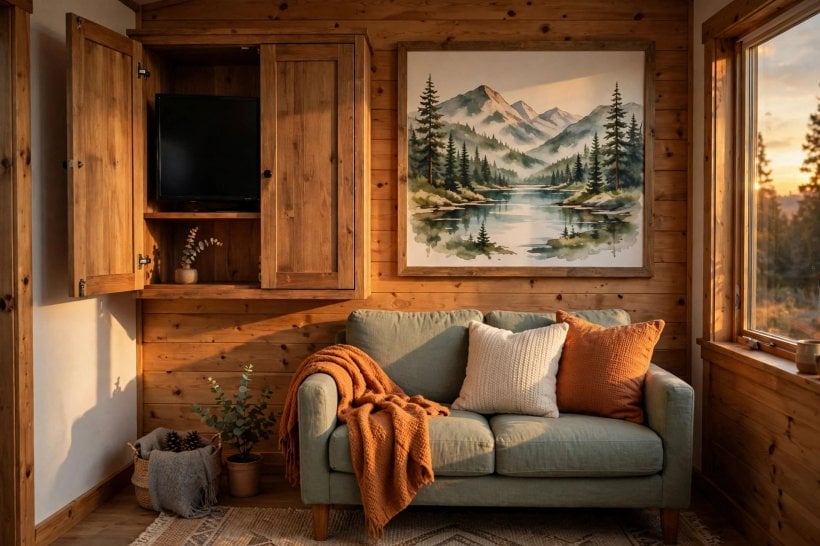
The TV question is the commandments applied to one object. The mounted is the first answer — the wall, the saved floor. The hidden is the second — the cabinet, the art: the screen that vanishes behind a door or a framed piece when the evening is for talking. The rule settles it: the TV is the decided — the lifestyle. Either it earns its place honestly, or it disappears; what it never does is drift onto a stand in the middle of the flow.
5. The Books, the Mistakes and the Plants
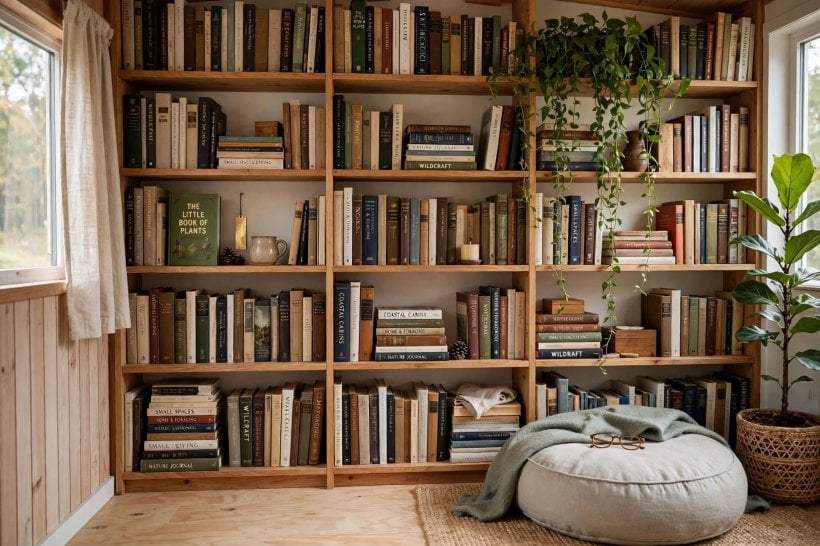
The books give the room its memory. The shelves are the wall — the displayed: the collection climbing the vertical the storage section promised. The curated is the discipline — the loved, the kept: a small room holds only the books that earned their place. The truth: the books are the soul — the room.
The mistakes are the commandments read backwards. The oversized — the sofa, the squeezed: the piece bought for a bigger life, against which everything else must fit. The dark — the cave, the lit: the room that dies when windows are covered and lamps are few. The cluttered — the surfaces, the edited: every surface a landing strip, nothing reset. The rule presides over all three: the room forgives — the nothing. A small room recovers from a wrong piece quickly, but it does not forgive the method skipped.
The plants bring the living into the living room. The corner is the tall — the alive: one generous plant taking the eye up. The hung is the trailing — the soft: green spilling from the high shelf, spending no floor. The truth: the plants breathe — the room breathes with them.
6. The Fireplace, Movie Night and Game Night
The fireplace is the focal point with a pulse. The stove is the wood — the warm: real heat, real gathering. The electric is the flame — the cozy: the same glow without the flue. The truth covers both: the fire is the heart — the winter.
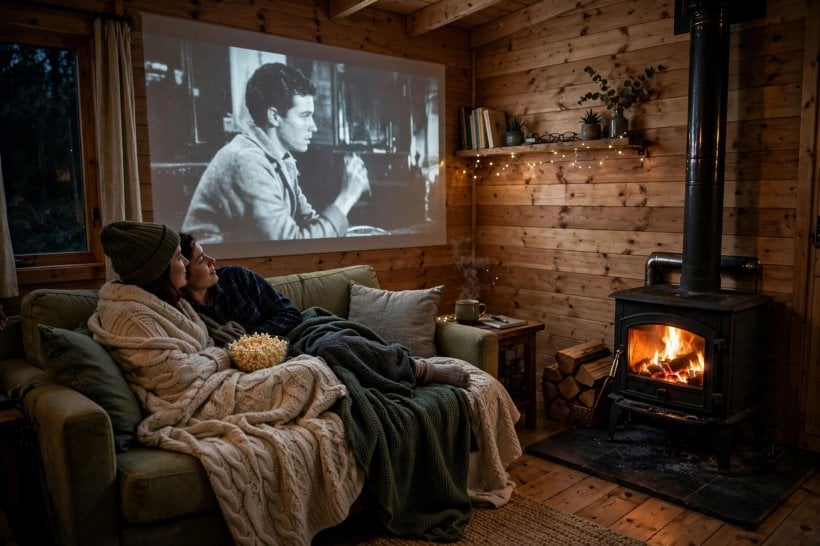
Movie night is the room’s set-piece ritual. The projector is the wall — the big: cinema scale with no cinema furniture. The snuggled is the blankets — the popcorn: the room at full cozy, the ritual the household keeps. The truth: the movie is the ritual — the tiny. A dedicated tiny house home theater design takes the ritual further, but the living room version needs nothing but the wall and the people.
Game night is the flow’s examination. The table is the cleared — the gathered: the surface reset for play. The laughed is the friends — the tiny: the loud small room, full. The truth: the game is the joy — the small.
Both rituals run on the same preparation: a room reset in minutes, seating that turns toward people, and surfaces that clear without a fight. That is why the storage and the flow matter more here than in any larger house — the entertainment is only ever as easy as the reset before it.
7. The Reading Nook and the Hours of the Day
The reading nook is the room’s smallest claim and its most loved seat. The chair is the window — the lamp: one perfect chair in the best light the house has. The claimed is the corner — the daily: space the layout was not using, returned as a sanctuary. The truth: the nook is the sanctuary — the room.
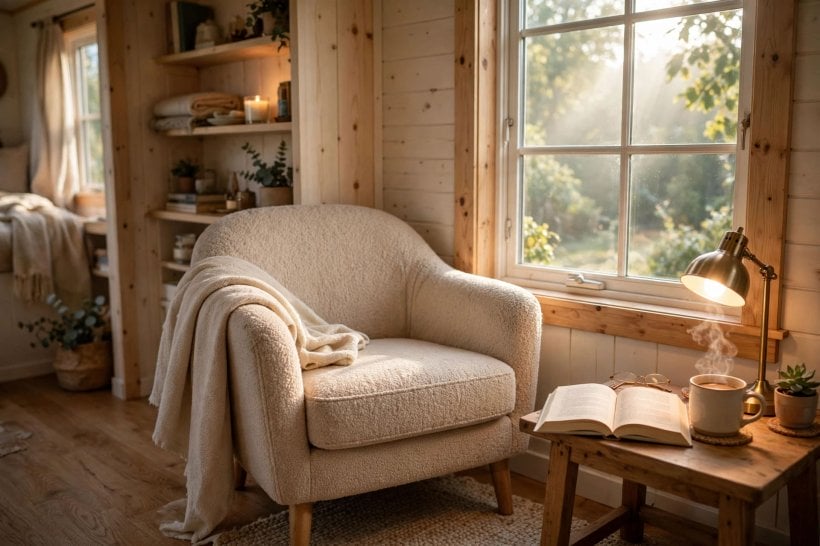
The same chair keeps the day’s hours. The morning coffee: the sunlit — the chair, the steaming; the started — the day, the calm; the truth: the coffee is the ritual — the room. The afternoon light: the golden — the windows, the warm; the basked — the cat, the rug; the truth: the light is the gift — the small. The evening wind-down: the dimmed — the lamps, the soft; the settled — the day, the cozy; the truth: the evening is the reward — the tiny. When the tempo drops fully, the room becomes the tiny house lounge — the same seating, the same light, the day released.
8. The Payoff, the First Evening and the Gathered
The payoff is not a feature; it is the accumulation. The gathered — the daily, the loved. The relaxed — the evenings, the cozy. The hosted — the friends, the impressed. The truth: the payoff is the life — the lived. And the invitation stands as the original gives it: anchor, scale, live — the room awaits.
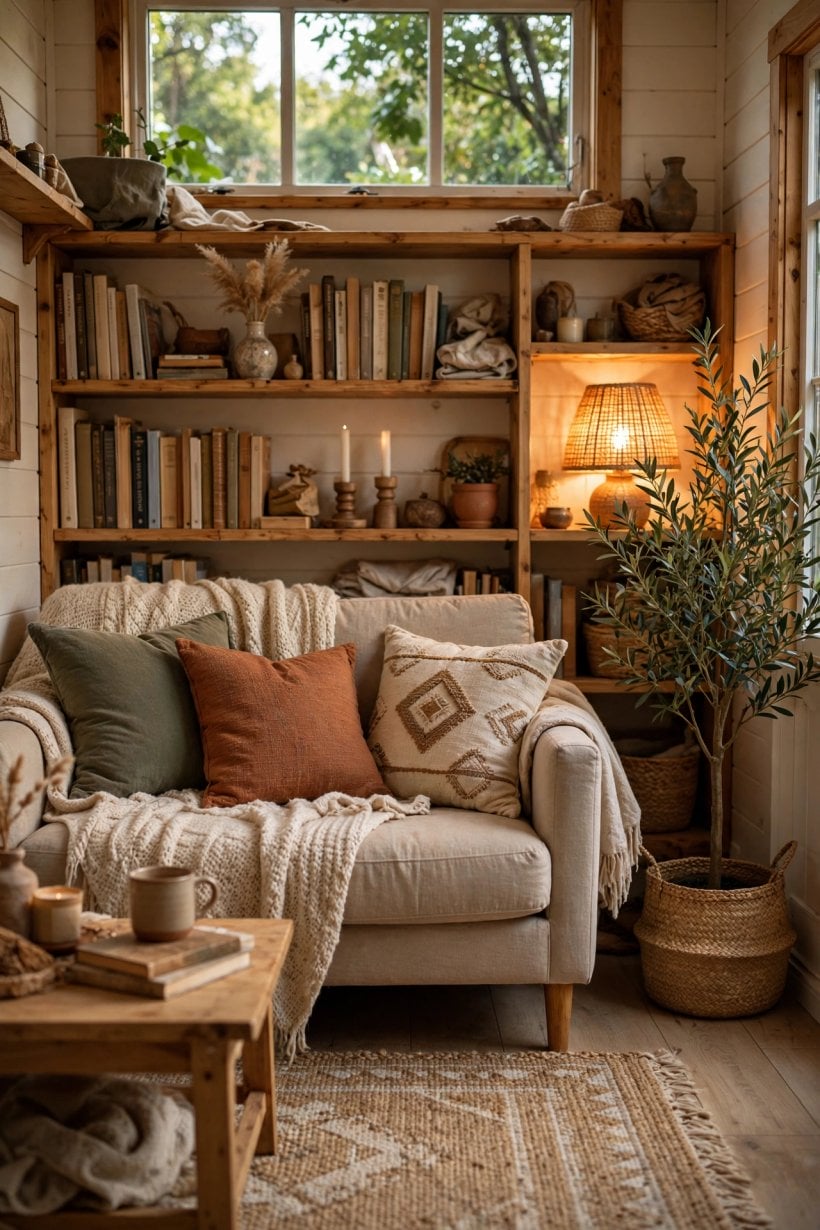
The first evening is where the payoff begins: the moved-in — the boxes, the lamp; the sat — the finally, the home. The truth: the first evening is the sweetest — the new. The gathered prove it repeatedly: the friends — the squeezed, the laughing; the family — the holidays, the tiny. The truth: the gathered is the joy — the small. And if the tiny house is a rental? The textiles, the art, the plants — the removable: the home feel is the layered, the temporary made personal.
9. The Cozy Factor and the Room Forever
Cozy is not an accident of size; it is a design decision. The cozy factor: the layered — the blankets, the pillows; the warmed — the light, the wood. The truth: the cozy is the designed — the tiny. A room layered this way holds people the way a larger room wishes it could.
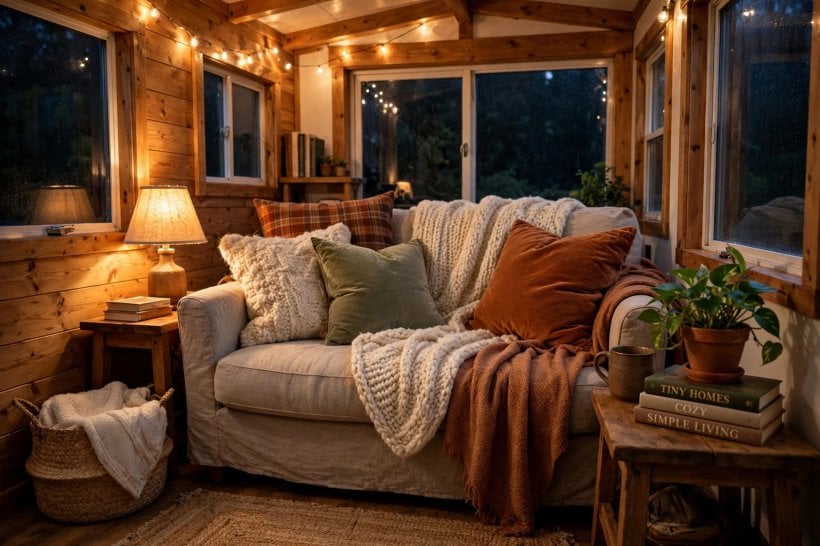
The room forever is the cozy kept: the loved — the years, the daily; the evolved — the seasons, the kept. The truth: the forever is the lived — the room. The room story accumulates with it: the told — the evenings, the years; the lived — the daily, the loved. The truth: the story is the room — the always.
10. The Heart of Home: The Closing Suite
The heart of home is where the suite closes: the centered — the life, the room; the returned — the daily, the welcomed. The truth: the heart is the living — the tiny. The always cozy keeps it: the kept — the warm, the years; the loved — the always, the room; the truth: the cozy is the forever — the tiny.
The snuggled is its smallest portrait: the curled — the blankets, the book; the truth: the snuggled is the best — the tiny. The final cushion signs the room off each night: the plumped — the last, the perfect; the sat — the sighed, the home; the truth: the cushion is the comfort — the always. The living blessing counts it: the grateful — the cozy, the daily; the small — the loved, the always; the truth: the blessing is the room — the tiny. And the last lamp ends the day the suite began: the clicked — the off, the night; the glowed — the embers, the stove; the truth: the lamp ends — the perfect day. The last word is the original’s own: the said — the anchor, the scale; the done — the lived, the loved; the truth: the last word is the room — the always.
Final Considerations
In the end, small living room interior design ideas for a tiny house are the heart made practical: anchor the focal, scale the seating, layer the light, hide the storage, soften it with textiles — and reset it nightly so the heart is ready again by morning. The original’s verdict stands as the whole method: design it well, live it daily.


0 Comments