
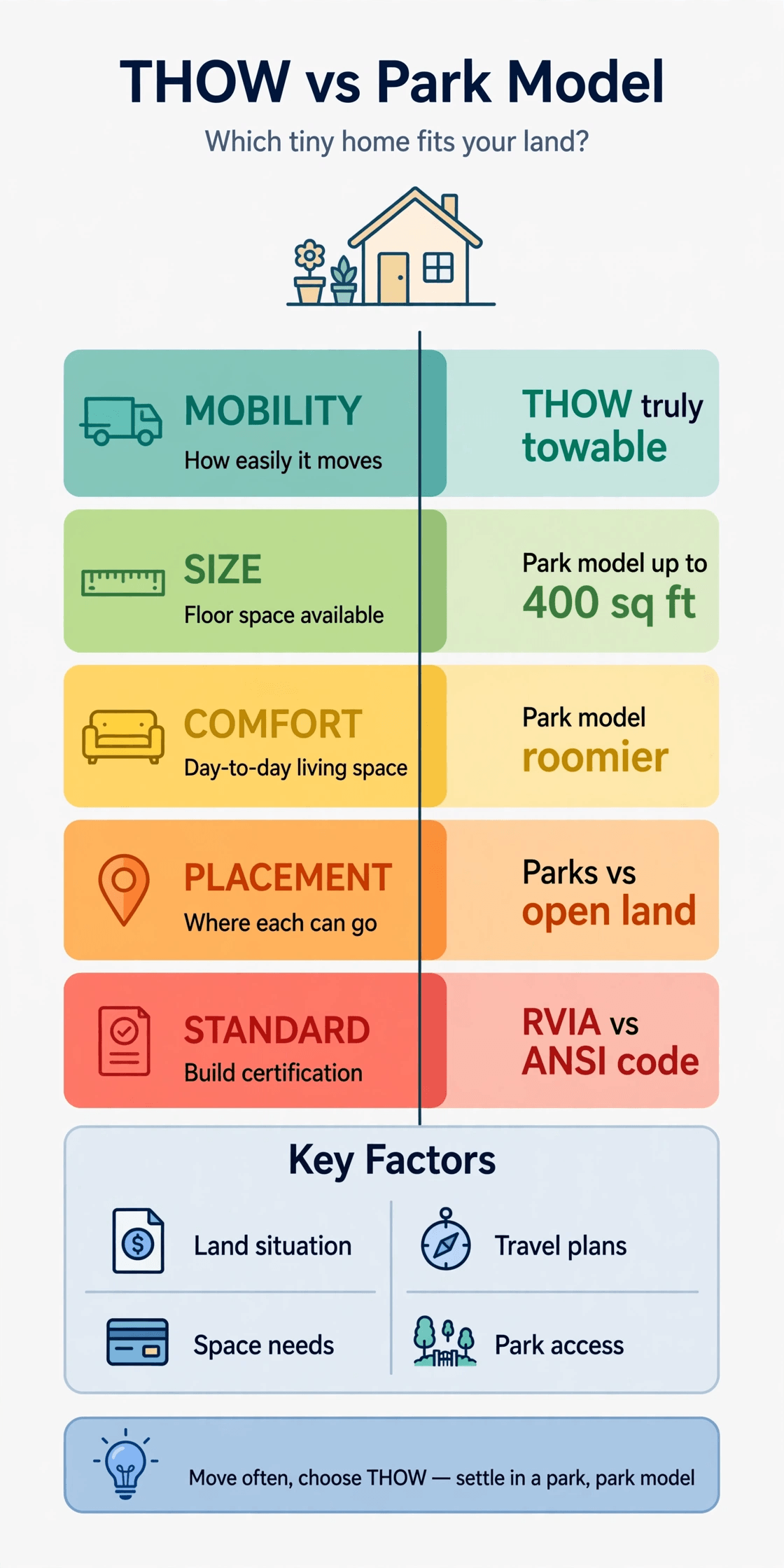
On paper, the choice of thow vs park model tiny home looks like a simple size question — but anyone who has priced both knows they are two different breeds of housing that only happen to share the word “tiny”. A THOW, a tiny house on wheels, is built to travel: it lives inside road-legal dimensions, rides on a trailer chassis, and can be towed from plot to plot as your life changes. A park model is built to arrive once and stay: it is a factory-built recreational unit, wider and roomier than most road-going tiny houses, designed to be delivered by professionals and set up in a park, resort or private plot for seasons or years at a time.
This comparison works through the differences that decide which one fits your land: how each actually moves, where the size limits bite, how comfortable each feels to live in, what certification each carries, where each can legally be placed, and what each costs to buy, run and sell on. There are no invented prices or sales claims here — figures are described qualitatively, standards are explained in plain terms, and anything that depends on your state, county or park operator is flagged as something to verify before you sign anything.
THOW vs Park Model Tiny Home at a Glance
| Criterion | Tiny House on Wheels (THOW) | Park Model |
|---|---|---|
| Basic nature | A small house built on a trailer, designed and equipped to be towed by its owner | A factory-built recreational unit, delivered by professionals and set up semi-permanently |
| Size cap | Limited by road rules: width, height and weight for legal towing | Capped at about 400 square feet of living area to stay in the recreational category in the US system |
| Mobility | Tow it yourself with a suitable truck, as often as you like | Moves need a transporter, permits and set-up crew; most units move rarely |
| Comfort | Clever but compact: lofts, ladders and multi-use furniture are the norm | More conventional: full-height rooms, normal doors, room for full-size appliances |
| Certification | Commonly RVIA-certified (or equivalent) when built as a recreational vehicle | Built to the ANSI A119.5 park-model standard and labelled accordingly |
| Typical placement | RV parks, tiny-house communities, backyard and rural plots where wheeled homes are allowed | RV parks and resorts, park-model communities, and private land where local rules accept them |
| Best for | People who want to move, self-build, or keep the home small and towable | People who want more space and comfort in one place, without a full house build |
1. Two Different Breeds: What Each One Actually Is
A THOW starts life as a trailer. The chassis is engineered for the load, the house is framed on top of it, and every design decision answers to the road: the width of a highway lane, the height of a bridge, the rating of the axles. Many are one-off or small-batch builds from specialist tiny-house builders, and a large share are DIY projects. Inside, space is fought for centimetre by centimetre, and the result is a genuine house that happens to be portable — small, personal, and built by someone who expected it to travel.
A park model starts life in a factory as a recreational vehicle. In the North American system it is defined by its size — up to roughly 400 square feet of living space — and by its standard, which covers how it is built, plumbed and wired. Park models are almost always single-storey, wider than a towable tiny house (they travel on a transporter, sometimes with escort arrangements), with a proper pitched roof, residential-style windows and a floor plan that imitates a small holiday house rather than a boat cabin. Understanding that difference in origin — custom road home versus factory recreational unit — explains nearly every other row in this comparison.
2. Mobility and Towability: Highway Home vs Delivered Home
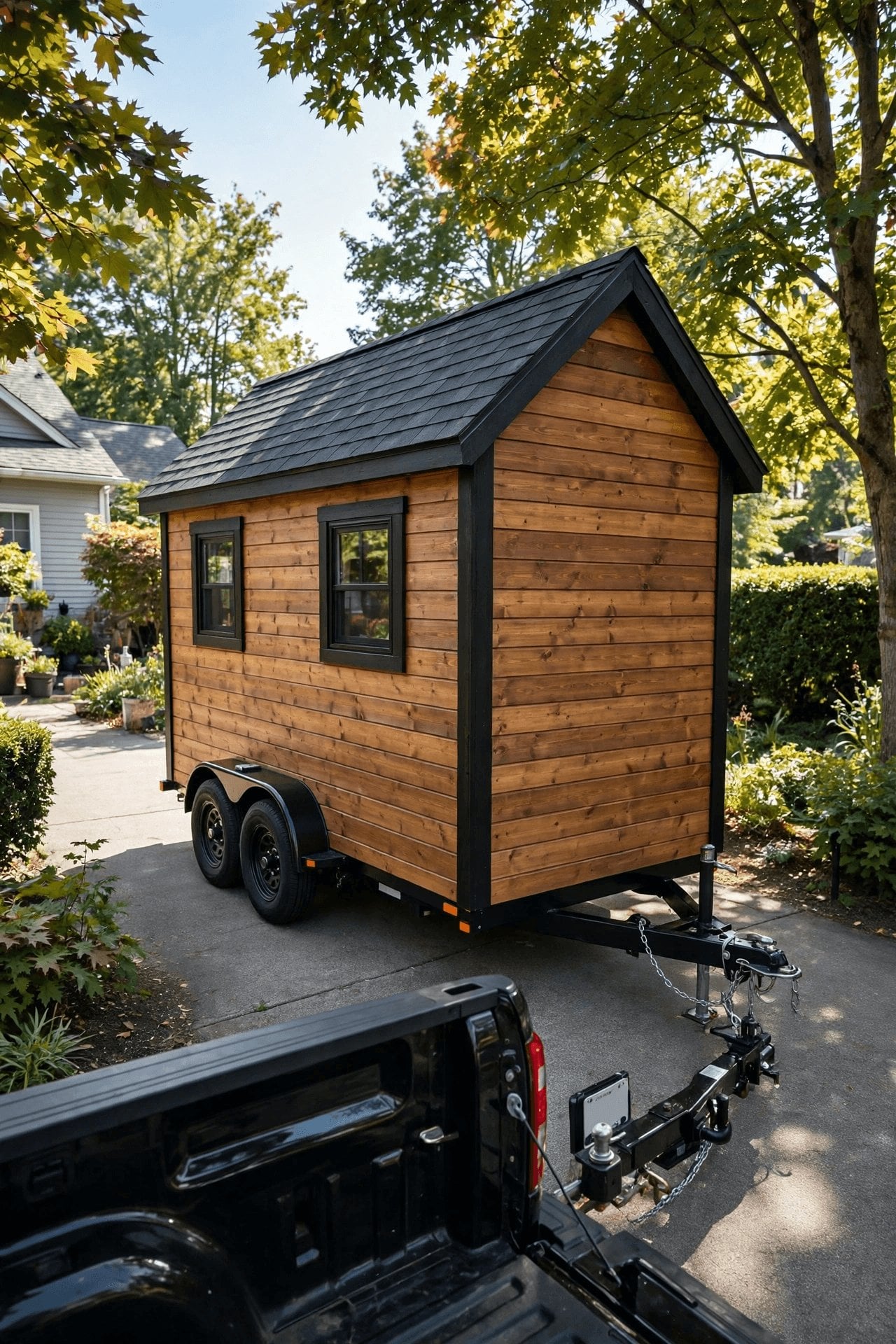
A THOW is meant to move under its owner’s hand. Hitch it to a suitable truck, check the tyres, brakes and lights, and drive — our guide to towing a tiny house covers trucks, hitch weights and road regulations in detail. That freedom is real but not casual: the house is heavy and tall, wind pushes it around, and routes need a thought for low bridges and tight turns. Our notes on tiny house wind resistance and aerodynamic towing are worth reading before a first long haul. When owners do not want to tow themselves, our tiny house moving guide explains what professional transport involves.
A park model, despite sitting on wheels and a chassis, is not a tow-it-yourself product. It is delivered by a specialist transporter, positioned with the right equipment, then levelled, blocked and often skirted — a set-up process closer to installing a manufactured home than parking a caravan. Moving one again means hiring that whole operation in reverse plus permits for an oversize load. Practically, park models move when they are sold or when a park reorganises, not when their owners fancy a change of scenery. If your plan involves moving every year or two, this section alone probably settles the comparison; if your plan is a decade in one resort or on one plot, the park model’s immobility may never trouble you.
3. Size Caps: Road-Legal Limits vs the 400-Square-Foot Ceiling
The THOW’s size is dictated by the highway. To travel without special permits, the unit must stay inside legal width and height limits and under its trailer’s weight rating, which is why towable tiny houses cluster in a fairly tight band of lengths and rarely feel spacious in width. Designers cheat the limits with lofts, because sleeping space above the living room does not need full standing height. The trade is permanent, though: no legal towing, no THOW — the road rules are not negotiable at the weighbridge or the state line.
The park model’s cap works the other way. Its category depends on staying at or under about 400 square feet of living area — exceed it and the unit stops being a recreational park model and falls into manufactured-housing rules instead, a completely different legal and lending world. Inside that cap, though, the park model is freed from towable width: it can be built wide, with full-height ceilings throughout and a floor plan arranged across the width rather than along a corridor. When you compare floor areas, compare like with like — a 400-square-foot park model feels dramatically bigger than a 200-square-foot THOW, but lofts add sleeping area to the THOW that floor-area figures do not capture. Measure the life you need, not just the number.
4. Interior Comfort and Day-to-Day Livability
Comfort is where the park model makes its strongest case. Full-height flat ceilings, a conventional bathroom with a normal door, a kitchen that can take full-size appliances, a separate bedroom in many plans, and heating and cooling sized for a small house rather than a vehicle — it is, deliberately, a miniature version of ordinary housing. For couples, for older owners, for anyone with mobility concerns about loft ladders, that ordinariness is the whole point. Storage is still limited by tiny standards, but the park model starts from a more generous place.
The THOW answers with ingenuity rather than volume. Sleeping lofts keep the footprint small; stairs double as drawers; tables fold, sofas convert, and every shelf is argued over. Many owners genuinely prefer this fitted, boat-like efficiency, and a well-designed THOW can feel calm and complete rather than cramped. The honest caveats are headroom in the loft, the daily ladder climb, and the way a narrow plan handles two people cooking, working and relaxing at once. If you can, spend a night in each type before deciding — our comparison of living in a yurt vs a tiny house on wheels makes the same point about trial stays, and the advice transfers directly.
5. Certification and Standards: RVIA, ANSI and What the Label Buys You
Certification sounds bureaucratic until you try to finance, insure or park an uncertified unit — then it becomes the whole conversation. Many professionally built THOWs are certified as recreational vehicles through the RVIA (Recreational Vehicle Industry Association), whose inspection programme checks electrical, plumbing, heating and safety systems against RV standards. Our explainer on what RVIA certification is and why a tiny house needs it goes through what the seal does and does not guarantee. DIY THOWs usually lack it, which does not make them unsafe — but it does narrow their finance, insurance and park options, as our guide to how to register a tiny house as an RV shows.
Park models are built to a different book: the ANSI A119.5 standard for park model recreational vehicles, which plays the same role — a recognised construction and safety standard, verified by accredited inspection agencies, with a label on the unit to prove it. Because park models come from factories inside that system, certification is rarely a question at all; it is simply part of the product. The practical consequence: a park model walks into parks, insurers and lenders with its paperwork already in order anywhere that category is recognised, while a THOW’s welcome depends more heavily on whether it carries the RV seal. Check which label your target parks and insurers ask for before you buy — the answer differs by state and by operator.
6. Placement Routes: Where Each One Can Legally Sit
Both homes share the tiny world’s central frustration: owning the unit is easy compared with finding a legal place to put it. THOWs most commonly live in RV parks that accept long-term tiny houses, in dedicated tiny-house communities, on rural land in tolerant counties, or in a backyard where local rules allow one as an accessory dwelling. Our comparison of tiny house communities vs RV parks explains how those two routes differ in rules, costs and culture, and our guide to zoning laws for tiny houses shows how to get a straight answer from your local officials before committing.
Park models have their own established geography: RV resorts and parks with park-model sections, seasonal and retirement communities built specifically around them, and — where zoning allows — private plots. Some jurisdictions treat a park model on private land more like a manufactured home and ask for foundations, tie-downs and permits; others will not accept them as dwellings at all outside licensed parks. If private land is your plan, start with our guide to where to buy tiny house lots and check the specific unit type with the county, in writing, before the purchase. The pattern to remember: a THOW’s placement is flexible but often permission-dependent; a park model’s placement is well-trodden but concentrated in the park and resort system.
7. Buying Routes: Builders and Kits vs Factories and Dealers
Buying a THOW usually means commissioning a builder or buying a finished unit from a small specialist firm — or building it yourself. You choose the design, the materials and the compromises, and lead times, deposits and quality vary builder by builder, which makes references and a written specification essential. The upside is a home shaped exactly around your life; the downside is that you carry the project risk. Site preparation is normally light: a level pad and hookups where you park it, in line with the basics in our guide to how to prepare land for a tiny house.
Buying a park model is closer to buying a small manufactured home. You choose from a manufacturer’s floor plans and option lists at a dealer, the unit is built in a factory to the ANSI standard, then delivered and set up — transport, blocking, levelling and utility connection are part of the purchase conversation, and they are real costs to pin down in the quote. Choice is narrower than a custom THOW but the process is more standardised, with warranties handled the way vehicle and manufactured-home warranties usually are. Ask exactly what the delivered-and-set-up price includes; the gap between the sticker price and a liveable, connected home is where park-model budgets most often surprise people.
8. Costs and Running Costs: The Honest Picture
Without inventing numbers, the shape of the money is this. A custom THOW’s price is driven by the builder, the specification and the trailer; DIY builds can undercut everything if your time is free. A park model’s factory efficiency often delivers more finished floor area for the money than a bespoke THOW, but delivery and set-up charges narrow that advantage, and park living adds site rent where an owned plot does not. On both sides, the unit price is only the opening chapter — transport, set-up, hookups, skirting, permits and insurance all belong in the same spreadsheet.

Running costs follow the physics. The park model’s larger volume and full-size appliances cost more to heat, cool and power, but its residential-style construction and insulation can be more forgiving in a hard winter than a lightly built trailer home; the THOW’s small volume is cheap to keep warm almost by definition, though its exposed floor and chassis need the skirting and pipe protection described in our guide to tiny house utilities. Maintenance differs in kind: a THOW keeps a vehicle’s chores — tyres, bearings, seals — while a park model behaves more like a small static home, with set-up checks, skirting and roof care. Neither is expensive to run by house standards; both punish owners who skip the boring seasonal jobs.
9. Financing, Insurance and Resale
Money systems treat the two units as cousins, not twins. THOWs are typically financed with RV loans (certification usually required), personal loans or specialist lenders, as our guide to how to finance a tiny house sets out. Park models are also commonly financed as recreational vehicles or with chattel-style loans through dealers and specialist lenders, and their standardised factory build can make the conversation simpler — but they are rarely mortgageable as real estate unless permanently installed and legally converted, which is a jurisdiction question, not a dealer promise.
Insurance follows the same logic: both units are insured as what they legally are, and our tiny house insurance guide explains how usage — full-time living versus recreational use — changes the cover you need. Resale is where the audiences separate. A THOW sells to the tiny-house market: movability is its asset, and certification and condition set the price. A park model sells largely within the park and resort world, often in place on its pitch, where the park’s desirability and site agreement matter as much as the unit itself — a beautiful park model on an insecure pitch is a weaker asset than a plain unit on a good one. On either side, paperwork is value: labels, manuals, service records.
10. Changing Your Mind: Moving, Selling and Upgrading Later
Plans change, and the two homes absorb change very differently. The THOW owner who takes a job across the state hitches up and goes — the flexibility was the point. The park model owner’s equivalent decision is a project: sell in place, or pay for professional transport and a new set-up, with permits along the route. Neither is wrong; they simply suit people whose lives move at different speeds. Think about the next ten years honestly — job mobility, family changes, health, the pull of a different climate — and weight this section accordingly.
Upgrading diverges too. A THOW can be modified like the custom build it is — lofts rebuilt, systems upgraded, interiors remodelled with ordinary carpentry. A park model can be redecorated and refitted inside, but structural changes run into its engineered factory construction and, in parks, into site rules about alterations and additions. If you are buying used on either side, our guide on how to inspect a used tiny home before buying lists the checks that matter, from chassis condition to certification labels. And if a future move to land of your own is the dream, remember that only one of these two homes can follow you there under its own wheels.
Final Considerations
So, who should pick which? Choose the THOW if movement is a real part of your plan — seasonal work, an unsettled land search, a life that relocates — if you want to self-build or commission something personal, or if keeping the home genuinely towable matters more to you than interior volume. Accept the lofts and ladders, the narrower plan, and the certification homework that comes with the territory. Choose the park model if your land or park pitch is settled and your priority is comfort: full-height rooms, a conventional bathroom and kitchen, single-level living, and factory certification already sorted. Accept that the home is effectively static, that moves are professional operations, and that your placement options run through the park and resort system or a county that explicitly accepts the category.
Before deciding, do three things. First, confirm the placement: get your county’s or your target park’s answer for each unit type in writing, because an unwelcome zoning answer defeats the best floor plan. Second, confirm the paperwork: ask a lender and an insurer what each unit, with its specific label, means to them. Third, compare complete costs — unit, delivery or towing, set-up, hookups and site fees — for your actual situation, not a brochure scenario. The right answer here is rarely about square feet. It is about whether your tiny home needs to be a traveller or a settler — and once you know that about yourself, the choice between these two makes itself.


0 Comments