

Two dwellings dominate the off-grid imagination: the ancient round tent perfected over a thousand years, and the tiny framed house bolted to a trailer. Similar in size and spirit, they could hardly be more different in what they demand and what they give. This is the honest head-to-head — structure, cost, winter, space, legality and daily life — with no cheerleading for either side.
Yurt vs Tiny House: At a Glance
The yurt and the tiny house on wheels are the two great alternative dwellings of the off-grid movement — similar in size and spirit, profoundly different in structure, cost and daily life. Choosing between them shapes everything: your budget, your building process, your legal standing and your winters. The yurt vs tiny house question is never really about which dwelling is better in the abstract; it is about which set of trade-offs matches the life you actually want. The yurt is a tensioned fabric circle perfected over centuries — light, voluminous and roughly half the price. The THOW is a conventional framed house on a trailer chassis — heavier, costlier and wrapped in a legal infrastructure the yurt simply does not have. The ten sections below take the comparison in the order the decision demands it: how each one stands up, what each one really costs, the winter question, usable space, legality, mobility, daily life, maintenance, resale, and the decision itself.
| Topic | What It Compares | Key Fact or Figure |
|---|---|---|
| 1. Structure | How each one stands up | Fabric lasts 15–25 years; a framed THOW 50+ years |
| 2. Cost | The full comparison | Yurt $30,000–80,000 all-in vs THOW $60,000–150,000+ |
| 3. Insulation and Climate | The winter question | Yurt R-8 to R-15 equivalent vs THOW R-13 to R-30 walls |
| 4. Space and Layout | Round vs rectangular | ~700 sq ft open circle vs 255 sq ft efficient rectangle |
| 5. Legality | The code comparison | THOW has the RV path; the yurt depends on local interpretation |
| 6. Mobility | Moving day | Hitch up and tow vs a multi-day disassembly project |
| 7. Daily Life | The lived experience | Intense and romantic vs conventional and private |
| 8. Maintenance | What breaks | Yurt: frequent but simple; THOW: rarer but technical |
| 9. Resale | The exit | Certified THOWs hold value; used yurts sell slowly, locally |
| 10. The Decision | Matching the dwelling to the life | Climate, land and budget decide — not fashion |
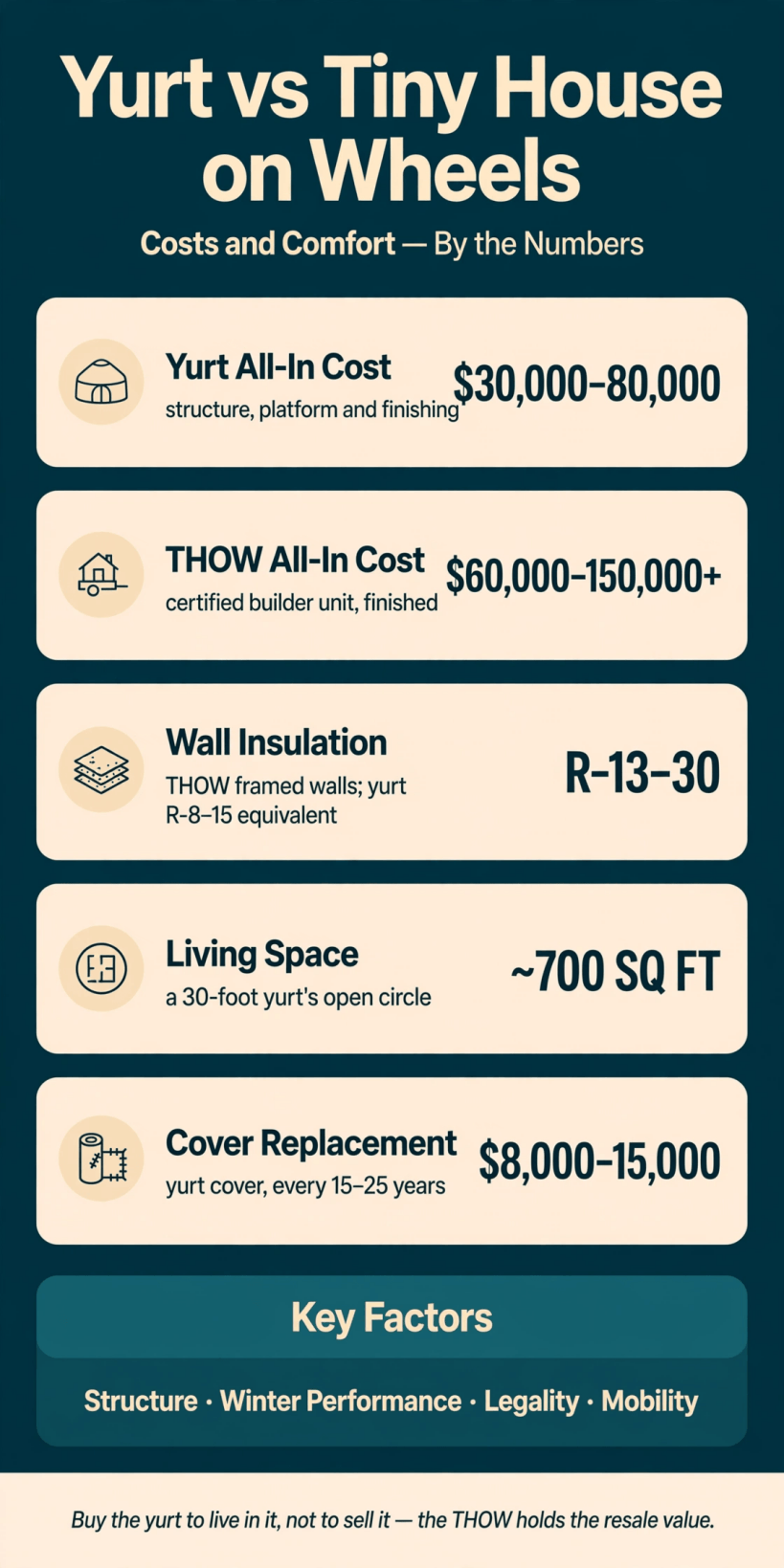
The comparison by the numbers: the yurt’s all-in cost against a certified THOW, wall insulation on both sides, the living space a 30-foot yurt actually holds, and the cover replacement every yurt owner must budget for.
1. Structure: How Each One Stands Up
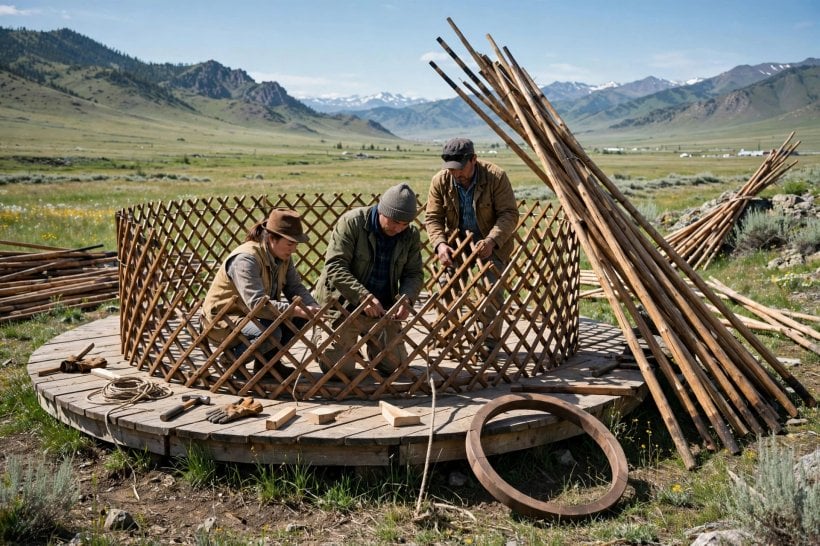
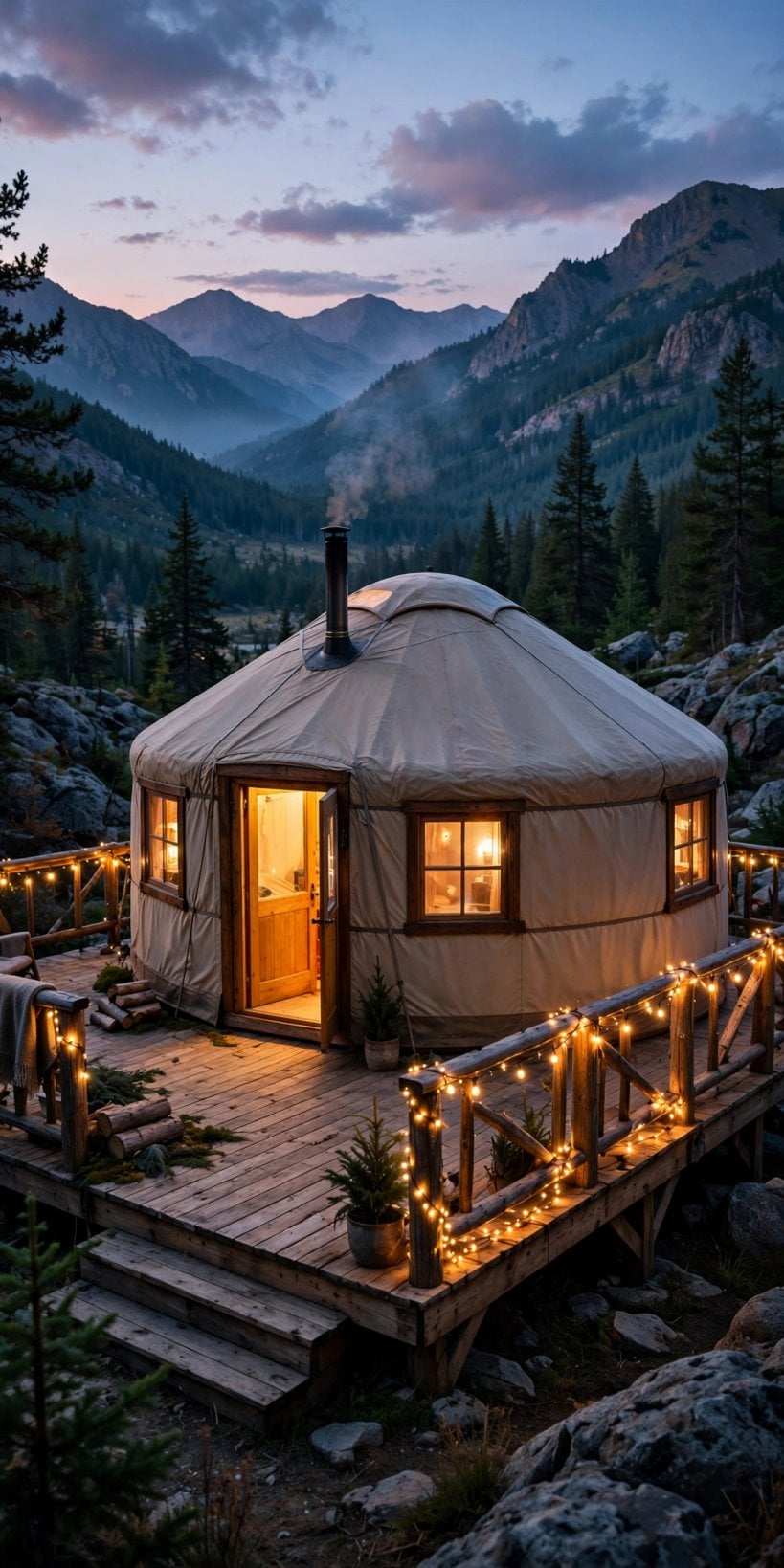
The yurt is a tensioned fabric structure — lattice walls (khana), roof poles (uni) meeting at a central ring (toono), covered in insulated fabric layers and anchored to a platform. It is an ancient design built with modern materials, and its strengths follow from that geometry: enormous interior volume for the footprint, with no hallways and no wasted corners; fast assembly, since a crew raises a 30-foot yurt in a day; and honest repairability, because a damaged section means replacing a panel, not rebuilding a wall. Its weaknesses are just as structural. The fabric itself lasts 15–25 years even for quality covers, extreme snow and wind loads must be respected against the engineered ratings, and the single-room reality means privacy has to be invented with creative partitioning.
The THOW is the opposite philosophy: a conventional framed structure on a trailer chassis — stick-built or SIP walls, standard roofing, residential windows and doors. Any carpenter can build or repair it, the structure lasts 50+ years with maintenance, and it offers conventional rooms with bedroom doors that close. The costs of that familiarity are weight — every design decision fights the scale — transport complexity, and a higher cost per square foot than the yurt. Neither structure is a compromise version of the other. One is a membrane held in tension; the other is a small house that happens to sit on axles.
2. Cost: The Full Comparison
Price the yurt as a kit plus everything the kit leaves out. The structure kit runs $15,000–40,000 for a 20–30 foot yurt from a quality manufacturer. The platform — an insulated deck, properly built — adds $5,000–15,000. Insulation upgrades for cold climates add $3,000–8,000, and interior finishing runs $5,000–20,000 depending on ambition. All-in, a comfortable full-time yurt lands at $30,000–80,000. The THOW sits in a different bracket entirely: $60,000–150,000+ for a builder unit that is certified, equipped and finished. The yurt costs roughly half, and the savings come from the simpler structure and the owner’s own labor in finishing it.
The honest comparison continues past move-in day. A yurt cover replacement costs $8,000–15,000 every 15–25 years — budget for it from the start — while THOW maintenance (roof, seals, systems) is comparable to a small house. Over decades, the yurt’s lifecycle cost narrows the gap considerably. And cost is never just the purchase: how a dwelling can be paid for matters, and the loan products, rates and classification logic in our guide to how to finance a tiny house apply to the THOW side of this comparison — the yurt, as the legality section shows, largely stands outside that system altogether.
3. Insulation and Climate: The Winter Question
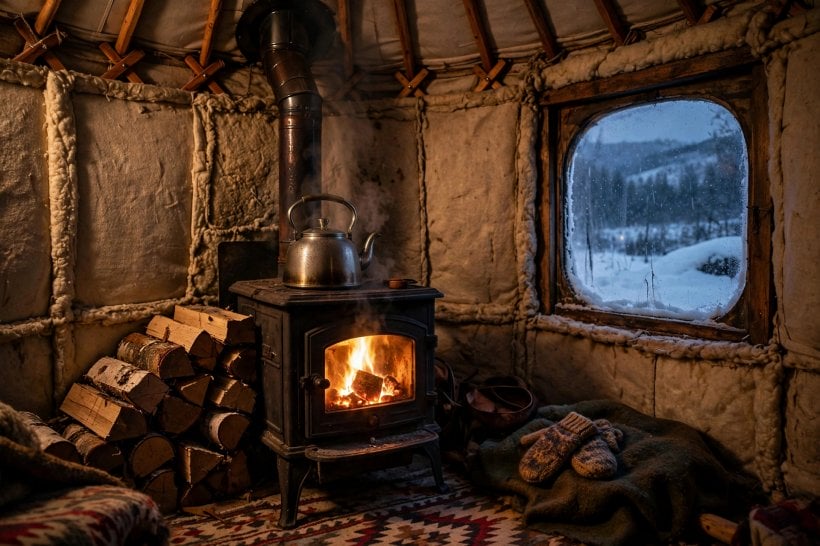
This is the decisive category for cold climates. THOWs insulate like houses — R-13 to R-30 walls with conventional air sealing — and are winter-capable with proper design. Yurts insulate like tents with ambition: reflective insulation layers achieving roughly R-8 to R-15 equivalent, with heat leaking at the crown and the wall-roof junction. The arithmetic is blunt — heating a yurt in a serious winter costs 2–3× the energy of heating a THOW the same size. Yurt winter living is absolutely done; Mongolians do it at -40° — but it is done with a serious stove, serious firewood logistics, and acceptance of temperature gradients: warm near the stove, cool at the edges.
For mild climates, the difference barely matters, and the yurt’s fast-to-heat, fast-to-cool character can even suit the rhythm of the day. For zone 5 and colder, the THOW wins this category decisively, and no amount of romantic attachment changes the physics. Anyone seriously weighing a fabric dwelling through a northern winter should read our field guide to how to live in a yurt in winter — the insulation package, stove sizing and moisture discipline it describes are exactly what separates a cozy January from a miserable one.
4. Space and Layout: Round vs Rectangular
Here the yurt lands its best punch. A 30-foot yurt holds roughly 700 sq ft of open circle — glorious volume, a high center, no corridors. But the round walls fight furniture: everything rectangular floats awkwardly against a curve, zoning the space requires freestanding partitions, and the kitchen and bathroom need custom solutions because there is no standard wet-wall to build against. The THOW answers with far less area used far better: 8.5 × 30 feet is 255 sq ft of efficient rectangle, where every inch is usable with conventional furniture and standard fixtures.

The summary writes itself: the yurt gives more space; the THOW gives more usable space. For couples, the yurt’s openness is romantic — one shared volume, lived in together. For families, the THOW’s rooms are functional — doors, separation, a bathroom that is a room rather than a corner. The layouts in our roundup of yurt floor plans show how far clever zoning can take the circle: kitchen cores against the wall, lofted sleeping, partitioned baths. Clever helps. It does not repeal geometry — the circle rewards people who furnish for it and punishes people who fight it.
5. Legality: The Code Comparison
Both dwellings live in gray zones, but in very different ones. The THOW has the RV path: RVIA certification leads to RV registration, insurance and park access — a mapped route, walked by thousands of owners. The yurt has no standard certification path at all. Its legality depends on local interpretation: some jurisdictions permit yurts as permanent structures with engineering, some as temporary or agricultural structures, and some not at all. Financing follows the same split — THOWs can get RV loans, while yurts essentially cannot, because there is no standardized collateral for a lender to value. Insurance likewise: THOWs get RV policies; yurts need specialty or rider policies.
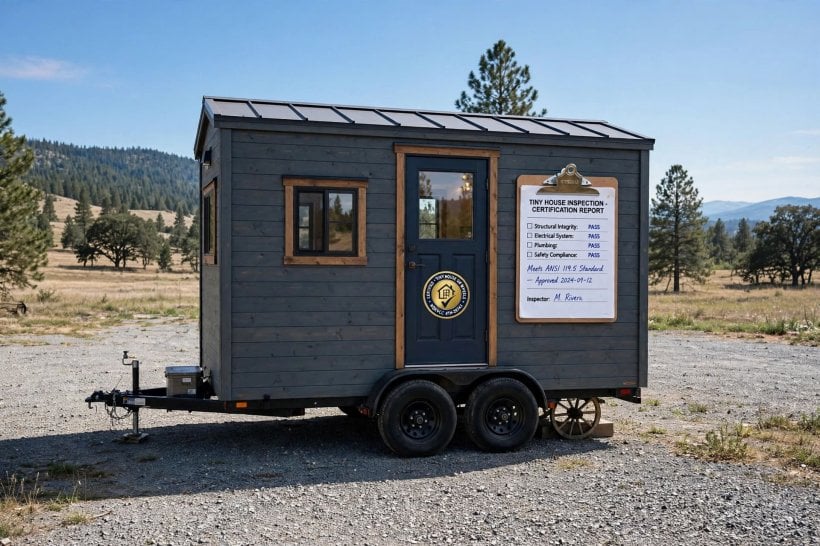
Put plainly, the THOW’s legal infrastructure is a decade ahead of the yurt’s. Before assuming a yurt is permitted on your land, work through the classification questions in our guide to whether yurt living is legal under zoning laws — the answer turns on how your jurisdiction classifies a fabric structure, not on the yurt itself. And on the wheeled side, understanding what RVIA certification is and why a tiny house needs it explains why the seal beside the door unlocks the loans, policies and park gates that the yurt owner must negotiate one office at a time.
6. Mobility: Moving Day
The THOW is designed to move: hitch up, tow away — the mobility is the point of the entire design. The yurt is movable only in theory. Disassembling, transporting and reassembling one is a multi-day project requiring the crew again, which makes the yurt practically semi-permanent: a dwelling that can move, rather than a dwelling that does. That distinction sounds academic until life changes — a new job two states away, a lease that ends, a family that grows — and the cost of relocating becomes the deciding fact of your housing.
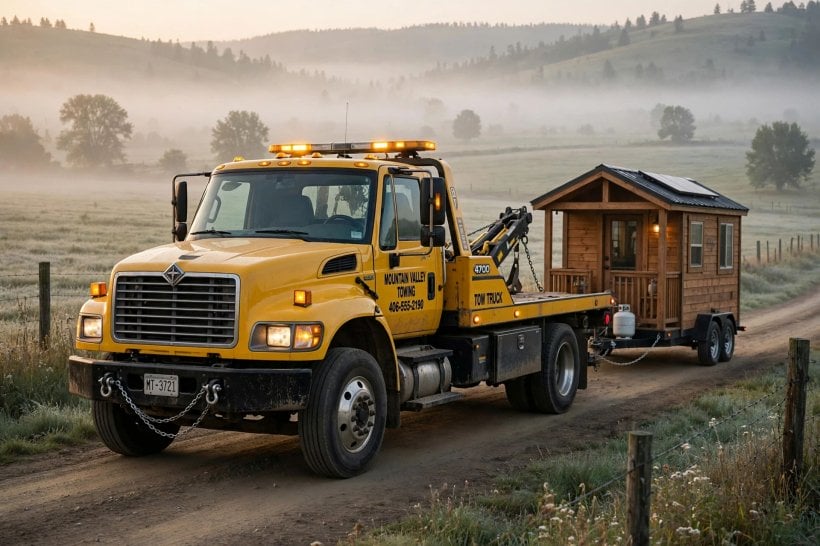
If your life plan includes moving every year or two, the THOW is the only real choice of the two. The practical side of that freedom — tow vehicles, hitch weights, permits and what a professional move costs — is laid out in our tiny house moving guide and transport cost breakdown, and the paperwork that makes those moves legal runs through how to register a tiny house as an RV. If you are settling on land you own, by contrast, the yurt’s semi-permanence is simply irrelevant — a house that never moves does not need wheels, and the platform it sits on is cheaper than the trailer it does not need.
7. Daily Life: The Lived Experience
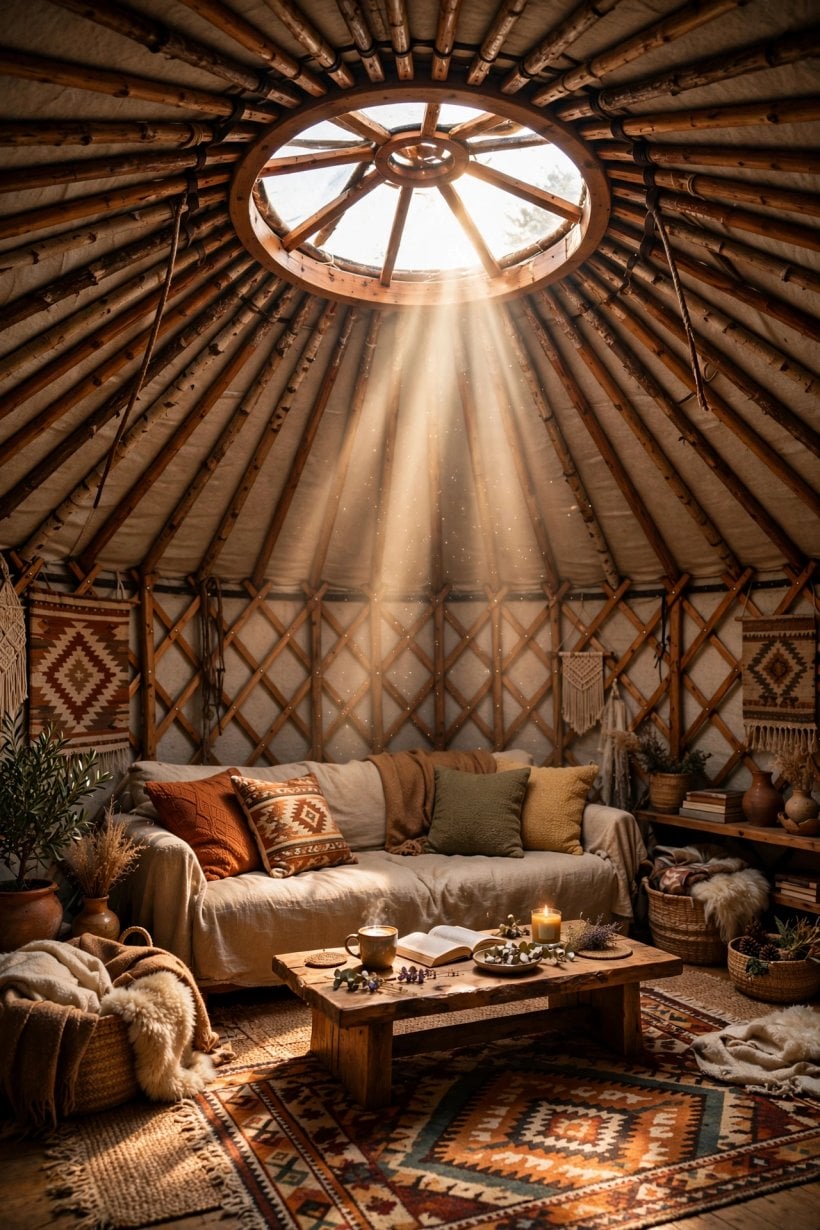
Numbers settle budgets; daily life settles satisfaction. Yurt life is defined by sensation. The acoustics: rain on fabric is loud and wonderful, and conversations carry — there are no secrets in a single volume. The light: the crown skylight floods the center of the circle with daylight in a way no window wall matches. The temperature swings: fast to heat, fast to cool, because thermal mass is minimal. And the connection to weather: you feel storms arrive and pass, which some people love and some people quietly cannot stand.
THOW life is conventional by design — it feels like a small apartment: familiar, predictable, private. That contrast is the honest core of this section. The yurt is the more intense, more romantic, more demanding experience; the THOW is the more practical, more private, more conventional one. Neither answer is wrong, but they suit different temperaments, and temperament is a terrible thing to discover you got wrong after the platform is built or the trailer is bought. Rent or borrow a night in each, in bad weather if you can arrange it, before deciding.
8. Maintenance: What Breaks
Both dwellings need attention; neither is maintenance-free. The yurt’s list is tactile and recurring: tension maintenance, because cables need periodic tightening; cover inspection, watching for UV damage and abrasion and patching promptly; platform integrity, since moisture is the enemy and the underside must stay ventilated; and stove pipe flashing, because the roof penetration is the leak point and earns an annual inspection. Skip these and the failures are slow but certain — a slack structure, a tired cover, a soft platform.

The THOW’s list reads like a small house crossed with a vehicle: roof and seal maintenance, like an RV; trailer maintenance — tires, brakes, bearings — which continues even when parked and must be inspected before any move; and systems maintenance across plumbing and electrical, all conventional work. The pattern is the useful summary: the yurt’s maintenance is more frequent but simpler, done with ladders, patches and wrenches; the THOW’s is less frequent but more technical, occasionally wanting a professional. Budget your temperament for one rhythm or the other, because the dwelling will collect its maintenance either way — in small scheduled doses, or in one neglected lump.
9. Resale: The Exit
Every dwelling decision eventually includes leaving it, and here the two paths diverge sharply. The THOW has an active resale market: certified units hold value well, and 10–20% depreciation over 5 years is typical — an exit that looks much like selling a good vehicle or a small property. The yurt has essentially no structured resale market. Used yurts sell locally, slowly, at steep discounts, and the buyer’s central question is always the same: how much life is left in the fabric? A cover nearing the end of its 15–25 years is a five-figure liability the next owner prices in.
If exit value matters to your plan, the THOW wins this category by a wide margin, and it is not close. The yurt’s value proposition runs the other way: it is cheaper to enter precisely because it is harder to leave. Buy the yurt to live in it, not to sell it, and the economics work beautifully. Buy it as an asset and the exit will disappoint you. This is also where the ownership paperwork earns its keep on the wheeled side — documented, certified, correctly insured units resell as assets, which is one more reason the cover types compared in the insurance section of this decision matter from day one.
10. The Decision
Choose the yurt if your budget is tight, your climate is mild, you own the land, you value volume and beauty over convention, and you will settle long-term. Choose the THOW if your winters are serious, you need financing or insurance, you may move, you want conventional rooms and resale value, or your legality must be straightforward. Notice that neither list mentions style. The yurt vs tiny house decision is not an aesthetic preference dressed up as research — it is climate, land tenure, money structure and temperament, and the honest answers to those four questions pick the dwelling for you.
And there is a third answer some households swear by: choose both. The yurt as the living and gathering space, the THOW as the private bedroom and bath — the hybrid homestead several off-gridders have built, where the circle hosts the days and the little house on wheels closes its door on the nights. It costs more than either alone and solves the argument entirely. Whichever way you land, decide from the life outward: the winters you will actually get, the land you actually hold, the moves you actually expect. The dwelling that fits the life beats the dwelling that fits the fantasy, every time.
Final Considerations
The yurt and the THOW are not competitors but cousins — two answers to the small-living question, optimized for different priorities. The yurt offers beauty, volume and affordability at the cost of convention; the THOW offers practicality, legality and comfort at the cost of poetry. Know your climate, your land situation and yourself — then choose the dwelling that fits the life, not the fantasy.
One last piece of homework belongs to whichever side you choose: the ownership paperwork. Registration, certification and cover decide more of your daily reality than floor plans do, and the wheels-versus-foundation comparison in our tiny house insurance guide for wheels vs foundation shows how differently the two dwellings are treated the moment something goes wrong. Get the structure right, get the winter plan right, get the paperwork right — and either of these small dwellings will hold a large life.




2 Comments