

An island state builds differently. A tiny home bound for a Honolulu lot, a Maui hillside, a Big Island lava-field parcel and a Kauai garden plot all begin with the same ocean crossing — and then meet four different counties, climates and permit desks.
Choosing among tiny house builders hawaii is therefore about matching the builder type to the shipping route, the permit path and your island — not about finding a statewide winner.
1. Hawaii Builders at a Glance
This guide’s infographic compares four builder types and names no companies, because in Hawaii the type decision also decides where the home is built — in an island workshop or on the mainland, thousands of miles from your lot. Custom builders provide full design-build and the most control. Semi-custom builders adapt plans plus options, in the mid-range. Shell builders hand over a weather-tight shell for a DIY finish. Kit and plan sellers supply the package or the plans, you build, and the cost is lowest. Each step down the ladder transfers work and responsibility — design, finishing, project management — from the builder to you, and on an island that transfer is harder to reverse, because every missing part and every specialist is a shipment away.
| Builder type | What they deliver | What the infographic highlights |
|---|---|---|
| Custom builders | Full design-build | Most control over design, siting and island specification |
| Semi-custom builders | Plans plus options | Mid-range, adapting proven floor plans |
| Shell builders | Weather-tight shell | DIY finish, with the interior work yours |
| Kit and plan sellers | You build | Lowest cost, with construction in your hands |
The four key factors on the graphic are shipping, termites, permits and warranty. Shipping earns its place at the top: for many Hawaii builds the ocean leg, the port handling and the inter-island hop together cost more than any single upgrade inside the home. The tip printed on the infographic is the section in miniature — island builds live or die on shipping and permits, so settle both before you fall for a design. A Hawaii search that starts with those four factors will sort builders more honestly than weeks spent comparing kitchen photographs.
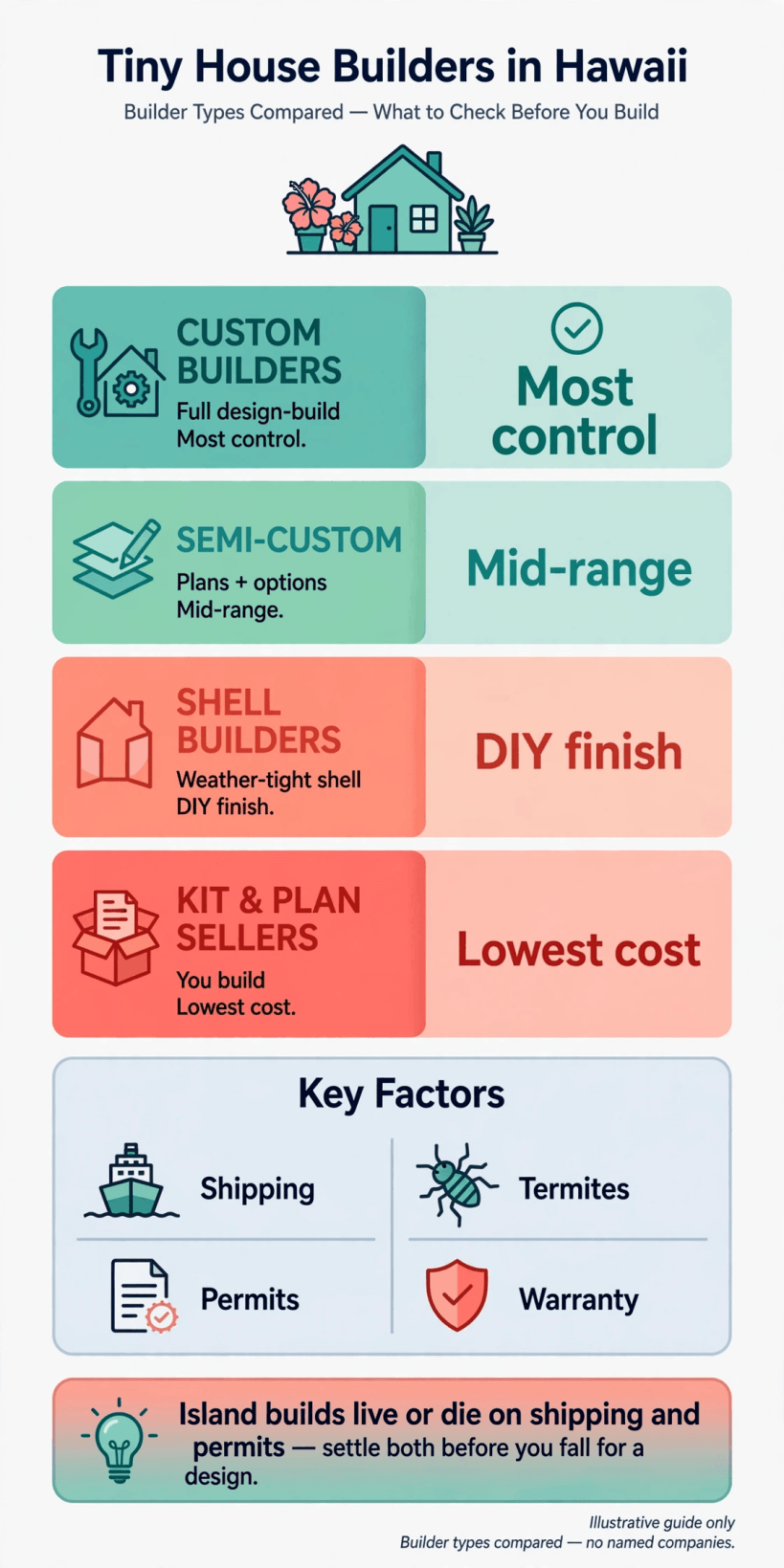
Hawaii at a glance: four builder types compared, and the four key factors — shipping, termites, permits and warranty — to test every candidate against.
2. Start With Your Island and Your County, Not Floor Plans
Hawaii is one state with four county governments, and tiny house placement is answered at county level, island by island: the City and County of Honolulu covers Oahu, Maui County covers Maui, Molokai and Lanai, Hawaii County covers the Big Island, and Kauai County covers Kauai and Niihau. State land-use districts sit above county zoning, so a parcel’s district and its county zoning both shape what may be built or parked. The decisive questions are the familiar ones, asked of the county office that covers your exact parcel: minimum dwelling size, setbacks, foundation expectations, whether a home on wheels is treated as a dwelling or as a recreational vehicle, and whether a small second dwelling is permitted behind an existing house. Keep our building a tiny house checklist open while you ask, and get the classification in writing before any design work begins.
Add the ground itself before you fall for a design. On the Big Island, ask where the parcel sits in relation to lava hazard zones and what that means for building and insuring, using the county and your insurer as the authorities. Near the shore everywhere, check flood and tsunami evacuation mapping and what it means for siting and tie-downs. Many rural parcels — windward Big Island and Kauai especially — rely on rainwater catchment rather than county water, and on septic or other approved wastewater arrangements rather than sewers, and each has county rules a builder’s plan must fit. Readers arriving from the mainland series will recognise the pattern from our tiny house builders in Georgia guide: the parcel writes the rules first, and the floor plan comes second.
3. Local Build or Shipped Build? Check Permits and Certification
Hawaii’s local tiny house building base is small, so most buyers compare two different products from the start: a home built on-island by a local builder, or a home built on the mainland and shipped. Local building trades ocean freight for island labour and material costs, and puts the builder within driving distance of your lot for permits, siting and warranty work. A shipped build reverses the equation — a larger mainland market and more choice, paid for with freight, port handling and distance. Neither route is automatically better; the honest comparison is total landed cost and who stands behind the home once it is on your lot, not the sticker price in a mainland showroom.
Permits are the infographic’s third factor because they decide which route is even open. A foundation build goes through county building permits and inspections, and the builder or an island-based professional normally shepherds that process. A home on wheels is evidenced through third-party inspection and certification for recreational vehicles or park models, and counties treat that documentation differently from a permitted dwelling — so confirm, in writing, how your county will classify the exact home you are buying before it is built, not after it is on a dock. Ask who files each permit, whose name is on it, and what happens to the timeline if the county asks for changes.
4. Build for Salt Air, Trade Winds and Termites
Termites earn their own box on the infographic because Hawaii’s warm, humid climate keeps them active all year, and a tiny house offers them a compact, timber-rich target. Ask what protection is built in rather than sprayed on later: treated or naturally resistant materials in the frame and floor, physical barriers at the foundation or trailer line, accessible inspection points, and a treatment warranty that names who retreats and who repairs. Ground contact, shaded damp corners and stored materials against the walls all undo good detailing, so the design conversation should end with how the home will be sited and ventilated, not just how it leaves the workshop.
The same envelope has to shrug off salt air, which corrodes ordinary fixings, hinges, roofing fasteners and appliance vents far beyond the beachfront, and driving trade-wind rain, which finds badly flashed junctions on the windward sides of every island. Stainless or properly coated hardware, careful roof and window detailing, and ventilation that keeps the interior dry without sealing in cooking and shower moisture are the island specification to demand. Leeward lots swap some rain for harder sun and heat, so shading and roof performance join the list there. Mainland buyers working through the same moisture logic in a different accent will find it in our Georgia guide linked above: humid states punish careless envelopes, and Hawaii simply never gives the envelope a season off.
5. Eight Questions to Ask Before You Sign
Ask these in writing, keep the answers with the contract, and treat an evasive answer as an answer:
- Is your price the price on my lot, or the price at your workshop — and exactly which shipping and port costs sit between the two?
- Who books and pays for the mainland port, the ocean leg and any inter-island barge my home needs?
- How will my county classify this home, and who files the permits or supplies the certification it requires?
- What termite protection is built into the structure, and what treatment warranty comes with it?
- What foundation, pad or tie-down specification must my site provide before the home arrives?
- How are change orders priced and approved once building has started?
- What warranty covers structure, envelope, appliances and workmanship — and who physically honours it on my island?
- Can I speak to two recent buyers whose homes were delivered to Hawaii?
The answers sort builders faster than any showroom visit. A builder experienced with island delivery answers the shipping questions with names, steps and documents rather than estimates and optimism, because they have watched a home make the crossing before. If a candidate cannot say which port your home enters, who collects it and what that costs, the freight risk is quietly being left with you — price that risk in, or keep looking while your deposit is still in your own account.
6. Shipping and Delivery Decide Island Builds
Delivery is the infographic’s first factor for a reason: in Hawaii it is a supply chain, not a truck trip. A mainland-built home typically travels by road to a West Coast port, crosses the Pacific by ship or barge to Honolulu, and — for neighbor island lots — crosses again by inter-island barge before a final truck leg on island roads. Each handover is a cost, a schedule risk and a damage risk, so the contract should name who owns the home at each stage, what insurance covers the ocean leg, how the home is protected and secured for transit, and what happens if a sailing is missed or weather closes the route. Dimensions and weight drive freight pricing, so confirm the finished home, exactly as specified, fits the shipping method quoted.
The last mile deserves the same written care. Island lots add steep driveways, narrow rural roads, low wires and soft ground after windward rain; walk the final approach as the driver will see it, and agree who supplies machinery if the home cannot be towed into position. Site preparation — pad or foundation, tie-downs, water, wastewater and power arrangements — should be finished before the home leaves the mainland, because storage and re-delivery on an island are expensive mistakes. Remote-delivery thinking of a colder kind runs through our tiny house builders in Alaska guide, where freight and season shape the build in the same unforgiving way.
7. Warranty, Snagging and Life After Handover
Warranty is the factor that distance tests hardest. Read the warranty as two different promises — a shorter workmanship and systems promise, and a longer structural promise — then ask the island question: who physically does the work? A mainland builder’s warranty is only as good as its Hawaii arrangement, whether that is a local contractor on call, a parts-by-courier agreement with a named island tradesperson for labour, or a commitment to fly someone out for structural faults. Get the arrangement, the claim process and the response expectations in writing before you sign, and weigh a local builder’s shorter warranty against a distant builder’s longer one accordingly.
Build the handover like an inspection, not a celebration. Walk the arrived home slowly with the contract and a snagging list: run every tap and appliance, check for transit damage at corners, roof junctions and underside connections, test every window and door after the home is levelled and tied down, photograph the certification plates and serial numbers, and hold the final payment until the snagging list and the paperwork pack — certification documents, manuals, warranty terms, shipping records — are agreed on the day, in writing. A home that has crossed an ocean has earned a more careful inspection, not a more forgiving one.
8. What Tiny Houses Cost to Build in Hawaii
Money follows the ladder on the infographic, with an island surcharge at every rung. Custom design-build carries the highest cost because professional time, one-off engineering and full finishing sit inside the price. Semi-custom work sits in the middle, spreading design cost across proven plans while charging for options and upgrades. A shell transfers the interior budget to you — and in Hawaii that means island prices for materials and trades, plus freight on anything not stocked locally. Kits and plans look cheapest at checkout and grow through shipping a package across the Pacific, materials, tools, hired help, permits and the time the build consumes.
The swing items in Hawaii are the crossing and the site. Ocean freight, port handling, inter-island barging and final trucking can together rival a large share of the build itself, and site costs — pad or foundation work, rainwater catchment where there is no county water, wastewater arrangements, an electrical service or a solar-and-storage setup, permits and fees — are the costs least visible in a mainland showroom quote. Get both estimated early, in writing, and hold a real contingency for the shipment you cannot control. Our tiny house builders in Idaho guide makes the mirror-image point for a landlocked state: everywhere, the route to the lot writes half the budget.
9. Warning Signs and Safer Ways to Pay
The warning signs repeat in every state because they are about behaviour, not geography, and distance amplifies every one of them. Be careful with a builder who quotes a finished price without asking which island — or which port — the home is going to, who cannot show certification paperwork for recent builds, who treats permits as your problem while taking deposits sized as if they were solved, or who pressures you to sign before your county has confirmed the classification route. A home built wrongly for Hawaii cannot be cheaply sent back, so vagueness about shipping, termites or warranty is not a personality trait — it is the product telling you what ownership will feel like.
Safer payment is mostly structure. Tie stage payments to completed, inspectable stages rather than calendar dates, keep the final payment until after delivery, siting and snagging are agreed, pay by traceable methods, and keep every promise — above all the freight and port promises — inside the signed contract rather than in messages and calls. Verify the business exists as claimed, visit the workshop if you possibly can, and speak to a recent buyer whose home has crossed the ocean and been lived in through a Hawaii year. Careful builders expect this diligence; the ones who discourage it are answering your most important question for free.
10. Compare Quotes Until They Are Like for Like
Quotes only become comparable when the specification underneath them is identical and the destination is the same, so build a small worksheet and make every builder price the same home delivered to the same lot: same size and layout, same certification or permit route, same termite and corrosion specification, same appliances and finishes, same shipping chain to the same port and the same siting scope, with site assumptions stated in writing. The cheapest quote is often simply the one that ends at a mainland dock, and the worksheet exposes the gaps — freight here, permits there, warranty serviced from another time zone — before they become your invoices.
Score the worksheet on the infographic’s four factors alongside price: shipping that is named leg by leg, termite protection built into the structure, a permit path your county has confirmed, and a warranty someone on your island can honour. Readers working across this state series can set this worksheet beside our tiny house builders in Indiana guide and our tiny house builders in Iowa guide to see how the same four factors reorder themselves where the freight is a highway rather than an ocean. The builder who wins on paper and on those four factors is usually the builder who wins in year three, long after the barge has come and gone.
Final Considerations
Hawaii rewards buyers who sequence the decisions correctly: county classification confirmed first, the shipping chain priced leg by leg, termite and salt-air specification settled before finishes are admired, and the permit path agreed before a deposit crosses the Pacific. Work through the four factors — shipping, termites, permits and warranty — with every candidate, keep the answers in writing, and let the worksheet rather than the showroom make the final call. Do that, and the small home that reaches your island lot will be the one you thought you bought.


0 Comments