

From metro Atlanta suburbs to North Georgia mountain land and the Savannah coast, Georgia compresses very different building conditions into one state: a tiny home that suits a shaded Piedmont lot can be entirely wrong for a humid coastal parcel or a cold, exposed ridge.
Choosing among tiny house builders georgia is therefore about matching the builder type and the moisture specification to your county, your lot and your exposure — not about finding a statewide winner.
1. Georgia Builders at a Glance
This guide’s infographic compares four builder types and names no companies, because the type decision shapes your budget, your timeline and the work that lands on you far more than any individual name. Custom builders provide full design-build and the most control. Semi-custom builders adapt plans plus options, in the mid-range. Shell builders hand over a weather-tight shell for a DIY finish. Kit and plan sellers supply the package or the plans, you build, and the cost is lowest. Each step down the ladder transfers work and responsibility — design, finishing, project management — from the builder to you, and the honest question is how much of that transfer your time, skills and site can absorb.
| Builder type | What they deliver | What the infographic highlights |
|---|---|---|
| Custom builders | Full design-build | Most control over design, siting and moisture detail |
| Semi-custom builders | Plans plus options | Mid-range, adapting proven floor plans |
| Shell builders | Weather-tight shell | DIY finish, with the interior work yours |
| Kit and plan sellers | You build | Lowest cost, with construction in your hands |
The four key factors on the graphic are certification, contract, delivery and warranty. Certification earns its place at the top: it is the evidence that the structure, the wiring and the plumbing were built and inspected to a recognised standard, which lenders, insurers and county officials may all ask about later. The tip printed on the infographic is the section in miniature — summer humidity rots careless builds, so ask how the envelope handles moisture. A Georgia search that starts with those four factors will sort builders more honestly than weeks spent comparing kitchen photographs.
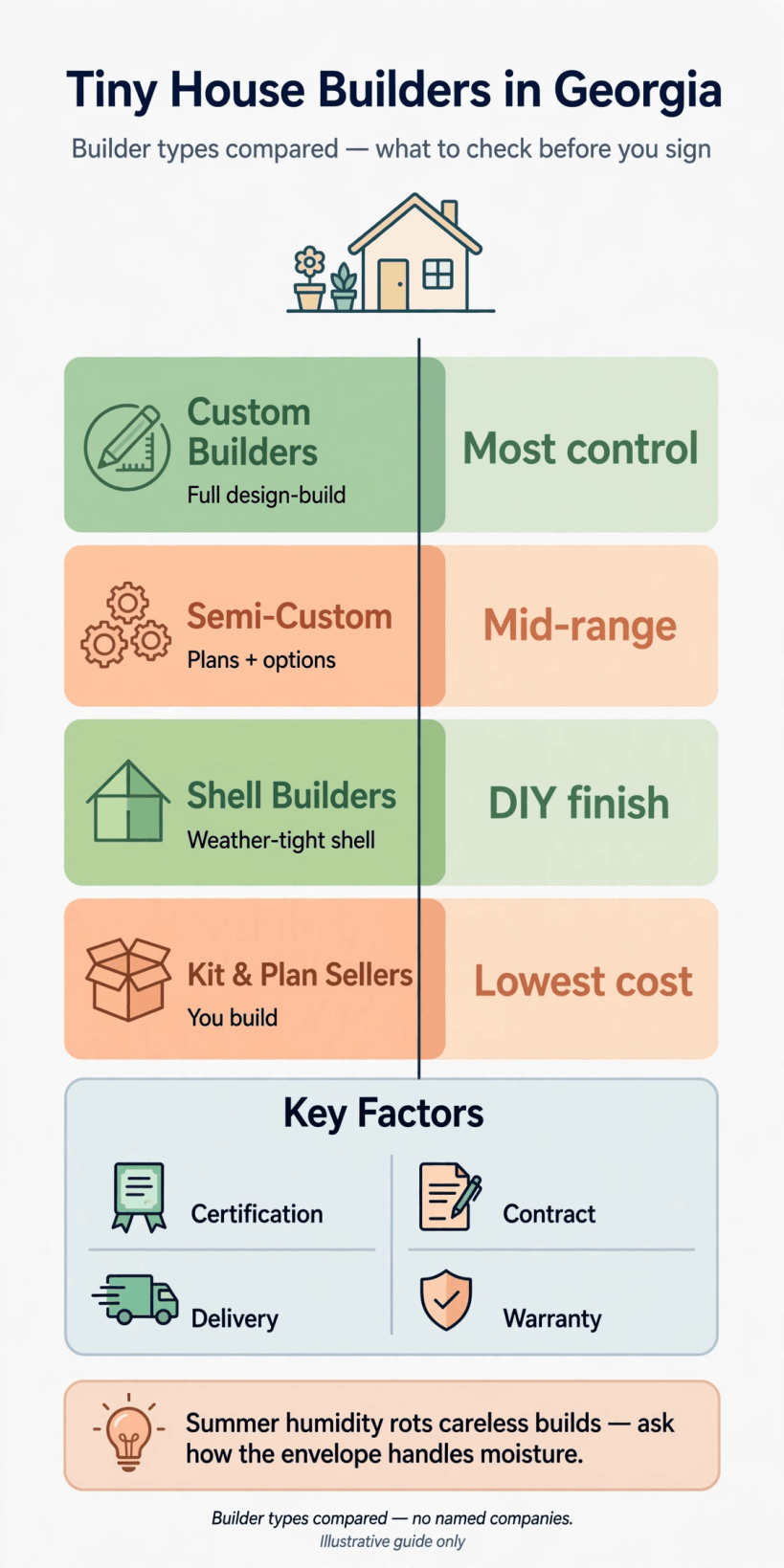
Georgia at a glance: four builder types compared, and the four key factors — certification, contract, delivery and warranty — to test every candidate against.
2. Start With Your County and Your Town, Not Floor Plans
Georgia has well over a hundred counties, and placement law is written county by county and town by town, so there is no single statewide answer to where a tiny home may sit. County zoning carries much of the weight on unincorporated land, while cities and towns inside those counties apply their own ordinances, and the questions that decide a project are the usual decisive ones: minimum dwelling size, setbacks, foundation expectations, whether a home on wheels is treated as a dwelling or as a recreational vehicle, and whether a small second home is permitted behind an existing house. Homeowners associations and recorded covenants add a further layer on many lots, particularly in metro Atlanta subdivisions. Put the questions to the planning office that covers your exact parcel, get the classification in writing, and keep our building a tiny house checklist open beside those answers, because the placement decision governs everything downstream.
Add the services layer before you fall for a design. Much of Georgia’s decision-making hides underground: whether the lot connects to public sewer or needs a septic system suited to its soil, what a percolation test says about the heavy red clay found across much of the Piedmont, what the well or public water position is, and where the parcel sits relative to creeks, rivers and coastal flood ground — heavy Georgia rain finds low land quickly, and that position shapes foundation, elevation and insurability. Buyers comparing states often work through several of these guides in sequence, and our tiny house builders in Delaware guide shows how a smaller state’s county questions differ from Georgia’s sprawling local map.
3. Find Builders, Then Check Certification and Licensing
Georgia builders are spread the way Georgia building is spread: workshops and yards around metro Atlanta, smaller shops serving the North Georgia mountains and lake country, general builders across the Piedmont and the south of the state, and coastal workshops within reach of Savannah. Range rewards a wide first list: talk to more than one type, because a custom design-build shop, a semi-custom yard and a shell builder are quoting different products even when the floor plans look alike. Ask each candidate who actually builds the home, who inspects it, and what paperwork follows it to your lot.
Certification is where the infographic’s first factor becomes practical. A tiny house on wheels is usually evidenced through third-party inspection and certification schemes for recreational vehicles and park models, or through independent inspection services that check the build at stages. A tiny house on a foundation is inspected under the local building code process, with permits and staged sign-offs. A manufactured route follows its own federal housing standards and state installation oversight. The routes are not interchangeable, and a builder who is fluent in one may be vague in another, so pin down which standard your home will carry, who issues the documentation, and whether your county, your lender and your insurer will each accept it — in writing, before a deposit changes hands.
4. Match the Build to Georgia Humidity and Heat
The infographic’s tip deserves a full section, because moisture is the quiet destroyer of small homes in a humid subtropical climate. Georgia summers are long, hot and wet with humidity, and a tiny house concentrates cooking, showering and breathing moisture into a very small volume of air. Ask how the envelope is detailed: what vapour and air control layers are used, how the roof and wall junctions are flashed against driving rain, how the bathroom and kitchen are vented to the outside rather than into a cavity, and what dehumidification or ventilation strategy the design assumes in daily life. Materials matter too — mould-resistant boards in wet zones, careful sealing around every penetration, and finishes that can dry out rather than trap damp against timber or steel.
Then test the same design against Georgia’s other extremes. Air conditioning sizing and shading decide summer comfort and running costs, especially on open southern and coastal lots, while a North Georgia mountain home needs insulation, pipe protection and heating thought through for cold snaps and occasional snow. Termites are a standing fact of Georgia building life, so ask what treated materials, barriers and inspection access the design includes, and expect a sensible builder to raise the subject before you do. Coastal buyers add wind-driven rain and storm exposure to the list. For a wetter island comparison, our tiny house builders in Hawaii guide works through the same moisture questions in a tropical setting.
5. Eight Questions to Ask Before You Sign
Ask these in writing, keep the answers with the contract, and treat an evasive answer as an answer:
- Which certification or code standard will this home carry, and who issues the paperwork?
- What exactly is included in the price — and what is excluded that buyers commonly assume is included?
- Who handles delivery, siting, levelling and connection to services, and who pays for each stage?
- What foundation, pad or tie-down specification must my site provide before the home arrives?
- How are change orders priced and approved once building has started?
- What stage payments do you require, and what completed work does each payment follow?
- What warranty covers structure, envelope, appliances and workmanship, and who honours it locally?
- Can I speak to two recent buyers whose homes were delivered in Georgia?
The answers sort builders faster than any showroom visit. A good builder answers plainly, prices the extras instead of waving at them, and expects to be asked. If a candidate resists putting answers in writing, that reluctance tells you how disputes will go later — believe it, and keep looking while your deposit is still in your own account.
6. Delivery Day Is a Georgia Logistics Problem
A tiny house is an oversize load moving through real Georgia geography: interstate miles are the easy part, and the last stretch decides the day. North Georgia mountain roads bring grades, switchbacks and low branches; rural routes bring narrow lanes, soft shoulders and gates; Piedmont and southern driveways surfaced in gravel or clay can turn treacherous after heavy rain, exactly when a heavy delivery should not be crossing them. Walk the route as the driver will see it — turning room, overhead lines, culverts, the firmness of the ground where the home will be placed — and agree who supplies mats, machinery or a crane if the final position cannot be reached by the tow vehicle.
Put the logistics in the contract, not in a phone call. Who books any required permits or escorts, who carries the risk if weather closes the route, what a failed delivery attempt costs, and who levels, blocks and ties down the home on arrival all belong in the written scope. Site preparation should be finished and inspected before the truck is loaded: pad or foundation ready, access cleared, services stubbed where agreed. Buyers further west will find the same last-mile thinking in our tiny house builders in Arkansas guide, where rural delivery raises a similar set of questions.
7. Warranty, Snagging and Life After Handover
Warranty is the infographic factor buyers test last and need first. Read the warranty as two different promises: a shorter workmanship and systems promise, and a longer structural promise, and check which one answers when a roof junction leaks, a door swells in August humidity or an appliance fails. Ask who physically does warranty work on a home sited hours from the workshop, whether travel is charged, how a claim is logged, and what response time the builder will commit to in writing. A warranty honoured by a builder three counties away is only as good as the arrangement behind it.
Build the handover like an inspection, not a celebration. Walk the home slowly with the contract and the snagging list in hand: run every tap and appliance, open and close every window and door, check seals after a hose test if you can, photograph the roof junctions, the underside connections and the certification plates, and record serial numbers before final payment is released. Agree the snagging list, the fix dates and the paperwork pack — certification documents, manuals, warranty terms — on the day, in writing. Small homes reward this discipline: a tiny envelope has no spare corners where a small leak can stay harmless for long.
8. What Tiny Houses Cost to Build in Georgia
Money follows the ladder on the infographic. Custom design-build carries the highest cost because professional time, one-off engineering and full finishing sit inside the price. Semi-custom work sits in the middle, spreading design cost across proven plans while charging for options and upgrades. A shell transfers the interior budget — insulation detail, lining, kitchen, bathroom, flooring and the trades to fit them — to you, so compare a shell price only against the finished cost of your own completion, honestly costed, not against a finished home. Kits and plans look cheapest at checkout and grow through materials, tools, hired help, inspection and the time the build consumes.
The swing item in Georgia is usually the site rather than the house. Septic installation suited to clay soils, a well or a long water connection, an electrical service run, driveway work that survives wet winters, permits and fees, delivery over distance and foundation or pad work can together rival a large share of the build itself — and they are the costs least visible in a showroom quote. Get site costs estimated early, hold a real contingency for the ground you cannot see into, and treat any quote that ignores the site as a partial quote. Our tiny house builders in Idaho guide makes the same point from the opposite climate: everywhere, the lot writes half the budget.
9. Warning Signs and Safer Ways to Pay
The warning signs repeat in every state because they are about behaviour, not geography. Be careful with a builder who wants a very large share of the price before work begins, who cannot show certification paperwork for recent builds, who has no fixed premises or verifiable recent buyers, whose contract leaves the specification vague while the deposit is precise, or who pressures you to sign before your county has confirmed the placement route. Cheerful vagueness about delivery, warranty or moisture detailing in a humid state is not a personality trait — it is the product telling you what ownership will feel like.
Safer payment is mostly structure. Tie stage payments to completed, inspectable stages rather than calendar dates, keep the final payment until after delivery, siting and snagging are agreed, pay by traceable methods, and keep every promise inside the signed contract rather than in messages and calls. Verify the business exists as claimed, visit the workshop or yard if you possibly can, and speak to a recent buyer whose home has been lived in through a Georgia summer. None of this is distrust; it is how careful builders expect careful buyers to behave, and the good ones will say so.
10. Compare Quotes Until They Are Like for Like
Quotes only become comparable when the specification underneath them is identical, so build a small worksheet and make every builder price the same home: same size and layout, same certification route, same insulation and moisture specification, same appliances and finishes, same delivery distance and siting scope, same site assumptions stated in writing. The cheapest quote is often simply the one with the most missing underneath it, and the worksheet exposes the gaps — an allowance here, an exclusion there, delivery to the county line rather than onto your pad — before they become your invoices.
Score the worksheet on the infographic’s four factors alongside price: certification you can file, a contract that names everything, a delivery plan that survives your actual access, and a warranty someone local can honour. Readers working down this state series can set this worksheet beside our tiny house builders in Indiana guide and our tiny house builders in Iowa guide to see how the same four factors reorder themselves as climate and county rules change. The builder who wins on paper and on those four factors is usually the builder who wins in year three, long after delivery day is a photograph.
Final Considerations
Georgia rewards buyers who sequence the decisions correctly: placement confirmed with the county first, builder type chosen honestly against your own time and skills, moisture and certification specified before finishes are admired, and site costs priced before the house quote is believed. Work through the four factors — certification, contract, delivery and warranty — with every candidate, keep the answers in writing, and let the worksheet rather than the showroom make the final call. Do that, and the small home that arrives on your lot will be the one you thought you bought.


0 Comments