

Pennsylvania townships can welcome a tiny home on one road and refuse it on the next, and a Pennsylvania winter will test every wall, window and pipe. Choosing well starts long before floor plans and finishes.
This guide to tiny house builders in pennsylvania is a checking system rather than a ranking: the documents to request, the questions to ask and the warning signs to respect before you commit to anyone.
1. Choosing a Pennsylvania Builder at a Glance
Most Pennsylvania shoppers end up comparing three broad kinds of builder. This guide’s infographic groups them that way, and it picks out four factors that shape almost every project in the state: township rules, winters, delivery and certification. Start with the type that matches how involved you want to be, then judge every candidate against the same four factors.
| Builder type | Best for | What the infographic highlights |
|---|---|---|
| Custom design-build firms | Buyers who want a fully finished, personal home | A full-service route, working from your plans or the builder’s own designs, with the widest choice of layouts and finishes. |
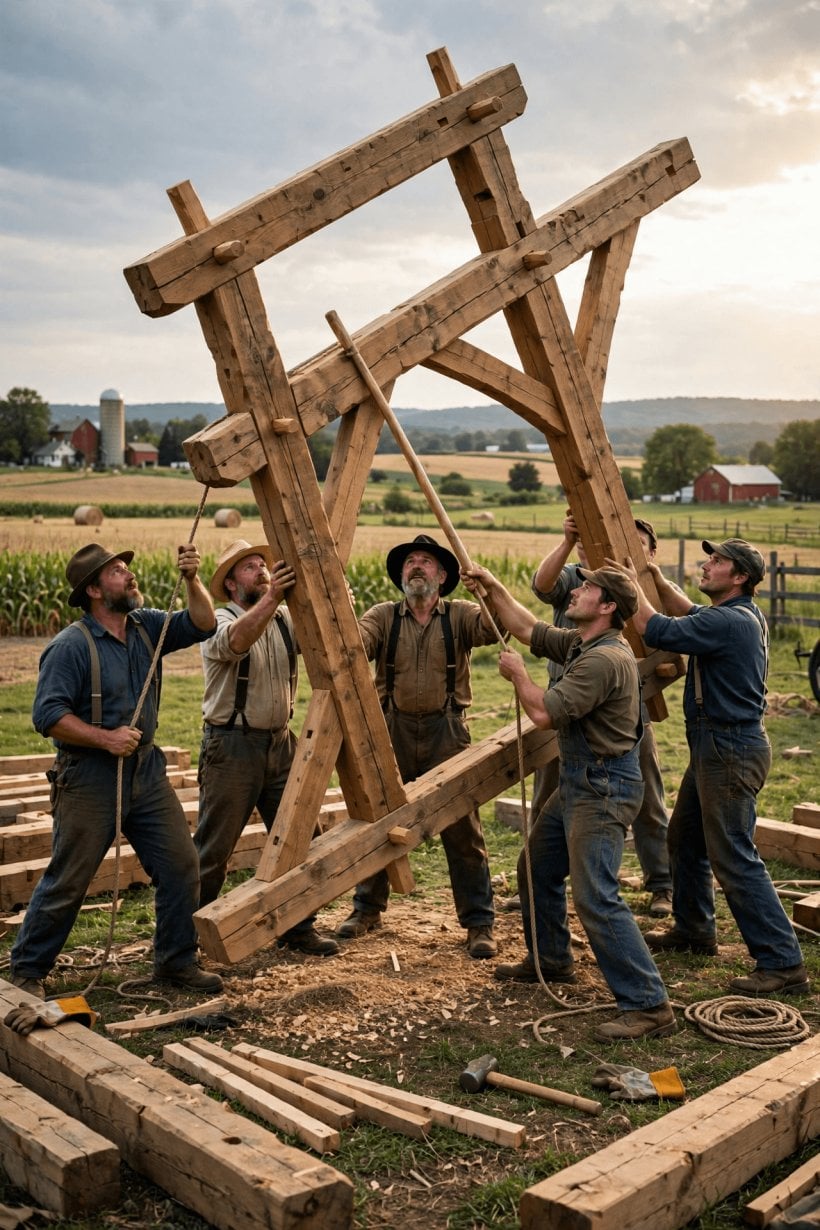
| Amish and timber-frame craftsmen | Buyers who value traditional timber craft | Handcrafted shells and heavy timber frames, with a strong reputation for joinery and simpler, durable interiors. |
| Shell and DIY-finish builders | Hands-on buyers watching the overall budget | A weather-tight shell that you finish inside yourself, trading your own labour for a lower total outlay. |
None of the three routes removes the same basic homework. Confirm the township position for your exact parcel, verify licensing and registration, ask how the finished home will be certified and inspected, check the winter specification in writing, agree how delivery and siting will work, and read the warranty properly before any deposit changes hands. The sections that follow take that sequence in order.
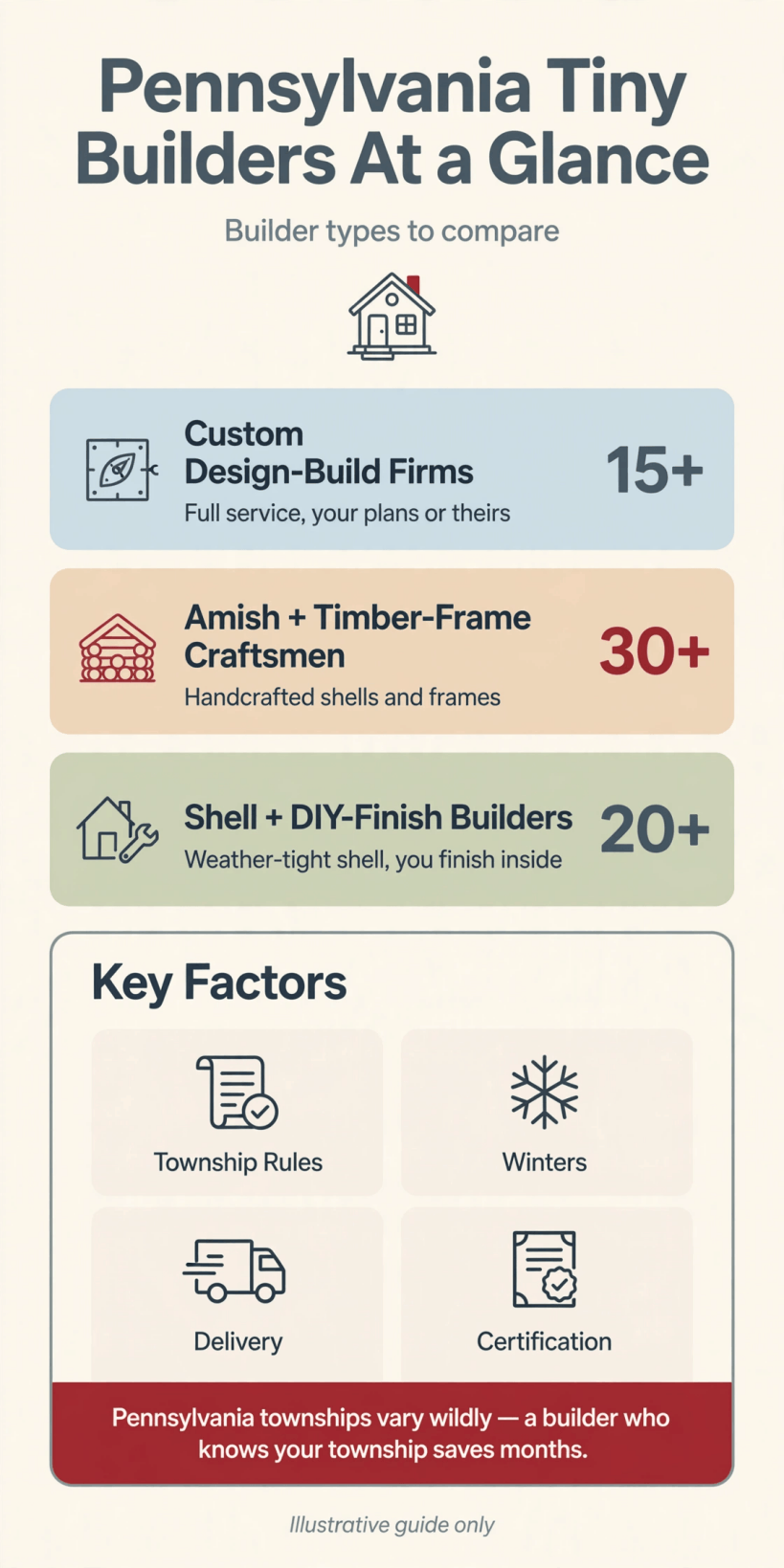
Pennsylvania at a glance: three builder types to compare, and the four factors — township rules, winters, delivery and certification — that should drive the final choice.
2. Start With Township Rules, Not Floor Plans
Zoning in Pennsylvania is famously local. Townships, boroughs and cities each write their own ordinances, so minimum dwelling sizes, setbacks, foundation expectations and whether a small home on wheels counts as a dwelling at all can change the moment you cross a municipal line. A design that suits one parcel may be unusable a mile away, which is why the land question comes before the layout question every single time.
Get the answer for your exact parcel in writing before the design hardens. Ask the township zoning office what category your home falls into, what permits the placement needs, and whether an accessory dwelling route, a foundation build or a designated park placement changes the position. Our overview of how to get a tiny house built, from first sketch to finished home explains the usual sequence, and our explainer on how building codes treat unconventional small homes shows why classifications matter so much. Then test each builder against those answers: someone who has already placed homes in your township will know which office asks for what, and where applications usually stall.
3. Verify Licensing, Registration and Certification
Verify the business before you discuss a single finish. Ask for the builder’s registration and licensing details, confirm they are current, and check that the legal name on those documents is the name that will appear on your contract. Pennsylvania home improvement contractors are expected to register with the state, so a serious operation will produce its paperwork without fuss, along with evidence of insurance. Treat any reluctance here as information, not as a personality quirk.
Certification is the second half of the check. Ask how the home is inspected during the build, which standard it is built and certified to, and who signs off each hidden stage — framing, wiring and plumbing are all much easier to verify before the walls close. Ask for stage photographs as a matter of routine and keep them with your contract. The same verification mindset runs through our neighbouring-state coverage, including our companion guide to tiny house builders in Illinois, because the paperwork questions matter in every state even when the answers differ.
4. Check the Winter Specification in Writing
A Pennsylvania winter is a design brief, not a detail. Northern and elevated counties see serious snow loads and long cold snaps, so ask how the roof is rated, what insulation goes into the floor, walls and roof, and how the windows are specified. Thin floor insulation is the classic tiny house cold spot, and frozen pipes are the classic first-winter failure, so both deserve direct questions and written answers.
Ask how plumbing runs are protected, where the water entry point sits, and what heating system the builder assumes your budget includes. If the home will sit on a foundation or a prepared pad, discuss how the underside will be closed and protected; our guide to tiny house skirting options that protect pipes and improve insulation covers the main approaches. Whatever is promised — heat tape, an insulated belly, a backup heat source — make sure it appears in the specification attached to your contract, not just in a friendly conversation at the workshop.
5. Questions to Ask Every Builder
Good questions asked early are cheaper than problems discovered late. Put these to every builder on your shortlist, and compare the quality of the answers as much as the answers themselves.
- How many tiny homes have you completed, and how many are occupied through a full winter?
- Can I speak to two recent buyers and, if possible, see a finished home in person?
- Exactly what is included in the quoted scope, and what is excluded?
- Who handles permits, inspections and certification paperwork, and what do I receive at handover?
- What payment schedule do you propose, and which build stages trigger each payment?
- How are changes priced and approved once the build has started?
- What is a realistic start and completion window, and what usually causes delays?
- Who delivers and sites the home, and what site preparation is my responsibility?
A careful builder answers plainly, offers references without being pushed twice, and is comfortable putting commitments in writing. Vague answers at this stage rarely become clearer after money has moved, so score every conversation honestly before you move on.
6. Delivery Radius, Roads and Siting
Ask early how far the builder delivers within the state and how delivery is charged, because a workshop at the other end of Pennsylvania adds distance, time and risk to the move. Rural delivery routes can involve narrow township roads, low branches, tight turns and older bridges, so share your site’s access details — photographs and measurements help — before assuming a standard delivery day will work.
Agree who is responsible for each part of siting day: transport, placement, levelling, anchoring where required, and connection to water, sewer or septic and power. Ask what happens if weather closes in or the ground is too soft, and what site preparation — a pad, a cleared path, trimmed trees — is yours to complete beforehand. Buyers comparing across the South will find the same delivery questions explored in the Mississippi tiny house builders guide, where long rural deliveries raise similar access issues. Get the delivery plan in the contract, with responsibilities named, so the last mile is organised rather than improvised.
7. Warranty, Aftercare and References
Read the warranty as carefully as the floor plan. Ask what it covers — structure, workmanship, roof and systems — how long each part runs, and how a claim actually reaches a person who can act on it. A builder several hours away may offer perfectly good cover, but you should know in advance whether small faults mean a site visit, a local contractor arranged by the builder, or a parts box in the post.
References complete the picture. Ask for recent buyers, ideally including one whose home has been through a winter, and ask those owners what went wrong and how the builder responded; the response matters more than the fault. While you plan ownership costs, our guide to how to insure a tiny house once it is delivered explains the cover questions to settle before the home arrives. A builder with nothing to hide will hand over references early — and will expect you to call them.
8. Understand What Drives the Cost
Prices vary too much between builders for headline figures to mean much, but the drivers are consistent. Size and layout complexity come first: every extra foot, bump-out and custom angle adds labour. Craft level follows — a hand-built timber frame, bespoke joinery and premium finishes cost more than a simple stock shell, while a DIY-finish route lowers the invoice by moving work onto you. The winter specification, window quality and heating system all move the total, as do off-grid equipment and utility connections.
Site-side spending is the other half of the budget: foundations or pads, delivery distance, placement equipment and utility runs can rival the difference between two builders’ quotes, so compare whole-project costs rather than workshop prices alone. If borrowing is part of the plan, read our playbook on how to get a loan for a tiny house and our explainer on tiny house mortgages and how lenders classify these homes before you sign, because how the home is certified can shape which finance is even available. A builder who explains cost drivers calmly, in writing, is usually a safer pair of hands than one who quotes a single round number.
9. Red Flags That Should Slow You Down
Certain patterns justify walking away, however appealing the photographs look. Be wary of a builder who will not provide registration or insurance details, who asks for most of the money up front without staged milestones, or who resists a written contract with a defined scope. Certification answers that change each time you ask, and a refusal to share references or let you see a completed home, belong on the same list.
Pressure is its own warning sign: a discount that expires today, a build slot that supposedly vanishes tomorrow, or a quote far below every other builder with no clear explanation of what has been left out. So is a delivery promise made without a single question about your site. None of these proves bad faith on its own, but each one shifts risk onto you — and a careful buyer responds by slowing down, checking paperwork again, or choosing the builder whose answers stayed boring and consistent.
10. Compare Final Quotes Like for Like
Final comparisons only work when every quote describes the same home. Line the shortlisted builders up against one checklist: shell and finish scope, insulation and window specification, heating, certification and inspection paperwork, delivery and siting responsibilities, warranty terms and the payment schedule. Where one quote looks cheaper, hunt for the missing item before celebrating — excluded delivery, a thinner winter specification or unfinished interior work explains most gaps.
Readers weighing neighbouring states against Pennsylvania can cross-check the same met
Keep one project file from the very first conversation. Save the township’s written answer about your parcel, copies of the builder’s registration and insurance, the signed specification, stage photographs from the build, delivery paperwork and every warranty document in a single folder, digital or paper. If a question surfaces in the third winter — a warranty boundary, an inspection record, a promised extra — that file answers it in minutes instead of weeks of searching through old messages.
That habit sums up the whole approach in this guide. A tiny house is a serious purchase, built by a small team, often at a distance, under rules that change from one township to the next. Buyers who choose slowly, verify documents before deposits and insist that promises live inside the contract almost always end up with the home they expected. Do the checks in order, trust evidence over enthusiasm, and let the builder who welcomes scrutiny earn the job.
hod in our guides to tiny house builders in Virginia, tiny house builders in South Carolina and tiny house builders in Ohio. Choose the builder whose paperwork, winter specification and references survive this side-by-side test, not simply the one with the lowest number or the prettiest gallery. The right choice is the one you can verify on paper before the build begins.
Final Considerations
The best Pennsylvania builder for your project is rarely the loudest advertiser. It is the one whose registration checks out, whose winter specification is written down, whose delivery plan fits your roads, and whose past buyers speak well of the aftercare. Work the checks in this guide in order, keep every promise in the contract, and the home that arrives should match the home you thought you bought.


0 Comments