

Mississippi rewards careful buyers. Humidity works on a small home all year, low land can hold water after heavy rain, and county rules differ more than most people expect.
This guide to tiny house builders in mississippi is a verification routine: the paperwork to request, the moisture and flood questions to press, and the warning signs that should pause any signing.
1. Choosing a Mississippi Builder at a Glance
Mississippi shoppers usually compare three kinds of builder, and this guide’s infographic sorts them by the job they do best. It also names four factors that decide whether a tiny home stays comfortable and sound in this state: humidity, flooding, termites and certification. Pick the builder type that fits your land and your skills first, then judge every candidate against those four factors.
| Builder type | Best for | What the infographic highlights |
|---|---|---|
| Custom design-build firms | Buyers who want a home tailored to them | A full-service route covering design and construction, suited to buyers who want a finished, personal home without managing trades. |
| Elevated and flood-smart builders | Low, wet or flood-prone land | Designs raised on piers with flood vents and drainage in mind, built for parcels where water is a regular visitor. |
| Shell and DIY-finish builders | Hands-on buyers protecting the budget | A weathertight shell you complete inside yourself, keeping the invoice lower in exchange for your own time and skills. |
Whichever route you take, the groundwork is identical. Confirm what your county allows on your parcel, verify the builder’s licensing and registration, ask how the home is certified and inspected, check the moisture and termite defences in writing, agree the delivery and elevation plan, and read the warranty before money moves. The sections below work through that list in order.
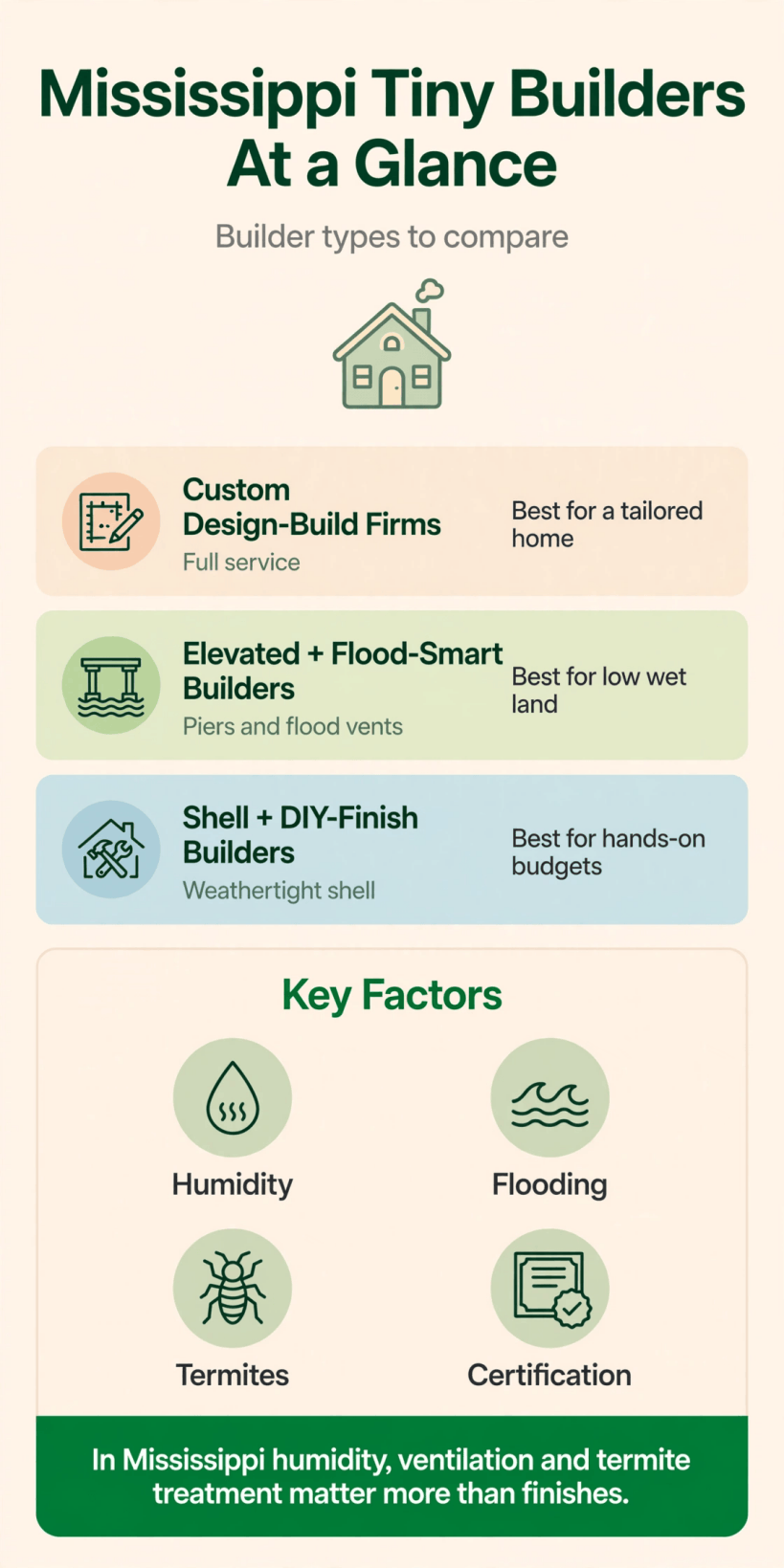
Mississippi at a glance: three builder types to compare, and the four factors — humidity, flooding, termites and certification — that matter most in this climate.
2. Start With County Rules and Placement
Mississippi has no single statewide answer for tiny homes. Counties and municipalities set their own zoning, minimum-size and placement rules, and land outside city limits can follow a different pattern again. Some parcels welcome a small home on a foundation, others treat a home on wheels as a temporary unit, and flood-zone land adds elevation and insurance conditions on top. The classification your parcel receives decides almost everything that follows.
Ask your county planning or permit office what category your home falls into, what permits the siting needs and whether utility connections change the answer, and keep the reply in writing. Our walkthrough of how to get a tiny house built, from first sketch to finished home maps the normal sequence, while our guide to how building codes treat unconventional small homes explains why the label attached to your home matters. Then ask each builder what they have already placed in your county — local experience shows up quickly in how fluently they talk about permits, inspections and flood paperwork.
3. Verify Licensing, Registration and Certification
Start with the business, not the brochure. Ask for the builder’s licensing and registration details, confirm they are current, and make sure the legal name on the documents matches the name on your contract. Ask what insurance the operation carries and expect paperwork to appear without drama. A builder who treats these requests as normal is showing you how the rest of the project will feel.
Certification deserves the same rigour. Ask which standard the home is built to, who inspects it during construction, and what documentation you receive at handover covering the structure and the hidden systems — wiring, plumbing and sealing are far easier to verify before wall panels close. Request stage photographs as a standing arrangement. Readers comparing states will recognise the same discipline in our guide to tiny house builders in Pennsylvania, where township paperwork plays the role that county and flood paperwork plays here. Documents first, design talk second, is the order that protects you.
4. Humidity, Ventilation and Moisture Control
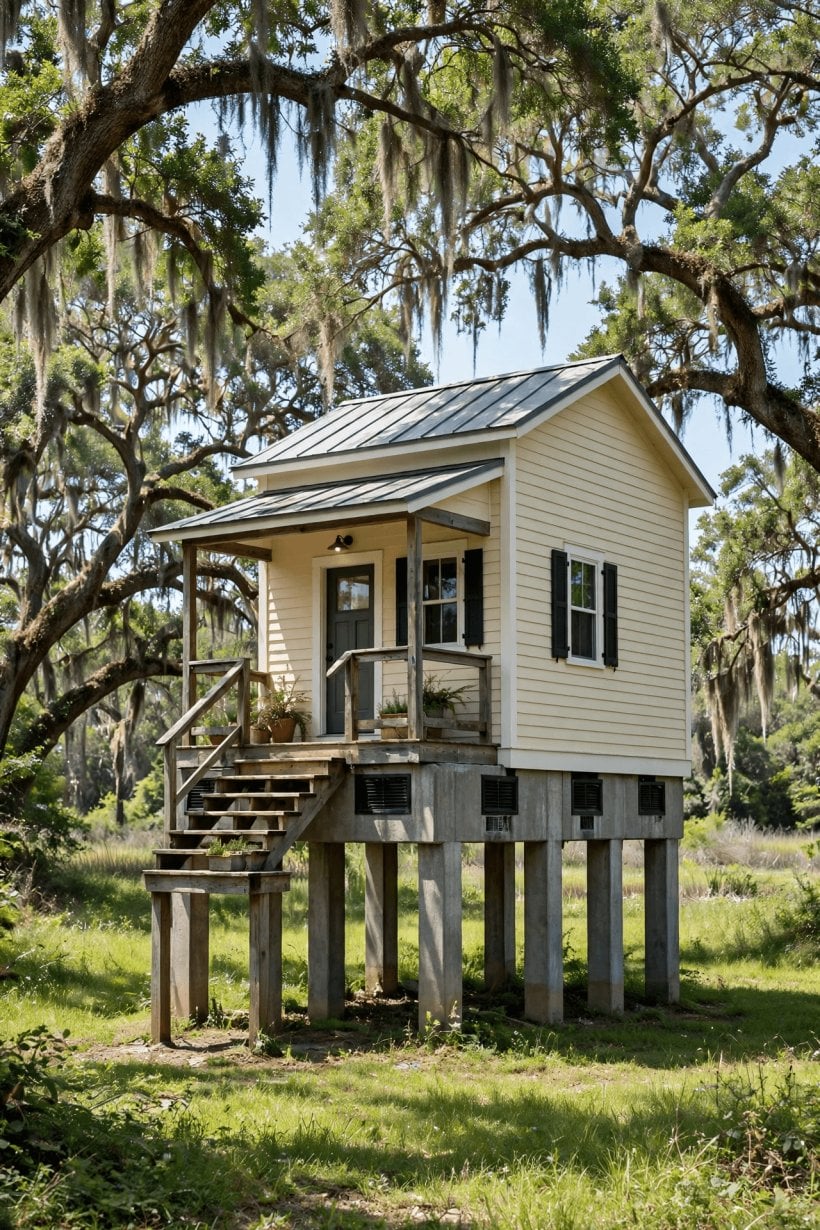
In Mississippi the enemy is damp. Long humid summers push moisture toward every joint and cavity, and a small home concentrates cooking, showering and breathing into a compact volume. Ask each builder how the home breathes: what ventilation is fitted, how bathroom and kitchen moisture is extracted, and whether a dehumidification plan is part of the specification or an afterthought you are expected to solve later.
Press on materials and detailing too. How are the floor edges, corners and roof junctions sealed against driven rain and condensation? What sits between the ground and the floor on an elevated build, and how is the underside protected from pests and splash-back? Our practical guide to how to seal and weatherproof tiny house sill plates and corners shows where small homes usually leak first. Whatever a builder promises on moisture — membranes, vents, treated timbers, extraction — it should appear in the written specification, because verbal assurances do not survive a humid August.
5. Flooding, Elevation and Storm Readiness
Ask where your parcel sits in relation to flood risk before you fall for a layout. Low land near rivers, creeks and the Gulf-facing counties can demand raised siting, and the infographic’s flood-smart category exists for exactly this reason: homes lifted on piers, with flood vents that let water pass rather than push, and drainage planned around the footprint rather than discovered after the first storm.
Wind readiness belongs in the same conversation. Ask how the home is anchored, what the roof and cladding are rated for, and how shutters or window protection are handled if your site is exposed. Ask, too, what the builder’s own completed homes have weathered locally — a reference buyer who has ridden out a storm season in the same design is worth a dozen showroom claims. The northern-state version of this thinking appears in our guide to tiny house builders in Illinois, where winter plays the role that water and wind play here.
6. Questions to Ask Every Builder
Ask the same questions of everyone and write the answers down side by side. The comparison, not any single answer, is what exposes weak spots.
- How many tiny homes have you completed in Mississippi, and may I visit one?
- Can I speak with recent buyers, including one on low or flood-prone land?
- What exactly is included in the quoted scope, and what is excluded?
- How is the home certified and inspected, and what paperwork do I receive?
- What moisture, ventilation and termite measures are standard in your builds?
- Who handles permits, elevation work and utility connections at my site?
- What payment stages do you propose, and what triggers each one?
- What timeline is realistic, and what tends to delay your projects?
Score the answers for clarity as much as content. Builders who answer directly, show documents unprompted and welcome reference calls are demonstrating their working style. Evasion at this stage is a preview, not a puzzle to solve after the deposit.
7. Delivery Radius and Rural Site Access
Many Mississippi sites are rural, which makes delivery a project in itself. Ask how far within the state the builder delivers, how the move is priced, and what they need to know about your route: gravel drives, low-hanging limbs, creek crossings, soft ground after rain and turning space at the parcel all change the plan. Share photographs and measurements early rather than hoping a standard truck day works out.
Agree responsibilities for siting day in writing — transport, positioning on piers or foundation, levelling, anchoring and who connects water, sewer or septic and power. Ask what the fallback is if the ground is saturated on the booked day, and what preparation is yours: a cleared path, a prepared base, trimmed access. Cross-state shoppers will find the counterpart discussion in our guide to tiny house builders in Virginia. The goal is a delivery that is planned on paper weeks ahead, not negotiated at your gate.
8. Warranty, References and Termite Protection
Read the warranty slowly. Establish what it covers — structure, roof, workmanship and fitted systems — how long each element runs, and the actual process for getting a fault fixed. Distance matters in a big rural state: clarify whether repairs mean a builder visit, a nominated local contractor, or shipped parts and guidance, and get that understanding into the contract documents rather than leaving it as a friendly assumption.
Termites deserve their own line of questioning in Mississippi. Ask what treatment and barriers are built in, what the new-owner maintenance expectations are, and whether any treatment warranty transfers to you. Then work the references: recent buyers, ideally through a full wet season, asked what went wrong and how the builder responded. Round out ownership planning with our guide to how to insure a tiny house once it is delivered, since flood-aware cover and builder paperwork often travel together at application time.
9. Understand What Drives the Cost
Headline prices mislead, because the specification underneath varies so much. The honest drivers are consistent: overall size and layout complexity; whether the design is stock or bespoke; elevation work such as piers and flood detailing; the moisture package of membranes, ventilation and treated materials; finish level inside; and any off-grid equipment. A shell route lowers the invoice by transferring interior work to you, which is a saving only if your time and skills are genuinely free.
Site costs form the second budget: base or pier preparation, delivery distance, placement equipment and utility runs frequently rival the gap between two builders’ quotes. If borrowing is involved, read our playbook on how to get a loan for a tiny house and our guide to tiny house mortgages and how lenders classify these homes before signing, because certification choices affect which lenders will engage at all. Prefer the builder who itemises drivers calmly over the one who defends a single lump sum.
10. Red Flags and the Final Comparison
Slow down if a builder cannot produce registration or insurance details, asks for most of the cost before work begins, or will not commit scope, specification and timeline to a written contract. Treat shifting answers on certification, no completed local homes to view, and moisture or flood questions brushed aside as the serious warnings they are in this climate. Pressure tactics — a vanishing build slot, a one-day discount — should end
Before you sign anything, run one final paperwork pass. Lay the written county answer, the builder’s registration and insurance documents, the certification explanation, the moisture and termite specification, the delivery and elevation plan and the warranty side by side, and read them as one connected story. Gaps announce themselves at this stage: a delivery promise with no anchoring detail, a warranty that ignores the systems most likely to fail, a specification that says nothing about ventilation. Each gap is simply a question to raise now, while raising it still costs nothing and changes can still be written into the deal.
Keep that bundle together after handover as well, with stage photographs and every inspection record the builder provides. In a humid, storm-tested state, the owners who fare best later are the ones who can produce documents quickly — for an insurance question, a warranty claim, a resale conversation or a future buyer who wants proof of how the home was actually built. Choose the builder who makes that file easy to assemble, and you will usually find you have also chosen the builder who built the home carefully in the first place.
conversations, not accelerate them.
For the final decision, compare like with like on one page: scope, moisture and termite specification, elevation and anchoring, certification paperwork, delivery and siting duties, warranty terms and payment stages. Readers cross-shopping the region can run the same test with our guides to tiny house builders in South Carolina and tiny house builders in Ohio. Keep a single project file — county answers, documents, photographs, warranty — from day one. In a state where water tests every home, the builder whose paperwork stays watertight is usually the one whose buildings do too.
Final Considerations
The right Mississippi builder is the one whose answers hold up in writing: registration verified, moisture and termite defences specified, flood and delivery plans matched to your actual parcel, and past buyers willing to vouch for the aftercare. Work the checks in order, keep every promise inside the contract, and the home that arrives will be ready for Mississippi weather — not just for delivery day.


0 Comments