

Arizona looks, from a distance, like tiny house country: cheap desert land, mild winters, wide-open counties, and a steady stream of people arriving with a house on a trailer and a plan. Then the paperwork starts. Arizona has no single statewide tiny house law, no state office that approves one, and no universal answer to the question of whether you may live in one. Ask three Arizona counties and you may get three different answers, because tiny house laws arizona is not one law at all — it is a patchwork of county zoning ordinances, city building codes, state vehicle rules, and health-department septic rules, and the patch that governs you is the one your parcel sits in.
This guide maps that patchwork the way an Arizona building department sees it. We explain the legal difference between a tiny house on wheels and one on a foundation, how building codes are adopted in Arizona and where the IRC tiny-house appendix fits, what minimum sizes apply, how zoning and placement rules work, the new statewide push on accessory dwelling units, where you can actually live legally, what permits and inspections to expect, and the counties and cities worth knowing — finishing with the practical steps and the mistakes that cost people money. Rules cited here are described at the level Arizona applies them; because every jurisdiction amends its code on its own calendar, treat this as your map for the conversation, and confirm specifics with the county or city before you spend.
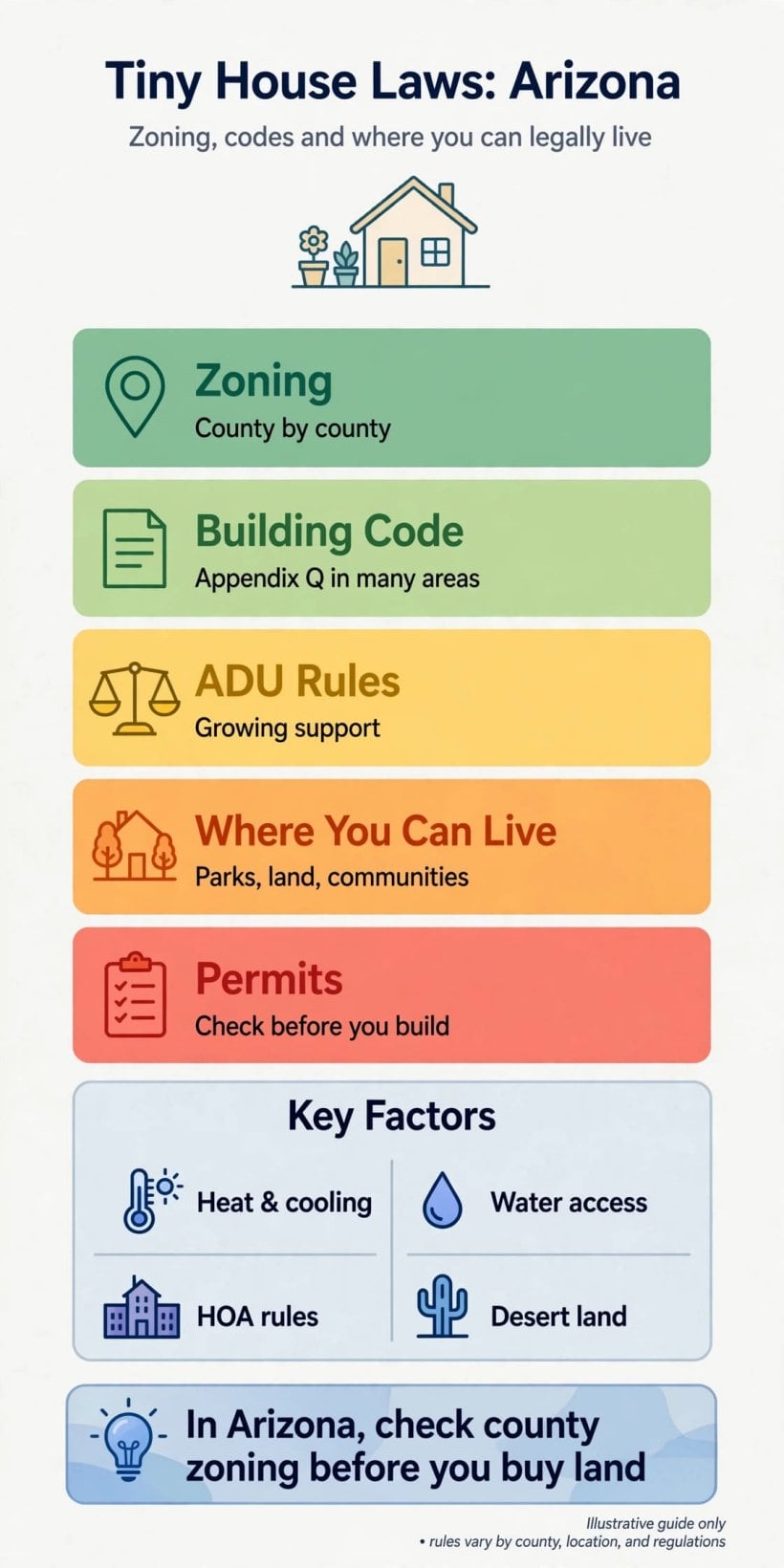
1. Tiny House Laws in Arizona at a Glance
| Question | Short answer |
|---|---|
| Is there one statewide tiny house law? | No. Zoning and building codes are adopted and enforced locally in Arizona, so legality is decided by your county or city. |
| Can I live in a tiny house on wheels full-time? | Only where local rules allow it — typically in RV parks, approved tiny house communities, or as an RV your zoning code permits on the lot; most residential zones do not accept a THOW as a permanent dwelling. |
| What code covers a tiny house on a foundation? | The locally adopted residential building code, which is IRC-based in most Arizona jurisdictions. Some have adopted the IRC tiny-house appendix; many have not. |
| Is there a minimum house size? | No statewide minimum. The IRC tiny-house appendix addresses dwellings of 400 square feet or less; local zoning may set its own minimum dwelling size. |
| Can a tiny house be an ADU? | Often, yes. State legislation passed in 2024 requires Arizona’s larger cities to allow accessory dwelling units on single-family lots; the size, parking, and owner-occupancy details are set locally. |
| Where is it easiest to live legally? | On unincorporated county land with permissive zoning, in an established tiny house or RV community, or in a permitted ADU behind an existing house. |
| What should I do first? | Take the parcel number to the local planning and zoning office, ask what that zoning district allows, and get the answer in writing before buying land or a house. |
2. Legal Status: Tiny Houses on Wheels vs on a Foundation in Arizona
Everything in Arizona starts with one classification question: is your tiny house a vehicle or a building? A tiny house on wheels that keeps its trailer, axles, and title is treated in most of the state as a recreational vehicle. That status is both its freedom and its cage. As an RV it can be manufactured to the RV standard, titled and registered through the Arizona Motor Vehicle Division, towed legally, and parked anywhere RVs are welcome — campgrounds, RV resorts, and communities licensed for them. But RV status also means most zoning codes do not recognise it as a dwelling. A residential lot that happily accepts a house usually does not accept full-time living in a vehicle parked on it, and many Arizona cities and counties limit how long an RV may be occupied on a residential parcel, or prohibit it outright.
A tiny house on a foundation plays by the opposite rules. Once the home is permanently sited — wheels and tongue removed, set on a foundation, connected to utilities — Arizona treats it as what it plainly is: a small single-family dwelling. It must then meet the local building code in full, sit in a zoning district that allows dwellings of its size, and pass the same inspections as any house. In exchange, it gains what the wheeled house can never have: unambiguous legal residence, a certificate of occupancy, mortgage and insurance options as real property, and the right to stay. Certification bridges the two worlds more often than people expect — an RVIA-inspected build reassures lenders, insurers, and some building officials alike, which is why what RVIA certification is and why your tiny house needs it is worth reading whichever route you choose, and the registration pathway itself is set out in our guide to how to register a tiny house as an RV.
3. Building Codes in Arizona: Local Adoption and the Tiny-House Appendix
Arizona is a home-rule state for building safety: there is no state-mandated residential building code that descends on every parcel, and no state inspector who will sign off your tiny house. Instead, each city and county adopts its own code — almost always an edition of the International Residential Code (IRC), sometimes with local amendments for desert conditions — and enforces it within its boundaries. One county may enforce a recent IRC edition with a full permit office; a rural neighbour may enforce an older edition, or administer permits with a much smaller staff. The code that applies to you is the one adopted where the house will sit, in the edition in force on the day you apply, which is why two identical tiny houses twenty miles apart can face different requirements.
The single most useful question you can ask a building department is whether it has adopted the IRC’s tiny-house appendix — Appendix Q in the 2018 IRC. Where adopted, the appendix gives a small dwelling a recognised compliance path: it relaxes ceiling heights in lofts, allows compact stairs and ladders to lofts, and accepts smaller room dimensions than the base code, all for dwellings of 400 square feet or less. Where it has not been adopted, the base code applies unmodified, and details like loft headroom and stair geometry become negotiation points rather than entitlements. Our explainer on IRC Appendix Q for tiny homes walks through what the appendix changes and what it does not. Do not assume your jurisdiction’s status from a neighbouring one — ask, and ask again if the code cycle has recently turned over.
4. Minimum Sizes and Space Standards
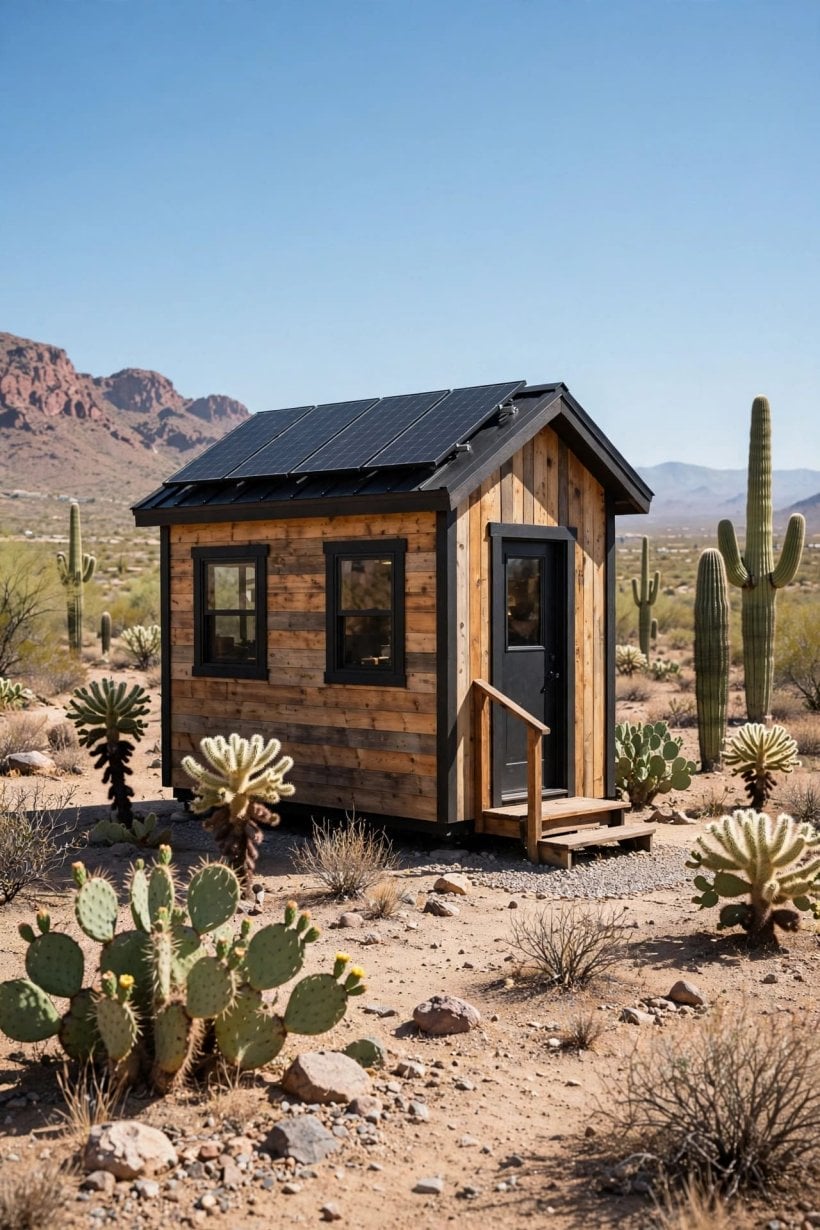
Arizona sets no statewide minimum house size, which surprises people who have fought minimum-square-footage rules elsewhere. The constraints you will actually meet are layered underneath. First, the definition itself: the IRC tiny-house appendix tops out at 400 square feet of floor area (excluding lofts), so a foundation build larger than that is simply a small house under the regular code. Second, the habitability floor of the base residential code: at least one habitable room of a minimum area, minimum ceiling heights (with the appendix’s relaxations for tiny houses and lofts where adopted), light and ventilation requirements, and safe emergency escape from sleeping areas — a loft bedroom still needs a compliant way out in a fire. Third, local zoning: some Arizona communities historically wrote minimum dwelling sizes into their zoning ordinances, separate from the building code, and those minimums survive in places even where the building department would happily permit a smaller home.
In practice, the sizes that clear Arizona review most easily are foundation homes in the 200 to 400-square-foot range, designed with the appendix in mind whether or not it has been locally adopted, because a plan that satisfies the appendix usually satisfies an unamended code with minor adjustments. For houses on wheels, floor area matters less to the state than the vehicle’s dimensions and weight for registration and towing — but the park or community you aim for may have its own size rules, and an insurer will measure the home before it prices it. Measure your design against all three layers — appendix, base code, zoning — before you build, not after.
5. Zoning and Placement: Where a Tiny House May Sit
Zoning is where most Arizona tiny house plans quietly succeed or fail, because zoning — not the building code — decides what may be placed on a piece of land in the first place. Every parcel in an Arizona city, and most parcels in populated county areas, carries a zoning district: single-family residential, rural or agricultural, manufactured-home, recreational-vehicle, and the rest. A foundation tiny house needs a district that permits a single-family dwelling and does not impose a minimum size the home cannot meet. A tiny house on wheels needs a district that permits RV occupancy or a park/community approval — a much shorter list. Setbacks, lot coverage, and height limits then shape exactly where on the parcel the home may sit, and utility easements can remove the obvious spot from play entirely.
Two Arizona wrinkles deserve emphasis. The first is the split between city and unincorporated county land: the same road can pass parcels governed by different rules, and county zoning in rural districts is often markedly more permissive about small dwellings, alternative construction, and living on your land while you build. The second is private rules layered on top of public ones — HOA covenants and deed restrictions bind a large share of Arizona subdivisions and can prohibit tiny houses, RV occupancy, or small minimum sizes regardless of what the county allows; no permit office will warn you about them, because they are not the county’s to enforce. Learning to interrogate all of this before you commit is a skill in itself, and our guide to zoning laws for tiny houses and talking to officials covers the questions to ask and how to ask them so the answers hold up later.
6. Tiny Houses as ADUs in Arizona
The accessory dwelling unit is the fastest-moving door into legal tiny living in Arizona. An ADU — a casita, guest house, or backyard cottage — is a second, smaller dwelling permitted on a lot with an existing single-family home, and a purpose-built tiny house on a foundation is an ADU in everything but name. The state’s direction of travel is clear: legislation passed in 2024 requires Arizona’s larger cities to allow ADUs on single-family lots rather than leaving them to case-by-case discretion, and several cities had already liberalised their own rules before the state acted. The practical details — maximum ADU size, whether it may be rented long-term, parking requirements, and whether the owner must live on the lot — remain local, and they differ meaningfully from city to city.
For tiny house hunters, the ADU route has three distinct advantages. It puts you in established neighbourhoods with water, sewer, and power already at the lot line, instead of raw desert where every utility is a project. It gives the tiny house an unambiguous legal identity as a dwelling, with permits and inspections to match. And it can serve either side of the arrangement: build an ADU behind a house you own, or — increasingly common in Arizona’s cities — rent a backyard arrangement from a homeowner who has permitted one. What the ADU route does not usually do is help a house on wheels: most ADU ordinances require a permanent foundation and building-code compliance, so the wheeled house stays in the RV world described in Section 2.
7. Where You Can Legally Live in a Tiny House in Arizona
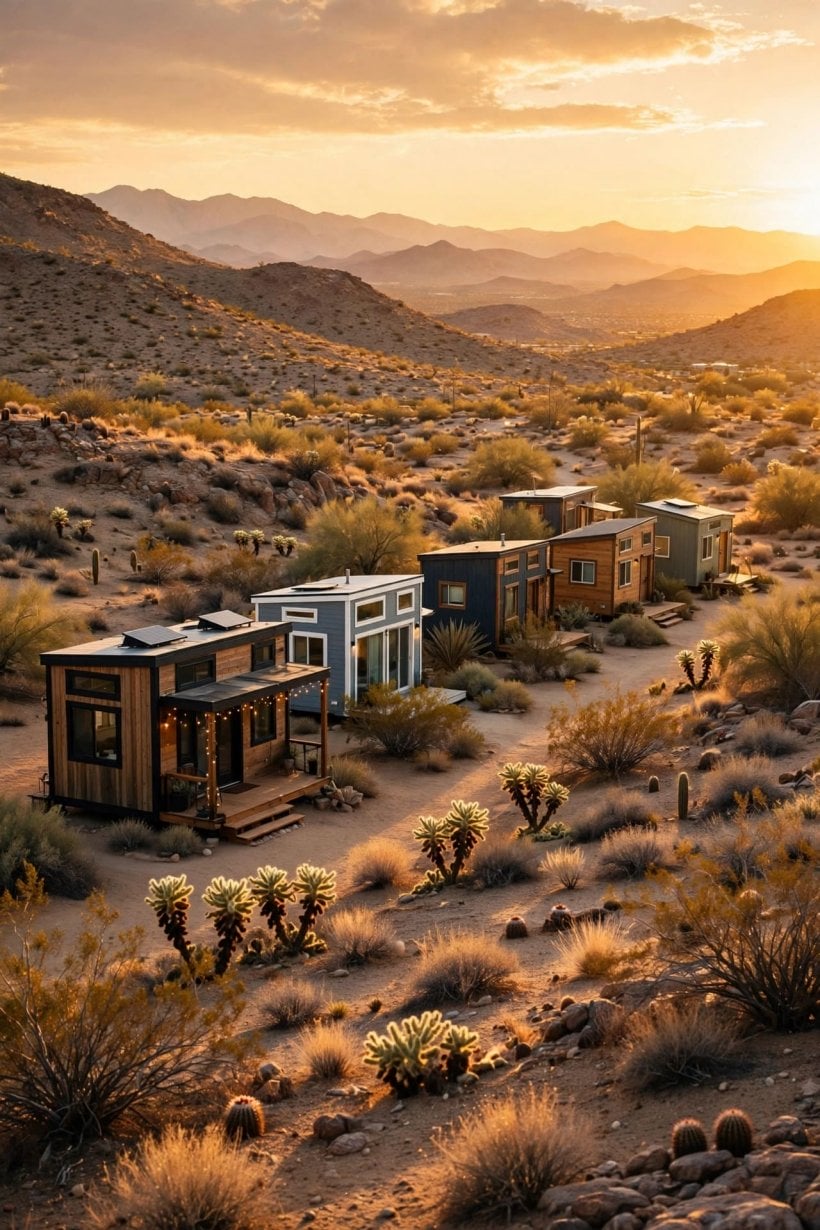
Putting the pieces together, there are four well-trodden legal homes for a tiny house in Arizona. First, as a permitted primary dwelling on your own land — a foundation build (or, in the most permissive rural counties, other arrangements the county will actually permit), in a zoning district that allows it, with water and septic or sewer solved. Second, as an ADU behind an existing house, under the rules in Section 6. Third, in a community built for it — RV resorts, tiny house communities, and manufactured-home parks that accept tiny houses on wheels or park models, concentrated around the Valley, Tucson, and the high-desert towns; you rent or buy the lot, the community handles the zoning identity, and length-of-stay rules are the operator’s rather than the county’s. Fourth, on rural unincorporated land in counties with light-touch enforcement — a genuine Arizona tradition, but one that still requires the zoning to allow the use and the health department to approve your wastewater plan; light-touch is not no-touch.
Notice what is not on the list: parking a wheeled tiny house on a random residential lot and calling it storage while living in it, or buying scenic desert land first and asking questions later. Both patterns end in code-enforcement complaints, and Arizona code enforcement — usually triggered by a neighbour — can require removal regardless of how long you have been there. If you are shopping for land with a tiny house in mind, our guide to where to buy tiny house lots explains how to screen parcels for zoning, utilities, and access before the romance of a listing takes over.
8. Permits, Inspections, and Fees
For a foundation tiny house, expect a recognisably conventional process with a smaller building at the end of it. You submit a site plan and construction documents to the city or county building department; the plans are reviewed against the locally adopted code edition (and the tiny-house appendix, if adopted); a building permit issues; and inspectors visit at the usual milestones — foundation, framing, electrical, plumbing, mechanical, and final — before a certificate of occupancy confirms the home may be lived in. Separate approvals usually run alongside: a septic permit from the county environmental or health department if you are not on sewer (a genuine design constraint on desert land, where soil and separation distances rule out some parcels), water service or a well permit, and driveway or grading permits where the county requires them. Fee schedules are local and usually scale with valuation or square footage; get the current schedule from the department rather than budgeting from a neighbour’s 2019 project.
For a house on wheels, the permit burden shifts rather than disappears. There is no building permit for the RV itself, but titling and registration through the Motor Vehicle Division, sales or use tax on purchase, and the host site’s own requirements take its place — a park’s application, a county permit for an RV pad and hookups, or an ADU-style review if a city treats your placement as one. Desert practicality belongs in this section too: an Arizona summer is a building system, not a season. Insulation, shading, and cooling capacity that would be generous in most states are survival equipment at 110 degrees, and inspectors, insurers, and your own electric bill will all have opinions about a home that cannot hold a safe interior temperature. Design for the heat on paper, where it is cheap.
9. City and County Examples Worth Knowing
Maricopa County and Phoenix. The Valley is Arizona’s strictest environment for informal tiny living and its most developed for the ADU route: Phoenix moved early to allow backyard casitas, and the larger Valley cities have been revising their ADU rules under the state’s 2024 direction. Wheeled tiny houses as primary dwellings on residential lots are generally a non-starter; permitted ADUs and licensed communities are the realistic doors. Pima County and Tucson. Tucson has cultivated a comparatively open posture toward small dwellings and ADUs, and Pima County’s code framework is frequently cited by Arizona tiny house builders as workable — still verify the parcel’s zoning and the current code edition rather than relying on reputation. Coconino County and Flagstaff. High-country Arizona brings real winters and, with them, snow-load and energy requirements that shape design; the Flagstaff area has seen sustained local discussion of tiny houses and small-lot housing, and county rules have been evolving — current code, confirmed in person, is essential here. Yavapai County. The Prescott area and the Verde Valley host established tiny house and RV communities and a meaningful number of rural placements on unincorporated land. Cochise County. Rural Cochise County is widely known in alternative-building circles for an owner-builder pathway that reduces inspection burdens for eligible rural homes — a real feature of the county’s approach, but one with conditions and limits; confirm eligibility with the county before designing around it.
Read those examples the right way: they are a shortlist of where to start asking, not a set of promises. Arizona jurisdictions amend codes frequently, staff interpretations vary, and a rule quoted from a forum post may be two code cycles old. The county examples above share one trait — each has a planning office that has actually thought about small dwellings — and that, more than any single ordinance, is what makes a project feasible.
10. Practical Steps and Common Pitfalls
The sequence that works, in order. Step one: choose the legal identity first — foundation dwelling, ADU, or RV — because it dictates the land, the code, and the budget. Step two: shortlist land only inside zoning districts that accept that identity, and verify the specific parcel with the planning office, in writing, including HOA and deed-restriction checks through the title record. Step three: solve water and wastewater before anything else — on rural Arizona land, the septic approval and a legal water supply (utility connection, well, or an approved hauled-water arrangement) decide more projects than the house does; our walkthrough of how to prepare land for a tiny house covers the full site checklist. Step four: design to the code your jurisdiction enforces, using the tiny-house appendix as your template even where it is not formally adopted. Step five: permit, build, inspect, and keep every approval in a file — the paper trail is the house’s legal identity for every future insurer, lender, and buyer. Financing threads through all of it: a foundation home can reach for mortgage-family money while a wheeled home borrows as a vehicle, and our guide to how to finance a tiny house maps those channels before you are committed to one.
The pitfalls repeat with metronome regularity. Buying land before checking zoning — the single most expensive Arizona mistake, because desert land is easy to buy and hard to resell. Assuming a state law exists that will rescue a local prohibition; it will not. Ignoring water: a parcel without a legal, reliable water supply is a campsite, not a homesite. Forgetting the HOA layer in subdivisions. Under-designing for heat, then discovering that a certificate of occupancy and a survivable July are different tests and you must pass both. And finally, trusting a seller’s or a forum’s summary of a county’s rules over the county’s own written answer — in a home-rule state, the office that enforces the rule is the only summary that counts.
Final Considerations
Arizona rewards tiny house owners who do the local homework and punishes, with real consistency, the ones who assume the desert’s openness extends to its rulebooks. There is no state permit to win and no state prohibition to fear: there are fifteen counties and dozens of cities, each with a zoning map, a code edition, and a planning counter where your project’s fate is actually decided. Choose your legal identity first, verify your parcel in writing, design for the code and the climate you truly have, and Arizona’s version of tiny living — a small, permitted, permanent home under a very large sky — is entirely achievable. Start with the parcel number and the planning office; everything else in this guide exists to make that conversation go well.



0 Comments