

This tool solves the “Cold Floor” problem. It compares the three most common skirting methods—Rigid Foam, Hay Bales, and Vinyl Kits—calculating not just the material cost for your specific perimeter, but also the “Warmth Factor” (R-Value) and “Rodent Risk”.
It includes an interactive “Wind Chill Simulator” that visualizes how skirting stops the wind from stripping heat away from your floor plumbing.
Cold floors are rarely a heating problem. They are a wind problem: air pours under an exposed trailer, strips heat from the floor and plumbing, and leaves pipes exposed. Good tiny house skirting for winter closes that gap — and the right material matters.
This guide compares rigid foam, hay bales and vinyl kits honestly, then hands you the calculator to run your own perimeter.
1. At a Glance: Tiny House Skirting for Winter Compared
Skirting is the barrier fitted around the base of a parked tiny house, closing the open space between the ground and the bottom of the trailer frame. It is not decoration. In cold weather that gap is where wind chill does its damage, where floor plumbing sits exposed, and where the earth’s warmth escapes sideways instead of rising into your home. The calculator below compares the three methods owners actually use — rigid foam, hay bales and vinyl kits — against your own trailer dimensions, so the comparison starts from your perimeter, not a generic package size.
| Skirting method | Warmth factor (R-value) | Risk factor | Best understood as |
|---|---|---|---|
| 2-inch rigid foam (XPS) | R-10 | Best overall | An insulated, wind-stopping wall around the crawlspace |
| Straw / hay bales | R-30 | High rodent risk | Powerful insulation that doubles as animal habitat |
| Vinyl skirting kit | R-1 | Wind break only | A neat barrier that blocks wind but barely insulates |
| No skirting at all | None | Frozen-pipe exposure | Under-trailer air matching the outside air — 10°F in the calculator’s example |
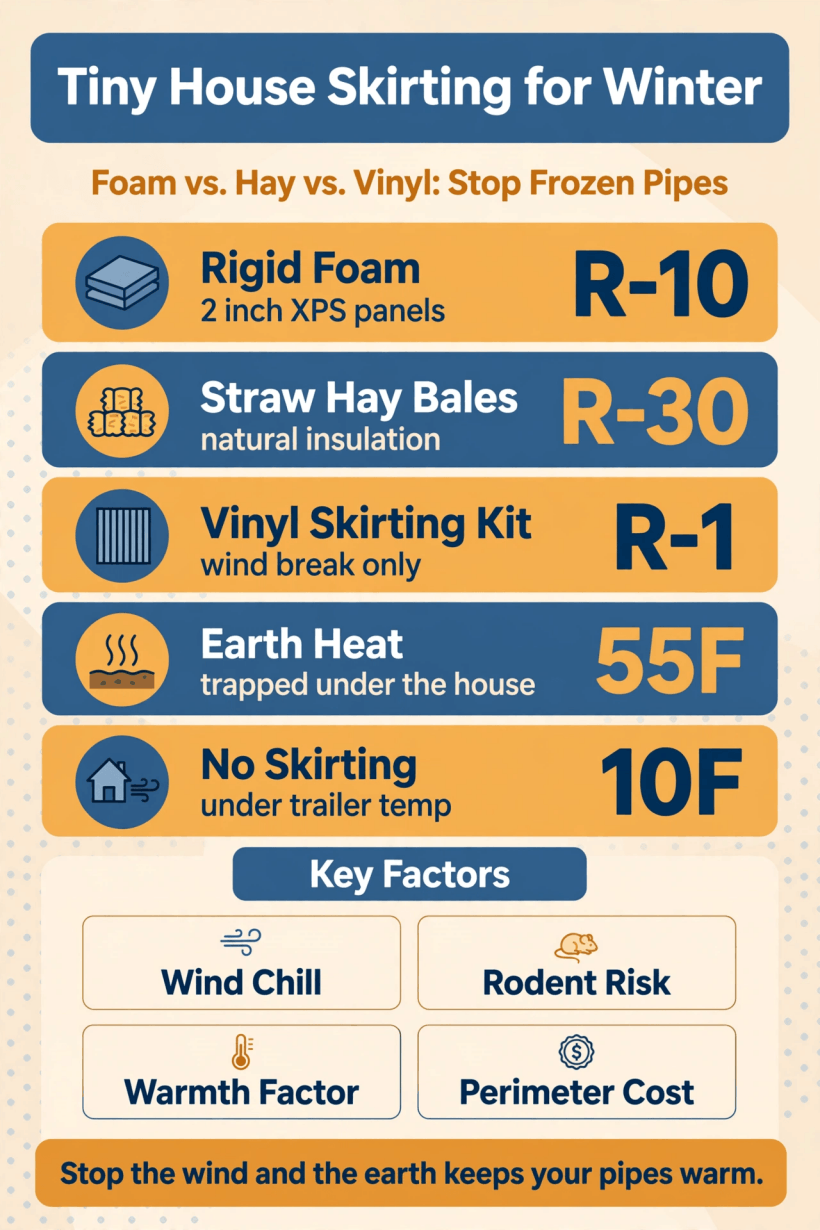
The three skirting methods at a glance: foam at R-10, hay at R-30 with a rodent warning, vinyl at R-1 — and the roughly 55°F earth heat that skirting traps underneath.
Two numbers explain the whole topic. The first is the earth’s natural heat, roughly 55°F: skirting works less by insulating the floor directly and more by trapping that ground warmth in a still, enclosed crawlspace. The second is the gap between materials — R-30 hay looks unbeatable on paper until the risk column enters the conversation. The best choice balances warmth, risk and your own perimeter cost, not the biggest R-value.
2. The Cold Floor Problem: Why Wind Wins
Every tiny house on wheels sits up off the ground on its trailer, and that raised floor is the design’s cold-weather weakness. A house on a foundation borrows the earth’s stability; a house on a trailer exposes its whole underside to moving air, and wind under the frame carries heat away from the floor continuously, the way a breeze cools skin. The calculator frames this as the “Cold Floor” problem, and its Wind Chill Simulator makes the invisible visible: outside air and under-trailer temperatures track each other, and the cold cabin stops being a mystery.
The floor is only part of the loss. Plumbing runs beneath many tiny houses, and exposed pipes in moving cold air are the classic route to a burst line. Skirting attacks the cause: stop the air movement and the space under the house holds heat instead of surrendering it. The layered thinking applies inside the build too — our floor insulation calculator for tiny houses covers the insulation built into the floor itself, which pairs with skirting rather than competing with it.
3. Measure First: Length, Width and Height off Ground
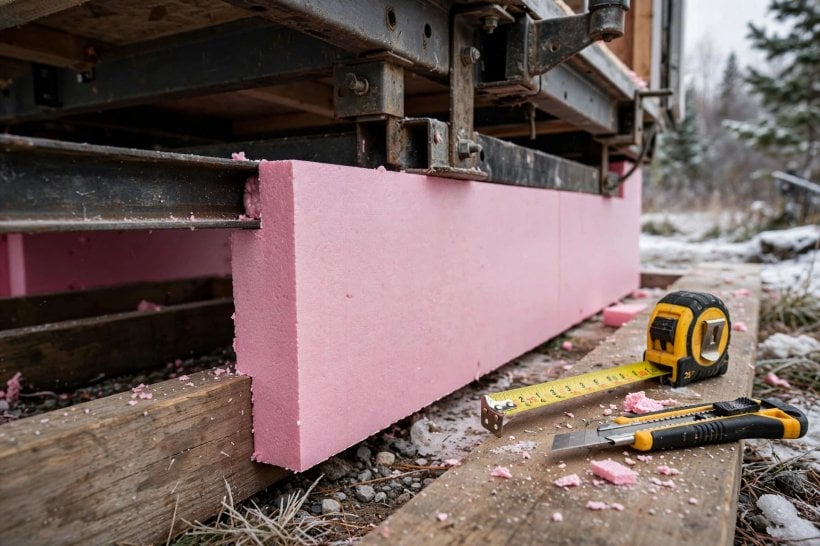
The calculator opens with three inputs — trailer length, trailer width and height off the ground, measured from the ground to the bottom of the frame — and those three numbers drive everything else. Length and width set the perimeter, and perimeter is what you actually buy: skirting material is sold and cut by the run, so a longer house needs proportionally more of it, and the cost comparison in the tool is explicitly built “based on” your linear feet. Guessing the perimeter is how owners end up one panel short in November.
The height input is the one people rush. “Average” is the honest instruction in the tool, because few parking spots are perfectly level: the gap under a trailer is usually taller at one end than the other. Measure at several points, average them, and remember that panels, bales and kits all have to cover the tallest gap without leaving a slot at the bottom for wind — and animals — to use. A skirt that stops two inches short of the ground is a wind tunnel with good intentions.
Measuring is also the moment to walk the perimeter and note what the skirting must work around: the hitch end, utility hookups, steps and access to tanks or valves. A sealed crawlspace still needs a way in — plan that access point now, not with frozen fingers later.
4. Rigid Foam: The R-10 All-Rounder
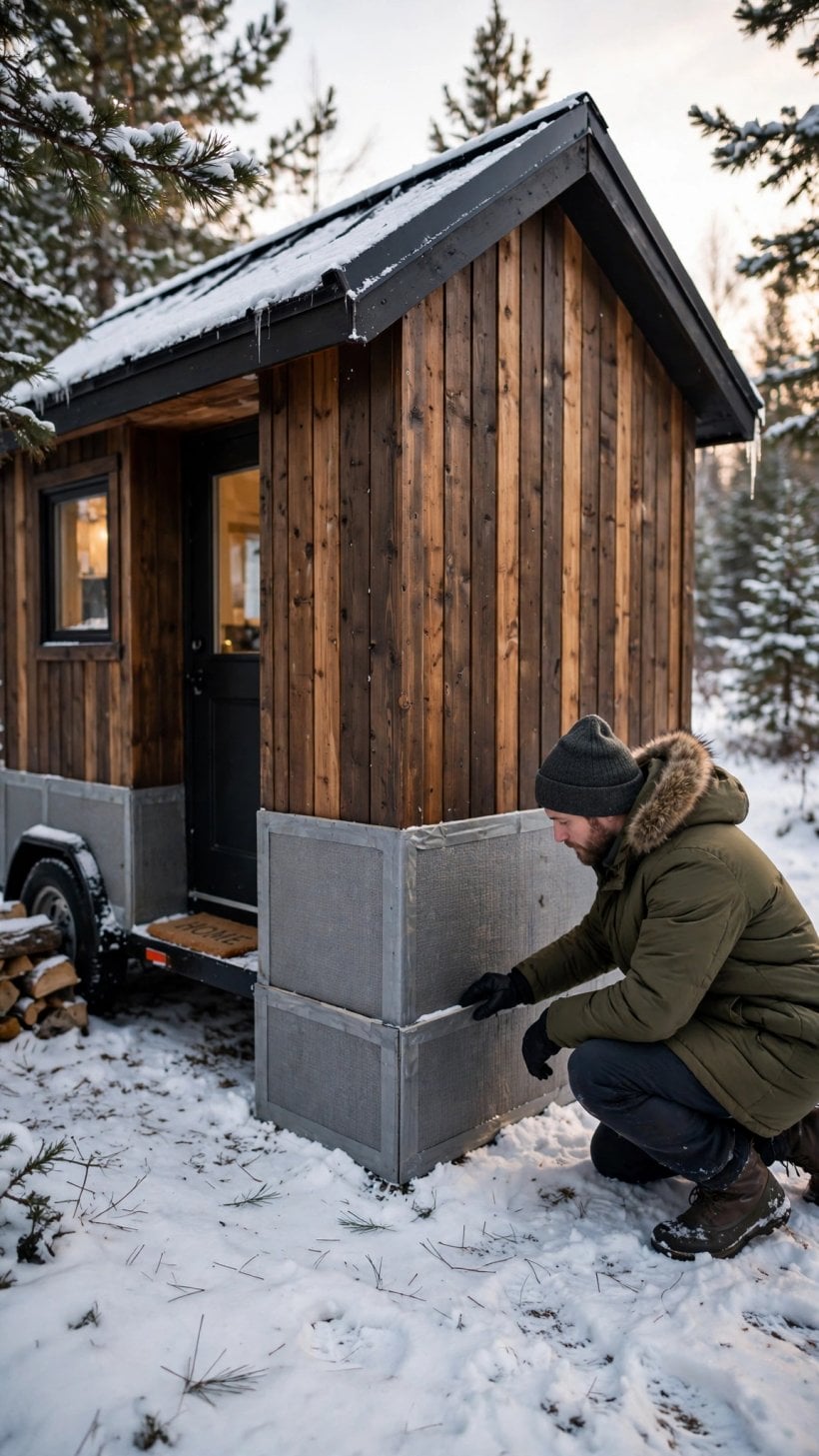
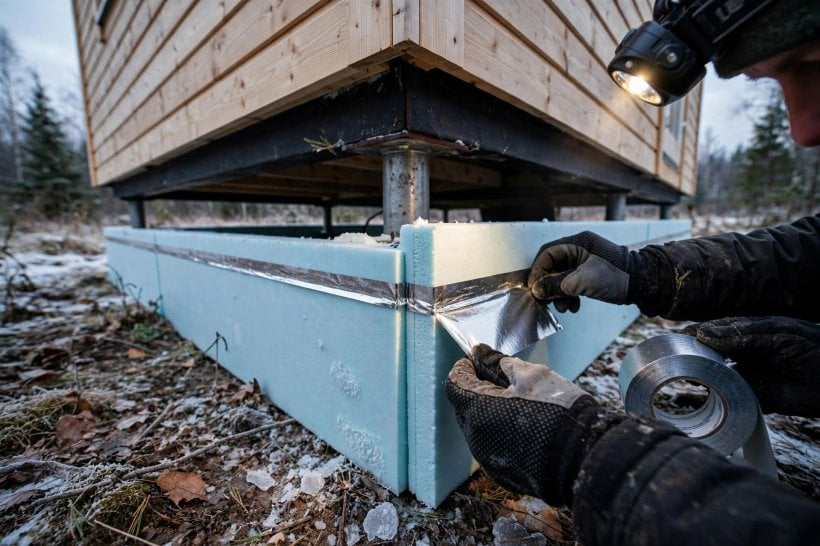
Rigid foam is the method the calculator rates “Best overall,” and the reasoning is balance rather than extremes. Two-inch XPS panels deliver R-10 — a genuine insulation value, not just a wind break — in a material that is light, cuttable with basic tools, and indifferent to moisture. Fitted snugly around the frame, foam panels stop the wind completely and add a real thermal layer, so the crawlspace can hold the earth’s warmth the way the geothermal principle intends. It is the only one of the three options that scores well on warmth and risk at the same time.
Foam also behaves predictably over a season. It does not slump, settle or rot, and it offers mice nothing to nest in and nothing to eat. Panels can be removed in spring, stored flat and refitted the following winter, spreading their cost across years. Seams matter more than thickness: taped or tightly butted joints keep the barrier continuous, because wind exploits gaps, not averages.
The honest drawbacks are appearance and fragility. Bare foam looks like a work site unless faced, painted or covered, and panels can crack if struck. Many owners treat foam as the functional core and dress it to taste. What matters is that its estimated cost buys the balanced option — the one with no failure mode hiding in the risk column.

5. Hay Bales: The R-30 Myth
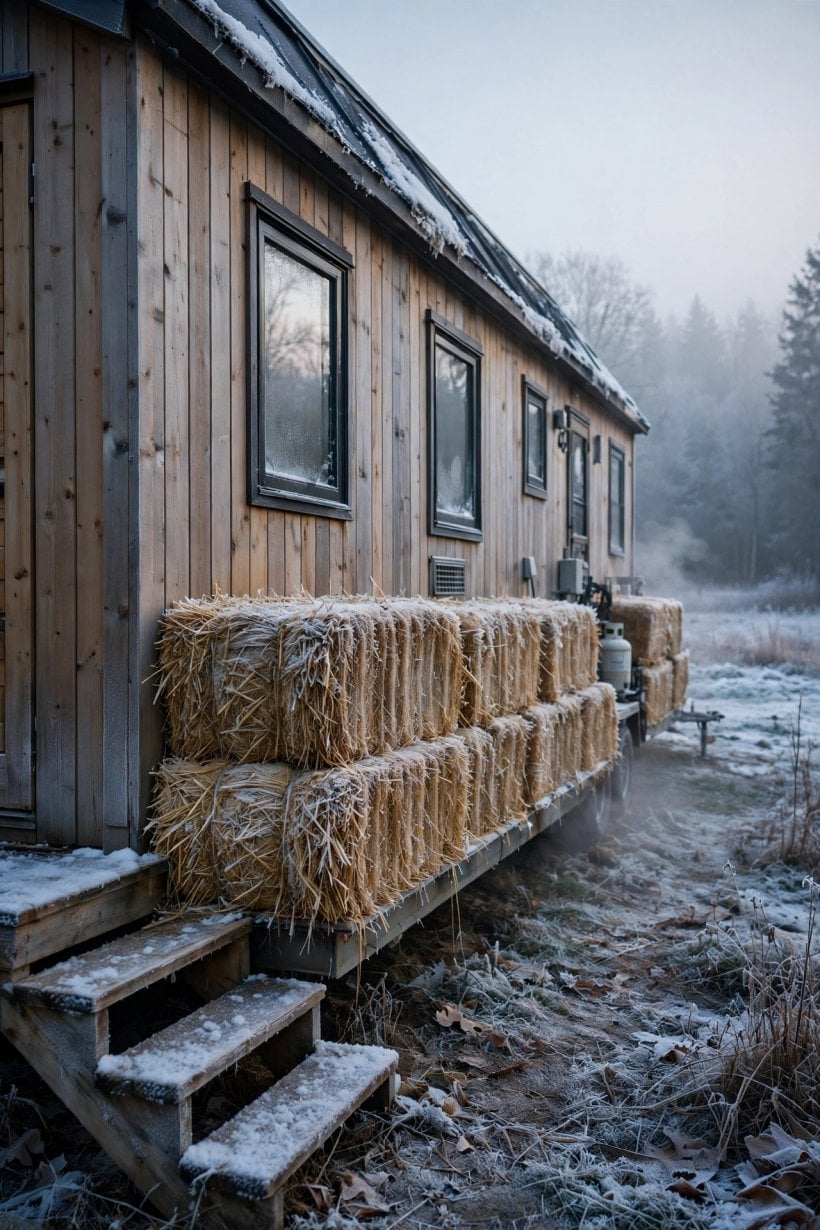
Hay is the seductive option, and the calculator names the section plainly: “The Hay Bale Myth.” On insulation value alone the case looks closed — straw and hay bales rate around R-30, three times the foam figure, from a material that is cheap, widely available and simple to stack around a trailer. Generations of farm buildings have used bales exactly this way, and the first cold snap after stacking them usually feels like vindication: the wind stops, the floor warms, the pipes survive.
The tool’s counter-argument is biological. Hay is, in its words, a magnet for mice looking for a warm winter home — a stacked bale is shelter, bedding and proximity to a heated floor in one package. Once rodents nest in the bales, the calculator warns, they eventually chew through the tiny house underbelly, trading a heating problem for damaged bellies, wiring and insulation. The second failure is water: when hay gets wet it rots and molds against the frame, holding moisture exactly where a steel trailer and timber floor least want it, all season long.
None of this makes hay useless in an emergency — a sudden freeze with bales on hand beats bare intentions. It makes hay a poor default: treat it as a monitored, single-season measure, inspect for nesting, and plan removal in spring. Moisture against the structure runs through the whole envelope; our vapor barrier placement guide for tiny houses covers the same discipline inside the walls and floor.
6. Vinyl Kits: A Wind Break, Honestly Labelled
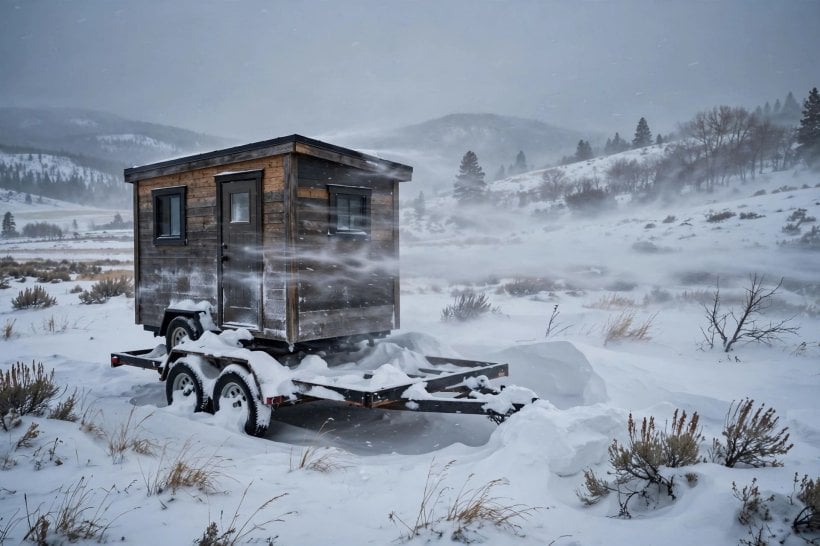
Vinyl skirting kits are the tidy, familiar option — the same style of kit sold for mobile homes for decades — and the calculator labels them with unusual honesty: R-1, “wind break only.” That is not a dismissal. Stopping the wind is the single most important thing skirting does, and a well-fitted vinyl kit does it neatly, with a finished look that foam cannot match and a system of rails and panels designed to go up quickly around a standard perimeter.
What R-1 means in practice is that the kit contributes almost no insulation of its own. The crawlspace behind vinyl depends entirely on trapped earth heat and still air, and on the coldest nights it sits closer to outside temperatures than it would behind insulated panels. Owners in milder cold may never notice. Owners facing sustained sub-zero air — the comparison runs at 10°F — are asking a wind break to do an insulator’s job too.
Vinyl’s strengths are order and acceptance: it looks like a finished foundation, satisfies landlords and parks that object to bales or bare foam, and its panels remove individually for access. Read its cost line as the price of neatness plus wind protection, and decide whether your climate lets a wind break be enough. Where it is not, the gap must be closed by insulation somewhere — skirt, floor, or both.

7. The Geothermal Effect: Trapping 55°F
The most important idea in the calculator reframes the whole purchase: “The goal of skirting isn’t just to insulate the floor; it’s to trap the earth’s natural heat (roughly 55°F) under your house.” Earth a short distance down holds a moderate temperature through the season, and an enclosed crawlspace lets that warmth accumulate instead of being stripped sideways by wind. Skirting builds a tiny earth-sheltered room under your floor.
This is why the Wind Chill Simulator matters as a teaching tool. With no barrier, the under-trailer temperature in its example sits at the air temperature — 10°F — because moving air constantly resets it. Close the perimeter and the trapped space can climb toward the earth’s figure, keeping pipes liquid, in the calculator’s phrase, “even in sub-zero air temps.” The difference between those two under-trailer temperatures is the entire return on a skirting project, and it is mostly bought by stopping air movement, which is why even the R-1 vinyl kit transforms conditions compared with nothing.
The geothermal effect also explains skirting’s limits. It is a passive store, not a heat source: a house on exposed rock, deep frost or a site where the crawlspace cannot be closed will harvest less of it. It pairs with, rather than replaces, the rest of the winter envelope — the whole-house logic behind our guide to heating a tiny home in winter.

8. Rodent Risk: The Column People Skip
Every comparison table has a column readers skim, and in this calculator it is “Risk Factor.” That column exists because winter skirting creates exactly what small animals are searching for in cold weather: a dark, windless, earth-warmed cavity against a heated floor. The skirt that protects your pipes also advertises shelter, and the material you choose decides whether that advertisement comes with nesting material included. Hay scores “High Rodent Risk” because it is simultaneously the wall and the bedding.
Foam and vinyl do not feed or house rodents, but no skirting is a sealed vault, and the calculator’s warning about mice chewing through the underbelly deserves respect with any material. Gaps at corners, utility penetrations and access hatches are the entries; a careful fit is a pest measure as much as a thermal one. Sealing the envelope is one connected discipline — the thinking that keeps condensation out of wall cavities in our flash coat mold prevention simulator applies here too, in simpler form.
Treat rodent risk as seasonal maintenance, not a one-time decision. Walk the perimeter after storms and thaws, looking for tracks, gaps and gnawing. The costliest skirting failure is rarely the material bill — it is the chewed underbelly or the nest discovered in spring, which is what the risk column is quietly pricing in.
9. Cost per Perimeter: Reading the Comparison Properly
The calculator’s “Cost & Performance Comparison” calculates from your linear feet, which is the right way to shop: materials are bought by the run, so a long house with a tall gap is simply a bigger project, and per-package prices mislead. Enter your real dimensions and all three estimates are priced against the same perimeter and the same height off ground.
Read the estimates alongside the other two columns before treating the cheapest line as the winner. A low material cost with R-1 performance may need help from floor insulation or heat tape to survive the coldest nights; a low cost with a high rodent risk carries a maintenance and damage expectation that never appears on the receipt. Foam’s position in the table — mid-pack on insulation, best on risk — is why the calculator calls it the best overall rather than the cheapest or the warmest.
Also budget the extras the table cannot know: ground preparation on a sloping site, fasteners and seam tape, an access hatch, and facing or paint if bare material will not satisfy your landlord, park or eye. They do not change which material wins; they change what finishing properly actually costs.
10. Putting It Together: A Winter-Ready Base
A sound skirting plan follows the calculator’s own order. Measure honestly — length, width, averaged height off ground. Choose by balancing warmth factor against risk factor for your climate and site, not by R-value alone. Fit a continuous barrier, because the geothermal effect rewards sealed still air and punishes gaps. Then check the result when real cold arrives: the space under the house should feel like a sheltered microclimate, not like the weather.
Skirting sits inside a wider thermal picture. Heat moves through every weak layer: steel frames conduct it in ways our steel frame thermal bridge simulator makes vivid, windows surrender warmth the thermal curtain calculator helps claw back, and the sun can be recruited through the tiny house passive solar simulator. Winter comfort is the sum of these decisions; skirting is the one that protects floor and plumbing first.
Finally, plan the whole season, not just installation day. Skirting goes on before the hard freezes, gets inspected after storms, and comes off — or opens for ventilation and drying — when the season turns. Foam stores for next year; hay should not be stored against the house at all. Managed this way, the base becomes what the calculator treats it as: a calculated part of the build.
Final Considerations
Skirting solves several problems with one barrier: it stops wind chill stripping the floor, traps roughly 55°F of earth heat in a conditioned crawlspace, and keeps plumbing liquid through threatening air temperatures. The calculator’s spread — foam R-10 and best overall, hay R-30 with high rodent risk, vinyl R-1 as a wind break only — is the decision in miniature. Choose with your climate, site and maintenance tolerance in view.
Run your own dimensions through the tool below before buying anything. Your perimeter sets the cost; your winters set the requirement. Measure carefully, seal completely, and check the skirt through the season — that discipline turns the coldest surface in the house into a warm floor.
Winter Skirting Calculator
Winter Skirting Calculator
Foam vs. Hay vs. Vinyl: Stop frozen pipes.
1. Trailer Dimensions
Measure from ground to bottom of frame.
Cost & Performance Comparison
Based on 0 linear feet.
| Material | Est. Cost | R-Value | Risk Factor |
|---|---|---|---|
| 2″ Rigid Foam (XPS) | $0 | R-10 | Best overall |
| Straw/Hay Bales | $0 | R-30 | High Rodent Risk |
| Vinyl Skirting Kit | $0 | R-1 | Wind break only |
The “Hay Bale” Myth
While hay has incredible insulation value (R-30+), it is a magnet for mice looking for a warm winter home. Once they nest in the hay, they eventually chew through your tiny house underbelly. Plus, when hay gets wet, it rots and molds against your frame.
The goal of skirting isn’t just to insulate the floor; it’s to trap the earth’s natural heat (roughly 55°F) under your house. By stopping the wind with Rigid Foam, you create a conditioned crawlspace that keeps pipes liquid even in sub-zero air temps.


1 Comment