

This tool answers the “Is it worth it?” question by calculating a unique metric: “Cost per Square Foot of Space Gained.” It demonstrates that while Aerogel is incredibly expensive upfront, in a tiny house where every inch counts, gaining back 15-20 square feet of interior floor space might actually be cheaper than building a slightly larger trailer.
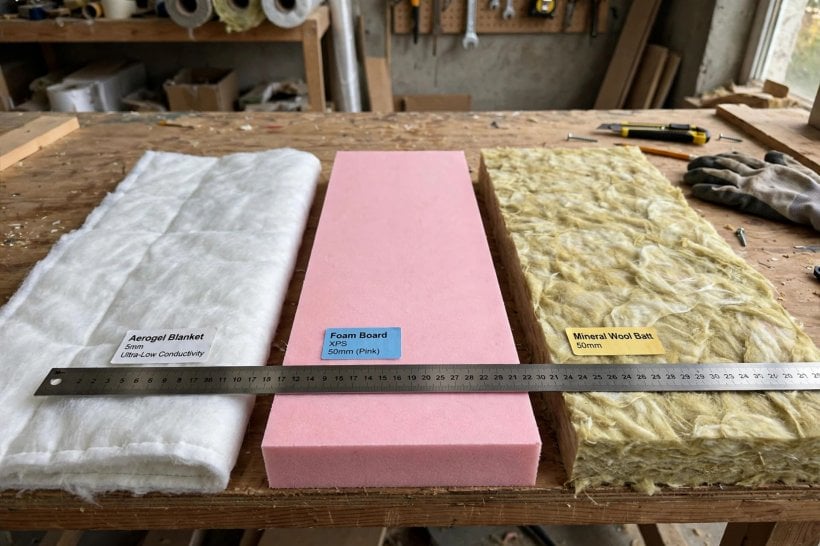
It compares Aerogel (R-10/in) against Closed Cell Foam (R-6.5/in) and Mineral Wool (R-4.2/in).
Aerogel is the most expensive insulation most tiny house builders will ever price — and the thinnest. Whether aerogel insulation ROI makes sense depends on one thing a big house never worries about: inches. Inside a road-legal shell, every inch of wall thickness is an inch of living space you lose on both sides.
This guide explains the space-versus-cost maths behind the calculator below, so you can judge the premium with clear eyes before you order a single blanket.
1. At a Glance: Aerogel Insulation ROI in a Tiny House Wall
The calculator on this page answers the “is it worth it?” question with a metric built for tiny houses: cost per square foot of space gained. Instead of asking only what the material costs, it asks what the recovered floor area is worth — because gaining back 15-20 square feet of interior floor space might actually be cheaper than building a slightly larger trailer. The comparison is three-way: aerogel against closed cell foam and mineral wool, all chasing the same target wall R-value inside the same footprint.
| Material | R-Value per Inch | Typical Wall Thickness | What It Means for Space |
|---|---|---|---|
| Aerogel (Spaceloft) | R-10 per inch | ~2 inches | Thinnest wall of the three; the most interior space kept |
| Closed Cell Foam | R-6.5 per inch | ~3.5 inches | A middle path — thinner than batts, thicker than aerogel |
| Mineral Wool / Batt | R-4.2 per inch | ~5.5 inches | The thickest wall; the most floor area given up to insulation |
| Space gained with aerogel | — | — | 15-20 square feet of interior floor space |
| Key output | — | — | Price per square foot of reclaimed space |

The three materials compared by R-value per inch, typical wall thickness, and the floor space the thinnest option gives back.
Two inputs drive everything: the size of your house — its length and width — and the target you choose for the walls, from R-13 (standard) through R-20 to R-30 (arctic). Change either and the verdict moves, because the value of reclaimed space depends on how much wall you have and how thick the conventional alternative would need to be. Run your own dimensions through the tool at the bottom of this page and read on with your numbers in mind.
2. Why Wall Thickness Is a Floor Plan Decision
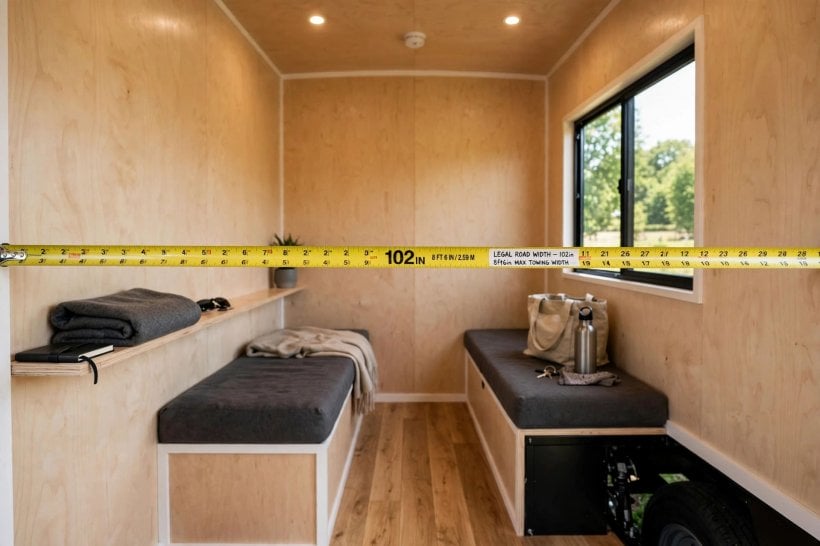
In a conventional house, insulation thickness is an energy decision. In a tiny house on wheels, it is a floor plan decision first. The outside of the house cannot grow: width is legally limited to 8.5 ft, and length is set by the trailer you already own. Every fraction of an inch the wall assembly takes is subtracted from the inside — twice, once on each side — along the full length of the house.
That is why the tool frames its headline result as space gained rather than energy saved. Fifteen to twenty square feet sounds modest until you picture it inside a tiny house: a wider walkway past the kitchen, a real desk instead of a fold-down flap, storage that does not have to be climbed over. Floor area is the scarcest resource in the build, and insulation trades directly against it.
The comparison also runs in the other direction. If the space matters enough, the alternative to thinner walls is a bigger trailer — longer, heavier, harder to tow and more expensive before a single stud is cut. Our guide to calculating GVWR for tiny homes shows how quickly a larger shell eats into your weight budget. Against that backdrop, paying a premium for inches looks less like extravagance and more like a design trade.
3. The Three Materials, Inch for Inch
The tool’s comparison rests on a single property: R-value per inch. Aerogel blankets such as Spaceloft offer R-10 per inch. Closed cell foam offers R-6.5 per inch. Mineral wool offers R-4.2 per inch, with traditional insulation generally landing in the R-4 to R-6.5 range. Because the walls must all reach the same target, those per-inch figures translate directly into thickness: roughly 2 inches of aerogel, roughly 3.5 inches of closed cell foam, or roughly 5.5 inches of mineral wool to reach comparable performance.
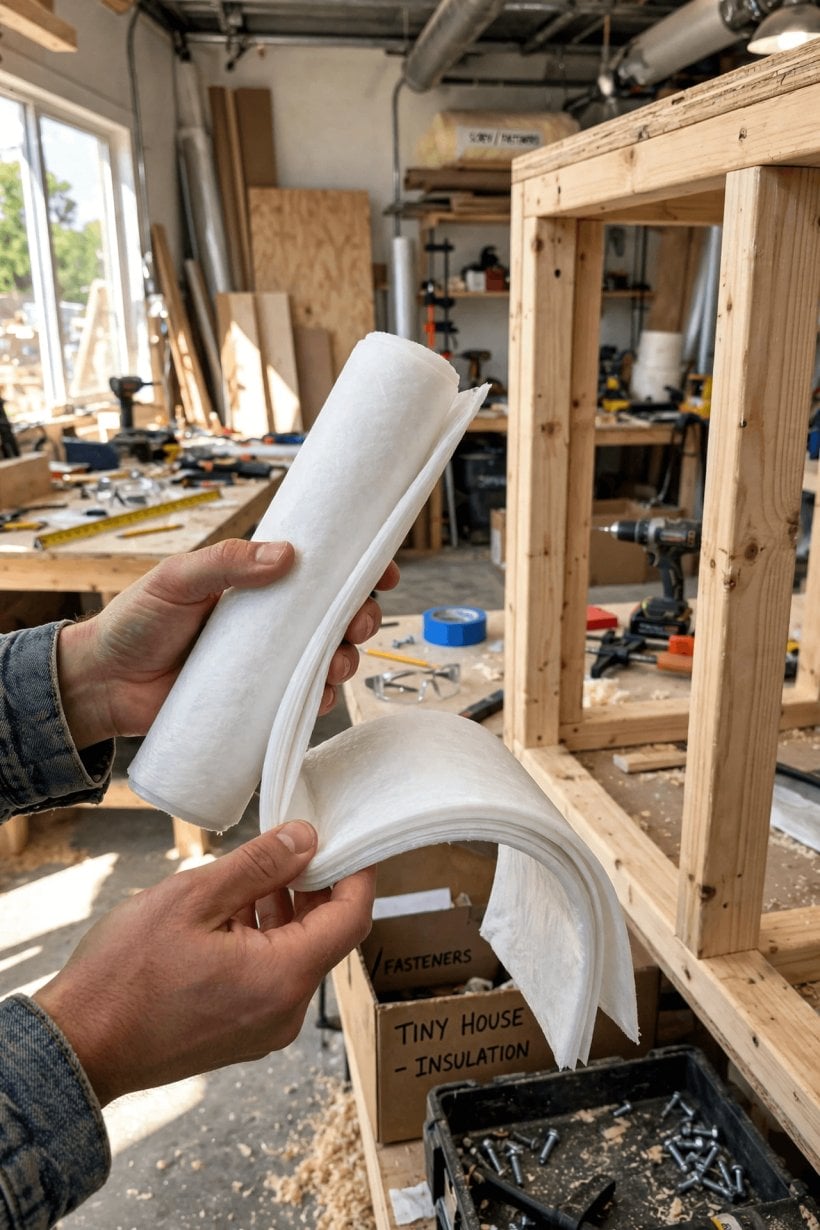
Read those thicknesses as a builder, not a shopper. A 5.5-inch wall needs deeper framing and deeper window and door bucks; a 2-inch wall can sit inside slim framing with comparatively simple detailing. Neither is automatically better — deeper cavities are forgiving and familiar — but the space cost of the thick option is real, continuous and permanent. You pay it every day you live in the house, along every wall.
It is also worth remembering that wall build-ups are systems, not single materials. Sheathing, membranes and interior finishes all add their own fractions of an inch, and our sheathing weight calculator helps you account for the layers outside the insulation. The thinner your insulation layer, the more freedom you have to spend those saved fractions on weather protection.
4. Cost per Square Foot of Space Gained — the Metric That Matters
Most insulation comparisons stop at material cost, which is exactly why aerogel always loses them. The calculator below uses a different yardstick: it takes the cost premium of the aerogel build — what you pay above the conventional options — and divides it by the floor space that premium buys back. The result, the price per square foot of reclaimed space, is the number the verdict panel reports, and it reframes the question completely. You are no longer asking “why is this blanket so expensive?” but “what would this floor area cost me any other way?”
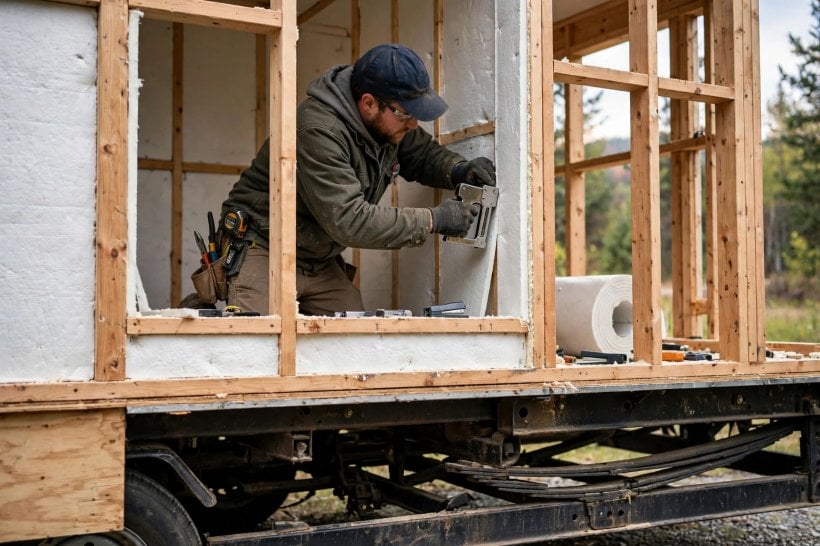
That second question has honest answers. Extra floor area bought with a longer trailer carries the cost of the trailer itself and the heavier tow setup it may demand. Extra area bought by pushing walls outward is simply not available once you are at the legal width. Seen that way, reclaimed space has a genuine scarcity value in a tiny house that it never has on a foundation plot — which is the entire point the tool was built to demonstrate.
Run the comparison both ways before you decide. If the price per reclaimed square foot comes back lower than what equivalent space would cost through a bigger build, the premium is defensible on maths alone. If it comes back far higher, your design does not need the inches enough to pay for them — and the money is better spent elsewhere, perhaps on the systems in our guide to heating a tiny home in winter.
5. Choosing Your Target: R-13, R-20 or R-30
The calculator offers three target wall R-values: R-13 (standard), R-20, and R-30 (arctic). The target you pick changes the aerogel case dramatically, because the thickness gap between materials widens as the target climbs. At modest targets, conventional insulation reaches the number inside a fairly ordinary wall, and the space aerogel saves is at its smallest. At arctic targets, the conventional wall grows very deep indeed — and every extra inch of depth is an inch aerogel hands back to the room.
Choose the target from your climate and heating strategy, not from ambition. A house that will live in mild country has different needs from one parked through northern winters, and over-insulating a mild-climate house buys comfort you may never feel. Our tiny house passive solar simulator shows how sun and orientation carry part of the heating load, which informs how hard the walls need to work.
Whatever target you choose, apply it consistently: walls, floor and roof should be planned as one thermal envelope. The floor is easy to under-plan because it is built first and hidden early, and the companion floor insulation calculator for tiny houses runs the same kind of thickness-versus-performance comparison for the underside of the house.
6. The Thermal Bridging Hack: Strips, Not Blankets
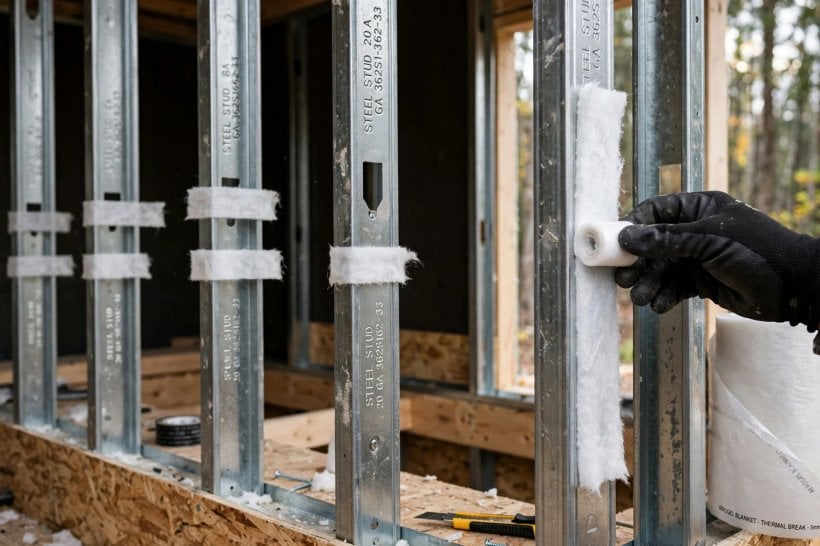
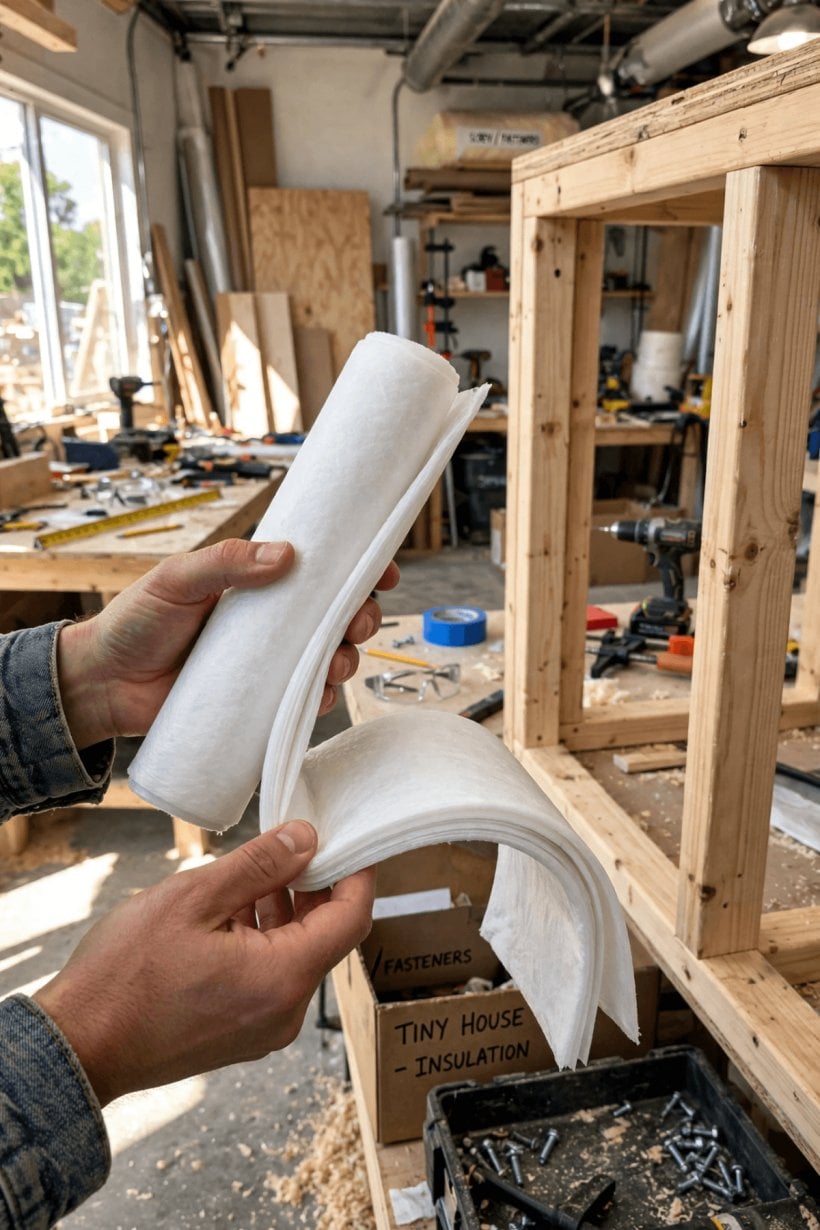
The tool’s pro tip may be the most valuable idea on this page: you do not have to do the whole wall. Many builders cut aerogel into 1.5-inch strips and apply them only to the faces of steel studs. Steel conducts heat eagerly, so the stud lines are where a steel-framed wall leaks warmth even when the cavities between them are well insulated. A thin, extremely high-R strip over each stud face breaks that thermal bridge — for a fraction of the cost of a full wall install.
This hybrid approach changes the economics completely. Instead of blanketing every square foot of wall with the premium material, you spend it only where physics makes it count most: the conductive paths. The cavity insulation can stay conventional, familiar and affordable, while the strips quietly fix its biggest weakness. For builders who love the aerogel idea but cannot justify full coverage, the strip strategy is the middle path the calculator’s verdict points toward.
Thermal bridging deserves its own look if you are framing in steel: our steel frame thermal bridge simulator models how stud lines drag down a wall’s real performance, and our vapor barrier placement guide covers where the moisture control layer belongs. Together, a hybrid wall can perform far beyond what its material list suggests.
7. Space Efficiency in Practice: Two Times the Room to Breathe
The tool describes aerogel as the space-age solution with 2x space efficiency, and the arithmetic behind the slogan is simple: at roughly twice the R-value per inch of the alternatives, aerogel lets you build walls about half as thick for the same thermal result. Half-thickness walls sound like a framing detail until you walk the interior. The gain shows up as width — the dimension tiny houses can least afford to lose — and width is what makes a kitchen worktop usable, a corridor passable with a laundry basket, and a bathroom merely snug instead of impossible.

Think about where reclaimed width actually lands in a floor plan. It widens the pinch points: the run between counter and wall, the space beside the bed, the shower you turn around in. Designers of small spaces know a few extra inches at a pinch point are worth far more than the same inches spread evenly, because pinch points decide whether a room feels workable. Slim walls let you spend those inches deliberately, exactly where the plan is tightest.
Space decisions also interact with weight and layout elsewhere in the build. Where heavy items sit affects how the house tows, and our appliance placement strategy calculator tackles that side of the plan. A coherent design treats width, weight and warmth as one problem.
8. When Aerogel Is the Wrong Spend
Honesty strengthens the case where it applies: there are builds where the premium buys nothing worth having. If your house is a park model or a foundation build with no legal width limit, the core argument collapses — you can simply make the walls deeper or the house wider, and conventional insulation wins easily. If your climate is mild and your target is R-13, the thickness gap shrinks and the reclaimed strip of floor may be too small to change how any room works. And if the budget is genuinely tight, money spent on aerogel is money not spent on the trailer, the roof, or the systems you will touch every day.
There is also a practical dimension. Specialty materials can mean longer lead times, fussier cutting and dust control during installation, and fewer local suppliers if you need more mid-build. None of that is disqualifying, but it belongs in the decision alongside the calculator’s verdict — the tool prices the material and the space, not your schedule.
Finally, weigh the alternative uses of the same money inside the thermal envelope. Better windows, careful air sealing and well-chosen curtains all move comfort noticeably; our thermal curtain calculator quantifies one of the cheapest of those wins. Aerogel should have to beat those options, not just the thicker-wall default.
9. Running Your Own Numbers
To use the calculator below, enter your house length and width, then pick your target wall R-value — R-13 (standard), R-20, or R-30 (arctic) — and press Analyze Space vs. Cost. The results open with the trailer footprint diagram, showing the aerogel interior against the wool interior so you can see the recovered strip rather than just read it. Below that sits the headline figure: space gained, and the cost premium that buys it.

The material breakdown panel then prices each option side by side — aerogel (Spaceloft) at roughly 2 inches thick, closed cell foam at roughly 3.5 inches, and mineral wool or batt at roughly 5.5 inches — each with its material cost and wall thickness stated. The verdict panel ties it together with the price per square foot of reclaimed space.
Try at least two targets before you conclude anything. The jump from R-20 to R-30 is where aerogel’s case strengthens most, and seeing your own house at both settings tells you whether you are buying meaningful room or expensive reassurance. If you are still comparing wall systems at a higher level, our SIPs vs stick framing analyzer covers another thin-wall contender and makes a useful cross-check.
10. Putting It Together: A Decision You Can Defend
The builders who end up happiest with this choice — either way — decided with numbers in hand. They knew their footprint, their target R-value, the thickness each material demanded, the floor area at stake, and the price per reclaimed square foot their premium implied. Aerogel became what it actually is: a way of buying interior space inside a fixed legal envelope, at a price you can calculate before you commit.
If the verdict favours aerogel but the full-wall cost still stings, remember the strip strategy: premium material only on the stud faces, conventional insulation in the cavities. It captures a meaningful share of the thermal benefit for a fraction of the cost. If the verdict favours conventional insulation, believe it — and spend the savings where your numbers say they will work hardest.
Either way, keep the envelope thinking joined up: insulation choices interact with framing weight, and a tiny house rewards builders who treat every system as connected — because inside 8.5 feet of width, everything genuinely is.
Final Considerations
Aerogel will never be the default insulation for tiny houses, and it does not need to be. Its case is narrow and specific: a road-legal width, a meaningful R-value target, and a floor plan tight enough that 15-20 reclaimed square feet change how the house lives. Where those conditions hold, the calculator’s cost-per-square-foot-of-space-gained metric can justify a material that looks indefensible on price alone. Where they do not hold, the same metric tells you to walk away — and a tool that can talk you out of a purchase is a tool worth trusting.
Run your dimensions, test two targets, and let the verdict panel have the last word. Then build the wall your numbers chose — thin and premium, hybrid with strips, or honestly conventional — knowing what each inch cost and what it bought.
Aerogel ROI Calculator
Aerogel ROI Calculator
Is R-10 per inch worth the premium price?
Material Breakdown
The Verdict
Analysis pending…
Aerogel: The Space Age Solution
Aerogel blankets (like Spaceloft or Pyrogel) offer R-10 per inch. Traditional insulation offers R-4 to R-6.5. This allows you to build walls half as thick, which is critical in tiny homes where width is legally limited to 8.5 ft.
Pro Tip: You don’t have to do the whole wall. Many builders cut Aerogel into 1.5″ strips and apply them only to the faces of steel studs. This breaks the thermal bridge for a fraction of the cost of a full wall install.


1 Comment