
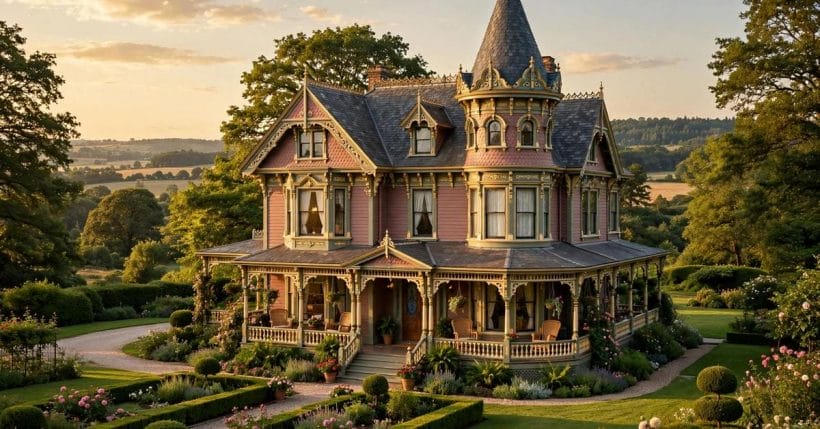
One tower changes everything. A plain Victorian facade becomes a landmark the moment a turret rises at its corner — a round room stacked on a round room, capped with a cone of slate, watching the street from windows that face three ways at once.
This post takes the turret itself as the subject: its shapes, roofs and curved windows, the round rooms it makes inside, and what it asks of you in upkeep — seventy-five ideas for reading, styling and caring for the most theatrical feature a house can wear.
Related Guide: Castle House Ideas: Layouts, Colours, Costs and Practical Details
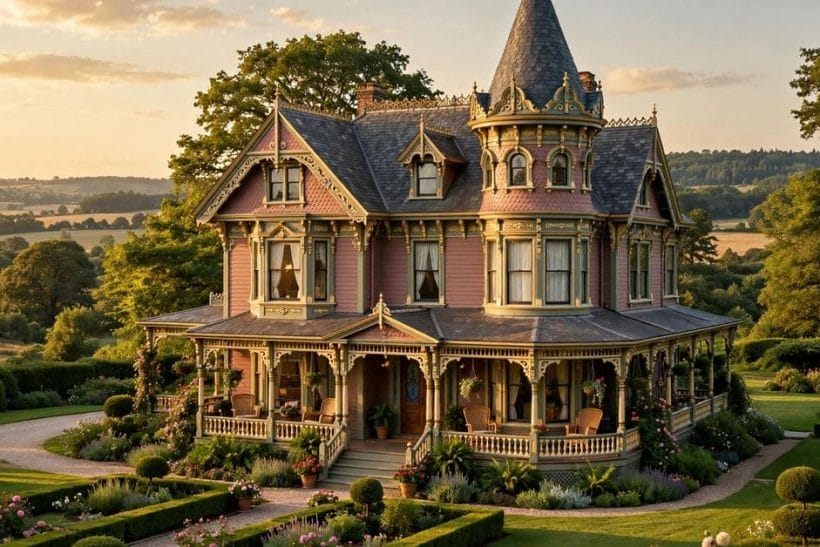
1. Victorian Turrets at a Glance
A turret is a small tower, usually round or polygonal, that rises from the corner or front of a house and is capped by its own steep roof. On Victorian homes — above all the Queen Anne style — it was never only decoration: it made a room with light on several sides, a lookout over the street, and a silhouette no neighbour could match. The keyword that brings readers here, victorian house turret, names a feature that is equal parts architecture, room and ornament, and it rewards being read in that order: form first, then roof, then windows, then the rooms inside.
The turret belongs to a family of period features. It sits on the front of the house, so it is read alongside the rest of the exterior home ideas that shape a facade — porches, bays, gables and trim — but it stays this post’s single subject: where the wider Victorian house is surveyed as a whole elsewhere, here the tower gets the full seventy-five.
| Question | Short answer |
|---|---|
| What is a turret, exactly? | A slim tower — round, square or many-sided — rising at a house’s corner or front, roofed separately, and holding a small room on each floor it passes |
| Why did Victorian houses have them? | For light, outlook and display: curved glass in several directions, a prestigious street presence, and a flexible little room — parlour, study, bedroom or sewing room |
| What does a turret room do best today? | Reading nooks, home offices, dressing rooms, nurseries and guest corners — small, bright, self-contained uses that suit a round plan |
| What does it ask in return? | Roof and flashing care at the cone, curved-glass maintenance, and respect for its structure — the tower is part of the house’s frame, not an ornament bolted on |

2. The Shape of the Tower: Round, Square and Many-Sided

1. The true round turret
The classic form is a cylinder: walls that curve in one unbroken sweep, windows following the bend, and a room inside with no corners at all. It is the most demanding shape to build and glaze, and the one that gives the turret its fairy-tale pull.
2. The polygonal turret
Many Victorian turrets are actually many-sided — flat facets joined at shallow angles, each holding a straight window. The effect from the street is nearly the same, while the framing and glass stay simpler; look closely at the window joints to tell which you have.
3. The square tower
A square or rectangular turret reads more castle than cottage: straighter lines, a pyramidal cap, and corners that take ordinary furniture. It suits the heavier stone and Romanesque-influenced Victorian houses.
4. The corner turret
Most turrets anchor a corner, turning the house to face two streets — or street and garden — at once. The corner position is why their windows gather light from morning to evening.
5. The front-and-centre turret
Some rise from the middle of the facade, splitting the house into matching halves around them. The symmetry makes the tower the whole composition’s pivot, and usually gives the hall or landing its grandest window.
6. Twin turrets
Two towers, as in the street view above, bracket a facade with ceremony. Twins are rarer and grander; each typically holds its own small room, and the pair frames the porch and gable between them.
7. The half turret
A turret need not run the full height. Some start at the first floor, carried on brackets above a bay below, or stop at the eaves while the main roof continues past — a modest version that still lends the curve and the cap.
8. Reading the whole house around it
A turret is one member of a composition. The fuller survey of the Victorian house — its porches, bays, patterned shingles and paint schemes — shows how the tower’s height and ornament were balanced against the rest; this post simply gives the tower the close-up it usually misses.
3. Windows on the Curve
9. Curved glass
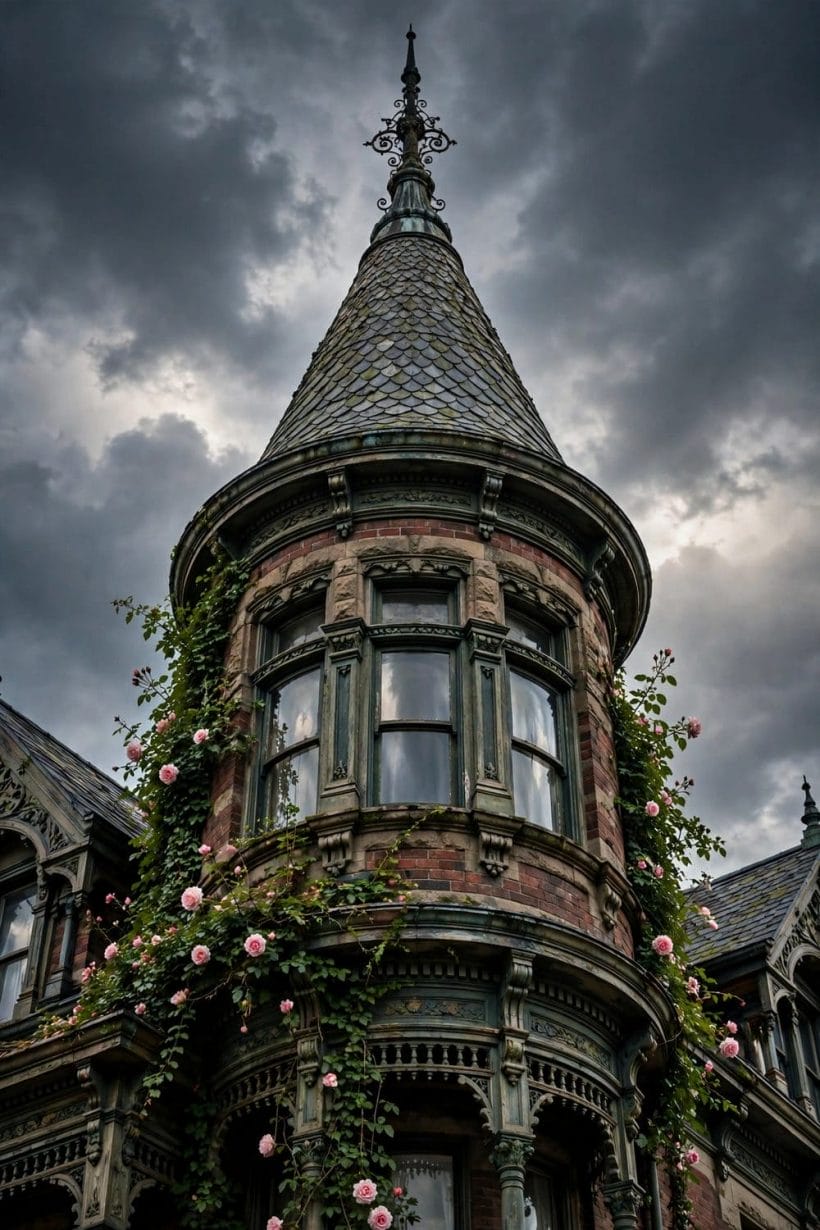
True round turrets carry glass bent to the wall’s radius — beautiful, and the single most specialised element to repair. Treat original curved panes as heirlooms: protect them during any work, and take specialist advice before replacing one.
10. Faceted windows
On a polygonal turret each facet takes a flat sash, and the sequence of straight windows reads as a curve from a distance. The practical gift is that individual panes and frames can be repaired with ordinary joinery skills.
11. Tall narrow sashes
Turret windows are often taller than they are wide, following the tower’s verticality. Their proportions are a large part of the elegance — resist any urge to widen them, and keep replacement sashes matched to the original pattern.
12. Windows that wrap the view
Because the curve faces several directions, a turret room borrows views a flat wall cannot: down the street both ways, across the garden, and up into the trees. Arrange the room’s seat or desk to collect them rather than facing inward.
13. Stained and coloured glass
Victorian turrets frequently carry a band of stained or coloured glass — in transoms, in an upper sash, or as a full decorative window on the stair. It throws patterned light across the round room and advertises the tower from the street at dusk.
14. Shutters and blinds on a curve
Dressing curved windows takes flexible thinking: shutters built to the facet, blinds fitted per window, or simple sheer curtains that follow the bend on a curved track. Keep treatments light — the glass is the feature.
15. Draughts and seals
More joints mean more places for weather to test. Sound seals and maintained putty or gaskets matter more on a turret than anywhere else in the house; a draughty turret room is usually a maintenance list, not a design flaw.
16. Cleaning the curve
Upper turret windows are awkward to reach from inside and out. When work is planned — painting, repairs, gutter clearing — group the turret’s window cleaning into the same access, and keep a note of which panes are curved before anyone orders glass.
4. Roofs That Crown It: Cones, Bells and Finials
17. The conical roof
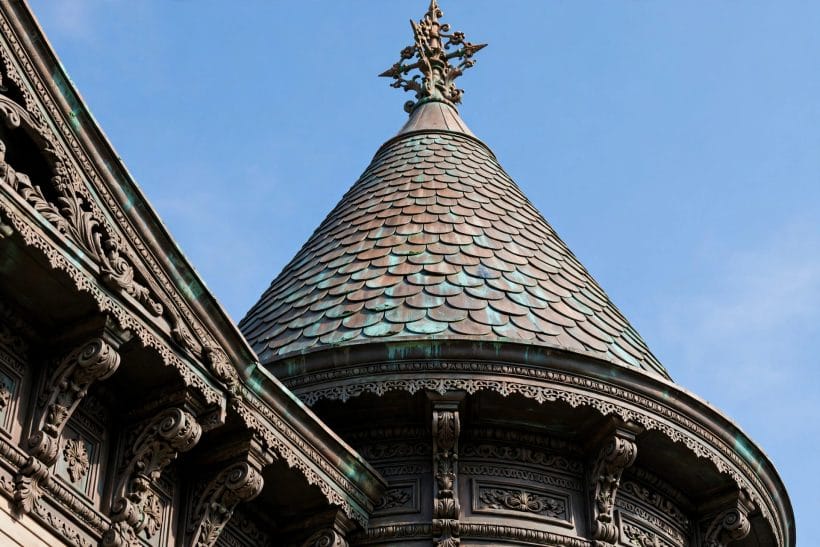
The pointed cone is the turret’s signature — the witch’s-hat silhouette that makes the tower readable from streets away. Its steep pitch sheds weather well, and its proportions against the tower’s width decide whether the turret looks elegant or top-heavy.
18. The bell-shaped cap
Some cones flare gently at the eaves into a bell or ogee curve, softening the point. The flare throws water clear of the curved wall below — a practical grace note as much as a pretty one.
19. The polygonal pyramid
Faceted turrets often wear a faceted roof: straight slopes meeting at crisp hips above each wall facet. The geometry echoes the plan below it, and repairs can be made slope by slope.
20. Fish-scale shingles
Small patterned shingles — fish-scale, diamond and octagonal cuts — wrap a cone’s curve where big slates cannot. The close view above shows the craft: courses of scalloped shingles following the cone, with carved brackets carrying the eaves.
21. Slate and metal coverings
Slate cones are cut from many small pieces; metal cones are seamed panels soldered or locked together. Each has its own repair trade. Identify your covering before any roofer quotes — a cone is specialist work, priced and scheduled as such.
22. The finial
At the very point sits the finial — a turned, cast or wrought ornament that finishes the silhouette and often carries the house’s date or a family flourish. A missing finial leaves the turret visibly unfinished; a faithful replacement restores the whole skyline.
23. Cresting and eaves trim
Decorative cresting along ridges, brackets under the eaves and patterned frieze boards tie the cap to the wall. These are the details that disappear first in careless repairs, and the ones that mark an authentic turret at a glance.
24. Flashing where cone meets house
The valley where the turret roof dies into the main roof or wall is the tower’s weather weak point. Keep it inspected and clear; most turret leaks begin at junctions, not through the cone itself, and early attention there is cheap insurance.
5. The Round Room: Furnishing a Space With No Corners
25. Start with the curve
Plan the room from its one fixed fact: a wall that bends. Pieces that follow the curve — a round table, a curved-back chair, a rug cut to the circle — settle instantly; big square pieces fight the room and should live elsewhere.
26. The window seat
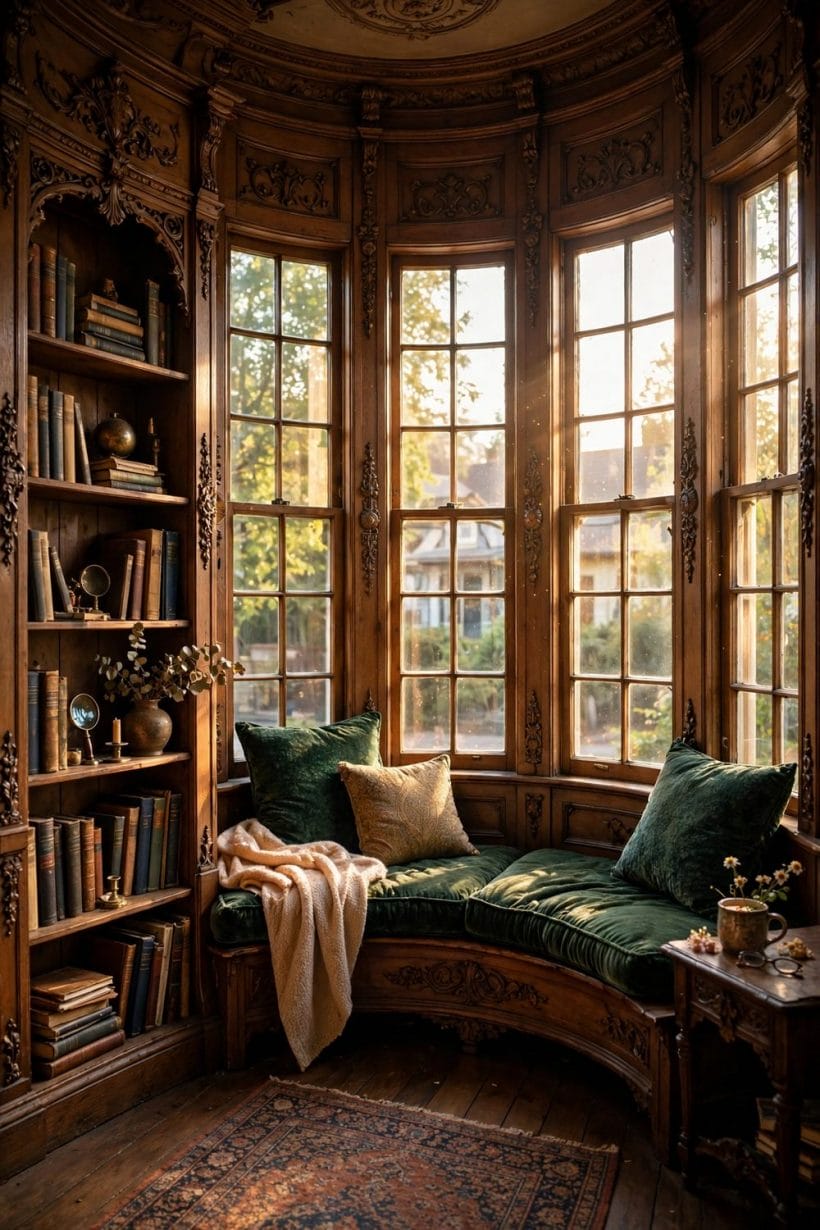
The natural throne of a turret room is a seat built into the curve beneath the windows: reading light from three sides, cushions over storage, and the best seat in the house claimed from space that fits nothing else.
27. A reading nook
One chair, one lamp, one small table: the turret’s scale suits single-occupant pleasures. Readers prize the wrap of windows and the slight separation from the house’s traffic — close enough to hear it, far enough to ignore it.
28. A desk with a lookout
Set a small desk against the glass and the turret becomes a study with a watchtower view. Writers and home-workers either love the outlook or find it a beautiful distraction; a chair that swivels between window and wall solves both.
29. The bedroom turret
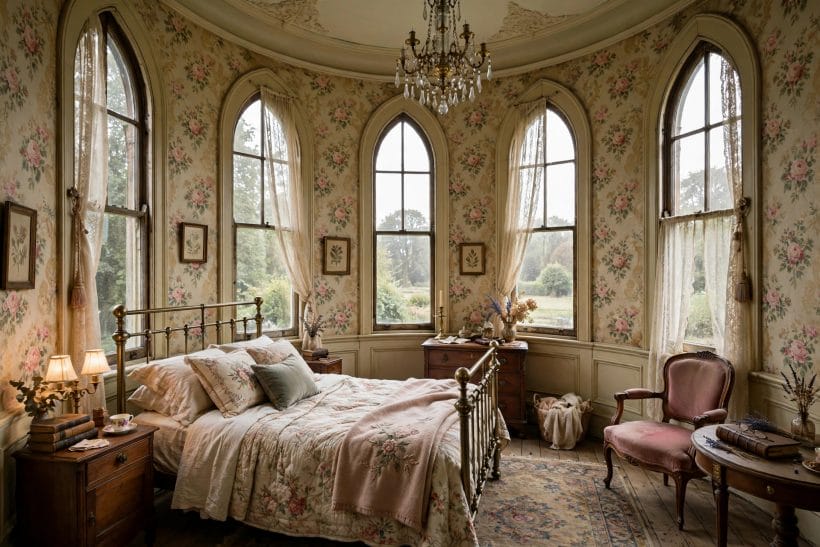
As the bedroom above shows, a turret makes a serene sleeping alcove: the bed against the straight wall, morning light arriving around the curve, tall windows in lace and floral paper. Keep the palette soft — the architecture is already busy.
30. A dressing room or nursery
Small, separable rooms take well to the tower: a dressing room with mirrors on the facets, or a nursery where the curve softens every edge. Both use the turret’s gift of feeling like a room apart while staying on the main floor plan.
31. Placing furniture that is not round
Straight pieces can work if they float: keep them off the curved wall, angled to the facets, with the gap behind absorbed by plants or a screen. The room forgives straight lines that acknowledge the curve; it resists ones that pretend it is straight.
32. Wallpaper and paint inside the curve
Pattern behaves beautifully on a curve — the floral paper above wraps without a corner to break it — but hang it with patience, since each drop steps around the bend. Plain paint in a light tone is the calm alternative, letting the windows pattern the room instead. For the wider period palette that turret rooms inherit, the Victorian living room ideas in this series show the same colours and papers at room scale.
6. Colour and Presence: The Turret From the Street
33. Paint the tower with the house
A turret is painted as part of the whole facade’s scheme — body, trim and accent shared with the main walls — so the tower reads as grown, not attached. Picking out the cone or the trim in the accent colour is the traditional way to let it sing.
34. Shingle patterns as colour
Patterned shingles on the tower’s upper stage take alternating bands of colour in classic paint schemes. It is the most Victorian move of all, and the one to research carefully: old photographs and paint layers on the house itself are the honest guides.
35. The dusk effect
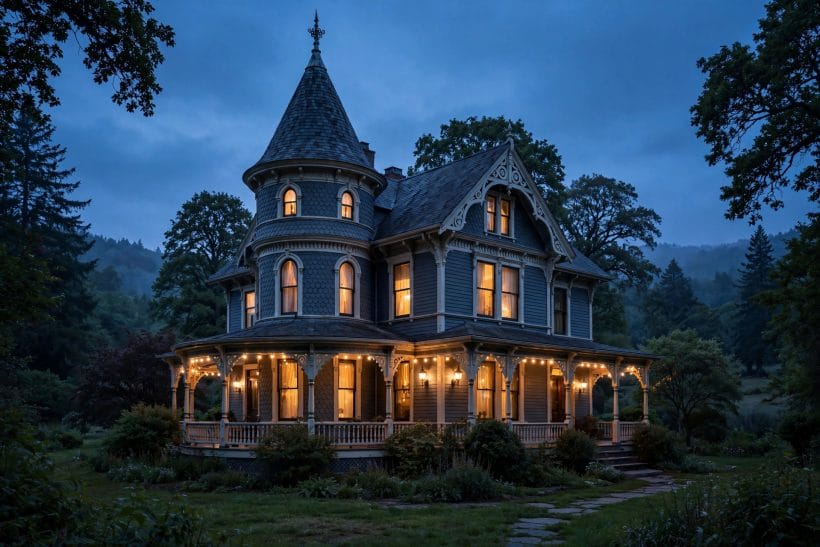
At dusk a lit turret becomes the house’s lantern, as in the view above — curved windows glowing above the porch. Warm, shaded lighting inside the turret room rewards the street as much as the room; it is the feature’s nightly performance.
36. Landscaping at the tower’s foot
Planting should frame, not swallow, the tower: low, structured planting at its base, a path that acknowledges the corner, and nothing that will grow to mask the first-floor windows. The turret is the garden’s backdrop and its folly in one.
37. The porch connection
Turrets frequently rise beside or through the wraparound porch, the tower’s curve echoed by the porch’s turn. Keep the two in the same trim and repair conversation — they share rooflines, gutters and the visitor’s first impression.
38. Standing among neighbours
A turret house is usually its street’s landmark, which cuts both ways: alterations show. Thoughtful colour keeps goodwill; the muted blue-grey scheme above shows how a painted lady can be calmed without being silenced.
39. Coastal and painted schemes
Victorian towers travelled to seaside towns and suburbs alike, and their paint traditions vary by place. The coastal exterior home ideas and the blue exterior home ideas in this series show two directions a turret’s scheme can take — breezy and pale, or deep and architectural.
40. Night lighting outside
One soft uplight or a lit porch lantern near the tower’s base is enough after dark. The turret’s own windows do the rest; theatrical floodlighting flattens the very modelling — shade, curve, depth — that makes it worth lighting.
41. Photograph before you change
Before altering colour or trim on a turret, photograph the facade in flat midday light and keep the pictures with the house’s papers. Period features are easiest to restore when someone recorded what was there — be that someone for the next owner.
7. Stairs, Glass and Light Inside the Tower
42. The turret stair
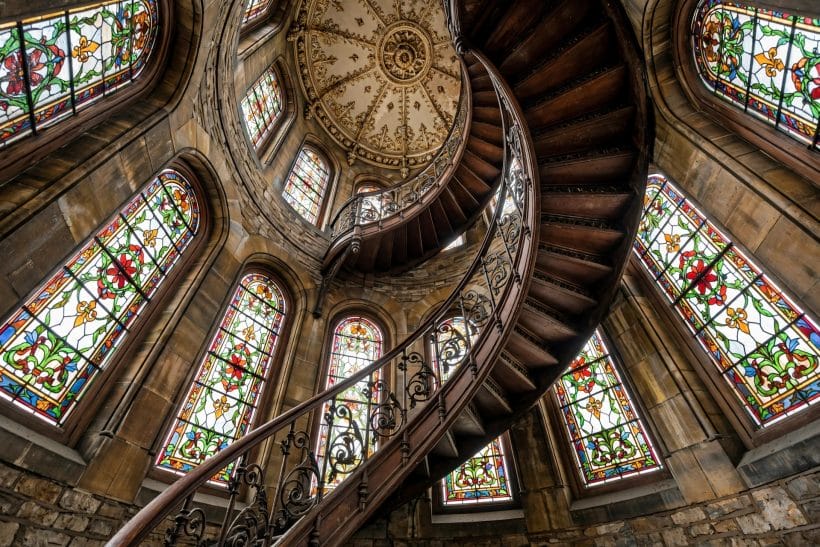
Some turrets hold the staircase itself, winding up the curve past a column of windows, as in the stained-glass stair above. It is the grandest use of the tower — every trip upstairs becomes a small ceremony of light.
43. Stained glass as the stair’s lamp
Coloured glass on a stair turret does practical work: it lights the treads while veiling the view in and out. Where original panels survive, their repair is specialist conservation — and worth it, since they are usually the house’s finest glass.
44. The landing window
Even without a full turret stair, a landing often borrows the tower’s curve: a window seat on the half-landing, a tall sash over the turn. These in-between moments are where the turret is felt daily rather than admired occasionally.
45. Light borrowed by inner rooms
A turret on the hall or landing throws light deep into the plan through open doors and fanlights. When redecorating, keep the glass between turret and hall clear rather than panelled over — the borrowed light is part of the house’s system.
46. Ceiling roses and the round ceiling
A round room’s ceiling is a small dome or flat circle that invites a central rose and pendant. Scale the fitting to the room: an oversized chandelier crowds a turret; a modest pendant at the circle’s centre crowns it.
47. Sound in a round room
Curved walls scatter sound softly — one reason turret rooms feel hushed and suit music practice, calls and reading aloud. Hard floors can sharpen echoes; a rug and upholstered pieces return the calm.
48. Heating the tower
More glass and more external wall mean the turret room runs cooler than its neighbours. A heat source under the windows — the classic position — counters the downdraught; check the room’s heating before blaming its aspect.
49. Curtains that follow the light
Because the sun visits a turret room across the day, layer the window dressing: sheers for glare, heavier curtains for evening. On facets, simple panels per window keep the geometry honest and the operation easy.
8. Restoring an Old Turret Without Losing It
50. Survey before scaffolding
Begin with a condition survey that names the turret’s parts separately: cone covering, flashing, curved glass, joinery, masonry or shingles, and the structure where tower meets house. Turret problems are specific; general quotes miss them.
51. Repair like with like
The conservation rule that suits turrets best is repair over replacement, and like-for-like where replacement is unavoidable: matching shingle patterns, timber sections and glass types. Each substituted material flattens the tower a little.
52. Rot at the base and sills
Water collects where the curve meets porch roofs and at window sills; probe these first. Localised timber repair by a joiner who has worked on period houses preserves far more original fabric than wholesale renewal.
53. Repointing and masonry
Brick or stone turrets need mortar matched to the original in strength and colour — hard modern mixes can damage soft old masonry. This is established conservation practice, and a heritage-experienced builder will treat it as routine.
54. The cone, professionally
Roofing a cone is a specialist’s day: patterns are templated, pieces cut small, and access planned. Engage roofers who can show you another turret they have covered, and expect the junction flashing to be renewed as part of the job.
55. Records and permissions
Many Victorian houses sit in conservation areas or carry listings that make the turret a protected feature. Check what consents alterations need before commissioning work — the tower is precisely the element such protections exist for, and local rules govern.
56. Scaffolding the curve
Access costs more on a turret: scaffolds must wrap the curve, and lifts rarely reach a cone. Group every high-level task — roof, gutters, painting, finial — into one hire so the tower is serviced in a single campaign.
57. Keep a turret file
Keep drawings, paint colours, glass notes and trades’ names in one file with the house papers. A turret outlives its owners; the file is how its next keeper learns which pane is curved, which roofer knows the cone, and what the colours are called.
9. Bays, Half-Turrets and the Garden Setting
58. The curved bay as turret’s kin
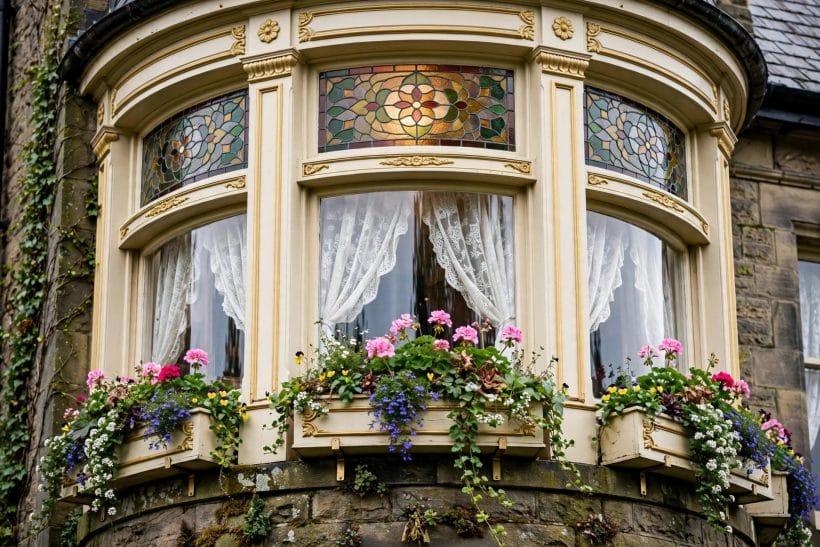
Not every curved front is a turret: the bay in the view above — curved glass, stained transoms, flower boxes — is a turret’s ground-floor cousin. The dressing lessons transfer directly: lace at the glass, planting at the base, trim picked out in cream and gold.
59. Adding a turret to a plain house
Owners do add turrets, and the honest summary is that it is structural work, not decoration: foundations, frame, roof and consents all come first, with design matched to the house’s era. Take architectural advice early; a badly proportioned addition fools no one.
60. The turret-style extension
A gentler route to the same pleasure is a round-ended extension — a garden room or enlarged bay with a curved wall of glass and a shallow conical cap. It borrows the turret’s light and outlook without pretending to be original fabric.
61. Proportion rules of thumb
Traditional towers keep their width modest against their height, rise at least a full storey above the eaves they leave, and centre their windows on the curve. These are proportions to discuss with a designer, not measurements to copy blindly.
62. Flower boxes and the base planting
The flower boxes above show the scale of planting a turret loves: generous at the windows, trailing, and seasonal. Keep climbers off the curved wall itself unless you are prepared to maintain them — tendrils in flashing and putty are slow damage.
63. A garden seat facing the tower
Give the turret an audience: a bench or garden chair placed to look back at the house turns the tower into the garden’s picture. Owners forget to enjoy the feature from outside; the garden is where it performs.
64. The turret in winter
Bare branches reveal the silhouette the summer garden hides. Winter is the season to assess trim, cresting and the cone against the sky — and the season the lit windows earn their keep most visibly.
65. Matching outbuildings and fences
Gates, fences and garden structures near a turret house sit best in the same period language: pickets rather than panels, turned posts echoing porch columns. Small echoes keep the composition the turret began.
66. Where turrets never were
Part of reading turrets well is knowing the houses that never carried them — plain workers’ cottages, severe classical terraces. The feature belongs to its era’s exuberance; respecting that is why the surviving towers still look inevitable rather than applied.
10. Costs, Structure and Practical Checks
67. What drives turret costs
Without inventing figures: the cost drivers are access, the cone covering’s material and condition, curved or specialist glass, and how much original joinery can be repaired rather than remade. Quotes that itemise these separately are the ones you can compare honestly.
68. Structure: the tower is not a bolt-on
A turret carries floors and roof on its own structure tied into the house. Cracks at the junction, doors drifting out of square in the turret room, or a leaning finial line are reasons to bring in a structural engineer — stated plainly, towers are inspected like the buildings they are.
69. Insurance and valuation honesty
Tell insurers the house has a turret and what its roof is covered with; unusual features priced openly are cheaper than unusual features discovered after a claim. Valuers, meanwhile, generally read a sound turret as the asset it is.
70. Buying a turret house
On viewings, look up before you look in: cone condition, finial line, flashing valleys, and the curve’s glass. Inside, check the turret room’s corners — it has none — for the damp patterns that gather where the tower meets flat walls.
71. Selling the tower
If you sell, present the turret room staged for its best use — seat in the curve, desk at the glass — and leave the turret file with the house. Buyers pay for the romance; the file proves the romance is maintained.
72. Living with the stairs it changes
Turrets often rearrange a house’s circulation: halls bend toward them, landings widen into them. Furniture routes upstairs may pass the curve closely — measure the turn before ordering the wardrobe, as with any period house’s stair.
73. Whole-house context
The turret is one form among the whole-house shapes this series covers; the split level homes post treats a very different way of stacking rooms, and the contrast sharpens what the turret is: not a level change, but a tower — verticality worn on the outside.
74. Everyday care rhythm
Walk the tower’s perimeter each season: gutters at the cone’s foot, putty on the curve’s panes, planting kept off the wall, and the valley where roofs meet. Fifteen unhurried minutes, four times a year, is the maintenance regime most turrets actually need.
75. Leave it more itself
The test of any turret work is whether the tower ends more itself — its cone crisp, its glass clear, its trim honest — rather than more modern, more plain or more like its neighbours. Keep that test in front of every quote and colour chart, and the feature will outlast us all.
Final Considerations
A turret is a promise a house makes to its street: that someone cared enough to bend a wall, bend glass, and cap the result with a cone. The seventy-five ideas above are that promise kept in detail — shape, roof, windows, rooms and records, each given its due.
For the house the tower belongs to, the traditional home survey covers the wider period composition, and the exterior pillar linked in the first section gathers the facade’s other features. Start where the turret starts — at the corner, looking up — and let the tower teach you the house.


0 Comments