

The vanity is the hardest-working piece of furniture in the house: it is washed at, leaned on, splashed daily, and asked to swallow the entire clutter of the morning — and it has to look serene while doing all of it.
This guide collects the advice that bathroom designers repeat to every client, in the order they give it: measure first, choose the form, plan the storage, then — and only then — fall in love with a finish. No brands, no showroom scripts; just the checks that decide whether a vanity works.
1. Bathroom Vanities at a Glance
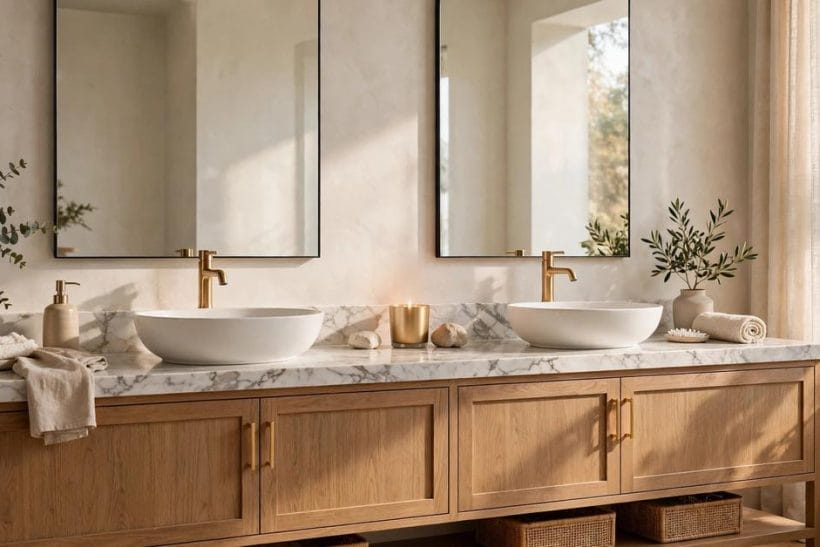
A vanity is three decisions wearing one name: a piece of storage furniture, a worktop with a basin, and the plumbing that serves both. Buyers fall for the first and discover the other two later. The feature vanity — a long double in pale oak with vessel basins on marble — works because all three decisions were made together: storage below, stone above, taps placed where the plumbing wanted them.
This guide is the buying-and-styling companion to the room itself; the bathroom as a whole — layouts, baths, showers, tiles — lives in bathroom ideas, and the two posts divide the territory between them. Here, everything is the vanity: how to size it, which form suits which room, what to check in the showroom, and how to style the wall above it without wrecking the mornings.
| Vanity form | Best for |
|---|---|
| Single | Small bathrooms and ensuites — one basin, honest storage, no elbows argued over |
| Double | Shared bathrooms with the width to spare — two basins, two routines, one long top |
| Floating | Modern rooms and small floors — wall-hung, with the floor visible and cleaning easy beneath |
| Freestanding | Classic cabinet storage — a furniture piece that stands on the floor and reads like joinery |
| Corner | Awkward corners and tiny cloakrooms — storage borrowed from space nothing else can use |

2. Measure First: Fit, Clearance and Plumbing

Every vanity mistake is a measurement that was not taken. The close view in gallery-1 — tap, marble, towels within reach — looks effortless because the unglamorous numbers underneath it were settled first: the width of the wall, the swing of the door, and the stubborn fixed point of the plumbing.
1. Measure the wall, the door swing and the human
Take the wall’s true width at skirting height and at top height; old walls are rarely the same twice. Then swing the bathroom door and the vanity’s own doors and drawers on paper — a drawer that meets the door handle twice a day will be cursed for a decade. Leave comfortable standing room in front: the vanity serves a person, not a dimension on a plan.
2. The plumbing position is the fixed point
Water arrives and leaves where the pipes already are, and moving them costs more than most vanity upgrades. Note where the waste and supplies sit, and let them shape the shortlist: a vanity whose basin lands over the existing waste is a vanity that installs in a day and behaves for years. Ambition is fine; surprise plumbing bills are not a design feature.
3. Heights and depths that suit the users
Comfort height is a household decision, not a catalogue default: taller households bless a higher top every morning, and children bless a lower one — or a step that lives in the vanity’s own toe-kick. Depth matters in small rooms most of all; a shallower vanity that preserves floor and door swing beats a deep one that bruises hips.
3. The Five Forms: Single, Double, Floating, Freestanding, Corner
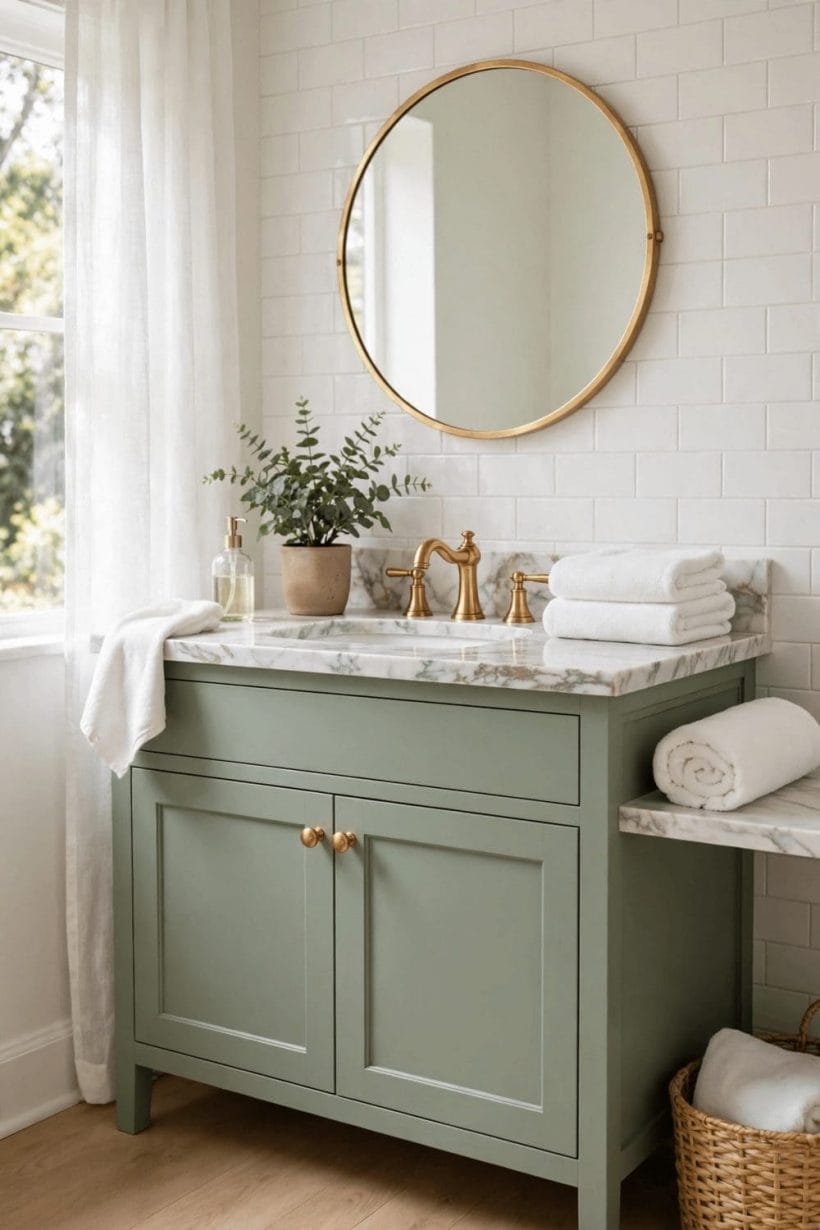
The sage-green single in the pin — compact, freestanding, its whole world in one cabinet and one round mirror — is one answer. The form question is really a question about the room and the routine, and it should be answered before finishes are even mentioned.
4. Single and double: count the mornings, not the basins
Two basins serve two people who truly overlap; for staggered mornings they mostly serve as one basin and one expensive counter. Be honest about the routine. Where a double earns its width — shared family bathrooms, the main ensuite — it transforms the room, as the double-vanity arrangements in master bathroom ideas show. Where it does not, a single basin with generous counter either side is the smarter luxury.
5. Floating: the small room’s sleight of hand
A wall-hung vanity shows the floor beneath it, and the room reads larger by exactly that visible strip. Cleaning is easier, the look is calm and modern, and storage is shallower than a floor-standing equivalent — the honest trade. The wall must be fit to carry it; that is a builder’s confirmation, obtained before purchase, not a hope expressed during it.
6. Freestanding and corner: furniture logic
Freestanding vanities bring the most storage and the most furniture character, and they suit rooms styled as rooms rather than as wet cells. Corner vanities are the specialists: triangular or curved-front pieces that put a basin and a cupboard into the one patch of floor every other form wastes. In a tiny cloakroom, that is not a compromise; it is the whole design.
4. Storage That Matches the Morning

Storage fails in one direction only: it does not fit the household’s actual objects. The rustic vanity in gallery-2 keeps its storage honest and visible — baskets below, towels on a rail — which suits its room. The general rule is to inventory first and choose second.
7. Inventory the clutter before choosing the cabinet
List what must live at the vanity: daily bottles, medicines, hair tools, cleaning things, spare towels. Measure the tall and the awkward — the bottle that fits nowhere has ended more storage plans than any catalogue dimension. Then choose the interior that swallows the list, not the interior that photographs best.
8. Drawers versus doors
Drawers bring the back of the cabinet to you; doors make you kneel to the back of the cabinet. For daily small things, drawers win almost every time — with one plumbing-shaped caveat, addressed in section 5. Doors still earn their place for tall bottles and cleaning supplies, which is why the strongest vanities mix both rather than preaching either.
9. Open storage: beautiful, within limits
Open shelves and baskets — as in gallery-2 and the compact vanity in the next section — suit households whose stored things are few and good-looking: rolled towels, a plant, a basket of spares. Everything else migrates to the counter. Open storage is a styling decision that must survive contact with a real family’s Tuesday, not just its photograph.
5. Small Bathrooms: The Compact Vanity Playbook

The small bathroom is where vanity advice earns its fee, and gallery-3 shows the playbook in one piece: a compact floating vanity, a vessel basin gaining height instead of width, open shelving below for towels, and a wall niche stealing storage from the wall’s own thickness.
10. Steal space from walls and air
Recessed niches, mirrored cabinets with storage behind the glass, and shelves above the door line all store things without spending floor. In compact rooms the vanity’s job is as much about what it makes unnecessary — no separate towel store, no floor cabinet — as about what it holds itself. The same discipline drives the small-space thinking throughout modern bathroom ideas.
11. The plumbing-shaped drawer
Small vanities live or die by their drawers, and drawers collide with the waste pipe. The designed answer is the U-shaped drawer that wraps the plumbing — full-depth storage on both sides, the pipe accommodated in the middle. When comparing compact vanities, open the drawers and look for it; its absence quietly halves the usable storage.
12. Light colours and one strong line
Compact vanities photograph best pale, and live best that way too: light fronts borrow the room’s light instead of absorbing it. Keep the composition simple — one material for the cabinet, one for the top, one metal for tap and handles — and a small vanity reads considered rather than apologetic.
6. Tops, Basins and Splashbacks
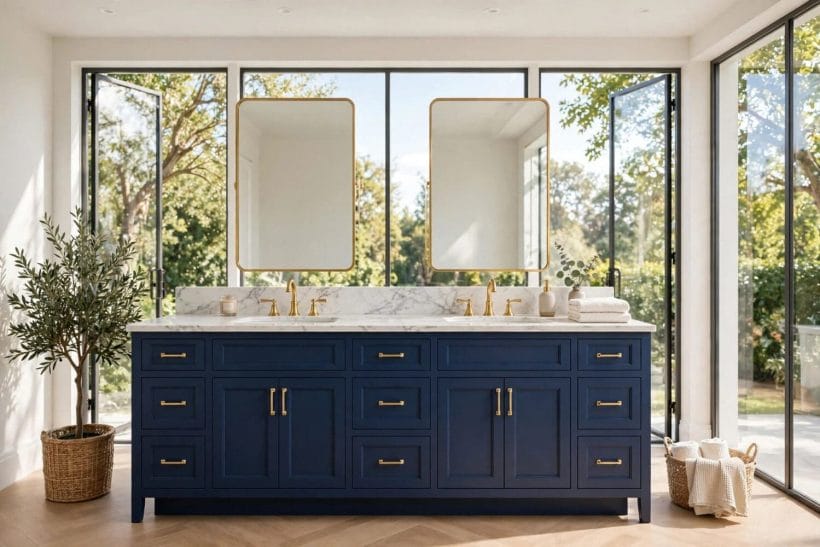
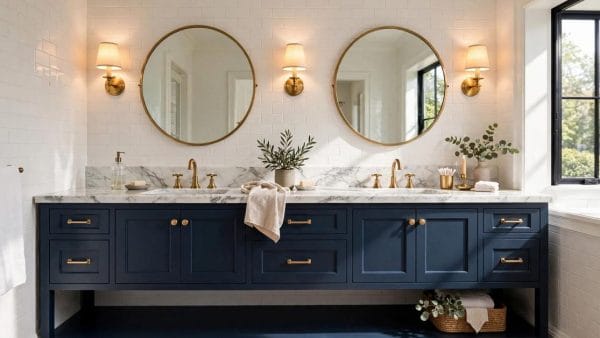
The navy double in gallery-4 carries its top beautifully: a pale stone slab unifying two basins and two banks of drawers, the contrast doing the styling work of the whole room. The top is the vanity’s work surface and its jewellery at once, and it is chosen as a material, not as a colour.
13. Top materials, in general terms
Stone brings weight, coolness and variation, and asks for sealing and a little respect. Engineered quartz brings consistency and shrugs off the daily chemistry of bathrooms. Solid-surface tops can integrate the basin in one moulded piece — no seam, no rim, nothing to trap grime. Timber brings warmth and a maintenance promise. The full survey of counter materials — edges, care and costs of ownership — is in bathroom countertops; choose the top with that evidence open.
14. Basin types: sit-on, inset, undermount, integrated
Vessel basins sit on top and make their statement at eye level; inset and undermount basins keep the top clear for the morning’s spread; integrated tops erase the join entirely. The differences are daily, not theoretical: wiping around a vessel, splashing from a shallow inset, the rim you cannot clean under. Live with each in the showroom for a minute before deciding for a decade.
15. Splashbacks and the wall behind
The strip of wall behind the taps takes the room’s weather. A raised upstand in the top’s own material, a tiled splashback, or a full-height panel each solve it differently; what matters is that the solution is chosen, sealed and washable — never an afterthought of bare plaster. Tile choices that behave here are the same family as those in ceramic tile bathroom.
7. Inside the Vanity: Drawers, Organisers and the Honest Interior

Open the drawer in gallery-5 and the guide’s whole philosophy is in it: compartments sized to real objects — brushes, bottles, cotton pads, the small armoury of a morning — each visible, each in its place. Interiors sell few vanities and redeem many.
16. Organisers: buy the drawer a system
Dividers and trays turn a drawer from a rattle-box into a cabinet of curiosities you can actually use. Fit them to the inventory from section 4, leave one flexible compartment for the objects no system predicts, and prefer organisers that lift out for cleaning — bathroom drawers collect a fine, damp dust that rewards washable order.
17. The damp truth: ventilation and materials inside
Vanity interiors live in humid air with occasional leaks. Interiors in moisture-resistant board, sealed edges and a ventilated back survive it; raw chipboard edges swell at the first escape of water. In the showroom, look inside and underneath — the parts never photographed — and judge the vanity by them, because that is where its years are decided.
18. A place for heat and water
Hair dryers and straighteners want a heat-safe home near a socket; brushes and bottles want to stand upright, not swim. The best interiors assign both deliberately — a deep drawer or tall section for the upright things, a heat-tolerant tray for the warm ones — instead of letting the morning sort it out on the counter, permanently.
8. Taps, Mirrors and Lighting
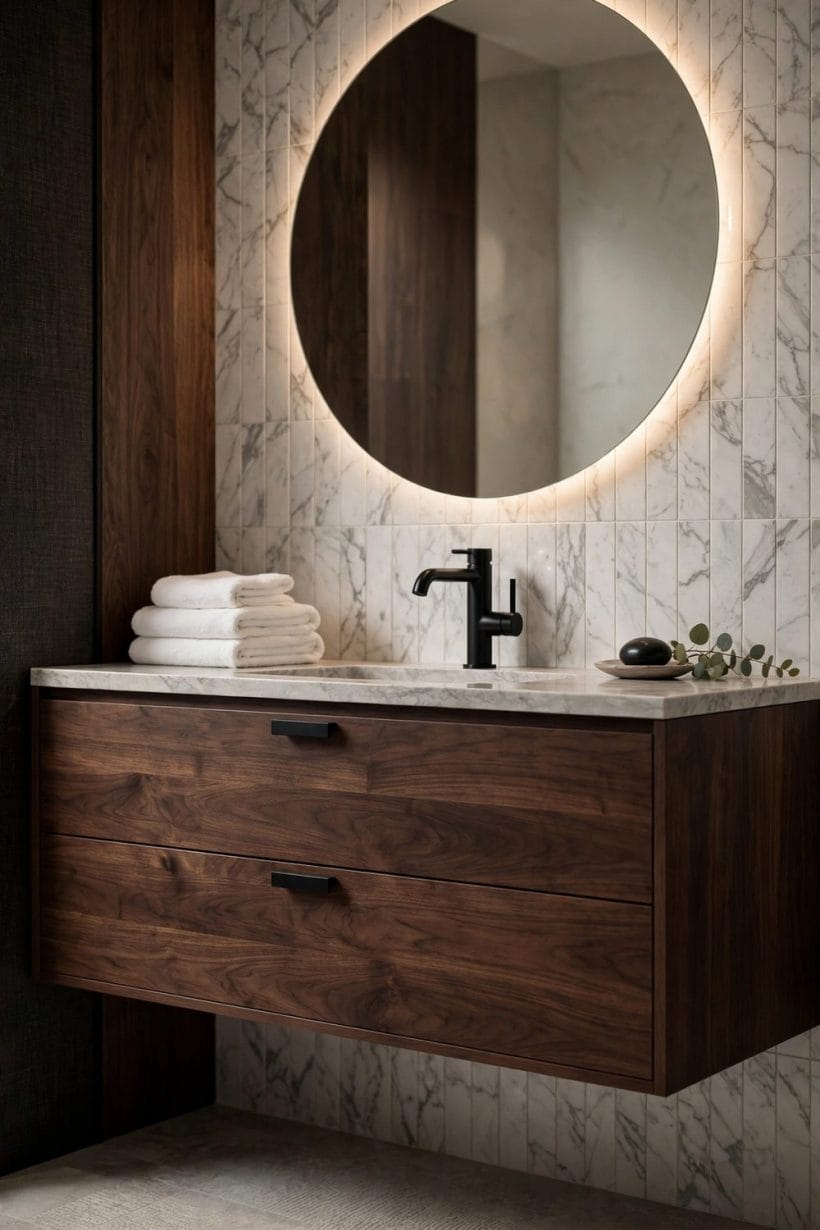
The walnut vanity in the pin keeps its wall to three actors: a backlit round mirror, a black tap, and marble. That restraint is the lesson of this section — the vanity wall has few elements, so each one is cast, not accumulated.
19. Taps: reach, splash and finish
A tap should deliver water into the basin’s bowl, not onto its rim or the user’s wrists: check the spout’s reach against the basin in the showroom, with the actual pairing, not the catalogue’s. Finishes should match or deliberately echo the handles and mirror frame — one metal, repeated, is the calmest sentence a bathroom wall can say.
20. Mirrors: size to the vanity, light to the face
A mirror roughly the vanity’s width, or a pair over a double, keeps the composition balanced. What matters more is the light it works with: light at face height, from the sides or from a lit mirror itself, flatters and functions; a single downlight above makes actors of us all, and not kindly. Backlit and demisting mirrors earn their keep in steamy rooms.
21. Sockets and the small electrics
Shavers, toothbrushes and dryers all queue for power at the vanity. Where local rules allow, a socket planned into the scheme — in a drawer, in the mirrored cabinet — ends the trail of chargers across the basin. This is electrician territory, specified before installation; the design task is simply to ask for it early.
9. Styling the Vanity Wall

Styling a vanity is editing, not decorating: the oak piece in gallery-6 carries a plant, a basket of towels and a shell or two, and stops. The counter’s first job is to be empty enough to use; its second is to look like it.
22. The tray rule: group, don’t scatter
Corral the daily objects on one tray or in one vessel and the counter reads styled; scatter the same objects and it reads untidy. One plant, one scented thing, one beautiful container — the classic trio — is a ceiling, not a target. Everything else lives in the storage you planned in section 4.
23. Textiles and the soft layer
Towels are the vanity wall’s largest area of colour after the cabinet itself, and the easiest to change: a matched set in one tone calms a busy room; a deliberate contrast wakes a pale one. Rolled in a basket or folded on a shelf, they double as the open storage’s content and its styling at once.
24. Restraint above the top
The wall above a vanity tempts additions — shelves, pictures, more mirrors. Add only what survives steam and splashing, and stop one item earlier than enthusiasm suggests. A single plant that tolerates humidity will out-charm a gallery wall of frames fogging gently behind glass.
10. Buying Checks and Honest Care
The last section is the showroom drill — the checks that separate the vanity in the photograph from the vanity in your bathroom, and the small upkeep that keeps it the same object in year five.
25. The in-person checks
Open every drawer and door: runners should travel fully and close softly or firmly, never gratefully. Sight along the fronts for alignment. Feel inside and underneath for sealed edges and finished surfaces. Check the top’s underside and the basin’s fixing. Ask what the carcass is made of, and what the warranty actually covers — in writing. A vanity that passes these checks in a bright showroom rarely disappoints in a steamed bathroom.
26. Delivery, installation and the honest total
Measure the route — stairs, doors, the turn into the bathroom — before the vanity is ordered, and agree who installs, who connects, and who disposes of the old unit. The honest total includes taps, waste, trap and the plumber’s visit; the guide to what bathroom work generally involves is in bathroom remodel cost. None of this is alarming; all of it is cheaper known early.
27. Care that takes minutes
Wipe splashes the day they happen and stone tops forgive nearly everything; leave them and even stone keeps the memory. Keep seals at the top’s edges sound, clear the trap when drainage slows, and let the interior dry after any leak before closing the doors on it. A vanity asks for minutes a month — and returns a calm room every morning.
Final Considerations
A vanity succeeds in a fixed order: it fits the wall and the door swing, its basin lands where the plumbing lives, its storage swallows the household’s real clutter, and only then does it get to be beautiful. Run the order backwards and the prettiest cabinet in the showroom becomes the morning’s daily negotiation. The designers’ advice in this guide — measure first, choose the form, plan the storage, style last — is not a ranking of pleasures; the styled wall in these photographs is the reward at the end of it. Choose the checks before the finish, and the vanity will repay you every single morning.



0 Comments