

Every vinyl floor box makes the same promises in bigger type: waterproof, scratch-proof, life-proof. The truths that decide how the floor actually lives are printed much smaller, in the specification — the wear layer’s thickness, the core’s construction, the finish’s name. Those small lines are what this guide teaches you to read.
Worked through in order: the anatomy of a plank, the wear layer itself, how thickness is stated, the core types underneath, finishes and embossing, backing and sound, sizes and locking edges, and the paperwork that separates a specification from a slogan.

1. Vinyl Flooring Wear Layers and Specs at a Glance
Scope first. This guide owns the specification end of vinyl flooring — how to read what a plank is made of before it goes down. The installed side of the topic lives elsewhere on the site: a surface-finish alternative in epoxy flooring ideas, the wet-room application in bathroom flooring ideas, the general buying route in the online flooring guide, the wider canon in tiny house flooring ideas, and the practical weight question in the flooring weight calculator. Here, everything serves the spec sheet.
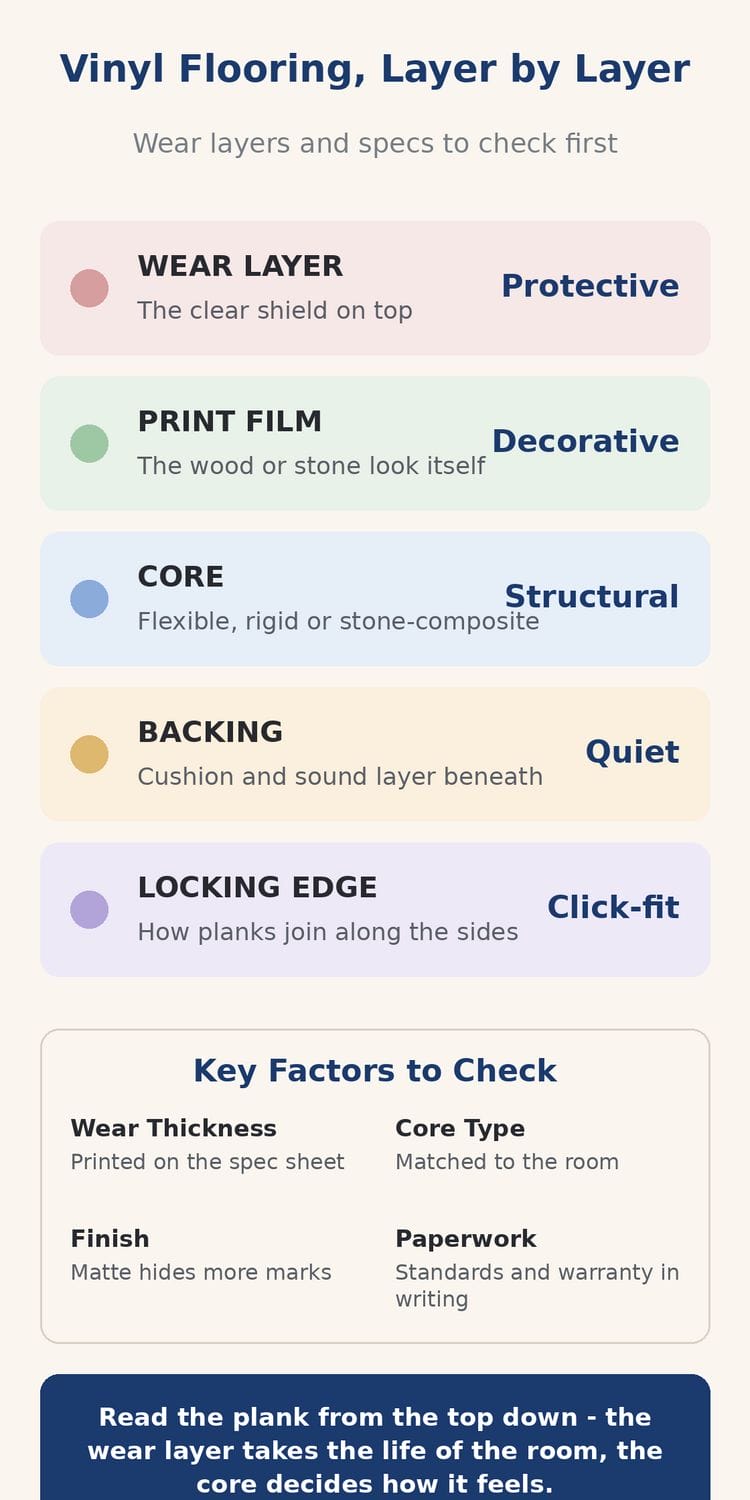
One discipline governs the whole guide: compare like with like, on paper. Two planks photographed in the same warm light can differ in every layer that matters, and the layers are all declared — wear layer, print, core, backing — for any buyer who reads the panel on the box rather than the poster above it.
| Layer | What it is | Check |
|---|---|---|
| Wear layer | The clear shield on top | Its stated thickness |
| Print film | The wood or stone design | Pattern repeat and realism |
| Core | The plank’s body | Flexible, rigid or stone-composite |
| Backing | Cushion and sound layer | Attached underlay or separate |
2. The Anatomy of a Plank

A vinyl plank is a sandwich, and every layer has a job. Reading the sandwich from the top down is the fastest way to understand what any specification is claiming — and what it is quietly leaving out.
The sandwich also explains the price ladder. Makers can spend money on any layer — a thicker shield, a denser core, a better print — and the boxes rarely say which layer the money bought. Learning the layers turns a price you cannot interrogate into four questions you can.
1. Meet the four layers in order
From the walking surface down: a clear wear layer, a printed design film, a core that gives the plank its body, and a backing that meets the subfloor. Each layer is specified separately, so each can be compared separately.
2. The edge profile tells the truth
Look at a sample’s cut edge in the showroom. The layers are visible as strata, and their relative thicknesses are obvious at a glance — a far better education than any diagram on the display stand.
3. Total thickness is not wear thickness
The number on the box’s front is usually the whole sandwich. A thick plank may simply carry a thick core or backing while its wear layer stays modest; the two figures answer different questions and must not be confused.
3. The Wear Layer Itself
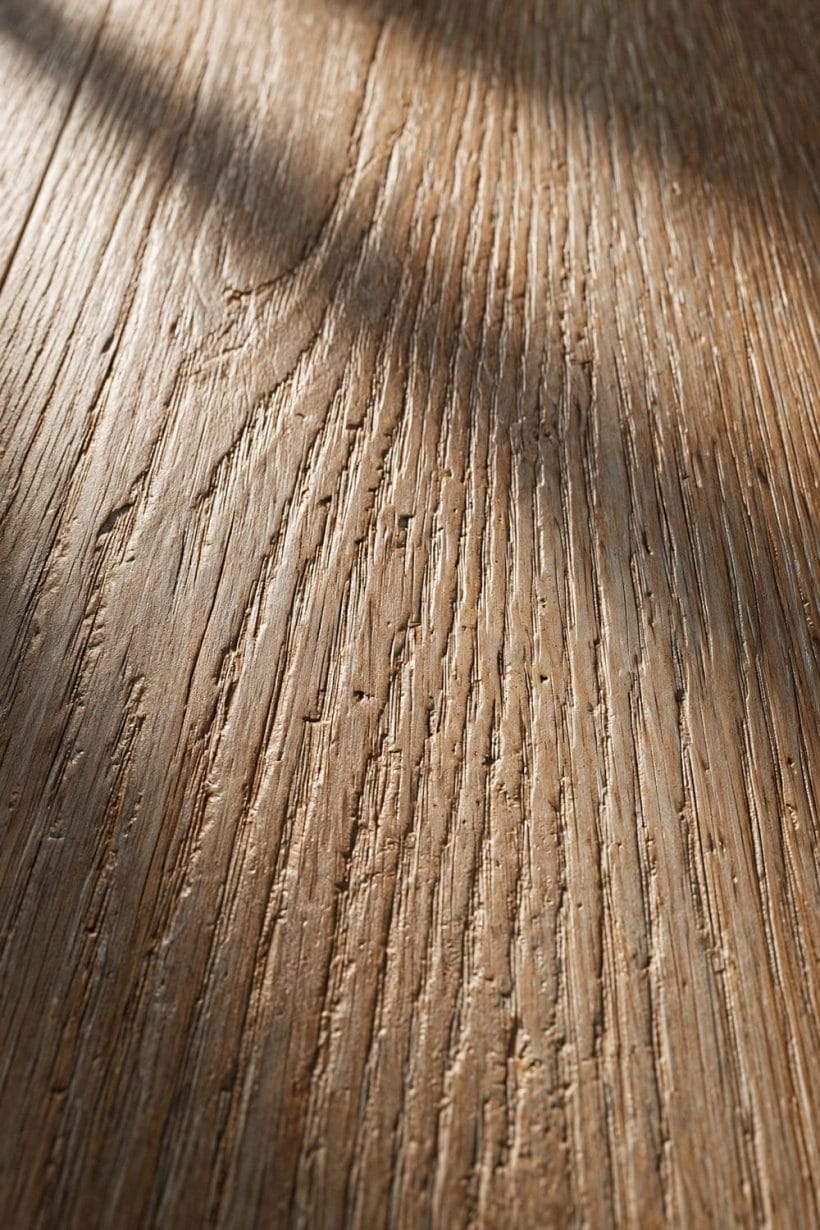
The wear layer is the transparent film that takes the room’s life — grit under shoes, chair legs, pet claws, dragged furniture — so the printed design beneath it does not have to. Everything above the print is armour; everything below is structure.
It is worth being precise about what the wear layer cannot do. It resists abrasion; it does not make the plank dent-proof, waterproof at its joints, or immune to dragged grit on its own. Buyers who know the limits of the layer they are paying for are the ones who stay pleased with it.
4. It protects the picture, not the plank
Sand and grit act like slow sandpaper. The wear layer is what they consume first, and its job is to be thick and hard enough that the design film below survives the years looking undegraded.
5. Surface coatings add a second defence
Many wear layers carry an additional cured topcoat that resists scuffs and stains and makes the surface easier to clean. Ask what the topcoat is and how the maker says to clean it — the answer is part of the specification.
6. Gloss level is a wear-layer decision too
Matte finishes hide the micro-scratching of daily life far better than gloss, which displays every mark in raking light. In a busy household, the forgiving finish is the practical specification, whatever the showroom prefers.
4. Wear-Layer Thickness: Reading the Sheet

Thickness is the figure buyers chase, and it is genuinely useful — read properly. It is a declared specification, printed in the product’s documentation, and it means the same thing across makers when it is stated in the same terms.
Units add a wrinkle worth knowing: the figure may be stated in millimetres or in mils depending on the market, and the two are not interchangeable. When you compare two planks, first make sure both figures are speaking the same unit — a surprising number of showroom comparisons quietly are not.
7. Find the figure in the specification, not the slogan
The wear layer’s thickness belongs in the technical panel or the product’s data sheet. If a display talks about durability without printing the figure anywhere, treat the durability as unproven until you have the sheet.
8. Compare within the same room’s job
A hallway, a child’s bedroom and a shop floor ask different things of a surface. The useful question is never the biggest number but the appropriate one — matched to the traffic the room will actually see, with the maker’s own use-class guidance as the reference.
9. Thickness is one line of the budget
Wear thickness, core quality, finish and price move together, but not in lockstep. Reading the specification lets you see what you are paying for — and spot the plank whose price is carried by its photograph rather than its layers.
5. Core Types: Flexible, Rigid and Stone-Composite

Under the design sits the core, and it decides how the floor feels, how flat the subfloor must be, and how the planks behave at their joints. Three families cover nearly everything on sale, described here in general terms.
The core also decides how the floor handles rolling loads and point loads — office chairs, pianos, the feet of a loaded bookcase. The maker’s guidance on heavy furniture and castors belongs with the core conversation, and it is printed in the installation documents for anyone who asks.
10. Flexible cores forgive and feel soft
The traditional flexible construction bends with the plank, feels warm and quiet underfoot, and follows a sound subfloor closely — which also means subfloor flaws can telegraph through it over time.
11. Rigid cores bridge minor imperfections
Rigid-core planks hold their own shape, which makes them more forgiving of small subfloor unevenness and quicker to lay in long runs. Their firmness underfoot is a preference to test standing on a sample, not a quality grade.
12. Stone-composite cores trade warmth for stability
Cores built with a stone composite are dense, dimensionally steady and cool underfoot. They suit rooms with strong sun or temperature swings, where a softer construction would move more across the seasons.
6. Surface Finishes and Embossing
The finish is where specification meets eyesight. Two planks with identical layers can look entirely different because one carries a deep, registered texture and the other a flat photographic print — and the difference survives every viewing distance.
Take samples into daylight before deciding. Showroom lighting flatters print quality and hides repeat patterns; a sample by a window, and then in your own room’s evening light, shows you the floor you will actually own. Most sellers expect the request — it marks you as a reader of specifications.
13. Embossing decides whether the wood look convinces
A surface texture that follows the printed grain — embossed in register — reads as wood under both eye and hand. A generic texture laid over the print reads as a picture of wood, however sharp the photography.
14. Pattern repeat is printed on nobody’s box
Ask how many different plank designs the range cycles through. A short repeat shows itself across a large floor as a tell-tale rhythm of identical knots; a long repeat keeps the illusion unbroken.
15. Tile and stone looks have their own checks
For stone-effect vinyl, judge the grout-line design and the tile-size logic of the print. Convincing stone looks keep their joints believable in width and colour; unconvincing ones draw a grid no tiler would lay.
7. Backing, Underlay and Sound

Turn the sample over. The backing decides how the plank meets the subfloor, how the room sounds, and whether a separate underlay enters the budget — a layer of the specification that showrooms rarely volunteer. It is also where this guide meets the warmth question covered in underfloor heating for tiny houses: if heat will ever run beneath the floor, the maker’s rules for the build-up belong in this section’s checks.
Backing also decides the floor’s behaviour at thresholds and stairs, where the build-up’s total height shows. Measure the full stack — plank plus any separate underlay — against your door clearances and adjoining floors before the boxes come home.
16. Attached underlay simplifies the stack
Many planks carry a factory-attached cushion backing. It speeds installation and settles the sound, but it also fixes the underlay choice at the factory — check that what is attached suits your subfloor and room.
17. Sound ratings belong to the whole floor build-up
Impact-sound figures are measured on a complete floor assembly, not a lone plank. If quiet matters — a flat, a bedroom over a living room — ask what build-up the published figure was measured on.
18. Moisture at the subfloor is a backing question
What sits under the plank decides how ground moisture is handled. The maker’s subfloor requirements — dryness, preparation, any membrane — are specifications too, and skipping them is how good planks fail.
8. Format and Fit: Sizes and Locking Edges
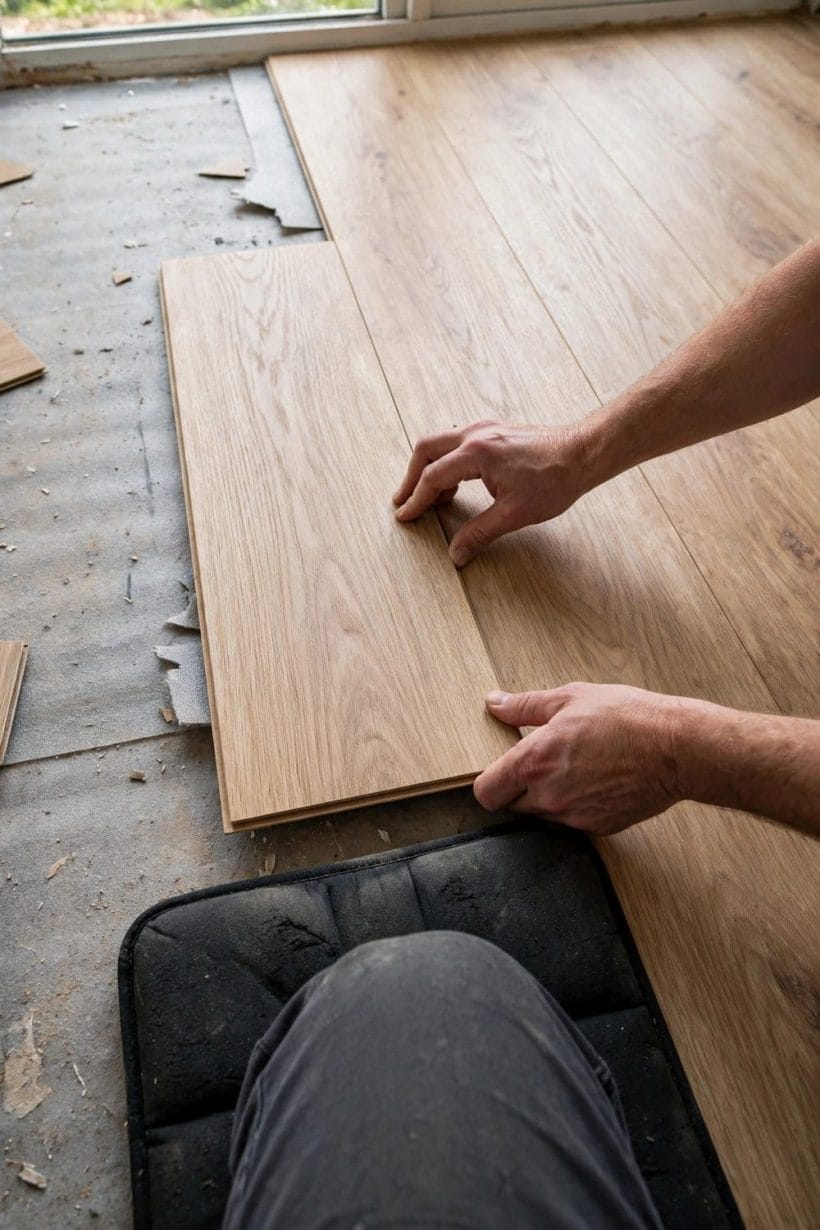
Plank dimensions and the joint between planks are specifications with daily consequences: they decide the floor’s scale in the room, its laying speed, and how the joints behave under chairs and through winters.
Laying direction is the format decision nobody prints. The same plank reads differently run toward the light than across it, and long planks emphasise the room’s longest line. Decide direction with the format, in the room, before a single box is opened.
19. Plank size should suit the room’s size
Long, wide planks flatter large rooms and can crowd small ones, where a modest format keeps the pattern’s scale believable. Take the room’s measurements to the showroom, not just its photograph.
20. Locking edges are the joint you live with
Click profiles vary in how positively they engage and how flat they hold the seam. Work two samples together in the shop: a well-made lock closes tight, sits level and resists being teased apart by hand.
21. Bevels draw the plank’s outline
Edge bevels range from square — a seamless sheet look — to a pronounced V that draws every plank. Neither is better; the bevel is a style specification, and it also decides how visible crumbs and dust lines become.
9. Paperwork: Standards, Ratings and Warranties

The last layer of a vinyl floor is paper. Standards classes, slip and fire ratings and the warranty’s fine structure are all declared somewhere; the buyer’s skill is knowing that they exist and asking for them by name.
Paperwork has a second use: resale and repair. A floor whose range, class and batch are documented can be matched years later for a repair or an extension; an undocumented floor becomes an archaeological puzzle. The folder you keep is a feature of the floor, not an admin chore.
22. Use-class ratings translate traffic into a class
Flooring is rated in use classes that describe the traffic it is built for, from light domestic to heavy commercial. Matching the class to your room is the single most reliable specification shortcut there is.
23. Read the warranty’s conditions, not its headline
A long warranty with narrow conditions protects less than a shorter one plainly kept. Check what voids it — installation method, subfloor preparation, cleaning products — before the floor is down, not after a claim.
24. Keep the documentation with the spare planks
Store the data sheet, the warranty and a note of the exact range and colour with the spare box of planks. A future repair, claim or extension of the floor will ask for precisely those papers.
10. Questions to Ask Before You Buy
The final section turns the guide into a showroom conversation. Each question maps to a section above; a seller who can answer them from the data sheet is selling you a specification, and that is the only kind of vinyl floor worth buying.
Bring the room’s measurements, a note of its traffic and one honest line about who lives there — children, dogs, wheelchair, drums. Specifications are matched to lives, not to photographs, and the three questions below work best answered against your floor’s real biography.
25. What is the wear-layer thickness, and where is it printed?
Ask to be shown the figure in the product’s own documentation. The location of the answer matters as much as the number: printed in the technical panel, it is a specification; spoken from memory, it is a pitch.
26. Which core is this, and what subfloor does it need?
Core family, preparation requirements and any underlay rules, stated together. A plank is only suitable for your room when its core and your subfloor agree, and the maker has already written down whether they do.
27. Which use class is it rated for, and what voids the warranty?
The class tells you the floor’s intended life; the warranty conditions tell you how to keep that life protected. Between the two answers, you know more about the floor than its display ever said.
Final Considerations
Vinyl flooring rewards the buyer who reads the sandwich. The wear layer’s declared thickness, the core’s family, the finish’s honesty and the paperwork’s conditions decide the floor’s next decade far more reliably than the showroom’s warm light and wide promises. Take the data sheet home, compare like with like on paper, and let the specification — not the slogan — close the sale.




0 Comments