

Before the fitted kitchen existed, one piece of furniture did the whole job — storage, worktop, flour bin and pantry in a single tall cabinet that a cook could run a household from without taking three steps.
This is the Hoosier cabinet: where it came from, how its parts work, and why a century-old workstation still earns a place in modern kitchens — plus what to check if you go looking for an original.
1. The Hoosier Cabinet at a Glance
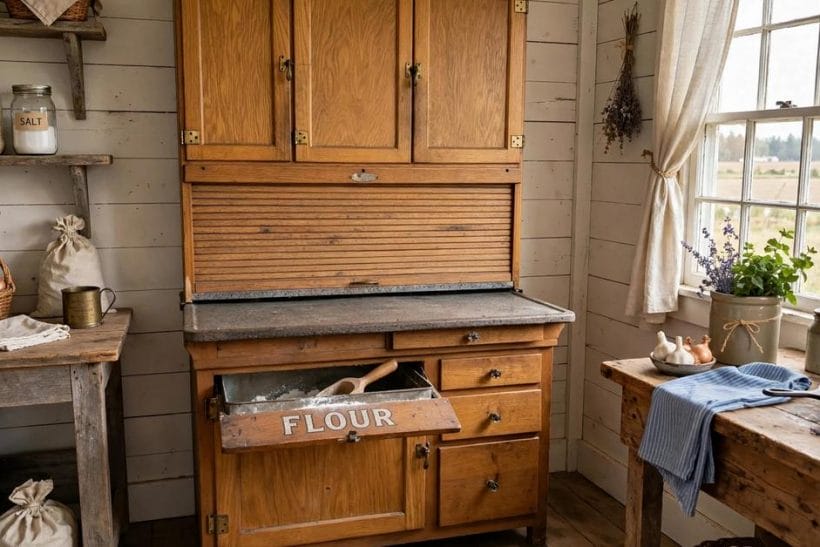
A Hoosier cabinet is a freestanding kitchen workstation, made in two stacked sections: a deep base with a pull-out work surface, and a shallower upper section of shelves, racks and small doors. It flourished in the early twentieth century, when most kitchens had no built-in cabinetry at all — the world the vintage kitchens post reconstructs — and it packed an entire kitchen’s storage into the footprint of a wardrobe.
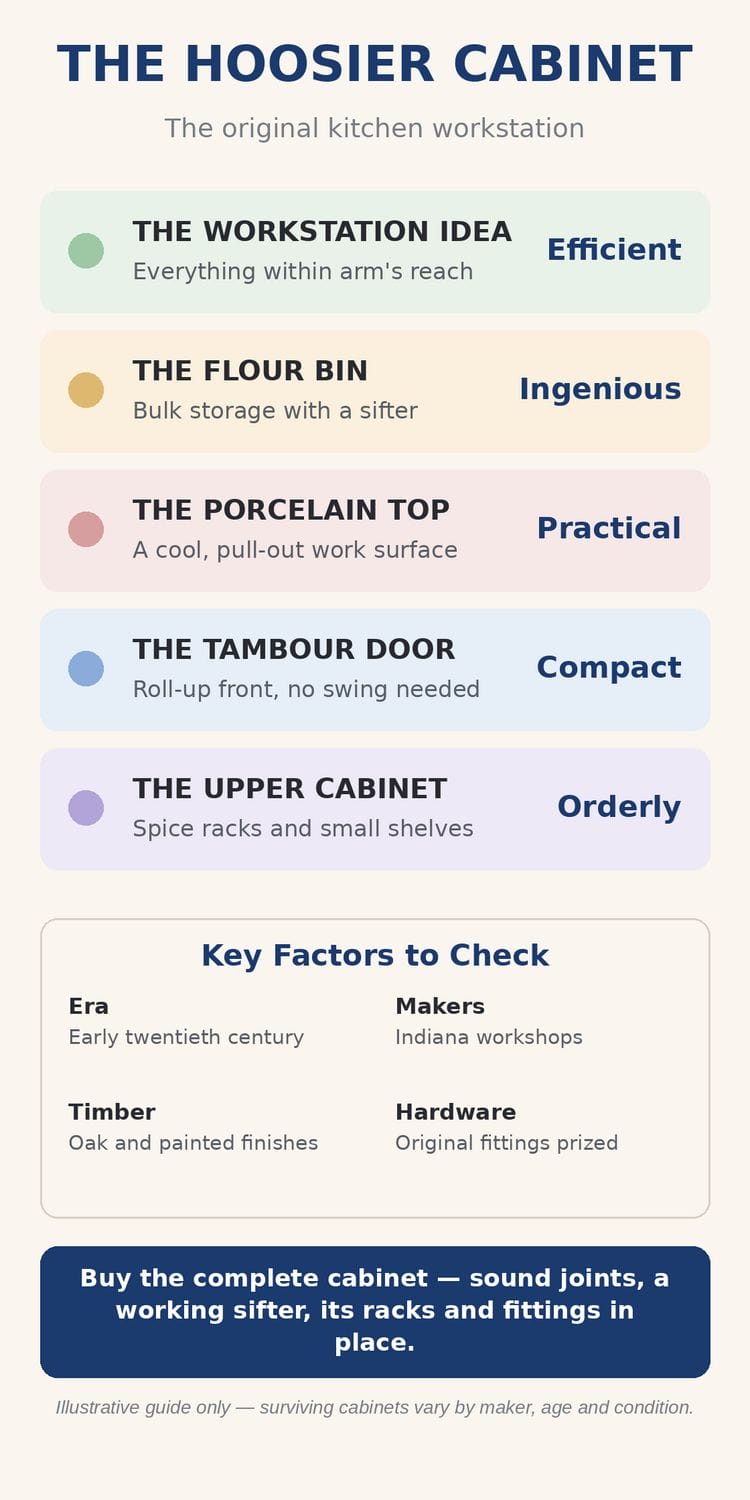
The five parts in the table below are the features that define the type. Find them on a cabinet and you are looking at a true Hoosier or one of its many close cousins; miss most of them, and you are looking at an ordinary cupboard in fancy dress.
| Family | Character | What it means |
|---|---|---|
| The Workstation Idea | Everything within arm’s reach | Efficient |
| The Flour Bin | Bulk storage with a sifter | Ingenious |
| The Porcelain Top | A cool, pull-out work surface | Practical |
| The Tambour Door | Roll-up front, no swing needed | Compact |
| The Upper Cabinet | Spice racks and small shelves | Orderly |
A note on names: “Hoosier” is the nickname of Indiana, where many of the best-known makers had their workshops, and the name settled onto the whole type of cabinet — made by numerous firms, in several states, over several decades. It names a kind of furniture, not a single brand, and that is how this guide uses it.
2. What a Hoosier Cabinet Is
Stand in front of a Hoosier and the idea explains itself. The base holds the heavy stores and the work surface; the upper section holds everything the cook reaches for hourly; and the whole arrangement puts the day’s work in one place, seated or standing, with nothing stored across the room.
Two Sections, One Job
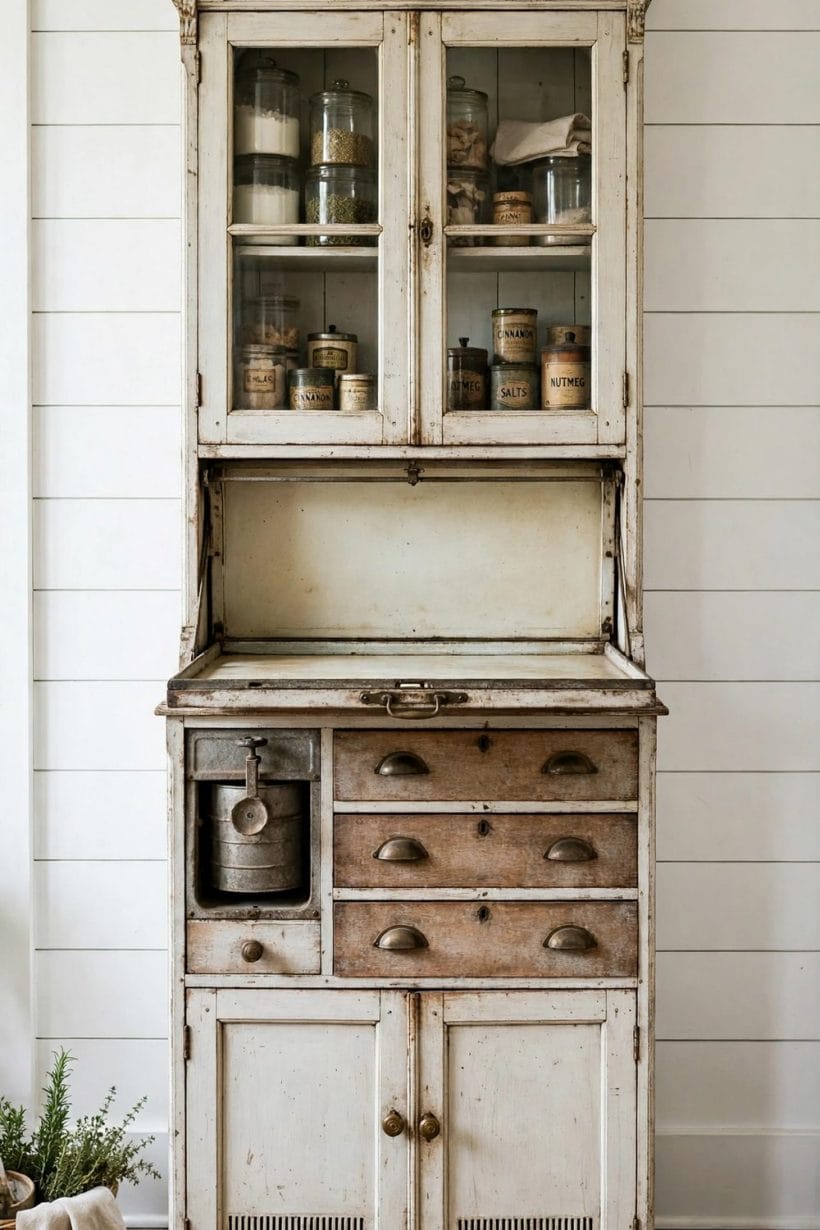
The base is cupboard-deep, with drawers and bins below the worktop. The upper section is shallower — deliberately, so its shelves sit behind the work surface without crowding it — and carries the small stores: spices, jars, utensils, the cookery book. The gap between the two sections is the stage on which the cooking happens.
A Kitchen Before Kitchens
To understand the Hoosier, forget the fitted kitchen entirely. Its first buyers cooked in rooms that might hold a stove, a table and a sink, and nothing else. The cabinet was sold as the missing kitchen: arrive with one piece of furniture and the room could function. Every feature answers that brief — including in homes where, as in the cabin interior ideas post, one hard-working piece still organises a whole room.
Not Just Any Old Cupboard
Age alone does not make a Hoosier. Kitchen safes, pie safes, dressers and hutches are all honourable antiques, but the Hoosier is defined by its workstation anatomy — worktop, flour storage, upper section — built as one system. The distinction matters when buying, as section 9 explains.
3. Where It Came From
The Hoosier belongs to the first decades of the twentieth century, when the “step-saver” kitchen was a serious domestic idea: reformers and manufacturers alike argued that a well-arranged workspace could give the home cook hours back. Indiana’s furniture towns became the type’s heartland, and makers there and elsewhere competed on fittings, finishes and ingenuity.
The Step-Saver Idea
The selling point was steps — or rather, their absence. Flour, sugar, utensils, work surface and storage within one reach meant a meal could be prepared in a small circle of movement. It is the same logic the modern butler’s pantry ideas apply at room scale: everything for a task, stored where the task happens.
Many Makers, One Pattern
Success bred imitation, and dozens of firms made Hoosier-style cabinets — in oak, in painted finishes, in sizes from compact to imposing. Surviving cabinets therefore vary widely in detail, hardware and quality. That variety is part of the type’s charm, and part of the buyer’s work: you assess the individual cabinet, never the legend.
Why It Faded
The fitted kitchen ended the Hoosier’s reign. When built-in units, continuous worktops and plumbed sinks became standard, a freestanding workstation lost its reason to exist — and thousands were relegated to barns, workshops and paint. Their return, a century on, is this guide’s last act.
4. Anatomy: The Base and Its Storage
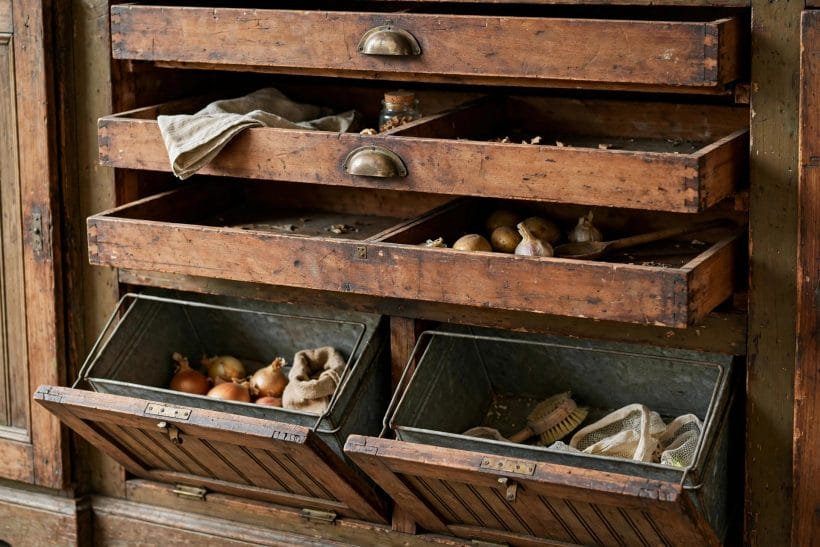
The base is the cabinet’s engine room. Below the worktop sit the stores a cook uses by the scoop and the handful: deep bins, lined drawers and cupboards sized for the bulky goods of a working kitchen.
Bins, Drawers and Cupboards
Typical bases combine a roomy cupboard, drawers for cutlery and linen, and tilting bins that present their contents at an angle — easy to scoop from, easy to see into. Metal linings in the bins were a hygiene feature of the period, keeping dry goods from timber and timber from spills. The honest joinery behind all of it is the same craft the furniture construction guide teaches you to read.
Wheels and Feet
Many bases stand on casters, and the feature is not quaint: a cabinet that could be rolled out could be cleaned behind, in an era that preached kitchen hygiene with missionary zeal. When you meet a Hoosier on its original casters, you are looking at a piece of early domestic science, not an inconvenience.
Sized for Work, Not Display
Everything about the base is workmanlike: heights set for a standing cook, depths set for sacks and crocks, doors that open flat against the sides. It is furniture designed from the task outward — the quality that still makes these cabinets useful rather than merely decorative.
5. The Flour Bin and Sifter
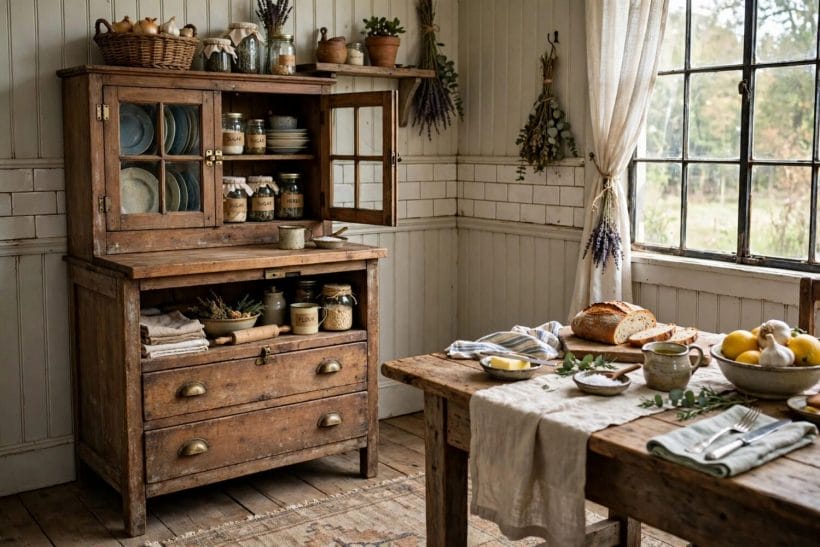
The Hoosier’s signature fitting is its flour bin: a large, often tilting or pull-down container that held the household’s flour and dispensed it through a built-in sifter, straight into the bowl, with a turn of a crank or a shake of the mechanism.
Why Flour Ruled the Design
Bread, pastry and cakes were daily work, and flour was bought in bulk and used by the pound. Storing it at the workstation — dry, enclosed, measurable without a trip to the pantry — was the cabinet’s killer feature, the one in every advertisement. The bin’s size tells you plainly what the era’s cooking cost in labour.
The Sifter Mechanism
The sifter combined storage and preparation in one motion: flour lived above, and fell through a mesh into the bowl below, aerated and lump-free. Surviving mechanisms range from the elegant to the agricultural, and their condition is one of the first things a buyer checks — a working sifter is the Hoosier’s party piece.
What to Use It For Now
Few modern owners store fifty pounds of flour. The bin adapts gracefully: pet food, birdseed for the garden store, laundry pods by the utility sink, or a lifetime supply of rice. The fitting outlasts its original purpose because generous, enclosed, tilting storage is a good idea in any century.
6. The Work Top and the Tambour Door
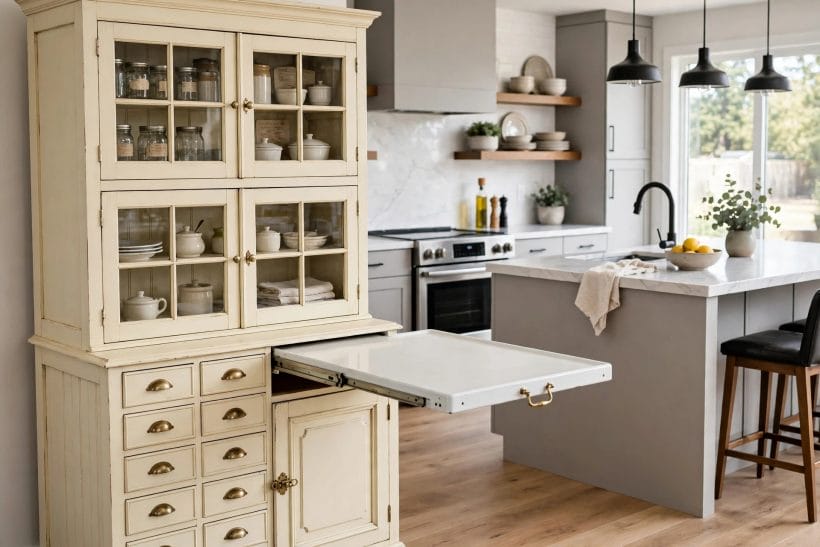
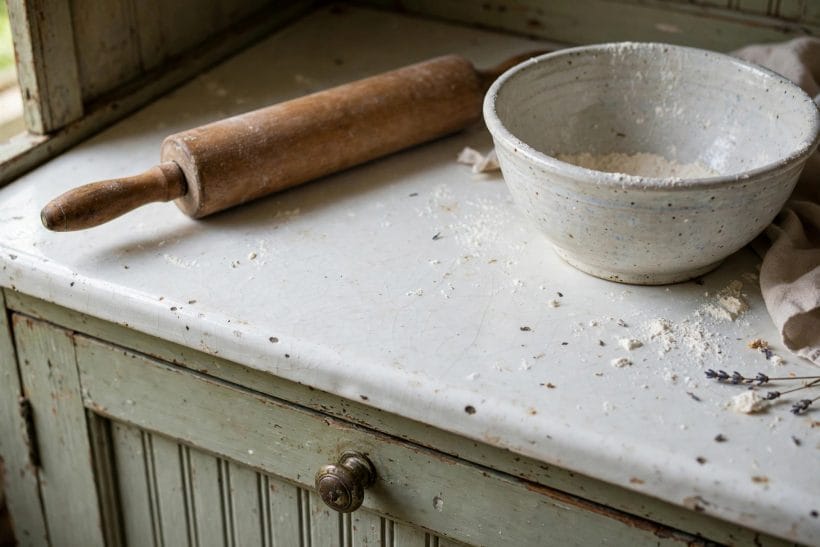
Between the sections sits the stage: a work surface, often enamelled metal or porcelain-finished, that pulls out from the base to give the cook a cool, smooth, generous counter — and slides away when the work is done.
The Pull-Out Surface
The sliding top is the Hoosier’s answer to the small kitchen: counter space on demand, doubled at a pull, gone at a push. Its cool, hard finish suited pastry work, and its smooth face wiped clean in seconds. Modern owners use it exactly as their great-grandparents did — as the extra counter every small kitchen wishes it had, the same trick in furniture form that the kitchen ideas pillar keeps meeting in island and cart form.
The Tambour Door
Many uppers close with a tambour: a flexible door of narrow slats that rolls up into the cabinet’s top instead of swinging out. In a cramped kitchen, a door that needs no swing space is pure gain, and the rolling slats became the Hoosier’s most graceful visual signature. Tambours that still run smoothly are prized; ones that stick are usually honest wear, addressed in section 10.
The Working Gap
The space between worktop and upper shelves is sized with intent: tall enough for mixing bowls, jars and the cook’s hands at work, shallow enough that nothing hides at the back. It is the original splashback zone, and in many cabinets it carries the small fittings — hooks, a clock, a menu board — that made the station personal.
7. The Upper Section: Racks, Jars and Order
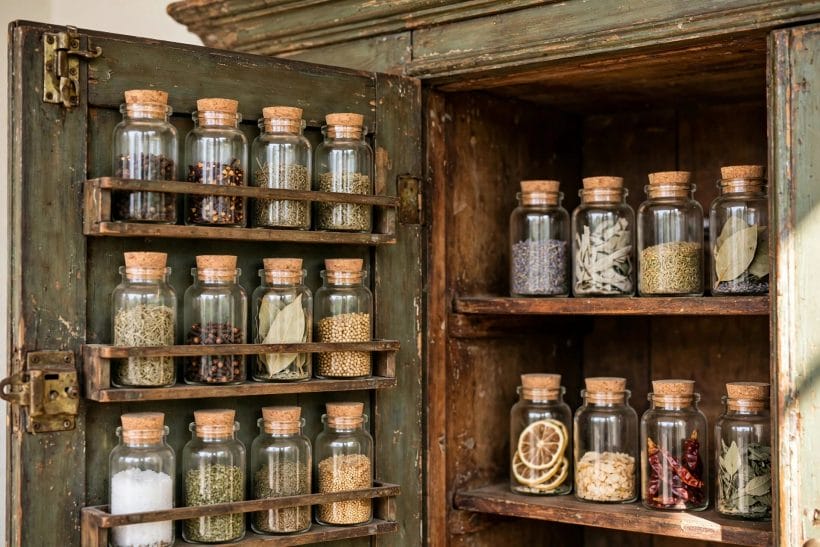
If the base is the engine room, the upper section is the bridge: the small, frequently handled things, arranged at eye level, each in its appointed place.
Spice Racks and Jar Shelves
Shaped racks on the doors and narrow shelves across the upper section held the spice jars and small stores where they could be read at a glance. Some cabinets came with fitted, labelled jar sets; most owners supplied their own. The principle — small things, visible, at the point of use — is one modern kitchen designers keep rediscovering.
Doors, Drawers and Sundries
Tiny drawers for string, stamps and recipes; a rack for the cookery book; hooks for measures and scissors. The upper section’s charm is its specificity: a place designed for each small tool of the trade. In a modern kitchen it takes the same role — the organised home for everything the white cabinets and backsplash ideas leave scattered across drawers.
Original Fittings Are the Treasure
Surviving uppers often arrive stripped — racks removed, jars long gone. A cabinet that keeps its original racks, hardware and fittings is the rarer and more valuable find, and the one to buy when the choice is offered. Completeness, in antiques, is the feature that cannot be added later.
8. Hoosiers in the Modern Kitchen
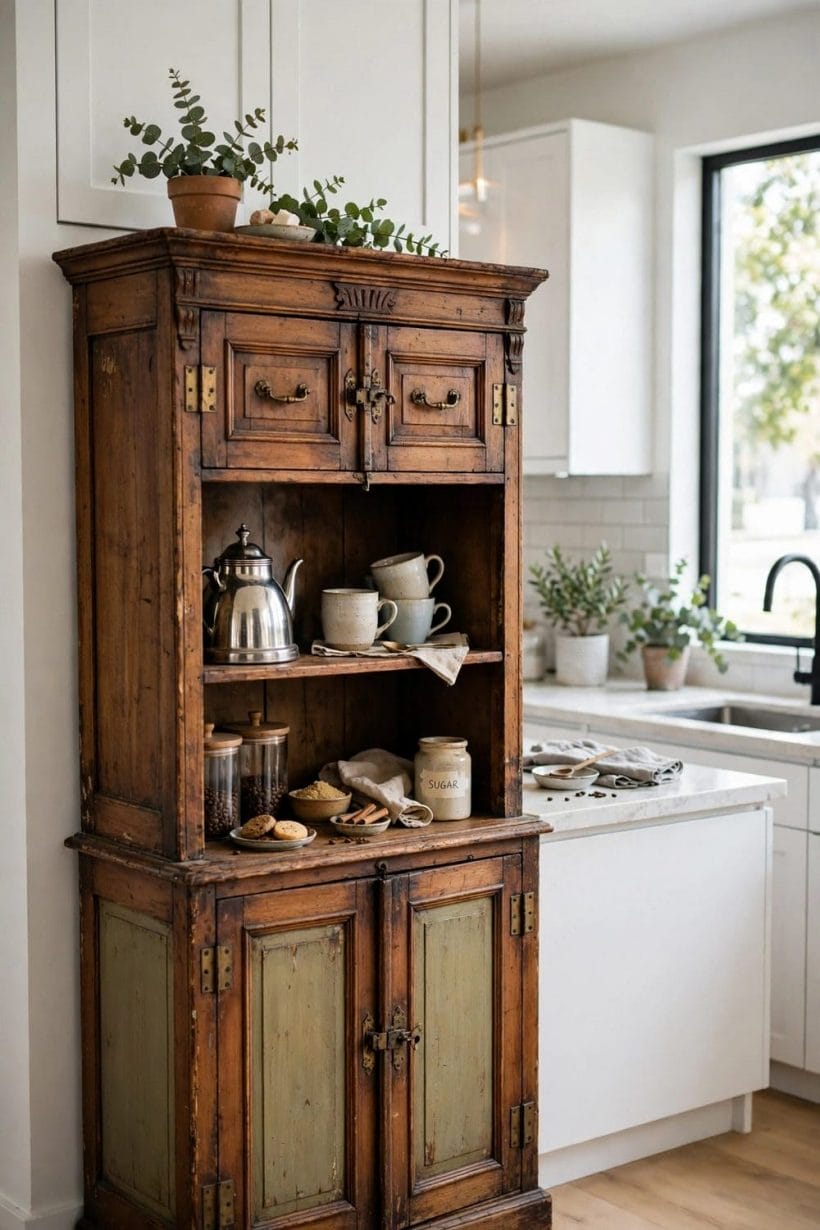
The Hoosier’s second life began when open-plan, freestanding and unfitted kitchens came back into fashion — and it turned out the old workstation had never stopped being good at its job.
The Coffee and Baking Station
The commonest modern role is the dedicated station: coffee at eye level, beans and cups in the upper, the pull-out top as the making counter. Bakers claim them for the same reason their ancestors did — everything for one beloved task, in one beloved place. A Hoosier station also solves the small kitchen’s oldest problem: the appliance that lives on the worktop because there is nowhere else.
An Island Alternative
Against a wall, a Hoosier gives a small kitchen much of what an island promises — storage, surface, presence — without the building work, and it can move house with you. In rentals and period homes where fitting is forbidden or unwise, that portability is not a compromise; it is the point.
Styling Around It
Let the cabinet be the room’s one antique statement and keep what surrounds it quiet: plain walls, simple textiles, modern lighting. Painted Hoosiers sit happily in contemporary schemes; oak ones anchor farmhouse and cottage rooms. Either way, one hero piece per kitchen is the rule — the cabinet has the presence to carry it.
9. Buying an Antique Hoosier: What to Check
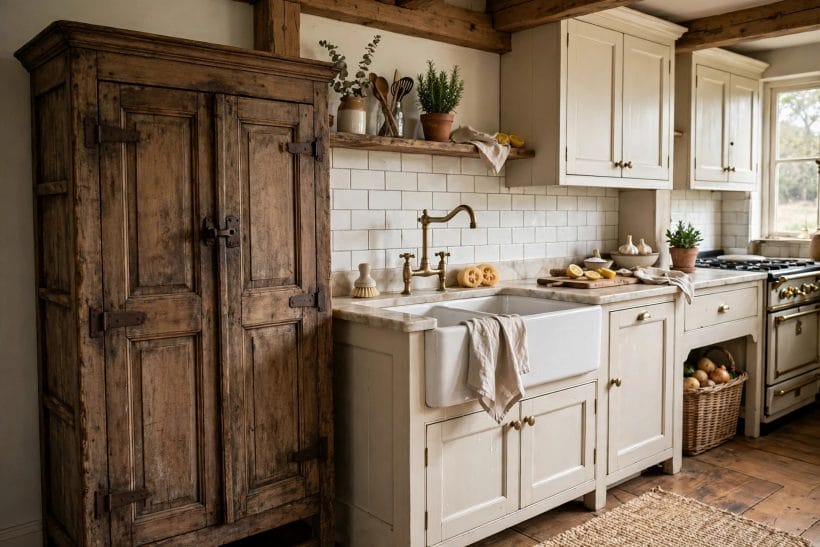
Originals surface at antique dealers, estate sales and online marketplaces, in conditions from museum to firewood. This section gives the checks; prices are deliberately absent — they vary by region, condition and completeness, and any figure printed here would be invented.
Structure First
Check the cabinet as you would any working antique, in the spirit of the furniture quality check guide: joints sound, sections matched (a base and upper born together, not married later), drawers running true, no active woodworm, no smell of damp or smoke soaked into the timber. Cosmetic wear is honest; structural tiredness is expensive.
The Fittings Inventory
Walk the anatomy of sections 4 to 7 as a checklist: flour bin present and sound, sifter mechanism present, worktop original and uncracked, tambour complete and running, racks and hardware in place. Each missing piece is either a deduction or a project. A complete, honest cabinet at a fair price beats a glamorous husk every time.
Provenance, Stated Honestly
Sellers’ stories about a cabinet’s past are entertainment, not evidence, unless documents travel with the piece. Buy the cabinet in front of you — its timber, fittings and condition — and let any verified maker’s marks add pleasure rather than price. Where a claim cannot be checked, treat it as decoration.
10. Restoring and Living With One
The best Hoosier restorations are the lightest: clean, repair, and stop. Sound original finish carries the cabinet’s history; stripping and refinishing should be the last resort for a finish genuinely beyond saving, not the automatic first chapter.
Attend to function next — a tambour eased back into its runners, casters freed, the sifter cleaned and its mesh renewed if perished, loose joints reglued by someone who works on antiques. Anything that held food should be cleaned with food-safe care and lined if its surface is doubtful; the bin’s second career, whatever you choose for it, starts from scrupulously clean.
Then simply use it, daily and without ceremony. A Hoosier kept polished behind a rope is a museum piece; a Hoosier holding the coffee, the flour and the household’s small chaos is what it was built to be — the hardest-working piece of furniture in the house, a hundred years young.
Final Considerations
The Hoosier cabinet deserves its fame. In one tall, handsome piece it solved storage, surface and order for kitchens that had none of the three, and its fittings — flour bin, sifter, pull-out top, tambour door — remain small masterpieces of domestic engineering.
If you find a complete, sound example, you are not buying a relic; you are hiring the most experienced workstation in the room. Give it a task, keep it working, and let it earn its place the way it has for a century — within arm’s reach of everything.


0 Comments