

Pick up one 2×10 and it feels manageable. Stack thirty for a deck rim, a floor system or a beam build-up and that same board suddenly decides your trailer payload, your axle count and how your back feels by noon.
That is why knowing how much does a 2×10 weigh, length by length, matters before you load, not after. The chart below gives the honest ranges, and the rest of this guide explains what moves a board inside them.
1. At a Glance: 2×10 Weight by Length
The 2×10 is a deep, wide framing member, and depth is what makes it useful and heavy at the same time. Rim joists run in it, floor joists span in it, deck beams are built up from it and long headers carry openings with it. In every one of those roles it works in multiples, never alone, so a small error in the weight of one board becomes a large error in the weight of a floor, a deck frame or a trailer load. That is why this guide works in typical ranges rather than a single tidy figure. A range respects the three things that genuinely change a board: the species it was milled from, the moisture still inside it and any preservative treatment it has been through.
Framing rarely uses one size alone, so read this chart beside its companion guides. The guide to how much a 2×4 weighs by length, species and moisture covers the stud workhorse, the guide to how much a 2×6 weighs by length, species and moisture covers the wall and rafter standard, and the guide to how much a 2×8 weighs by length, species and moisture covers the shallower joist size. Together those charts let you estimate a whole mixed frame without inventing a single figure the charts do not support.
| Length | Typical weight range | What the range covers |
|---|---|---|
| 8 ft | About 24–31 lbs | Common species, from kiln-dried to greener stock |
| 10 ft | About 30–39 lbs | Common species, from kiln-dried to greener stock |
| 12 ft | About 36–47 lbs | Common species, from kiln-dried to greener stock |
| 16 ft | About 48–62 lbs | Common species, from kiln-dried to greener stock |
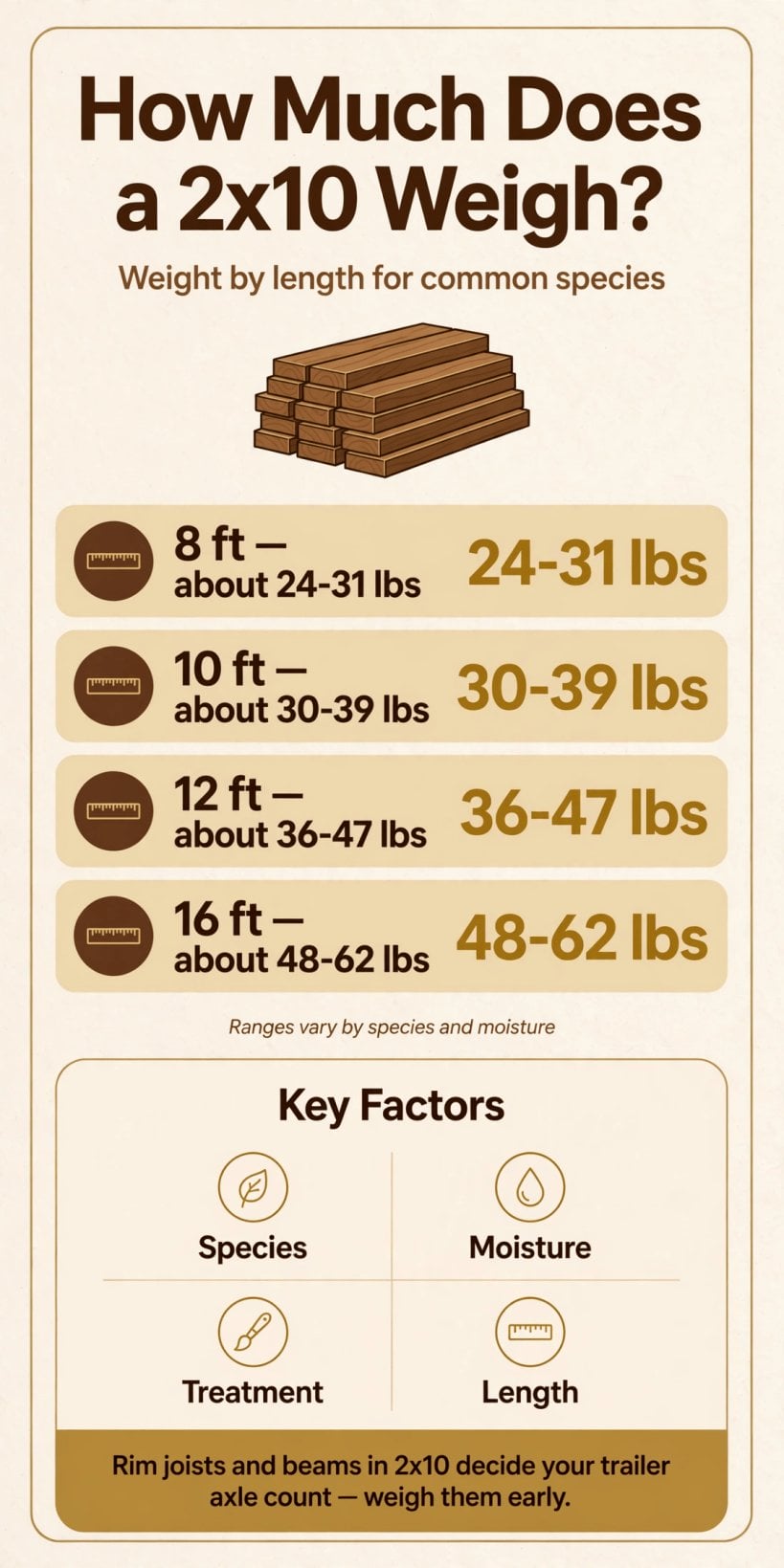
At a glance: a 2×10 runs about 24–31 lbs at 8 ft, 30–39 lbs at 10 ft, 36–47 lbs at 12 ft and 48–62 lbs at 16 ft, varying by species and moisture.
2. Nominal vs Actual Size: Why a 2×10 Is Not 2 by 10 Inches
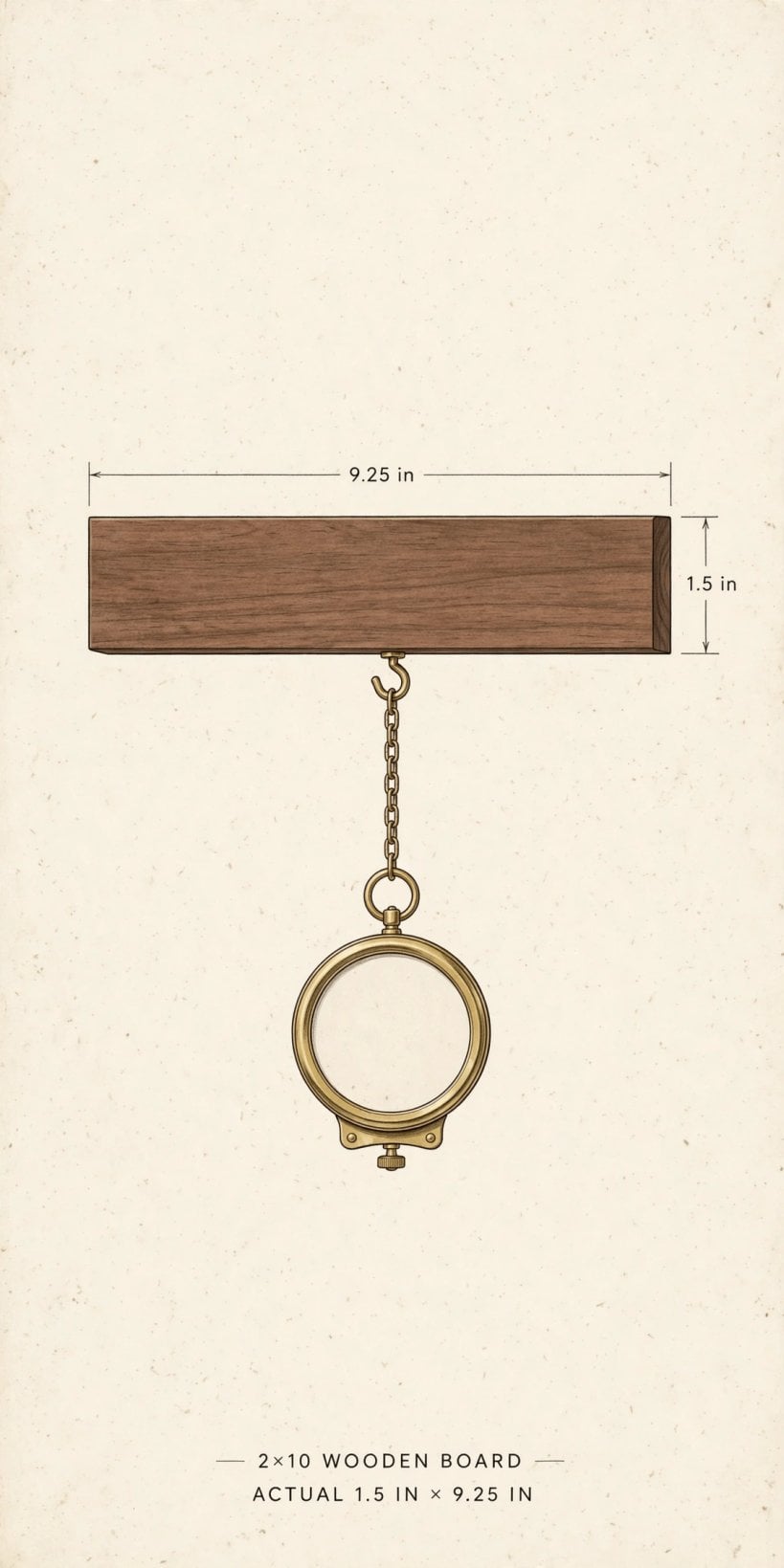
A 2×10 carries a nominal size, the dimension the board held as rough-sawn lumber before drying and planing finished it. The board on the rack measures about one and a half inches thick by nine and a quarter inches wide, slimmer in both directions than its name suggests. Every shaving that left the planer and every point of moisture that left in the kiln took mass with it, so estimating from the nominal name alone quietly assumes more timber, and more weight, than the member actually contains.
Weight follows the wood that is really there: a planed rectangle of softwood, multiplied by its length. That simple relationship is why weight rises so steadily with length in the chart. Double the length and you double the volume of the same cross-section, so the board carries roughly twice the wood and roughly twice the weight, whatever the species. It is also why older, reclaimed 2x10s can feel heavier board for board. Lumber sawn in earlier eras was often finished fuller than modern standards, so a reclaimed joist may contain measurably more wood in the same nominal size, another reason to plan in ranges whenever old and new stock share a project.
3. Species: Why One Board Outweighs Another
Softwood is not one material, and a rack of 2x10s proves it on the first lift. Southern yellow pine, the default structural species across much of the United States, grows fast yet lays down dense, resinous latewood, which puts pine boards toward the heavier end of the range and gives them their well-earned reputation in joists and beams. Douglas fir, the western structural standard, is also dense and strong for its size, while spruce-pine-fir, sold as a graded group rather than a single tree, generally runs lighter and is often the board that surprises you by feeling easy to carry.
The differences come from how a tree builds itself. Slow growth in a cold climate produces tight rings with a high share of dense latewood in every inch. Fast growth produces wider rings with more light earlywood. Two boards of identical finished dimensions can therefore hold quite different amounts of actual wood fibre, and weight is simply fibre, water and resin made tangible. Hem-fir and other regional species sit between those poles. None of this makes one species better in the abstract: span tables, grade stamps and local availability decide what you should frame with, and weight then follows from that decision rather than leading it.
4. Moisture: Kiln-Dried, Air-Dried and Green Weight
Water is the invisible half of lumber weight. A living tree moves water constantly, and a freshly sawn 2×10 still holds much of it, bound inside cell walls and sitting free in the spaces between them. Green lumber, sold soon after milling, carries the most of that water and sits at the top of any honest weight range. It also moves as it dries in place, shrinking across its width, sometimes twisting and often checking, which is why experienced framers prefer it for very little finish-sensitive work.
Kiln-dried lumber has been dried in a controlled chamber until the moisture deep inside the board is low and stable, and the KD stamp on the grade mark is your evidence. It is lighter to carry, straighter on the wall and far less likely to shrink away from its fasteners. Air-dried lumber reaches a middle state outdoors, stacked with stickers between layers so air can move, losing weight steadily until it settles near the moisture level of the air around it. Storage matters just as much after purchase: a kiln-dried stack left uncovered in a wet week will pick surface water back up, and its weight will creep upward again before you ever cut it.
5. Pressure Treatment and Other Added Weight
Pressure-treated 2x10s add a further variable, because treatment is essentially a plumbing job performed on wood. Preservative solution is forced deep into the fibres under pressure, and a board sold soon after treatment still holds much of that liquid. A freshly treated rim board or deck beam can feel startlingly heavier than the same size untreated, not because the wood changed, but because you are also lifting the water and chemicals the process left behind. Ground-contact rated stock is treated to a heavier retention than above-ground stock, so the rating itself is a clue to what you will feel.
As treated lumber dries in service, that added weight leaves with the water, which is one reason a new deck frame can feel so punishing to build and so unremarkable to lift a season later during a repair. Incising, the small slits cut into some species to help preservative penetrate, and end-cut treatments brushed on after cutting add smaller amounts again. For load planning the practical rule is simple: treat freshly treated stock as the top of the range, allow it time to dry where the project allows, and never assume a wet treated board and a dry untreated board are interchangeable on a trailer calculation.
6. How 2×10 Weight Adds Up Across a Whole Build
One 2×10 is a carry. A floor system is a logistics problem. Joists repeat at regular spacing across an entire plan, rim boards run the full perimeter, blocking fills between them and beams double or triple the member wherever a span needs help. Multiply a per-board range by that count and the total quickly becomes the number that decides how many trailer trips you make, whether a small lift can place the material and how you sequence delivery so the heaviest packs land closest to where they will be framed.
That whole-build view is also where companion sizes enter the same calculation. The guide to how much a 2×12 weighs by length, species and moisture covers the deeper joist used for longer spans, while posts carry the frame from below: the guide to how much a 4×4 post weighs by length, species and moisture and the guide to how much a 6×6 post weighs by length, species and moisture use the same range method. Even the wood you will burn rather than build with follows it, in the guide to how much a cord of firewood weighs by species and seasoning. Plan every size at the top of its range and the total stays honest.
7. Carrying, Handling and Working Safely with 2x10s
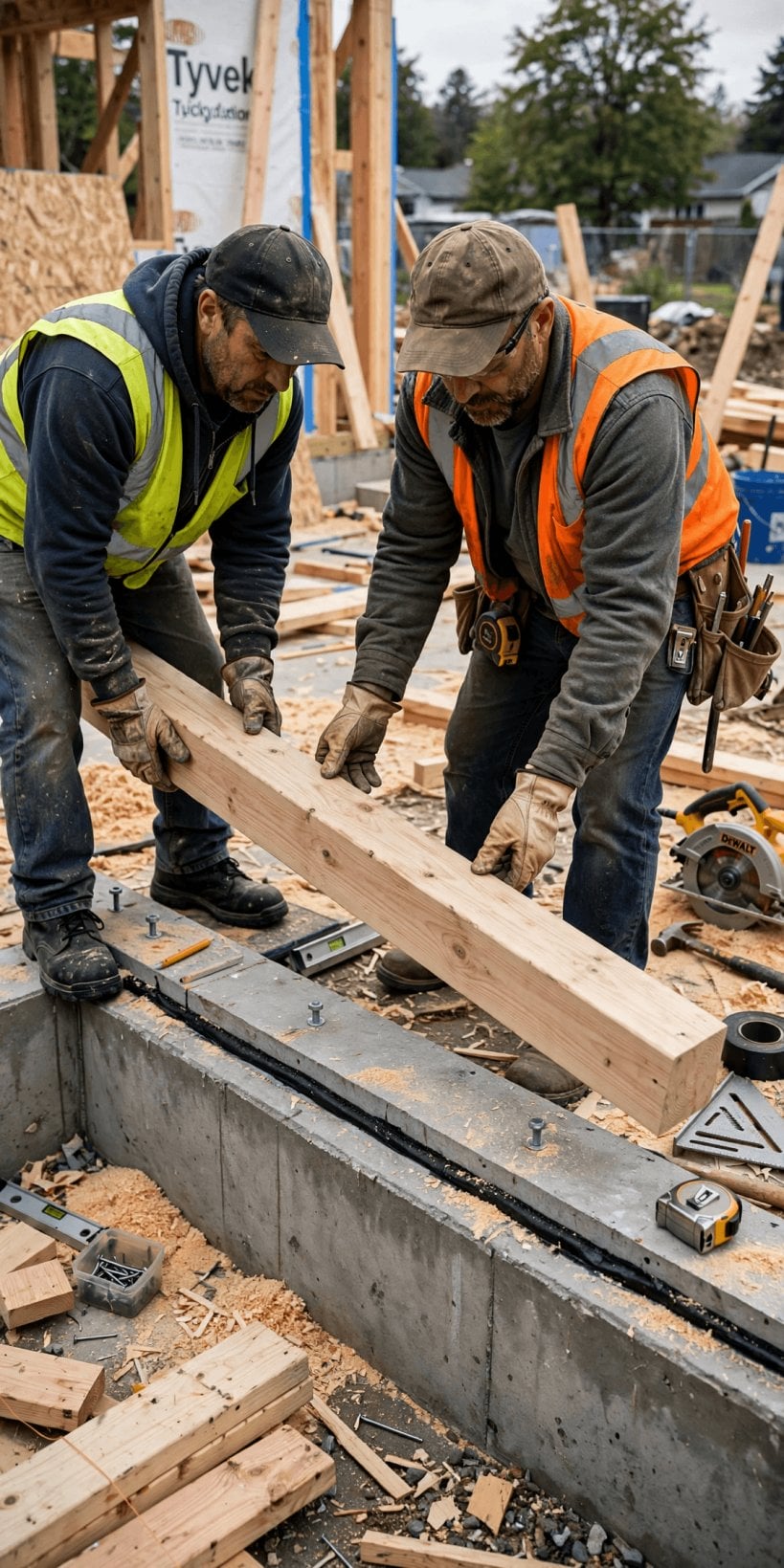
The longer lengths in the chart deserve respect in the hand as much as on paper. A long 2×10 is awkward before it is heavy: its length catches wind, its centre of balance sits far from your grip and a board carried on edge can roll if you hold it carelessly. Two people, one near each end, make the longest boards a routine carry instead of a strain, and gloves matter because deep members are handled hard, with splinters and rough arrises at exactly the points where your hands take the load.
Good handling starts at the stack. Store 2x10s flat, supported at several points along their length and stickered if they will sit for a while, so they stay straight instead of taking a bow you later have to frame out. Keep them off wet ground and covered from above while still letting air move. When cutting, support both sides of the line so the offcut cannot drop and tear the last fibres or kick the saw. On joist work overhead or at a deck edge, position and fastening are team jobs: one person holding a deep, long board in place while another fixes it is not a luxury but the standard safe method, and staging boards close to their final position saves the most dangerous carries of all, the tired ones at the end of the day.
8. The 2×10 vs the Sizes Around It
Every framing size is a trade between depth, stiffness, availability and weight. The 2×8 is shallower, easier to lift and entirely adequate for shorter spans and lighter floors, which is why it remains common despite the 2×10’s greater reach. Step up to the 2×12 and depth, stiffness and weight all climb again, suiting long spans and heavy loads at the cost of harder handling and a higher price per board. The 2×10 sits in the productive middle: deep enough for serious residential spans, still a single solid-sawn board that any yard stocks and any framer can handle without special equipment.
Engineered alternatives change the comparison rather than ending it. Laminated veneer lumber and I-joists can deliver equal or greater stiffness at a different, often more predictable weight, and they stay straighter over long lengths. They also cost more, need their own fastening rules and are not a like-for-like swap on a whim. The honest way to choose remains the old one: let the span, the load and the code-approved tables select the member, then use a weight guide like this one to plan how that member will be delivered, carried and placed. Choosing a shallower board only because it is lighter is how floors come to feel bouncy for the life of the building.
9. Estimating a Load: Trailers, Trucks and Delivery
A load estimate is only arithmetic, but it has to be the right arithmetic. Count every 2×10 in the order, group them by length, and multiply each group by the top of its range in the chart, not the middle and never the bottom. The top of the range is the planning figure because it already allows for the denser species, the wetter boards near the middle of a pack and any treated stock in the mix. Then add everything travelling with the lumber: sheathing, fasteners, hardware, tools and fuel all consume payload that the trailer plate counts whether you remember them or not.
Compare that total with the payload figure that actually governs, which is the vehicle’s rated capacity minus the trailer’s own weight, not the headline towing number in an advertisement. Position the heaviest packs over and slightly ahead of the axles, keep long lengths supported so they cannot slide, and strap deep boards as a unit so the load moves as one mass. If the honest top-of-range total sits anywhere near the limit, split the load or pay for delivery. A lumber yard truck with a small crane or a rear-mounted forklift turns the heaviest question in this guide into a scheduling detail, and it does so without testing your axles, your brakes or your back on a public road.
10. Common Questions About 2×10 Weight
Why do two 2x10s of the same length feel so different? Because dimensions are only the visible part of a board. Species changes the density of the wood itself, moisture changes how much water that wood is carrying and treatment can add liquid weight of its own. A dry spruce board and a freshly treated southern pine board share a size and almost nothing else, and your hands report the difference immediately. The range in the chart exists precisely because that variation is normal, not a defect.
Should I actually weigh a board before a big load? For a single project board, the chart is enough. For a full trailer of long lengths, weighing removes the guesswork: a bathroom scale under one end of a supported board, or a trip over a vehicle scale with the loaded trailer, turns an estimate into a number you can plan around. Weigh a sample from the middle of the pack rather than the dry board on top, because that sample represents the load you are really moving.
Does a 2×10 get lighter as a building ages? In its first seasons, yes, a little. Framing dries toward the moisture level of the finished, heated space, and water leaving the wood is weight leaving the structure. After that early drying the weight stabilises, changing only slightly with the seasons and the humidity of the building. The structural design already assumes ordinary dried framing, so that early loss is expected rather than a concern, and it is one more reason green lumber, which has the most water to lose, also shrinks and moves the most as it settles.
Final Considerations
A 2×10 earns its place by spanning farther and carrying more than the sizes below it, and its weight is simply the price of that depth, paid board by board. Use the chart’s ranges, plan at the top of them, respect species, moisture and treatment as the reasons the ranges exist, and the heaviest member in a small frame stops being a surprise. Estimate honestly, carry in pairs and let delivery equipment do the work whenever the total says it should.


0 Comments