

There is a moment in every big deck or dock build when the delivery driver looks at the longest posts, then at you, and asks where the machine is. He is not joking.
Start with the 6x6x12 post weight, the heaviest common length in the chart below, and everything else about moving, setting and paying for these timbers starts to make sense.
1. At a Glance: 6×6 Post Weight by Length
The 6×6 is where posts stop being lumber you carry and start being timbers you plan around. Tall decks stand on it, docks and piers are framed with it, retaining walls, carports, pavilions and heavy gates all trust its big square section to hold ground level loads that would overwhelm a smaller post. That trust is earned by sheer substance: there is a great deal of wood in every foot of a 6×6, and its weight ranges are in a different class from every other post and board in this series. The chart below gives those ranges by length, transcribed from this post’s own chart, and they are the only per-length figures this guide uses.
The rest of the structure still belongs in the same weight budget. The guide to how much a 2×4 weighs by length, species and moisture covers bracing and rails, the guide to how much a 2×6 weighs by length, species and moisture covers beams and decking boards, and the guide to how much a 2×8 weighs by length, species and moisture covers the joists such posts usually carry. Together with the post charts, they let you price a whole heavy frame in pounds before a single hole is dug.
| Length | Typical weight range | What the range covers |
|---|---|---|
| 8 ft | About 55–75 lbs | Common species, from kiln-dried to greener, treated stock |
| 10 ft | About 70–95 lbs | Common species, from kiln-dried to greener, treated stock |
| 12 ft | About 85–115 lbs | Common species, from kiln-dried to greener, treated stock |
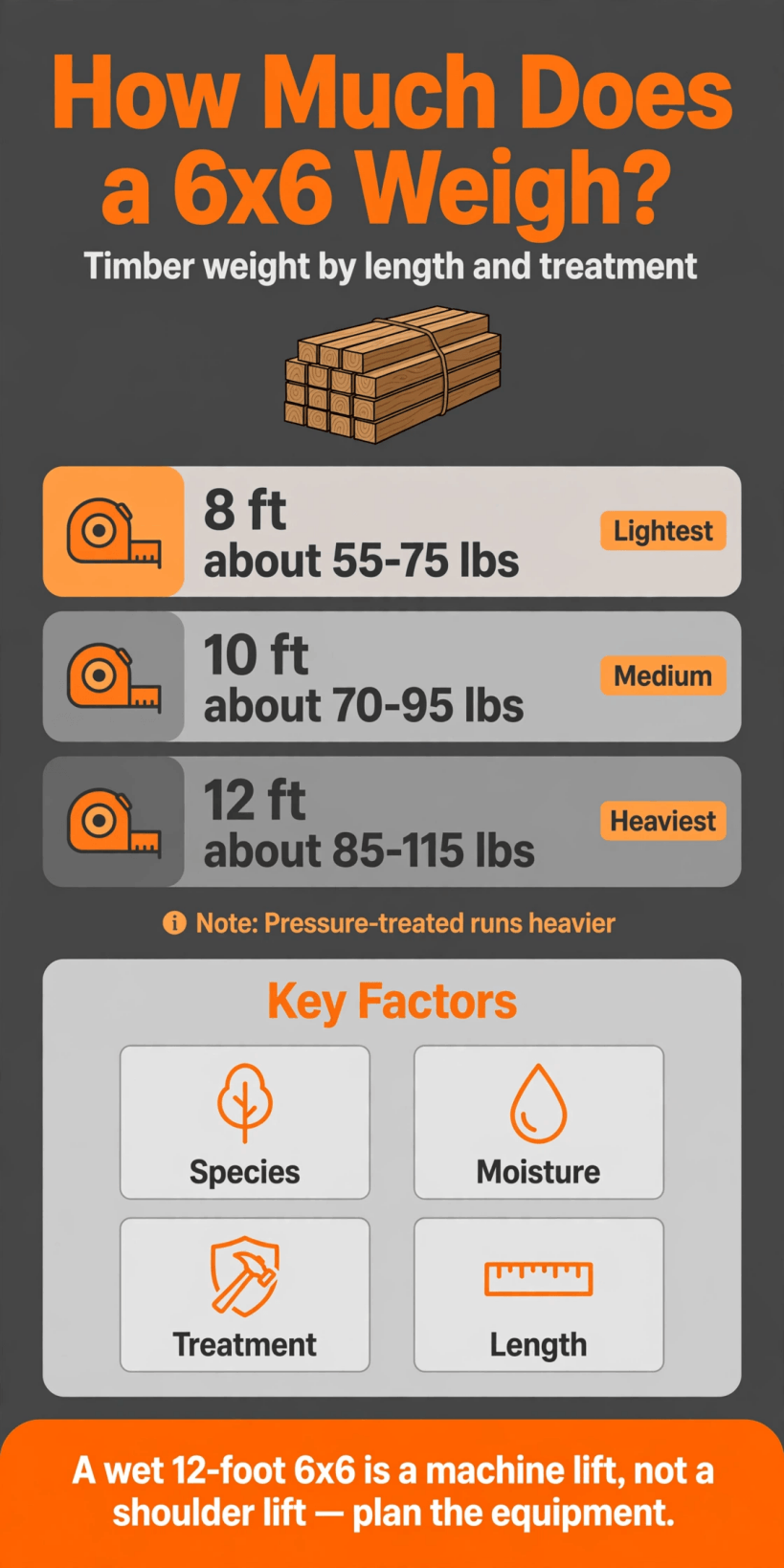
At a glance: a 6×6 runs about 55–75 lbs at 8 ft, 70–95 lbs at 10 ft and 85–115 lbs at 12 ft, and pressure-treated posts run heavier. A wet 12 ft 6×6 is a machine lift, not a shoulder lift.
2. Nominal vs Actual Size: Why a 6×6 Is Not 6 by 6 Inches
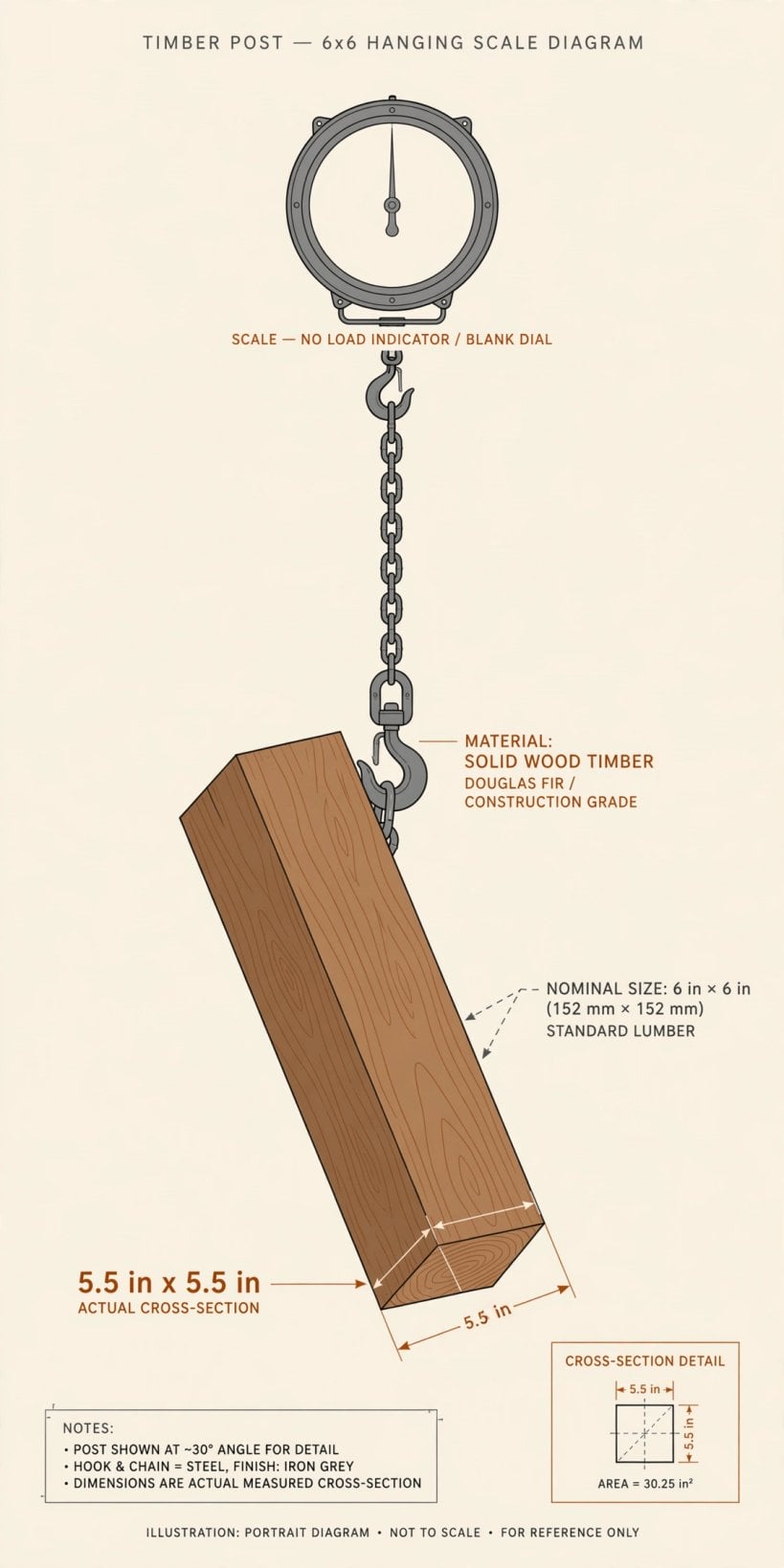
The finished 6×6 measures about five and a half inches square, dressed down from its rough-sawn nominal size by drying and planing like every other member in this series. On a post this size the arithmetic hides a surprise: although the name overstates each face by the usual half inch, the actual cross-section is still enormous, roughly two and a half times the wood of the familiar smaller post in every foot of length. That cross-section, multiplied by length, is the entire weight story in one sentence, and it is why even the shortest charted length is a serious lift.
Actual size matters beyond the scale. Post bases, caps, beam seats and through-bolt layouts are all drawn for the finished dimension, and a rough-sawn or reclaimed timber that truly measures six inches will not drop into modern hardware without work. Old barn and dock timbers, which are often full dimension or larger, can sit well above the feel of this chart at the same length, a fact worth remembering before promising to move a salvaged pile by hand. For new yard stock, though, the standard finished size is reassuringly consistent, and the variation that remains in the range comes from the wood itself rather than from its dimensions.
3. Species: What the Timber Is Made Of
At 6×6 size, species stops being a footnote and becomes a handling decision. Southern yellow pine, the default treated timber across much of the country, is dense, strong and resinous, and a long pine 6×6 lives at the heavy end of everything in this guide. Douglas fir, the western structural timber, is comparably substantial and is the post behind countless decks and pergolas in its region. Cedar in this size exists and is dramatically kinder to lift, but it is expensive, softer and less commonly stocked as a structural treated post, so for most builders it is a special-order conversation rather than a yard default.
Inside identical dimensions, the tree’s life decides the mass. Tight rings grown slowly in hard conditions pack more dense latewood into every inch, while fast growth spreads the same inch across more light, airy earlywood. A 6×6 multiplies whatever density its species carries by the largest cross-section in this series, so differences that feel minor in a stud become unmistakable at the end of a long post. Choose the species for strength, ground-contact suitability and local availability, the things the structure will depend on for decades, and then let the chart tell you honestly what that choice will feel like on delivery day.
4. Moisture: The Hidden Timber Inside the Timber
A freshly treated 6×6 is, in part, a container of water. Its large cross-section holds moisture in a deep core that dries far more slowly than the surfaces suggest, so a post can feel dry to the hand on the outside while its centre is still close to green. That hidden water is a large share of the upper end of every range in the chart. It is also why these posts can check dramatically as they dry, opening deep cracks along their faces while the core finally gives up its moisture months after the ends look seasoned and grey.
Time and storage write the rest of the story. Kiln-dried or long air-dried stock sits at the lighter end of the range, handles better and behaves more predictably in joinery and hardware. Stock delivered straight from treatment, or stored in a wet yard through a rainy season, arrives at the other extreme. Builders who can take delivery early and stack 6x6s under cover, stickered and off the ground, gain in every direction: lighter lifts when setting day comes, less movement after setting and a clearer eye for any post that arrives twisted. Moisture is the variable you can schedule around even when you cannot choose it, and on timbers this size that scheduling is worth real effort.
5. Pressure Treatment: Heavy Protection for Ground Contact
A 6×6 almost always works in the hardest service wood faces. It stands in soil, in concrete, in splash zones and at the bases of structures that cannot be allowed to rot, so ground-contact pressure treatment is not an upgrade for this size but its normal condition. The chart says it plainly: pressure-treated runs heavier. Treatment drives preservative solution deep into a very large cross-section, and the volume of liquid a 6×6 can hold dwarfs what a board absorbs. A post bought days after treatment is carrying that solution with it, and everyone who lifts it pays the toll.
Retention levels for ground contact are the highest in ordinary use, which is correct engineering and heavy logistics at once. As the post seasons in place, the water leaves and the weight settles toward its species norm, while the preservative remains guarding the fibres. Incised patterns on some western species, cut to help treatment penetrate dense wood, are a visible clue to a heavily treated, and therefore initially heavy, post. Plan every fresh 6×6 at the top of the chart, confirm the ground-contact rating on the tag before it goes in a hole, and never let a dry display post at the yard convince you the delivered pack will feel the same.
6. How 6×6 Weight Adds Up Across a Real Structure
One 6×6 is an event. A structure is a sum of events. A tall deck may stand on a grid of them, a dock repeats them at every bent, a retaining wall consumes them in a continuous line and a carport concentrates them into a few very tall, very heavy lifts. Multiply the count by the top of the relevant range and the total stops being trivia: it decides whether a small trailer can legally fetch the order, whether the site machine can place each post and how many hands must be on site, at the same hour, when the holes are ready and the concrete is coming.
The frame above the posts must join the same calculation. Beams and joists are charted in the guide to how much a 2×10 weighs by length, species and moisture and the guide to how much a 2×12 weighs by length, species and moisture, the smaller post option is covered by the guide to the weight of a 4×4 post by length, species and moisture, and the guide to how much a cord of firewood weighs by species and seasoning handles the woodpile that shares so many rural deliveries. Estimate every element at the top of its range and the logistics of a heavy build become calm, sequential and safe.
7. Moving and Setting Timbers Without Hurting Anyone
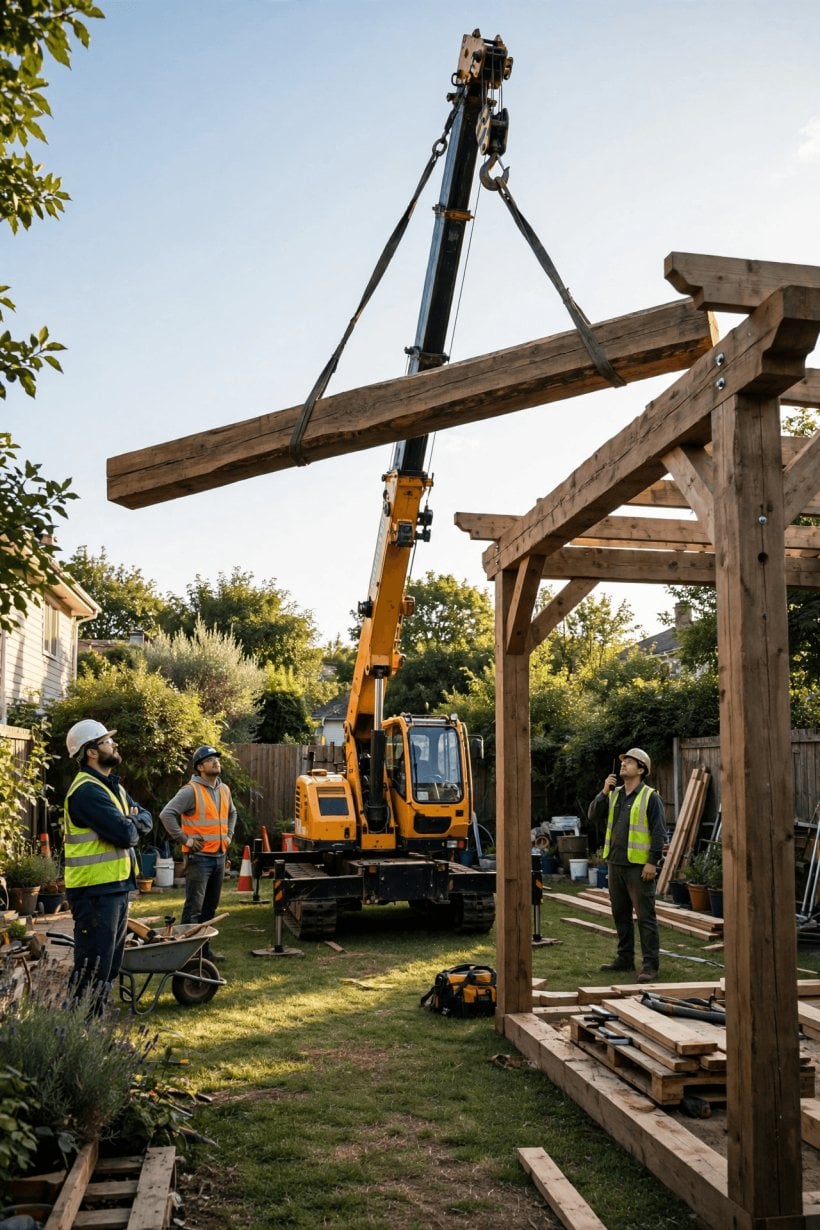
The chart’s own closing advice deserves to be quoted in spirit on every site: a wet twelve-foot 6×6 is a machine lift, not a shoulder lift, so plan the equipment. That means a tractor with forks, a skid steer, a small crane or at minimum a well-briefed team with hand trucks, rollers and a route prepared before the post moves. Dragging beats lifting where the ground allows, a sling at the balance point beats four hands at the corners, and nobody, at any point, puts a hand under a suspended timber. These are not refinements for big commercial sites; they are how a two-person owner-build stays injury free.
Setting the post is the delicate part that follows the heavy part. A tall 6×6 must be raised into a hole or onto a base, held plumb in two directions and braced, all while its weight wants to lean, roll and settle where it chooses. Props, clamps and braces should be cut and ready before the lift, the hole dug and inspected before the post is anywhere near it, and the pour or backfill staged within reach. Once a timber this size is standing and braced, it is a wonderfully stable thing to build on. Getting it to that moment is the job the chart’s numbers exist to help you staff and equip properly.
8. The 6×6 vs the 4×4: Choosing the Right Post
The smaller post wins on everything logistical: price, availability, handling, hardware and the simple speed of a fence line that one person can largely set alone. For ordinary fences, low decks and light garden structures it is not merely adequate but correct, and oversizing every post out of caution wastes money and backs alike. The 6×6 wins where the structure genuinely asks for it: tall decks where posts are long and loaded, wide spans between supports, heavy roofs, big gates, docks, retaining work and any design whose engineer or code table names the bigger section without apology.
Appearance casts a real, if secondary, vote. A 6×6 looks settled and monumental under a pergola or a farmhouse porch in a way the slimmer post cannot imitate, and many owners choose it for that presence as much as for strength. That is a legitimate reason, provided the logistics are faced honestly: the chart for this size, the equipment conversation and the delivery plan all come with it. Read the two post guides together, decide on structure first and looks second, and budget your effort for the post the building actually needs rather than discovering its weight at the tailgate.
9. Trailers, Deliveries and Equipment Decisions
Heavy posts simplify one decision beautifully: most orders belong on the yard’s delivery truck. The arithmetic shows why. A modest count of long 6x6s, taken honestly at the top of the chart, plus the beams, concrete and hardware travelling with them, consumes a typical small trailer’s payload with room to spare for nothing else. Attempting that load in pieces costs multiple trips, multiple handlings of the heaviest items on the order and repeated chances for something to go wrong at a ramp or a tailgate, all to save a delivery fee that is usually the smallest line in a heavy build’s budget.
When you do haul them, haul like a professional. Posts lie flat and low in a tight bundle, supported along their length, strapped as one mass and checked after the first miles, with the load’s centre over and slightly ahead of the axle. At the site end, have the machine that will unload them present before the trailer stops, not summoned after it. The through-line of this whole guide is that 6×6 weight is entirely manageable when it is treated as a planning number from the first sketch, and entirely punishing when it is discovered by hand, one post at a time, on the day the holes are already dug.
10. Common Questions About 6×6 Weight
Can one person move a long 6×6 at all? Move, sometimes, with dollies, rollers, levers and patience on flat ground. Lift and set, no, not safely and not at the wet, treated top of the range. The distinction matters, because most injuries with timbers happen when a solo move turns into a solo lift halfway, with the post already committed and no help in reach. Treat the longest length as an equipment and team job from the start, and reserve solo effort for rolling, sliding and fine positioning with tools.
Why is the range for each length so wide? Because a 6×6 magnifies every variable in this series. Species density is multiplied by the biggest cross-section, moisture hides in a deep, slow-drying core and ground-contact treatment loads that core with solution. A dry, light post and a fresh, treated dense one share a stamped size and almost no other property, so an honest guide must publish a range wide enough to hold both. Plan transport and lifting at the top, enjoy anything lighter as a bonus and the width of the range becomes your safety margin rather than a frustration.
Will a 6×6 get easier to handle if I let it dry first? Yes, noticeably. Stickered under cover, a green or treated 6×6 sheds water for months and every litre that leaves is weight off the eventual lift, with the added benefit that a drier post checks and twists earlier, in the stack, where you can reject or reassign it, instead of later, in your structure. Drying will not turn it into a light post, because the wood itself is the majority of its mass, but on a build where the posts can be delivered a season ahead it is the cheapest handling help available.
Final Considerations
The 6×6 is the timber you choose when a structure must stand on something undeniable, and its weight is the honest price of that substance. Respect the chart, plan at the top of it, bring equipment for the longest lengths and let the smaller post do the jobs it does perfectly well. Handled that way, these great square posts go in plumb, stay for generations and never once have to be wrestled into place by hope alone.


0 Comments