

A fence line, a deck, a pergola: all of them stand on 4×4 posts, and all of them start the same way, with you wrestling a wet, treated post out of a truck bed that is heavier than it looks.
So how much does a 4×4 post weigh, really? The chart below answers by length, and the rest of this guide explains why treated posts so often sit at the heavy end of it.
1. At a Glance: 4×4 Post Weight by Length
The 4×4 is the post of everyday outdoor building. Deck supports stand on it, fence lines march away in it, pergolas, mailbox posts, raised beds and gate posts all reach for the same familiar square section. It is small enough to handle and large enough to trust, which is exactly why its weight surprises people: a square post packs a lot of wood into every foot, and most 4x4s are sold pressure treated and still wet from that process. The chart below gives the typical ranges by length, and nothing in this guide uses per-length figures beyond them, because an honest range serves a builder better than a precise-sounding guess.
Posts never work in a project alone, and the boards they carry have charts of their own. The guide to how much a 2×4 weighs by length, species and moisture covers the rails and braces, the guide to how much a 2×6 weighs by length, species and moisture covers decking-scale boards and beams, and the guide to how much a 2×8 weighs by length, species and moisture covers the joist size many decks are framed with. Read together, the charts price the whole structure in weight, from the footing to the top rail.
| Length | Typical weight range | What the range covers |
|---|---|---|
| 8 ft | About 24–34 lbs | Common species, from kiln-dried to greener, treated stock |
| 10 ft | About 30–42 lbs | Common species, from kiln-dried to greener, treated stock |
| 12 ft | About 36–50 lbs | Common species, from kiln-dried to greener, treated stock |
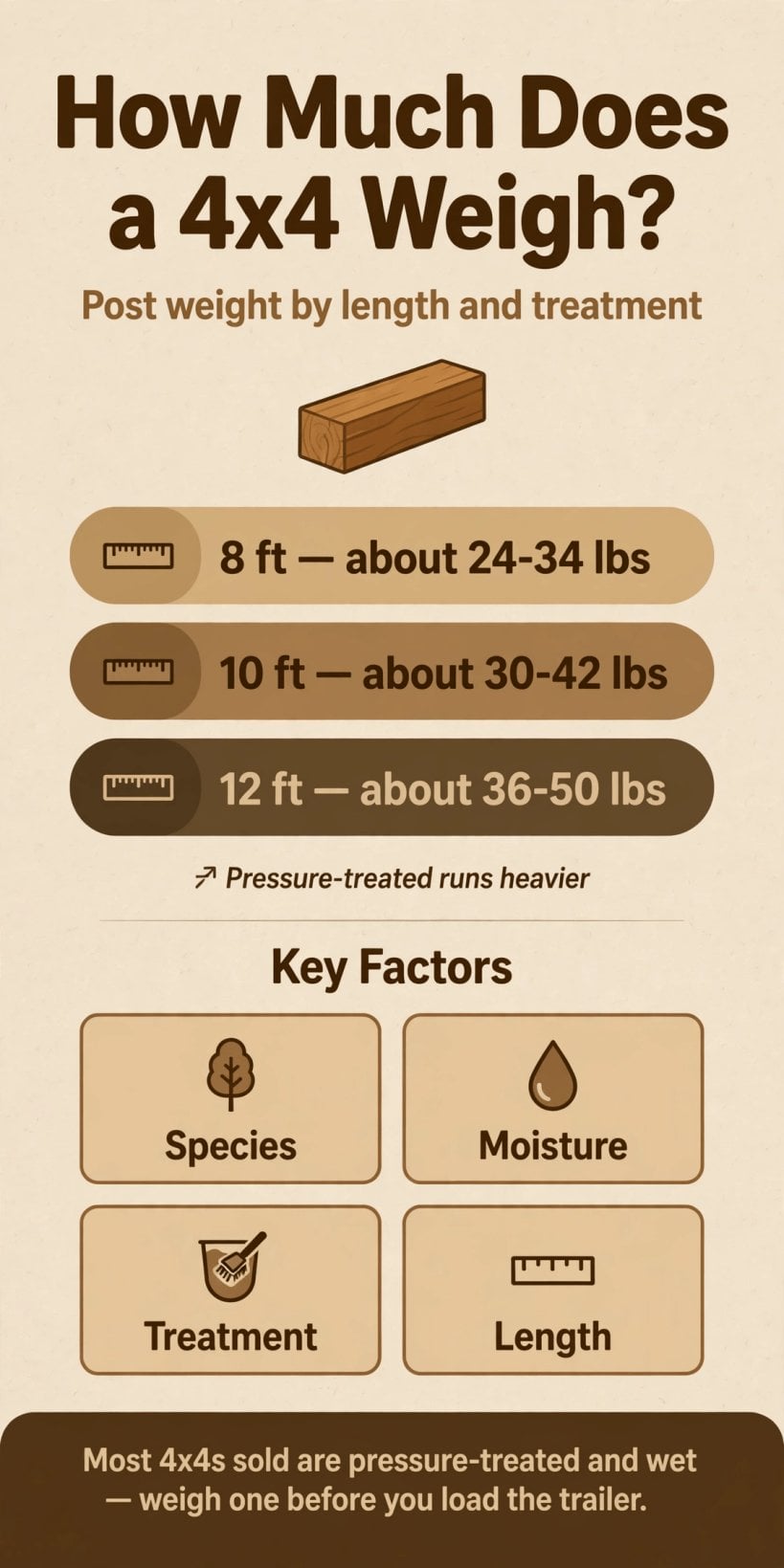
At a glance: a 4×4 post runs about 24–34 lbs at 8 ft, 30–42 lbs at 10 ft and 36–50 lbs at 12 ft, and pressure-treated posts run heavier.
2. Nominal vs Actual Size: Why a 4×4 Is Not 4 by 4 Inches
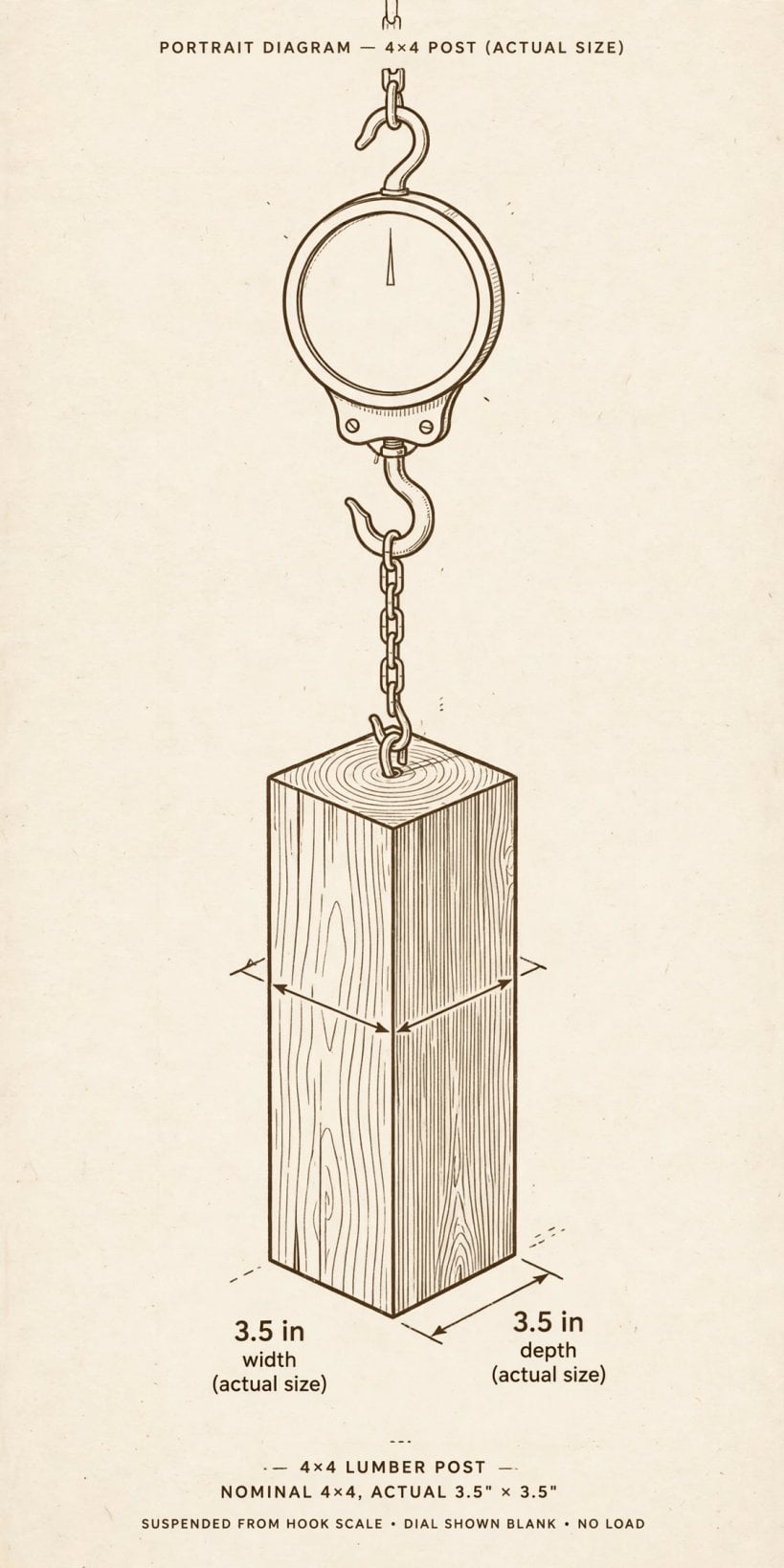
Like every size in this series, the 4×4 is named for its rough-sawn past rather than its finished present. The post you buy measures about three and a half inches square, planed smooth and dried down from the full dimension in its name. That missing half inch in each direction matters to weight more than intuition suggests, because a post’s volume is its cross-section multiplied by its length, and the cross-section shrinks in two directions at once. Estimate from the nominal name and you assume a noticeably larger, heavier stick of timber than the one standing in your post hole.
It also matters to how the post is used. Hardware, post bases, caps and brackets are all made for the actual finished size, and a post that measured a true four inches would fit none of them. Older posts, and rough-sawn posts from small mills, can still be genuinely full dimension, and they feel it: more wood in every foot and a heavier lift at every length. When a project mixes modern yard posts with rough-sawn or reclaimed ones, expect the older stock to sit above the feel of the chart even at the same marked length, and plan carries and concrete quantities with that extra substance in mind.
3. Species: Cedar, Pine and the Weight Between Them
A 4×4 reaches the rack in more species than almost any other post size, and species is where much of its weight story begins. Southern yellow pine, dense and strong, is the standard treated post across much of the country and sits toward the heavier end of the range. Western red cedar, chosen for its natural resistance to rot and insects, is markedly lighter in the hand and kinder on a long fence line, though it costs more and is softer under hardware. Douglas fir and redwood occupy the middle ground in their regions, each with loyal builders who swear by them for posts.
The differences are built into the trees. Dense latewood, resin and tight growth rings add mass inside identical dimensions, while lighter species hold more air in a more open structure. For a single pergola post the difference is a shrug; across a full fence order it decides how the delivery stacks up and how you feel at the last hole of the day. Species choice should still be led by rot resistance, strength and local supply, the qualities a buried post lives or dies by. Weight is the consequence you plan around, with the chart’s range wide enough to hold whichever species your yard actually stocks.
4. Moisture: The Water a Post Carries
No member in this series is as defined by water as the 4×4 post, for the simple reason that most of them are sold wet. A post that has recently come from pressure treatment, or that has sat in a yard stack through wet weather, carries water deep in its fibres as well as on its surface. That water is heavy, it is real and it explains why two posts of the same length, species and stamp can feel like different products on different days. Green, untreated posts hold their own share of sap moisture for the same reason, straight from the living tree.
Drying changes a post steadily and visibly. Kiln-dried and well air-dried posts sit at the light end of the chart, are pleasanter to handle and are less prone to the twisting and checking that appear as a wet post dries in place, sometimes around its own fasteners and brackets. A post set wet will do much of its drying standing in your fence or under your deck, and it will lose weight as it does, while also shrinking slightly across its faces. None of that is a reason to refuse sound wet stock, which is often all a yard holds, but it is a reason to weigh your planning toward the top of the range whenever posts come straight from a fresh, dripping pack.
5. Pressure Treatment: The Defining Factor for 4x4s
For joists and studs, treatment is an option. For 4×4 posts it is the default, because posts live where wood dies fastest: buried in soil, splashed at ground level, holding moisture at their bases through every season. Treatment forces preservative deep into the wood under pressure, and the chart’s own note carries the consequence plainly: pressure-treated posts run heavier. The preservative arrives dissolved in water, and a post sold soon after treatment is still carrying much of that water with it, which is why a fresh treated post can drip, stain a truck bed and outweigh a dry untreated post of the same size by a margin your arms will not miss.
Retention level sharpens the point. Ground-contact treated posts hold more preservative than above-ground rated stock, because the ground is a harder service, and they are the correct, and only correct, choice for anything buried or within a few inches of soil. That extra treatment is extra liquid weight at purchase. Over the first season in place the water portion leaves and the post lightens toward its species norm, while the protection stays behind in the fibres. Until then, treat every fresh post as a top-of-range lift, and let the use category on its end tag tell you which rating, and roughly which heft, you are buying.
6. How Post Weight Adds Up Across a Project
Posts are bought in lines and grids, and that is where their weight stops being a curiosity. A deck needs a post at every footing, a fence needs one at every bay along its run plus braced posts at gates and corners, and a pergola concentrates its posts into a small count of long, tall lifts. Multiply the chart’s top-of-range figure by the count on your plan and you have the number that sizes the vehicle, the delivery and the crew. Add the beams and boards those posts will carry and the project total comes into proper focus.
The companion charts complete that picture. Beams and joists come from the guide to how much a 2×10 weighs by length, species and moisture and the guide to how much a 2×12 weighs by length, species and moisture, the heavier support option is priced in the guide to how much a 6×6 post weighs by length, species and moisture, and even the offcuts’ destination has a chart, the guide to how much a cord of firewood weighs by species and seasoning. A project estimated this way, element by element at the top of each range, rarely surprises the trailer or the team.
7. Carrying, Setting and Working with 4×4 Posts
A single 4×4 is a one-person carry at the shorter lengths and a test of judgement at the longest, especially treated and wet. Carry it on the shoulder with the balance point found before you set off, or at the hip with both hands, and keep gloves between your palms and a post that may be damp with treatment. On a fence line, the smartest handling is the handling you avoid: have the posts delivered or carted along the run and dropped at their holes, so each post is lifted once into place rather than carried the length of a garden a dozen times over.
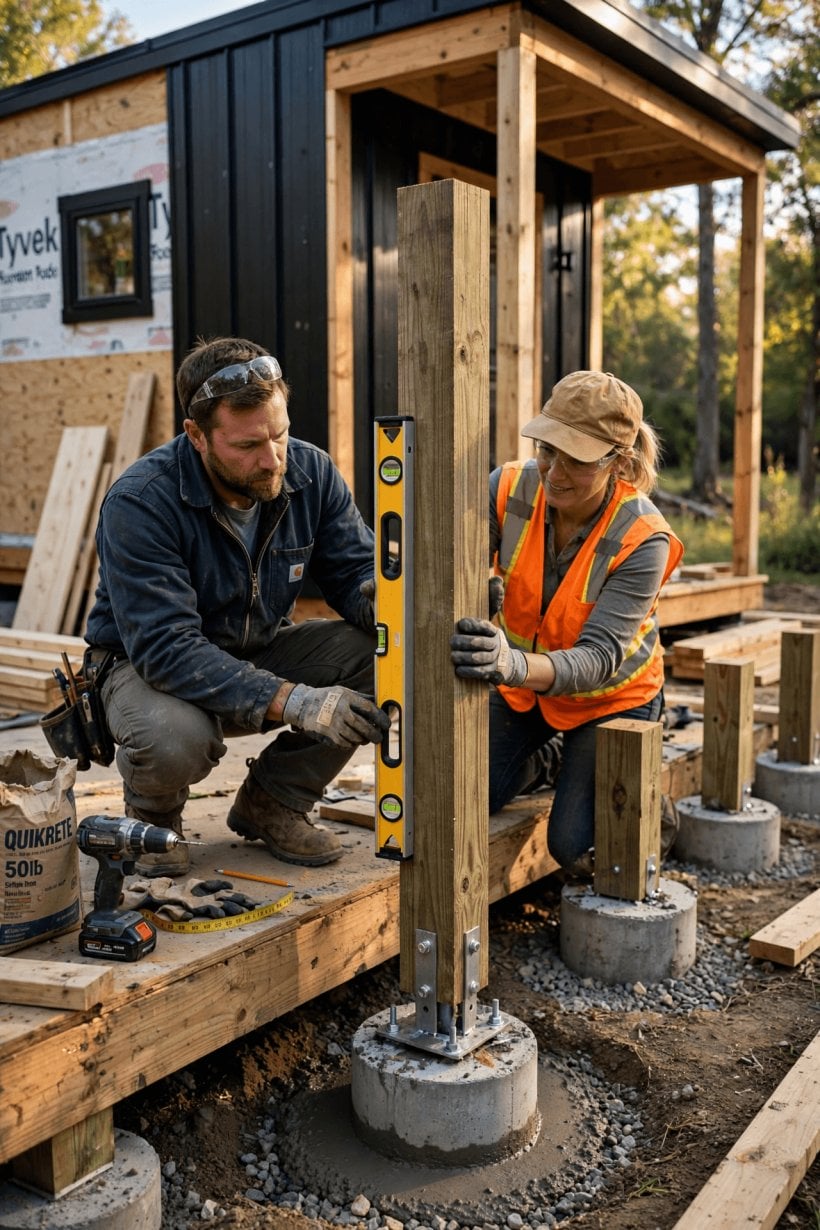
Setting is its own weight problem. A post must be held plumb, at height, in a hole, while concrete or compacted gravel goes in around it and bracing is fixed, and it must stay there while you work. That is a two-person task at the longer lengths, or a one-person task only with clamps, braces and props prepared in advance. Work the post, not against it: dig the hole before the post arrives at it, stage mix and water beside the hole and check plumb from two faces before the set begins. A heavy post wobbling in a fresh footing is how good fence lines go crooked in their first hour.
8. The 4×4 vs the 6×6: When the Bigger Post Earns Its Weight
Every builder with a tall deck, a heavy gate or a long retaining run eventually asks whether the 4×4 is post enough. The 6×6 answers with substance: a far larger cross-section, greater stiffness against lateral loads, a more durable heart at ground level and a visual solidity that suits pergolas and entrances. It also answers with weight, at every length, on every carry and in every hole, and with a price that follows its size. The 4×4 remains the right post for the great majority of fences, ordinary decks and garden structures, where loads are modest and spans between supports are short.
The deciding factors are structural, not sentimental. Height above ground, the size of the deck or roof the post carries, soil conditions, local code requirements for footings and posts, and the lateral forces of wind and gates all push the choice one way or the other. Where a 4×4 is specified and sufficient, its lighter handling is a genuine project advantage, speeding every stage from delivery to bracing. Where the design calls for the bigger section, no amount of grumbling about the lift changes the specification. Read the two charts side by side, choose on engineering, and then plan the handling for the post you actually need.
9. Loading the Trailer: Weigh One Before You Load Them All
The 4×4’s own infographic carries the best loading advice in this series: most posts sold are pressure treated and wet, so weigh one before you load the trailer. A single post on a scale, taken from the middle of the pack you are actually buying, converts the chart’s range into your load’s reality in seconds. Multiply that weighed figure by the count, add concrete bags, hardware and the beams travelling with them, and compare the total honestly with your vehicle’s payload rather than its towing headline.
Posts load well when they are loaded deliberately. A flat, low stack between the wheel wells, the longest posts supported so they cannot flex and slide, and the whole bundle strapped as a unit keeps the weight where the trailer wants it, over and just ahead of the axle. Wet treated posts will mark and dampen a bed, which is normal, and they will also shift more readily than dry lumber if they are left loose, which is not. If the weighed total crowds the limit, split the order or take the yard’s delivery and spend your own trips on the lighter materials. The arithmetic takes five minutes at the yard and protects everything the drive home depends on.
10. Common Questions About 4×4 Post Weight
Why is the treated post at the yard so much heavier than the one in my old fence? Because your old fence post has spent years drying in place. It arrived, very likely, as wet as the yard post is now, carrying treatment solution deep in its fibres, and it shed that water through its first seasons until it settled at the ordinary weight of dry wood in outdoor air. The yard post will follow the same path once it is set. The difference you feel between them is mostly water, measured in time.
Is a cedar post always the light option? Among common post species, cedar is reliably at the lighter end, and on a long fence that difference multiplies into real relief. It is not automatically the right option, though. Cedar costs more, is softer around bolts and brackets and may not be the treated ground-contact product a particular design requires. Choose the species for the service the post must survive, then enjoy the lighter carry as a secondary benefit where it applies, rather than buying a species for its weight alone.
Does cutting a post to length change how I should estimate? Cutting changes the total by exactly the proportion you remove, because a post’s weight is spread evenly along its length in the same cross-section. An offcut from the longest charted length, cut down for a short gate post, can be estimated from the chart for its new length rather than its bought one. That is also why buying the longest posts and cutting everything from them is wasteful in weight as well as wood: you haul home mass you intend to throw into the offcut pile.
Final Considerations
The 4×4 post is humble, ubiquitous and heavier than its friendly size suggests, mainly because so many of them reach you treated and wet. The chart’s ranges, read with species and treatment in mind and confirmed by weighing a sample post, turn that heaviness into a planned quantity instead of a sore surprise. Plan at the top of the range, set posts with help and bracing ready, and the backbone of your fence, deck or pergola goes in straight, plumb and without drama.


0 Comments