

The deepest board on the rack looks like insurance against a bouncy floor. It also looks, the first time you shoulder a long one alone, like a mistake: wide, awkward and far heavier than the size beside it.
Knowing how much does a 2×12 weigh before that moment changes the plan: two people, a shorter carry, the right trailer. The ranges below are the planning numbers, with the reasons behind them.
1. At a Glance: 2×12 Weight by Length
The 2×12 is the deepest solid-sawn board in ordinary framing, and depth is both its virtue and its weight. Floor joists spanning a wide room run in it, stair stringers are cut from it, beams and girders are built up from it and the longest headers reach for it when a shallower board would flex. In those roles it is asked to be stiff first and convenient second, so nobody should expect it to be light. What a builder can expect is a predictable range, set by the same three influences that govern every size in this series: the species in the board, the moisture still inside it and any treatment it carries.
Compare it with the rest of the frame before you order. The guide to how much a 2×4 weighs by length, species and moisture covers studs, the guide to how much a 2×6 weighs by length, species and moisture covers walls and rafters, the guide to how much a 2×8 weighs by length, species and moisture covers shorter joist spans, and the guide to how much a 2×10 weighs by length, species and moisture covers the size one step down. Reading the charts together gives a whole structure a weight budget instead of a guess.
| Length | Typical weight range | What the range covers |
|---|---|---|
| 8 ft | About 29–38 lbs | Common species, from kiln-dried to greener stock |
| 10 ft | About 36–47 lbs | Common species, from kiln-dried to greener stock |
| 12 ft | About 44–56 lbs | Common species, from kiln-dried to greener stock |
| 16 ft | About 58–75 lbs | Common species, from kiln-dried to greener stock |
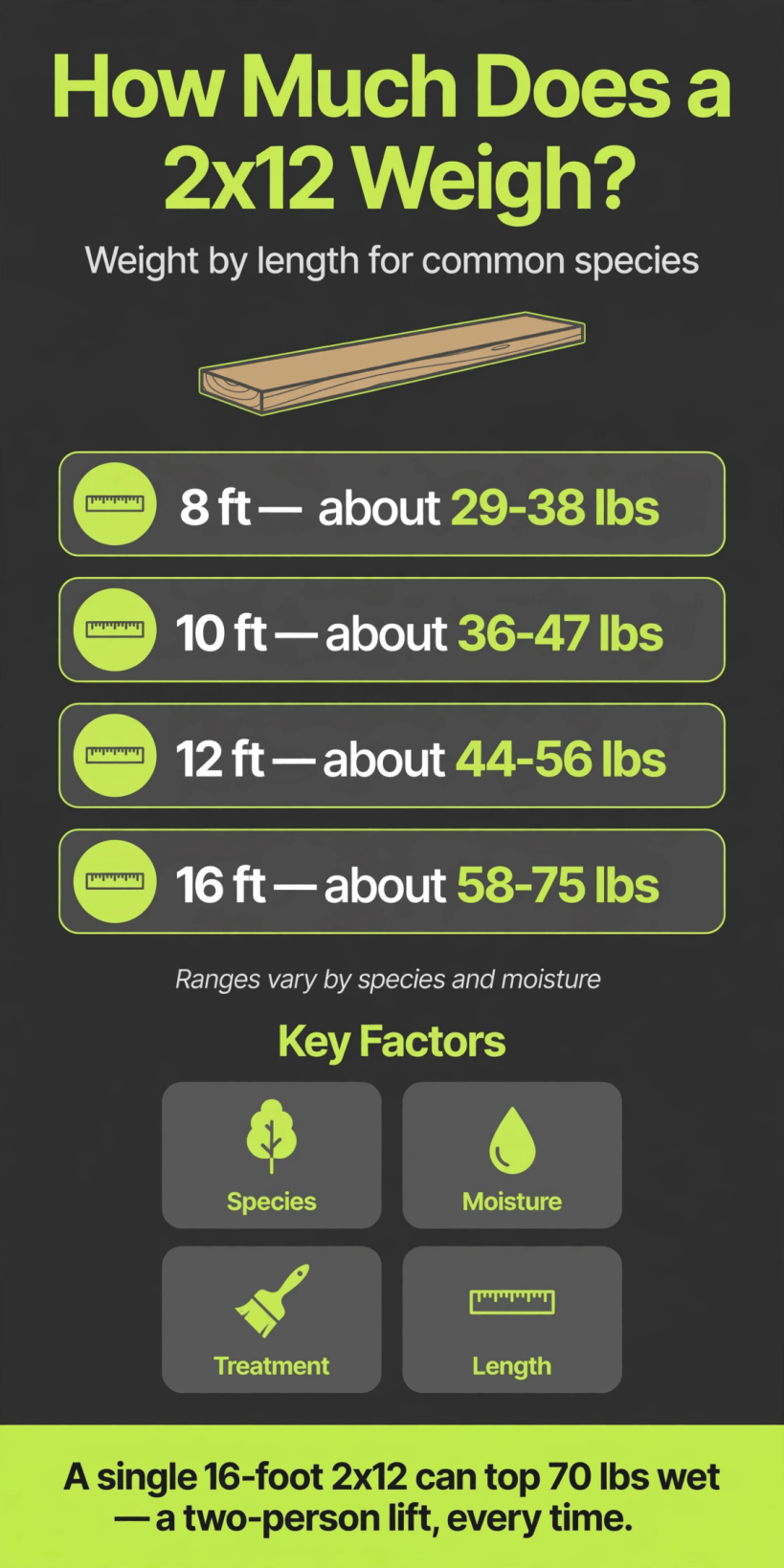
At a glance: a 2×12 runs about 29–38 lbs at 8 ft, 36–47 lbs at 10 ft, 44–56 lbs at 12 ft and 58–75 lbs at 16 ft, varying by species and moisture.
2. Nominal vs Actual Size: Why a 2×12 Is Not 2 by 12 Inches
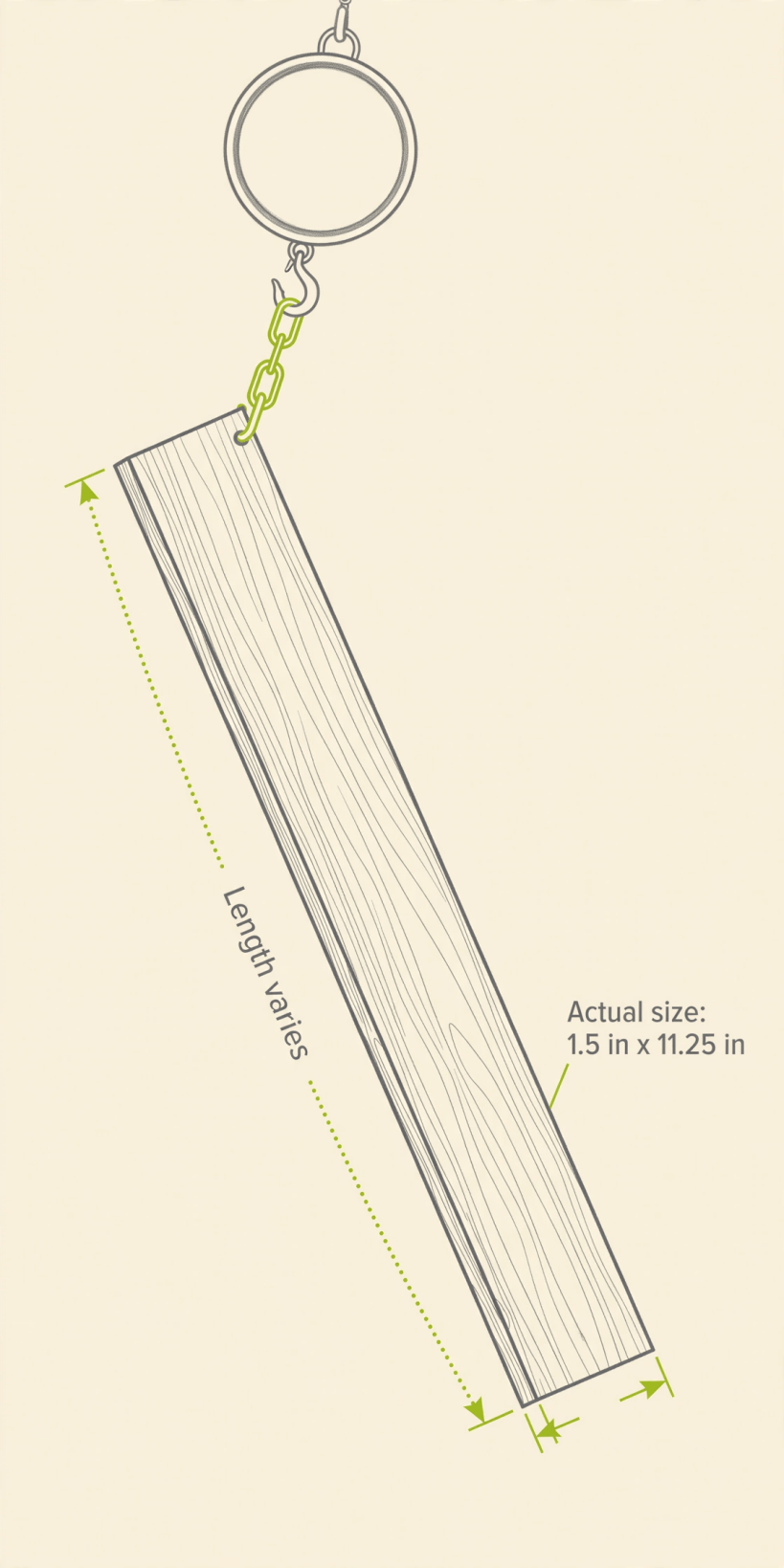
The name promises more wood than the board contains. A finished 2×12 measures about one and a half inches thick by eleven and a quarter inches wide, the result of sawing, drying and planing a rough blank down to a smooth, standard size. That finishing is not a trick: it gives framers consistent dimensions to design around, and it removes the roughest, weakest surface wood. But for weight it means the honest starting point is the actual cross-section, not the round numbers in the name, and anyone estimating from the name alone will overstate every board in the stack.
Even at its finished size, this is the largest common cross-section in the framing family, which is why its ranges sit above every other dimension lumber chart in this series. Weight grows in direct step with length because each added foot adds the same full cross-section of wood. There is no taper and no shortcut in that arithmetic. It also explains why a long 2×12 feels disproportionately awkward rather than merely heavy: the mass is spread over a wide, flat plank that wants to flex and catch the wind, so the carry tests your grip and balance long before it tests your strength alone.
3. Species: The Density Inside the Dimensions
Two 2x12s can leave the same saw line with identical dimensions and noticeably different weights, and species is the first reason. Southern yellow pine packs dense, resin-rich latewood into its growth rings and tends toward the heavier end of the range, one reason it is favoured for stair stringers and joists where strength matters. Douglas fir, the other great structural species, is comparably substantial and is the board western builders reach for by default. The spruce-pine-fir group usually runs lighter, and in a board this size that difference is impossible to miss when you lift one end.
Density is written by climate and growth rate long before a saw touches the log. Tight rings from slow growth hold more latewood, the dark, heavy part of each ring, while fast-grown wood holds more pale earlywood and more air. Weight is that internal architecture made obvious. Grade plays a smaller part than species, because grading sorts for strength and appearance rather than mass, but a clear, knot-free length and a knotty one from the same species can still differ slightly. The practical response is not to hunt for the lightest board, but to read the species stamp, expect the range that species implies and choose the board the span table requires.
4. Moisture: Where Much of the Range Comes From
If species sets the frame of the range, moisture fills most of it. A board is a bundle of hollow fibres, and in a freshly sawn 2×12 those fibres hold a great deal of water. Green stock therefore sits at the very top of the chart, heavy, cool to the touch and still destined to shrink across its considerable width as it dries. On a board this wide, that shrinkage is not a detail: cups, checks and a slight bow can all appear as the moisture leaves, and fasteners set into green wood can loosen as the wood contracts around them.
Kiln drying brings the board down to a stable, predictable state before it is sold, and kiln-dried 2x12s are the lighter, steadier boards at the bottom of the range. Air-dried stock settles between the extremes, losing weight month by month in a stickered stack until it matches its surroundings. Site storage can undo good drying in days if a pack sits in standing water or under a torn cover through a storm, while a dry, ventilated store preserves it. When you plan a load or a carry, judge the board in front of you, dry and pale or dark and damp smelling, rather than the board the invoice describes.
5. Pressure Treatment: Weight Added on Purpose
Some 2x12s work where rot and insects are a standing threat: deck beams near the ground, stair stringers outdoors, sill and foundation details. Those boards are pressure treated, with preservative driven deep into the wood, and the process leaves the board holding liquid long after it leaves the treatment cylinder. A recently treated 2×12 can be the heaviest single piece of dimension lumber a small builder handles, and the weight is mostly water carrying preservative, not extra wood. Ground-contact retention levels hold more solution than above-ground ratings, so the use category printed on the tag tells an experienced hand roughly what to expect on the lift.
That treatment weight is temporary in a way the wood’s own weight is not. As the board dries in place, the water leaves and the weight falls toward the ordinary range for its species, though the preservative itself remains in the fibres doing its work. Builders who can stage treated stock to dry before installation gain easier handling and tighter joints. Those who cannot should at least plan for it: carry in pairs, allow for the weight in the vehicle and expect freshly treated long lengths to be the load that decides whether delivery is worth paying for.
6. Adding It Up: 2x12s Across a Whole Project
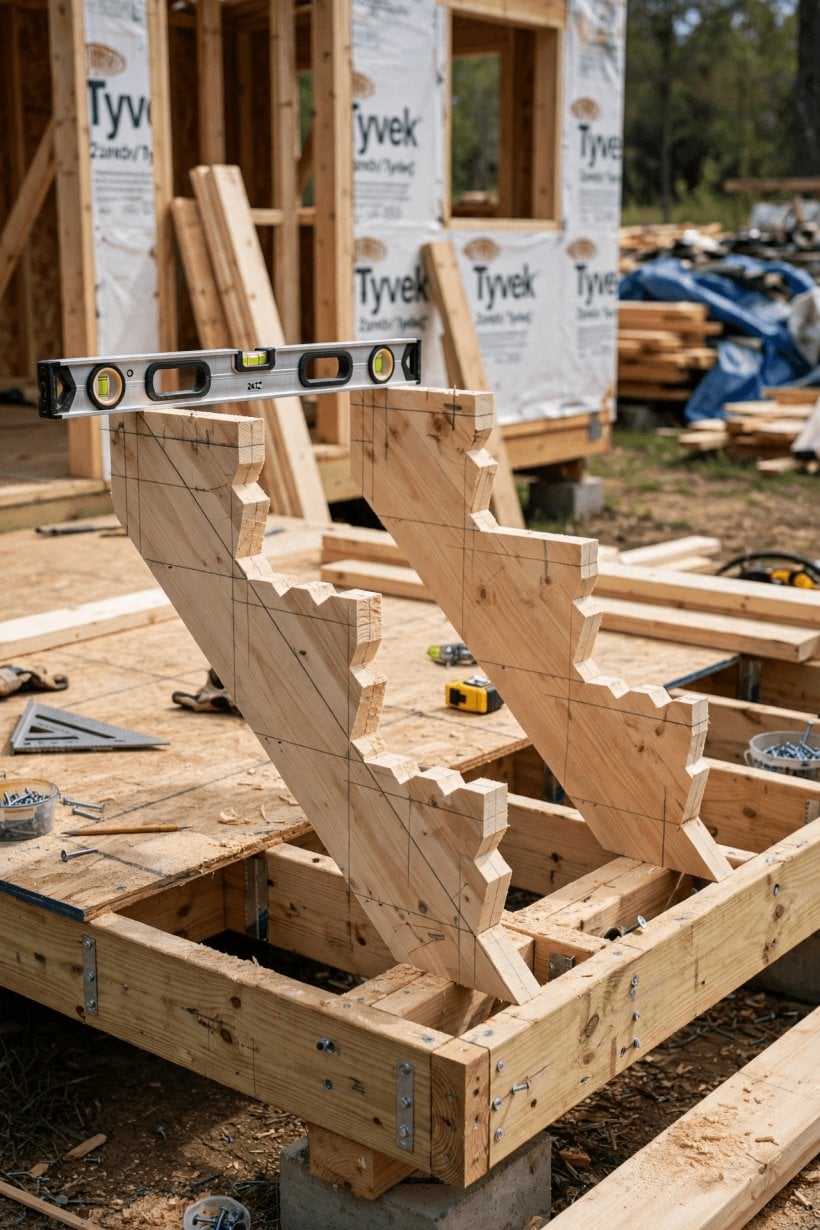
A single board from the chart is a planning unit, not a project. A floor framed in 2x12s repeats that unit across every joist bay, adds rim boards around the full perimeter, doubles members under partitions and builds beams from two or three plies wherever the plan concentrates load. Stair work multiplies differently, with stringers cut from long boards and much of the original plank ending as offcuts, so the delivered weight and the installed weight part company. Either way, the honest total comes from multiplying counts by the top of each length’s range, then adding sheathing, hardware and everything else travelling in the same load.
The posts beneath the frame belong in that same budget. The guide to how much a 4×4 post weighs by length, species and moisture covers the lighter support size, the guide to how much a 6×6 post weighs by length, species and moisture covers the heavy pier and post standard, and site fuel has its own chart in the guide to how much a cord of firewood weighs by species and seasoning. Treating every element with the same top-of-range discipline keeps the trailer legal, the delivery order complete and the crew’s energy spent on building rather than on unplanned second trips.
7. Handling the Deepest Board Safely
The chart’s longest length belongs, without exception, to two people. A long 2×12 carried solo puts the load far from the body’s centre, invites a twisting lift and leaves no spare hand when the wide face catches a gust or a doorway. A carrier at each end, boards moved on edge, a route cleared before the lift and a set-down point agreed in advance turn the heaviest board on the site into routine work. Gloves are part of that routine, because a wide board is gripped by its edges and rough edges are exactly where hands take the strain.
Storage and cutting deserve the same care. Stack 2x12s flat on level bearers spaced closely enough that the wide boards cannot sag between supports, and keep the stack covered from rain while letting air circulate. A board stored badly can cup or bow enough to complicate a stair or floor layout before it is ever cut. At the saw, support the full length on both sides of the cut so a heavy offcut cannot drop, bind the blade or tear the last fibres. For stringer work, where one board becomes a finished stair’s backbone, that support preserves the accuracy of every tread and riser line you marked.
8. The 2×12 Against the Sizes Below It
Stepping down from a 2×12 saves weight immediately, and sometimes that trade is exactly right. The 2×10 spans a large share of ordinary floors with less mass to carry and a little less money in every board, while the 2×8 handles shorter spans, decks and lighter structures with handling one person can manage comfortably. The cost of stepping down shows up only where the span demands depth: a floor that deflects, a stair stringer that feels springy, a header that sags over a wide opening. Weight saved at the lumber yard is a poor bargain against stiffness lost for the life of the building.
Engineered wood frames the choice from the other side. I-joists and laminated beams can match or exceed a 2×12’s spanning ability in a lighter or more consistent package, and for very long, quiet floors they are often the professional answer. They bring their own costs, handling rules and hardware, and they cannot be trimmed or notched with the same freedom as a solid board, which is why the solid 2×12 endures: one honest piece of timber, cut with ordinary tools, understood by every framer. Choose by span and load first, consult the weight chart second, and the board’s heaviness becomes a planned detail rather than an argument.
9. Trailers, Payloads and the Delivery Decision
No board in this series settles the delivery question as often as this one. Run the estimate properly: list the order by length, take every group at the top of its chart range and total it before adding a single other item. Then compare that figure with the payload you truly have, the rated carrying capacity of truck or trailer after the trailer’s own weight and any passengers, tools and fuel are counted. Long 2×12 orders reach that ceiling quickly, because both the unit weight and the typical piece count work against you at once.
If the total is close, the decision makes itself. Splitting the load doubles your travel but protects axles, tyres and brakes, while yard delivery places the whole pack beside the work with equipment built for it, often for less than the cost of a second trip. When you do haul them yourself, load the longest boards flat and low, support them along their length so they cannot bounce and crack, strap the pack as one unit and check the straps after the first miles. A load of deep boards carries a lot of energy at road speed, and the chart’s numbers, respected early, are what keep that energy a statistic instead of a story.
10. Common Questions About 2×12 Weight
Is one long board really a two-person lift? At the longest charted length, plan on it. Even a dry board at the bottom of the range is a wide, unwieldy plank whose balance point sits far from any single grip, and a wet or treated board pushes well past sensible solo lifting. Two carriers halve the load each, keep the board under control and protect both backs and the board itself. Builders who frame alone stage long 2x12s on trestles and slide rather than lift wherever the work allows.
Why is the range for each length so wide? Because the range has to hold several truths at once: a dry, light species board at one end and a green or freshly treated dense species board at the other, with every ordinary yard board in between. A single average figure would be wrong for both ends and would invite exactly the overloads and strained lifts this guide exists to prevent. Use the bottom of the range to understand a board in your hands, and the top to plan anything that carries, hauls or supports them in quantity.
Can I reduce weight by letting boards dry on site? Yes, within limits. Green or damp stock stickered in a covered, ventilated stack will shed water and weight steadily, and treated boards in particular become noticeably easier to handle after some drying time. What drying will not do is take a board below the natural weight of its species at a stable moisture level, and it will not rescue a board stored in poor conditions from cupping or twisting. Dry storage is good practice for quality first; the easier lifting is a welcome side effect.
Final Considerations
The 2×12 is the heavyweight of ordinary framing lumber, chosen when spans, stairs and beams demand the deepest solid board available. Its weight follows from that role as surely as its stiffness does. Read the range for your length, plan at the top of it, carry the long boards in pairs and let the span tables, not your shoulders, decide where the size is needed. Planned that way, even the heaviest board on the rack is just another known quantity in a well-run build.


0 Comments