

An infinity pool is a study in one disappearing line: the water meets the view, the rim falls away, and garden, sky and horizon read as a calm surface.
These 75 infinity pool ideas stay on that edge — hillside and level-garden siting, rooftop layouts, finishes, lighting and the poolside room — closing with the care, costs and professional build that keep the line crisp.
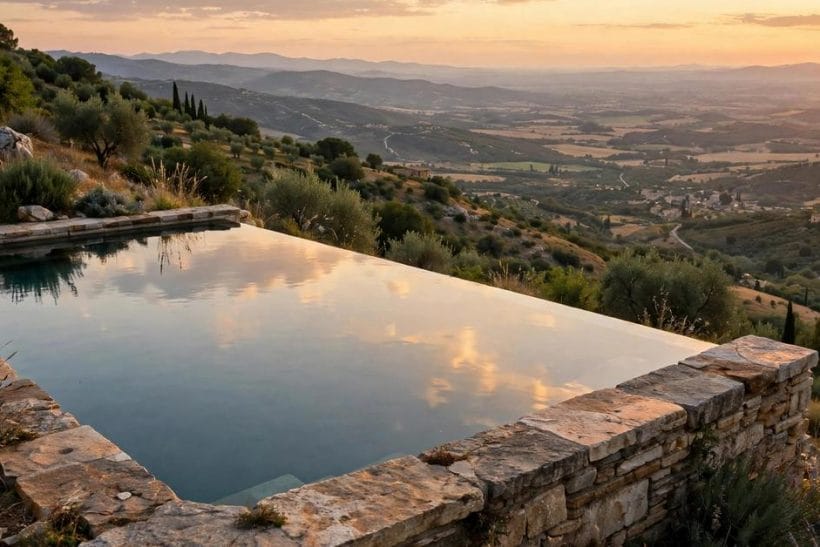
1. Infinity Pools at a Glance
Scope first. This post owns the vanishing edge — the siting, finishes, lighting and setting that make the waterline disappear. The wider collection of pool ideas covers the whole family, from layouts to planting and fencing; here, every idea begins and ends at the rim, where pool becomes view. Structure and safety are touched on only in general terms: an infinity edge is always designed and built by professionals.
In general terms, the edge works like this: the pool is filled to the brim of one lowered side, so water slips over that edge in a thin sheet into a catch basin below, then is filtered and pumped back. The effect is simple; the engineering behind it is not, which is why siting, structure and barriers are settled by designers before any finish is chosen.
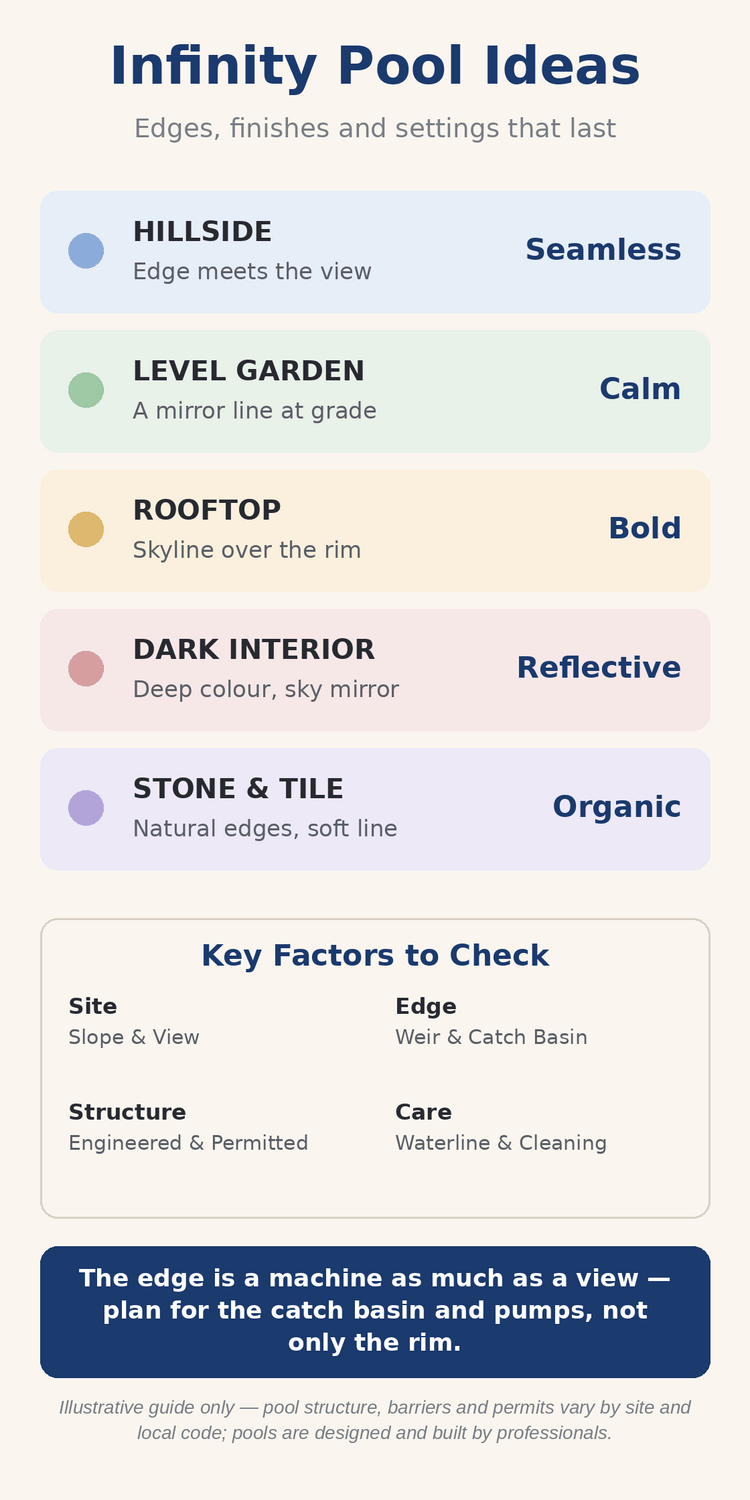
| Type | Character | What it means |
|---|---|---|
| Hillside Edge | Seamless | The waterline meets a slope or view and the far edge disappears |
| Level-Garden Edge | Calm | A mirror-still line at garden level with planting at the rim |
| Rooftop Edge | Bold | City or skyline carried over the rim of a raised pool |
| Dark Interior | Reflective | Deep-coloured finishes that turn the surface into a sky mirror |
| Stone and Tile Edge | Organic | Natural edges and soft lines that settle the pool into a garden |
2. Hillside and Slope Infinity Edges
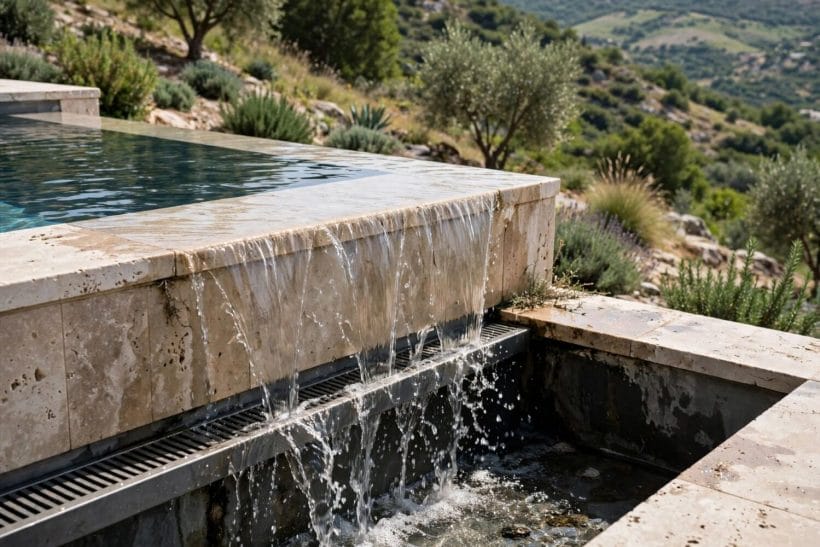
A slope is the infinity edge’s natural home: the ground falls away, the waterline holds level, and the view does the decorating. The siting follows the same fall of land as the best backyard pool ideas — read the contour, then place the edge where the garden wants to open.
1. One vanishing edge facing the valley
Set the vanishing edge facing the fall of the land, and the pool reads as a level sheet laid over the slope. The view does the work, so keep planting low and let nothing interrupt the line.
2. Twin edges meeting above the slope
Where a plot turns a corner above the valley, carrying the overflow around two sides doubles the sense of floating. The corner becomes the place to stand, swim to and photograph, with the horizon wrapping the water.
3. An edge following the hill’s contour
A rim that bends with the contour settles the pool into the hillside instead of imposing a rigid rectangle on it. The curve softens every view and makes the garden, not the geometry, lead the design.
4. Terraced planting stepping down below the rim
Below the edge, the falling ground still needs dressing. Terraced beds of grasses step the slope down in green shelves, hiding the pool’s outer wall, steadying the bank and giving the vanishing line a soft landing.
5. A catch basin tucked into planting
The basin that collects the overflow sits beneath the rim, and on a slope it can disappear into a planted bank. Surround it with dense, water-tolerant planting and the working edge reads as garden, not machinery.
6. Stone coping that echoes the hillside rock
Choose coping stone that answers the hill’s own rock — similar tone, similar roughness — and the rim looks quarried from the site. The pool then belongs to the slope as pale imported edging never manages.
7. A lawn running level to the waterline
On the house side of a hillside pool, a lawn carried level to the coping keeps the approach calm and barefoot-friendly. The contrast does the design work: soft green order behind you, open air and view ahead.
8. An edge aligned with the evening view
On western slopes, align the vanishing edge with the sunset and the pool becomes an evening room. The water takes the colour of the sky at the garden’s busiest hour, and the rim disappears into the light.
9. Native planting softening the slope below
Finish the hillside with the planting that already thrives there. Native grasses and shrubs knit the bank together, ask for little attention and blur the boundary between the designed garden and the wilder ground beyond it.
3. Level-Garden Vanishing Edges
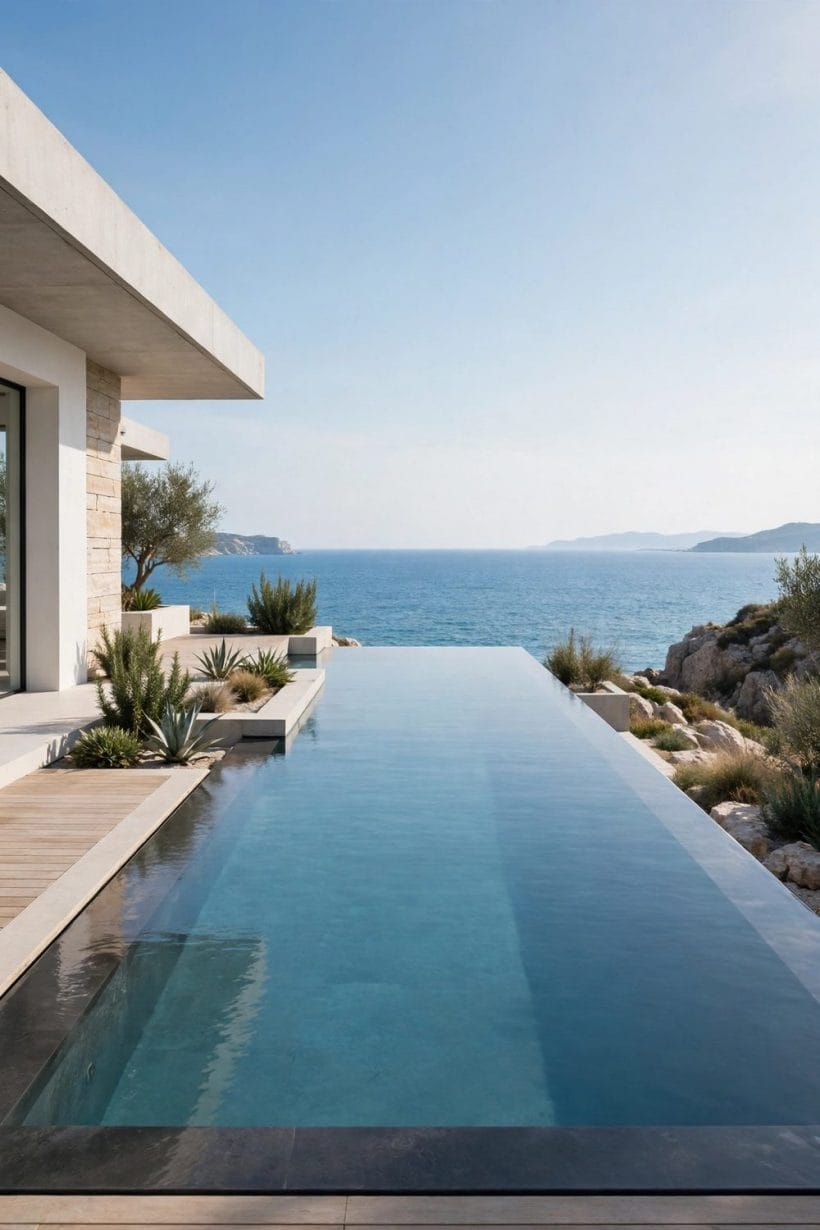
No slope is no obstacle. On level ground the edge is raised enough for the water to spill and return, and the trick is played with reflection, not height: a still surface that mirrors sky, house and planting.
10. A mirror line flush with the lawn
Set the pool so its surface sits almost flush with the lawn, and the water reads as a polished sheet laid on the grass. Mown stripes toward the rim sharpen the effect and keep the approach simple.
11. Planting at the rim for softness
Low planting carried to the coping softens the one hard line a level pool cannot hide. Grasses and ground-hugging perennials blur the rim without dropping debris into the water, and the edge feels grown rather than built.
12. A still edge reflecting the house
Face the vanishing edge toward the house and the water returns the compliment, mirroring gables, windows and evening lights. It is the quietest drama in garden design: architecture doubled in a surface that barely moves.
13. A narrow planted rill alongside the water
A slim planted channel beside the pool echoes the overflow line and gives the level garden a second ribbon of green. The pairing makes the waterline feel intentional, part of a composition rather than a lone rectangle.
14. Pale paving brightening the waterline
Pale paving around a level pool lifts the whole scene, bouncing light onto the water and making it sparkle against the rim. It suits bright, open gardens where the pool is the centre of the plan.
15. An edge facing a favourite garden view
Every level garden has one best outlook — a mature tree, a borrowed church spire, open fields beyond the fence. Aim the vanishing edge at it, and the pool frames the view you love most for life.
16. Low hedging framing the far rim
A low, clipped hedge behind the far rim gives the water a dark backdrop that deepens its colour and sharpens the vanishing line. The hedge also shelters the surface, keeping the mirror calm on breezy days.
17. A reflective edge beneath mature trees
Place the edge where mature trees reflect in it, and the pool borrows their height and movement. Dappled shade keeps the water cool-looking through summer, and the rim carries a shifting pattern of leaf and sky.
18. A calm edge for a formal courtyard
In a walled courtyard the infinity edge becomes a piece of geometry: one brimming rectangle, one disappearing side, gravel held in strict lines around it. The stillness suits the formality, and the water softens every hard surface.
4. Rooftop and Raised Infinity Pools
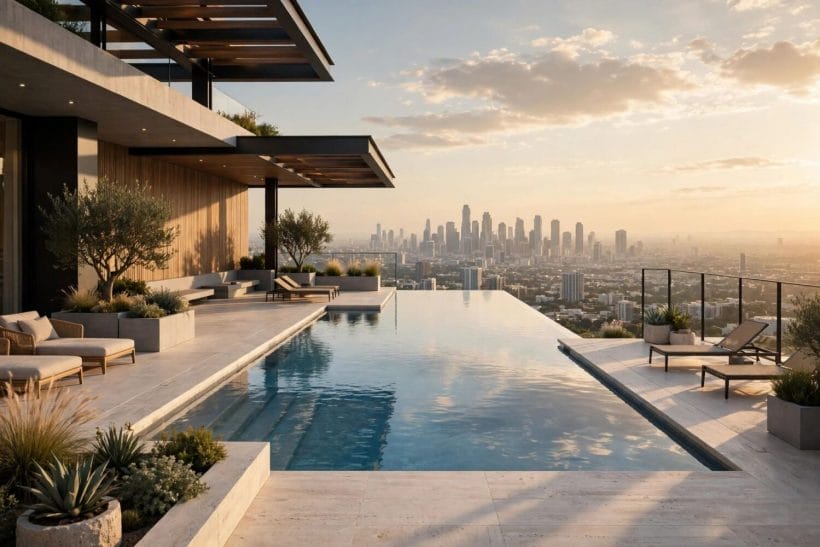
Height is the other way to earn a vanishing edge. Raised on a roof or terrace, the pool borrows the skyline as its far bank — the raised cousin of the modern pool, designed as part of the building itself.
19. A skyline edge on a city rooftop
The classic rooftop composition: the waterline held level with the towers beyond, so the city seems to rise from the pool. Keep the rim detailing minimal and the furniture low, and nothing competes with the view.
20. A raised edge above a terraced garden
Where a garden falls in terraces, raising the pool gives it a borrowed slope. The edge spills toward the lower garden, and swimmers look out over planting instead of a fence — height without a hillside.
21. A rooftop pool lifted to the view
On flat roofs the pool is lifted on a plinth so the waterline clears the parapet and meets the view. That rim doubles as a seat wall around the deck, giving the roof a gathering edge.
22. A sheltered lounge corner beside the rim
Rooftops are breezy places, so plan a sheltered corner beside the edge: a screen, a deep sofa, a place to sit with the view. The pool stays the spectacle; the corner makes it comfortable to linger.
23. A slim raised edge for daily lengths
A long, narrow raised pool suits the swimmer first: one vanishing side, an uncluttered deck, and the horizon at the turn of each length. The discipline of the shape is its beauty, especially against a busy skyline.
24. An edge wrapping a corner terrace
Where a terrace turns a corner, wrap the overflow around both sides and the pool reads as the building’s own waterline. The double edge opens two views at once and makes a modest roof feel generous.
25. A raised edge over a garden court
A pool raised above a courtyard looks down on its own private green room. From below, the brimming rim is a calm ceiling line; from the water, the court below feels like a garden in miniature.
26. Rooftop planting softening the hard lines
Roof pools sit among hard surfaces, so planting earns its place: grasses in troughs, small trees in planters, green softening the parapet. Kept clear of the water, it turns an engineered deck into a floating garden.
5. Infinity Edges with Spas and Fire Features
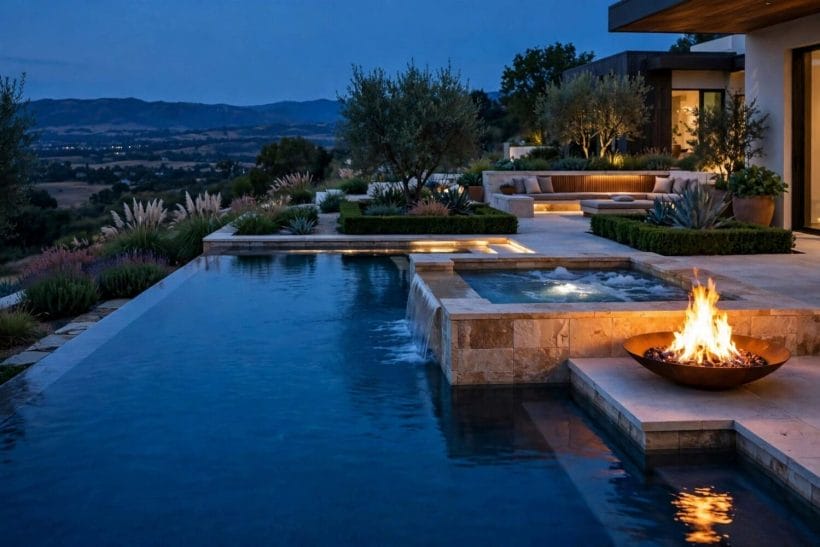
Warm water and open flame are the edge’s natural companions. A spa shares the view at sitting height, firelight doubles on a still surface, and the pool becomes an evening room rather than a daytime-only pleasure.
27. A raised spa sharing the vanishing view
Raise the spa beside the main edge so seated bathers get the same horizon as swimmers. The raised rim gives the composition its step: deck, spa, pool, view — each level borrowing the outlook from the last.
28. A fire bowl at the vanishing corner
Place a fire bowl where two edges meet and the flame anchors the composition. By day it is a sculptural full stop; by night its reflection runs down the water and the corner glows from both sides.
29. A spa sharing the main outlook
A common disappointment: the pool faces the view, the spa faces the fence. Set the spa on the view side from the start, angled with the pool, so the warmest seat also holds the best outlook.
30. Firelight reflected across still water
An infinity surface is at its stillest in the evening — a perfect mirror for flame. A fire feature low near the rim throws a long reflection across the pool, doubling its warmth without any extra fitting.
31. A sunken lounge beside the spa
A lowered seating pit beside the spa keeps company at eye level with bathers, out of the wind. Surround it with the pool’s coping stone and the lounge reads as part of the water’s architecture.
32. One calm waterline for pool and spa
Where pool and spa sit together, a shared, brimming waterline unites them into one sheet of water with two temperatures. The eye reads one calm surface; the vanishing edge then serves both with one disappearing line.
33. A linear fire feature along the far rim
A long, low line of flame along the far rim echoes the vanishing edge — fire answering water along the same horizon. It is best after dark, when the pool light is low and the line glows.
34. A spa rim raised for evening soaks
Raise the spa rim higher than comfort alone demands, and evening bathers sit above the garden’s shadow line with the last of the light. Add the pool glowing below and the spa becomes the garden’s evening lookout.
6. Finishes: Tile, Stone and Dark Interiors
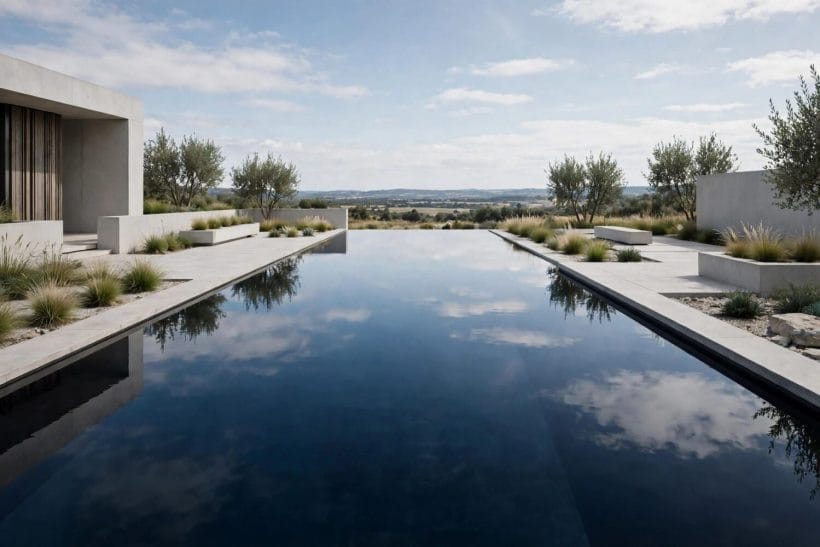
The interior finish decides what the water looks like, and on an infinity pool what the view looks like too — pale finishes sparkle, dark finishes mirror, and the rim ties the edge to its garden.
35. Deep blue tile for a sky-mirror surface
Deep blue tile under a brimming surface turns the pool into a second sky, exactly what a vanishing edge wants. The horizon line softens where water meets air, and the pool reads calm even before you swim.
36. Dark interiors deepening the reflection
Charcoal, ink and deep green interiors trade sparkle for reflection, becoming a mirror that carries clouds, trees and rooflines. It suits still, shaded gardens and pools made to be looked at as much as swum in.
37. Natural stone for an organic rim
A rim of riven stone gives the edge a soft, irregular line among planting. Where a tiled rim would draw a hard stripe across the garden, stone lets the waterline feel like a natural pool’s edge.
38. Mosaic tile tracing the vanishing edge
Run a band of mosaic along the waterline and over the rim, and the overflow reads as a designed line rather than a wet accident. Small tiles follow curves kindly, suiting contour edges and corners alike.
39. Pale interiors for a bright, lagoon-like calm
Sand, pale grey and soft aqua interiors give the bright look of a lagoon — cheerful in full sun and flattering to pale paving. On a level plot, the lightness keeps the garden feeling open and airy.
40. Slate tones for a woodland setting
Among trees, bright blue can shout. Slate and stone-grey interiors keep the water the colour of a woodland pond, reflecting canopy instead of sky, and the vanishing edge settles quietly into shade and leaf litter tones.
41. Stone and tile for a settled look
The settled gardens often mix the two: tile inside for colour and easy care, stone at the rim for weight and welcome. Each material does its best job, and the edge gains a crafted, furnished quality.
42. A matte finish softening the glare
On sun-trap plots, a matte interior finish takes the dazzle off the water and lets the eye rest. The surface reads deeper and calmer, the reflections lengthen, and the vanishing line stays readable through the brightest hours.
7. Lighting the Edge After Dark
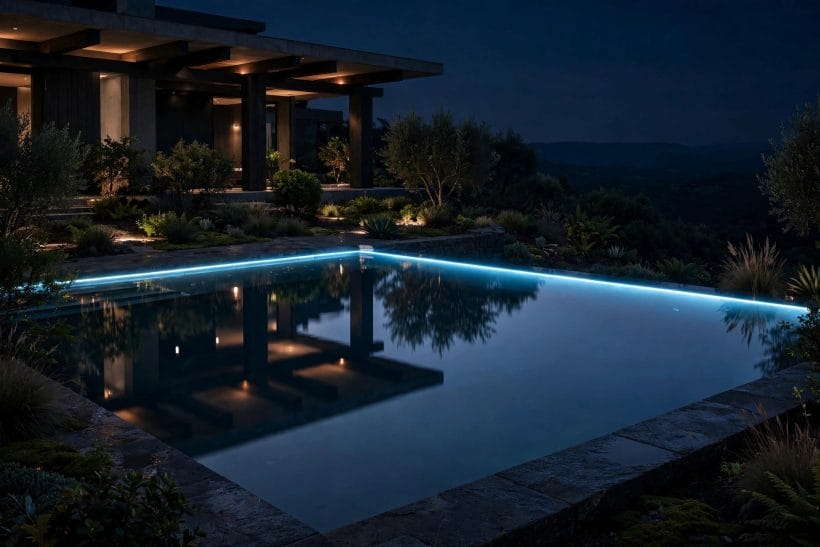
An infinity pool earns a second life at night. Lit well, the waterline glows, reflection replaces the view, and the edge that vanished all day returns as the garden’s brightest line — so plan lighting with the siting.
43. Underwater light washing the edge at night
Light placed to wash along the water, not glare from it, turns the surface luminous. The rim catches the glow first, so the vanishing edge reads as a line of light suspended between garden and darkness.
44. A lit waterline drawing the eye outward
Keep the pool’s edge the brightest element in the night garden and every sightline follows it outward, as the view does by day. Dimmer light behind the viewer completes the trick, letting the water hold the stage.
45. Warm light glowing in the catch basin
A warm light in the basin below the rim outlines the falling sheet of water after dark. The overflow, invisible by day, becomes a thin lit curtain, the one moment the machinery is worth showing.
46. Lanterns marking the poolside path
Low lanterns along the path do quiet, practical work: they guide bare feet, mark the deck’s edge and leave pools of light that never compete with the water. The route to a night swim feels ceremonial.
47. Spa light and firelight layered after dark
Layer the evening sources — spa glowing softly, firelight flickering above it, the pool lit low — and the poolside gains depth like a lamplit room. Each at a different warmth keeps the scene rich, not flat.
48. Low garden light keeping reflections clear
Bright floodlighting kills the night mirror, scattering the surface with glare. Keep surrounding light low and shielded, and the pool keeps its reflection of sky, flame and rim — the darkness becomes part of the design.
49. Light beneath the coping for a floating rim
A concealed light line beneath the coping makes the rim appear to float above its own glow. It suits raised and rooftop edges, where the pool’s outline against the night is the whole composition in one stroke.
50. A dark surround letting the water glow
The simplest scheme is contrast: dark planting, dark decking, unlit boundaries — and the pool shining at the centre. The vanishing edge then melts into blackness beyond, and the water seems to end in the night itself.
8. Small-Site Infinity Pools
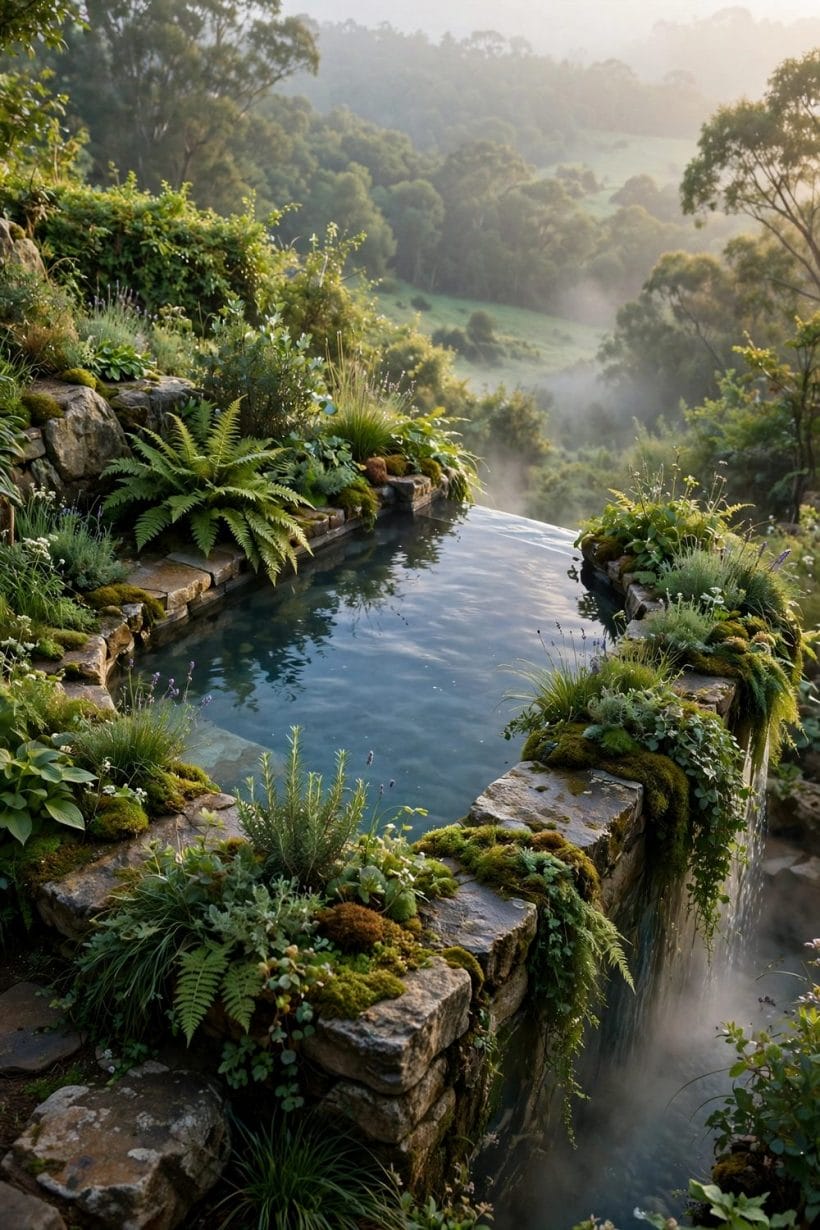
A vanishing edge is a space trick as much as a luxury, which is why it flatters small plots: the waterline borrows the view and the eye travels further. The layouts below follow good small pool ideas — one strong line, everything else quiet.
51. A short edge borrowing a long view
On a small plot the edge need not be long to work; it needs the right outlook. Even a short side aimed at rooftops, trees or a gap in the hedge borrows distance the garden lacks.
52. A compact plunge pool with one vanishing side
A plunge pool is made for cooling off and lingering — and one infinity side gives it grandeur far beyond its footprint. The rest of the plot stays garden, while the water performs its disappearing act daily.
53. A courtyard edge doubling space
In a walled courtyard, a brimming edge against one wall reflects the sky the walls cut off, and the court feels twice its size. Keep the paving simple and the water becomes the courtyard’s window.
54. A narrow pool on the garden axis
Run a narrow pool along the garden’s axis — door to boundary — and the vanishing end pulls the plot into one long perspective. Planting in lines either side strengthens the corridor of green and water.
55. A small edge framed by one tree
One well-placed tree reflected in a small pool does the work of a whole planting scheme. Frame the edge so the canopy fills the surface, and a compact garden gains shade, movement and a living ceiling.
56. Pale finishes making a small pool feel larger
Light interiors and pale coping borrow brightness across a small plot, making the water read wider and the rim lighter. Paired with the vanishing line, the whole pool feels less like an object, more like light.
57. A raised small pool as garden focal point
Raise a compact pool and it becomes the garden’s centrepiece: a brimming table of water with a seat-height rim. The edge spills on the view side; the other sides serve as perch, shelf and gathering place.
58. A quiet corner edge for morning swims
Tuck the pool into the garden’s sunniest corner and aim its edge along the boundary planting. Morning light reaches it first, the rest of the garden stays free, and a daily swim starts with birdsong, not ceremony.
9. Decks, Cabanas and the Poolside Room
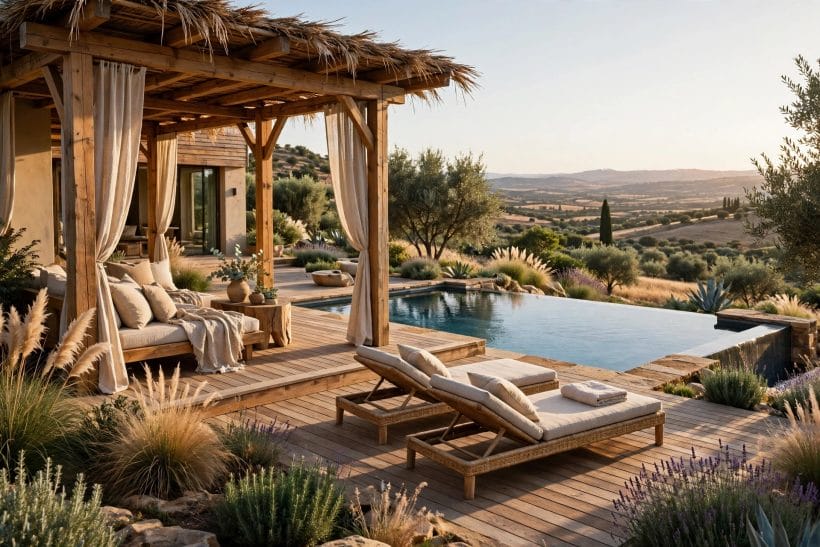
The edge is the view; the deck is the room it is viewed from. Plan the poolside as furnished space — somewhere to sit, eat and store the day’s things — drawing on pool cabana ideas for shelter, pool house ideas for a building, and the calm geometry of rectangular pool ideas to hold the composition together.
59. A timber deck level with the rim
Timber carried level with the coping makes the deck feel part of the pool itself — warm underfoot, soft in tone, kind to the waterline’s reflection. A shadow gap at the rim keeps the edge crisp.
60. A cabana framing the vanishing view
Place the cabana to one side of the view axis, never across it, and its roofline frames the horizon like a picture mount. From its shade, the vanishing edge sits centred in the composition all afternoon.
61. A pool house anchoring the far end
A pool house at the end opposite the edge anchors the layout: changing, shade and storage in one building, balanced against the open water at the other end. The garden reads as a room with two ends.
62. Loungers aligned with the edge line
Line loungers parallel to the vanishing edge and the furniture repeats the pool’s main line. It is a small discipline with a large effect — the deck looks composed from every window of the house, even empty.
63. A pergola shading the poolside seating
A pergola over the deck’s seating gives the poolside its ceiling: dappled shade by day, a frame for lanterns by night. Keep its posts clear of the view corridor and the edge keeps its open horizon.
64. An outdoor kitchen beside the water
Put cooking where the cook can see the water — along the house wall or the deck’s end — and poolside lunches stop feeling like exile. The edge stays the backdrop; scent stays downwind of swimmers.
65. A rectangular layout keeping the room orderly
The classic rectangle suits the poolside room best: deck, lawn and planting all take their lines from the pool’s straight edges. Within that order, the one vanishing side provides all the drama the composition needs.
66. Soft seating settled beside the deck
Deep seating on a rug beside the deck turns the poolside into a sitting room that has water in it. Choose fabrics that shrug off splashes, and keep the colours quiet so the water stays loudest.
67. Planting pockets breaking up the paving
Break a wide paved surround with planted pockets — grasses, herbs, a small tree — and the poolside gains shade and scent without losing order. The green interruptions make the water’s own green reflections feel at home.
10. Water Care, Costs and the Professional Build
Close honestly: an infinity edge is the most mechanical of pool designs, and its costs follow its engineering. Site works, structure and the overflow system come first in any budget; finishes and lighting are the final layer.
68. Plan the catch basin into the design
The basin beneath the rim collects every litre it spills, and needs room, access and thoughtful finishing from the outset. Design it into the garden — planted over or honestly expressed — never as an afterthought.
69. Keep the waterline clean for a crisp edge
The vanishing line shows everything: a tide mark at the rim breaks the illusion faster than any other flaw. Regular gentle cleaning of the waterline, agreed in the care routine, keeps the edge reading as glass.
70. Budget for structure before finishes
On any infinity build, spend in this order: site, structure, overflow system, then finishes. A modest tile on sound engineering outlasts a precious finish on a compromised build, and the edge will thank you every season.
71. Choose finishes for care and colour
Every finish asks for different attention at the waterline. Ask how each candidate ages, how it cleans and how it shows marks, and let the answers stand beside the colour chart when the choice is made.
72. Let professionals design structure and water movement
The edge’s calm surface depends on structure, levels and water movement working together — professional territory throughout. A specialist team settles these questions on paper, where changes are cheap, before anything is built on site.
73. Settle barriers and permissions at design stage
Barriers, boundary rules and permissions vary by place, and they shape where an edge can sit and how its garden is arranged. Raise them with the designers early, in general terms, and let local guidance settle the detail.
74. Allow for running care in the budget
An infinity system circulates more water than a still pool, so allow for its care — energy and servicing — in the household budget. Owners who plan for it enjoy the edge; those who ignore it resent it.
75. Agree a care rhythm with the build team
Before the builders leave, agree the rhythm: who checks the basin, who tends the waterline, how it is serviced through the seasons. A written rhythm, handed over with the keys, keeps the disappearing line disappearing for years.
Final Considerations
An infinity pool is bought for one line and kept for everything around it: the siting that aims it, the finish that colours it, the light that returns it at night. Choose view first, edge second, finishes last.
Hold the discipline that runs through every idea above: this is a professional’s build, designed as a whole and cared for as a system. Treat it so, and the waterline where garden meets sky stays where it belongs — nowhere to be seen.

0 Comments