

Rock gardens promise low maintenance, right up until the weeds discover that gravel is an excellent nursery. The chemical shortcut poisons the soil, the pollinators, and the entire point of a naturalistic garden. Keeping a rockscape clean without herbicides isn’t harder — it’s a different system, and it starts before the first stone goes down.
1. Eco-Friendly Weed Control for Rock Gardens at a Glance
Eco-Friendly Weed Control for Rock Gardens is a system, not a spray. Prevention does the heavy lifting: a woven geotextile barrier under deep gravel, washed stone and sealed edges stop most weeds before they start. What slips through meets hand-pulling after rain, a monthly flame pass on the hardscape, dense groundcover competition, and targeted natural sprays — all held together by a seasonal rhythm that costs minutes a week.
| Attribute | Detail |
|---|---|
| The Foundation | Woven geotextile under all gravel, 3–4″ of washed stone, steel or stone edging — prevention is 90% of control |
| The Primary Tool | Hand-pulling after rain with a hori-hori knife — the 5-minute pull instead of the 20-minute fight |
| The Heat | Propane flame weeder, $50–80, 100,000 BTU — a slow 2-second pass that wilts rather than incinerates |
| The Eradication | Sheet mulch, spot smothering and solarization at 140°F — the no-dig resets for invaded ground |
| The Living Mulch | Thyme, sedum and phlox planted 20% tighter — the carpet that finds light before weeds can |
| The Chemistry of Plants | Allelopathy — the walnut and the sunflower suppress weeds naturally, used cautiously |
| The Sprays | 20% horticultural vinegar, boiling water, salt and corn gluten — contact killers and one pre-emergent |
| The Rhythm | Spring pre-emergent, weekly 10-minute walk, monthly flame pass, seasonal edge check, yearly top-dress |
| The Budget | 15–20 hours a year — against the chemical route’s 2 hours plus the poison |
| The Golden Rules | Never compost seed heads; never leave bare soil; pull the crown, not the leaves |
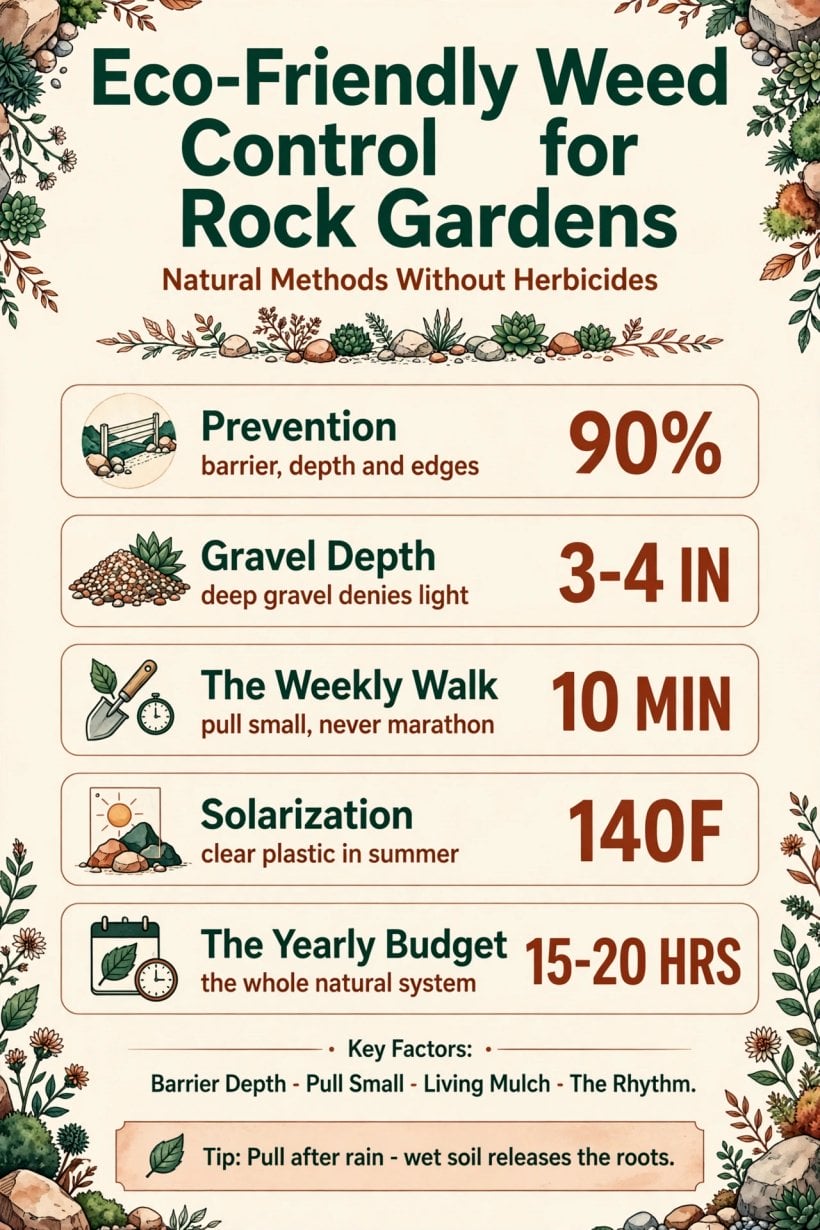
Ninety percent prevention, ten minutes a week, and a 15–20-hour year — the whole chemical-free system on one card.
Read the table as a sequence of dependencies rather than a menu. The foundation decides how much work everything else has to do: a bed built on fabric and depth barely weeds, so the weekly walk stays a stroll instead of becoming a rescue mission. The tools, the heat and the sprays exist for the minority of weeds that beat the barrier, and the living mulch steadily shrinks that minority as the groundcovers knit. Underneath it all sits the rhythm — because every element in this system is cheap and easy, and the only expensive version of it is the one done too late.
2. Prevention: The Weed-Proof Foundation
Prevention is 90% of weed control, and it is built, not sprayed. The foundation has four parts. Woven geotextile goes under all the gravel — the barrier, the single most effective weed prevention there is, because the fabric blocks germination from below and a properly installed barrier stops 90% of weeds before they ever see light. Depth does the second job: 3–4″ of gravel is the light block, because weed seeds need light to germinate and deep gravel denies it, while the shallow 1″ topping is the weed invitation — a dusting of stone that holds moisture at the surface and gives every seed a lit, damp nursery. This is the same depth discipline the edged beds of the gravel path with rock borders build on, where the stone layer is a structure, not a scattering.
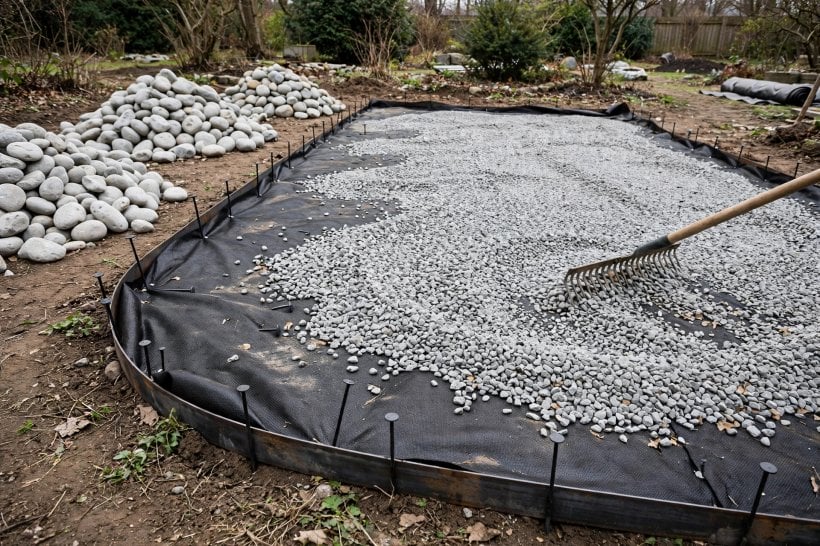
The third part is clean gravel: washed stone, because dirty gravel carries weed seeds in its dust — quarry-fresh and unwashed means the weed problem was delivered by the truckload. The fourth is sealed edges, because weeds invade from the lawn edge, creeping in from the perimeter while the gardener watches the middle: steel or stone edging contains the bed and closes the invasion route. Put the four together — barrier, depth, clean stone, sealed edges — and the result is the established rockscape that barely weeds: the foundation is the system, and everything after this section is maintenance of its verdict. The same sealed-edge logic protects the long gravel runs of a river rock dry creek bed, where an open edge would let lawn and weed roots colonize the channel from both banks.
3. Hand-Pulling: The Primary Tool
For the weeds that beat the foundation, hand-pulling is the primary tool — and timing is what makes it effective instead of Sisyphean. Pull after rain: wet soil releases roots, turning the job into the 5-minute pull instead of the 20-minute fight against dry ground that snaps every stem at the surface. The rain is the assistant; the gardener who pulls on a dry afternoon is volunteering for the harder version of the same task. The tools are small and specific: the hori-hori knife, the weeding sword that slices taproots in gravel, and the fishtail weeder for tight spots between stones where fingers cannot reach.
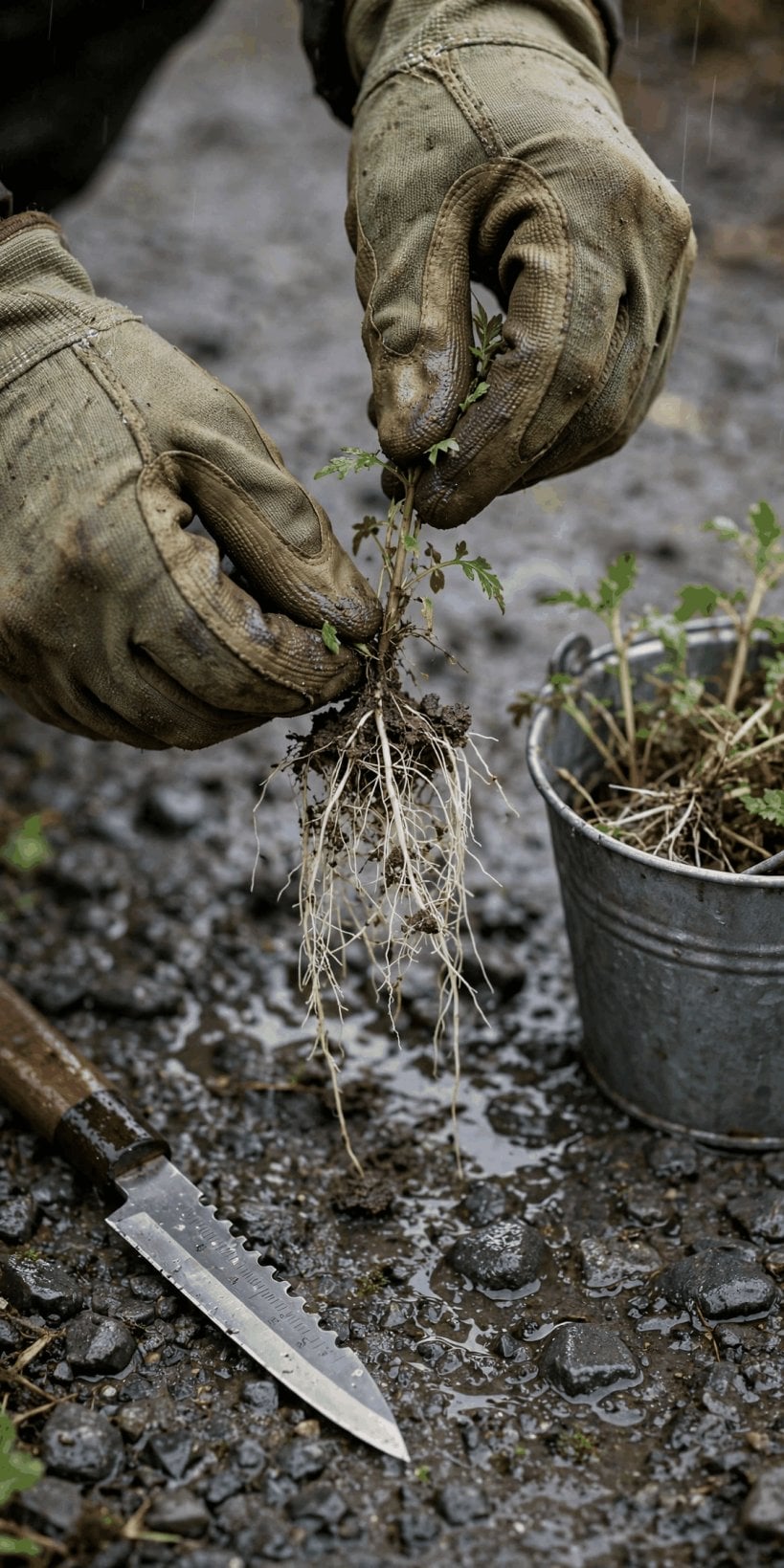
Technique decides whether the pull is a cure or a pruning. Pull the crown — the growing point — grasping low and pulling slow, because a broken root resprouts and a weed beheaded at the surface returns with interest. Complete removal is the whole game. Frequency keeps it small: the weekly walk, 10 minutes, the stroll with the bucket, because weeds pulled small never become problems and the habit beats the marathon every time. And one rule is absolute: seed heads are never composted. Weed seeds survive home composting, so anything carrying seed is bagged for the trash or the municipal green bin — the compost heap is a nursery, not an executioner.
4. Heat: The Flame Weeder on Hardscape
Heat is the system’s heavy tool, reserved for where plants are not. The tool is the propane flame weeder — $50–80 for the 100,000 BTU torch the original calls the dragon — and the technique is restraint: the slow pass, two seconds over each weed, wilting rather than incinerating. The heat bursts the plant’s cells, and the weed dies over the following days; a weed burned to ash was overcooked, and the pass that merely wilts it has done the complete job with a fraction of the fuel.
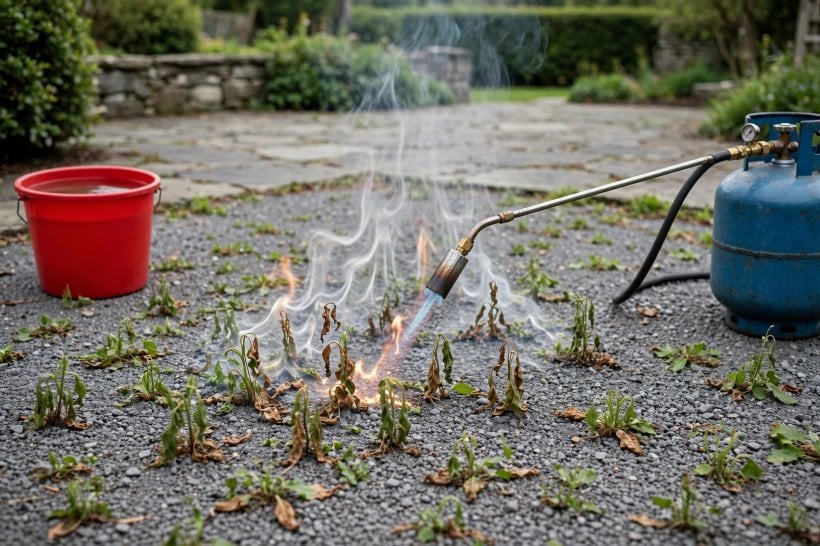
The flame weeder is best for gravel paths and patios — the hardscape: the driveway, the path, the patio — where there are no plants to damage and weeds colonize the joints. The jointed surfaces of permeable rock pavers are exactly this terrain, open stone joints where a flame pass cleans what fingers cannot reach. Safety is the non-negotiable half of the section: fire awareness, because dry conditions plus flame is the risk — keep water handy, never work near mulch or structures, and respect the burn ban absolutely. The frequency is monthly in season, the maintenance pass that keeps hardscape weeds from ever establishing: done on rhythm, the dragon is a broom; left until the path is green, it becomes a project.
5. Smothering: The No-Dig Eradication
When a patch is already lost, smothering is the no-dig eradication — killing by darkness rather than by chemistry or by the spade. For new beds, sheet mulch is the preparation: cardboard under 4″ of wood chips, the lasagna that kills everything beneath in 2–3 months and leaves a clean, plantable bed. For established rock gardens, spot smothering is the targeted version: landscape fabric and gravel laid over the weedy patch, a 6-week kill that resets one invaded corner without disturbing the rest of the planting.
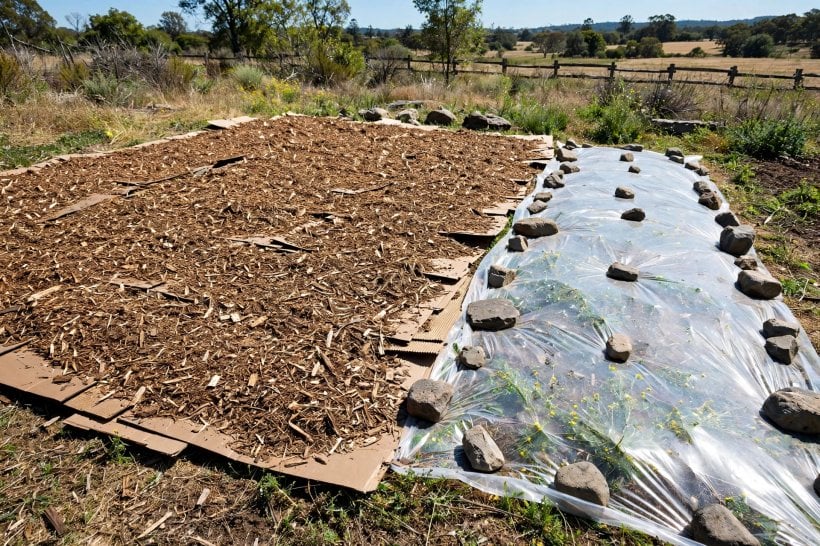
Solarization is the strongest form: clear plastic in summer, the greenhouse effect driving soil to 140°F, killing seeds and roots through a 4–6 week treatment — the nuclear option, and entirely natural. On the sloping beds built by the rock garden terracing for slopes approach, a smothered-and-reset section can be replanted without ever digging the terrace apart. The honest cost of all three methods is patience: smothering is slow — the trade is no chemicals, but the wait — so the bed is planned a season ahead, smothered through one season and planted in the next, which is precisely why it belongs in the plan rather than in a panic.
6. Plant Competition: The Living Mulch
The most beautiful layer of the system is the one that weeds against itself: plant competition. Density is the mechanism — plant tight, following the 20% tighter rule, so the groundcovers knit into a continuous carpet and weeds cannot find light. Thyme, sedum and phlox are the living mulch, the weed-suppressing carpet that is also the garden’s flowering surface — the beautiful prevention, doing with roots and shade what the fabric does in darkness below the gravel. It is the same palette that anchors the best native plants for rock gardens, planted there for drought and here for war.
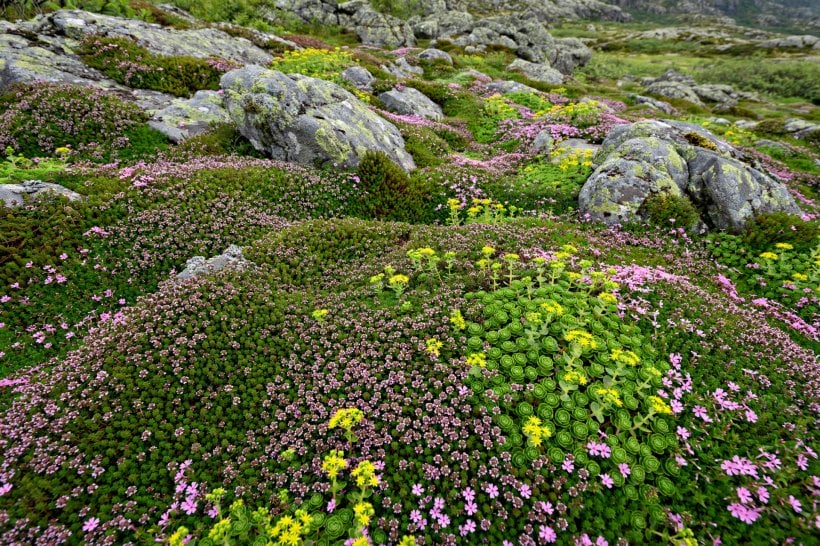
The principle underneath is the oldest in ecology: nature abhors bare soil. Every bare patch is a weed invitation; the surface is either planted or mulched — no thirds. A planted rockscape weeds less than a sparse one, which inverts the beginner’s instinct to space plants wide for their health: in a rock garden, the generous spacing is the weed nursery, and the tight knit is both the healthier planting and the cleaner one. Shade changes the cast but not the principle — the low-light beds of rock gardens for shade knit their own shade-tolerant carpets to the same end, because a covered surface is a defended surface at any light level.
7. Allelopathy: The Plants That Fight Chemically
Some plants do not merely compete for light — they wage chemical warfare. Allelopathy is the suppression of weeds by compounds a plant releases into its surroundings: the walnut and the sunflower are the original’s named examples, the natural herbicides already growing in the garden. The walnut’s bare zone is the famous case, a tree whose understory stays strikingly clear; the sunflower works the same quiet chemistry at garden scale. In a system that refuses bottled herbicides, these plants are the standing army that never clocks off.
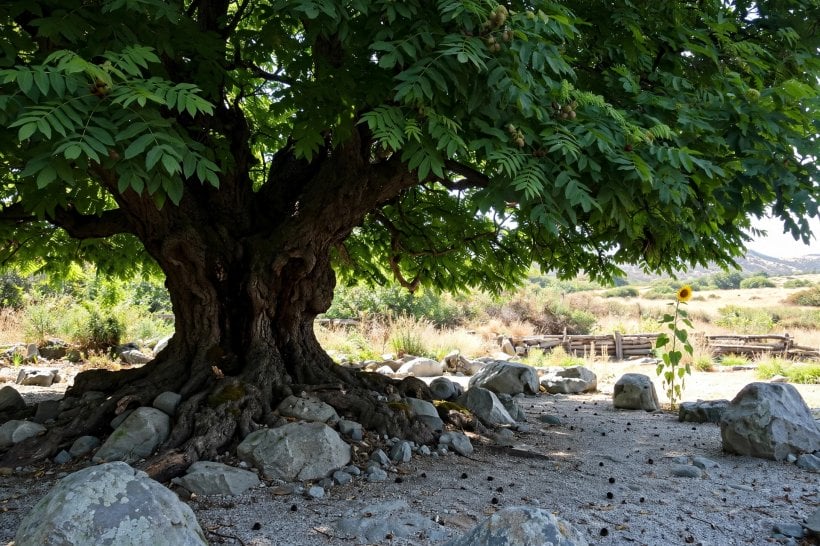
The original’s caution travels with the tactic: use allelopathy cautiously. A compound that suppresses weeds does not read plant labels, and the same chemistry that clears an understory can check the growth of wanted plants placed inside its reach. The skill is placement — allelopathic plants at the boundaries and problem edges, where their suppression zone covers ground the gardener does not intend to plant, and kept away from the beds where the chosen palette must thrive. Used that way, allelopathy is free suppression with no application and no residue — the one spray in this guide that the plants apply themselves, continuously, all season.
8. Natural Sprays: Vinegar, Boiling Water, Salt and Corn Gluten
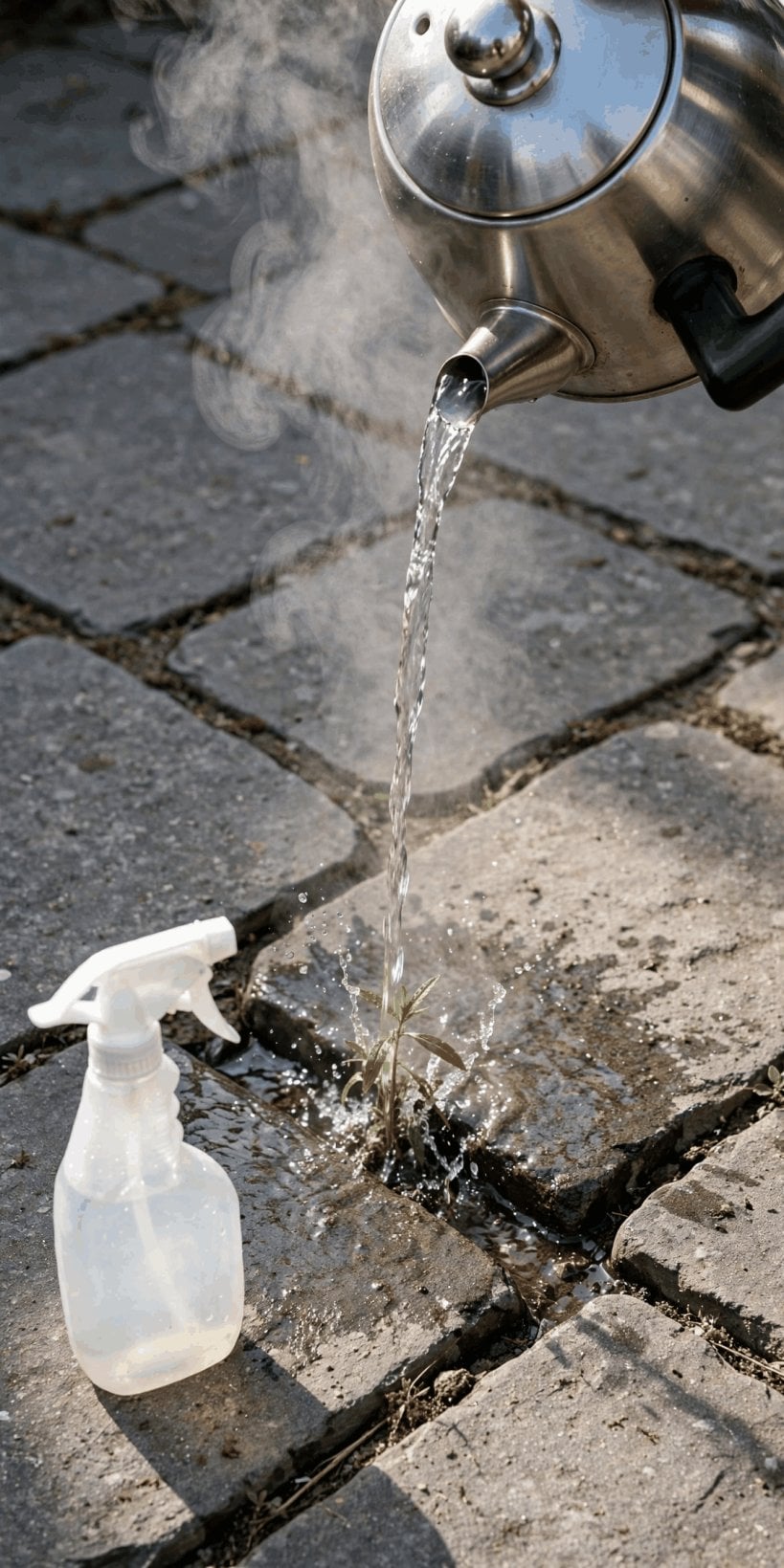
The sprays are the targeted tools, for survivors in specific places. Vinegar — 20% horticultural strength — is the contact killer: it burns top growth and handles annual weeds, with the strong-acid caution attached: gloves, eye protection, and respect for the fact that it kills any plant it touches, because it is non-selective. Boiling water is the kettle: poured on path weeds, instant and free. Salt is the permanent option, killing everything and sterilizing the soil — to be used only where nothing should ever grow, the path center and the patio, because it is irreversible and demands care.
Corn gluten is the different one: the pre-emergent, preventing seed germination rather than killing anything, applied in spring as the natural counterpart of a synthetic pre-emergent — with the stated limit that it does not kill established weeds, so it defends clean ground rather than retaking dirty ground. And the honest summary of the whole shelf: natural sprays are contact killers. They burn tops, not roots, and perennial weeds resprout — so the repeat application is part of the method, not a sign of its failure. The paved areas where salt and boiling water belong meet their planted counterpart in the water-wise beds of xeriscaping with rocks and native plants, where the same no-herbicide discipline runs on competition and depth instead.
9. The Maintenance Rhythm: The System on a Calendar
The system holds together as a rhythm, and the calendar is short enough to memorize. Spring is the pre-emergent: corn gluten down, plus a fresh gravel top-dress — the season’s armor, laid before the weed year begins. Weekly, the walk: 10 minutes, the pull-small habit that keeps every other task small. Monthly, the flame pass over the hardscape — the paths and patios. Seasonally, the edge check: the invasion points walked, the barrier’s integrity confirmed where lawn meets stone.
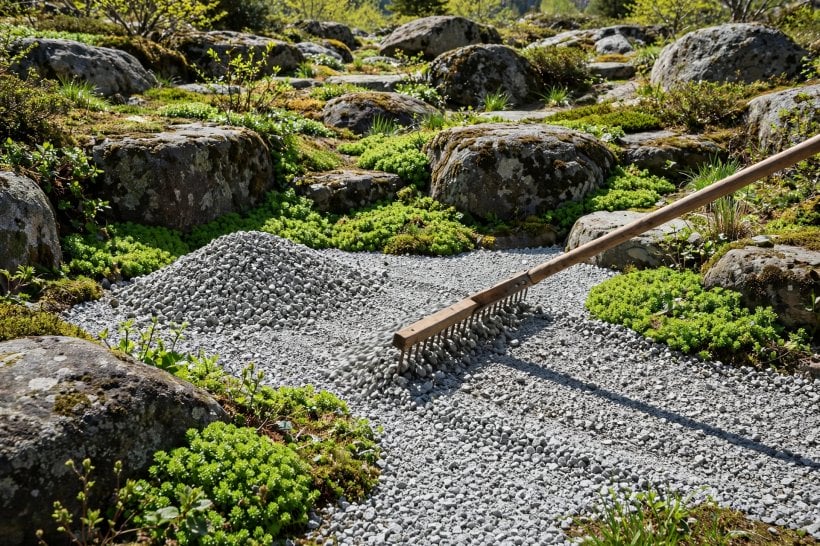
Yearly, the gravel top-dress: the 1/2″ renewal that maintains the depth the whole foundation depends on, because gravel migrates, settles and thins, and the light block only works at full thickness — the same build-once discipline as a dry-stack stone path, where the structure is maintained in minutes precisely because it was built in layers. The total is the figure the whole guide argues for: 15–20 hours a year, the natural rockscape’s weed budget — against the chemical route’s 2 hours plus the poison. The trade is stated plainly and chosen deliberately: hours instead of herbicide, a rhythm instead of a residue.
10. Putting the System Together: From Invaded Gravel to Clean Rockscape
Assembled, the system is a sequence any invaded garden can walk in one season. Audit first: where is the gravel shallow, where are the edges open, where has a patch been lost entirely — because each failure has its own layer of the answer. Reset the lost patches with smothering, timed a season ahead where the calendar allows. Restore the foundation everywhere else: top the gravel back to its 3–4″ depth, seal the open edges, and let the barrier do the 90% again. Then plant the gaps — every bare patch closed with groundcover at the 20% tighter spacing, so the surface defends itself.
Two closing disciplines keep the reset permanent. The first is disposal: everything pulled goes into the bucket, and anything carrying a seed head is bagged for the trash or the municipal green bin, never the compost — the seeds survive home composting, and a single composted seed head can re-sow the bed the system just cleaned. The second is expectation: perennial survivors will resprout after their first vinegar burn, because contact killers burn tops and not roots, so the repeat application is scheduled rather than resented — each return is weaker, the walk catches it smaller, and within a season the resprouts stop arriving. The system does not promise a garden that never weeds; it promises one where weeding is a stroll, a kettle and a calendar.
From there the rhythm takes over: corn gluten in spring, the 10-minute walk each week, the flame pass each month, the edge check each season, the top-dress each year. The pulled weeds go in the bucket and the seed heads in the trash, the kettle handles the path joints, and vinegar handles the survivors. Nothing in the sequence is heroic, and that is the design: a chemical-free rockscape stays clean not through effort but through coverage — every route a weed can take, met by a layer that was built, planted or scheduled against it in advance.
Final Considerations
Barrier + deep gravel + sealed edges (the prevention), pull small weekly (the habit), flame the hardscape monthly (the dragon), smother the invasions (the patience), plant densely (the competition), spray vinegar on the survivors (the targeted), and maintain the rhythm. The chemically-free rockscape isn’t weed-free by luck — it’s weed-free by system. Build the system, walk the walk, and the gravel stays clean.




0 Comments