

Gardeners curse their shade, then plant sun-lovers in it and curse louder. But shade is the rock garden’s secret weapon: moss creeps where nothing else will, ferns unfurl in the cool damp, and stone holds a soft green light that sunny gardens never get. The shady corner is not a problem bed. It is the best bed.
1. Rock Gardens for Shade at a Glance
Rock gardens for shade are woodland compositions built on a different economy from the sun garden’s: where the sunny bed trades in flowers, the shaded bed trades in texture — fern fronds against stone, moss over rock, green layered on green in a quiet composition that stays cool and damp while the rest of the garden bakes. The design starts with an honest reading of the light, because shade is not one condition but four, and each one carries its own palette. It continues with stone chosen to brighten rather than darken, ferns planted into the rock pockets, a living carpet underfoot, white and pale flowers that glow at dusk, and a small canopy overhead. The table gathers the whole design in one place; the sections after it take the light, the stone, the ferns, the carpet, the flowers, the structure, the moss garden, the water and the composition apart in turn.
| Attribute | Detail |
|---|---|
| The Four Shades | Deep (under 2 hours of sun), partial (3–5 hours), dappled under high canopy, and dry shade under root competition |
| The Stone | Moss rock — weathered and porous, so moss colonizes it: the aged look in 2 years instead of 20 |
| The Brightener | Pale limestone or sandstone reflects light and lifts the gloom; dark basalt disappears in shade |
| The Stars | Ferns — Japanese painted, ostrich, maidenhair and Christmas fern, planted in the stone pockets |
| The Carpet | Moss, wild ginger, foamflower, sweet woodruff and barrenwort — the living groundcover layer |
| The Flowers | White and pale blooms — the moonlight palette; bright colors look muddy in low light |
| The Workhorse | Hosta — the shade perennial with 1,000+ varieties; the blue-leaved types glow in shade |
| The Structure | Japanese maple, mountain laurel, dogwood and rhododendron — the canopy and the flowering peak |
| The Moss Garden | Acidic soil at pH 5–5.5, constant moisture, daily watering for the first month after transplanting |
| The Payoff | A garden that looks 100 years old in 5 — cool, textured, and quieter than any sun bed |
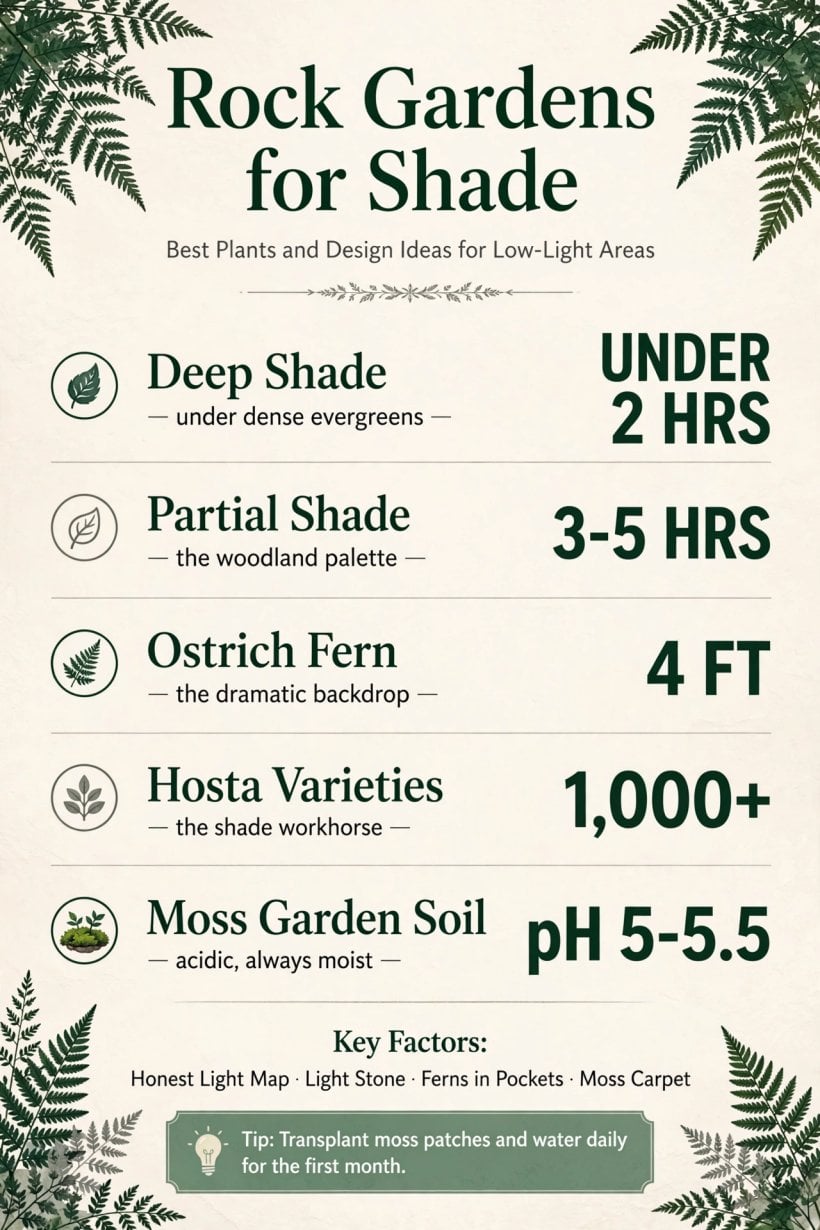
Under two hours for the deep bed, three to five for the woodland palette, and a moss garden at pH 5–5.5 — the shade design on one card.
Read the table as a dependency chain. The light reading decides which palette is even possible; the stone decides whether the composition glows or sulks; the ferns and carpet decide whether the ground plane reads as designed; and the structure overhead decides whether the bed feels like a room or a leftover corner. Get the first decision wrong and every later one is wasted effort — which is why this guide begins with a full day spent simply watching the sun.
2. Reading the Shade: The Four Light Types
Shade is not a single condition, and treating it as one is the mistake that kills shade plantings. The original guide divides it into four types, and the division is the design. Deep shade lies under dense evergreens and receives less than 2 hours of direct sun: it is the moss garden’s territory, where few flowering plants succeed and the composition is all texture. Partial shade receives 3–5 hours of sun: it is the woodland, the richest shade palette of the four, where most shade perennials thrive. Dappled shade falls under a high deciduous canopy — shifting, filtered light that is bright enough for flowers yet gentle enough for moss; the original calls it the ideal. Dry shade is the hardest of the four: the ground under trees with root competition, the eaves and the maple roots, where the toughest plants only survive.
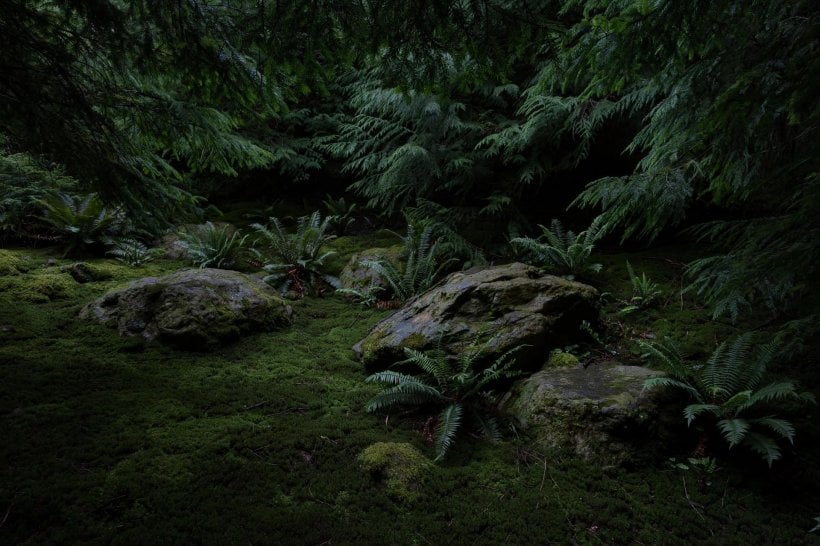
The reading itself is a discipline: watch for a day, draw the sun map, note the hours. The shade garden’s design starts with honesty about the light — a bed recorded as it actually is, hour by hour, rather than as the gardener wishes it were. A corner that gets its sun only in the morning is a different bed from one lit only in the evening, and a bed under deciduous canopy changes its light entirely between spring, when the canopy is bare, and high summer, when it closes. Once the map exists, plant choice stops being guesswork: the palette-matching discipline is the same one used for the native plants for rock gardens, where every species is assigned to the conditions it evolved for rather than the conditions the gardener hopes for.
The four types also grade the ambition. Deep shade asks for surrender — moss and texture, beautifully done. Partial and dappled shade ask for composition — the full woodland palette of ferns, carpet and pale flowers. Dry shade asks for toughness above all: the problem-solver plants of §5, led by barrenwort under the maples. Naming which of the four you actually have is the single most valuable hour in the whole project.
3. Stone in Shade: The Cool Palette
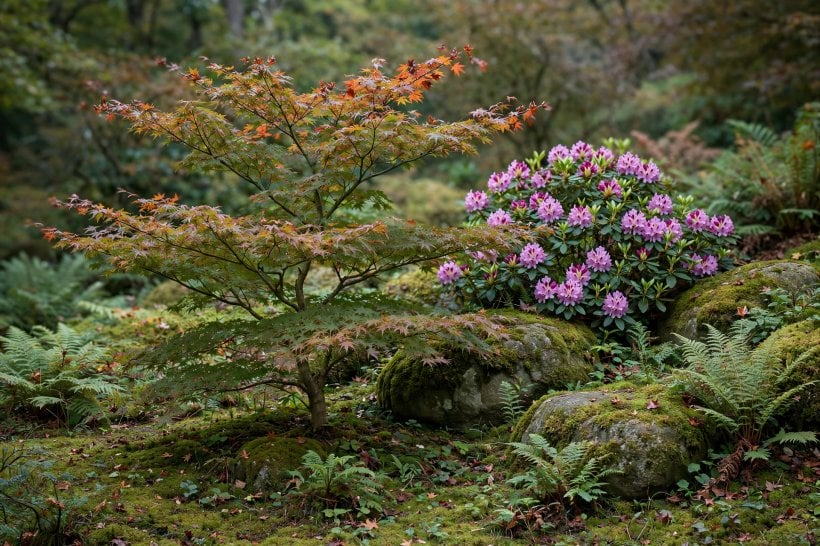
Stone behaves differently in shade, and the original’s first choice is moss rock: weathered, porous stone that moss colonizes willingly, giving the aged look in 2 years instead of 20. In a sunny bed, stone is structure; in a shaded bed, stone is a host — the surface the garden’s green skin grows on. Choose stone with texture and pores for the moss to grip, and the bed begins aging the day it is built instead of decades later.
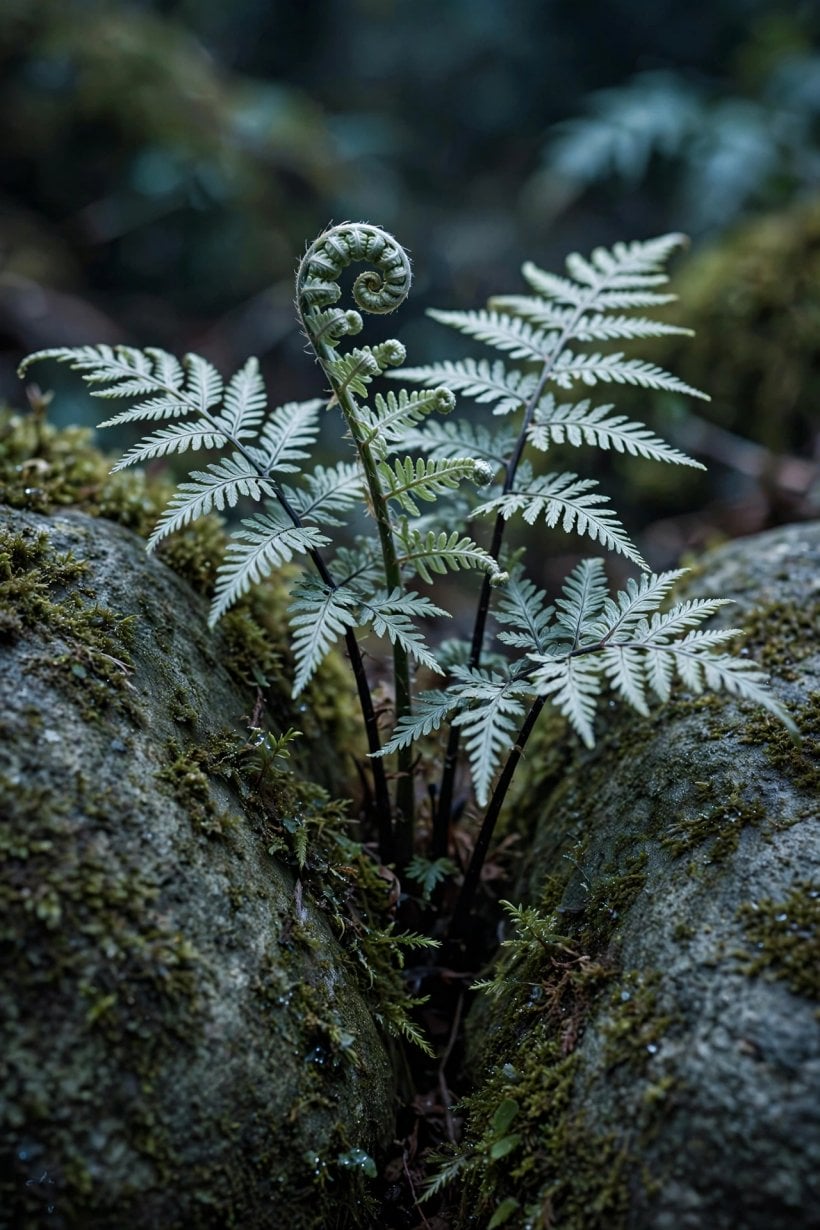
Color is the second decision, and it runs opposite to sun-garden instinct: light stone brightens shade. Pale limestone or sandstone acts as a reflector, lifting the gloom and bouncing what light there is back into the planting, while dark basalt simply disappears in low light — money buried invisibly. Placement follows the same logic of restraint: fewer, larger stones. The shade garden’s stones are sculptural, and one hero boulder with ferns beats scattered pebbles every time — the composition principle worked at yard scale in the rockscape ideas for small yards, where a single well-placed boulder organizes everything around it.
Two features complete the stonework. The damp feature — a small basin or a bubbling rock — belongs in shade, because shade keeps water cool and algae-free; it is the shade water garden in miniature. And the paths are stepping stones through moss: flags set in moss, not gravel — the woodland walk, soft underfoot, built with the same mortar-free laying craft as the dry-stack stone path. Stone, water and path together give the shaded bed its architecture before a single plant goes in.
4. Ferns: The Shade Garden’s Stars
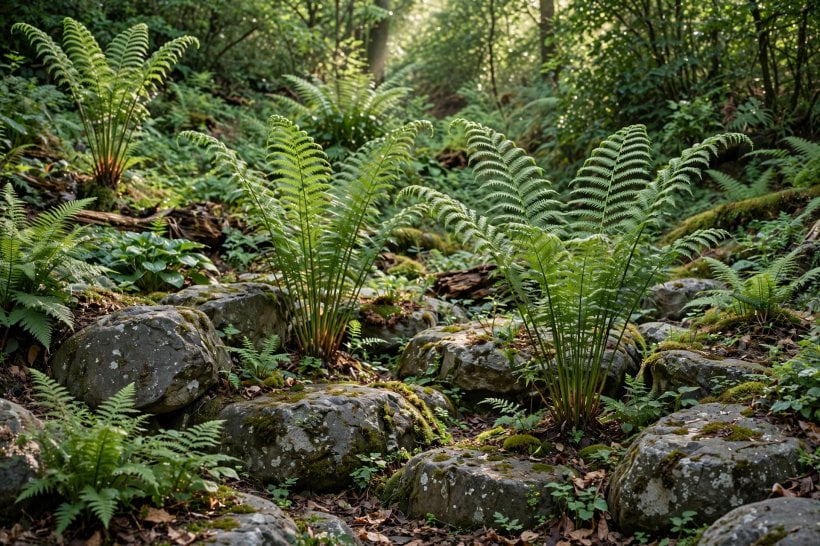
If the shade garden has stars, they are the ferns — the original gives them the section outright, and the four it names cover every role. The Japanese painted fern is the silver: metallic fronds that catch what light there is, the most beautiful shade plant in the guide’s judgement and the rock garden’s jewelry. The ostrich fern is the dramatic one, a 4-ft vase of fronds that forms the backdrop — with a warning attached: it spreads, so give it room or the discipline of a contained bed. The maidenhair is the delicate one, lacy foliage on black stems, the crevice plant of the group, and the thirstiest: it needs constant moisture. The Christmas fern is the evergreen, the winter structure, the shade garden’s backbone when everything else has died back.
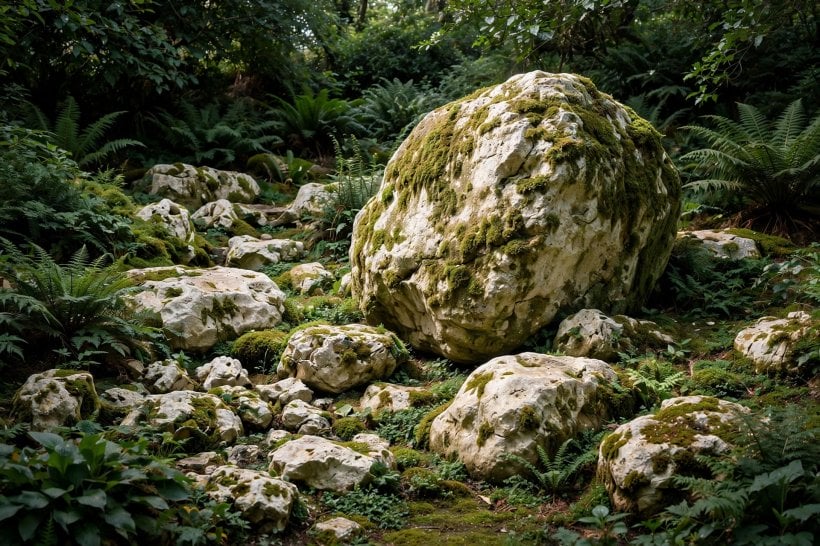
The planting is the composition: ferns go in the stone pockets. Ferns and rocks are the eternal pairing — fronds against stone, the soft against the hard, each making the other look better — and a fern planted in open soil reads as a specimen while a fern planted in a pocket reads as a landscape. Tuck the painted fern where its silver can be seen at path level, set the ostrich fern at the back where its 4-ft vase has room to spread, thread maidenhair into the dampest crevice near the water feature, and let the Christmas fern carry the winter. Four ferns, four jobs, one family — the shade garden’s whole middle layer in a single genus group.
5. Groundcovers: The Green Carpet
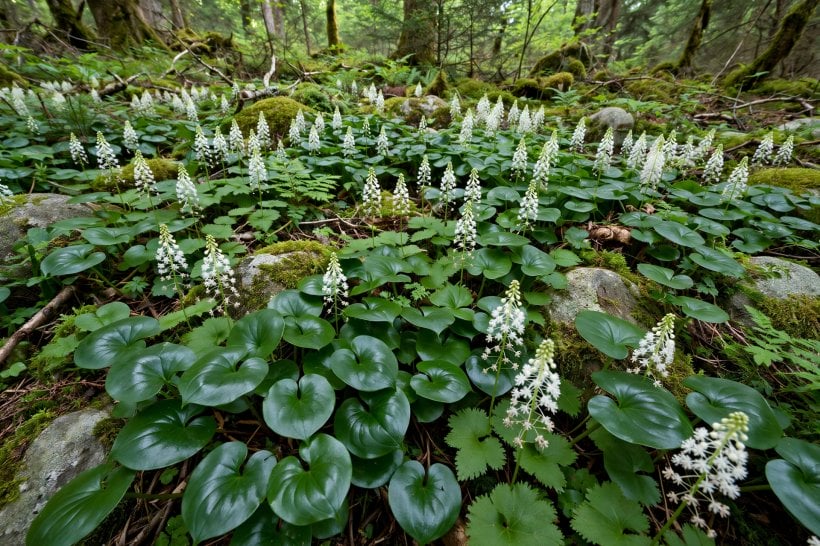
Under the ferns runs the carpet, and its first member is the ultimate shade groundcover: moss itself, treated fully in §8. The four planted carpets follow. Wild ginger is the glossy one — heart-shaped evergreen leaves, refined in effect, spreading politely; it is the carpet for the bed that borders a path or a terrace, where its finish shows. Foamflower is the foamy one, spring flowers over beautiful foliage, a native that earns its place twice a year. Sweet woodruff is the fragrant one — white spring flowers and a vanilla scent when dried — with the group’s one warning: it is aggressive, so contain it. And barrenwort is the dry-shade hero, the toughest of the set, thriving under maples where nothing else grows; the original names it the problem-solver, and in the dry shade mapped in §2 it is close to the whole answer.
The carpet’s job is to close the ground plane so completely that the composition reads as a woodland floor rather than a planted bed — no bare soil, no mulch lines, just green running stone to stone. That is the same floor-building logic, run in timber, that stacks the hugelkultur raised bed from logs and brush: a ground layer built to hold moisture, feed the planting above it and disappear into the landscape. Plant the carpets in drifts that follow the stone, let the ginger take the refined edges, the foamflower the spring-bright middle, the woodruff the contained corner, and the barrenwort the maple roots — and the floor of the shade garden is finished.
6. Flowering Perennials: Color in the Shadows
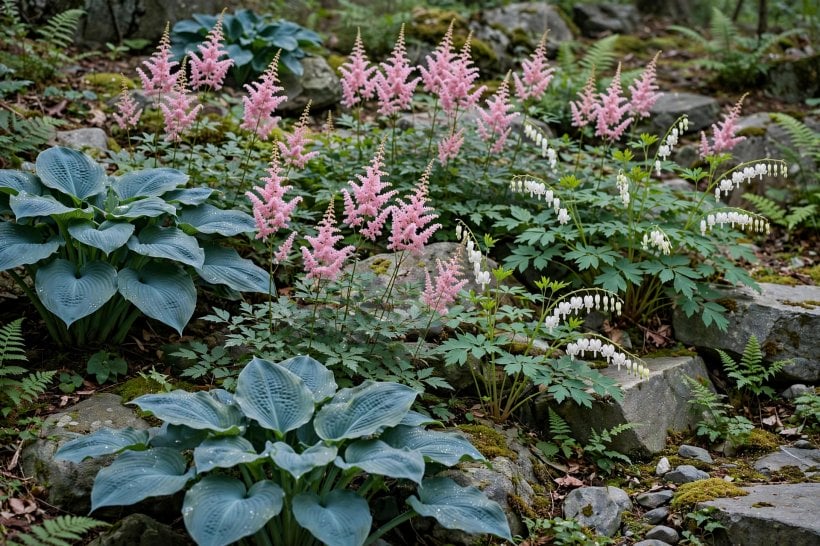
Flowers in shade obey one design law, stated plainly in the original: white and pale flowers glow in shade — the moonlight palette — while bright colors look muddy in low light. Within that law, four perennials carry the color. Hosta is the obvious one, the shade workhorse with 1,000+ varieties; the guide is honest about its tax — it is a slug magnet, answered with beer traps — and about its glory: the blue-leaved types glow in shade. Astilbe is the plume, feathery flowers over fern-like foliage, and the damp shade star: it needs moisture, so it belongs near the water feature and the maidenhair. Bleeding heart is the spring romance, arching stems of heart-shaped flowers — and it goes dormant in summer, so the planting plan pairs it with ferns to fill the gap it leaves. Toad lily is the fall surprise, orchid-like flowers in autumn, arriving when the shade garden needs color most.
Sequence is what turns four plants into a season: bleeding heart in spring, astilbe and hosta foliage through summer, toad lily in fall, with the hosta’s blue leaves and the carpet’s greens holding the composition between flowerings. In the smaller beds where most shade gardens actually happen, this tight sequencing matters even more — it is the planting-density thinking of small backyard rockscaping, where every plant must earn its square foot in more than one season. Plant for the gaps as much as for the peaks, and the shaded bed never has an empty month.
7. Shrubs and Small Trees: The Structure
Even shade gardens need height, and the original’s structure layer is four plants deep. Rhododendron and azalea are the spring explosion — the shade garden’s flowering peak — with their condition attached: they are acid-soil plants, and they need the pH honored. Mountain laurel is the native, evergreen foliage under intricate flowers, the eastern woodland’s own shrub. The Japanese maple is the sculpture, the shade garden’s tree: layered branches overhead and fall fire below them — the original calls it worth every penny. And the dogwood is the native tree with four seasons of service: spring flowers, fall berries, winter bark, and the canopy in between.
Placement is a single idea: the canopy. The small tree is the ceiling of the shade garden — it is what turns a planting under trees into a room of its own, with the shrubs as its walls and the carpet as its floor. Set the maple where its layered branches can be seen against the light, the laurel and rhododendron where their spring flowers close the view in, and the dogwood where its winter bark stands against the evergreen ferns. Structure is planted first and grows slowest; everything else in this guide can be rearranged in a season, but the ceiling cannot.
8. The Moss Garden: The Deep-Shade Specialty
Where the light map of §2 records deep shade — under 2 hours, where nothing else thrives — the original prescribes the surrender that is also a triumph: the moss garden, the most serene composition in the whole guide. Establishing it is transplant work: moss patches pressed onto bare soil and watered daily for the first month. The debated accelerator is the buttermilk slurry, painted on to encourage the spread. The conditions are exact and non-negotiable: acidic soil at pH 5–5.5, constant moisture — daily misting through the first year — and no foot traffic.
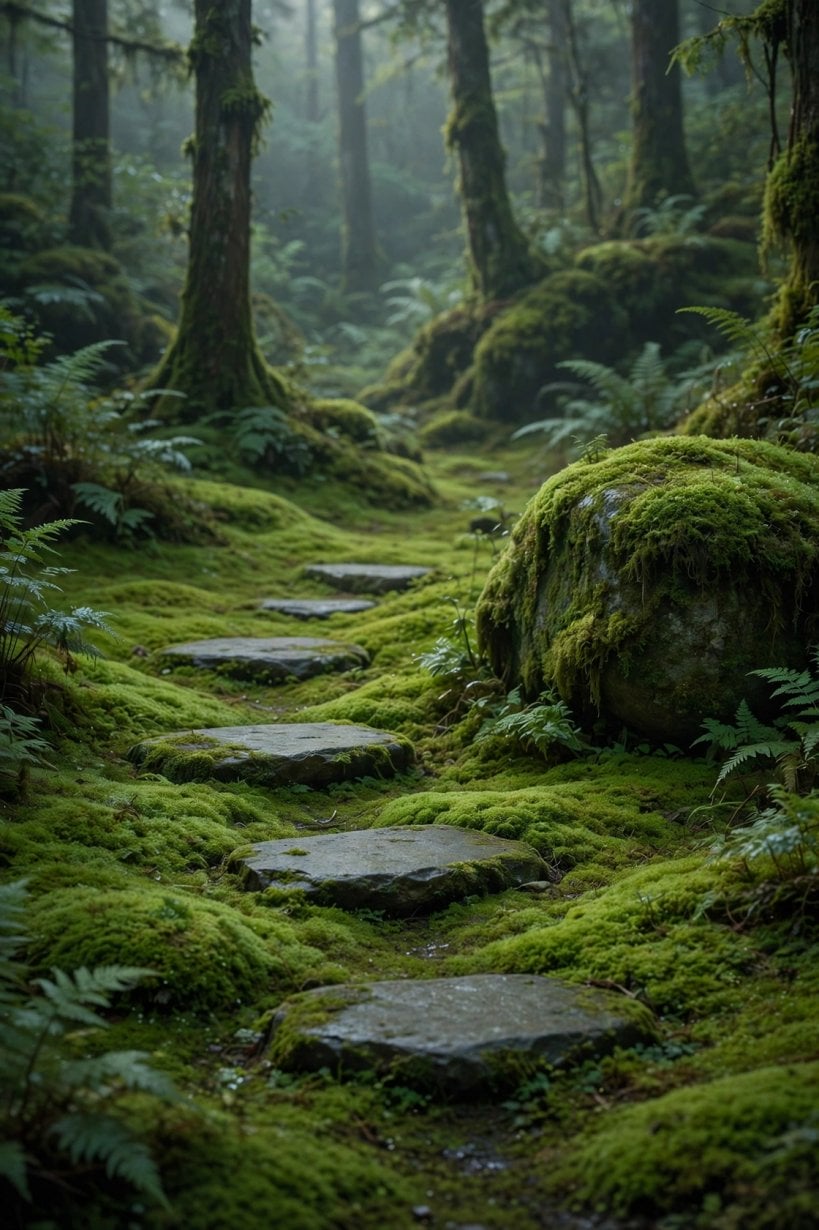
Maintenance is a single eternal task: weeding, done by hand, on knees — the original calls it the meditation, and a moss garden’s keeper either learns to love it or hires it out in their heart by the second month. The stones are the moss garden’s partners: moss-covered boulders, the ancient look, the garden that looks 100 years old in 5. It is the deepest expression of the shade garden’s whole philosophy — no flowers, no height, nothing but green depth and stone — the same surrender-to-place discipline the Japanese zen rock garden practices in gravel, practiced here in living green instead.
9. Water and Moisture: The Damp Advantage
Shade’s least-sung attribute is what it does to water: it keeps it. The damp feature of §3 — the small basin, the bubbling rock — stays cool and algae-free precisely because the sun never reaches it, which makes the shaded bed the natural home for the garden’s water. The planting follows the moisture gradient the water creates: maidenhair fern in the constantly damp crevice, astilbe in the moist soil at the feature’s edge, moss drinking the splash zone, and the carpets drinking the general cool damp that a shaded, stone-covered floor holds long after a sunny bed has dried out.
Water moving through shade is also a design tool in its own right: a bed that drains poorly in the open becomes, under trees, a designed damp garden — the low corner where a river rock dry creek bed can carry storm water through the planting while the ferns and moss colonize its banks. The rule is to stop fighting the damp and start planting it: moisture-lovers in the wet line, the carpet everywhere else, and stone — which never rots, never drowns and holds the cool — as the frame that makes the wet places look intentional.
10. The Quiet Composition: Texture over Flowers
The last discipline is the one the original states in its opening: while sun gardens shout, shade gardens whisper — texture over flowers, green on green, the quiet composition. Every choice in this guide serves it. The light map keeps sun-lovers out, so nothing struggles and looks it. The pale stone reflects, so the bed glows instead of glaring. The ferns supply movement, the carpet supplies continuity, the moonlight palette supplies the few flowers that can hold their own at low light, and the canopy supplies the ceiling that makes the quiet feel enclosed rather than neglected.
It is worth naming the contrast directly: the shaded bed is the opposite discipline from the sun-washed alpine rock garden or the drought-proof rock and succulent garden, and a garden with both is richer for the argument between them — scree and silver against moss and green, each making the other look more itself. Compose the shade bed as a room of textures, visit it at dusk when the white flowers and pale stone do their glowing work, and it becomes what the original promises: not the garden’s problem corner, but its sanctuary — the cool, quiet depth no sunny bed can offer.
Final Considerations
Map your shade honestly, choose light stone that brightens, plant ferns in the rock pockets, carpet with moss and ginger, flower in white and pale, structure with a maple or laurel, and surrender the deepest shade to moss. The shade rock garden doesn’t compete with the sun — it offers what the sun can’t: coolness, texture, and the quiet green depth that makes a garden feel like a sanctuary.



1 Comment