

The television wants every seat facing one way; conversation wants them facing each other — and most living rooms have to serve both, often on the same evening. These living room arrangements with tv resolve the tug of war with layouts that keep sightlines comfortable on film night yet still gather people face to face. Start with the quick comparison below, then work through the arrangements that suit your room’s shape, doors and windows.
1. Living Room Arrangements With TV at a Glance
| Layout | Best for watching | Best for talking | Watch-out |
|---|---|---|---|
| Facing layout | Excellent — every seat square to the screen | Fair — seats sit side by side | Can feel like a cinema row at gatherings |
| Conversation-first | Fair — screen sits to one side | Excellent — seats face each other | Pick one or two hero seats for long films |
| L-shaped sectional | Very good — chaise and return both view well | Good — the L turns people toward each other | Needs a corner with two reasonably clear walls |
| Corner / angled | Good — screen angled into the room | Good — seating wraps the corner | Keep walkways clear of angled furniture |
| Swivel / flexible | Very good — chairs turn to the screen | Excellent — chairs turn back for chat | Lightweight pieces must still feel stable |
| Above the fireplace | Fair — screen sits higher than ideal | Very good — the hearth stays the room’s focus | Pull seats closer and tilt the mount down |
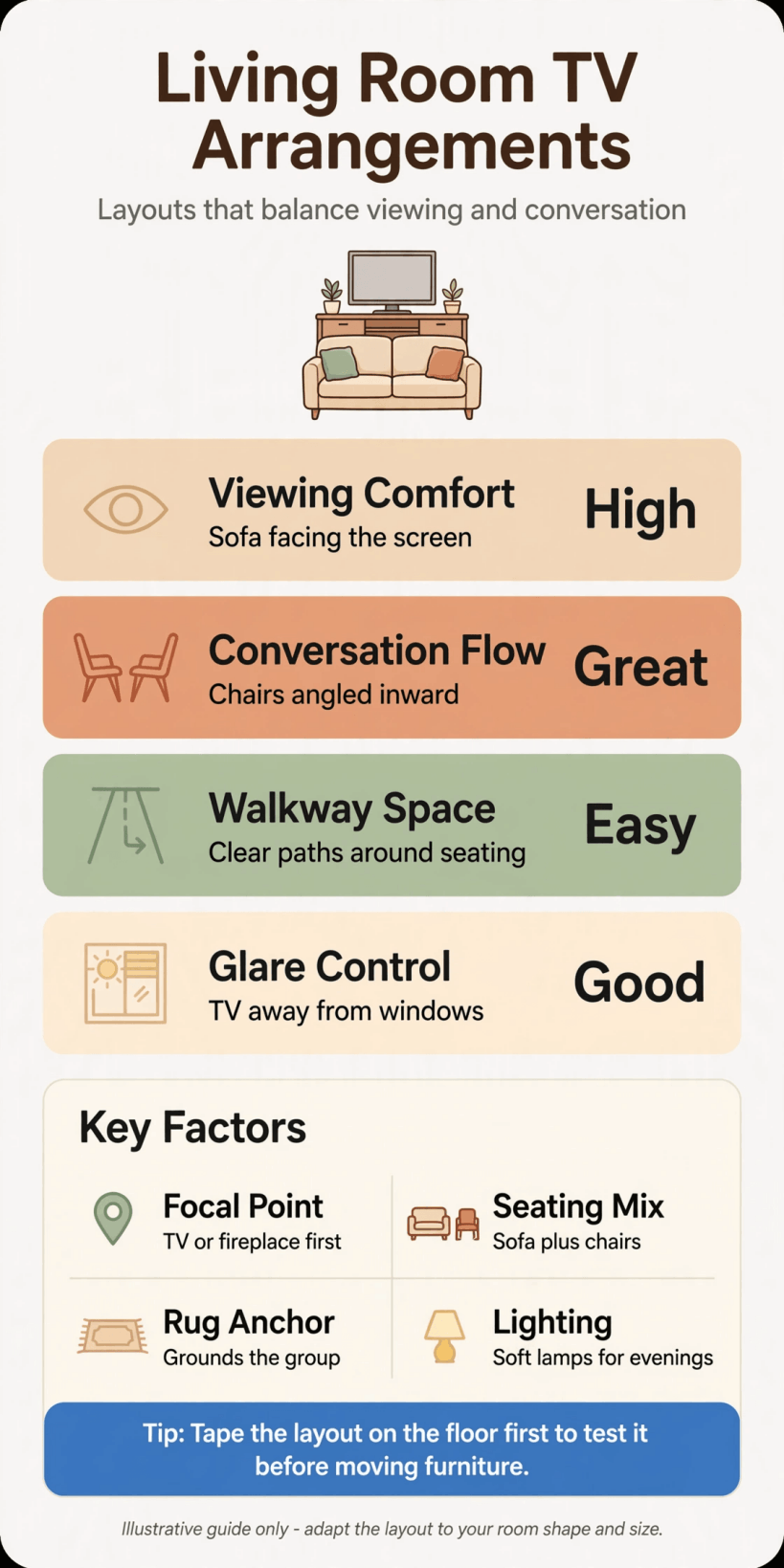
The main layout families compared: choose the arrangement that matches how your room is actually used on most evenings, not just on special ones.
Before moving a single chair, count how the room is honestly used. If most evenings end with a film or a match, viewing comfort deserves the stronger say; if the room hosts long talks, board games and visitors who rarely glance at a screen, conversation should lead and the television can take a supporting role. Fixed points decide much of the rest: the fireplace, the window wall, door swings and radiator positions are all expensive or impossible to move, so the layout has to bend around them. Screen size matters too — a large panel dominates a small room from any angle, while a modest set can sit quietly on a side wall without pulling the whole plan toward it. With those priorities set, the layouts below become a shortlist rather than a gamble.
2. The Classic Facing Layout: Sofa Opposite the Screen
The arrangement most people picture first: the sofa square to the television, a coffee table between, and a rug anchoring the group. Its strength is honest viewing — everyone on the sofa gets a straight, comfortable sightline, and a low media console keeps the screen at a natural height. Its weakness appears when guests arrive: a row of people shoulder to shoulder is a poor shape for talking, and the room can read as a waiting room for the screen.
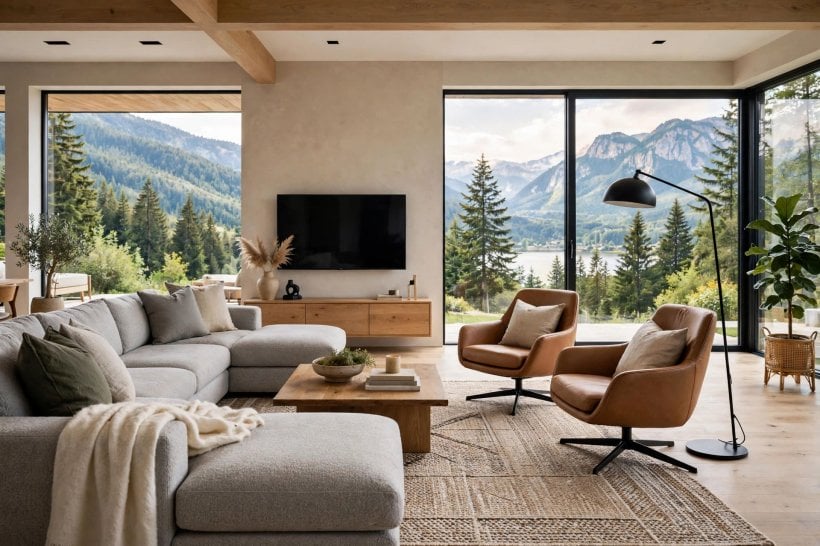
Small adjustments fix most of that. Angle the end armchairs inward instead of lining them up parallel, so their occupants can split attention between screen and sofa. Add a pair of ottomans or a bench opposite the sofa to close the U for gatherings, and keep the coffee table light enough to shift when the room changes mode. A rug that extends under all the front feet ties the group together visually. Households with a separate media space often go further — our guide to a home theater in a tiny house shows how dedicated viewing rooms handle seating rows and screen placement when watching is the whole point.
3. The Conversation-First Layout: Seats Facing, Screen to the Side
Turn the plan inside out and the television becomes a guest in a talking room. Two sofas face each other across a coffee table, or a sofa faces a pair of armchairs, and the screen sits on a side wall, a low console or an easel-style stand where it can be watched from one end seat. Conversation quality is superb — eye contact is natural, the table serves drinks and games, and nobody’s neck is committed to one direction all evening.
Viewing, honestly, is a compromise, so design the compromise well. Give the room one or two hero seats — the end of the sofa nearest the screen, or a swivel chair that turns — with genuinely good sightlines for the household’s main viewer, and accept that guests perch for casual viewing of sport or news rather than a three-hour epic. A screen on an articulated arm, angled toward the hero seat when in use and flat when not, softens the trade further. This is the layout that suits smaller, sociable rooms especially well, and the seating plans in our tiny house living room ideas show how face-to-face arrangements keep compact rooms feeling social rather than squeezed.
4. The L-Shaped Sectional Layout
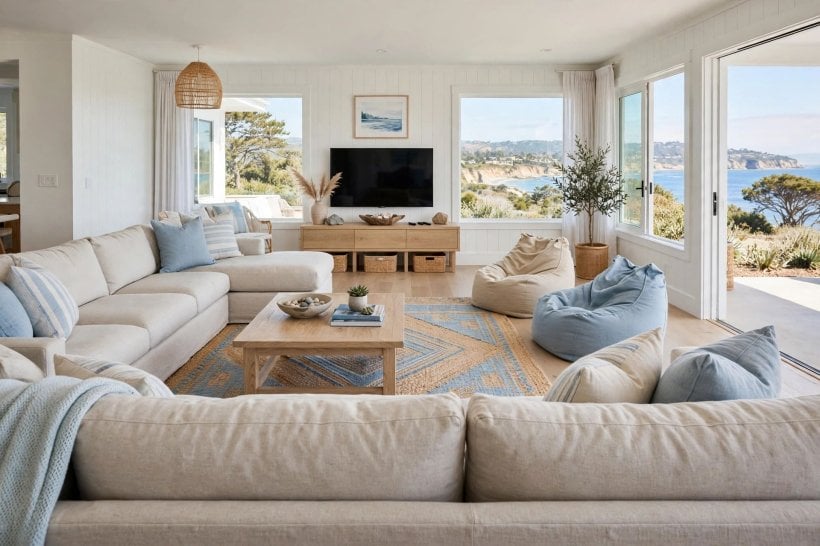
A sectional earns its popularity in TV rooms because its two runs answer both briefs at once. The long run faces the screen for stretched-out viewing; the return run turns its sitters partly toward the long run, so talk flows along the L instead of across a void. Place the screen on the wall the long run faces, keep the media console low and wide, and the corner seat — where the two runs meet — becomes the household’s most contested spot.
Details decide whether a sectional feels generous or bulky. In a room with the floor space, float it off the walls a little — even a hand’s width of shadow gap makes the piece look lighter and lets curtains hang properly. Choose the chaise side by where people actually recline, not by symmetry, and define individual seats with cushions and a throw so the L reads as places, not acreage. In tighter rooms a compact sectional or a sofa-plus-chaise combination gives the same geometry at a smaller scale. For wider inspiration on seating shapes and how they anchor a scheme, browse our living room interior design ideas for a tiny house.
5. Corner and Angled Arrangements for Awkward Rooms
Some rooms refuse the tidy rectangle: the fireplace sits mid-wall, windows take the only screen-sized stretch, or doors cut every corner. The diagonal layout answers by rotating the whole arrangement — television in or near a corner, seating angled to face it, rug turned to match. Angled plans look informal and welcoming, and they often free a surprisingly useful triangle behind the sofa for a lamp, plant or storage basket.
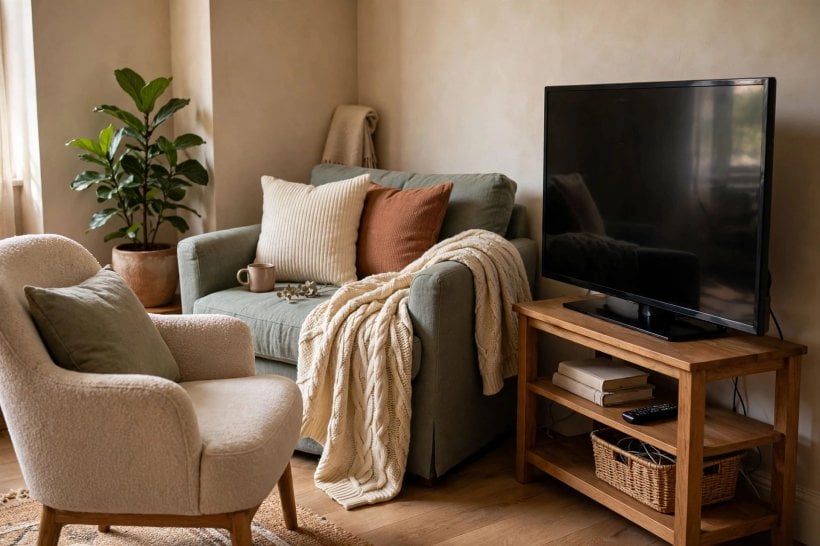
Work carefully with the geometry. Keep door swings and the walkway to the garden or hall completely clear of angled chair backs, and test the angle with the actual furniture before committing — a few degrees either way changes both the view and the traffic flow. A corner media unit or a screen on an angled stand keeps cables and boxes tidy in the wedge behind. Colour can reinforce the plan: a deeper shade on the screen’s corner walls settles the panel into the room, an approach explored in our guide to living room paint for a tiny house, where wall colour is used to zone awkward shapes into calm ones.
6. The Swivel and Flexible-Seating Layout
The most adaptable family of all keeps the main sofa conversational and lets the supporting seats move. Swivel armchairs are the stars: turned one way they face the screen, turned back they join the circle, with no dragging and no scuffed floors. Add lightweight occasional chairs that can be carried to where they are needed, plus poufs and floor cushions for overflow on busy nights, and the room reshapes itself around whatever the evening holds.
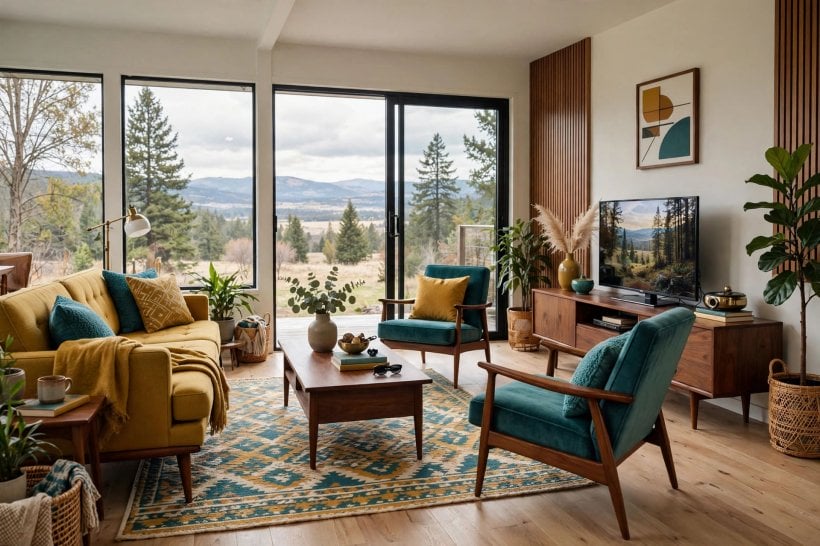
Flexibility has limits worth respecting. Pieces moved daily must be genuinely light yet feel planted when sat in — wobbly chairs get left in corners and the system quietly dies. Swivel bases need clearance to turn without clipping the coffee table, so measure the full circle, not the chair. Keep a consistent palette across the movable pieces so the room looks composed in every configuration. This shape-shifting approach suits multi-use rooms in smaller homes particularly well; our roundup of home designing ideas for a tiny house is full of furniture that works two jobs in exactly this spirit.
7. TV Above the Fireplace: Making the Compromise Work
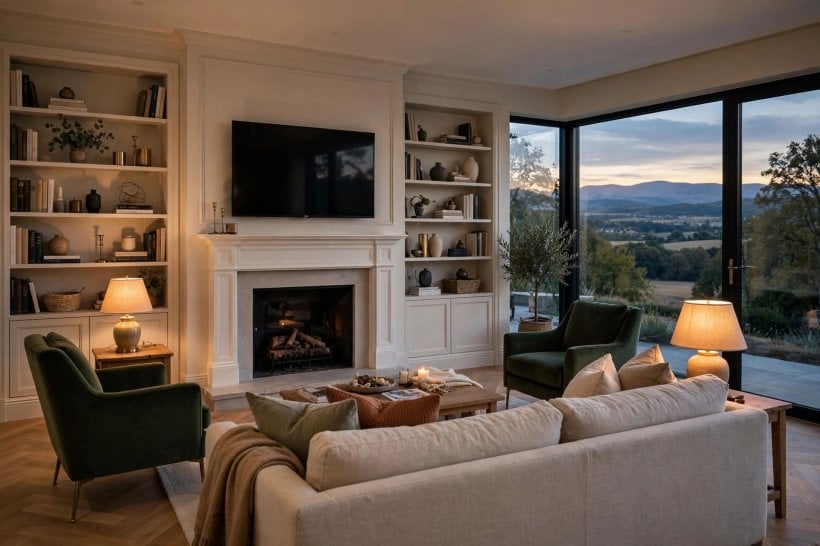
Mounting the screen over the fireplace remains the most argued-about placement in the living room. It keeps the hearth as the room’s single focal point, saves the other walls for seating and art, and suits rooms where the fireplace wall is the only sensible screen wall. The trade is height: a screen above a mantel usually sits higher than relaxed viewing prefers, and heat is a genuine consideration that deserves respect rather than dismissal.
Three mitigations help. First, check the television manufacturer’s own guidance on mounting above heat sources and on clearances — requirements vary, and the manual outranks any rule of thumb. Second, use a mount that tilts the screen down toward the seats, and pull the seating a little closer than usual so the viewing angle softens; reclined seats with raised footrests are the most forgiving combination of all. Third, style the mantel quietly — low, calm objects that do not compete with the picture. If the compromise still nags, the neighbour layout — screen beside the fireplace on an articulated arm — keeps the same focal wall with a kinder height.
8. Small Rooms and Open-Plan Zones
Compact rooms and open-plan spaces share a problem: the television zone must exist without annexing everything around it. Wall-mounting the screen frees the floor that a stand would take, and in the smallest rooms a corner placement can give a longer, more comfortable viewing throw than the short wall everyone assumes. Keep the seating plan shallow — armless chairs, a two-seater sofa, a narrow console — and let pieces with legs show floor beneath, which keeps the zone feeling light.
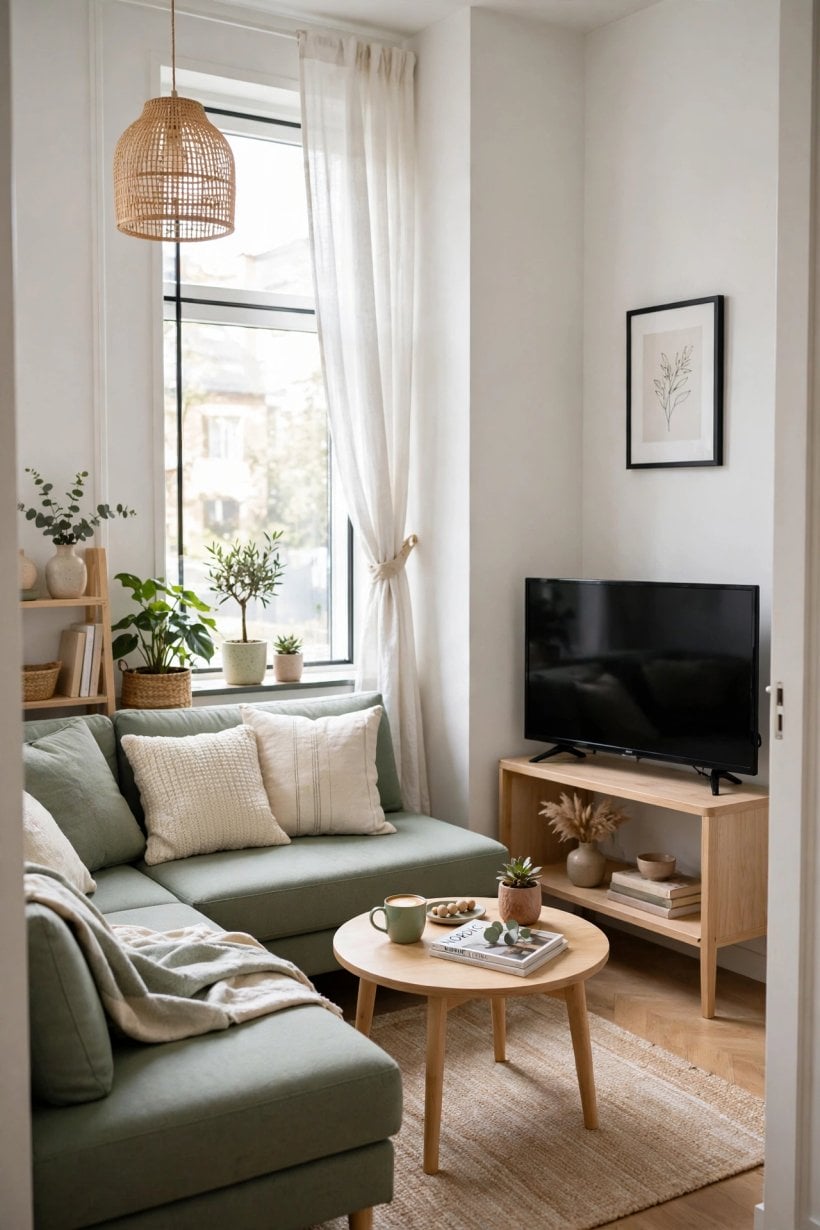
In open-plan rooms, the back of the sofa is your room divider: run it across the space with a slim console table against it, and the TV zone reads as a room within the room while the dining or kitchen side keeps its own identity. A rug under the seating group only — not wall to wall — sharpens the border. Small-space discipline matters throughout: every piece should earn its footprint. Our guides to apartment interior design for tiny houses and to tiny house small-space interior design both dig into zoning tricks and slim furniture choices that translate directly to a compact TV corner.
9. Distances, Heights and Glare: The Comfort Details
Any of the layouts above can be spoiled by three quiet discomforts: sitting at the wrong distance, craning at the wrong height, or fighting reflections. Manufacturers publish recommended viewing distances for their screen sizes — check the guidance for your set, then apply the comfort test: the picture should fill your view pleasantly without making you turn your head to follow action at the edges. If you are choosing seats before a screen, tape its outline on the wall and live with the tape for a few evenings first.
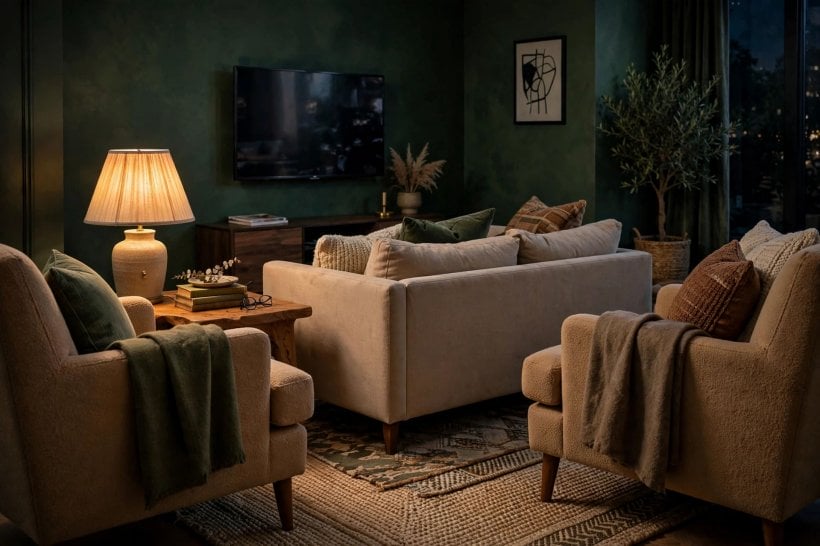
Height follows the same comfort logic: for seated viewing, the centre of the screen landing near seated eye level is the usual aim, which is why low consoles suit most layouts and why the over-fireplace placement needs its tilt. Glare is the third fixable flaw. A screen facing a bright window mirrors it back at you; angle the panel, hang curtains or a blind you will actually close, and favour matte screen finishes where the choice exists. A soft light behind the screen in the evening also eases the contrast between a bright picture and a dark room, and makes long films kinder on the eyes.
10. Cables, Sound and Finishing Touches
The best layout still disappoints if a cable snakes across the rug and the dialogue disappears into a cushion. Plan cable routes as part of the arrangement: along skirting, inside discreet trunking, or through the wall where a qualified installer handles it — never loose across a walkway. Keep consoles and boxes ventilated and reachable, because equipment that is hard to reach stops being maintained, and park remotes in one basket on the coffee table so the system has a home.
Sound deserves the same placement care as the picture. A soundbar centred under the screen is the simple, effective default; separate speakers belong either side of the panel, roughly at the listeners’ ear height, and clear of soft furnishings that swallow dialogue. Finally, soften the black rectangle itself: many modern sets offer ambient or art display modes for when they are off, a plant to one side breaks the hard edge, and art grouped around the screen can absorb it into a gallery wall. The screen is one object in a room full of life — the finishing touches are what make that true.
Final Considerations
The right arrangement is the one that matches the evenings you actually have: count the viewing hours against the talking hours, let the room’s fixed points rule out what cannot work, and choose the layout family that serves the majority case — then tune it with the comfort details of distance, height and glare. Before committing to heavy moves, test the plan with the furniture on sliders or the layout marked in painter’s tape, and live with it through one film and one gathering. And when the screen or the sofa eventually changes, revisit the plan rather than inheriting it: a layout is a working answer, not a permanent one, and the room will tell you when it is time to ask the question again.



0 Comments