

Quartz has quietly become the bathroom countertop to beat: engineered from stone aggregate and resin, it offers the polish of natural stone with a consistency and forgiveness that busy family bathrooms genuinely need. Every slab behaves like the sample, and no two mornings test it the same way twice.
These 75 quartz bathroom countertop ideas stay strictly on quartz — its colours, finishes, edges and pairings — and on the vanities, basins and small bathrooms it serves, closing with the honest care notes and fitting checks that decide how the surface ages.
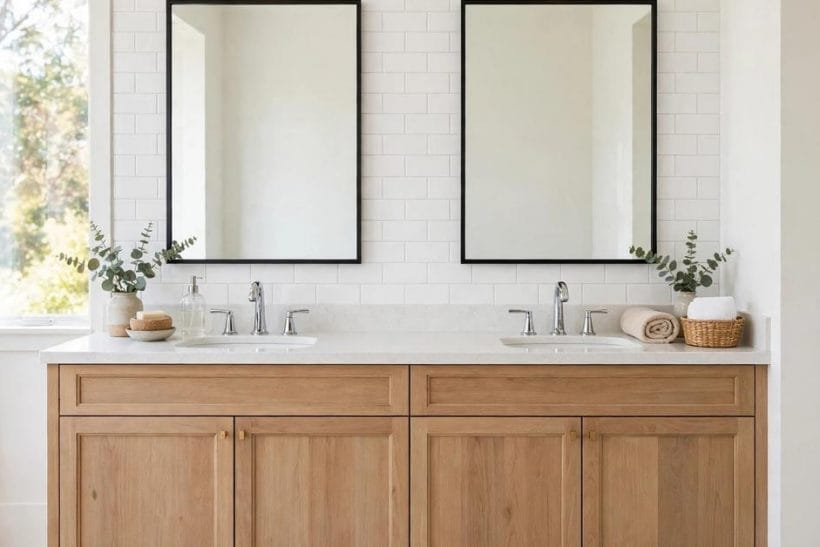
1. Quartz Bathroom Countertops at a Glance
Scope first, because the countertop shelf is crowded. The bathroom countertops survey compares every surface material side by side, and the granite bathroom countertop ideas take the natural-stone lane on its own. This post owns quartz alone in the bathroom: what it is, how it looks, and where it outperforms and underperforms its rivals.
Quartz is a manufactured surface, which is its strength: the veining is controlled, the colour is consistent from sample to slab, and the surface does not drink spills the way porous stone can. Its honest limits — heat and harsh chemicals — are covered in the care section, not hidden.
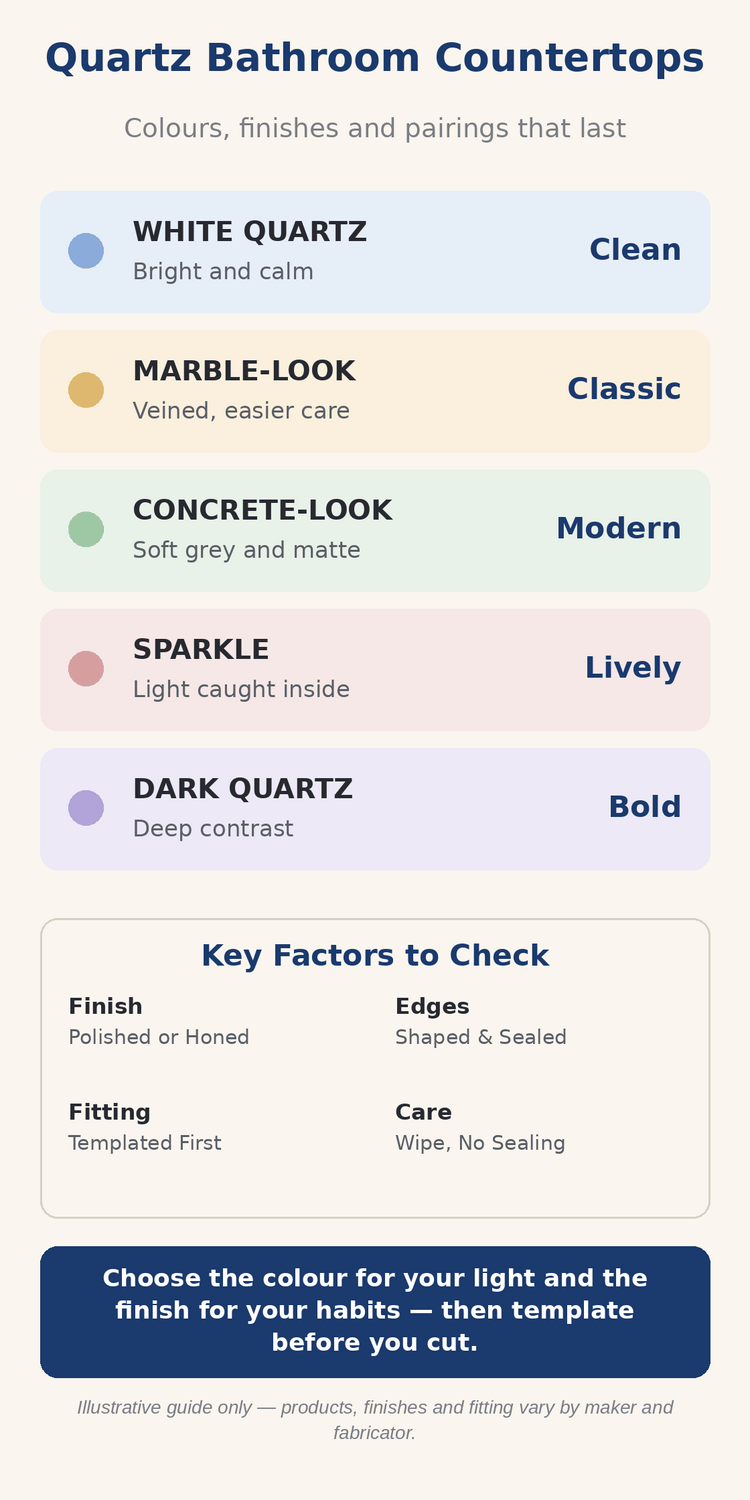
| Style | Character | What it means |
|---|---|---|
| White Quartz | Clean | Bright, calm surfaces that make small bathrooms feel washed and new |
| Marble-Look | Classic | Veining like marble with an easier daily temperament |
| Concrete-Look | Modern | Soft greys and matte finishes for contemporary rooms |
| Sparkle and Stone-Chip | Lively | Light caught inside the surface for a gentle shimmer |
| Dark Quartz | Bold | Deep contrast that anchors pale walls and cabinetry |
2. White and Bright Quartz Tops
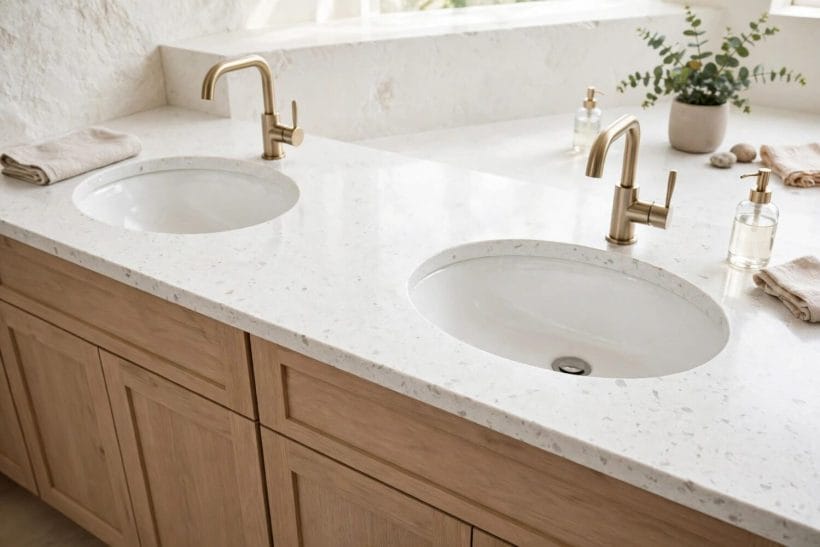
White quartz is the bathroom’s clean sheet of paper: it brightens windowless rooms, shows you honestly where cleaning is needed, and lets towels, timber and plants supply the colour. Within white there are more choices than the name suggests.
1. Pure white for the crisp hotel look
A true, un-veined white top against white sanitaryware is the hotel formula — calm, bright and easy to keep honest. It suits modern bathrooms where the interest comes from black fittings, timber and one good mirror rather than from the surface itself.
2. White with a whisper of grey veining
The softest veining loosens pure white just enough to forgive a water mark and flatter marble tiles. It is the choice for bathrooms that want the bright look with a little natural movement in it, and it bridges old and new fittings gracefully.
3. Warm white against timber vanities
A warm-toned white quartz over oak or walnut cabinetry keeps an all-white scheme from turning clinical. The surface stays bright while the timber does the warming — a partnership that suits family bathrooms and Scandinavian-leaning rooms.
4. Bright tops in windowless bathrooms
Rooms without daylight live on reflected light, and a pale quartz top bounces more of it around than any dark surface can. Pair it with a large mirror and pale tiles and a windowless ensuite stops feeling like a cupboard.
5. White on white: texture does the talking
When top, basin and tiles are all white, interest moves to texture — a honed finish here, a ribbed tile there, brushed rather than polished metal. The monochrome only reads as bland when every surface is finished identically.
6. A bright top to lift patterned floor tiles
Busy floors need quiet company. A plain bright quartz countertop calms a patterned or encaustic-look floor and gives the eye one resting place, which is exactly what a small patterned bathroom needs to stay charming rather than dizzy.
7. White quartz with black fittings
The graphic pairing of the last decade still earns its place: black taps, handles and mirror frames drawn against bright quartz like ink on paper. It photographs sharply and, more importantly, looks deliberate every ordinary morning.
8. Double-basin runs in seamless white
Long vanities with two basins benefit most from quartz’s consistency — the colour and finish hold unbroken across the full run, where natural stone would shift character halfway along. One surface, two stations, no quarrel between them.
9. White tops for rental and resale calm
Bright quartz reads as clean and current to almost every eye, which makes it the safe surface for a bathroom meant to please future occupants as well as present ones. It also shows its condition honestly, a virtue when buying as much as selling.
3. Marble-Look Veined Quartz
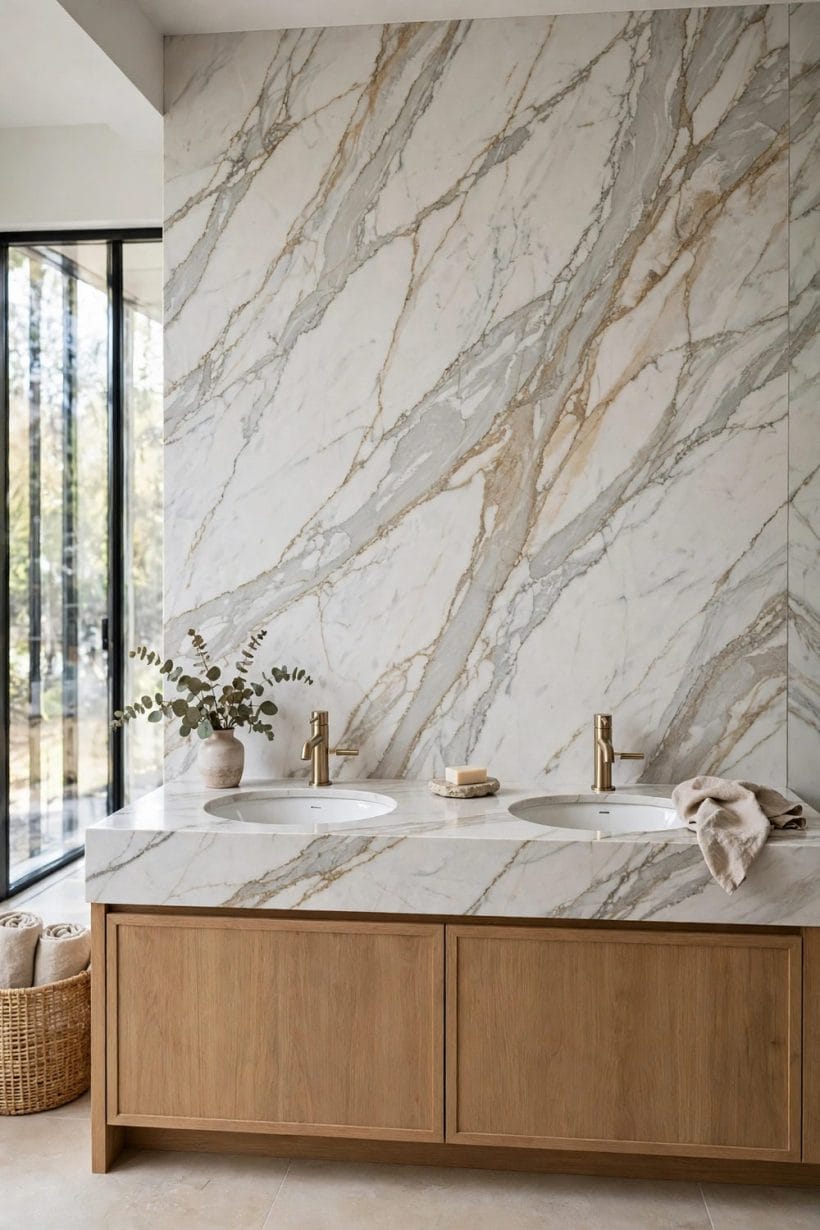
Marble-look quartz gives the bathroom the most borrowed elegance in the house — soft grey or gold veining across a white ground — without marble’s appetite for etching and sealing. The art is choosing the vein, not the stone.
10. Soft grey veins for a classic ensuite
Fine grey veining on white is the direct marble quotation, and in a bathroom it behaves beautifully: calm, traditional, and flattering to chrome. Keep the vein scale gentle in a small room so the pattern soothes rather than shouts.
11. Bold drama veins for a statement vanity
Wide, confident veining turns the countertop into the room’s artwork, best on a single vanity against plain walls. Give it space and simple company; a dramatic top under a clutter of bottles and patterns wastes its effect.
12. Gold-warmed veins with brass fittings
Veins warmed with gold and taupe meet brass and bronze fittings halfway, producing the layered, expensive look of boutique hotels. It is the natural partner for warm lighting and timber anywhere in the room.
13. Book-matched splashbacks in veined quartz
Running the same veined quartz up the wall as a splashback — ideally with the vein continuing — creates one unbroken stone gesture behind the basins. It is easier to clean than tile grout lines and twice as grand.
14. Veined tops with plain cabinetry
Movement on the top calls for stillness below: flat, plainly coloured cabinet doors let the veining perform. Shaker fronts in a soft colour are the classic compromise — detail in the joinery, calm in the colour, drama only in the stone.
15. Cool veins for north-facing rooms
Grey-blue veining leans into cool light and makes a north-facing bathroom feel intentional rather than chilly. Pair with white and pale grey elsewhere and the room reads serene — the spa direction, at home.
16. Veining that echoes the floor
When the floor carries marble or marble-look tile, a quartz top whose veins rhyme with it — same direction of movement, similar spacing — ties the room together quietly. Mismatched veins in one small room fight; matched ones converse.
17. Subtle veins for guest bathrooms
Guest bathrooms want polish without personality overload. A faintly veined quartz top looks considered and expensive, offends no taste, and hides the evidence of a household’s different products better than pure white does.
18. Honed marble-look for a softer shine
A honed, low-sheen finish takes the showroom glare off veined quartz and makes it feel closer to real, aged marble. It also hides water spots and fingerprints better through a busy week — a practical kindness disguised as taste.
4. Grey, Concrete-Look and Matte Finishes
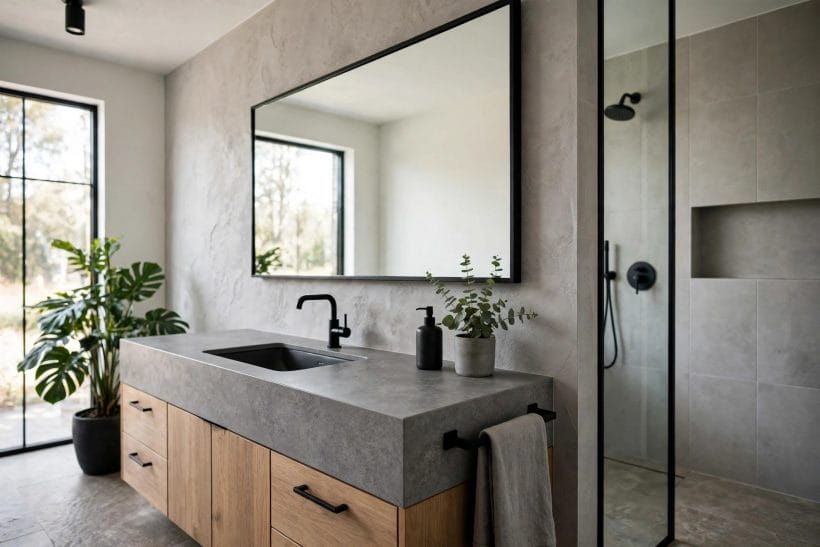
Between white and black sits the modern bathroom’s favourite territory: greys, concrete effects and matte surfaces that read architectural rather than decorative, and forgive the daily evidence of use better than gloss ever did.
19. Concrete-look quartz for industrial calm
Concrete-effect quartz carries the soft, cloudy grey of poured concrete with none of its staining or sealing anxieties. It suits loft-style bathrooms, black fittings and raw timber, and it hides toothpaste heroically.
20. Mid grey tops with white cabinetry
A mid-grey counter over white cabinets is the contemporary default for good reason: the contrast is gentle, the top hides the day’s splashes, and the pairing survives every towel colour you will ever own.
21. Pale grey for small, soft bathrooms
Pale grey quartz is white’s moodier sibling — still bright, less stark, and kind to skin tones in the mirror. In small bathrooms it adds just enough depth to stop the all-white box feeling without darkening the room.
22. Matte finishes that mute the shine
Matte and suede finishes absorb light instead of bouncing it, giving the counter a stone-like, settled presence. They show fewer water marks than polished quartz and suit the calm, spa direction modern bathrooms keep taking.
23. Grey on grey: the tonal scheme
Layering greys — pale walls, mid-grey top, darker floor — produces a room of real sophistication with zero colour risk. Interest comes from the steps between tones and the textures that separate them.
24. Textured leathered finishes
A leathered finish has a soft, pebbled touch that reads as natural stone and grips less visual noise than gloss. It is forgiving of fingerprints and pairs beautifully with brushed metals and unlacquered brass.
25. Greige quartz between warm and cool
Greige quartz — grey warmed with beige — is the mediator surface, agreeing with warm timber and cool chrome alike. Choose it when the bathroom’s fittings are mixed or likely to change over the years.
26. Grey tops with coloured cabinets
A neutral grey worktop is the licence for colour below: deep green, navy or plum cabinetry under a quiet grey quartz top looks designed rather than daring, and the top will outlast several repaints of the doors.
27. Large-format calm: fewer joins, cleaner lines
Grey quartz in long, unbroken runs with an integrated or matching splashback gives the architectural, gallery calm this family does best. Fewer joins also means fewer grout and sealant lines to keep clean — the aesthetic and the practical agree.
5. Dark and Dramatic Quartz
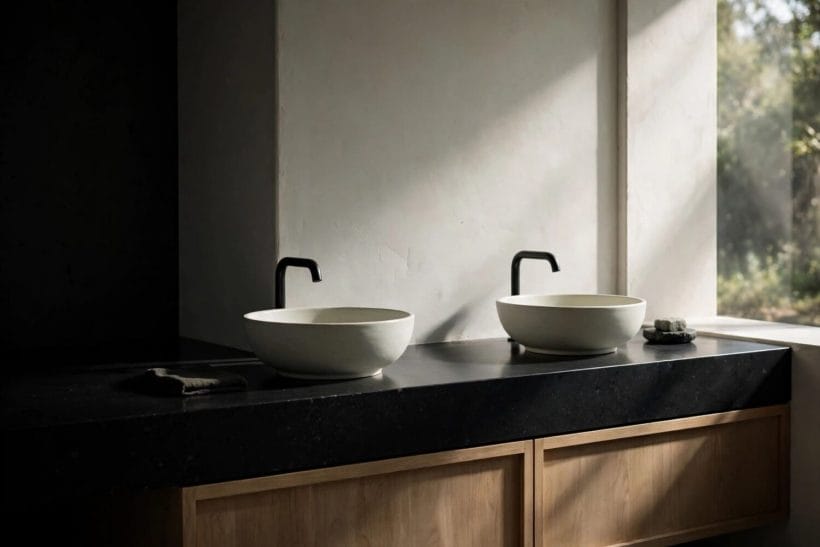
Dark quartz — charcoal, ink, near-black — turns the countertop into the room’s anchor. It asks for good light and pale company, and repays both with a depth and formality pale surfaces cannot reach.
28. Near-black tops with pale walls
A near-black counter against white or pale walls is the strongest single gesture a bathroom can make. Everything on it — white basins, green plants, brass taps — stands forward like objects on a stage.
29. Charcoal quartz with timber warmth
Charcoal over warm timber cabinetry balances drama with comfort: the top brings the mood, the wood brings the welcome. It is a reliable formula for ensuites that want hotel character without hotel coldness.
30. Dark tops, light basins: the contrast play
White or pale ceramic basins sitting on dark quartz read crisp and deliberate, and the contrast makes both elements look more expensive. Keep the basin shapes simple so the pairing stays graphic, not fussy.
31. Sparkle flecks that wake a dark surface
Fine mirror or mineral flecks inside dark quartz catch the light like stars when you move — the surface shifts from flat to alive. It is the friendliest version of dark stone for rooms that cannot afford to feel heavy.
32. Dark quartz in a powder room
The downstairs cloakroom is the place to be brave: small, briefly used, and made for theatre. A dark quartz top with a statement basin and moody lighting turns the tiniest room into the one guests mention.
33. Matte black finishes for modern schemes
A matte black quartz top is the quietest drama of all — no shine, no veining, just depth. It demands tidy habits, since pale dust and limescale show on it, and rewards them with unmatched calm.
34. Dark tops need deliberate lighting
Dark surfaces drink light, so plan the lighting with the top, not after it: mirror lights at face height and a warm overall glow stop a dark-countered bathroom from feeling like a cave. Get the light right and the drama stays luxurious.
35. Pairing dark quartz with patterned tiles
A plain dark top is the perfect foil for patterned wall tiles — it grounds the pattern and gives it a stage. Choose one pattern only; the top’s restraint is what lets it sing.
36. Bookend the room: dark top, dark floor
Matching a dark quartz counter with a dark floor and pale everything between produces a cocooned, deliberate room — the bathroom as evening space. It suits ensuites and hotels of the home, less so family bathrooms at dawn.
6. Vanity Pairings: Cabinets, Basins and Fittings
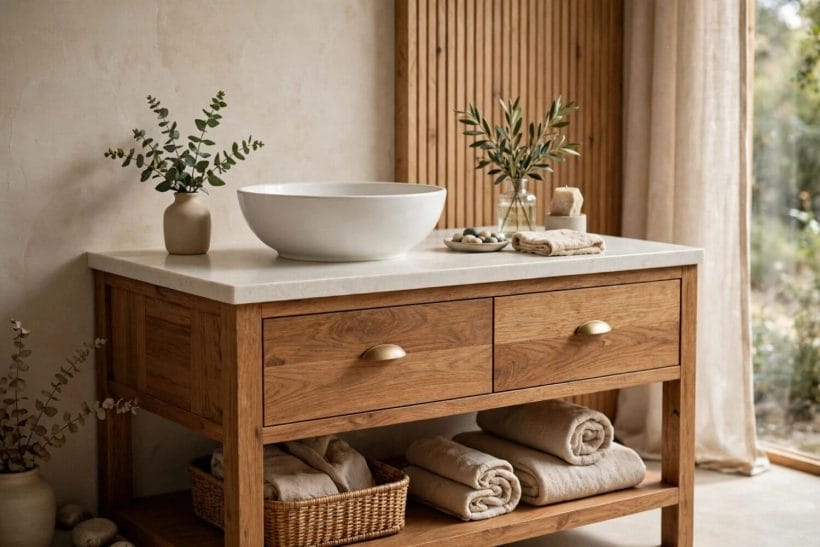
No countertop is chosen alone: it lands on a vanity, carries a basin and answers to the taps. This section works the partnerships, because most bathroom disappointments are really pairing disappointments.
37. Slab-front cabinets under a quiet top
Flat slab doors in a soft colour are quartz’s natural base — the surfaces share a calm, modern language. The bathroom vanity buying guide covers the vanity side of this partnership in full; here, simply keep door and top in the same temperature family.
38. Blue cabinets under pale quartz
The navy and mid-blue vanity under a white or pale veined top is the combination of the decade, and it endures because the contrast is both classic and fresh. Our bathroom with blue cabinets collection shows the pairing at full stretch; quartz keeps its side of the bargain by staying light and calm.
39. Undermount basins for one clean sweep
An undermount basin leaves the quartz as one unbroken plane — the easiest surface in the house to wipe, and the most elegant. It is the default recommendation wherever the budget reaches, in every quartz colour.
40. Vessel basins as sculpture on stone
A vessel basin turns the countertop into a plinth and the basin into the exhibit. Keep the quartz quiet — plain white, soft grey — so the vessel’s shape and material take the applause.
41. Integrated quartz basins for zero seams
Some quartz tops are fabricated with the basin formed in the same material: no rim, no sealant ring, no ledge for grime. It is the sleekest and often the most hygienic answer for family bathrooms.
42. Wall-hung vanities and floating tops
A floating vanity with a quartz top lifts the whole composition off the floor, making small bathrooms feel larger and cleaning simpler. The top’s edge profile becomes a design feature at eye level — choose it deliberately.
43. Timber vanities under stone-look tops
Warm timber under cool quartz is the spa equation. Keep the timber sealed and the quartz pale, and let towels in natural fibres finish a composition that has carried retreat bathrooms for years.
44. Chrome, brass or black: let the top arbitrate
Fittings should answer to the countertop’s temperature: cool white and grey quartz with chrome or black, warm-veined and greige quartz with brass and bronze. Mixed metals work when the top clearly belongs to one camp.
45. Twin basins: symmetry and its exceptions
Pairs of identical basins on one quartz run give the composed, hotel calm most ensuites want. The exception worth considering: one long trough basin, which reads more sculptural and gives elbows more room.
7. Edges, Splashbacks and Details
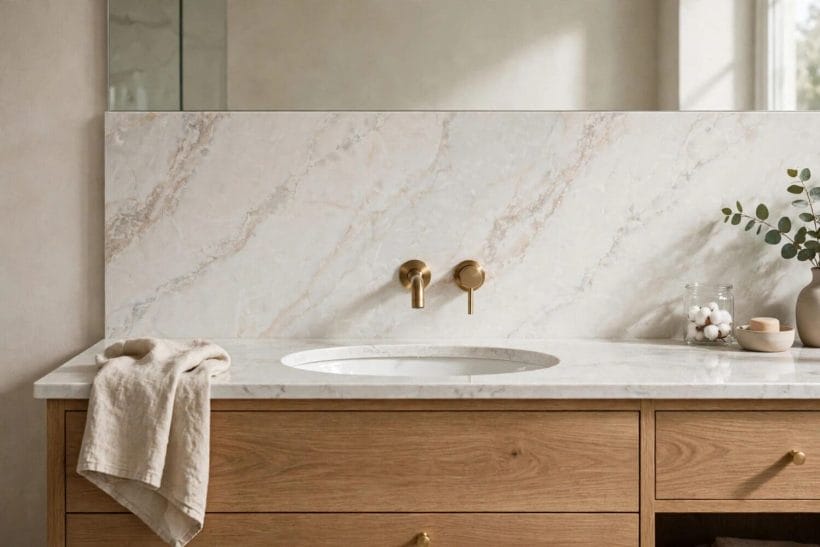
The details at the counter’s edge — its profile, its splashback, its junctions — are where a quartz installation proves its quality. Stone is bought by the slab; bathrooms are judged by the finishing.
46. The simple square edge for modern rooms
A crisp square or lightly eased edge is the contemporary standard: honest, easy to clean, and at home with every quartz style in this post. It lets colour and veining speak without a carved frame around them.
47. Pencil and bevel edges to soften
A small bevel or pencil round takes the sharpness off a square edge — kinder to hips in tight bathrooms and to children at counter height, while keeping the modern line almost intact.
48. Deep aprons for a chunky, furniture feel
Building the front edge down into a deep apron makes the top read as a substantial piece of furniture rather than a slab. It suits traditional vanities and marble-look quartz especially well.
49. Full-height quartz splashbacks
Carrying quartz from counter to mirror or ceiling removes grout from the wettest wall in the room. The surface wipes in one pass, and a veined slab turns the whole basin wall into a single composition.
50. Short upstands for a tailored finish
A short upstand in matching quartz gives a crisp, sealed line where top meets wall without committing to a full splashback. It is the tidy, mid-budget classic and suits tiled walls that deserve to stay visible.
51. Waterfall ends on island-style vanities
Where a vanity stands free like an island, a waterfall end — quartz continuing down the side to the floor — makes it a piece of architecture. Reserve it for rooms with the floor space to admire it.
52. Cut-outs and drilling done by the fabricator
Tap holes, basin cut-outs and waste positions belong to the fabricator’s templates, never to site improvisation. Quartz’s one unforgiving trait is that it cannot be re-cut casually once installed — measure twice, in writing.
53. Seams placed where eyes do not rest
Long runs may need a join; a good fabricator hides it in a vein line, under the basin’s shoulder or at the room’s least-seen corner. Ask where the seam will fall before the slab is cut, not after.
54. The reveal: shadow gaps and setbacks
A small setback of the top from the cabinet face, or a shadow gap beneath it, gives the installation its tailored, furniture-grade finish. These millimetres are invisible individually and unmistakable together.
8. Small Bathrooms and Space-Saving Fixtures
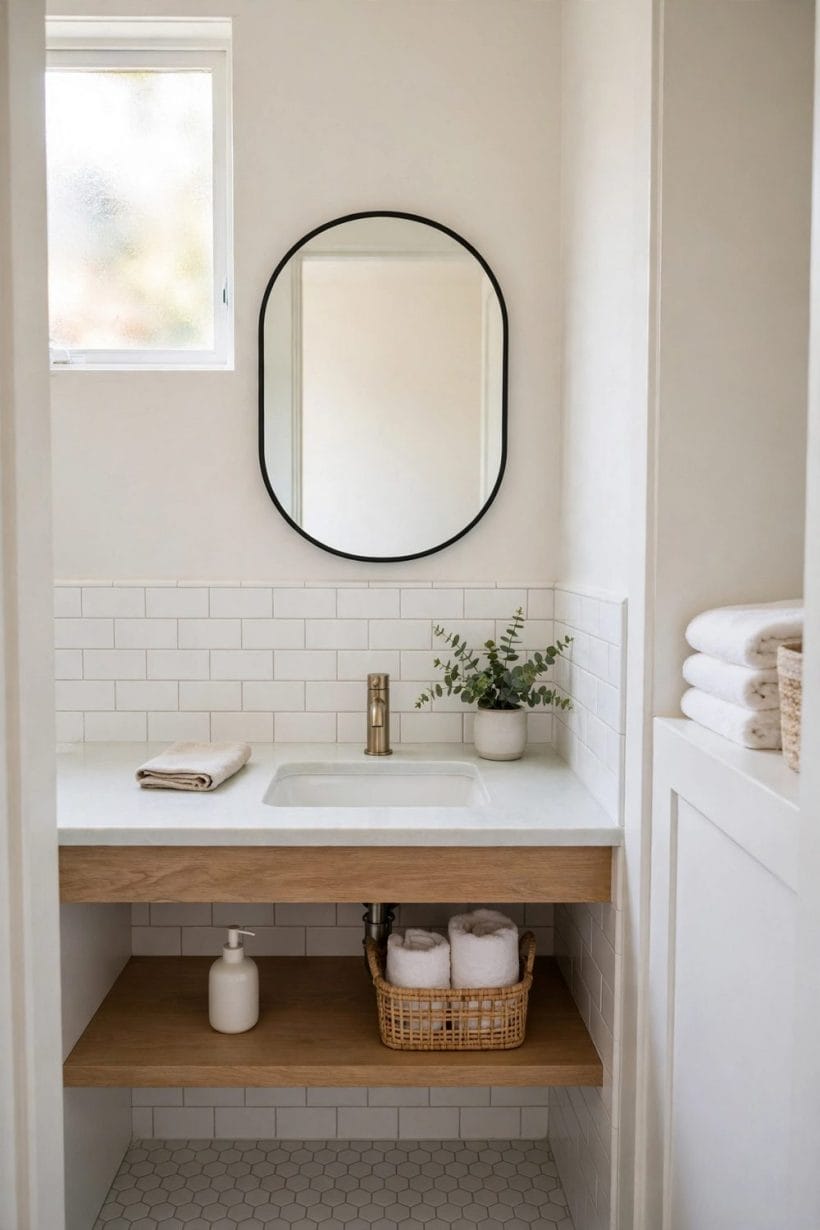
Quartz earns special keep in small bathrooms: one hard, bright, easy surface that can be cut precisely to awkward footprints, paired with fixtures chosen to give back centimetres. The bathroom ideas pillar holds the whole-room picture; here the focus stays on the counter and its companions.
55. Slim-depth tops for narrow vanities
A reduced-depth vanity with a quartz top cut to match keeps a small bathroom’s floor visibly open while still giving a full basin. Quartz cuts cleanly to these custom sizes where natural stone choice would narrow.
56. Corner basins on a shaped quartz top
A corner basin frees the middle of a tiny room, and a quartz top shaped to the same corner makes the arrangement look designed rather than improvised. It is the cloakroom and small-ensuite classic.
57. Wall-hung basins with a quartz shelf
Where no vanity fits, a wall-hung basin plus a narrow quartz shelf above or beside it gives the essentials: a place for soap, toothbrush and one nice object, on a surface that wipes clean in seconds.
58. One bright surface to stretch the room
In the smallest rooms, a pale quartz top that matches the wall colour visually extends the room’s lines. The counter stops being an object in the room and becomes part of its architecture.
59. Semi-recessed basins to save the walkway
A semi-recessed basin lets the vanity stay shallow while the basin keeps its comfort, and the quartz top follows the same stepped line. Knees and toes gain room; the basin loses nothing that matters.
60. Mirrored cabinets above a quartz ledge
Storage hidden in a mirrored cabinet above a slim quartz ledge keeps every bottle off the counter. The top stays clear, the room stays calm, and the morning routine stops being a negotiation with clutter.
61. Compact twin stations for shared ensuites
Two small basins on one shaped quartz run can serve a couple in the footprint of one generous vanity. The consistency of quartz keeps the squeezed arrangement looking composed rather than crowded.
62. Rounded corners for safe passage
In a bathroom measured in centimetres, a quartz top with rounded front corners is a daily kindness to hips and children. Fabricators round quartz cleanly; ask before cutting, not after bruising.
63. Light finishes where space is tightest
The tighter the room, the harder a pale, reflective quartz top works — bouncing light, hiding its own edges, and letting fixtures carry the design. Save the dark drama for the powder room with space to spare.
9. Care, Cleaning and Honest Limits
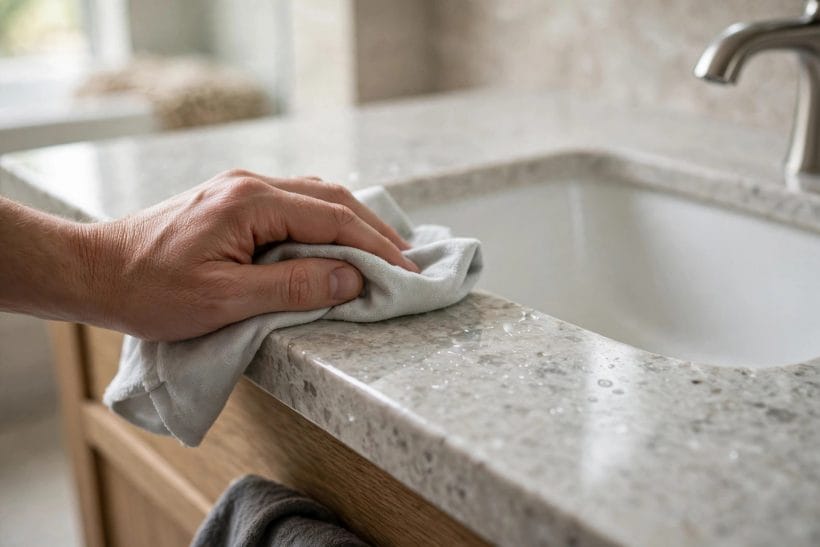
Quartz asks little, but it does ask. The quartz countertop explainer covers the material’s science in depth; this section keeps to the bathroom counter’s daily reality — what it shrugs off, what it dislikes, and the habits that keep it new.
64. Daily wiping is nearly the whole regime
Warm water, a soft cloth and a drop of mild soap handle the bathroom’s day: toothpaste, soap film and water spots all leave without argument. The surface’s real maintenance programme is thirty seconds long.
65. No sealing — the quiet advantage
Unlike porous natural stone, quartz does not ask for periodic sealing to resist stains. For a bathroom that hosts cosmetics, hair dye near-misses and children’s bath potions, that single fact decides many purchases.
66. Heat is the honest limit
Hair straighteners, curling irons and heated tools can mark resin-bound surfaces left sitting on them. Use a trivet or rest hot tools on a towel or the basin’s edge — the only real discipline quartz asks of a bathroom.
67. Keep harsh chemicals off the surface
Strong solvents, oven-grade cleaners and highly alkaline or acidic products can dull the finish. Everything a bathroom actually needs — mild soap, bathroom spray used as directed — is safe; the aggressive cupboard is not.
68. Limescale: prevention beats cure
In hard-water areas, a quick squeegee or cloth pass after splashing stops limescale from filming the shine. Dark quartz shows scale most, one more reason its care section in this post is the longest.
69. Stains: rare, and usually patient work
Because the surface is non-porous, bathroom stains sit on top rather than sinking in: a poultice of patience, mild cleaner and time lifts nearly all of them. Rushing with abrasives is the only way to make a small mark permanent.
70. Chips happen at edges — and can be repaired
A dropped heavy bottle can chip an edge. Fabricators repair chips with colour-matched resin so well the eye passes over them — one more argument for keeping the fabricator’s name and your slab’s colour code on file.
71. Sunlight and the rarely mentioned caveat
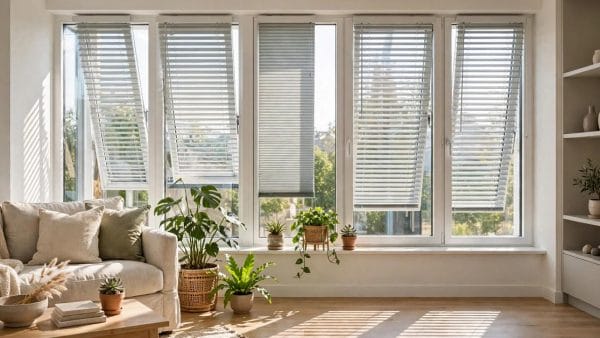
Prolonged direct sun can shift resin-bound surfaces over the years, so a quartz top in a sun-drenched bathroom is worth a thought about blinds. Indoors and shaded, as most bathrooms are, it is a non-issue.
72. The ten-year test
Judge quartz by how it looks after a decade of mornings, not a day of showroom light. Chosen in a colour you love, cleaned in seconds and spared the hot tools, it passes that test as well as any surface made.
10. Choosing and Fitting: Final Checks
The last decisions are unglamorous and decisive: templating, written quotes and keeping the paperwork. They are gathered here because they apply to every colour and finish above.
73. Template before you commit
A proper installation is templated — measured exactly, including walls that are not straight — before any slab is cut. If a quote skips templating for a standard size, expect gaps and surprises; the template is the contract between room and stone.
74. Ask what the price includes
Quotes vary in what they bundle: templating, cutting, edge profile, splashback, delivery, fitting and sealing of junctions. Compare like with like on a written list, and let the cheapest line explain itself — the pattern is the same as for any fitted surface in the house.
75. Keep the offcut and the paperwork
An offcut becomes a shelf, a windowsill or a repair donor one day, and the colour code finds its match. Store both, plus the care guidance, with the house paperwork — your future self, mid-renovation, will be grateful.
Final Considerations
Quartz succeeds in bathrooms because it is honest engineering wearing stone’s clothes: consistent, forgiving, and beautiful in more directions — bright, veined, grey and dark — than any single natural material manages. Choose the colour for your light, the finish for your habits, and the fabricator for their templating, and the counter will repay you every morning it wipes clean in seconds.

0 Comments