

Rooms rarely look unfinished because of their furniture. They look unfinished at the ceiling line, where a bare right angle collects shadow and stops the eye dead. One plain strip of trim — no swags, no dentils, no fuss — is all it takes to close that line, and it is the cheapest piece of architecture a room can buy.
These 36 simple crown molding ideas work through the whole decision: the profiles that stay simple, sizing, materials, corners, paint, and the rooms that suit each — crown as trim only, honestly covered.

1. Simple Crown Molding at a Glance
The central entity is crown molding in its plainest form: the angled trim that caps the joint between wall and ceiling, softening the corner with a shadow line. Simple crown asks for one soft step rather than a stack of classical detail, and it joins the wider trim family surveyed in our trim molding ideas — this post stays at the ceiling line only, where crown does its particular work.
| Aspect | What to know | In a word |
|---|---|---|
| The Profile | One soft step, no fussy detail | Plain |
| The Size | Scaled to the room’s height | Proportion |
| The Material | Painted timber, board or polymer | Choice |
| The Corners | Mitred, coped or blocked | Joints |
| The Finish | Painted to vanish or contrast | Colour |
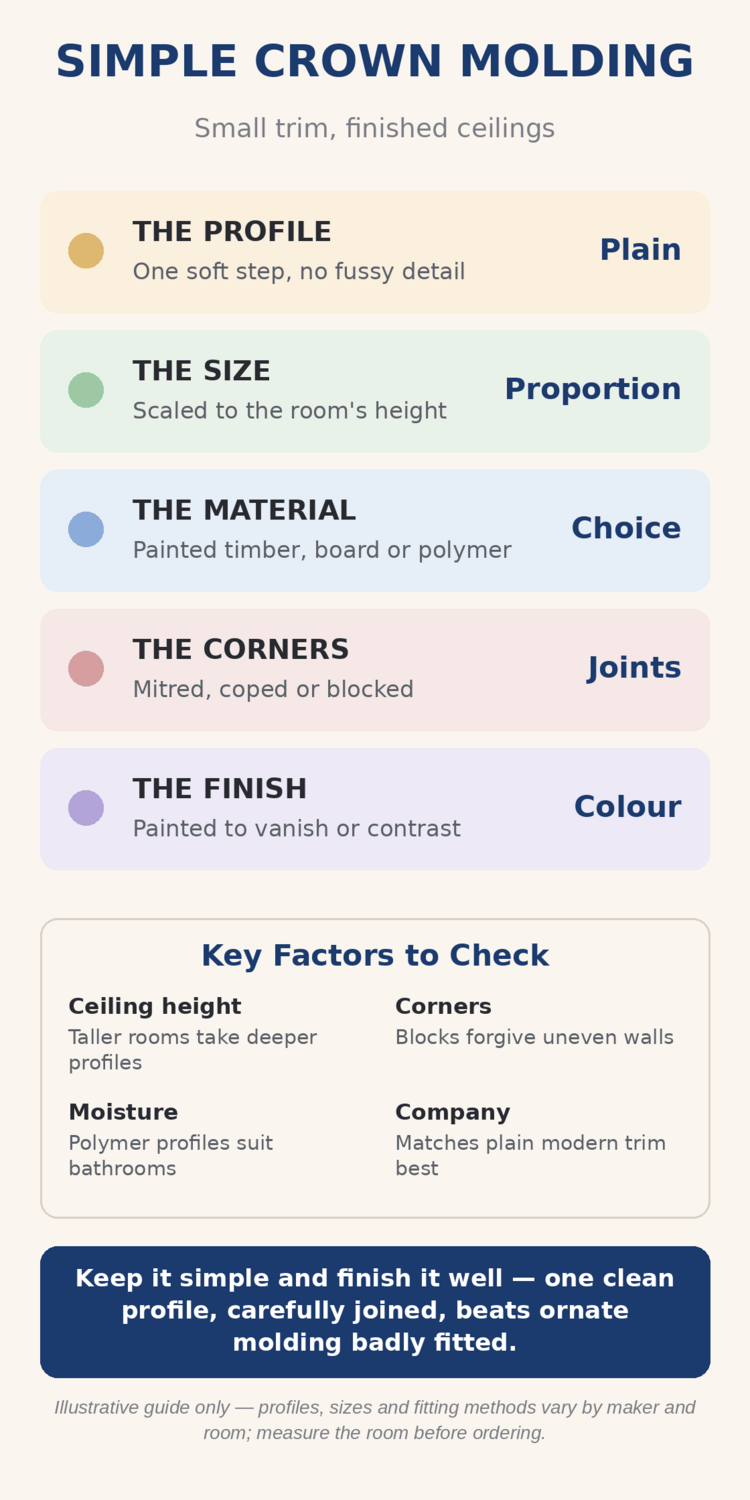
Keep it simple and finish it well — one clean profile, carefully joined, beats ornate molding badly fitted. Four checks sit behind the table: ceiling height, because taller rooms take deeper profiles; corners, where blocks forgive uneven walls; moisture, where polymer profiles suit bathrooms; and company, since simple crown matches plain modern trim best.
Most readers arrive here from crown molding images, and photographs make the profiles look interchangeable. They are not: the same room will forgive a modest profile and expose a grandiose one, and the 36 ideas below are ordered the way the decision is actually made — profile first, then size, material, corners, colour, and finally the room itself.
2. Profiles That Stay Simple
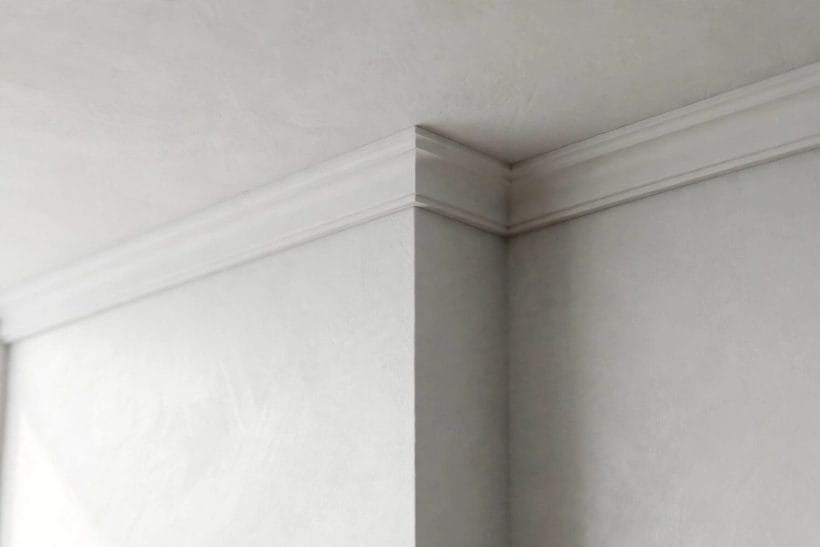
The close view in this photograph shows the whole philosophy: a single graceful curve, a clean shadow beneath it, nothing else. Simple profiles earn their place by disappearing into the architecture.
1. The Single-Step Cove
One concave sweep from wall to ceiling and nothing more — the plainest crown there is. It suits modern and older rooms alike because it reads as a shadow treatment rather than a decoration, and in small rooms it finishes the ceiling line without spending any visual height.
2. The Softened Ogee
The classic S-curve with its detail planed down to a gesture. An ogee keeps a traditional room honest — the proportions are period-correct — while the simplified face stops it competing with furniture or artwork below.
3. The Flat-Stock Modern Crown
A plain angled board, or two boards in an L, with square edges and no curve at all. Flat-stock crown is the contemporary answer: it caps the corner, casts a crisp shadow, and matches the square language of modern casing and skirting.
4. The Cove-and-Bead
A cove with one small bead run along its lower edge — the minimum ornament that still catches light. The bead draws a fine highlight line around the room, useful in plain boxes of rooms that need one deliberate detail and no more.
5. The Square-Stepped Profile
Two or three square steps climbing the corner, in the spirit of Art Deco and modern farmhouse trim. Stepped crown is simple to read from across a room — geometry rather than carving — and it pairs naturally with stepped door casing.
6. The Plain Colonial, Simplified
The familiar colonial crown with its beads and coves merged into one smooth face. It is the profile most older houses already wear in their grander rooms, so the simplified version lets a plainer room join the same house without shouting.
3. Sizing It to the Room
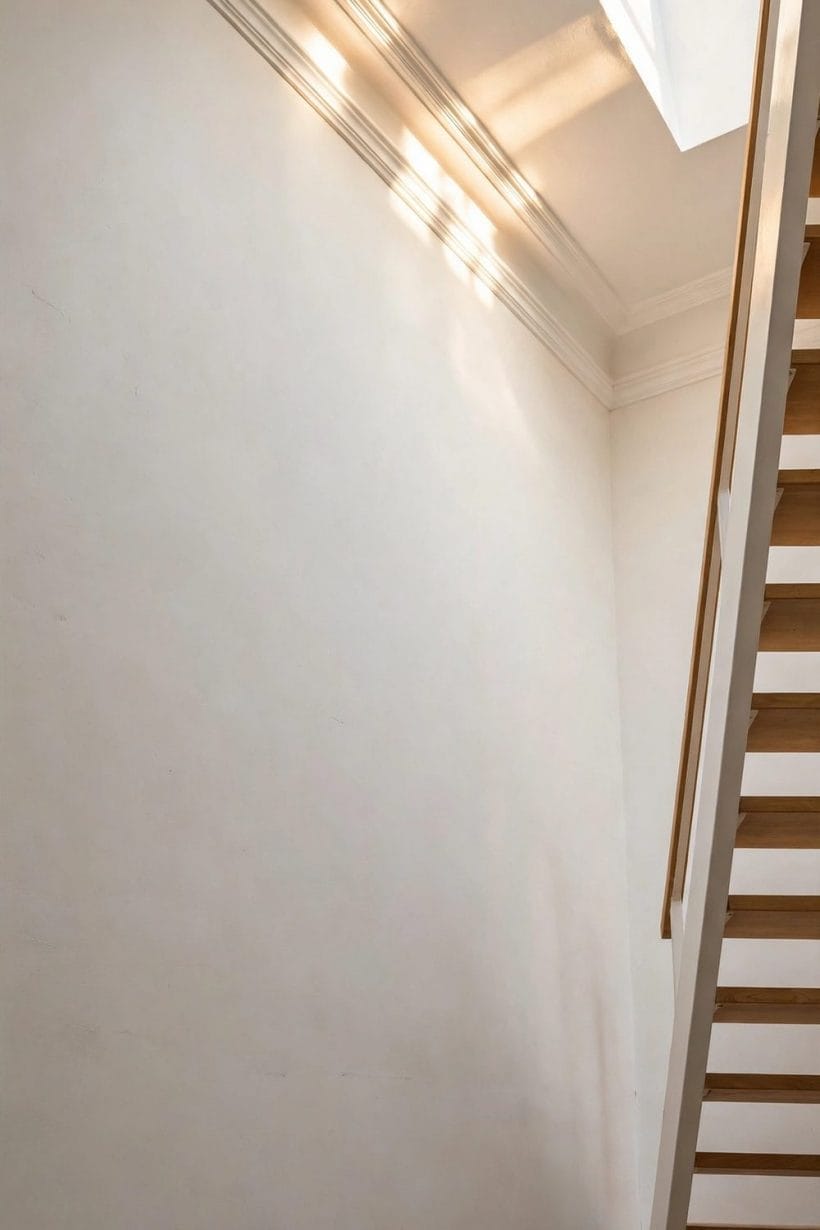
On a tall stairwell wall like this one, crown does double duty — finishing the ceiling line and giving the eye a resting place on a long climb. Size is the decision that decides whether crown looks tailored or pasted on.
7. Slim Crown for Low Ceilings
In a room with a low ceiling, a shallow profile keeps its promise: the corner softens, the shadow line appears, and no precious height is spent. Oversized crown in a low room leans over the walls and makes the ceiling feel lower still.
8. Mid-Size Crown for Standard Rooms
The middleweight profile is the workhorse of ordinary rooms — deep enough to cast a real shadow and read from the doorway, shallow enough to leave the wall its full dignity. Most simple crown sold is this size, for this reason.
9. Deep Crown for Tall Rooms
High ceilings swallow small trim whole. A deep simple profile — or a built-up stack from idea 20 — restores the proportion, giving a tall room the finished cornice its height was designed to carry. Our staircase ideas show the tall spaces that ask for it.
10. Crown Scaled to the Wall Length
Long walls take slightly deeper crown than short ones in the same house, because distance shrinks trim. Keeping one profile family and stepping its size by room keeps the house coherent while each room stays in proportion.
11. One Size Throughout the House
The conservative alternative: a single mid-size profile everywhere. It is how most well-kept houses actually read — one quiet line running room to room — and it simplifies ordering, spares and every future repair.
12. Sample Lengths Before Committing
Profiles cannot be judged in a hand or on a shelf. A short length held in the corner, lived with through a day’s changing light, settles more arguments than any catalogue — buy the samples first and the lengths after.
4. Materials That Stay Simple
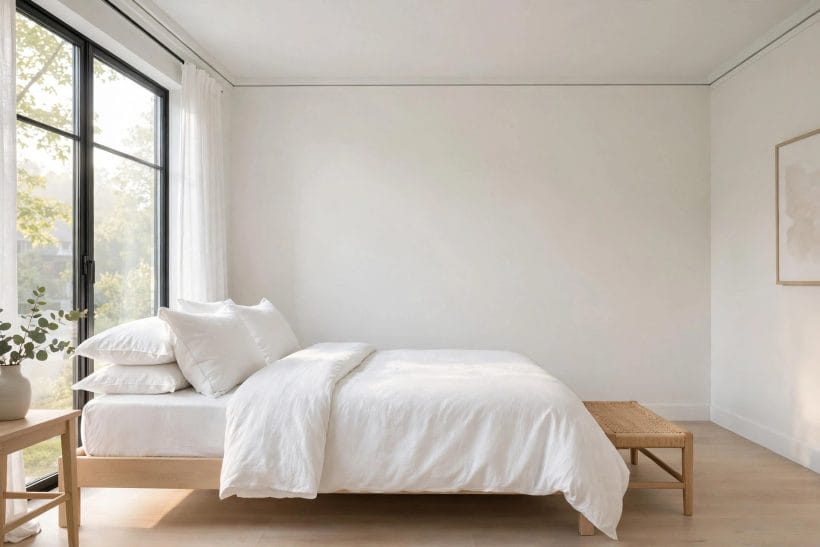
This bedroom wears slim crown painted to vanish into the ceiling — a material and finish decision working together. Material decides how crown is cut, joined and kept, and simple profiles exist in every family.
13. Painted Timber
The traditional material: real wood, primed and painted. Timber cuts cleanly, copes beautifully at corners and takes a hard knock without complaint. Its price sits mid-range and its behaviour is the known quantity every other material is compared against.
14. MDF and Engineered Board
Factory-primed, knot-free and consistent, engineered board is the economical route to a crisp painted profile. It dislikes moisture and rough handling at the cut ends, so it belongs in dry rooms — which is most rooms — and rewards careful sealing.
15. Polymer and Foam Profiles
Feather-light synthetic crown that one person can hold overhead alone, and the natural choice for bathrooms and kitchens where steam rules timber and board out. It cuts with simple tools and asks for flexible filler at its joints.
16. Plaster Crown for Period Rooms
In a house whose original cornice is plaster, a simple plaster profile keeps faith with the building. It is the specialist end of the family — heavier, dearer, fitted by fewer hands — and the right answer where the architecture is genuinely old.
17. Finger-Jointed Pine
Short clear lengths joined into long economical boards, made to be painted. Finger-jointed stock avoids knots and twists, and under paint it is indistinguishable from clear timber — the quiet budget hero of many whole-house crown projects.
18. Pre-Finished Profiles
Crown that arrives already coated, needing only its joints touched in. Pre-finishing moves the painting to the factory, which suits a one-room project where decorating everything twice is out of proportion to the trim being added.
5. Corners and Joins
Corners are where crown is judged, and this dining room’s built-up corners carry the room. A simple profile helps — there is less pattern to match — but the joint method is the real decision.
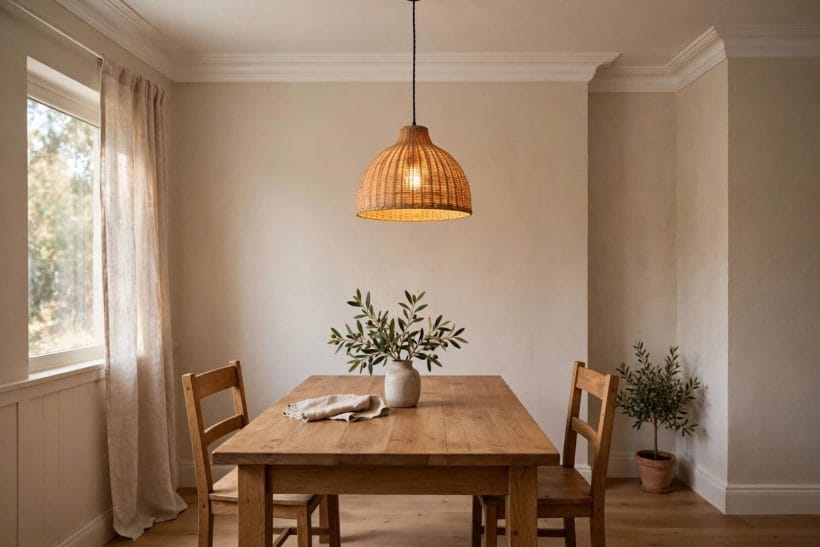
19. The Coped Inside Corner
One piece cut square, its neighbour cut to hug its profile — the traditional inside corner that stays tight when walls move with the seasons. Coping simple profiles is quick work, one more argument for keeping the profile plain.
20. The Mitred Outside Corner
Outside corners meet at a mitre, two angled faces closing on a point. On chimney breasts and boxed columns the mitre is unavoidable, and a simple square-stepped profile mitres more forgivingly than a deep curve.
21. Corner Blocks
A square decorative block planted in the corner, with crown butting into its faces — the forgiving pattern in the infographic’s advice. Blocks forgive uneven walls, end the need for perfect mitres, and add a deliberate punctuation mark at every corner.
22. The Built-Up Corner
Where a deep crown is assembled from two or three stacked pieces, corners stop being one difficult cut and become several easy ones. Built-up work also lets a tall room’s crown be made from standard, cheaper lengths.
23. Scarf Joints on Long Runs
Long walls need joins along their length, and the scarf — two angled faces overlapped and glued — hides in a simple profile almost invisibly. Placed over a stud and away from the room’s main sightlines, a good scarf disappears entirely.
24. Flexible Crown for Curved Walls
Bay windows and curved walls meet flexible polymer crown, which bends to the arc where timber never will. Keep the same simple profile as the rest of the room and the curve reads as one continuous, intentional line.
6. Paint and Finish
Down this hallway the crown runs white above white casing — the vanishing act at its most complete. Paint is where simple crown is finished or fumbled, because a plain profile has nowhere to hide a bad coat. Most crown is painted the ceiling’s white or the trim’s white, often with a soft sheen difference doing the separating, as our light grey paint guide discusses for walls that meet trim quietly.
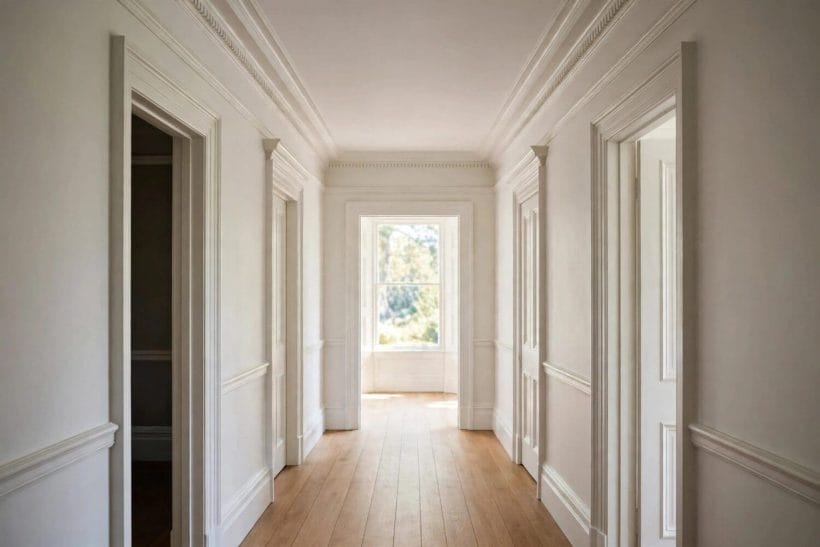
25. Ceiling White, Blended
Crown painted exactly the ceiling’s colour disappears upward, making walls look taller and rooms calmer. It is the safest finish in this whole list and the one plain rental-grade rooms are quietly crying out for.
26. Trim White, Defined
Crown in the same white as skirting and casing, against a coloured wall, draws the room’s full trim outline. The line reads deliberate and tailored — the standard treatment in most well-finished traditional rooms.
27. The Sheen Step
Same colour, one sheen apart: satin crown against a matt ceiling. The difference shows only as the light moves, a whisper of definition that suits simple profiles perfectly because it adds interest without adding pattern.
28. A Soft Colour Contrast
Pale grey, warm stone or the wall colour deepened a shade — gentle contrasts keep crown simple while making it a chosen feature. The reading-corner photograph later in this post shows the bolder end of this idea done calmly.
29. The Dark Crown
Deep charcoal or ink crown in a room with the confidence for it: the ceiling line becomes a drawn frame and tall rooms gain intimacy. Dark crown is unforgiving of wavy walls, so the room must be straight before it is dramatic.
30. Caulk and Fill, Invisible
The unglamorous finish that decides all the others: joints filled, gaps caulked, nail holes lost before paint. On a simple profile there is no detail to distract the eye, so preparation is not a step in the finish — it is the finish.
7. Room by Room
Kitchen crown does a special job, capping tall cabinets and bridging them to the ceiling — this kitchen’s plain run is the template. The same simple profile behaves differently in every room, and the last six ideas walk the house.
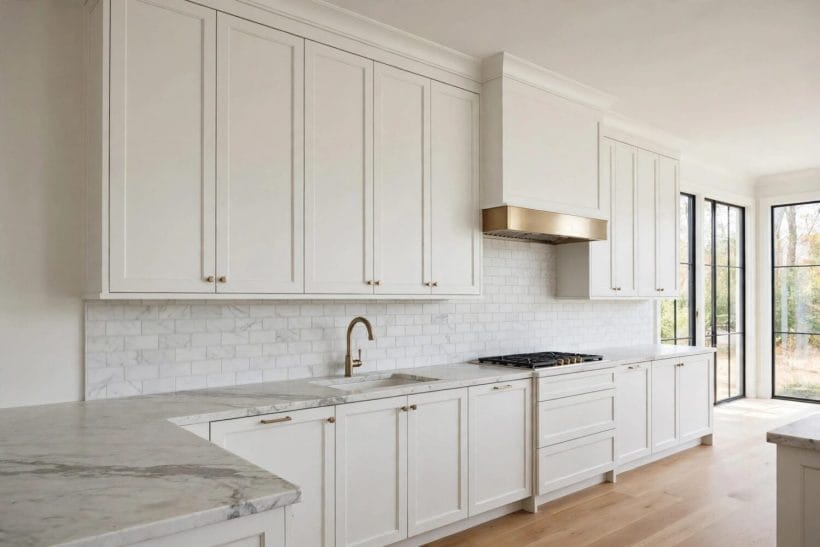
31. Living Room: The Showcase Line
The living room is where crown is seen longest and judged hardest, so it takes the house’s best profile at its best size — usually the mid-size cove or softened ogee, painted trim white against the room’s main colour.
32. Bedroom: The Quiet Line
Bedrooms ask for calm: a slim profile, ceiling-blended paint, nothing that draws the eye upward at bedtime. The bedroom photograph in section 4 is the whole idea in one image.
33. Kitchen: Crown Over Cabinets
Cabinet crown closes the dust-catching gap above tall units and finishes the run like furniture — the pairing celebrated in our white cabinets with dark floors kitchens. Match the cabinet colour, keep the profile plain, and the kitchen gains a built-in calm.
34. Bathroom: The Polymer Line
Steam rules the bathroom choice: a polymer profile, sealed joints, mould-resistant paint. The bathroom photograph in section 8 shows how a small room takes crown gracefully when the material respects the moisture.
35. Hallway: The Running Line
Halls and landings are where crown runs longest and meets the most doors. One continuous profile at one height ties the whole circulation space together — the hallway in section 6 makes the case without a word.
36. The Small Room Proof
A box room, a study, a nursery — the smallest rooms benefit most, because crown is what turns four walls and a ceiling from a container into a room. Slim profile, blended paint, finished corners: the full recipe at its cheapest.
8. Crown and Its Company
Crown never works alone. Below it in this bathroom the tiles end and the mirror hangs; around it in every room sit ceiling styles, casing, picture rails and ceiling roses, and simple crown’s job is to agree with all of them. It meets flat ceilings most often, but it also finishes the edges of grander ceilings — the beams and coffers of our coffered ceiling ideas frequently end in a plain crown run, and the sloped trays in tray ceiling bedroom ideas are crown’s close cousins, a ceiling stepping in where the molding steps out. The wider family is gathered in our ceiling design ideas.
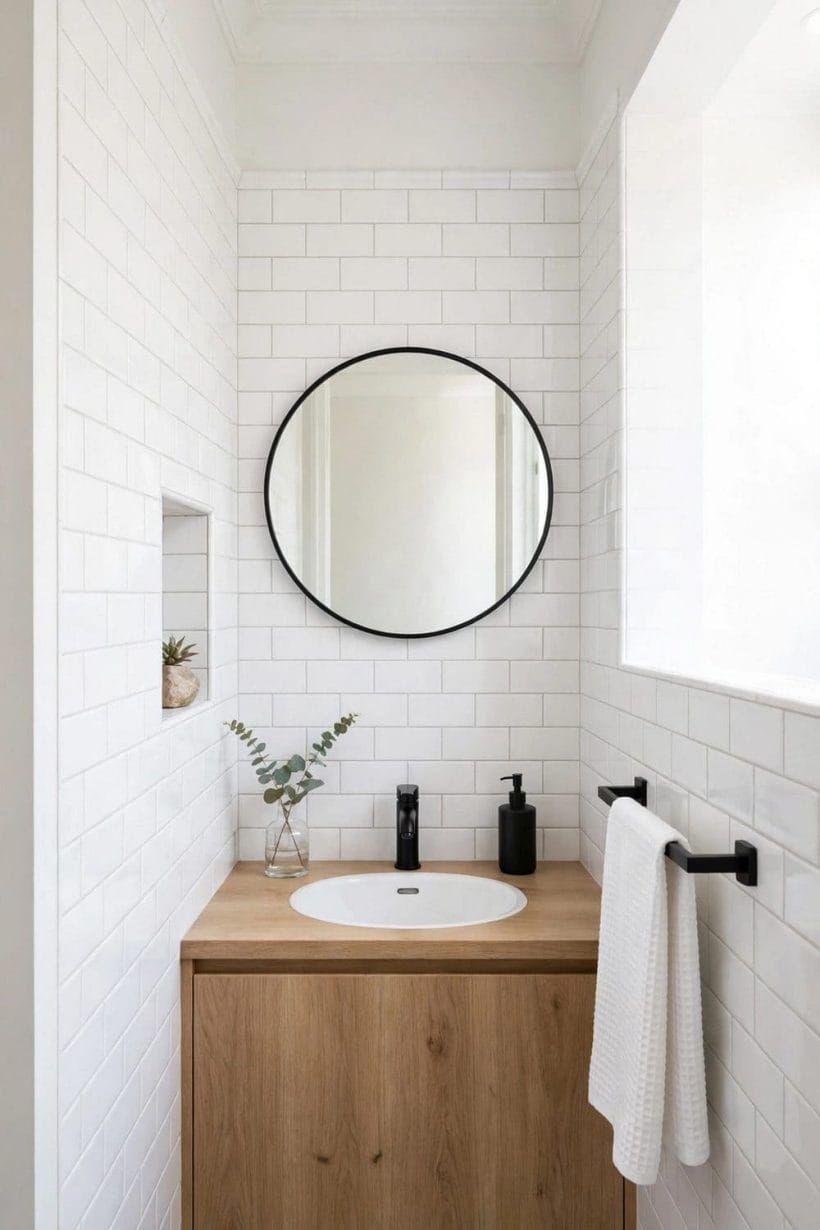
The matching rule is simple: profiles in a room should share a language. Square modern casing wants flat-stock crown; traditional architrave forgives the softened ogee; a picture rail below wants the cove-and-bead’s bead answered somewhere in the room. Ceiling height stays the senior partner in every decision — crown is fitted to the room first and to its companions second.
Lighting deserves a mention in the company crown keeps. A plain profile throws a clean, predictable shadow under downlights and picture lights, which is why simple crown photographs so well — the shadow line is the ornament, and it never dates.
9. Where Simple Crown Struggles
Honesty about the limits: this reading corner’s painted crown works because the walls are true and the ceiling is level. Crown struggles where the building does. Ceilings that sag or wave will show every undulation against a straight trim line — sometimes the wiser spend is making the ceiling true first. Very small, low rooms can feel pressed by any crown at all if the profile is too deep; section 3’s slim sizes exist precisely for them.
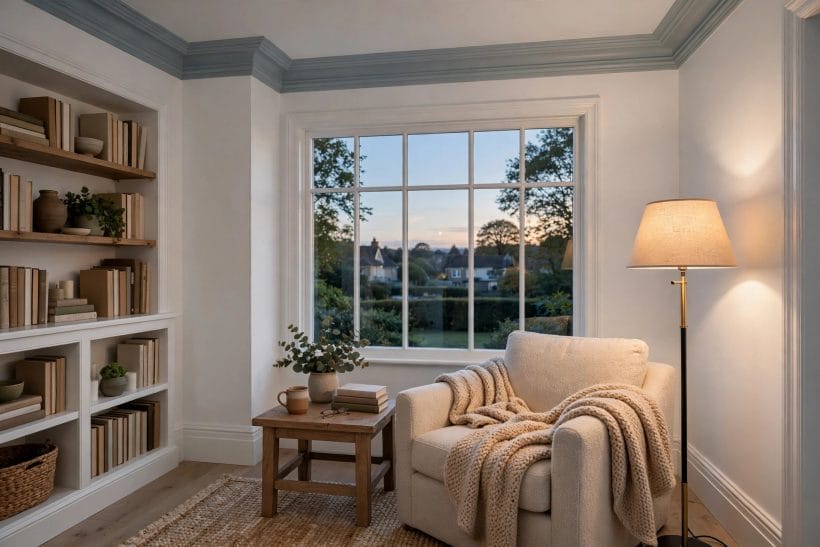
Rented rooms and rooms about to be gutted are poor candidates too — crown is a finishing trade, and finishing a room whose future is demolition is money spent backwards. And on genuinely ornate period ceilings, a simple profile can look like a stand-in; section 4’s plaster route, or a sympathetic built-up stack, respects the architecture better than the plainest answer.
None of these limits is an argument against crown generally. They are the same lesson the whole post teaches: the profile is simple, but the thinking — size, material, corners, finish, room — is the substance, and rooms reward the thinking every time.
10. Fitting and Upkeep in General Terms
Fitting crown is measuring, cutting and fixing in that order of importance, and the general shape of the work is well within an experienced decorator’s or carpenter’s day — lengths are measured wall by wall, corners are coped or mitred as section 5 describes, fixings go into the structure rather than the plaster wherever the profile’s weight asks for it, and gaps are filled before paint rather than after. Ceiling lines in older houses are rarely level, and the fitter’s craft is mostly the art of keeping the line looking level anyway.
Upkeep is the lightest in this whole series of posts: dust along the top edge with the year’s spring clean, a wash where kitchen grease reaches, and a fresh coat whenever the ceiling is repainted. Joints that open with the seasons are a filler-and-paint hour, not a repair project. Polymer bathroom crown asks for its seals checked when the bath’s seals are checked — the same visit, the same tube.
What crown never needs is the thing ornate molding demands: no dusting of carved detail, no picking paint out of dentils, no specialist cleaning. That is the final argument for simple — the trim that finishes the room and then asks for almost nothing, forever.
Final Considerations
Simple crown molding is the smallest architectural decision with the largest finishing effect: one soft step at the ceiling line, correctly sized, honestly materialled, tightly cornered and calmly painted. Work the 36 ideas in their order — profile, size, material, corners, colour, room — hold a sample in the corner before ordering a single length, and let the shadow line do the decorating. The rooms in this post ask for nothing grander, and neither, on the evidence, do most rooms anywhere.


0 Comments