

A desert garden does not ask to be coaxed. Planted with natives of the Desert Southwest, it settles into sun, stone and dry air as if the plot had always been desert, only tidier.
These ten plants are the region’s old inhabitants — cacti, rosettes, flowering shrubs and one small green-barked tree — each earning its place by form, bloom and an easy fit with gravel, rock and bright light.
1. Plants That Live in the Desert at a Glance
Ten plants, five temperaments. The table below follows the five families that anchor this post — the tough giant, the easy paddle cactus, the bold rosette, the graceful canes and the cheerful golden mound — and the remaining five plants deepen the same palette with green bark, resinous leaves, soft summer bloom, silver foliage and coral flower spikes.
Desert planting begins with the ground itself, and the rock-and-gravel end of that work is gathered in stone landscaping ideas.
| Family | Character | What it means |
|---|---|---|
| Saguaro | Iconic desert giant | Tough |
| Prickly Pear | Paddle cactus, vivid blooms | Easy |
| Agave | Sculptural blue rosette | Bold |
| Ocotillo | Arching canes, red tips | Graceful |
| Desert Marigold | Sunny golden mounds | Cheerful |
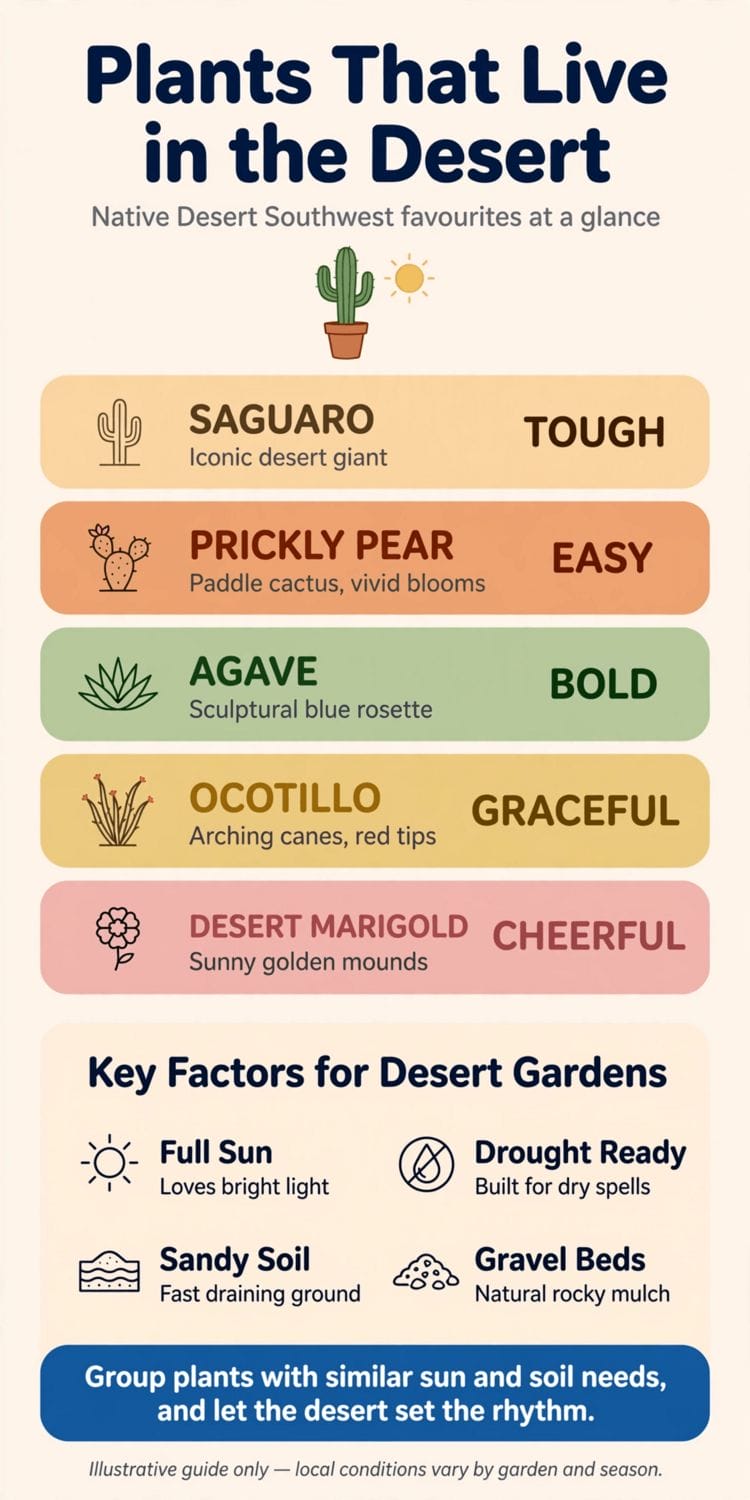
Scope, in general terms: every plant here is a well-established native of the Desert Southwest — the Sonoran, Chihuahuan and Mojave deserts and the dry country around them. In gardens they are used the way the desert uses them: widely spaced, in full sun, in sandy or gravelly ground that drains freely, with stone and gravel as their natural companions. Needs are stated the way gardeners actually meet them — sun, soil and water once established — rather than as measurements, because aspect, soil and season decide more than any single figure could.
Garden use follows the same pattern the plants keep in the wild. The giants and small trees stand alone with air around them, the rosettes mark turns and thresholds, the shrubs fill and back the wide middle ground, and the mounds and spikes work the sunny fronts where a bed meets path or paving. Nothing here wants crowding, rich feeding or a tidy, watered border’s routine — space, light and restraint are the design, and the ten plants supply the rest.
2. Icons of the Open Desert
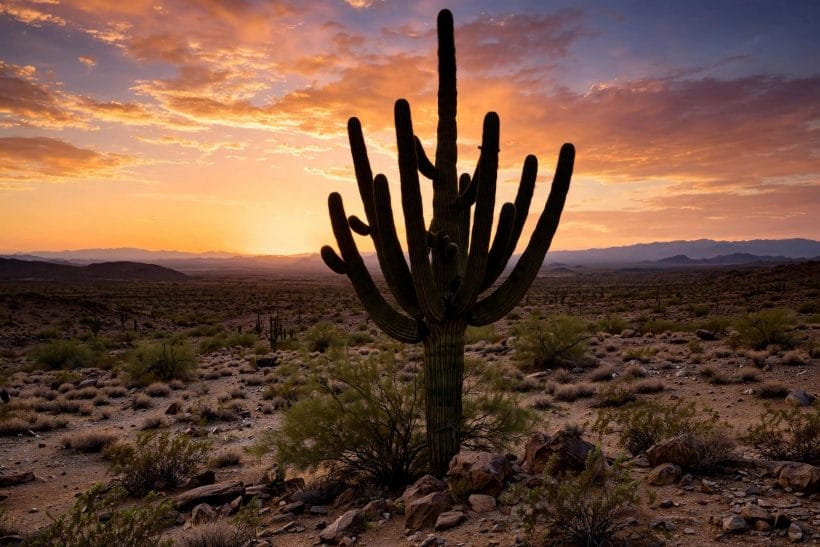
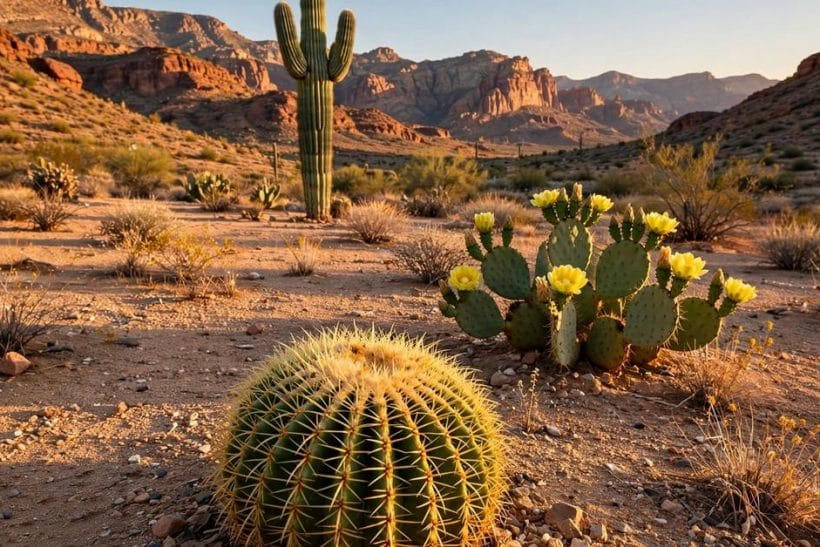
Two plants draw the Desert Southwest in a single line each: a column with arms, and a cluster of flat green pads. Both belong where a garden is seen from a distance as well as close up — the open front plot, the boundary bed, the sunny approach — which is why they sit so naturally among front yard patio ideas that give the front of a house a planted welcome. Seen together in open country they are rarely far apart, and in a garden they still read as a natural pair — height answering spread, column answering clump, each making the other look more itself.
Saguaro
The saguaro is the desert’s signature silhouette: a ribbed green column that, with great age, raises curved arms until the whole plant reads like a figure standing watch over the garden. Give it the role of a landmark — one plant, widely spaced, against sky, wall or open gravel — and it organises everything planted around it. Its needs are the desert’s own terms: full sun all day, sandy or gravelly soil that never stays wet, and very little water once established. It grows slowly and asks for patience rather than attention, repaying both with a presence no quick planting can imitate.
Prickly Pear
Prickly pear builds its garden presence from flat, paddle-shaped pads joined into a spreading, sculptural clump, and in season it crowns the pads with vivid blooms in yellow, pink or red tones, followed by colourful fruit. It is the easiest of companions where a low, wide shape is wanted — along a sunny wall, at the edge of a gravel bed, or filling a dry corner that defeats fussier plants. Full sun, sharp drainage and restraint with the watering can are its whole care regime once established. Plant it where its spines will not brush a path, and let the pads do the rest.
3. Sculpture and Arching Canes
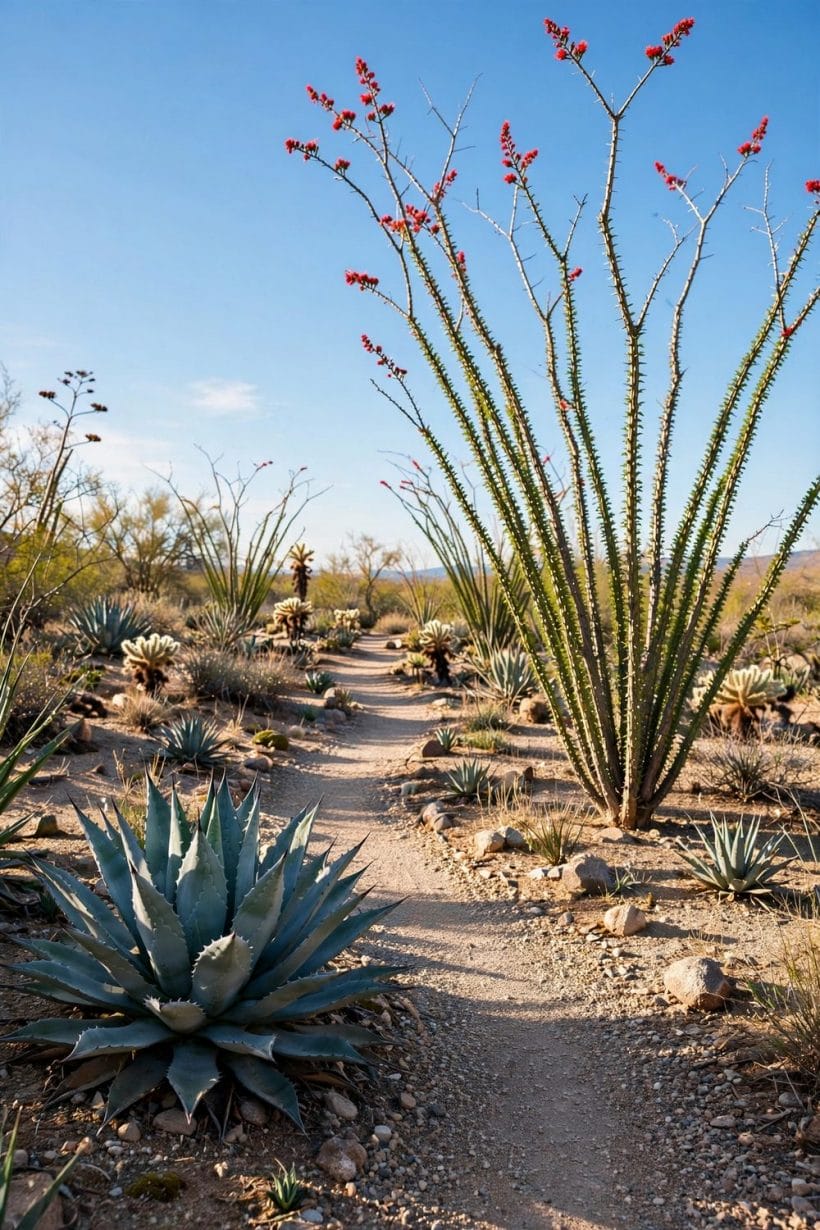
Where the first two plants give a garden its outline, the next two give it contrast: one low, symmetrical and architectural, the other tall, loose and moving in the light. Together they are the classic desert pairing of geometry and grace, and the taller of them is often set along boundaries, Set side by side in one bed, the rosette holds the ground plane while the canes draw the eye upward, and the contrast between them does the work that flowers do in wetter gardens. It is a pairing in the same spirit as the screens gathered in lattice fencing ideas.
Agave
An agave is a rosette drawn with a compass: thick, blue-grey leaves radiating in near-perfect symmetry, each leaf edged and tipped so the plant holds its sculptural poise in every season. It earns its place as a focal point — beside a path turning, at the foot of steps, in a gravel court, or in a generous pot — anywhere a garden needs one bold, permanent shape. Its needs are spare: full sun, gritty, fast-draining soil, and little water once established, with wet winter ground the one condition it dislikes. Give the rosette room to be admired from all sides.
Ocotillo
Ocotillo sends long, slender canes arching up and out from a single base, a fountain of grey-green stems that leafs out along its length when moisture allows and flames at the tips with clusters of red blooms. In a garden it earns its place as movement and height without bulk — against a plain wall, along a boundary, or rising behind lower rosettes and mounds. It wants full sun, open, stony soil and a light hand with water once established. Bare, leafy or in flower, the canes change the light of the bed they stand in, which is their quiet gift.
4. Golden Mounds for Sunny Edges
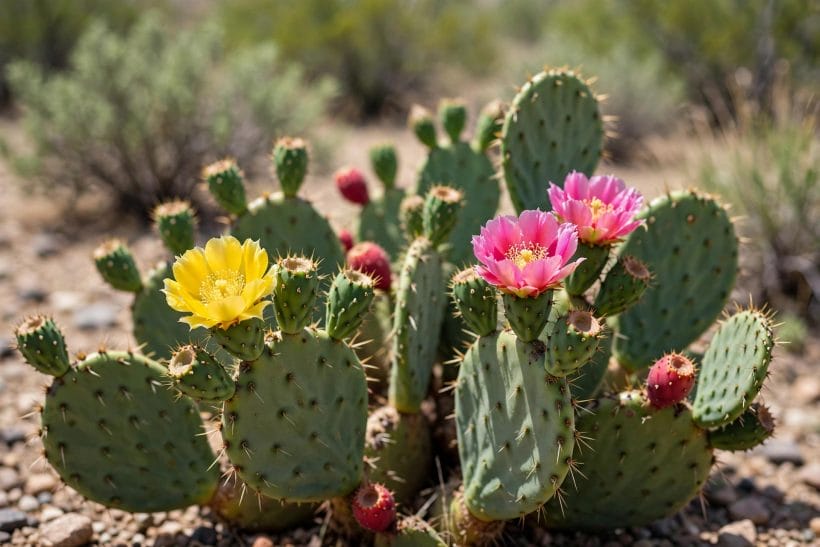
Every desert planting needs its cheerfulness at ground level, and this is the plant that supplies it. Low golden mounds soften the feet of cacti and rosettes, edge paths, and spill along the sunny fronts of beds — the same ground-covering job that the schemes in mulch landscaping ideas approach from the surface side, here done by a living plant over gravel. Colour is its other contribution: against blue-grey rosettes, green pads and pale stone, a drift of gold is what turns a collection of specimens into a composition, and it keeps that effect at the modest scale of a front bed as happily as across a wide, open plot.
Desert Marigold
Desert marigold forms a soft, rounded mound of silvery-green foliage and covers itself for much of the year in sunny, golden, daisy-like blooms held above the leaves. It earns its place wherever a desert bed needs warmth at its front — edging a path, ringing a boulder, or drifting in loose groups through gravel so the cacti behind it look deliberate rather than scattered. Its needs are simple and desert-true: full sun, sandy or gravelly soil, and modest water once established, with good drainage valued far more than feeding. Left to seed lightly, a drift renews itself the way it does on open desert ground.
5. A Small Tree with Green Bark
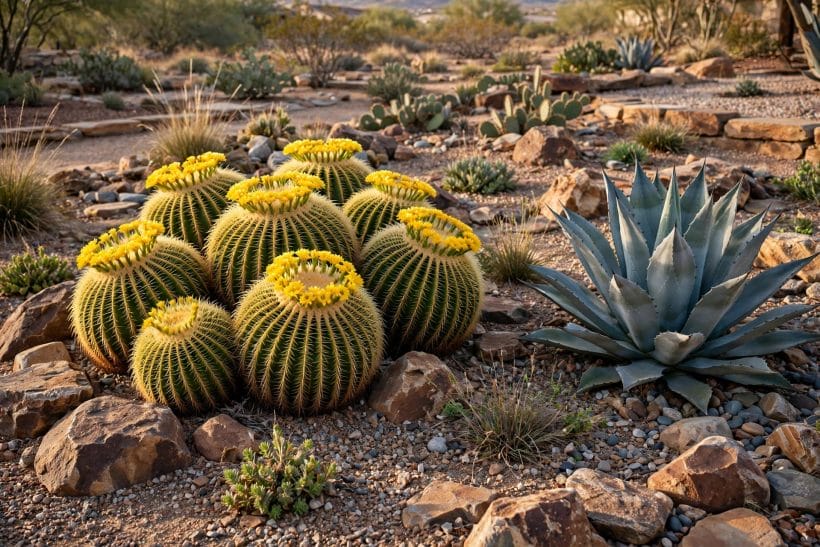
A desert garden still needs shade, but of a desert kind: light, filtered and cast by a small tree that belongs to the place. This one tree among the ten changes the planting beneath it, cooling gravel at midday while letting winter sun pour through, and it settles as happily on a rocky bank as in a courtyard corner. It is also the plant that most changes what can grow beneath it, because its shade is a sieve rather than a blanket — marigolds, brittlebush and young rosettes all do well in its shifting light, in a way they never would under a dense, thirsty canopy tree.
Palo Verde
Palo verde is a small desert tree with smooth green bark and a light, airy canopy of tiny leaves, so the whole tree photosynthesises in green even when the foliage thins in dry spells. In spring it covers itself in a cloud of yellow blossom that briefly makes it the most joyful plant in the garden. It earns its place as gentle shade over seating, paths and lower plantings, and as the vertical layer a flat bed of cacti needs. Full sun, well-drained soil and deep, infrequent water once established suit it; it is a tree content to be left largely alone.
6. The Resilient Backbone Shrub
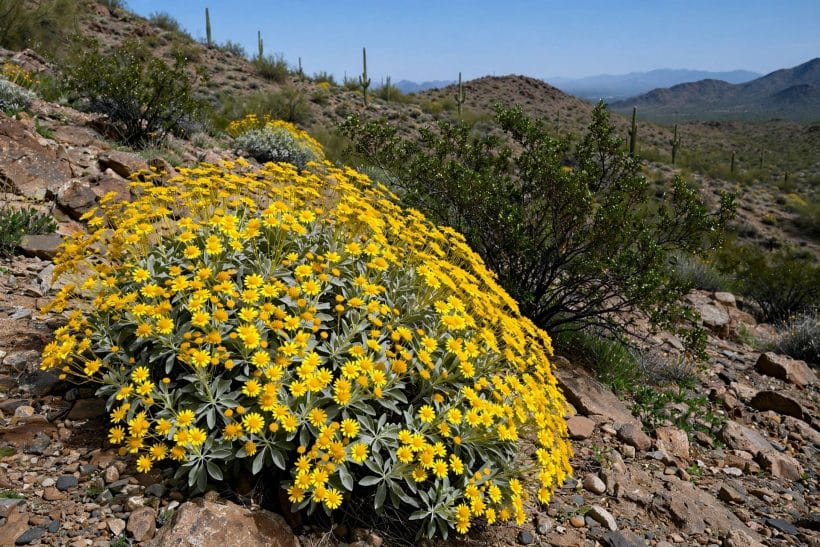
Behind the stars, every honest desert planting has a backbone — the tough, evergreen shrub that holds slopes, fills wide ground and keeps a bed looking furnished in the plainest months. On banks and open inclines it does the holding work explored in hillside landscaping ideas, with roots and canopy matched to dry, stony ground. Backbone planting is unglamorous and indispensable in equal measure: it is what stops a desert bed reading as a row of exhibits, knitting the focal plants into one continuous, believable piece of dry country that still looks composed in the quiet months.
Creosote Bush
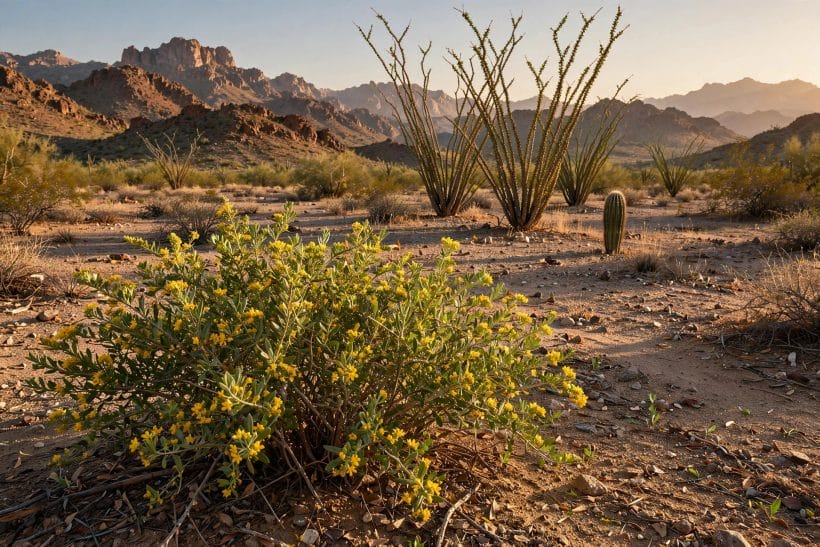
Creosote bush is the open desert’s most characteristic shrub: an open, airy framework of slender stems carrying small, glossy, resinous leaves, dotted in season with small yellow flowers. After rain its foliage gives off the clean, resinous scent many desert dwellers simply call the smell of the desert itself. In gardens it earns its place as a backdrop and a unifier — behind rosettes and marigolds, along a boundary, or standing alone in gravel where its light shade and fine texture calm a planting. Full sun, lean, fast-draining soil and very little water once established are its terms, and it thrives on exactly that neglect.
7. Soft Bloom for a Garden Corner
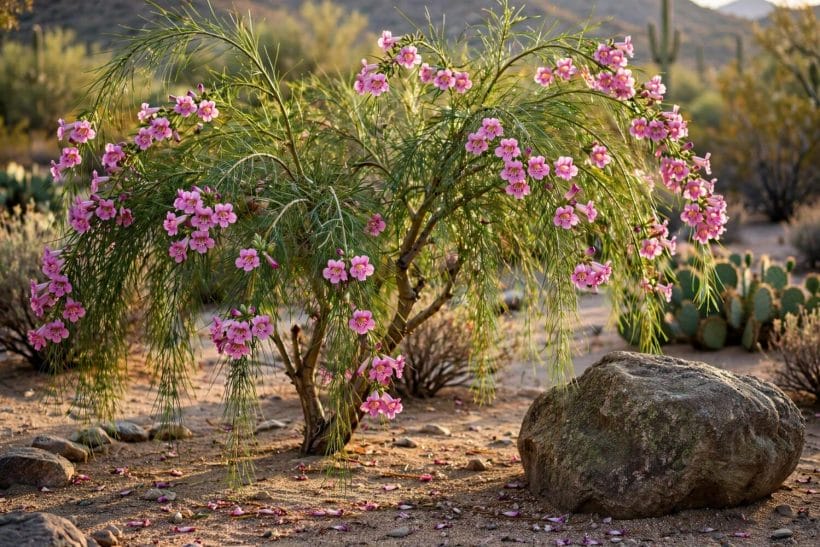
Not everything native to the Desert Southwest is spined or sculptural. One small tree brings the region’s softest summer display — loose, orchid-like flowers on a rounded canopy — and with it a gentler mood that suits a courtyard, a patio edge or the corner where a garden turns from show to shade. That softness is useful design currency in a planting of spines, points and stone — one flowering tree lowers the temperature of a whole corner, visually as much as literally, and gives pollinating insects and hummingbirds a native table in the middle of the gravel.
Desert Willow
Desert willow is a small, graceful tree with long, narrow leaves and, through the warm months, generous clusters of trumpet-shaped blooms in shades of pink, lavender and white with softly marked throats. Despite its name and leaf shape it is a desert plant through and through, happiest where heat reflects off walls and paving. It earns its place as light shade with flowers — over a bench, beside a patio, or as the soft counterpoint to agaves and cacti nearby. Full sun, well-drained soil and moderate water once established keep it blooming; it asks for sun most of all, and rewards it all summer.
8. Silver Leaves and Yellow Daisies
Some plants earn their keep in the weeks when nothing else is trying. This low, silver-leaved shrub is one of them, brightening rocky ground with daisies in the cooler seasons and holding its pale, light-catching mound through the heat between flowerings. Silver is the rarest colour in most gardens and the commonest in the desert, and learning to use it — as foil, as distance, as a cool note between greens — is one of the quiet skills a Desert Southwest planting teaches better than any other style of garden.
Brittlebush
Brittlebush makes a rounded mound of soft, silvery-white leaves — a pale cushion that catches light beautifully among dark rock and green cacti — and in the cooler flowering seasons it lifts a loose canopy of bright yellow daisies above the foliage. It earns its place on rocky banks, along dry walls and at the fronts of wide beds, anywhere its silver can set off the plants around it. Its needs are the familiar desert terms: full sun, stony or sandy soil that drains freely, and little water once established. The foliage is brightest kept lean and dry, so kind neglect suits it better than cosseting.
9. Slender Leaves and Coral Spikes
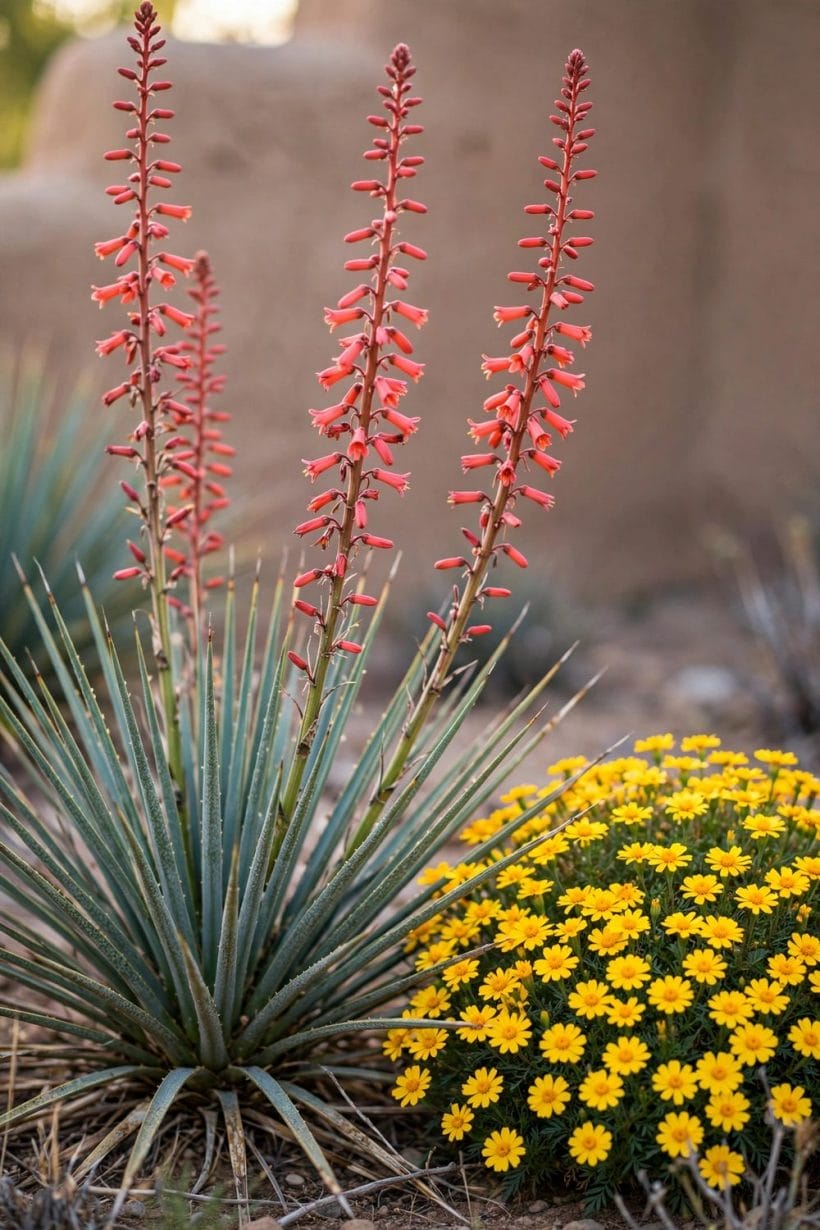
The last of the ten is the vertical accent at ankle-to-knee scale: a fountain of slender leaves with flower spikes that hummingbirds work from the moment they open. Its gravel-and-stone composure has a quiet kinship with the dry gardens in small Japanese garden ideas, where raked gravel and a few placed plants carry the whole design. Placed singly it punctuates; repeated along a path it gives a dry garden rhythm, leading the eye from rosette to rosette the way stepping stones lead the feet, and its flowering season is long enough to carry a bed while slower neighbours rest.
Red Yucca
Red yucca forms a neat fountain of slender, blue-green, grasslike leaves that arch from a tight base and stay handsome through the year, then sends up tall, wiry spikes of coral-pink, tubular flowers through the warm months. It earns its place at path edges, in gravel courts, flanking steps and in pots, where its spikes give height without shade and its leaves give texture without thorns to dodge. Its needs are undemanding: full sun, sharp drainage in sandy or rocky soil, and little water once established. Few desert plants work so steadily, flower so long, or ask so little in return for both.
10. Planning and Care Checks for a Desert Garden
Group by thirst, not by looks. The infographic’s closing tip is the whole method: plants with similar sun and soil needs belong together, so a bed of cacti, rosettes and marigolds can share one lean regime, while the small trees and the desert willow take their own deeper, less frequent drinks at their own roots. Walk the plot at midday before planting and give every sun-lover the open sky it expects; reflected heat from walls and paving is a gift to these plants, not a hardship.
Drainage decides more than feeding ever will. Sandy, gravelly, fast-draining ground suits all ten; where a garden’s soil stays wet and heavy, a gritty raised bed of the kind gathered in raised garden bed ideas can lift roots into the dry conditions they prefer. Water new plants while they settle, then step back — established desert natives resent fussing, and most garden losses come from kindness with the hose. Finish with gravel over the beds, leave generous space around each plant for its mature shape, and check local guidance before planting any protected native, since wild desert plants belong in the desert and garden stock should always come from a reputable grower.
Final Considerations
Ten natives, ten temperaments: a giant for the skyline, pads and rosettes for sculpture, canes for grace, a green-barked tree and a willow-like tree for shade and bloom, a backbone shrub, silver foliage and coral spikes, and golden mounds to stitch it all together at the ground. Planted in sun, stone and gravel, they ask for restraint and repay it with a garden that looks inevitable.
Start with the structure — one saguaro or palo verde, an agave where paths turn — then fill the sunny ground between with the mounds, shrubs and spikes. The desert has already done the designing; a good desert garden mostly agrees with it, edits kindly, and lets the plants that live in the desert prove, season after season, how little they needed anyone’s help.

0 Comments