

Picture the typical homestead errand: a feed sack to pick up, tools to haul to the back forty, and a gas-guzzling truck doing all of it. For years that felt like the only option — until a handful of small electric vehicles proved they could handle real work. Choosing between an e-bike, a cargo bike and a velomobile is not about style. It is about matching the machine to your daily miles.
1. Sustainable Micro-Mobility at a Glance
Sustainable micro-mobility is the family of small electric machines — e-bikes, cargo bikes and velomobiles — that replace car trips at a tenth of the cost and a fraction of the carbon. For the off-grid homesteader, the target is the second car: the expense that never sleeps, billing insurance, fuel and maintenance whether it moves or not. The three formats differ wildly in price, carrying capacity, weather protection and real ownership cost, and this guide compares them honestly — which vehicle handles farm chores, which wins the commute, and where each one falls short. The table below gathers the whole comparison in one place; the sections after it take each machine, each dollar and each mile apart in turn.
| Attribute | Detail |
|---|---|
| The Problem | The second car — $5,000–9,000 a year all-in for insurance, fuel, depreciation and maintenance |
| The E-Bike | Bicycle + motor with 20–28 mph assist; $1,000–4,000 — the simplest format, the everyman’s EV |
| The Cargo Bike | Longtail or front-loader carrying kids, groceries and feed sacks; $2,000–6,000 — the most useful format |
| The Velomobile | Recumbent trike in an aerodynamic shell, a human-electric hybrid cruising at 30+ mph; $5,000–12,000 — the most efficient format |
| Range | E-bike 30–60 miles; cargo e-bike 25–50; velomobile 60–100+ — aerodynamics stretch the human engine |
| Carrying Capacity | Cargo bike 400+ lbs; e-bike a backpack and panniers; velomobile limited — the shell constrains cargo |
| Energy Use | Velomobile ~10Wh/mile; e-bike ~15Wh/mile; cargo e-bike ~25Wh/mile — the shell sips least |
| Running Costs | Electricity is pennies per mile — a 500Wh charge costs ~$0.07; maintenance runs $100–200 a year |
| Weather Protection | Velomobile enclosed and all-weather; e-bike and cargo bike riders stay exposed and reach for rain gear |
| The Payback | Any of the three pays for itself in under two years of replaced second-car trips |
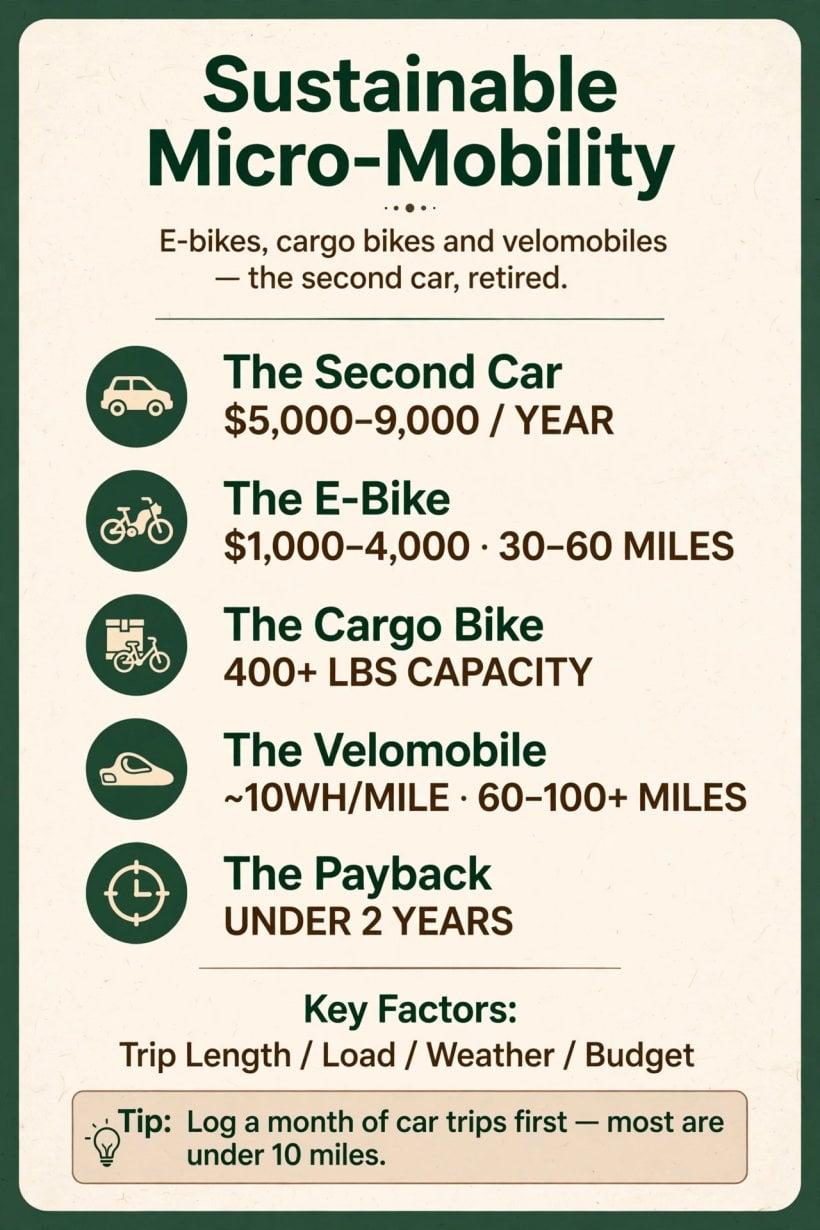
A second car at $5,000–9,000 a year, a cargo bike rated at 400+ lbs, and a velomobile sipping ~10Wh a mile — the three-way comparison on one card.
Read the table as a spectrum rather than a podium. The e-bike is the simplest machine, the cargo bike the most useful, and the velomobile the most efficient — three different answers to three different patterns of daily miles. No row crowns a universal winner, because the right machine is the one whose strengths line up with the trips you actually make: the feed run, the school run, the fifteen-mile commute. The sections that follow walk the spectrum in order — the contenders themselves, what they cost to buy and run, what each one actually does, how they fit homestead life, how they charge from sunshine, and how to choose.
2. The Contenders: Three Formats
The e-bike is the familiar format: a bicycle plus a motor, delivering 20–28 mph of assist at $1,000–4,000 — the everyman’s EV, and the machine most riders already half-know how to use. There is no new skill to learn and no new silhouette to explain; it is the bicycle the world grew up with, electrified. That familiarity is its strategic strength: the e-bike is the format a household can adopt this week, ride on the infrastructure that already exists, and maintain with bicycle knowledge. Sizing its battery and motor for real commuting duty is covered in the e-bike commuting guide.
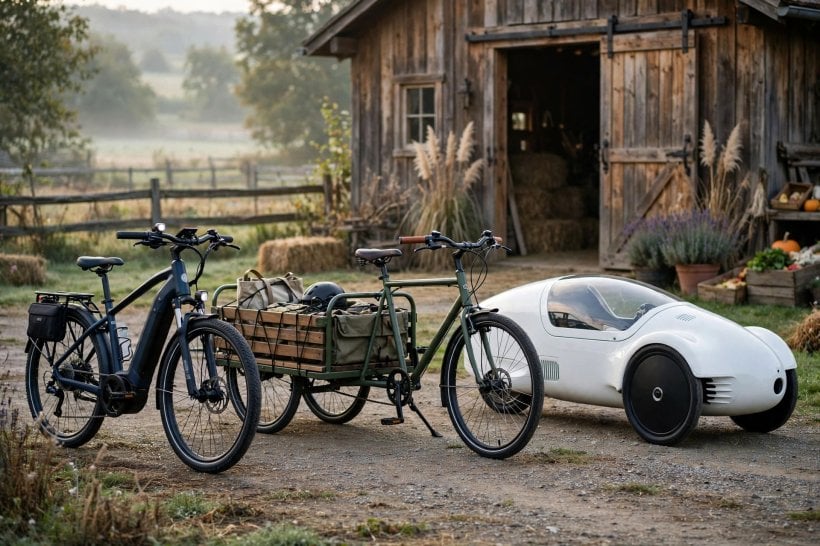
The cargo bike is the hauler: a longtail or a front-loader built to carry kids, groceries and feed sacks, at $2,000–6,000 — the car replacement for families, and the most useful format of the three. Where the e-bike carries a rider and a backpack, the cargo bike carries the week’s shopping and the children besides. The velomobile is the exotic: a recumbent trike inside an aerodynamic shell, a human-electric hybrid with a 30+ mph efficient cruise at $5,000–12,000 — the efficiency king, and the strangest silhouette on the road. The family these machines belong to is introduced machine by machine in the guide to what a velomobile is; this guide’s business is how the three compare.
3. Cost: Purchase and Ownership
Purchase prices sort the spectrum quickly. The e-bike’s sweet spot is $1,500–3,000, inside its wider $1,000–4,000 range. The cargo e-bike runs $3,000–5,000, inside the cargo family’s $2,000–6,000 span. The velomobile is the premium: $7,000–12,000 in the detailed pricing, handbuilt and low-volume, inside its $5,000–12,000 headline range. Those gaps look decisive until they are set against the machine all three are replacing: the second car at $5,000–9,000 a year, every year, in insurance, fuel, depreciation and maintenance. Against that baseline, the original’s verdict is blunt — any micro-mobility option pays for itself in under two years of replaced car trips.

Running costs compress the differences further. Electricity is pennies per mile for all three: the e-bike’s 500Wh battery costs about $0.07 to charge, and the velomobile sips less per mile than any of them. Maintenance is bicycle-level across the family — tires, chains and brake pads at $100–200 a year — with one honest addition: the velomobile’s shell needs occasional care, the price of the enclosure that makes it the all-weather machine. There is no fuel bill, no insurance line and no depreciation cliff of the automotive kind. The full ownership ledger for the premium end of the family is worked through in the cost of owning a velomobile.
4. Capability: What Each One Actually Does
Range first, because range draws the map each machine can serve. The e-bike covers 30–60 miles, battery-dependent. The cargo e-bike covers 25–50 — heavier, and the load shows in the miles. The velomobile covers 60–100+: aerodynamics again, the human engine going further inside a shell than it can in the open air. Cargo inverts the ranking completely. The e-bike is the light carrier — a backpack and panniers. The cargo bike is the truck, rated at 400+ lbs of capacity. The velomobile is limited: the shell that makes it fast constrains what it can swallow, though some models manage grocery runs.
Weather separates the family just as sharply. The e-bike rider is exposed and reaches for the rain gear; the cargo bike is exposed too, with the kids exposed alongside. The velomobile is enclosed — the all-weather machine, the winter commuter’s answer, ridden in street clothes while the others dress for the sky. What bad weather does to each format across a full season is the subject of the winter commuting guide. Hills, by contrast, unite the family: motors flatten them, and all three climb — with the mid-drive cargo bike the hill champion under load, torque where the weight sits. Capability, read whole, is a trade: the cargo bike hauls, the velomobile endures and goes far, the e-bike does a bit of everything cheaply.
5. The Homestead Fit: Which for Off-Grid Life
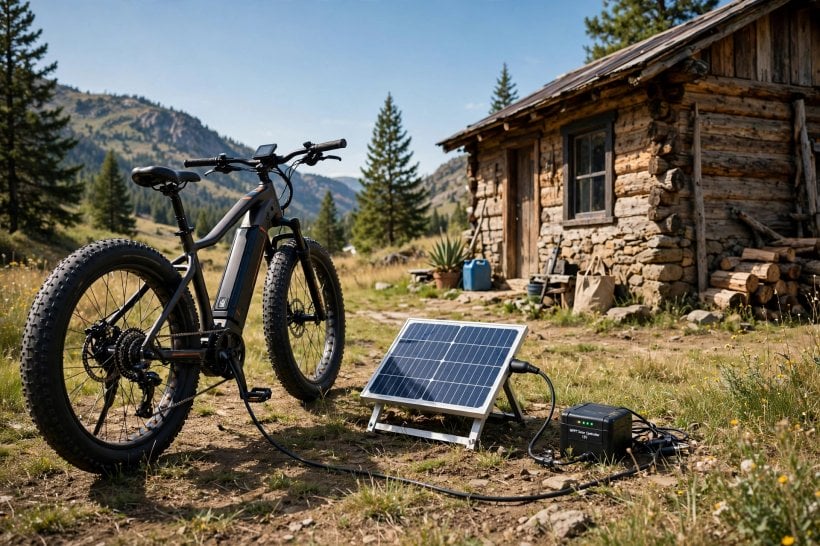
On the homestead, each format finds its job. The e-bike is the default: cheap, simple, and charged from a small solar setup — its 500Wh battery charges from a single panel — the homestead’s runabout for the quick trip to the gate, the neighbour, the village. It is the machine that replaces the most car trips for the least money and the least thought, which is why the original’s buying order starts here: the versatile first purchase, the one that earns its place in the first month.
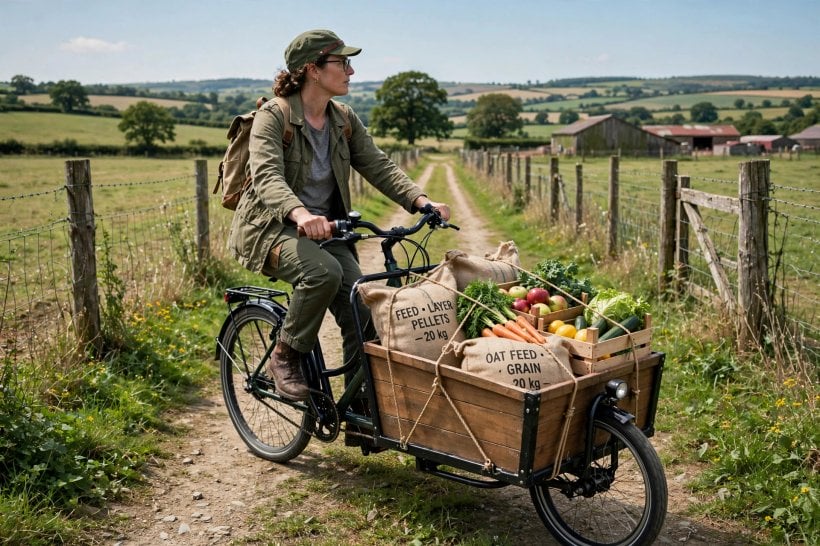
The cargo bike is the worker: feed runs, farmers-market trips, kid transport — the homestead truck, whose front-loader doubles as a wheelbarrow when the garden calls. The velomobile is the commuter: built for the 15-mile each-way commute, the distance eater, the weatherproof one, the statement. The pattern the original prescribes is sequential — most homesteads want the e-bike first, add the cargo bike when hauling matters, and consider the velomobile when a long commute enters the picture. Choosing between the hauler’s variants is its own decision, worked through in the roundup of electric cargo bikes for homesteaders.
6. Energy and Solar: Charging Off-Grid
The energy ledger is where the family’s efficiency shows in hard numbers. Consumption per mile: the e-bike sips ~15Wh, the cargo e-bike burns ~25Wh under its loads, and the velomobile — aerodynamics beating weight — uses ~10Wh, the least of the three despite being the largest machine. All three are trivially solar-chargeable: a 200W panel and the e-bike’s charger make a direct daytime charge, sunshine in at noon and miles out by evening. The dedicated setup for drinking from the array is the guide to charging an electric bike with off-grid solar power; the principle here is that no machine in this family strains a homestead’s harvest.
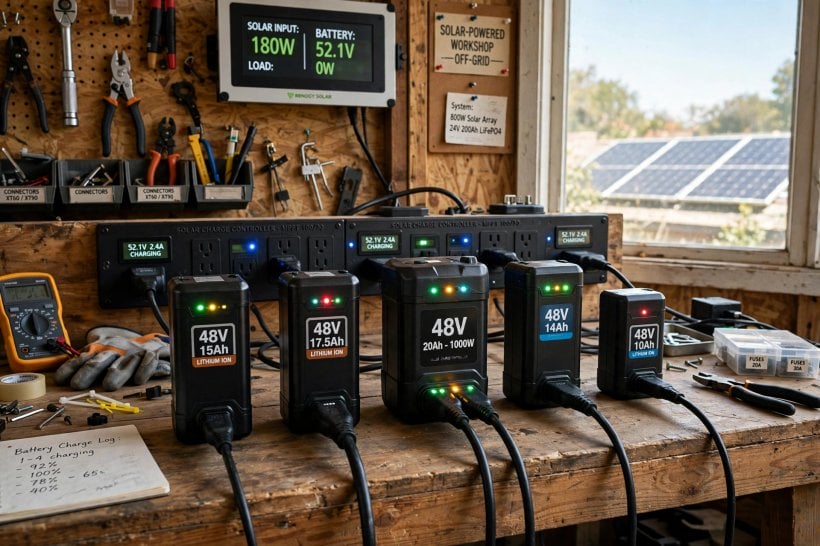
Battery care is the longevity discipline that protects the family’s most expensive component, because the battery is the vehicle’s priciest part and is to be treated so. Charge to 80% for daily use — the habit that buys a 2× lifespan. Store at 50% through the winter, when the machine rests. Those two numbers, observed, are the difference between a pack that fades in two seasons and one that serves for years of feed runs and commutes. Off-grid, where every watt-hour was harvested from your own roof, the discipline is also respect for the system: the panel, the battery and the machine are one economy, and the rider who runs it gently runs it longest.
7. Safety and Legality: The Real Talk
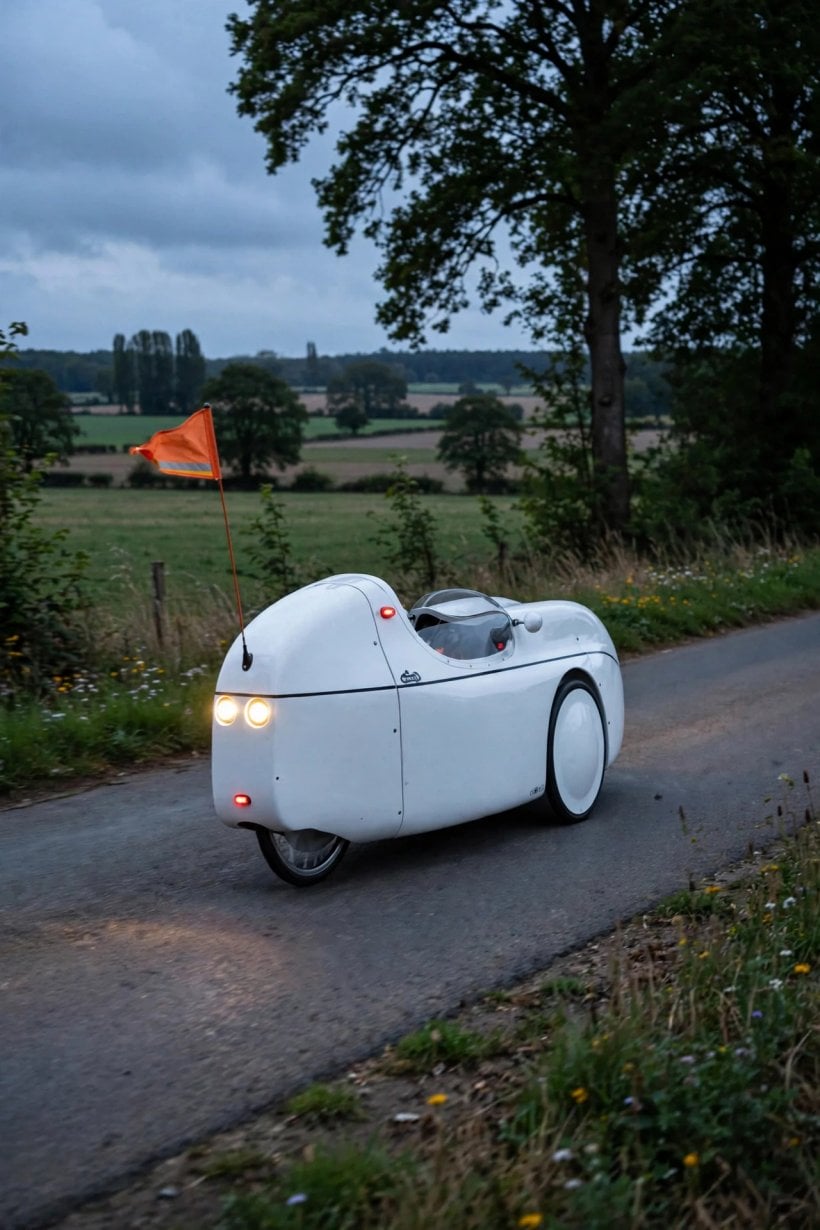
Visibility is the velomobile’s honest challenge: it sits low to the ground, below the sightline drivers scan, and the recumbent reality is answered with flags, lights and a reflective shell — being seen as a deliberate system rather than a hope. The e-bike family’s legal frame is its classes: Class 1, 2 and 3, the 20 vs 28 mph distinction, with the rider’s duty to know their state’s class rules and the trail-access question that follows from them. The velomobile’s legality is generally simpler than its silhouette suggests: it is generally bicycle-classified, a gray area in places, with most jurisdictions treating it as a bike.
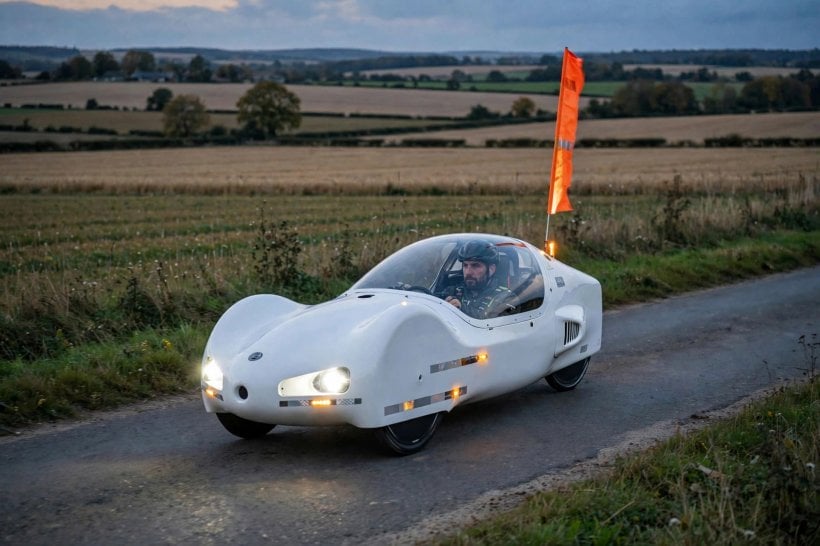
The gear rules apply across the family without exception. The helmet is always worn — the non-negotiable. Lights run day and night — the seen, made visible in both directions of the clock. The mirror is the recumbent essential, the low rider’s rear view. None of this is decoration; it is the safety system that lets a small, quiet machine share roads built for trucks. Where velomobiles may legally travel — paths as well as roads — is mapped in the guide to velomobile regulations and bike-path legality, and the cautious rider reads it before the first long commute rather than after the first stopped conversation.
8. The Decision: Matching Vehicle to Life
The decision itself compresses into four honest matches. Short trips and a tight budget point to the e-bike — the 80% solution, the machine that covers most of what a second car was doing for a fraction of its cost. Kids, cargo and homestead hauling point to the cargo e-bike — the truck replacement, bought when the loads are real. A long commute in all weather points to the velomobile — the efficiency machine, bought when the miles are long and the sky is unreliable. And the two-vehicle homestead runs the fleet: e-bike plus cargo bike, the versatile and the worker together, still cheaper than one car’s annual costs.
Notice what the matches share: none of them starts from the machine. Each starts from the pattern of trips — the distance, the load, the weather, the frequency — and lets the pattern pick the format. That is the discipline this whole comparison exists to teach, and it is why the test in the next section matters more than any specification in this one. A rider whose life is five-mile errands gains nothing from the velomobile’s hundred-mile legs; a rider with a thirty-mile round commute gains everything from them. Match the machine to the miles, and the machine disappears into the routine it serves.
9. The One-Month Test: Log Your Trips
Before buying anything, the original prescribes a month of data: log your car trips. Write down every journey the second car makes for a month — where, how far, carrying what, in what weather. The result, for most households, is the revelation that justifies the whole family: most second-car trips are under 10 miles, squarely inside the micro-mobility envelope. The car was never being used as a car; it was being used as a very expensive bicycle with a roof, at $5,000–9,000 a year for the privilege.

The log also sorts the fleet decision with evidence instead of enthusiasm. Count the trips that carried real loads and the cargo bike’s case makes itself; count the long commutes and the velomobile’s case does the same; what remains — usually the great majority — is the e-bike’s home ground. Households that want a structured way to think through the wider transport picture can take the sustainable transportation quiz as a companion exercise. Either way, the month of paper is the cheapest research in this guide: it converts a guess about your life into a measurement of it, and the right machine follows from the measurement almost automatically.
10. The Fleet and the Freed Budget
Step back and the family’s real product comes into view: not miles, but money and carbon returned. Every trip moved from the second car to a machine in this family moves it at a tenth of the cost and a fraction of the carbon, and the trips compound — the feed run, the school run, the commute, each one a small transfer from the automotive ledger to the homestead’s. What that efficiency means at the level of the planet’s ledger is tallied in the environmental impact of velomobiles versus electric cars; what it means at the level of the household is simpler and larger: the second car’s $7,000 a year, freed, is the homestead’s budget — the greenhouse, the fencing, the water system the land was waiting for.
The fleet view also explains why the formats coexist rather than compete to extinction. The e-bike’s simplicity, the cargo bike’s usefulness and the velomobile’s efficiency are answers to different questions, and a homestead’s week asks all three questions in turn. Start where the original starts — the versatile default, solar-chargeable from a single panel — and let the logged trips, the growing loads and the lengthening commute argue for each addition in its season. The machines are small. The change they make to a household’s arithmetic, and to the air above its road, is not.
Final Considerations
Start with the e-bike — the versatile default. Add cargo capacity when the homestead demands hauling, and consider the velomobile when the commute is long and the weather is real. Log a month of trips before you spend a dollar, charge from the panel on your roof, and treat the battery like the investment it is. Any of the three retires the second car — and the second car’s $7,000 a year is the homestead’s budget, freed.




6 Comments