

At a stoplight, it looks like a tiny spaceship that lost its way. Drivers stare, kids point, and then it pulls away faster than anything with pedals has a right to. The velomobile is the most efficient road vehicle most people have never heard of — a bicycle perfected by physics, wrapped in a shell, and quietly cruising at speeds that embarrass its tiny power budget.
1. What is a Velomobile at a Glance
So what is a velomobile? It is a human-powered — usually electrically assisted — vehicle enclosed in an aerodynamic shell: part bicycle, part recumbent trike, part tiny car. The rider lies back in a reclined seat, pedals a tricycle chassis, and lets a teardrop fairing do the work that muscles alone cannot, slipping through air that stops an ordinary cyclist. The result is the most efficient motorised transport ever built — a machine that cruises at 25–30 mph on a whisper of energy, keeps its rider dry in the rain, and is still, in the eyes of the law, a bicycle. The table below compresses the whole definition into its load-bearing attributes; the sections after it unpack the anatomy, the history, the physics and the future one attribute at a time.
| Attribute | Detail |
|---|---|
| The Definition | A human-powered, usually electrically assisted vehicle enclosed in an aerodynamic shell — part bicycle, part recumbent trike, part tiny car |
| The Base | A recumbent tricycle in tadpole layout — two wheels at the front, a stable platform and a low centre of gravity |
| The Shell | A teardrop fairing in fiberglass, carbon or coroplast — the shape that does the work |
| The Drag Coefficient | Cd of 0.05–0.10, against a car’s 0.30 |
| The Drive | Pedals plus electric assist of 250–750W — the human-electric hybrid, bicycle-classified |
| The Position | Reclined — the recumbent seat, trading a high view for comfort and aerodynamics |
| The Weight | 55–75 lbs complete — bicycle weight with car-like weather protection |
| The Cruise | 25–30 mph on 150W of human power plus assist — double an ordinary bicycle’s 15 mph |
| The Energy | 8–15 Wh per mile — about 1/25th of a car’s energy |
| The Family | Sport and touring machines, utility models, four-wheel quads, DIY builds and rare tandems |
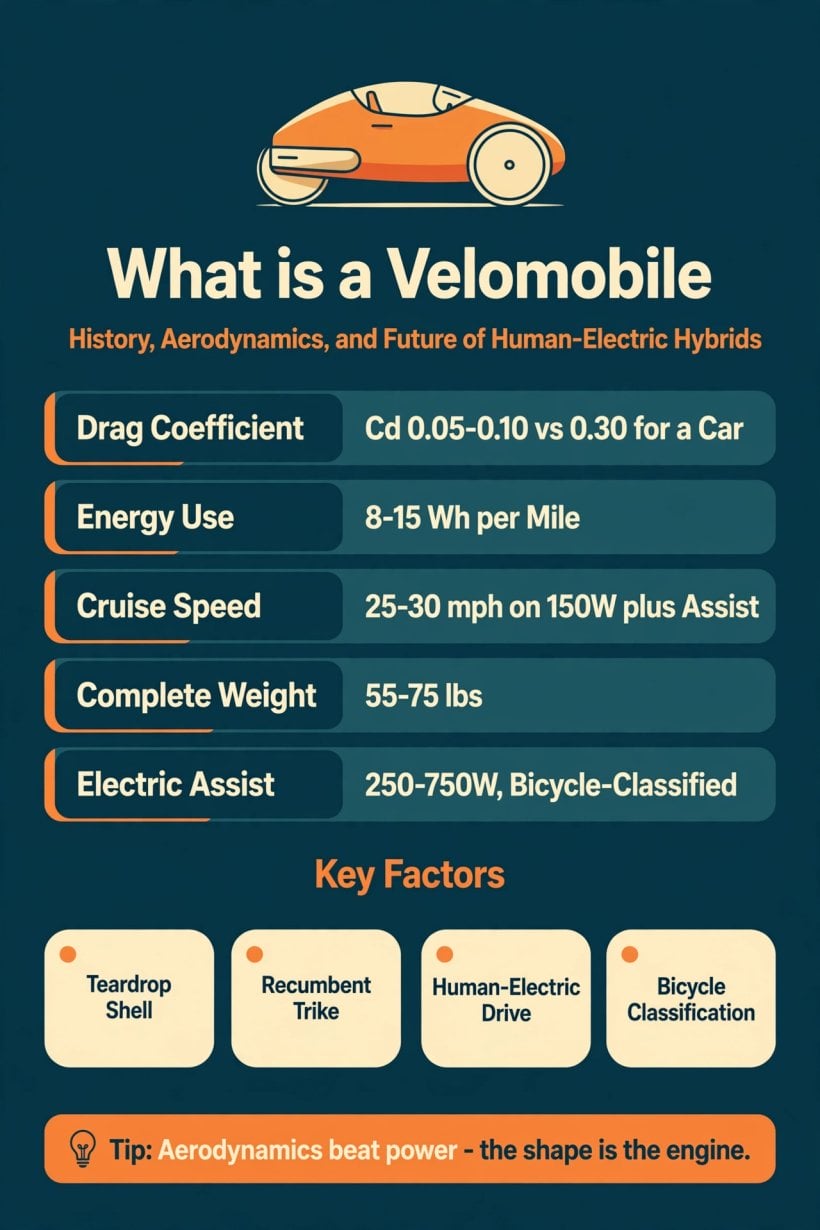
A drag coefficient a car cannot approach, 8–15 watt-hours a mile, and a 25–30 mph cruise — the whole machine on one card.
Read the attributes as a chain of dependencies. The reclined position exists because the trike platform makes it stable; the shell exists because the reclined rider presents a shape worth fairing; the cruise speed exists because the shell cuts drag to a fraction of a car’s; and the tiny energy figure exists because, once the air is beaten, very little power is needed to sustain that speed. Remove any link — ride upright, drop the shell, add a big motor instead — and the machine collapses back into an ordinary bicycle or an inefficient micro-car. The velomobile is what happens when every attribute is chosen to serve the one before it.
2. The Definition: A Recumbent Trike Inside an Aerodynamic Shell
Strip the shell away and the velomobile’s skeleton is a recumbent tricycle. The standard layout is the tadpole — two wheels at the front, one at the back — which gives the machine its stable platform and low centre of gravity. Three wheels matter: a faired two-wheeler would demand constant balance at walking pace and in crosswinds, while the trike simply sits, planted, at every stoplight. Onto that chassis goes the defining component, the shell: an aerodynamic fairing in fiberglass on production machines, carbon on the fastest ones, and corrugated plastic — coroplast — on homebuilt ones, always shaped as a teardrop, because the teardrop is the form air resists least.
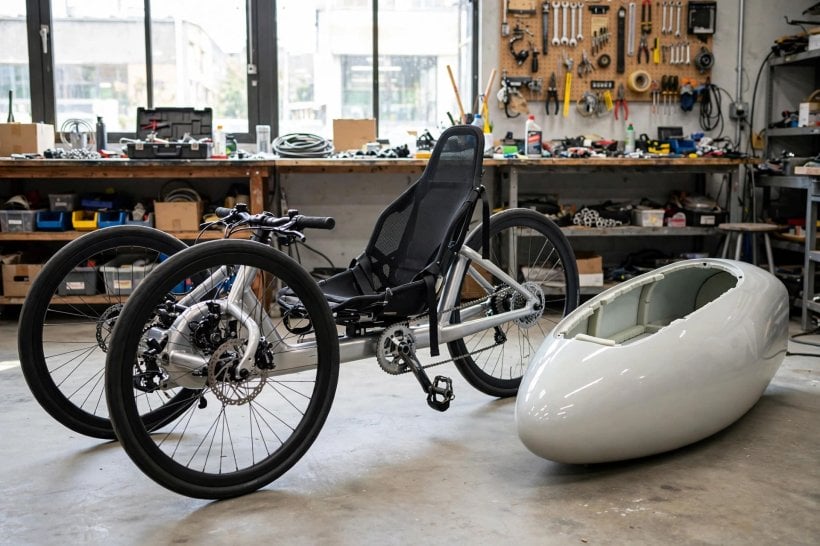
The rider’s position completes the anatomy. You do not sit on a velomobile; you recline in it, legs forward, back supported — the recumbent position. That posture buys comfort and aerodynamics in the same move, at the price of the one honest trade-off in the design: visibility. A rider lying low sees less over hedges and parked cars, and is seen later, which is why flags and lights are standard practice rather than accessories. And the whole assembly stays astonishingly light: 55–75 lbs complete — the weight of a bicycle, wearing the weather protection of a tiny car.
3. The 1930s Streamliners and the 1970s Renaissance
The idea is older than the cars it now outruns. In the 1930s, riders chasing speed records wrapped bicycles in fairings and produced the streamliners — faired bikes that pushed human power past 80 mph and proved, decades before the word velomobile was common, that the limit on a bicycle was never the legs. It was the air. Those record machines were the concept in its purest form: an ordinary human engine, an extraordinary shape, and speeds no unfaired rider could touch.

The idea then slept until the 1970s, when the oil crisis sparked a recumbent renaissance. With fuel suddenly expensive, tinkerers revived the human-power idea wholesale — recumbent bicycles returned, and homebuilt fairings began appearing over them in garages and workshops. The revival mattered less for any single machine than for the knowledge it rebuilt: a generation relearned how to build low, stable, faired cycles by hand, and that homebuilt tradition — plans shared, shells improvised — became the soil the commercial machines of the 1990s grew from.
The two eras teach the same lesson from opposite directions. The streamliners proved the physics at the extreme — given a fairing, human power alone could reach motorway speeds — but they were record machines, built for a rider, a day and a number. The 1970s builders proved the other half: that the same fairing idea could survive contact with ordinary roads, ordinary weather and ordinary garages. A practical velomobile needed both proofs. Speed without practicality stays on the record course; practicality without the speed was just a heavy bicycle. The production machines that followed are simply the two traditions bolted together.
4. The Commercial Birth: Dutch and German Production, Then Electric Assist
The 1990s were the commercial birth. Dutch and German makers turned the garage tradition into the first production velomobiles — machines like the Alleweder and the Quest that a customer could simply buy, finished, with the shell’s shape refined by people who built them in series rather than one at a time. Production changed the machine’s character: tolerances tightened, shapes converged on the fastest forms, and the velomobile became a product with a waiting list instead of a project with a parts pile.
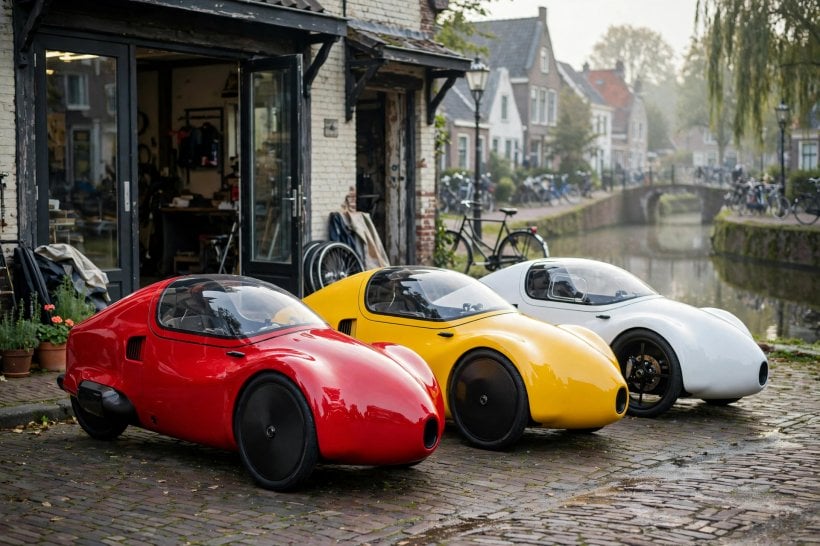
The 2000s brought the second birth: e-assist. Electric motors arrived in the shell, and the electrification flattened the hills that had always been the faired trike’s weakness — a heavy, enclosed machine is a joy on the flat and a labour on a climb, and the motor quietly deleted the labour. With assist, the velomobile’s mainstream potential came into view. The refinement has continued from the 2010s to now: carbon shells, a 100-mile range, a growing community of riders — and new branches on the family tree, including PodRide-style four-wheelers that trade the trike’s purity for a car-like stance.
5. Aerodynamics: Drag, Cd and CdA — Why the Shell Matters
Above 15 mph, air resistance dominates everything a cyclist fights. Rolling resistance and gravity fade into rounding errors; the ride becomes a negotiation with the wind. That is why the shell matters more than any other component, and why the velomobile’s numbers look like misprints next to a car’s. The drag coefficient of the teardrop shell runs at a Cd of 0.05–0.10; a car manages about 0.30. The combined measure, CdA, is starker still: roughly 0.05–0.10 m² for the velomobile against 0.6 m² or more for the car — an order of magnitude less air to push aside with every metre travelled. The physics behind those figures is worked through in the physics of velomobile aerodynamic shells, and the speed consequences are traced in velomobile aerodynamics and drag coefficients.
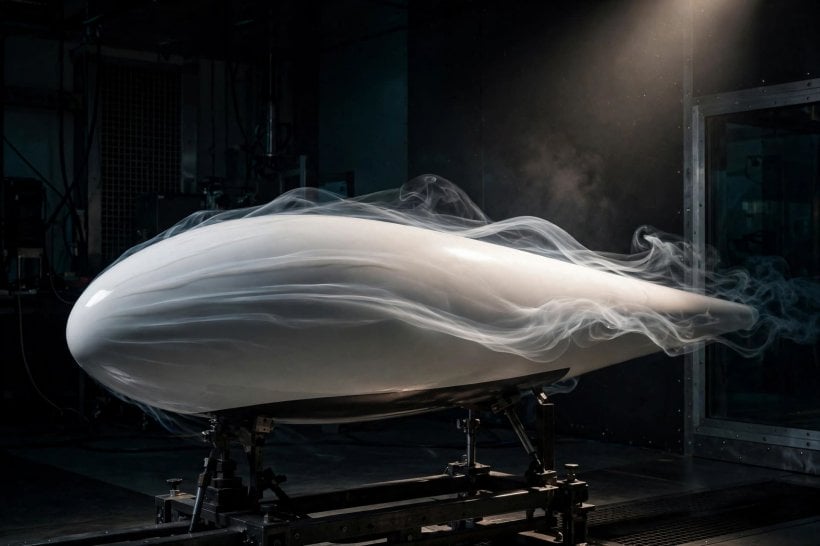
The result is speed out of all proportion to effort: a 25–30 mph cruise on 150W of human power plus assist, roughly doubling the ordinary bicycle’s 15 mph on similar legs. Energy use falls to 8–15 Wh per mile, the lightest figure of any electric vehicle. The lesson the whole design teaches is that aerodynamics beat power — the shell matters more than the motor, because a watt saved by shape is saved at every speed, forever, for free. The shape is the engine; everything else is accessories.
6. The Human-Electric Drive: Pedals Plus 250–750W of Assist
The drive is a partnership. The human pedals — always; a velomobile is a pedal vehicle first — and an electric motor assists, typically between 250W and 750W. That human-electric hybrid arrangement is the machine’s modern identity: the rider supplies the base load and the steering, the motor supplies the margin that flattens hills and holds the cruise into headwinds. The balance between the two sides of the partnership — how much the legs give, how much the motor gives, and what each does to the other — is examined in human power versus electric assist.
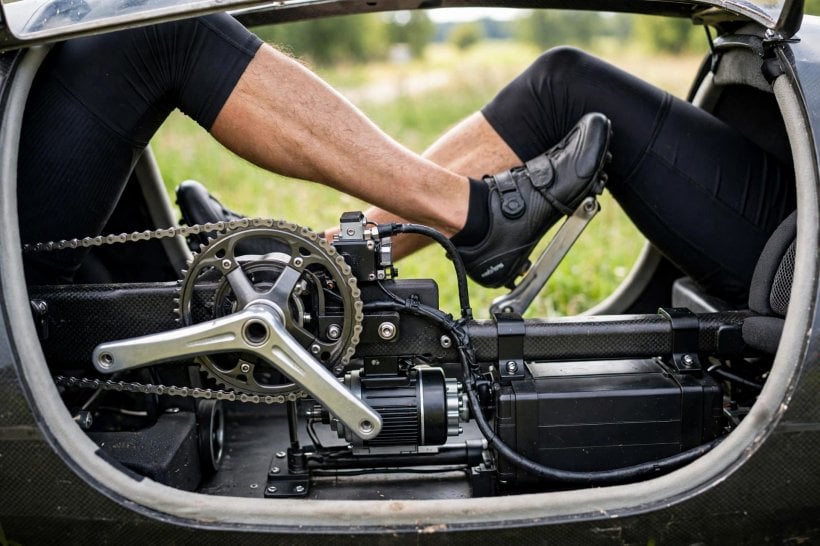
The classification consequence is as important as the mechanical one. Because the machine is pedal-driven with a modest assist motor, it is bicycle-classified — it lives in the bicycle’s legal world rather than the motorcycle’s or the car’s. No different licence regime, no separate vehicle category: the most car-like bicycle ever built is, to the law, a bicycle. That status is a large part of the design’s elegance. The shell gives car-like speed and weather protection; the drivetrain keeps bicycle-like simplicity and bicycle-like rights.
7. The Family: Sport, Utility, Four-Wheel, DIY and Tandem
One definition, several species. The classic branch is sport and touring: machines like the Quest, the Milan and the DF — the fast ones, built for long distances, priced at $7,000–12,000. The utility branch is the practical one: cargo-capable models with a box, built as commuters and load-carriers rather than record-chasers. The four-wheel branch is the PodRide class — the enclosed quad, car-like in its stance and its stability, the member of the family that looks least like a bicycle and behaves most like a tiny car.
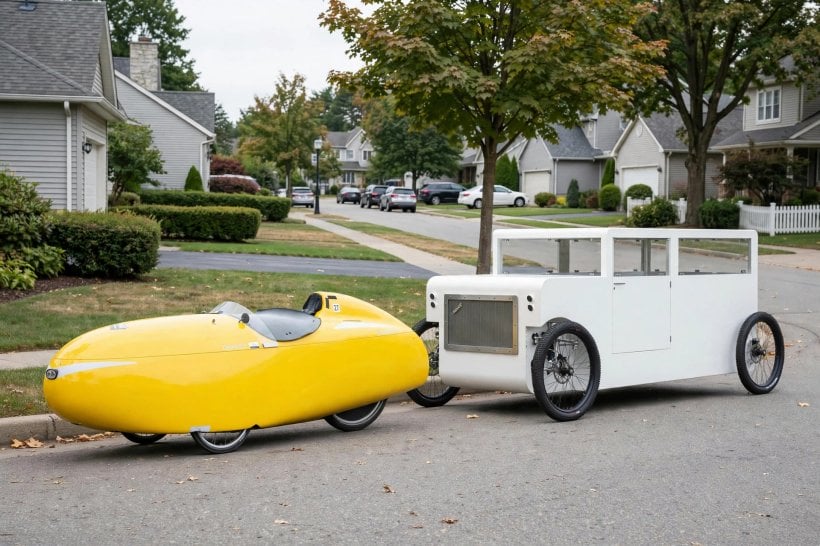
The DIY branch honours the homebuilt tradition directly: the coroplast build, a shell for about $500 folded and fastened over a trike you already own — the route detailed in the guide to building a velomobile from a DIY kit. And at the edge of the family sits the tandem: the rare two-seat machine, the social, exotic branch, built in tiny numbers for riders who want to share the shell. Every branch keeps the same anatomy — reclined trike, teardrop shell, pedals with assist — and varies only the emphasis: speed, cargo, stability, price, company.
The utility branch deserves a second look, because it is where the family quietly stops being a sport. A cargo-capable shell with a box turns the commuter specification — enclosed, weatherproof, efficient — toward errands and loads: the school run, the shopping, the work kit, carried dry at bicycle energy. It is the least glamorous branch and arguably the most consequential one, because a machine bought to replace car trips rather than to chase records is the machine the design was always, underneath the streamliner romance, for.
8. The Riding Experience: The Armchair, the Cocoon and the Trade-Offs
From the seat, the first surprise is comfort. The reclined, suspended riding position is an armchair: no saddle sores, no weight on the wrists, an all-day posture that upright cycling cannot offer. The second surprise is the weather cocoon. Rain and cold, the two forces that end most cycling seasons, are defeated by the shell — the rider stays dry inside it, which is why winter riders treat the velomobile as the season-proof option, a point the winter commuting guide for velomobiles and e-bikes develops in full. The third surprise is speed itself: 30 mph on the flat, a car’s pace, arriving with a grin the original literature is unembarrassed about.

The trade-offs are real and are managed rather than denied. Visibility is the standing one: the machine is low, so its riders run flags and lights and ride with heightened traffic awareness. And there is the attention — the celebrity. A velomobile rider answers questions at every stoplight, becomes an ambassador for the design whether they planned to or not, and generally counts it as part of the joy. The experience, assembled, is a vehicle that feels like a bicycle’s economy wearing a car’s composure — and turns every commute into a small public exhibition.
9. The Future: Standardised Assist, Lighter Shells, Clearer Rules
The trajectory from here is visible in five directions. E-assist is standardising: machines now ship electrified as a matter of course, with the 250W norm anchoring the bicycle classification. Materials are lightening: carbon is trickling down from the flagship machines, and the 50-lb velomobile is the industry’s visible target. Regulation is clarifying around the bicycle-classified status — the position mapped in the velomobile regulations and bike-path legality guide — and infrastructure is bending trike-friendly, with wider lanes arriving on the cargo-bike boom’s coattails.
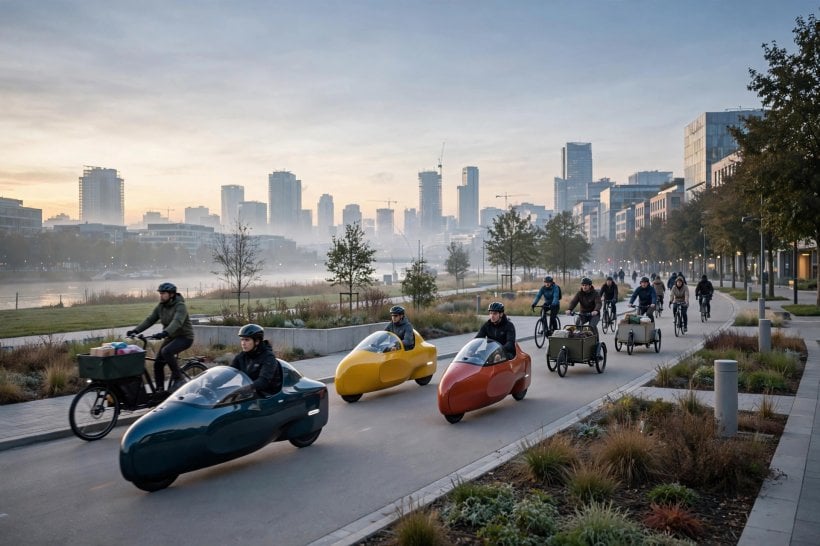
The market argument underneath all of it is arithmetic. As a car replacement, the velomobile’s economics compound: the five-year savings against running a car are put at $35,000, which is why the growth case is usually stated as a matter of time rather than taste. The velomobile’s future, in other words, is not a new invention waiting to happen; it is the steady mainstreaming of an old one — the same shell, the same physics, filed under the wider family of sustainable micro-mobility and finally priced, regulated and roaded for ordinary riders.
10. Getting Started: Test Ride, Buy Used, Buy New or Build
Entry begins with a test ride, and the advice is to treat it as essential: dealers and owners’ groups both offer them, and the try-before-buy rule exists because the reclined position converts some riders in a minute and leaves others cold. Buying used is the value route — $3,000–6,000 through the forum classifieds, a depreciation gift from the small market’s thin demand. Buying new is the factory route at $7,000–12,000, with the warranty and the current shapes; the full ownership picture behind those tickets is set out in the cost of owning a velomobile.
Building is the fourth route: $1,000–4,000 for a DIY machine, coroplast shell and all — the winter project, and the direct descendant of the 1970s homebuilt tradition. Whichever route you take, the last step is the community: the forums and the clubs, where the accumulated knowledge of a small, devoted ridership lives. And the reason to bother with any of it is the figure that opened this guide: at 8–15 Wh per mile, the velomobile’s footprint undercuts every motorised alternative, as the comparison in the environmental impact of velomobiles versus electric cars shows in detail.
Final Considerations
The velomobile is the bicycle perfected by physics: the recumbent trike’s comfort, the shell’s aerodynamics, the motor’s hill-flattening, delivered at 1/25th of a car’s energy. Born from 1930s streamliners, matured through Dutch workshops, electrified for the modern commute, the human-electric hybrid is not the future’s curiosity — it is the present’s best answer to the second car. If you ride one, you will be stared at, questioned at stoplights, and dry when you arrive. That is the whole review, and it has been true for ninety years.




8 Comments