

Walk past a shagbark hickory after a wind and you will find the craft store restocking itself: long curling slabs of bark, free for the taking, textured like nothing manufactured. Bark is the most overlooked craft material in the woods — lightweight, beautiful, and lying on the ground waiting. This guide takes it from forest floor to finished piece.
1. Tree Bark Crafts at a Glance
Tree bark crafts begin with a simple discipline: the material is gathered, never taken. Bark — the tree’s skin, shed in slabs by shagbark hickory and peeled in sheets from birch — is a craft material hiding in plain sight. Lightweight, textured and free, it becomes baskets, wall art, fire starters and garden accents, and each species brings its own form to the bench: hickory gives the slab, birch the sheet, pine the chunky plate and cedar the fibrous strip. Work through the table below for the whole craft on one screen, then read on for the harvesting rules, the classic projects and the preserving routine that keeps bark beautiful for years.
| Attribute | Detail |
|---|---|
| Material | Natural bark — the tree’s shed outer skin, reused |
| Bark Types Covered | Shagbark hickory, birch, pine, cedar and willow |
| Source Rule | Ground-fall and dead trees only — never strip a living tree |
| Signature Bark | Birch — the papery sheet bark, the classic craft material |
| Drying | Pressed flat between weighted boards for 2–4 weeks |
| Pest Treatment | 200°F oven for 2 hours, or freeze for a week |
| First Projects | Birch bark ornaments and fire starter bundles — the 1-hour makes |
| Basket Build | Folded birch bark, stitched with spruce root or twine — the 2-hour craft |
| Cordage Skill | The reverse twist — a 10-minute skill |
| Finish | Usually none; a light matte sealer for handled pieces |
| Storage | Dry, flat and dark — pressed sheets keep for years |
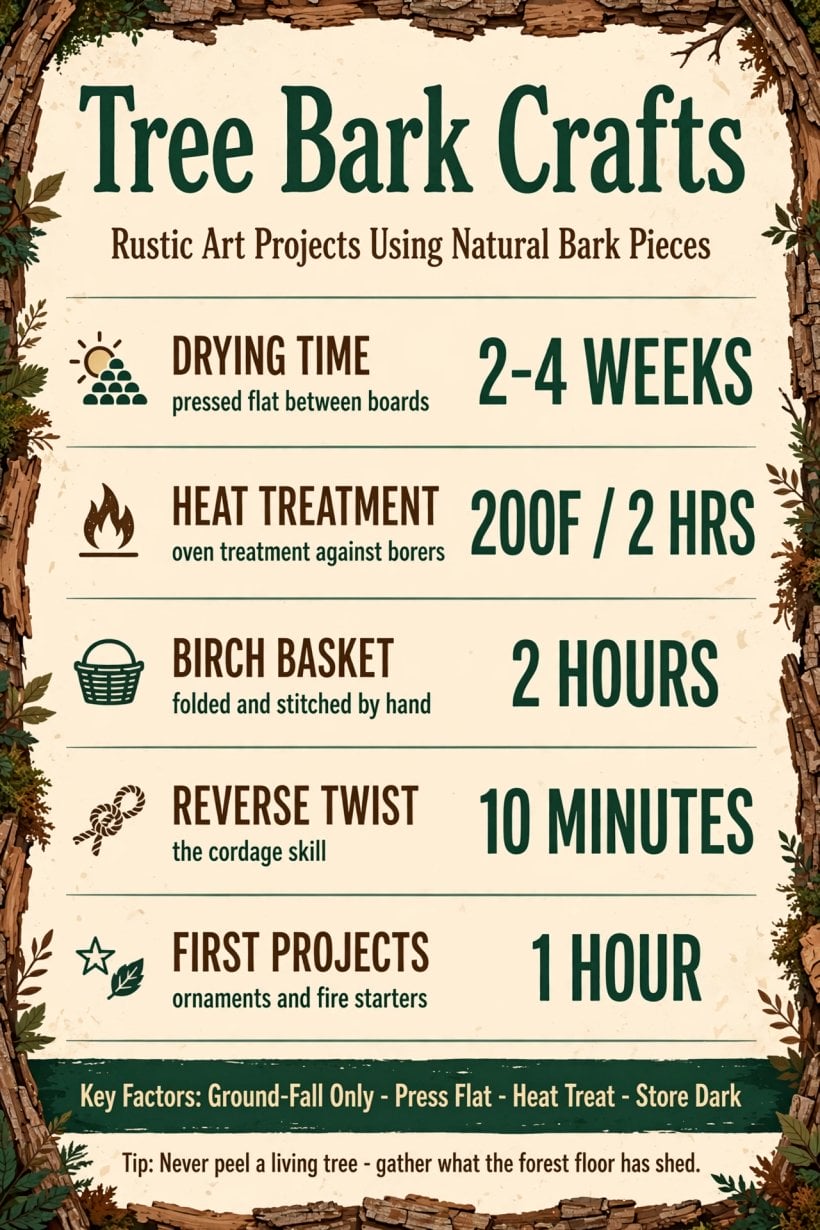
The craft in numbers: pressing and drying times, the heat treatment, and the basket and cordage benchmarks behind the projects below.
2. Harvesting Bark: Species, Forms and the Ground-Fall Rule
Every bark project starts on the forest floor, and the first skill is knowing which tree shed what. Shagbark hickory is the premier craft bark: its long curling plates shed naturally, so the supply gathers itself — walk the ground after a wind and pick up the slabs the tree has already let go. Birch is the sheet bark, peeling in papery sheets from dead or downed trees; it is the waterproof bark of the classic crafts, and the rule around it is absolute — never peel live birch, because stripping the sheet kills the tree. Pine gives the chunky form: thick plates from dead pines, the rustic puzzle-piece bark that suits bold, rough work. Cedar gives the fibrous form: long strips that serve as the weaving bark and the cordage bark. Willow joins the list in spring, when its bark slips and turns flexible for weaving.
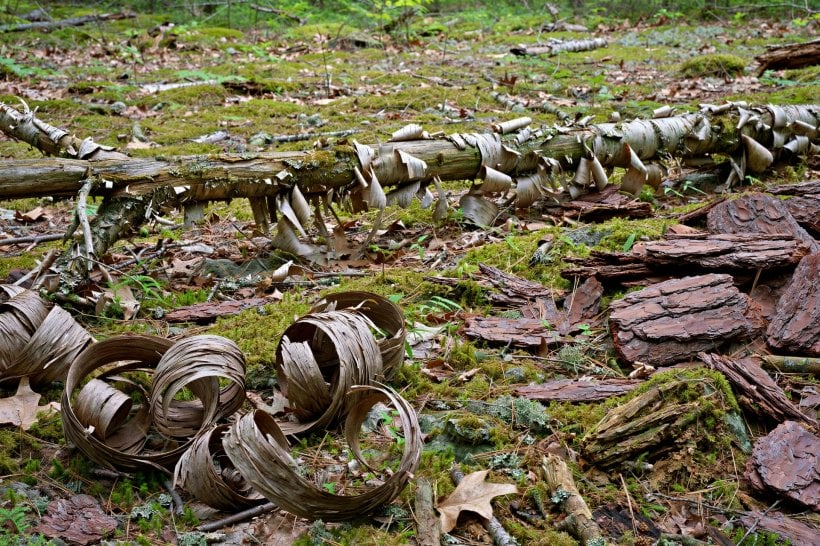
The ethics underneath all of it are one sentence long: ground-fall and dead trees only. Bark harvest never harms a living tree, because the forest floor is the supply. Read the ground before you gather from it: take the pieces that have come away clean and dry, leave the sodden and crumbling ones to finish returning to the soil, and leave some sound bark behind you as well — the floor you are gathering from is also shelter and food for the life of the wood, and a light hand keeps the supply renewing itself. A gathering walk needs no kit beyond a bag and your eyes: the species announce themselves by form, curl for hickory, sheet for birch, plate for pine, strip for cedar, and sorting by form as you walk means the pieces arrive home already organised for the press.
It is the same ethic that governs the wider world of fallen-wood making — the branches gathered for fallen limb crafts and the deadfall given a second life in fallen log landscaping both work because the wood was already down. Gather with the season in mind: willow slips in spring, birch sheets come from deadfall whenever you find them, and hickory slabs are at their best fresh off the ground after weather has loosened them. What you bring home goes straight into the preserving routine of section 8 — pressed, dried and heat-treated — before it ever reaches the craft bench.
3. Birch Bark: Baskets, Canoe Miniatures, Ornaments and Fire Starters
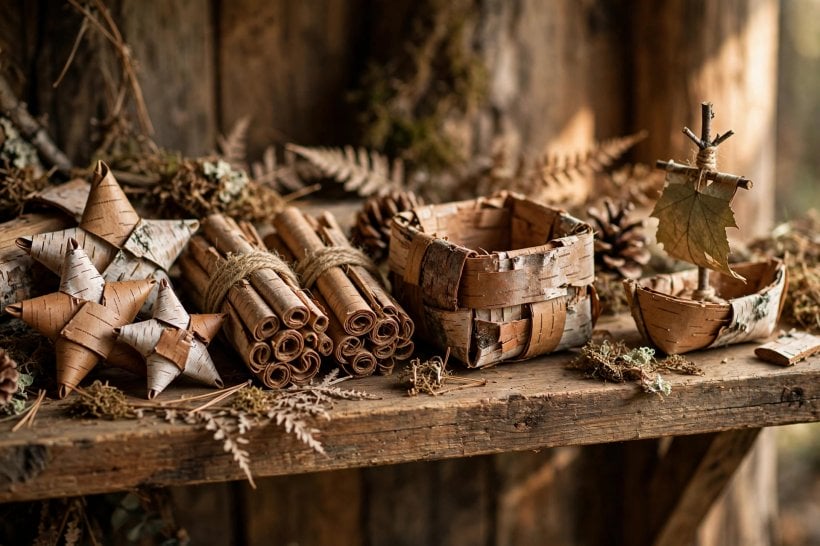
Birch bark is the classic craft bark, and it earns the title on versatility. It folds like heavy paper, cuts cleanly with scissors, and carries natural oils that make it useful far beyond decoration. The folded container is its signature make: a sheet folded into the traditional berry basket and stitched with spruce root or twine — the 2-hour craft, and the project most makers start with. The birchbark canoe in miniature is the iconic heritage piece, a folded hull that carries the whole tradition of the material in one small object. Ornaments are the quick win: stars and shapes cut from the papery sheets, clean-edged and light — the Christmas craft. And the fire starter is the practical classic: birch bark’s oils ignite even when damp, so shavings catch a spark and a strip of bark becomes the legendary tinder, the survival essential every kit should hold.
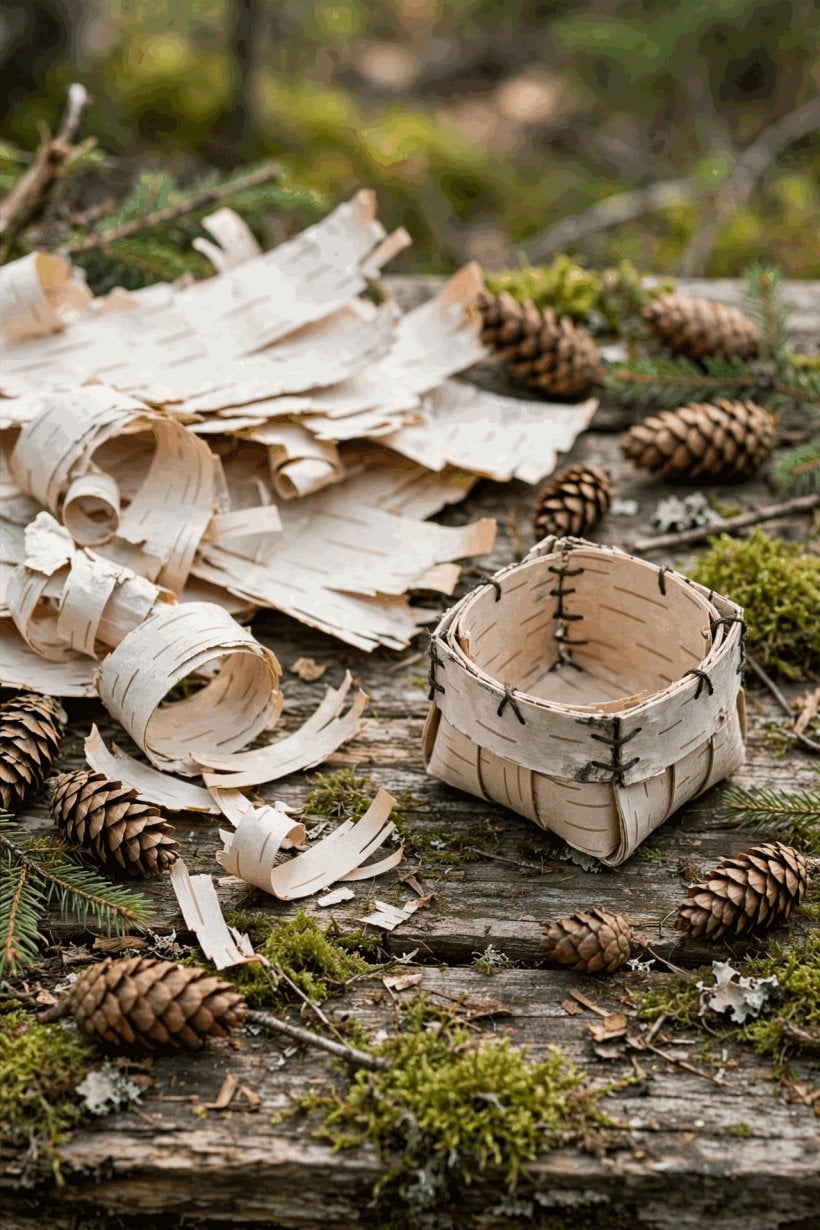
Birch rewards flat, careful storage between projects. Keep the sheets pressed between boards — the bark library — and they keep for years, ready to fold, cut or shave whenever a project calls. Work the sheet while it is supple, stitch rather than force the folds, and let the pale, papery surface stay the visible face of the piece: with birch, the material itself is the decoration.
4. Bark Art: Mosaics, Frames and Sculpture
In bark art, texture is the medium. The wall art form is the bark mosaic: pieces arranged on a backboard into a texture collage, the shades and ridges of different barks doing the work that paint does elsewhere — the natural abstract, built from whatever the last walk brought home. Frames take the opposite approach: slabs used as the frame itself, bark-edged frames around a mirror or picture, the rustic border carrying as much character as the image inside it. Sculpture is the assembled form, bark pieces joined into shapes — animals, abstracts — with hot-glue or wire construction holding the forms together. All three share one finishing rule: usually none. Bark’s texture IS the finish, so art pieces are left raw; only handled pieces get a light matte sealer, a protection that stays invisible.
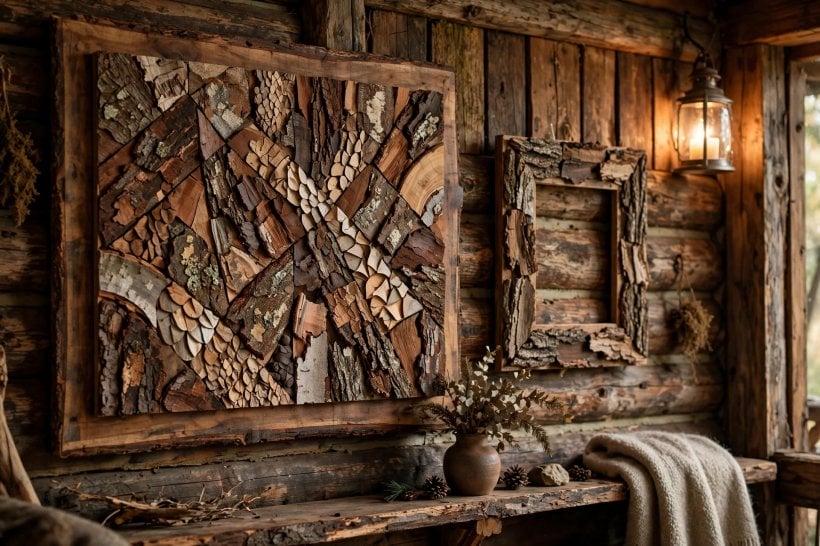
Mosaic work is where a mixed bark library pays off — pale birch against dark pine plates, curled hickory against flat cedar. Sort pieces by tone and relief before you glue anything, lay the composition out dry on the backboard, and build from the flattest pieces outward. If you enjoy what bark does on a wall, the same rustic instinct runs through log craft ideas for the home — candle holders, coasters and decor cut from the wood the bark once covered.
5. Bark Planters and Containers: Slabs Formed Into Pots
Bark containers work in two families. The first is the folded family from section 3: birch sheets folded and stitched into baskets and berry containers, light and waterproof by nature. The second is the formed family: slabs shaped into pots — bark planters lined with plastic, the woodland planter that lets a fern or a potted herb sit inside a curl of tree skin. Choose the slab for the job: a natural curl holds its own shape and needs little more than the liner, while flatter plates can be bent and joined around a form. The liner matters — it keeps soil moisture off the bark’s inner face and turns a decorative shell into a working pot.
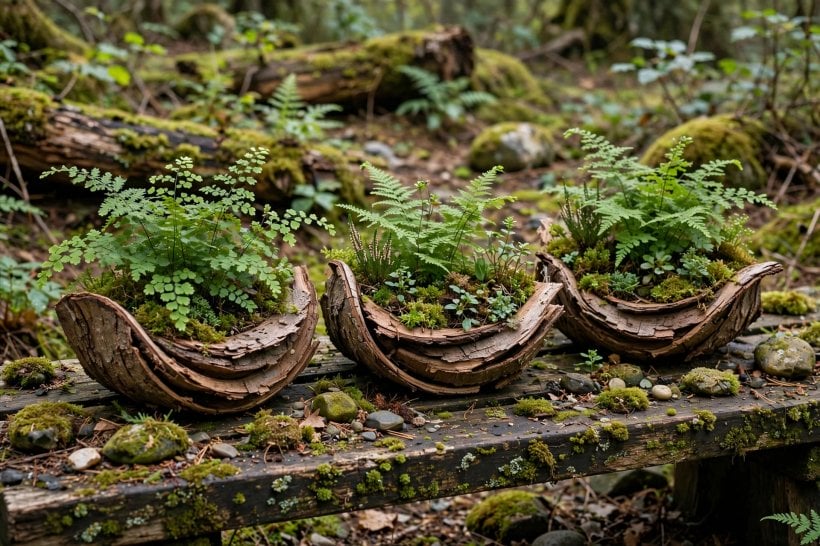
Planters are also where bark craft meets the wider garden workshop. A bark pot beside a hollowed log planter reads as one family — compare the approach in creative log planters, where logs are hollowed and tiered into containers, and mix the two for a bench of planters that ranges from solid log to pure skin. Keep bark planters where their texture shows: on the bench, along the path, at the woodland edge of the bed.
Containers repay a little ceremony. Group them in odd clusters rather than rows, let a tall curled slab stand behind flat folded pots, and repeat one plant across several bark forms so the bark — not the planting — becomes the variation. Because the liner carries the soil and the moisture, the bark itself stays a shell: when a shell finally tires after its seasons outside, it goes to the mulch pile and a fresh slab from the archive takes its place, which is the whole economy of this material in one gesture.
6. Garden Uses: Mulch, Path Edging, Markers, Birdhouses and Hugelkultur
The garden takes whatever bark the bench cannot use, and takes it gladly. Mulch is the obvious use: bark chips, the standard mulch — the moisture keeper and the weed suppressor under everything else you plant. Path edging is the rustic use: bark slabs set on edge along paths, a woodland border that costs nothing but the walk that gathered it. Plant markers are the charming use: bark pieces carrying wood-burned names, the labeled garden in its most literal form. Birdhouses take bark as siding — slab bark on a birdhouse is camouflage and rustic finish in one, and the birds approve. And hugelkultur takes the leftovers as filler: bark in the hugel layers, the carbon in the decomposition that feeds the bed.
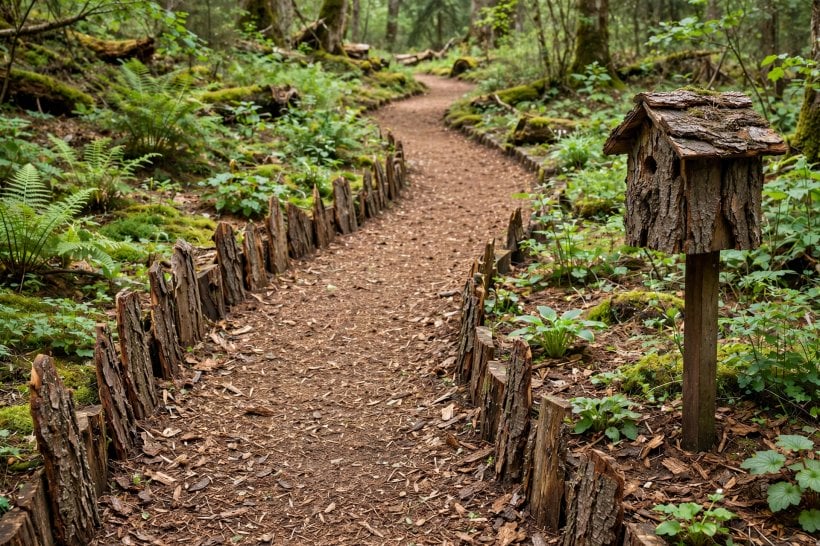
The hugel connection runs deeper than scraps: bark layered into a hugelkultur raised bed breaks down alongside the logs at its core, and the same garden logic shapes the bigger timber work in log projects for outdoor furniture and garden planters. Work down the value ladder — bench first, garden second, mulch last — and almost nothing you gather goes to waste.
7. Bark Cordage: Cedar Fiber, the Reverse Twist and Weaving
Cordage is bark’s fiber craft, and cedar is the cordage bark: inner bark strips, the strong fiber, twisted into rope the traditional way. The technique is the reverse twist — two strands twisted against each other so the rope locks itself together — the rope-maker’s method, and a 10-minute skill once your hands learn the rhythm. The uses start in the garden: bark twine is the biodegradable tie, the plant support and the rustic lashing that disappears back into the soil when its work is done. The same strips weave: bark weavers work the flat fiber into mats and baskets, the woven containers standing alongside the folded birch ones as the second great container tradition. Willow is the seasonal partner here — its bark slips in spring, the weaving season, when the strips come away flexible and ready.
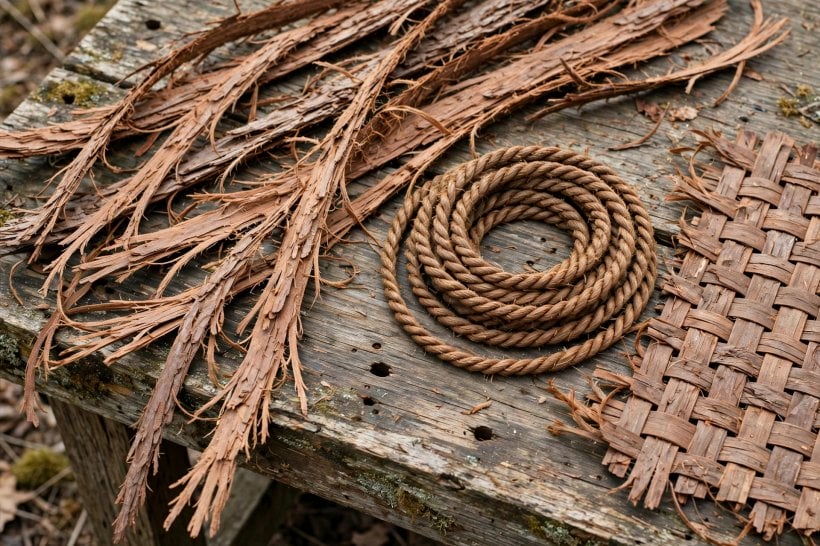
Practice the twist on short offcuts first. Keep both strands under even tension, roll each one the same way before crossing them, and the rope will hold its twist instead of springing open. A coil of finished cordage on the bench is garden twine, lashing and basket edging in waiting — the most useful ten minutes in the whole craft.
8. Preserving Bark: Pressing, Heat Treatment and Dark Storage
Bark arrives curled, damp and occasionally inhabited, so preserving is where craft bark is actually made. Drying comes first: press the pieces flat between boards, weighted, for 2–4 weeks — the curl prevention that turns a scroll into a sheet you can fold, cut and glue. Insects come next, because borers ride home in gathered bark: the heat treatment is a 200°F oven for 2 hours, the insurance that kills them; freezing for a week is the alternative where the oven is impractical. Finish follows the rule from the art section: a matte sealer for handled pieces, the protection; art pieces are often left raw. Storage closes the routine — dry, flat and dark, the bark archive — because UV fades birch bark’s contrast, and dark storage keeps the pale sheets pale.
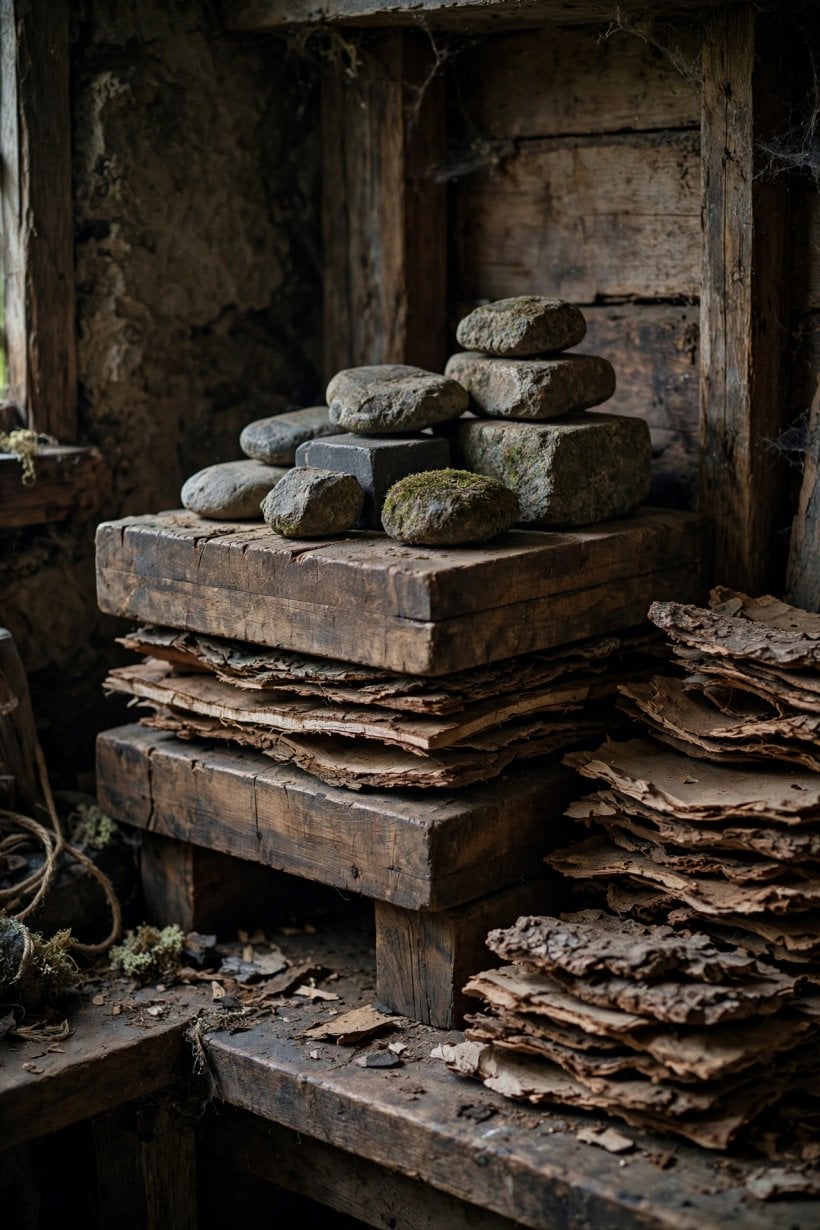
The routine mirrors how solid wood is handled before it is worked: the drying patience here is the same discipline behind curing and drying wood logs, and the matte sealer choice is the light-touch end of protecting outdoor log crafts. Press every new gathering the day it comes home, heat-treat before it joins the archive, and your bark library will hold flat, clean, ready stock for years.
9. The Project Portfolio: Beginner, Intermediate, Advanced and Kids
The portfolio ladders cleanly by skill. Beginner work is birch bark ornaments plus fire starter bundles — the 1-hour makes, and the gifts: stars cut with scissors, tinder bundles tied with your first cordage. Intermediate work is folded baskets plus bark frames — the weekend builds, the functional art that teaches folding, stitching and edging in two projects. Advanced work is bark mosaics plus woven containers — the statement pieces, the gallery work, where composition and patience replace new techniques. Kids get the classic: bark boats, the floating craft — a bark slab, a twig mast and a leaf sail — the creek classic, the childhood memory built in minutes. And the collection itself becomes a project: the bark display, framed bark specimens on the wall — the natural history, the wall of texture that shows every species you work with.
Climb the ladder in order and each rung teaches the next: ornaments teach cutting, baskets teach folding, frames teach joining, mosaics teach composition. Keep one beginner project in every batch you make — the 1-hour gifts are what turn a private hobby into presents, and presents into requests.
10. Matching Bark to Project: Form, Season and Finish
Choosing well is mostly matching the form the tree already gave you. Take the slab where the project is bold and structural — hickory plates for edging, frames and planter shells, pine chunks for rustic siding and chunky mosaic work. Take the sheet where the project folds, cuts or stitches — birch for baskets, ornaments, canoe miniatures and tinder. Take the strip where the project twists or weaves — cedar for cordage and woven containers, willow in its spring season for flexible weaving stock. Then match the finish to the handling: raw for wall pieces and displays, a light matte sealer for anything hands will hold, and no finish at all for garden work that is meant to return to the soil. Season steers the calendar: gather hickory after wind, slip willow in spring, and press and treat everything the week it comes home so the archive is always ahead of the bench.
Keep the library sorted the way you choose: slabs with slabs, sheets pressed in their stack, strips coiled and hung. A sorted archive turns matching from a search into a glance, and it shows you at a glance which form is running low — which is simply the forest telling you which walk to take next.
Final Considerations
Gather only fallen bark — never strip the living — press it flat and heat-treat it against insects, fold the birch into baskets, mosaic the slabs into art, twist the cedar into cordage, mulch the garden with the rest, and float a bark boat for the kids. Bark is the tree’s gift after the timber is taken: the material that asks nothing but attention, and repays it in texture.




0 Comments