

After every windstorm, the woods are littered with the most accessible craft material on earth — and most of it goes to the brush pile. Branches and twigs ask for nothing but hand tools and an afternoon: a trellis, a rustic chair, a garden obelisk, all from wood that cost exactly zero dollars. The forest restocks the supply for free.
1. Fallen Limb Crafts at a Glance
Fallen limb crafts are the craft of the forest’s smallest timber: branches and twigs — the forest’s leftovers — worked with hand tools into furniture, garden structures, woven pieces and decor. The material is free, everywhere, and honest: what decides a piece is not the wood’s price but its character, its dryness and the joinery that holds it. Gather storm-fall and prunings, never cut live wood, dry before you build, join with mortises, screws or lashings, and finish for the outdoors — the whole craft in one sentence. The table gathers its attributes in one place; the sections after it take the gathering, the furniture, the garden structures, the decor, the weaving, the species, the tools, the drying and the finishing apart in turn.
| Attribute | Detail |
|---|---|
| The Material | Branches and twigs — storm-fall and prunings; free, everywhere, workable with hand tools |
| The Sources | Storm-fall after every windstorm (gather within days); fruit-tree prunings, straight-ish at 1–3″ diameter |
| The Ethic | Deadfall and prunings only — never cut live branches for crafts |
| The Furniture | Twig chair (the weekend build), the 2-hour side table with its 16″ cookie top, tiered plant stands |
| The Structures | Pea sticks, twig obelisks of 5–7 branches (the 20-minute build), wattle edging, arbors, hurdles |
| The Weaving | Willow whips of 1-year growth, 6–8 ft; stake-and-strand baskets; the living willow fedge |
| The Joinery | Mortise and tenon, or screwed — 2.5″ exterior screws, pre-drilled; lashings of tarred twine or wire |
| The Kit | Pruning saw, loppers, secateurs, drawknife, spokeshave, drill, chisels, mallet — under $150 total |
| The Drying | 3–6 months stickered, ends sealed — small diameters dry fast but check fast too |
| The Finish | Spar varnish or oil for outdoor pieces; small pieces take a 10-minute dip |
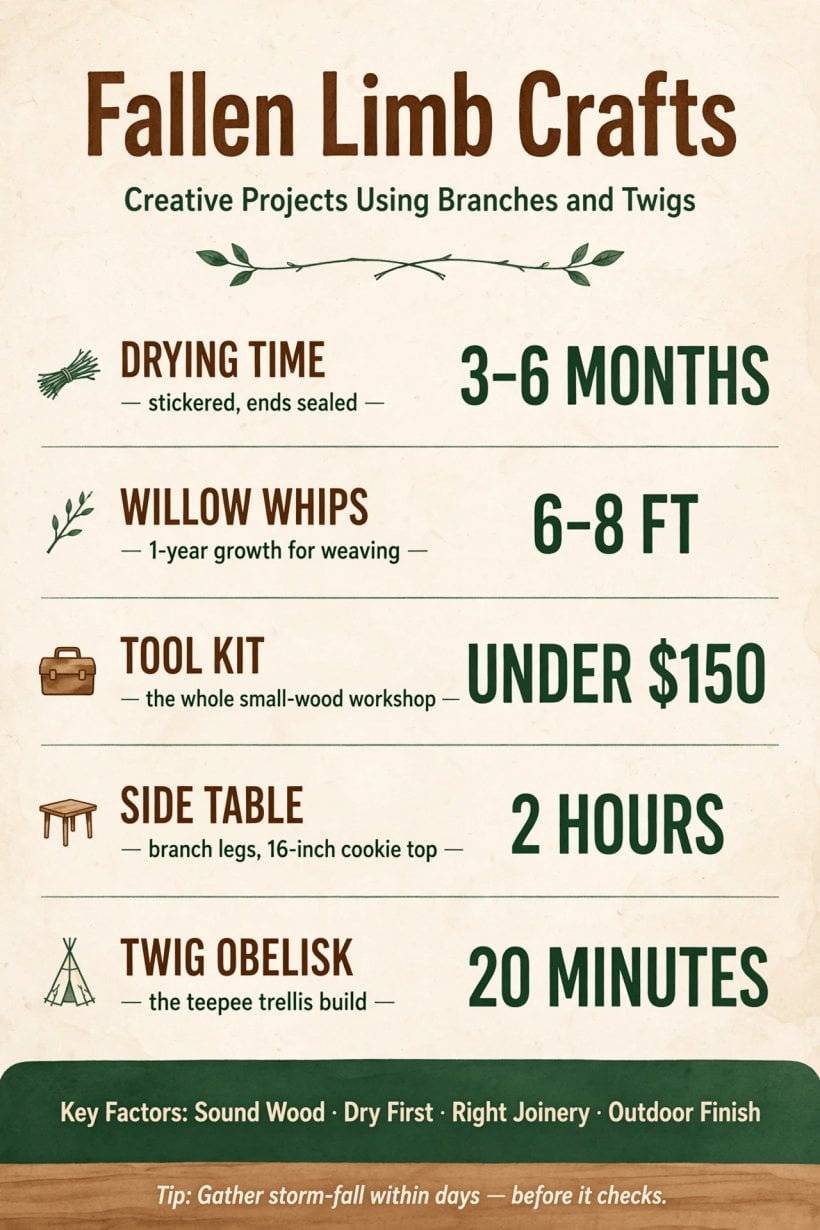
Three to six months of drying, six-to-eight-foot willow whips and a whole workshop under $150 — the small-wood craft on one card.
Read the table as a workflow rather than a catalogue. The source decides the schedule — storm-fall waits for no one, and prunings arrive once a year with the orchard’s cut. The species decides the project — dense hardwoods for furniture that must last, flexible willow for anything woven. The drying decides the calendar: nothing gets built green that is meant to hold a joint. And the joinery decides the strength, because a branch is only ever as useful as the connection at its end. Get those four decisions right and the projects themselves are the easy part.
2. Harvesting: The Ethical Gathering
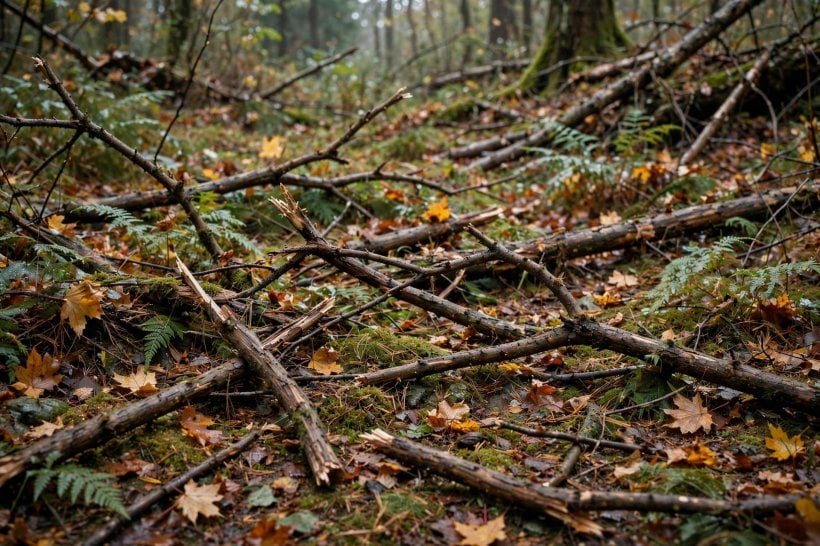
The primary source is storm-fall. After every windstorm, the woods are littered — the free harvest — and the gathering has a deadline: collect within days, before the fallen wood checks as it starts to dry where it lies. What the storm brings down is yours for the carrying, in whatever shapes the wind chose: the forked, the curved, the gnarled. Selection at the gathering stage is the craft’s first design decision, because character is the material. Straight branches are for structures; crooked ones are for art — a forked limb is a pea stick or a chair back waiting to be recognised, and a gnarled piece no sawmill would touch is exactly what a wall arrangement is made of.
The second source is the garden’s own yield: prunings. Fruit-tree prunings — the annual cut — give straight-ish branches of 1–3″ diameter, the orchard’s byproduct, in the sizes most furniture and structure work asks for. Between storm-fall and prunings, the supply renews itself without a single purchase. And the ethic that governs both sources is absolute: never cut live branches for crafts. Deadfall and prunings only — the living tree’s limbs aren’t yours to take. The rule costs the craftsperson nothing, because the dead wood is the better material anyway: seasoned by the tree’s own letting-go, and free of the guilt and the sap of a live cutting.
3. Twig Furniture: The Rustic Classics
The twig chair is the craft’s classic — the Adirondack’s wild cousin: a branch frame with a twig back, joined with mortise-and-tenon or screws, and sized as the weekend build. It is the piece that proves the material: a chair asks for strength at every joint and comfort in every curve, and branches supply both when the frame is chosen from sound, straight stock and the back from pieces with a natural bend. Beside it sits the fastest furniture in the guide — the side table: four branch legs and a cookie top, the 2-hour table, its top a 16″ wood cookie of the kind cut and finished in the guide to slicing wood cookies without cracking. The plant stand completes the trio: tripod legs under a small top, tiered with three legs and progressively smaller tops — the fern stand.
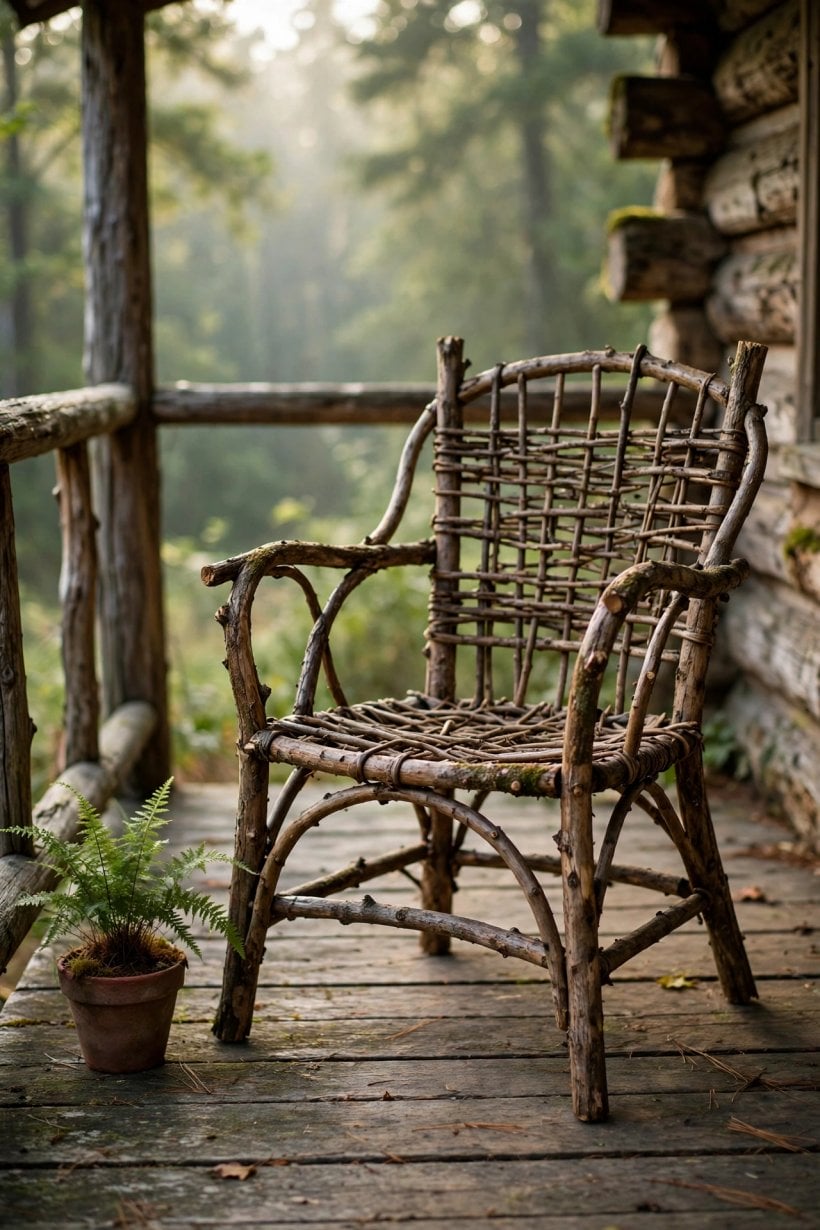
Joinery is where twig furniture earns its sturdiness. The traditional joint is the mortise and tenon — drill and chisel work, the pegged connection that has held rustic furniture together for as long as the craft has existed. The practical joint is the screw: 2.5″ exterior screws, always pre-drilled, because a branch end splits under a screw driven dry. Either way, the furniture belongs to the same timber family as the rustic log cabin bench — the bench works the trunk, the chair works the limbs, and the two read as one set on a cabin porch. The finish for outdoor pieces is spar varnish or oil, applied on the systems set out in the guide to protecting outdoor log crafts; the finish question returns in full in §10.
4. Garden Structures: Branches at Work
In the garden, branches go to work at the scale of the growing season. Pea sticks are the original trellis: forked branches pushed into the ground that peas climb as they have climbed them for centuries — the zero-cost support, and the cottage garden classic. The twig obelisk is the teepee trellis: 5–7 branches tied at the top for beans, clematis and morning glories — the 20-minute build, and the garden’s cheapest vertical accent. Wattle edging weaves the border: stakes driven in a line with flexible whips woven between them — the medieval technique — edging beds beautifully in willow or hazel whips.
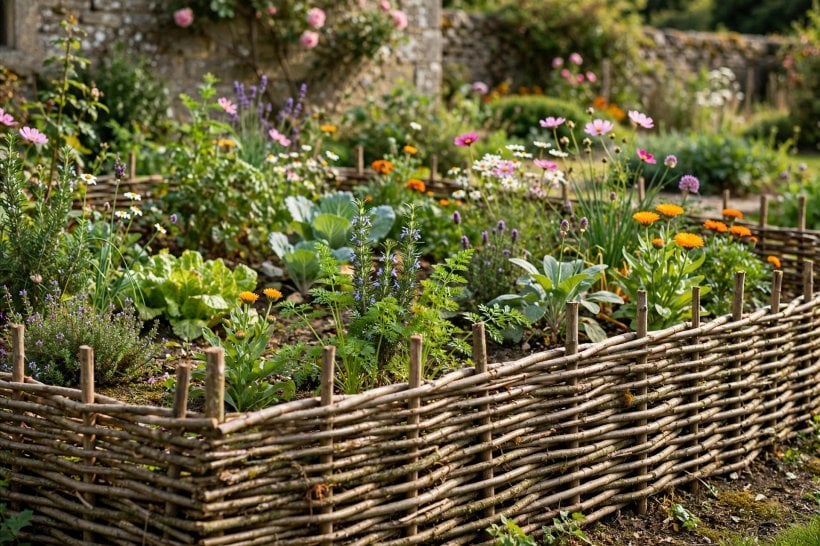
Two structures scale the idea up. The arbor is the branch arch — two posts and a curved top — the twig arbor, lighter and more delicate than the log version built in the rustic log arbor guide, and the right weight of structure for a garden path rather than a property entrance. And the fence is the twig hurdle: woven panels, the English garden fence, a weekend weaving project that encloses a bed or a border with nothing but stakes, whips and patience. Every structure in this section shares one virtue — it is built from the garden’s own prunings, used in the garden, and when it finally tires it returns to the garden as compost. No other building material on the property completes that circle.
5. Decor: Twigs as Art
What furniture and structures don’t use, decor does — because the pieces rejected for straightness are the pieces with the character art wants. The wreath builds on a grapevine base dressed with accents: dried flowers and pinecones, the foraged decor, changing with the season because the accents do. Wall art is the sculptural use: interesting branches mounted on a backboard or hung as they are — the gallery twig, a single gnarled limb given the wall a painting would get. Mobiles turn branches kinetic: balanced limbs hung with stones and shells, driftwood-style hangings that move in the room’s air.
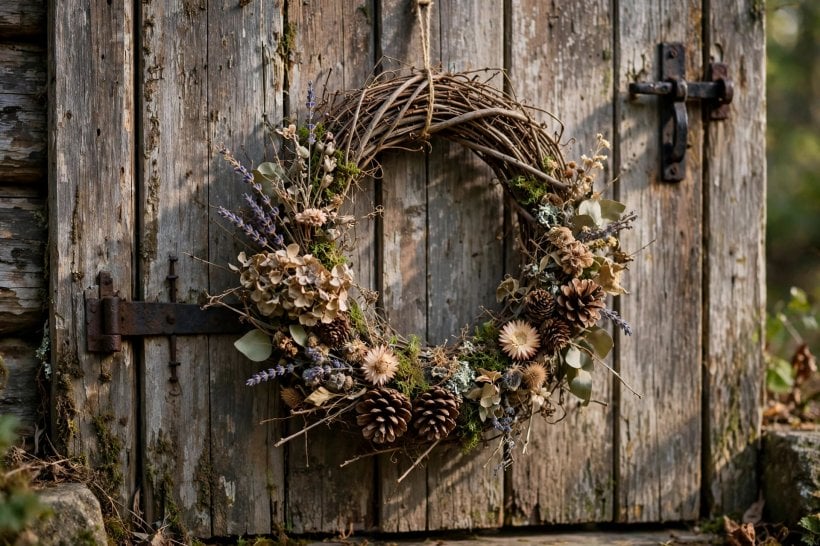
The smallest projects are the fastest. Candle holders bundle twigs around a glass votive — the 15-minute craft, and firelight through twigs is its own reward. Frames miter or overlap small branches into the twig frame, the technique shared with the mirror and frame work in the log craft ideas collection, where the trunk’s offcuts and the tree’s limbs meet in the same household craft. Decor is also the forgiving end of the craft: a wreath asks for no joint stronger than twine, a mobile for nothing but balance — the projects a beginner starts with on the first afternoon, while the furniture stock dries.
6. Weaving: Willow and Withies
Weaving is the branch craft’s oldest technique, and its material is specific: willow whips — 1-year growth, 6–8 ft long — the weaver’s rod. They are harvested in winter, when the willow is dormant, and soaked before weaving to restore the flexibility the rod grew with. The beginner’s project is the basket, built stake-and-strand: stakes set upright in a circle, weavers passed over-under around them — the 3-hour first basket, lopsided as every first basket is, and serviceable anyway. The woven obelisk is the deluxe trellis — willow woven into a cone — the garden jewelry version of §4’s tied obelisk, trading twenty minutes for an afternoon and a support that is itself ornamental.
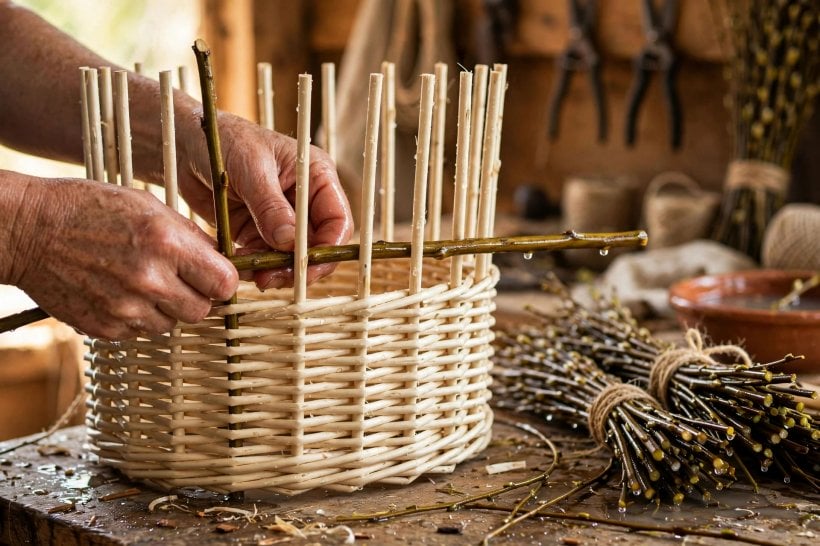
The living willow fedge is the technique’s marvel: a fence woven from living whips — plant the whips, weave them as they grow — the fence that roots, thickens and leafs out, a boundary that gets stronger every season instead of weaker. And the supply can be grown: a willow bed of 10 plants yields hundreds of whips yearly — the renewable craft supply, a small plantation that turns one winter’s planting into every future winter’s harvest of rods. Weaving rewards the calendar: cut in dormancy, soak before the session, and the material behaves like the craft’s oldest bargain — a plant that wants to be pruned, pruned into baskets.
7. Species and Selection: Hardwood to Last, Willow to Bend
Species decides what a branch can become. Hardwood branches last — oak, maple and hickory, the dense woods — and they are the furniture and structure stock, the pieces that will stand in weather. Willow and birch are the flexible pair, the weaving woods, bending without snapping because their fibres give. Matching species to project is the selection skill: a chair leg in willow would be a short-lived chair, and a basket woven from oak rods would never be woven at all. Within a species, shape selects the project, as §2 established — the forked, the curved and the gnarled are kept for their character, straight stock reserved for structures that must read true.
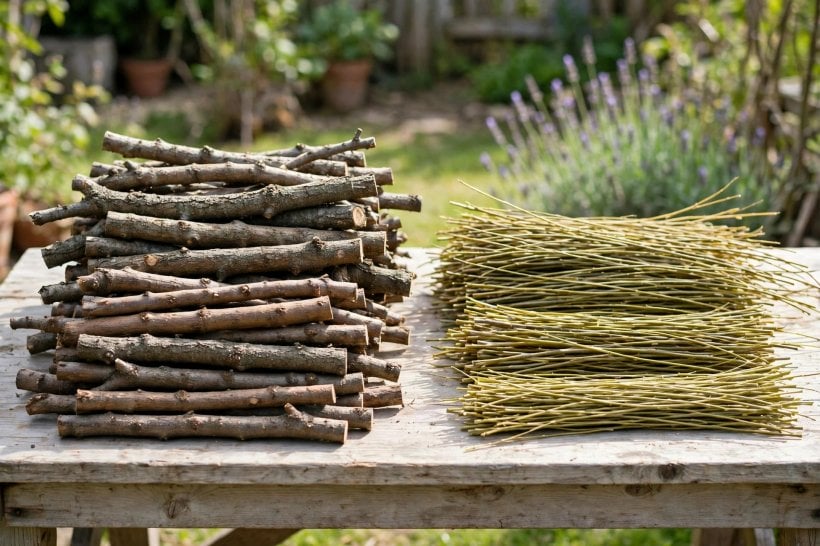
Soundness is the third selection test, after species and shape. The craft works deadfall and prunings, so every piece is auditioned: wood that is punky, soft or bored through goes to the brush pile it was rescued from, and wood that rings sound and feels dense for its size goes to the drying stack. The audition happens at gathering, not at the bench — there is no point stickering a branch for six months to learn it was compost all along. Gather generously, audition strictly, and the pile that reaches the workshop is all material.
8. Tools: The Small-Wood Kit
The small-wood kit is the cheapest workshop there is — hand tools, mostly, at under $150 total. Cutting is a trio: the pruning saw, the loppers and the secateurs, every branch diameter covered between them, from a whip the secateurs snip to a limb the saw takes. Shaping is two edged tools: the drawknife and the spokeshave — the peeling and smoothing pair — because bark comes off for furniture and stays on for rustic work, and both finishes start at the drawknife’s edge. The drawknife is shared with the shaping side of green wood carving, where fresh wood is worked with the same edge tools at bowl and spoon scale.

Joinery tools complete the kit: a drill and bits, chisels for the mortises, and a mallet to persuade them. Binding is the third fastener family beside mortise and screw: tarred twine, wire and screws — lashing for the rustic look, screws for strength, wire where a lashing must not weather loose. That is the whole inventory. No power tool is required at any point in this guide, which is part of the craft’s accessibility: the workshop fits in a bucket, travels to the wood instead of the wood travelling to it, and its entire capital cost is less than a single milled chair from a shop.
9. Drying and Preserving: The Small-Wood Rules
The first rule is the schedule: dry before building — 3–6 months stickered. Branches check fast: the small diameter dries quickly but unevenly, and a joint cut in green wood loosens as the wood shrinks around it. Stickering — stacking with spacers so air moves around every piece — plus sealed ends is the whole technique, and the discipline behind it is the same one worked at log scale in the guide to curing and drying wood logs: ends sealed against fast moisture loss, air on all sides, time doing the work. Bark is a decision, not a default: on for rustic decor — but bark harbours insects — and off for furniture, where the drawknife finish is the point.
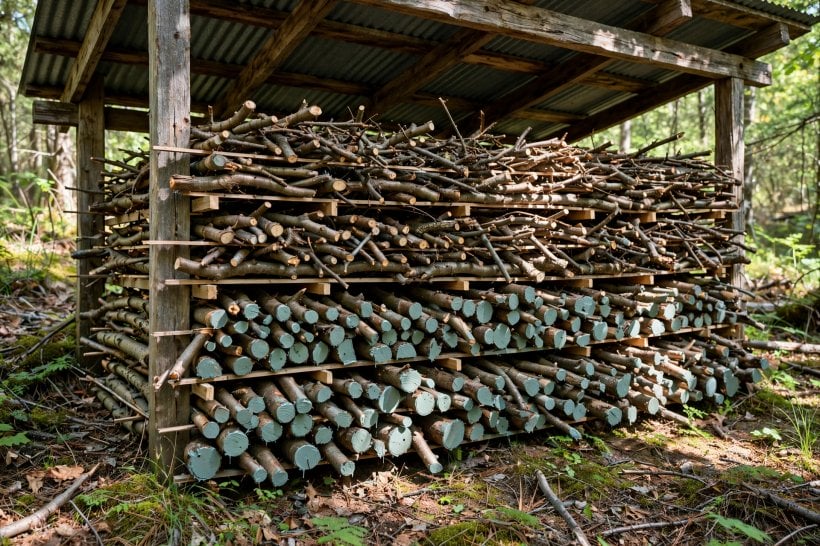
Storage keeps what drying achieved: dry and ventilated, the branch pile under cover. A pile left in the weather re-wets, moulds and undoes the six months — moldy branches are compost, not craft, and they go back to the garden without regret. The sizes work in the craftsperson’s favour here: small wood dries in months where logs take seasons, so a storm in autumn is furniture stock by spring, and the prunings of one winter are the weaving rods and chair legs of the next.
10. Finishing and Care: Keeping It Handsome Outdoors
The finish is the piece’s weather contract. Outdoor pieces get oil or spar varnish — the protection systems — because a twig chair on a porch and a hurdle in a border live in rain and sun that indoor decor never meets. Small pieces finish fast: the 10-minute dip, a small branch piece immersed and set to cure, is the efficient finish for decor-scale work. The full systems — which oils, which varnishes, and what each asks in re-coating over the years — are set out in the guide to protecting outdoor log crafts, and they apply to limbs exactly as they apply to logs, because the enemies — UV, moisture, end grain — are the same at every diameter.
Care after finishing is mostly placement and inspection. Bark-on decor lives best under cover, since the bark that gives the rustic look also shelters insects; furniture with its bark off and its finish on asks only for an eye once a season and a re-coat when the surface dulls. Pieces that tire — a hurdle after its seasons, an obelisk after its beans — are retired to the compost with the craft’s thanks, and replaced from the pile for nothing. The finished pieces belong on the porch and in the garden alongside the trunk-scale work of the log projects family — one timber, every diameter, nothing wasted.
Final Considerations
Gather storm-fall and prunings — never cut live — audition every piece for species, shape and soundness, dry it stickered for 3–6 months, and build: the twig furniture on mortises or pre-drilled screws, the garden structures tied and woven, the willow soaked and stranded, the gnarled pieces saved for decor. Finish outdoor work in oil or spar, store the stock dry, and let the failures compost. The branch is the tree’s afterthought — and the craftsperson’s opportunity. Nothing wasted, everything beautiful.




4 Comments