

A wooden garden gate is the smallest piece of architecture most gardens own, and the one touched most often. It clicks shut behind the shopping, swings open for visitors, and frames the first and last view of the planting every day.
These seventy-five ideas stay at garden scale throughout: pedestrian timber gates, the paths and beds around them, the climbers that dress them and the seasonal care that keeps them swinging sweetly. Good wood garden gate designs are never complicated — honest boards, sound posts and planting in sympathy.
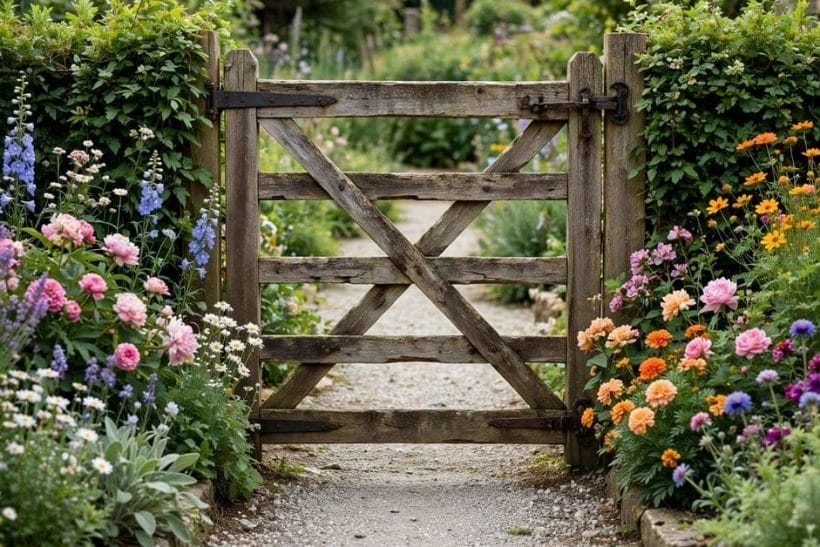
1. Wooden Garden Gate Ideas at a Glance
A timber garden gate succeeds as part of a small system: the leaf itself, the posts and fence it hangs in, the path that leads to it, the planting that frames it, and the care that keeps weather from winning. The five families below sort wood garden gate designs by character, so the right gate is easy to place.
For the wider family this post grows from, start with garden gates, which surveys gate settings across the whole garden.
| Family | Character | What it means |
|---|---|---|
| Ledged Timber | Sturdy boards with a cottage feel | Enduring |
| Arched Gates | A soft curve over the opening | Welcoming |
| Picket Gates | Low, open and friendly at the front | Friendly |
| Tall Privacy | Close boards for sheltered corners | Private |
| Planting Partners | Climbers and beds that dress the gate | Lush |
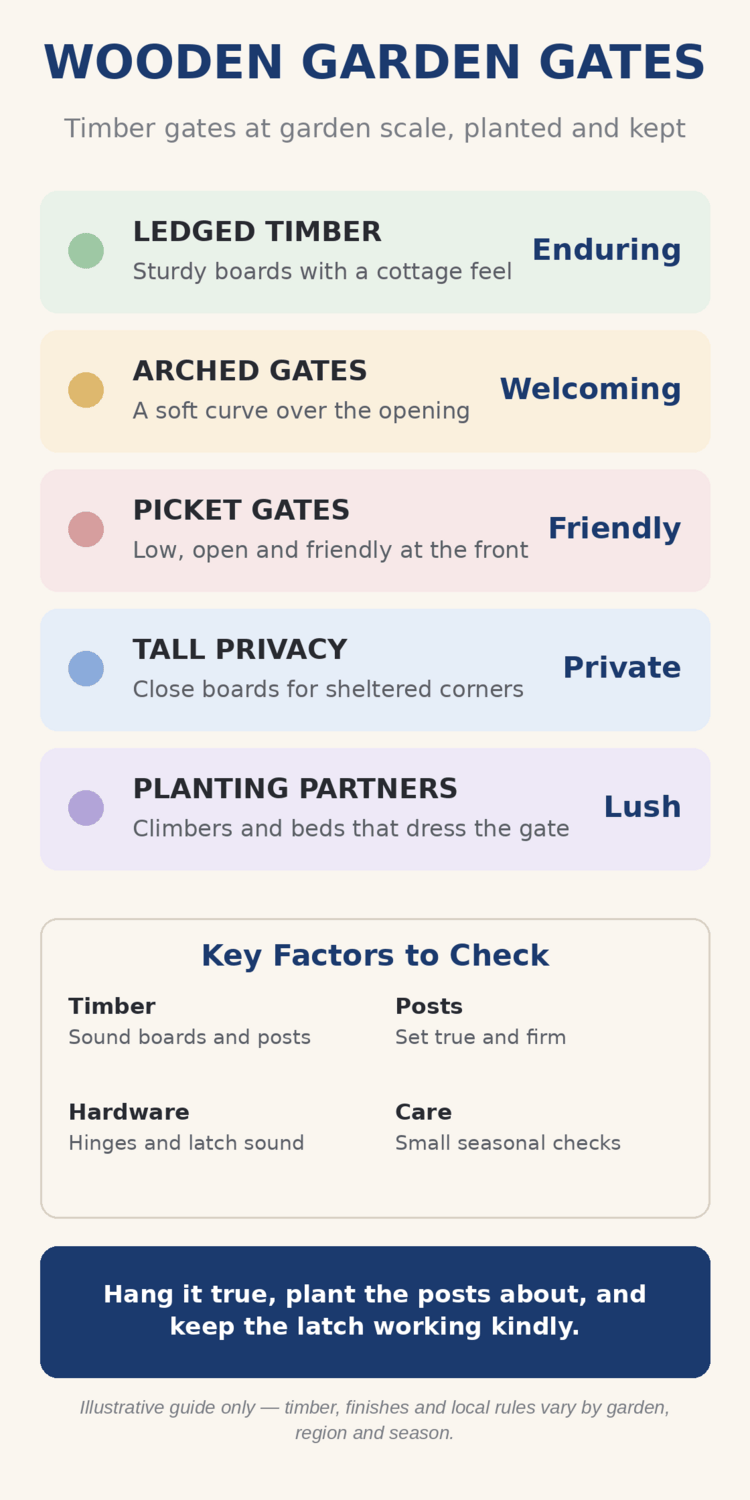
Scope, so the lanes stay clear: this post covers garden-scale timber gates only — the pedestrian gate you lift a latch on, set in a hedge, fence or garden wall, with the planting, paths and beds around it. Modern metal designs and wide driveway-scale gates are a separate subject, covered elsewhere, and no driveway gate appears below. General gate planning across every material belongs to the pillar, gate ideas. The sections walk from the gate leaf outward: ledged and arched gates first, then pickets and privacy, planting partners, paths and the vegetable garden, quiet styles, finishes and hardware, and finally choosing, placing and seasonal care.
2. Ledged Timber Gates and Cottage Character
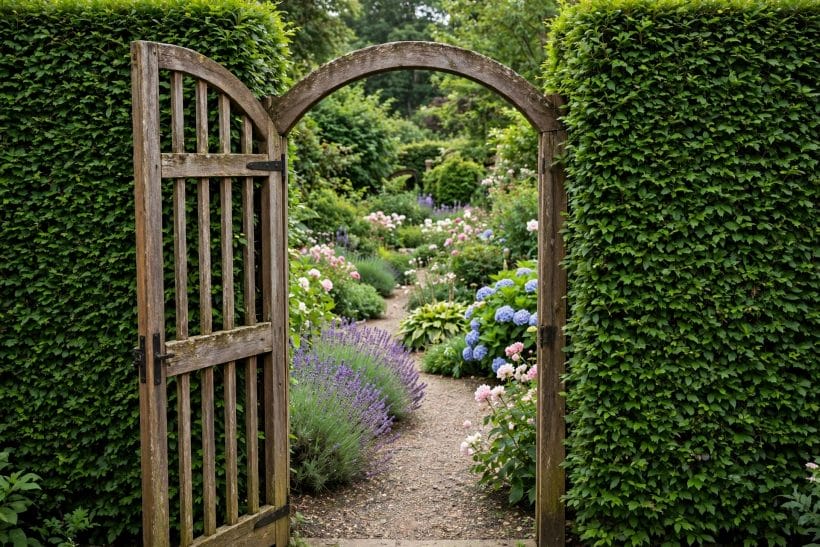
The ledged timber gate is the cottage garden’s default: vertical boards held by horizontal ledges, braced against sag, honest from both sides. Traditional iron is a different craft, explored in wrought iron gates; here the subject is timber alone.
1. A Classic Ledged Gate in a Flower Border
Vertical boards on simple ledges, hung between planted posts, is the gate a flower border deserves. Let the planting billow close on both sides, keep the swing clear, and the gate reads as part of the border rather than an interruption in it.
2. Ledged and Braced Against Sag
A diagonal brace keeps a ledged gate true through years of weather and use. Hung with the brace working in compression, the leaf stays square, the latch keeps meeting its catch, and the gate never develops a tired, dragging corner.
3. Vertical Boards for a Tidy Cottage Line
Boards running upright give a gate its classic cottage rhythm and shed rainwater cleanly down the grain. Small, even gaps between boards let the leaf breathe and move with the seasons without binding against the posts in wet weather.
4. Horizontal Boards for a Calmer Run
Where the fence runs horizontally, a gate of matching horizontal boards keeps the line unbroken and the garden feeling calm. The leaf almost disappears into the boundary until a hand reaches for the latch.
5. A Low Cottage Gate at the Front Path
A low gate at the front garden’s edge marks the threshold without closing the view: neighbours chat over it and planting shows above it. Low gates suit front gardens where welcome matters more than screening.
6. Wide Boards for a Solid, Simple Leaf
Fewer, wider boards give a gate a plainer, more settled face and fewer joints for weather to worry at. The look suits older gardens and simple fences, where honest timber carries the whole effect.
7. A Narrow Gate for the Side Passage
The side passage asks for a plain, narrow, hard-working gate: easy to open with full hands, quick to close, sturdy enough for bins, bikes and barrows passing daily. Plain boards and sound hinges are all it needs.
8. A Gate that Echoes the Fence Boards
Build the gate from the same boards, finish and rhythm as the fence it hangs in, and the boundary reads as one piece of work. The gate is found by its latch rather than by a change of pattern.
3. Arched Gates, Hedges and Garden Openings
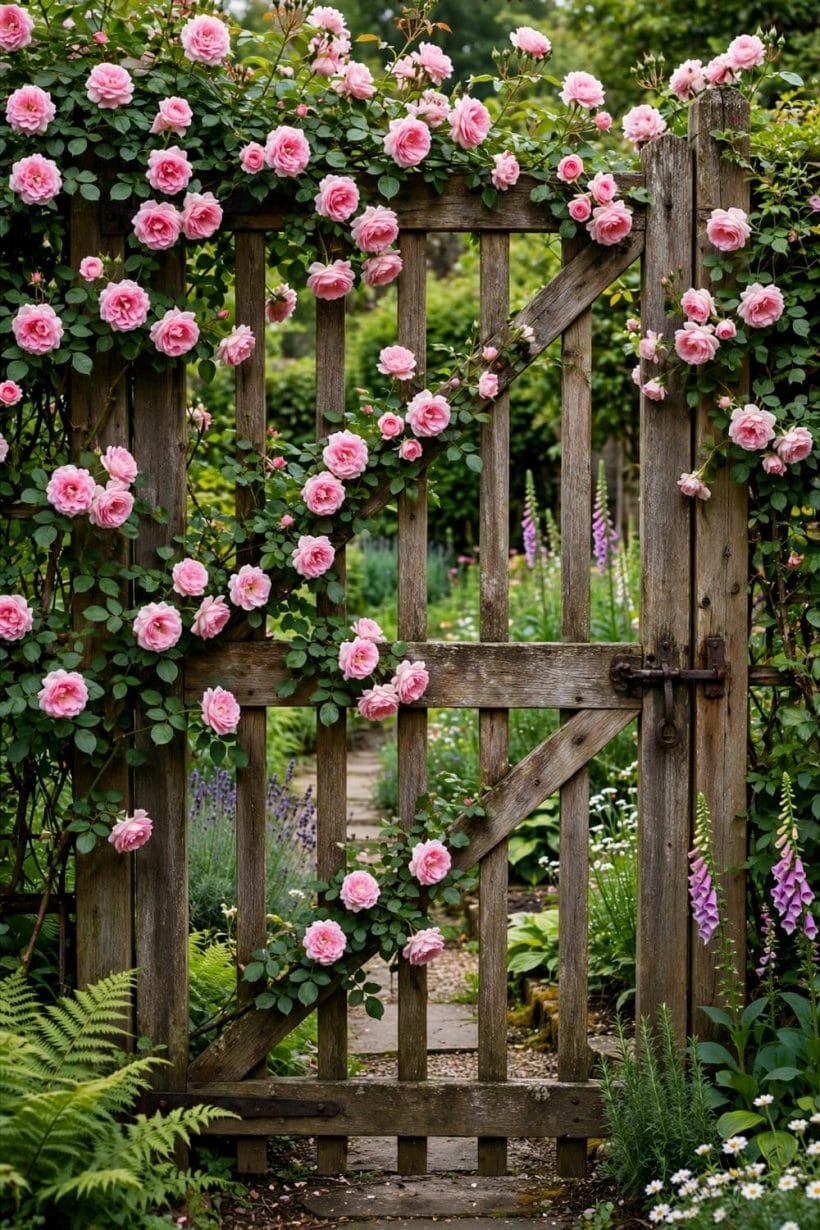
An arched top softens everything a gate touches: the hedge it sits in, the wall it pierces, the path beyond it. These ideas use the curve gently — a garden gesture, never a grand one.
9. An Arched Gate Set into a Tall Hedge
A curved-top gate in a hedge opening is the garden’s classic invitation: green walls, a timber curve, a glimpse of the room beyond. Keep the hedge trimmed clear of the swing and the arch reads cleanly against the foliage all year.
10. A Gentle Curve over a Path Gate
A shallow curve across the top rail lifts a plain gate out of the ordinary. It echoes arched doorways and garden openings without ceremony, and suits brick walls, timber fences and hedges with equal ease.
11. A Pointed Arch for a Storybook Corner
A soft point to the arch gives a gate a storybook note that children and romantics both approve of. Use it once, in a quiet corner, with simple planting around it; repeated everywhere, the charm wears thin.
12. An Arch Carried on a Timber Frame
Where no hedge or wall holds the shape, a simple timber frame with an arched head can carry the gate across a fence line. Plant a climber at one post and the frame joins the planting within a season.
13. A Round-Topped Gate in a Garden Wall
A semicircular top in a wall opening is the most architectural of the garden arches, and the most forgiving to walk through with hats and baskets. Keep the boards simple so the curve does the talking.
14. Trellis Sides Beside an Arched Gate
Short trellis panels flanking an arched gate let climbers frame the opening without crowding the leaf itself. The gate stays free to swing, the posts gain a green shoulder, and the threshold feels planted rather than built.
15. A Low Arch Between Two Garden Rooms
Between one part of the garden and the next, a low arched gate makes passing through a small event. Garden rooms are made by thresholds like this: a step, a latch, a change of planting beyond.
16. An Arched Gate Kept Plain and Painted Pale
Pale paint lifts an arched gate out of dark foliage and makes the opening easy to find at dusk. The curve shows best in a light finish against green — which is why cottage gardens have long done it this way.
4. Picket Gates and Front Garden Entries
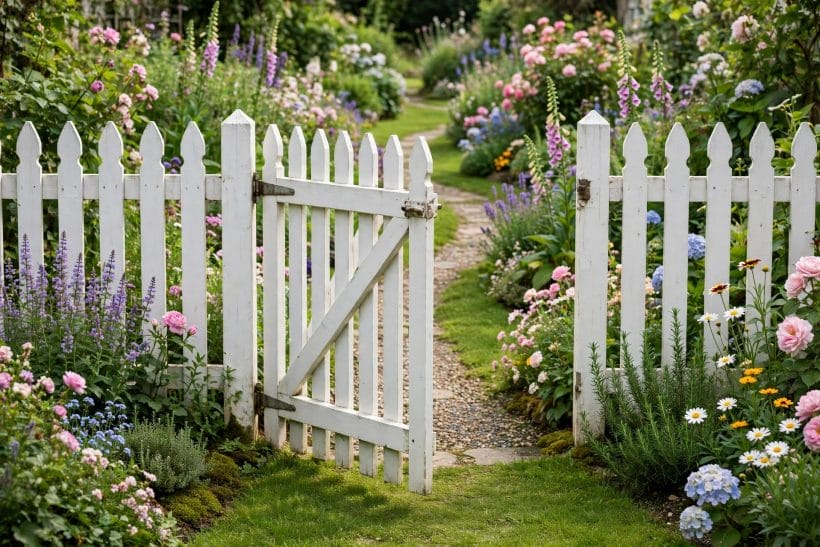
Picket gates belong to the front garden: low, open, friendly, and more about marking the threshold than guarding it. Their rhythm should match the picket fence they hang in, so gate and fence read as one run of work.
17. A Classic Picket Gate Matching the Fence
Cut the gate’s pales to the same height, profile and spacing as the fence, and visitors will find it by the latch alone. That seamlessness is the whole picket effect, and it is easy to keep once established.
18. Pointed Pales for a Crisp Traditional Edge
A simple point on each pale is the traditional picket finish: it sheds rain and reads crisply against planting. Keep the points even and the whole run looks tailored rather than homemade.
19. Rounded Pales for a Softer Welcome
Rounded pale tops soften the picket line for gardens where children, dogs and passers-by brush close daily. The look is gentler, the welcome warmer, and the gate feels made for a family garden.
20. A Scalloped Top Line on the Gate Leaf
Let the pales rise and fall in a gentle scallop across the gate and the plainest front garden gains a crafted detail. The curve is cut once and enjoyed daily — the best ratio any garden detail offers.
21. A Low Picket Gate Children Can Manage
A low, light picket gate with a simple latch is often the first gate a child is trusted to open alone. Keep it swinging freely, the latch smooth, and the path beyond it clear.
22. A Pair of Picket Gates on a Wide Front Path
Where the front path is generous, two small picket leaves meeting in the middle keep the opening in scale. One leaf does the daily work; both open for barrows and deliveries.
23. Picket Gates Painted to Match the Door
A picket gate painted in the front door’s colour ties the garden’s edge to the house in one glance. Gate, path, porch and door then speak the same colour language quietly.
24. Natural Timber Pickets in a Green Front Garden
Left unpainted and allowed to weather, pickets settle into a green front garden with no upkeep beyond soundness. The silvered timber, the hedge behind and the flowers in front need no coordination.
5. Tall Privacy Gates and Sheltered Corners
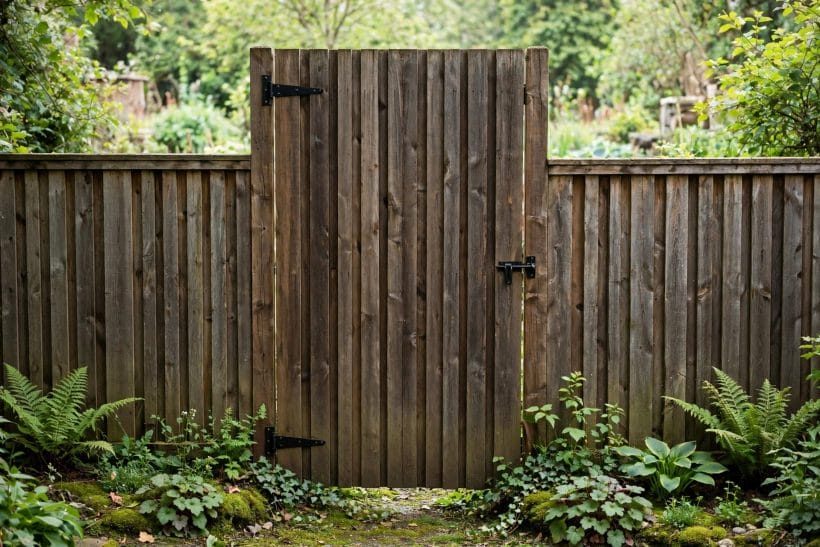
Some garden gates guard quiet rather than views. A tall timber gate in a close fence gives a sheltered corner its privacy and stills the wind; the fence line it hangs in matters as much as the leaf, as backyard fence planning shows.
25. A Close-Boarded Tall Gate for a Quiet Corner
Boards fitted closely on a tall leaf close the view completely and calm the air behind them. A seating corner or private terrace gains an outdoor room that overlooking windows cannot read.
26. Feather-Edge Boards for a Soft Shadow Line
Overlapping feather-edge boards cast a gentle shadow rhythm across a tall gate and shed weather kindly. The texture stops a large plain leaf reading as a blank wall, especially with planting at its foot.
27. A Lattice Top that Lets the Light Through
Finish a tall gate with an open lattice band at the top and privacy survives while light and air pass over it. Climbers find the lattice in time, softening the line between leaf and sky.
28. A Solid Gate as a Windbreak for Seating
A solid gate on the weather side of a seating corner does quiet, constant work: candles stay lit and evenings last longer. Place seating in the lee the closed gate makes and the garden gains an hour a day.
29. A Tall Side Gate Kept Plain and Strong
The tall gate in a side fence is pure workhorse: privacy, a secure back garden and daily passage in one leaf. Plain boards, a firm frame and hardware kept in good order are its whole design.
30. Climbers Sent up a Tall Gate’s Posts
A tall plain leaf can feel stern until planting dresses its posts. A rose or honeysuckle at each post, tied in as it climbs, softens the height and scents the threshold on summer evenings.
31. A Gate Height Matched Kindly to Its Fence
Let the tall gate meet its fence at a line the eye approves: level with it, or stepped gently where the ground falls. A gate that fights its fence for height looks restless from every angle.
32. A Planting Pocket at a Tall Gate’s Foot
A narrow bed or pair of pots at a tall gate’s foot breaks the hard junction between leaf and path. Low planting keeps the swing clear while showing the corner beyond is tended, not forgotten.
6. Planting Partners: Beds, Borders and Climbers
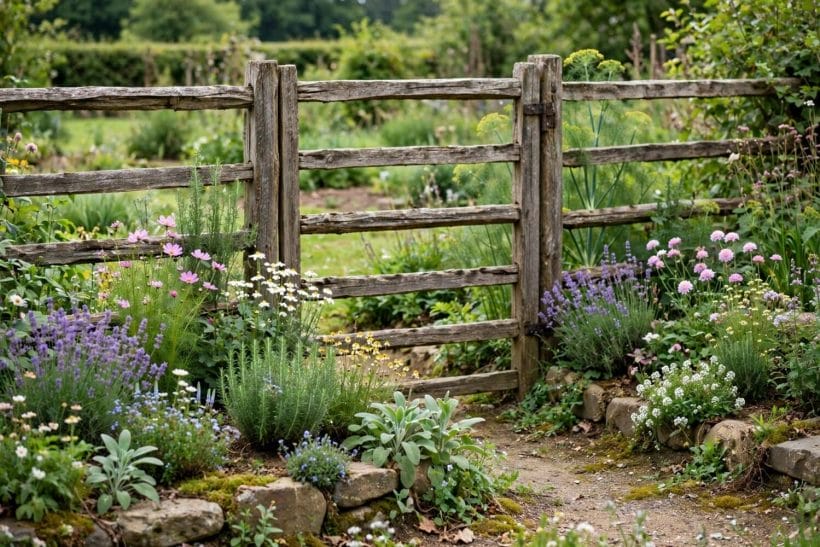
A gate is only ever half the picture; the planting around it is the other half. Beds billowing toward the posts, climbers dressing the frame and scent at the threshold make a sound timber leaf the garden’s most loved crossing place.
33. Climbing Roses over the Gate Frame
A rose trained over the gate’s frame is the timber gate’s oldest partnership. Tie new growth in loosely, keep swing and latch clear, and the gate becomes a doorway made of flowers each summer.
34. Clematis Woven Through a Trellis Panel
A clematis on a trellis panel beside the gate gives flowers at eye level exactly where people pause to work the latch. Mulch its roots cool and prune it in its proper season, kindly and on time.
35. Lavender Edging Along the Gate Path
Lavender lining the short path to the gate brushes every arrival with scent and holds the path’s edge in a soft grey-green line. Nobody shortcuts through a lavender hedge twice in one visit.
36. Beds that Billow Toward Both Posts
Plant the beds either side of the gate a little fuller than elsewhere, so the opening sits in the garden’s softest planting. The gate reads as a gap in a border rather than a hole in a fence.
37. Herbs Planted Where Hands Brush Past
Rosemary, sage and other sturdy herbs at gate height release their scent whenever a coat or hand passes. A gate you can smell before you see it becomes a landmark in the garden’s daily round.
38. Spring Bulbs Clustered at the Gate Posts
Bulbs gathered thickly at the posts announce the gate each spring before the border wakes. Snowdrops first, then daffodils, then tulips where soil suits them: a small calendar at the garden’s front door.
39. An Evergreen Frame that Holds the Winter Gate
Evergreen shrubs flanking the gate keep the opening composed when borders rest and climbers are bare. Winter is when a gate’s structure shows most, and a green frame shows it kindly.
40. Night-Scented Planting by the Latch
Stocks, nicotiana or honeysuckle near the gate reward everyone who comes home after dusk, when the latch is worked by feel. Evening scent is planting’s invisible half, and a gate is its best stage.
41. Pots Flanking the Gate, Changed with the Seasons
A sturdy pot at each post, replanted as the seasons turn, keeps the threshold dressed even when the beds are between shows. Keep pots plain, planting generous and watering faithful in dry spells.
7. Paths, Beds and the Vegetable Garden Gate
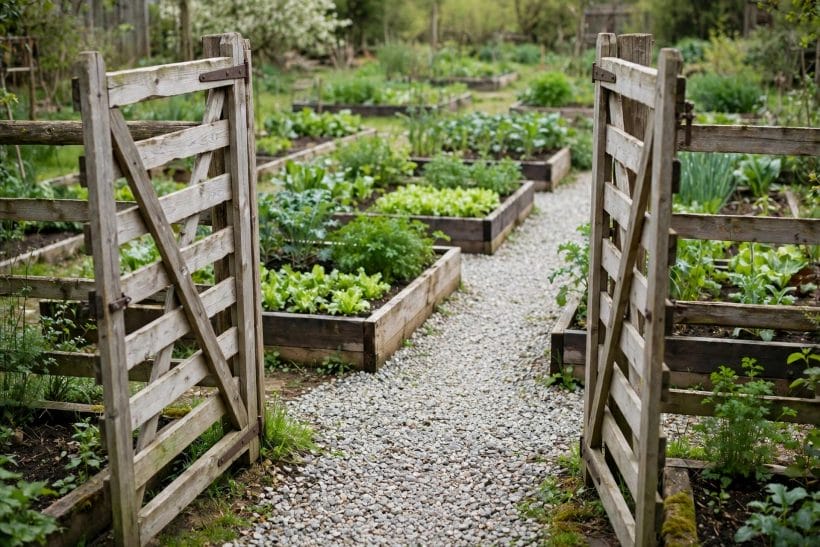
Beyond the flower garden the gate turns practical: paths that stay dry, thresholds that take the wear, and a vegetable garden gate opening onto the working beds — the beds themselves are planned in raised garden bed ideas.
42. A Gravel Path Running Through the Gate
Let the path’s gravel run unbroken through the gateway so feet never hesitate at the threshold. The gate sits in the route rather than across it, and the crunch underfoot announces visitors pleasantly.
43. Stepping Stones Where the Ground Stays Damp
Where the gate path crosses a damp hollow, flat stepping stones keep feet dry and grass unscarred. Set them at a natural stride and let planting close around them.
44. A Brick Apron at the Gate’s Threshold
A small apron of brick or setts where the gate swings takes scuffing that gravel and grass cannot. It gives the latch a firm place to be worked from in wet weather.
45. A Simple Ledged Gate for the Vegetable Garden
The vegetable garden wants the plainest gate of all: ledged boards, a lift latch, and a swing wide enough for baskets and barrows. Its beauty is its fitness, in a garden opened daily in season.
46. A Gate Opening Straight onto the Beds
Align the vegetable gate with the path between the beds so the barrow runs straight from gate to compost and back. Every bend saved is saved daily for years.
47. A Herb Garden Gate Kept Low and Open
A low gate at the herb garden keeps the planting visible and the picking inviting: a threshold, not a barrier. The gate’s only real job is to say this scented corner is entered on purpose.
48. An Orchard Gate Hung in a Hedge
Where the garden gives way to fruit trees, a plain gate in the hedge keeps the orchard a room of its own. Fallen fruit is gathered without trampling the flower beds to reach it.
49. A Gate Easy for Barrows and Baskets
Whatever its style, a working gate must pass the barrow test: width to spare, a threshold that does not catch a wheel, a latch workable with one hand. Test it loaded, not empty.
8. Quiet Styles: Rustic, Japanese-Inspired and Weathered Gates
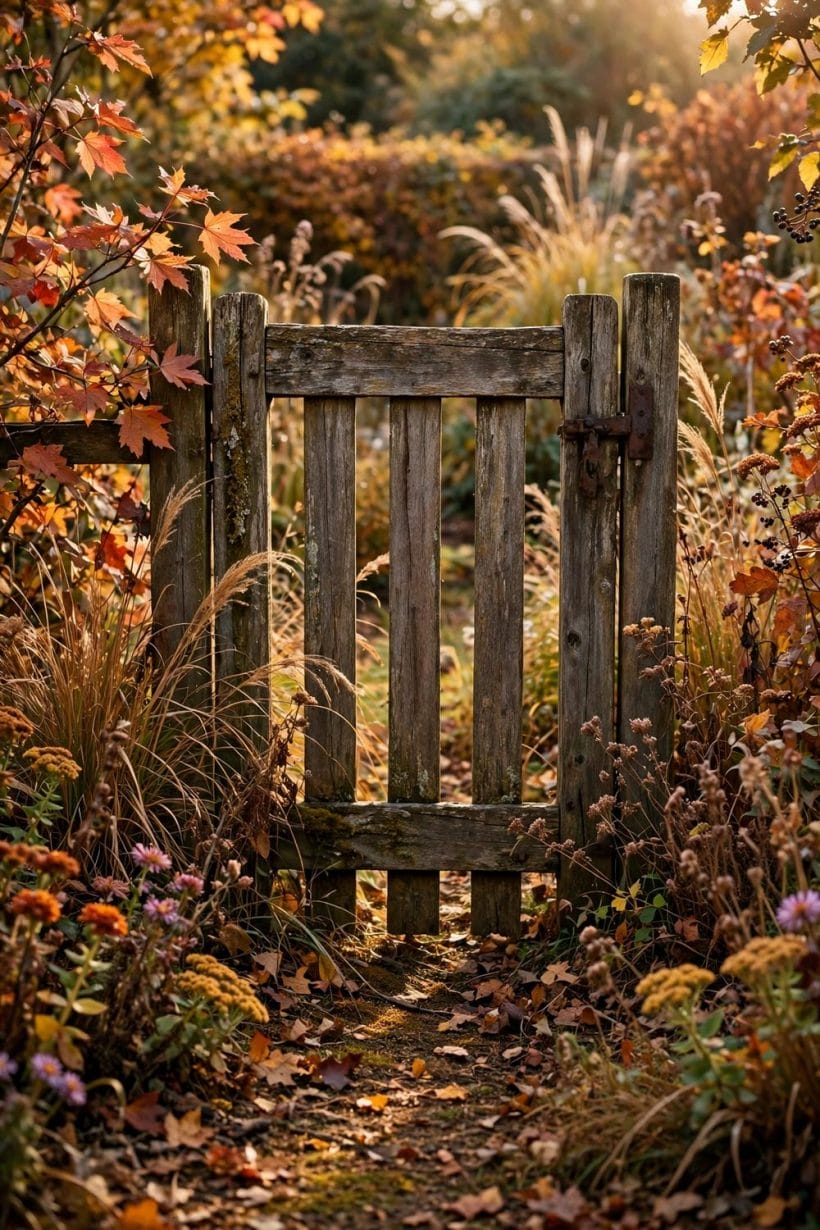
Not every gate wants cottage charm. Rough timber, quiet slats and silvered boards suit gardens that prize calm over prettiness; the stillest end of this family grows from small Japanese garden ideas.
50. A Japanese-Style Slatted Gate in a Quiet Corner
Fine vertical slats, a simple frame and a gravel threshold make a gate that whispers rather than calls. Keep planting restrained around it and the crossing becomes a moment of quiet.
51. A Rustic Gate of Rough-Sawn Timber
Boards left rough-sawn, with the saw’s texture still in them, suit woodland edges, orchards and informal boundaries. The gate asks for no paint: sound posts, honest boards, planting leaning close.
52. Waney-Edge Boards for a Woodland Feel
Boards keeping one natural, wavy edge give a gate an unmistakably woodland character. The uneven top line looks grown rather than made, and birds approve of it before people do.
53. A Weathered Gate Allowed to Silver
Timber left unfinished weathers to a soft silver-grey that sits kindly against green planting. The choice is palette, not neglect: keep the leaf sound and the hardware oiled, and let colour arrive in time.
54. A Plain Gate in an Autumn Border
In a border planted for autumn — asters, grasses, late colour against turning leaves — a plain weathered gate is the right backdrop. Its grey boards make the season’s colours burn brighter by contrast.
55. A Low Gate Between Gravel and Green
Where a gravel court meets lawn or meadow planting, a low plain gate marks the change of ground underfoot. The step from crunch to softness is a small daily pleasure.
56. A Gate Framed by Grasses and Cane-like Planting
Tall grasses and cane-like stems at the posts give a simple gate movement, sound and a rustling frame. Cut them back in spring and the frame renews itself yearly.
57. A Plain Gate that Lets the Garden Speak
The quietest design is a plain, well-made timber leaf claiming no attention: the view through it and the planting around it do the talking. Restraint like this is a style, chosen deliberately.
9. Colour, Finish and Hardware in General Terms

Finish and hardware decide how a timber gate ages, in the same language used across the garden’s other woodwork, as wooden porch ideas shows: protect the timber, keep moving parts sound, let the garden set the colour.
58. A Natural Finish that Lets the Grain Show
A clear or lightly toned finish keeps the timber’s grain and knots in the picture while shedding the worst of the weather. It suits ledged and rustic gates best, where wood itself is the decoration.
59. Pale Paint for a Cottage Gate
Soft white, cream or pale grey paint is the cottage gate’s classic dress: it lifts the leaf out of dark planting and matches picket fences and porch woodwork. Repaint in rotation and the job never grows large.
60. A Deep Colour in a Leafy Garden
A deep green, slate or near-black gate disappears kindly into foliage and makes the planting in front of it glow. Dark finishes suit tall privacy gates, where the leaf should read as shadow.
61. Letting Timber Silver Where It Suits
Leaving a gate unfinished is a finish decision like any other: the silvering is even and upkeep shrinks to soundness checks. It suits rustic and quiet gardens; painted cottage gardens prefer colour kept.
62. Hinges Chosen Sturdy and Kept Sound
In general terms, a garden gate wants hinges strong enough to carry the leaf without strain, fixed firmly into sound timber. A hinge holding the leaf true is noticed only when it stops doing so.
63. A Latch that Works with Full Hands
The best garden latch opens with an elbow, a wrist or the back of a hand carrying a basket. In general terms: simple action, positive catch, nothing needing two free hands. Garden gates are worked loaded.
64. A Simple Latch in Keeping with the Gate
Let the latch’s character match the leaf: plain and blackened on a cottage gate, simple and unobtrusive on a quiet slatted one. Hardware that shouts dates a gate faster than weather ever will.
65. Posts Set True and Kept Sound
More gates fail at the post than at the leaf. Posts set firmly, plumbed true and kept clear of soil piled against them outlast several leaves. When a latch starts missing its catch, check the post first.
66. End Grain and Bottom Edges Given Extra Care
Water lingers longest on a gate’s bottom edge and soaks deepest into end grain, so those places earn the extra coat of finish and the extra seasonal glance. A small clearance above the path helps the leaf dry and swing freely.
10. Choosing, Placing and Seasonal Care
The right gate in the wrong place still disappoints, so choosing and placing come before building — and seasonal care, a rhythm of small checks rather than rescues, keeps a timber gate swinging sweetly for its whole long life.
67. Choosing the Gate by the Garden’s Character
Start from the garden you actually have: cottage planting asks for ledged or picket timber, quiet gravel corners for slats and plain boards, sheltered seating for height. A gate chosen for its neighbours looks inherited, not installed.
68. Placing the Gate on the Path People Walk
Gates belong where feet already want to go. Watch the worn line in the grass and the route from door to shed, and put the opening there: a gate off the natural path gets bypassed.
69. Sightlines Kept Open Through the Gate
A garden gate is a picture frame used daily. Set it so the view through it — a bench, a tree, the beds at their best — rewards the opening, and keep planting from swallowing the frame.
70. Spring Checks: Swing, Latch and Posts
Spring is the gate’s annual inspection: swing it fully, work the latch, wobble the posts, look for winter’s soft spots. Small repairs made now prevent daily use worrying them larger.
71. Summer Care: Ease, Clearance and Attention
In summer, keep the swing clear of the season’s growth, ease any leaf that swells and binds, and brush boards clean. A gate used daily reports quickly when a hinge dries or a fixing loosens.
72. Autumn Care: Leaves, Drainage and Clear Swings
Fallen leaves gathered against a gate’s bottom edge hold damp exactly where timber least forgives it. Clear them as they fall, keep the threshold draining freely, and check the path’s wet places.
73. Winter Care: Frost, Water and Sound Hinges
Winter asks least and threatens most: standing water at the posts, frozen latches forced by impatient hands, wind worrying an unlatched leaf. Keep the gate latched in storms and free frozen parts gently.
74. Checking Rules Before a New Gate
Front garden gates, walls and fences can fall under local rules about height, boundaries and visibility near roads. Check before building, talk to neighbours early, and leave structural boundary work to professionals.
75. The Weakest Detail Repaired First
Every garden has one gate detail that dates the whole scene: a dragging corner, a latch tied with string, a leaning post. Repair that first, and the garden’s character returns for its smallest honest repair.
Final Considerations
A wooden garden gate asks for so little — sound timber, true posts, hardware kept in order, planting in sympathy — and returns so much: a threshold, a picture frame, a daily click of arrival and departure. Chosen at garden scale, it looks as if it had always hung there.
Begin where the garden asks loudest: the gate that drags, the opening that needs making, the corner that wants its privacy. Set the posts true, plant the posts about with something generous, and keep the seasonal rhythm of small checks. It is simply the garden’s front door, in timber, opening on green.



0 Comments