

The lawn is the most irrigated crop in America, and it gives back nothing but mowing. A xeriscape flips that bargain: a garden that sips instead of gulps, built from rock mulch and plants that never needed your hose in the first place. Done right, it doesn’t look like a sacrifice — it looks better than what it replaced, and this guide shows how.
1. Xeriscaping with Rocks and Native Plants at a Glance
Xeriscaping with rocks and native plants is landscaping for water conservation: it cuts outdoor water use 50–75% while looking better than the thirsty lawn it replaces. Rock is the foundation — a permanent mulch that holds moisture in the soil and weeds down — and native plants are the stars, chosen because they evolved for your rainfall and need no irrigation once established. Seven principles hold the system together: plan the hydrozones on paper, amend only the planting pockets, drip-irrigate by water need, plant natives and adapted species, mulch 3–4 inches deep in rock, limit turf ruthlessly, and maintain on a short, smart schedule. The table gathers the whole system in one place; the sections after it take each principle, each material and each number apart.
| Attribute | Detail |
|---|---|
| The Payoff | Outdoor water use cut 50–75% against the lawn the xeriscape replaces |
| The System | Seven principles — planning, soil, irrigation, plant selection, mulch, turf limits, maintenance |
| Rock Mulch | 3–4″ of 3/4″ crushed or river rock over a woven weed barrier — permanent, unlike bark |
| The Native Ratio | 70%+ native planting — the threshold where the garden becomes self-sustaining |
| Planting Pattern | Drifts of 5–9 plants in three layers: groundcover, mid-layer, structural |
| Turf’s Water Bill | 1,000 sq ft of turf drinks 20,000+ gallons a year in arid climates; the xeriscape uses under 5,000 |
| Drip Rates | 1–2 GPH emitters for perennials, 2–4 GPH for shrubs, on separate valves by water need |
| Establishment Water | 1″ per week in year 1, cut 50% in year 2, rainfall-only for natives by year 2–3 |
| Smart Controller | Weather-based, $100–200 — skips watering when it rains and pays for itself in one season |
| The Time Dividend | 10–15 hours of maintenance a year, against 100+ hours for a turf landscape |
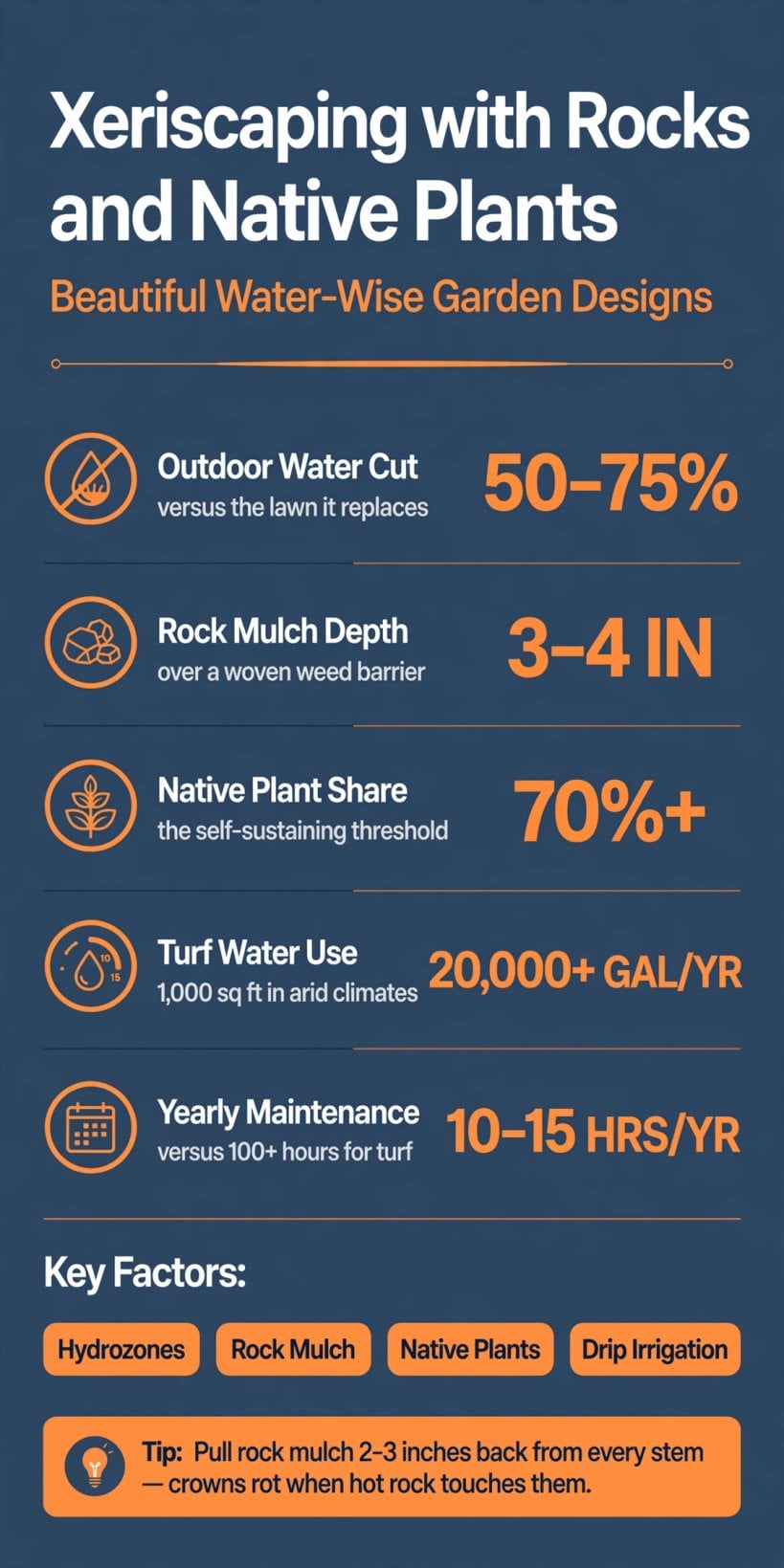
Half to three-quarters of the water saved, 3–4 inches of rock, 70% native — the water-wise garden on one card.
Read the system as a chain of dependencies rather than a shopping list. The plan decides the hydrozones; the hydrozones decide which plants can share a valve; the plants decide how deep the roots must go; and the rock mulch protects all of it from evaporation and weeds while the roots get there. Skip the first link — the paper plan — and the original guide names the result plainly: random plants in gravel, the number one xeriscape failure. Every section that follows is one link of that chain, in the order the work actually happens.
2. The Seven Principles: The System Behind the Garden
Xeriscaping is not a style; it is a method with seven working parts. Planning comes first: the design is drawn on paper before a single plant is bought — hydrozones mapped, plant placement settled, hardscape placed — because the plan is what prevents the classic failure of random plants scattered in gravel. Soil improvement is deliberately narrow: amend only the planting zones, with compost worked into the pockets, because natives want lean soil between plants. Efficient irrigation means drip, zoned by water need. Plant selection is the heart: natives and adapted plants, covered in §4. Mulch is rock, 3–4 inches deep, the moisture keeper and weed suppressor of §3. Turf is limited or eliminated, the subject of §6. And maintenance runs on the right schedule — less of it, but smarter — which §10 tallies.
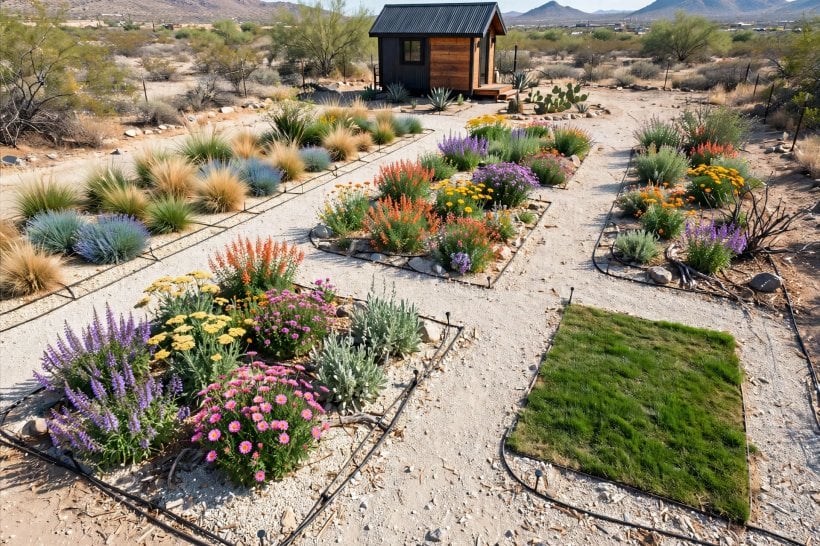
The principles also explain why this method suits a tiny home lot so precisely. A small lot has no room for a thirsty border and a dry corner to be watered as one zone; the hydrozone plan forces every square foot to declare its water need before it is planted. The lot-scale thinking behind that — treating the whole parcel around a small house as one designed system — is the same approach taken by the tiny house landscaping ideas guide, where the garden is planned as part of the home rather than decorated around it afterwards.
Notice what the principles never promise: zero water and zero work. A xeriscape sips; it does not fast. What they promise is proportion — water and effort matched to what the plants actually need, in the climate they were chosen for — and that proportion, held for a decade, is where the 50–75% saving comes from.
3. Rock Mulch: Depth, Stone Type and the Barrier Beneath
Rock is the xeriscape blanket, and it earns the role on four counts. It doesn’t decompose — bark mulch needs yearly replacement, while rock is permanent. It doesn’t blow away in windy sites. It doesn’t harbor the same pests bark does. And it keeps soil cooler than expected: light-colored rock reflects heat, and rock-mulched soil measurably stays cooler than bare soil. Depth is a narrow specification: 3–4 inches. Less doesn’t suppress weeds; more wastes money and can overheat crowns. The stone itself is 3/4-inch crushed or river rock — angular stone locks together, smooth stone is walkable, and the choice between them is made per area, crushed where the bed must stay put and river rock where feet will travel.
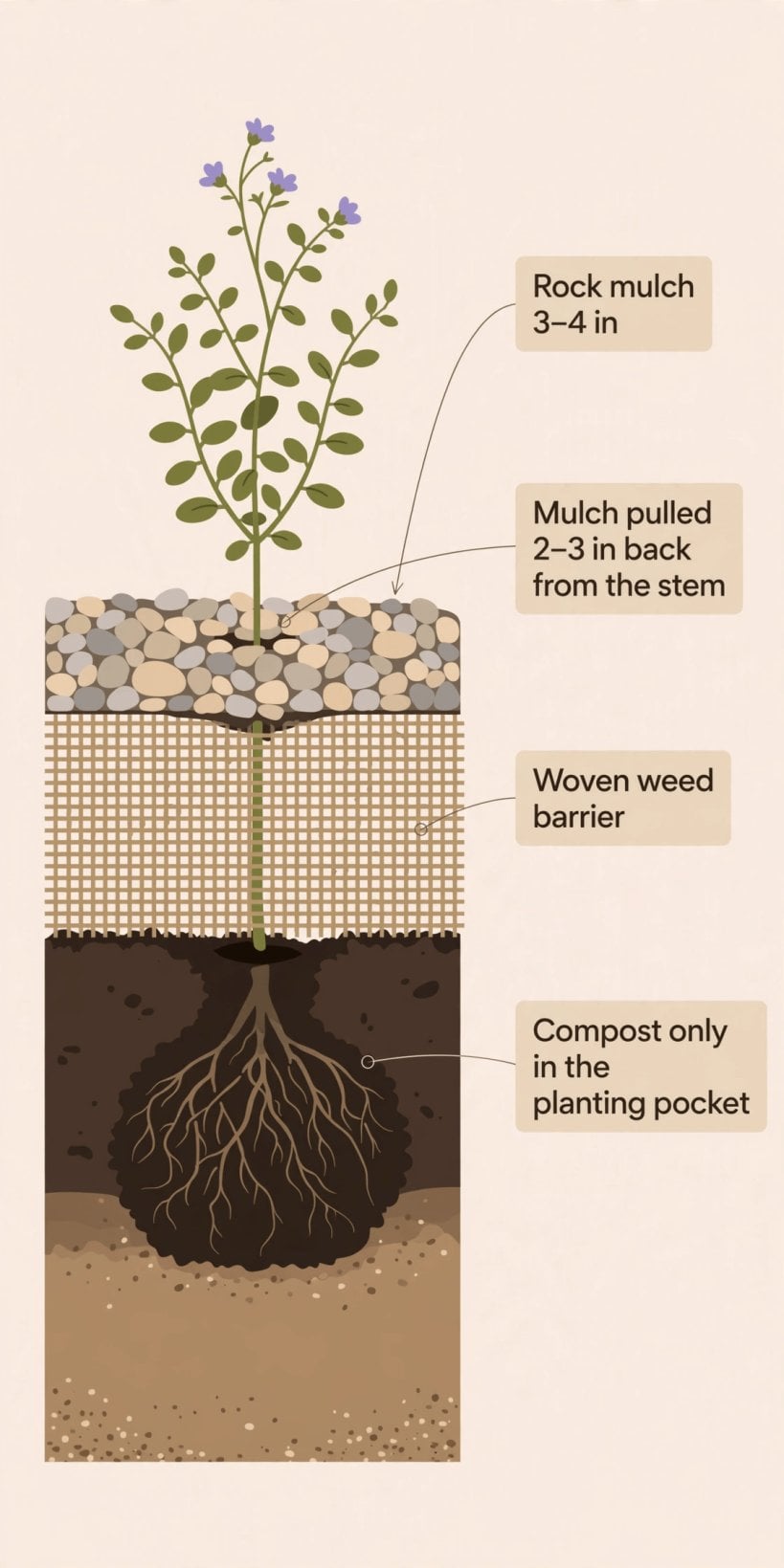
Under the rock goes a woven weed barrier — woven, not plastic, because the soil must breathe. Plastic sheeting suffocates the soil biology the plants depend on and sheds the little rain that falls; the woven barrier blocks weeds while letting water and air through. Around each plant, the mulch is pulled 2–3 inches back from the stems: rock resting against a stem traps moisture against the crown, and crown rot is the quiet killer this one habit prevents. The barrier and the setback together are the mechanical half of weed control in a rock garden; the chemical-free strategies for the weeds that still appear are covered in the guide to eco weed control in rock gardens.
The permanence cuts both ways, and the plan of §2 is what makes it a virtue. Bark can be rethought every spring; rock, once spread 3–4 inches deep across a lot, is a decision you live with — which is precisely why it rewards the gardens that were designed before they were planted. Chosen well, the stone also becomes the garden’s ground plane and its color field: the pale reflective surface that cools the soil is the same surface the planting drifts rise through in §5.
4. Native Plants: The Palette That Belongs
Native plants are the heart of the system for three reasons the original states plainly. They evolved for your rainfall, so after establishment they need no irrigation at all. They support local pollinators — the ecological payoff no imported ornamental matches. And they look right: the landscape echoes the surrounding wild, giving the garden its sense of place. Selection has one authoritative source — your state’s native plant society list. The garden center’s “drought-tolerant” tag is not a substitute, because it often means a plant from a different desert, adapted to a different rainfall pattern than yours.
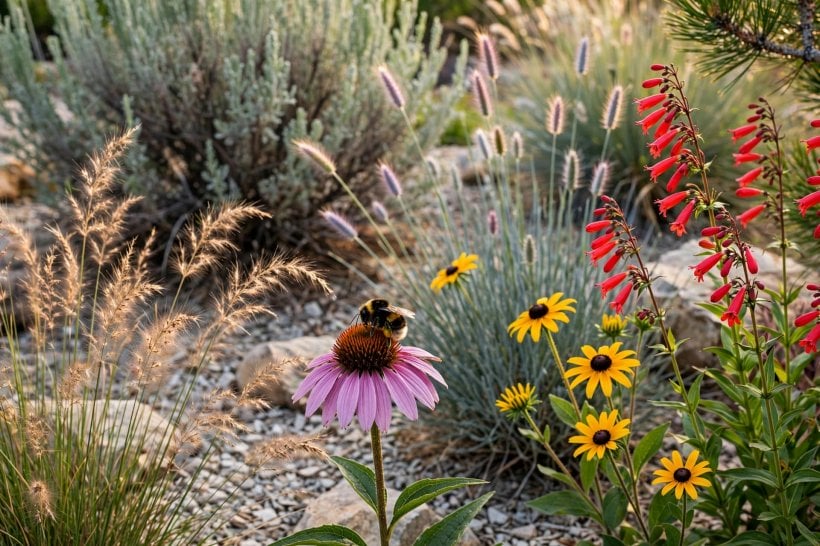
The palette is structured in four layers of function. Native grasses form the matrix — little bluestem, blue grama, muhly. Flowering perennials bring the color — coneflower, black-eyed Susan, penstemon. Shrubs are the bones — sagebrush, manzanita, currant. And a tree or two gives canopy — native oak, piñon, desert willow — because even tiny lots deserve one tree. The governing ratio is 70%+ native: the threshold where the garden becomes self-sustaining, tipped far enough toward plants that belong that the whole planting runs on rainfall and its own ecology. The rock-garden-specific side of the palette — which natives pair with stone, sun and sharp drainage — is worked through in the guide to the best native plants for rock gardens.
That 70% figure is also what makes the garden’s later stages possible. The irrigation taper of §9 ends at rainfall-only because the planting is mostly natives; the no-fertilizer rule of §10 holds because natives in lean soil stay compact instead of floppy. A garden planted at 30% native would need its drip lines forever. The ratio is not purism — it is the load-bearing number of the whole design, and it is why the alpine specialists of the alpine rock garden make such natural companions in the same cluster of beds: both palettes are chosen by belonging first and looks second.
5. Design: Drifts, Layers and One Focal Point per View
Composition is where a water-wise planting becomes a garden instead of a collection. The first rule is drifts, not dots: plant in groups of 5–9, the naturalistic pattern — single specimens scattered across gravel look like a plant sale, not a garden. The second rule is layers, three heights working together: groundcover at the base (creeping thyme, sedum), a mid-layer of grasses and perennials, and a structural layer of shrubs, boulders and one tree. Rock is integrated, not applied afterwards: boulders serve as the anchors of the composition, gravel is the ground plane, and the plants rise through it. Each view gets one focal point — a sculptural agave, a striking boulder cluster, a water feature — because the eye needs somewhere to land. And the edges are crisp: steel or stone edging draws the line between designed and weedy.
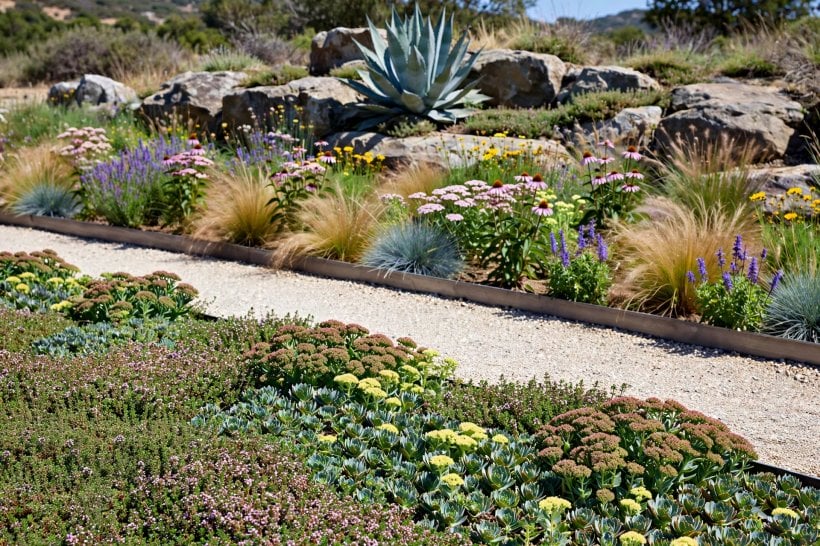
The drift rule and the hydrozone rule are secretly the same rule. A group of 5–9 plants of one kind shares one water need, one emitter pattern and one mature size, so a drift is simultaneously a composition unit and an irrigation unit — beauty and plumbing drawn with the same line. This is the composition logic the rockscape ideas guide applies to stone itself in small yards, where boulders, river rock and gravel are composed as deliberately as the planting. On a small lot the discipline matters more, not less: there is no distance to hide a scattered planting behind, so every group must read as intentional from the door.
The focal-point rule deserves its restraint. One per view means exactly that — a second sculptural agave in the same sightline halves the effect, turning a composition into a catalogue. The boulder cluster, the tree and the water feature take turns by viewpoint: what anchors the view from the porch can be background from the path.
6. Turf: The Last Lawn Question
Every xeriscape eventually faces the lawn honestly, and the original’s math is blunt: 1,000 sq ft of turf drinks 20,000+ gallons a year in arid climates, where the xeriscape replacement uses under 5,000. Three options follow. Eliminate the turf entirely — the full rockscape, the purist answer. Reduce it — keep a small functional lawn only where it is genuinely used, a play area or a run for dogs: 200 sq ft of turf where it matters, xeriscape everywhere else. Or replace it — buffalo grass, a blue grama lawn or clover, using 50–75% less water and mowed monthly instead of weekly. What is never an option is the half-measure: a struggling lawn next to new xeriscape looks like neglect, so the rule is to commit to the zone — each area is fully lawn or fully xeriscape, decided on the plan.
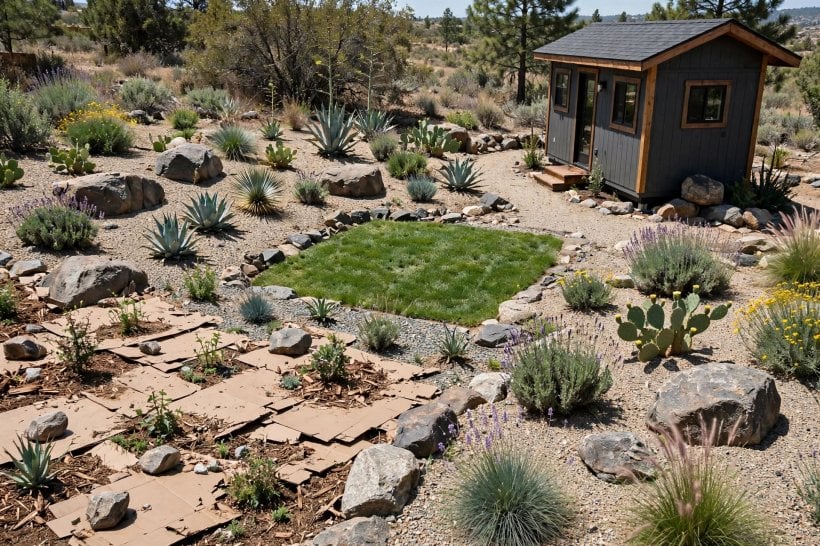
The transition itself has a lazy method that works: kill the old lawn by sheet mulching, then build the xeriscape on top of it. No stripping, no hauling — the dead turf becomes the first layer under the new garden. The reduced-lawn option is where most tiny lots land, and it reframes the question from ideology to use: lawn is kept as a room, sized to the activity that happens on it, and everything that was lawn by default becomes garden by design. That curb-facing version of the same decision — how much green the street should see — is worked through in the front yard rock landscaping makeovers, where the rock garden carries the public face of the house.
7. Irrigation: Drip Zoned by Water Need
Drip is the delivery system the whole design assumes, and its first rule is separation: zones on separate valves for turf (if any), perennials, shrubs and trees, because their water needs differ — one shared schedule drowns some plants and starves others. Delivery is by drip line or individual emitters at each plant, sized to the plant: 1–2 GPH for perennials, 2–4 GPH for shrubs. The schedule is deep and infrequent, the root-training rule — 1 inch per week in the establishment year — tapering as §9 describes until the system idles. A weather-based smart controller, at $100–200, skips watering when it rains; the original calls it the device that pays for itself in one season.
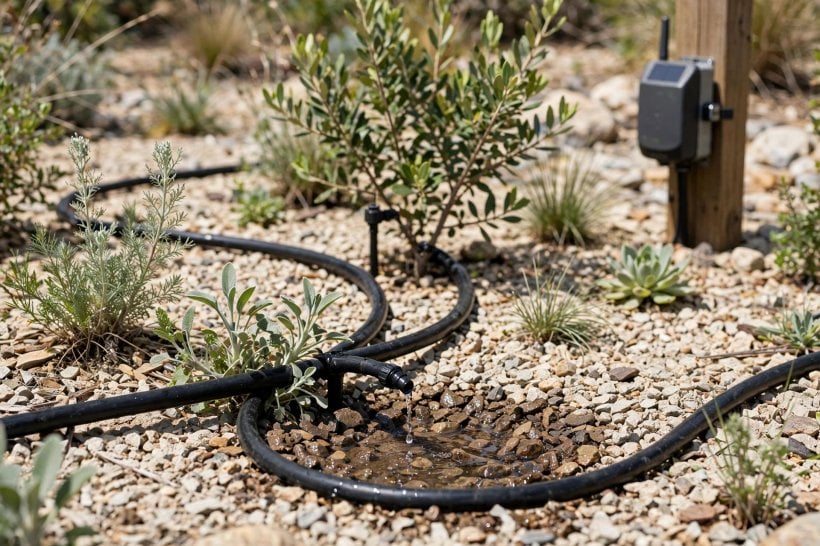
The goal of all this plumbing is its own obsolescence. Irrigation in a xeriscape is scaffolding: it exists to establish roots deep enough that the planting can live on rainfall, and a system designed by hydrozone can retire zone by zone as each group of plants matures. The valves and emitter rates are therefore chosen for flexibility, not just for day one — a shrub zone that will one day run only in extreme drought is plumbed separately from the perennial zone that taps off in year two, so each can be tapered on its own calendar.
8. Soil: Amend the Pockets, Not the Lot
The soil principle is the one newcomers most often reverse. The instinct is to enrich everything; the xeriscape rule is to amend only the planting zones — compost worked into the pockets where plants will actually sit — and leave the ground between plants lean, because natives want lean soil between plants. Rich soil everywhere grows the weeds the rock mulch is trying to suppress, pushes native plants into soft, floppy growth, and spends money amending ground that will never hold a root.
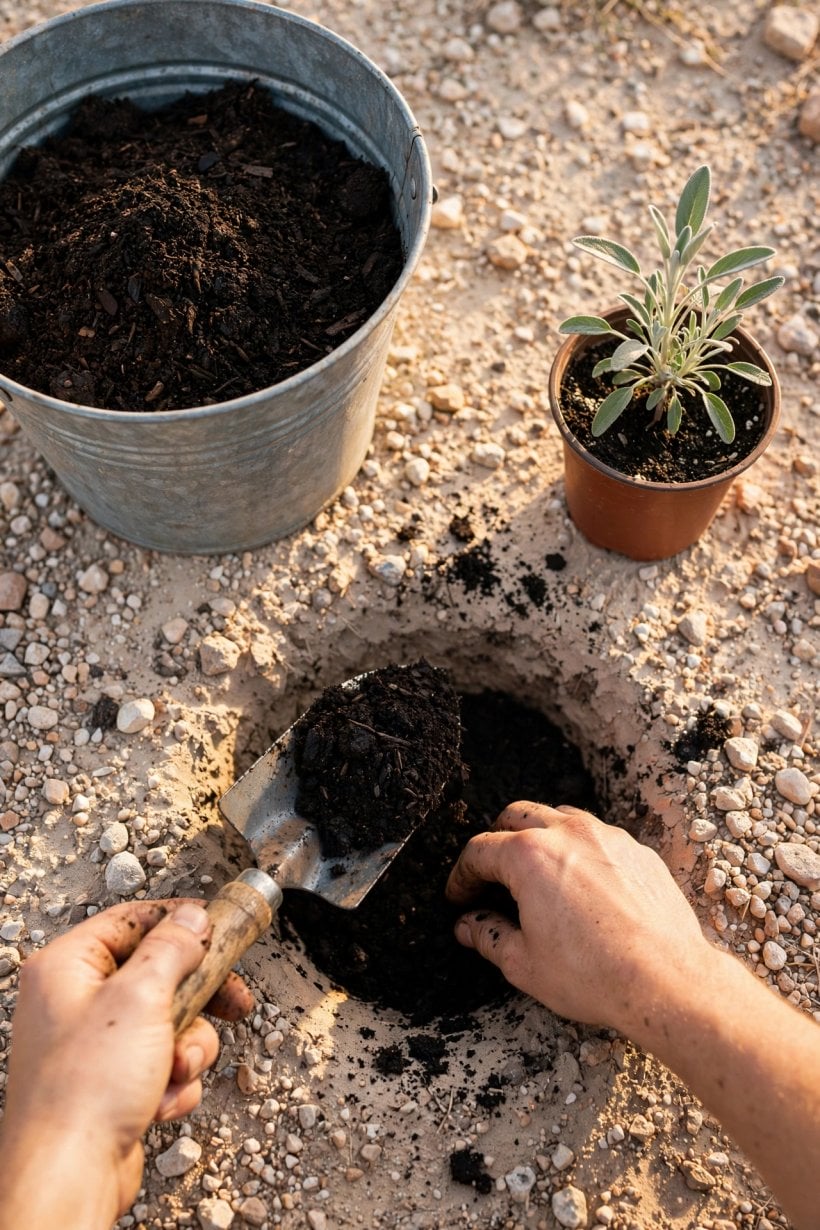
The pocket method concentrates the benefit where the establishment year is won or lost. A young native spends its first season building roots in a small volume of soil; compost in that volume holds each deep watering long enough for the roots to use it, while the lean matrix beyond waits for the roots to arrive in year two and three. Resources placed precisely where the plant is, and nowhere else — the soil expression of the whole xeriscape idea.
9. Establishment: The Three-Year Taper
The establishment paradox governs the garden’s first years: natives need pampering to become independent. Year 1 is regular water — deep weekly watering at the 1-inch-per-week schedule — while roots chase moisture downward. Year 2 is the taper: cut irrigation 50% and force the roots deep, so the plant learns to find its own water. Year 3 and beyond, natives run on rainfall only, supplemented in extreme drought — the mature xeriscape sips. Rushing the taper is the classic way to kill a young planting; skipping it is the quieter failure, a garden still on the hose in year five because its roots never had a reason to go deep.
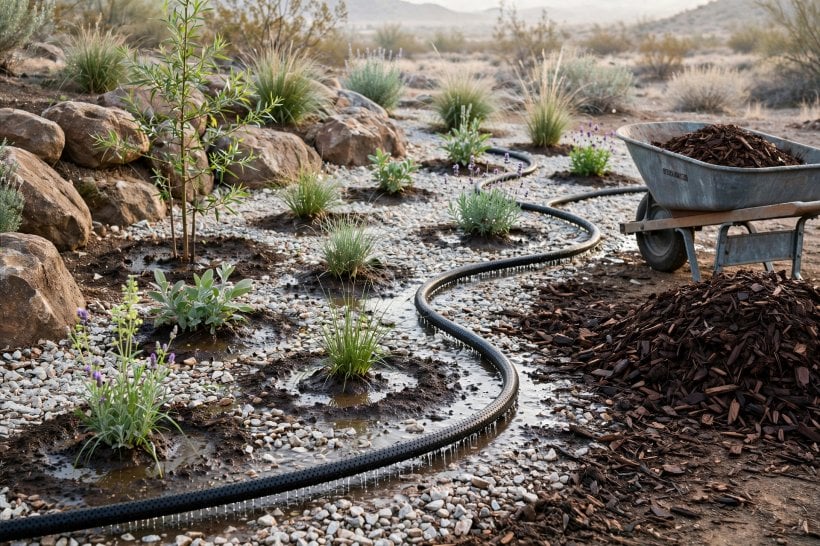
Read the taper against the irrigation design of §7 and the two sections explain each other. Deep and infrequent watering is not a preference; it is the training mechanism — water delivered rarely and deeply wets the full root zone and then recedes, and roots follow it down. Shallow daily watering trains a shallow root system that collapses the first time the schedule slips. On the driest sites, where the taper meets its hardest test, the high-desert planting strategies in the landscaping with rocks for high-desert climates guide show the same three-year rhythm carried through under harsher sun and wind.
10. Maintenance: Less, but Smarter
The mature xeriscape’s maintenance rhythm is short enough to list in one breath. A spring cutback handles the grasses and perennials — one big cleanup a year. Monthly weeding takes 15 minutes, because the rock mulch handles most of it. And there is no fertilizer: natives in lean soil stay true to form, while feeding makes them floppy. The total is 10–15 hours a year, against 100+ hours for a turf landscape — the time dividend that, over a decade, rivals the water saving as the reason owners never go back.
The “smarter” half of the schedule is knowing what not to do. No weekly mowing ritual, no fertilizing calendar, no reseeding, no irrigation repairs on a system that mostly idles. The 15 monthly minutes go where they matter — the weed that found a gap in the barrier, the emitter that clogged — caught while they are small. Small yards reward exactly this kind of attention: the compact-lot composition in the small backyard rockscaping guide assumes the same light-touch rhythm, where the garden is maintained by inspection rather than by routine labor.
Final Considerations
Plan the hydrozones on paper, mulch 3–4 inches deep in rock over a woven barrier, plant 70% native in drifts of 5–9, limit the turf ruthlessly, drip-irrigate by zone, and taper the water as the garden matures. Xeriscaping isn’t the absence of gardening — it’s gardening in partnership with the climate instead of against it. The result drinks less, works less, and belongs more: a garden whose beauty comes from the same discipline as its water bill, and whose best years begin exactly when the hose is finally put away.




6 Comments