

A wall, a fence or a pergola in full summer sun is a promise most gardens never quite keep: the structure stands bare while the flowers happen somewhere else. Flowering vines are how the promise gets kept. Given a support, sun and a season to settle, a climber turns the vertical surfaces of a garden — the ones no border can use — into the most flower-covered square metres you own.
This article presents eight flowering vines that earn their place in a summer garden: what each one brings, what it asks in return, and the support and care that keep the blooms coming. The eight are given as characters rather than a ranking — the right vine is the one whose habits fit your wall, your climate and your patience — and their care is stated in general terms throughout, because bloom times and hardiness always vary with climate and variety.
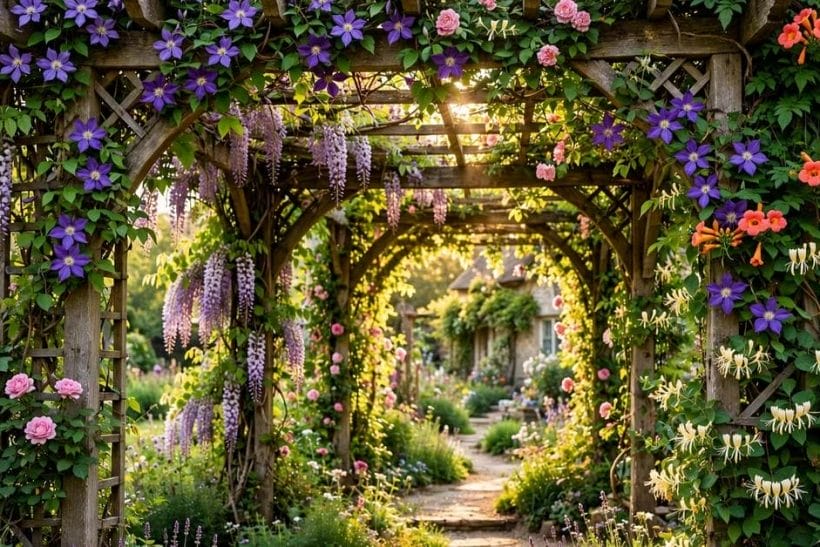
1. Flowering Vines at a Glance
Scope first. This article owns one subject: flowering vines grown for summer bloom on supports — walls, fences, trellis, arches and pergolas. The wider garden reading lives elsewhere on the site: pergola ideas for the structures vines climb best, courtyard landscaping ideas for enclosing small spaces in green, container garden ideas for growing in pots, mulch landscaping ideas for the soil care underneath, front yard landscaping ideas for the street-facing garden, greenhouse ideas for sheltered growing, and small Japanese garden ideas for a calmer planting style. Here, everything climbs.
One rule governs the whole article: a vine is a long-term tenant. It will lean on whatever you give it for years, grow heavier every season, and reward the gardener who chose the support and the site before choosing the plant. Flowers are the easy part; structure is the decision.
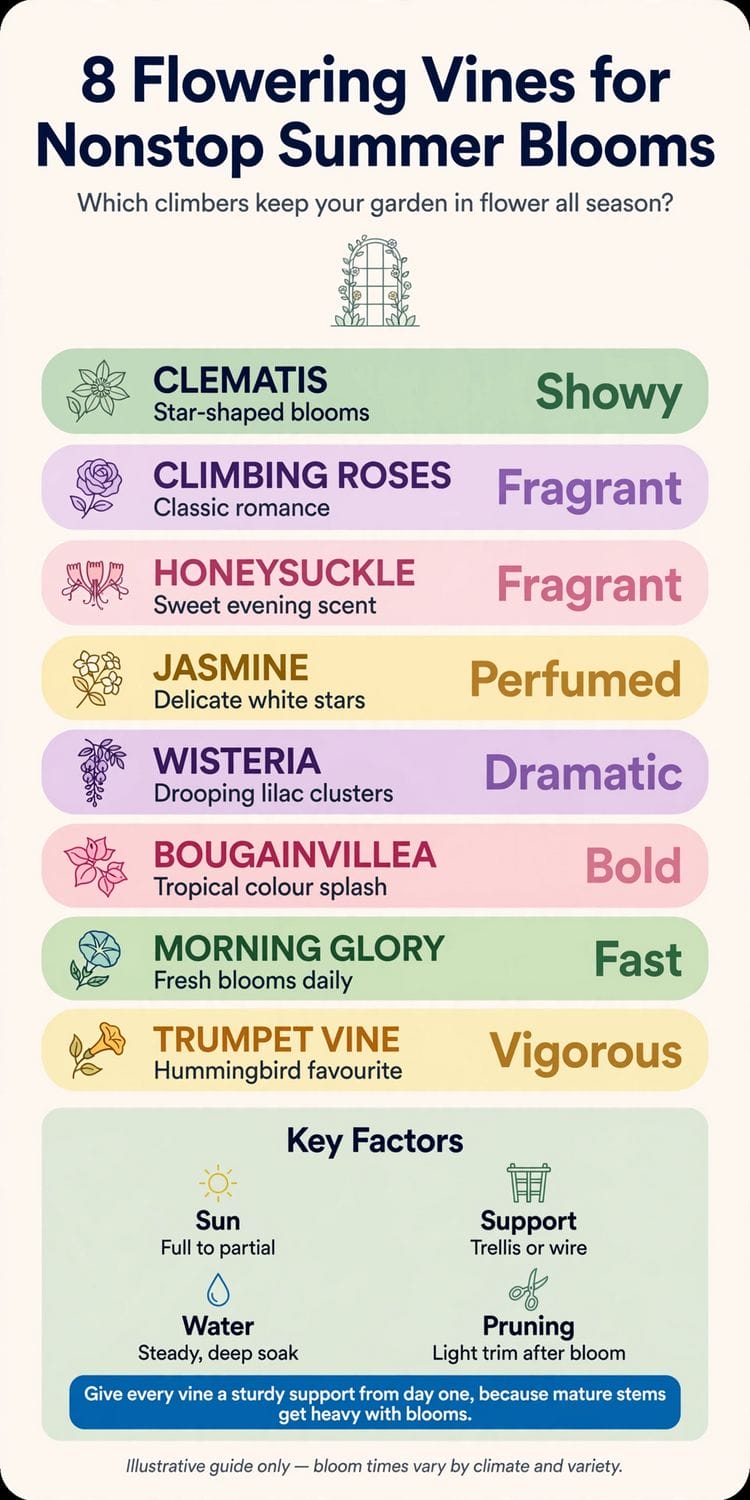
| Vine | Character | Asks of you |
|---|---|---|
| Clematis | Showy, star-shaped blooms | Cool roots, sunlit stems, light support |
| Climbing roses | Fragrant, classic romance | Tying in, feeding, airflow |
| Honeysuckle | Fragrant, sweet evening scent | Room to twine and scramble |
| Jasmine | Perfumed, delicate white stars | A warm, sheltered wall in cool climates |
| Wisteria | Dramatic, drooping lilac clusters | Serious support and regular pruning |
| Bougainvillea | Bold, tropical colour splash | Heat, sun and frost protection |
| Morning glory | Fast, fresh blooms daily | Almost nothing — it is an annual sprint |
| Trumpet vine | Vigorous, hummingbird favourite | Space, and firm control of its spread |
2. Clematis and Climbing Roses
1. Clematis: stars over a shaded root run
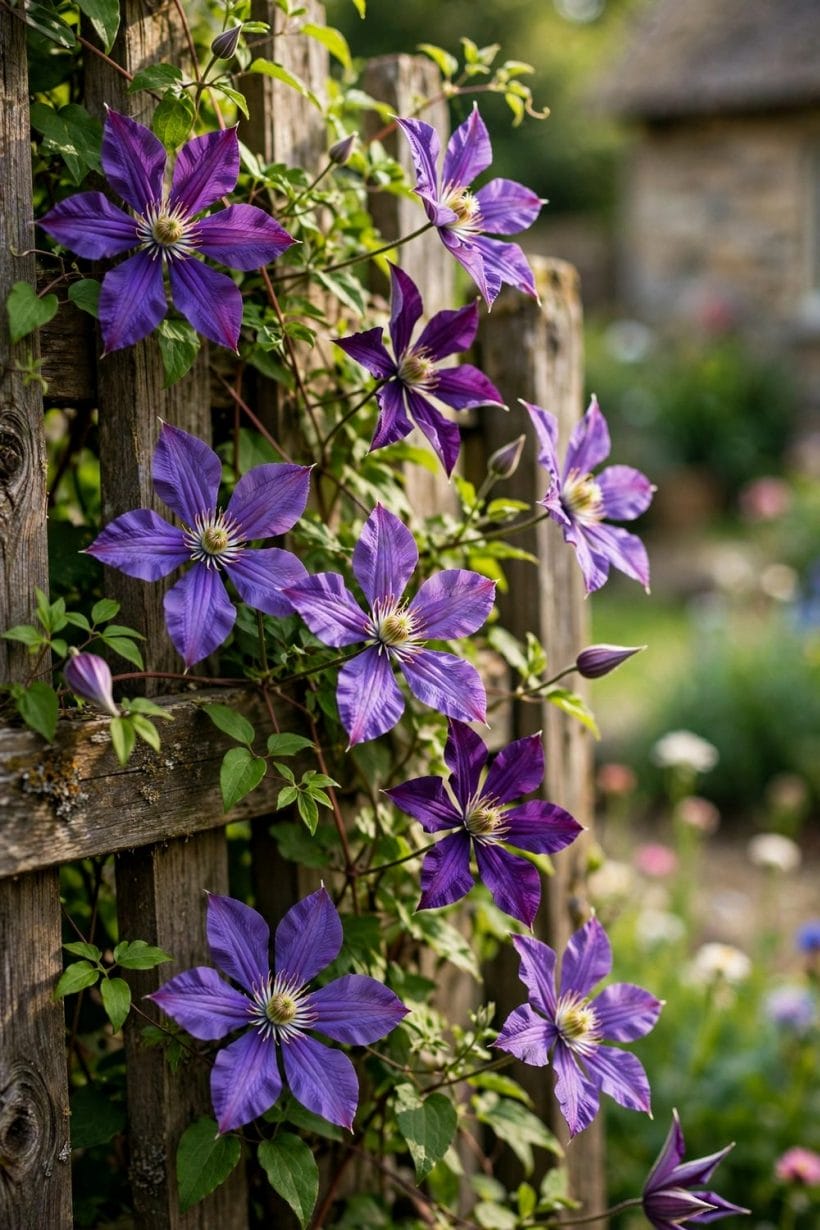
The clematis is the showpiece of the eight: large, star-shaped flowers in purples, pinks, whites and reds, produced in generous flushes on a plant that climbs by twining leaf stems rather than brute force. Its one famous preference is a split climate — roots in cool shade, stems and flowers in the sun — which a low shrub, a mulch of stones or a neighbouring plant at its base provides easily.
2. Training clematis up wires, trellis and shrubs
Because clematis grips with slender tendrils, it needs something thin to hold: wires, mesh, trellis or the branches of a host shrub all serve. One of the loveliest uses is letting a clematis scramble through a climbing rose or an early-flowering shrub, so one support carries two seasons of flower. Pruning groups differ by variety, so keep the plant’s label and prune by its own instructions rather than a general rule.
3. Climbing roses: the romantic framework
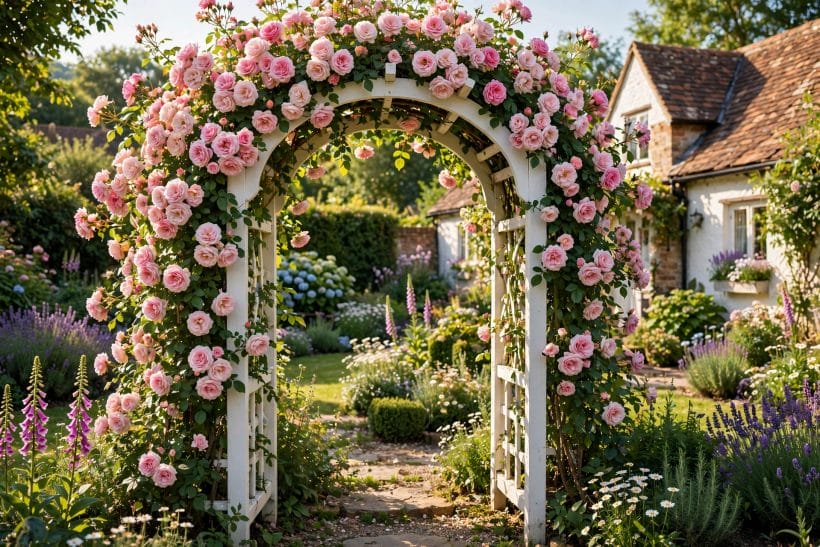
Climbing roses bring what no other vine here offers: fragrance, history and flowers bred for cutting. They do not truly climb — they produce long, sturdy canes that must be tied in to their support — and that turns out to be an advantage, because a rose trained near-horizontal along wires or a fence flowers along its whole length rather than only at the top. Give them sun, air movement to keep foliage healthy, and a feed in the growing season.
3. Honeysuckle and Jasmine
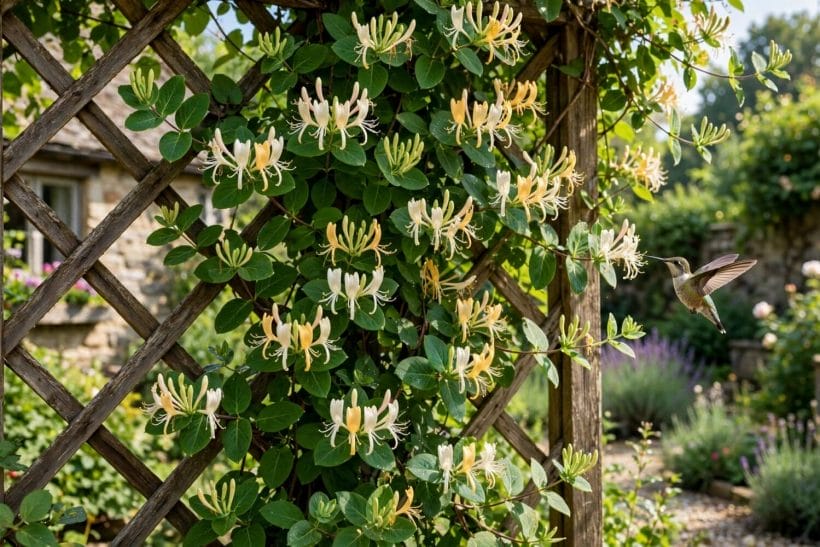
4. Honeysuckle for evening scent
Honeysuckle is the scent of a summer evening made into a plant: twining stems, tubular flowers loved by moths and hummingbirds, and a perfume that strengthens as the light fades. It is happiest scrambling over an arch, a pergola corner or through a hedge, where its informal habit reads as generosity rather than untidiness. Like clematis, it enjoys cool roots and a sunlit top.
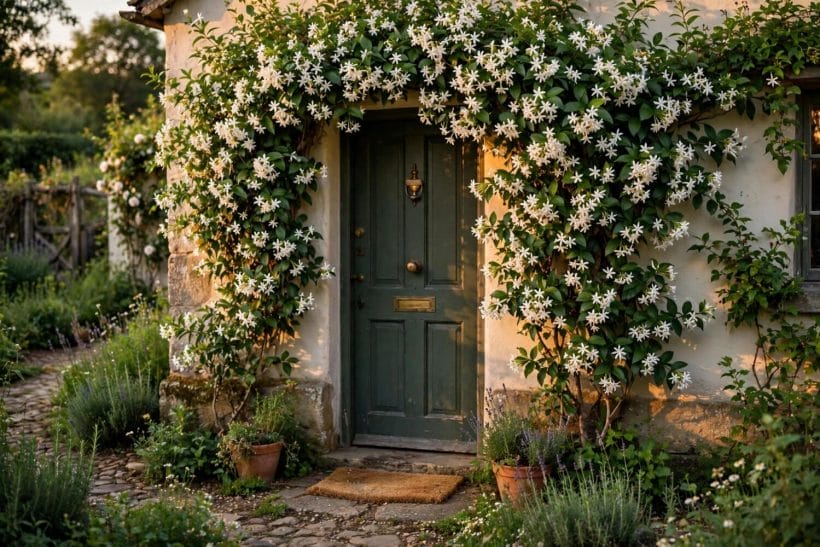
5. Jasmine: delicate white stars
Common jasmine covers itself in small, white, intensely perfumed stars and fine, ferny foliage. It is a twiner of moderate vigour — mannerly enough for a trellis panel beside a door, where its scent greets everyone who passes. In cooler climates it appreciates the warmth stored in a sunny wall and shelter from the hardest frosts; in warm ones it romps.
6. Planting for scent near seats and paths
Of the eight vines here, honeysuckle and jasmine earn their keep after dark, so place them where evenings are actually spent: beside the bench, around the porch, along the path from the gate. Scent drifts on still air and pools in enclosed corners, which is why a courtyard wall or a sheltered arch carries fragrance further than an open fence line. One scented vine, well placed, perfumes a whole seating area.
4. Wisteria and Bougainvillea
7. Wisteria: drama that needs muscle
Wisteria is the most dramatic vine in this collection and the most demanding: long, drooping clusters of lilac, violet or white flowers, a trunk that thickens into sculpture, and a weight that will test any support built lightly. It flowers on mature wood and repays a regular pruning rhythm — a summer tidy and a winter shortening, in general terms — with heavier bloom. Plant it once, plant it properly, and expect it to outlive the fence it climbs.
8. Supporting serious weight from day one
The infographic’s tip applies to wisteria above all: give every vine a sturdy support from day one, because mature stems get heavy with blooms. For wisteria that means a properly anchored pergola, strong wall bolts and stout wires, or a mature tree in the right setting — never a lightweight trellis panel. Retrofitting support under a ten-year-old wisteria is one of gardening’s least pleasant jobs; building it first is an afternoon.
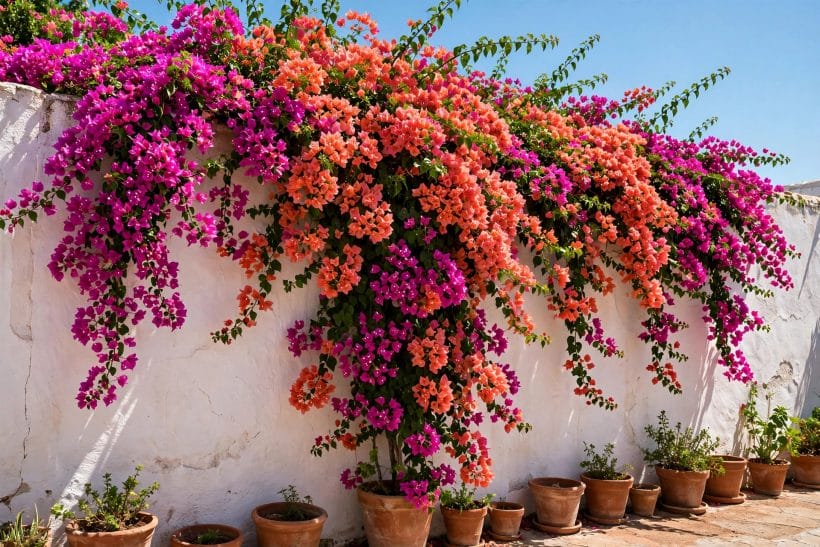
9. Bougainvillea for hot walls
Bougainvillea is pure tropical colour: papery bracts in magenta, coral, orange and white that blaze for months on a hot, sunny wall. It is a child of warm climates — grown against sheltered walls at the cool edge of its range, or in large pots that move under cover for winter. It climbs by scrambling and thorny anchoring, so tie it in as it grows, and keep its roots on the drier side once established.
5. Morning Glory and Trumpet Vine
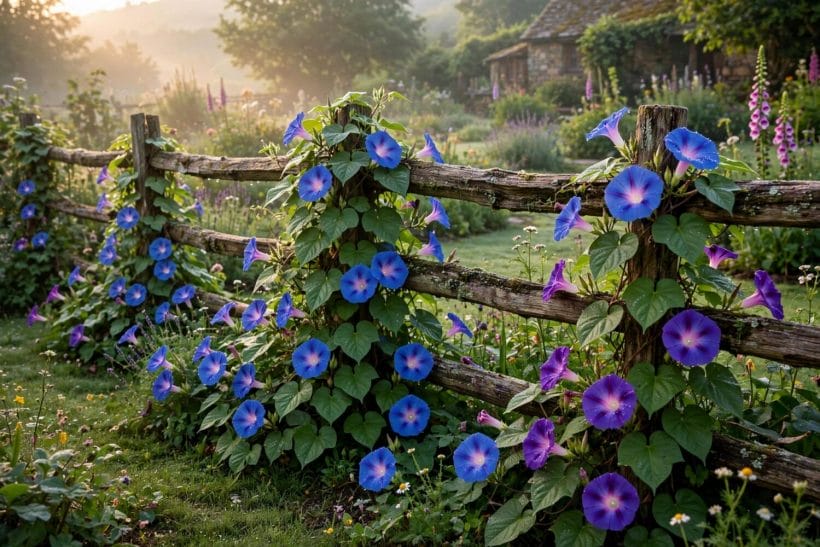
10. Morning glory: the fast annual screen
Morning glory is the sprinter of the eight: an annual vine that grows from seed to a flowering screen in a single season, opening fresh trumpets every morning. It asks for almost nothing — a sunny fence, string or netting to twine up, and water while it establishes — and it is the honest answer for a new garden, a rented house, or a bare support while the permanent vines grow up around it.
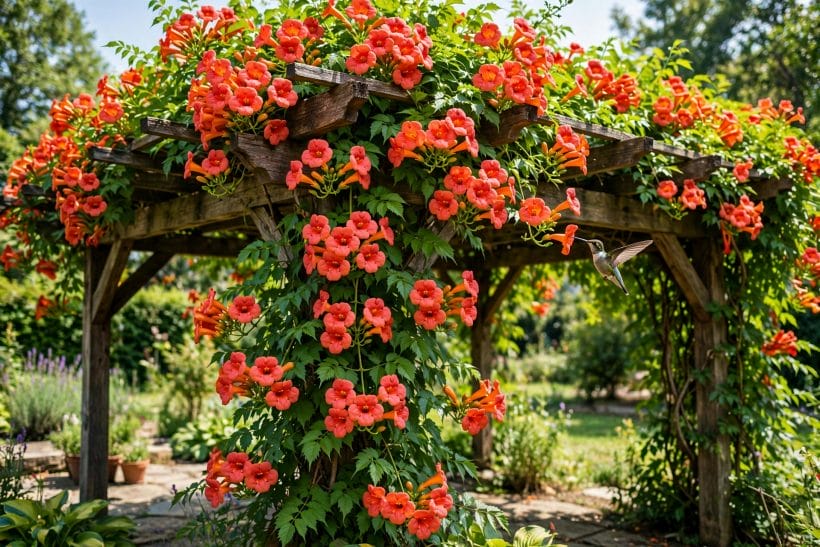
11. Trumpet vine: vigorous and wildlife-friendly
The trumpet vine produces bold orange-red trumpets that hummingbirds work all season, on one of the most vigorous growth habits in this article. It climbs by aerial rootlets that grip walls and bark directly, which makes it superb on a sturdy tree, a strong pergola or an outbuilding — and a poor choice for delicate fences, painted siding or anywhere its spread cannot be welcomed.
12. Managing vigour without a fight
Vigorous vines are assets in the right place and chores in the wrong one. Site trumpet vine where its roots and stems have room, keep it off roofs and gutters, and prune in the dormant season to hold its outline. The same honesty applies to wisteria near buildings. None of the eight is a problem plant by nature; problems come from a strong vine given a weak setting and no annual attention.
6. Supports That Last
13. Trellis panels and fans
Trellis is the gardener’s default: quick to fix, easy to space off a wall so air can move behind the foliage, and well matched to the moderate vines — clematis, jasmine and honeysuckle. Wooden trellis eventually rots behind a mature vine, which argues for the sturdiest panels you can fit, fixed so they can be unscrewed for wall maintenance without cutting the plant down.
14. Wires and cable systems
Horizontal wires on vine eyes are the neatest support of all: nearly invisible in winter, strong in service, and ideal for climbing roses trained along them and for wall shrubs generally. Space the wires to the plant’s habit, keep fixings stainless or galvanised for outdoor life, and tension them properly — a sagging wire line under a loaded rose looks tired and works worse.
15. Pergolas, arches and obelisks
Freestanding structures carry vines where no wall exists. A pergola roofed in wisteria or grape-style growth is the classic summer room; a garden arch suits honeysuckle and roses at a path entrance; an obelisk in a border gives clematis height among perennials. Build each for the mature plant, not the plant in the pot — the difference in weight, within a few seasons, is the difference between a feature and a repair.
7. Sun, Soil and Siting
16. Match the sun to the vine
Most of these eight flower best in full sun, and all of them manage in partial sun with reduced bloom — the infographic’s “full to partial” is the honest summary. Bougainvillea and morning glory are the true sun-demanders; clematis, honeysuckle and jasmine are the most forgiving of a half-day. Read your wall before you shop: a north-facing fence is a foliage project, not a flower one.
17. Heads in sun, roots in shade
The clematis rule generalises further than gardeners expect. Many woodland-edge climbers evolved with their roots in cool, leaf-littered soil and their flowers lifted into the light, and they sulk when the arrangement is reversed. A stone, a tile or a low companion plant shading the root zone, with the stems free to climb into sunshine, reproduces the woodland edge on a garden wall.
18. Soil, drainage and the rain shadow
Vines at the foot of a wall live in the driest soil in the garden, because the wall sheds rain away from its own base. Plant a little out from the wall, enrich the planting hole with garden compost, water deeply through the first seasons, and mulch the surface. Free drainage matters for all eight; even thirsty vines resent sitting in a sump, and a raised or improved bed at a wall base is rarely wasted work.
8. Water and Feeding
19. Deep watering beats little and often
The infographic’s phrase — steady, deep soak — is the whole method. A long drink that wets the root zone encourages roots to run deep, where moisture lasts; daily sprinkles keep them at the surface, where they scorch. New vines need regular watering through their first one or two summers; established ones, in the ground, mostly look after themselves outside drought.
20. Mulch: the quiet workhorse
A mulch of compost, bark or leaf mould over the root zone keeps moisture in, keeps roots cool for the woodland-edge vines, and slowly improves the soil as it rots down. Keep it a hand’s width from the stems themselves, top it up as it disappears, and it will do more for a wall of climbers than any amount of fussing above ground.
21. Feeding in general terms
Flowering takes energy, and a general-purpose feed in the growing season — or a mulch of rich compost doing the same job slowly — keeps the eight in good heart. Roses and clematis are the hungriest; bougainvillea flowers better for restraint than for richness. Follow the instructions on whatever product you choose, and feed the soil rather than chasing the plant: vines fed moderately flower over a longer season than vines pushed hard.
9. Pruning and Training
22. Tie in as it grows
Young stems tied in regularly — loosely, with soft ties that will not cut — build the framework everything else hangs from. Spread the main stems to cover the support evenly rather than letting them bunch up one post, and a rose or wisteria will reward the geometry with flowers along every tied stem. Ten minutes with a ball of twine, a few times a season, is most of vine training.
23. A light trim after bloom
Most of the eight need no more than the infographic’s advice: a light trim after bloom to remove spent flowers, shorten wayward stems and keep paths and windows clear. Clematis pruning varies by group, wisteria keeps its own twice-a-year rhythm, and roses are pruned by type — the shared principle is restraint plus the plant’s own label, not a single calendar for all.
24. Renovation, rarely and carefully
An old, neglected vine with bare legs and flowers only at the top can often be renovated by cutting back hard in the dormant season — but it is a gamble some plants refuse, and it costs a season or two of bloom. Where the plant matters, renovate a portion at a time over two or three winters, and where it does not, the honest answer may be a new vine, a better support, and the lessons of the old one kept.
10. Keeping the Show Going
25. Pair vines for a longer season
No single vine flowers all summer at full stretch, but combinations come close: an early clematis through a climbing rose, honeysuckle following wisteria on the same pergola, morning glory filling a new support while everything permanent establishes. Layering two vines on one structure — chosen so their peaks follow rather than clash — is how a wall stays in flower from the first flush to the last.
26. Deadheading and small attentions
Removing spent flowers where it is practical encourages many vines to keep producing rather than setting seed, and a weekly walk with secateurs — snipping, tying, redirecting — catches the season’s small problems while they are still small. Morning glory deadheads itself daily by opening fresh flowers; roses repay the attention most visibly of the eight.
27. Tender vines in pots
Bougainvillea, and jasmine in cold districts, grow happily in large pots against a sunny wall, trained up a fixed trellis or an obelisk in the pot itself. Pots dry out faster than borders and need the deep-soak watering of section 8 more often; in return, the whole display can move under cover before the frosts, and a rented or paved garden gets its summer wall of flowers anyway.
Final Considerations
Eight vines, eight different temperaments, one shared bargain: a sturdy support, a site with sun, cool and mulched roots, and a gardener who ties in the young stems and trims lightly after bloom. Clematis for show, roses for romance, honeysuckle and jasmine for the evening air, wisteria for drama, bougainvillea for heat, morning glory for speed and trumpet vine for sheer vigour — there is a vine here for every wall a summer garden owns.
Start with the structure and the site, not the flower catalogue. The gardens whose climbers stop passers-by are never the ones with the rarest plants; they are the ones where the trellis was built for the mature vine, the roots were mulched from the first year, and somebody walks the wall each week with twine in a pocket. Choose your eight — or your one — on that basis, and the nonstop summer blooms will look after themselves.



0 Comments