
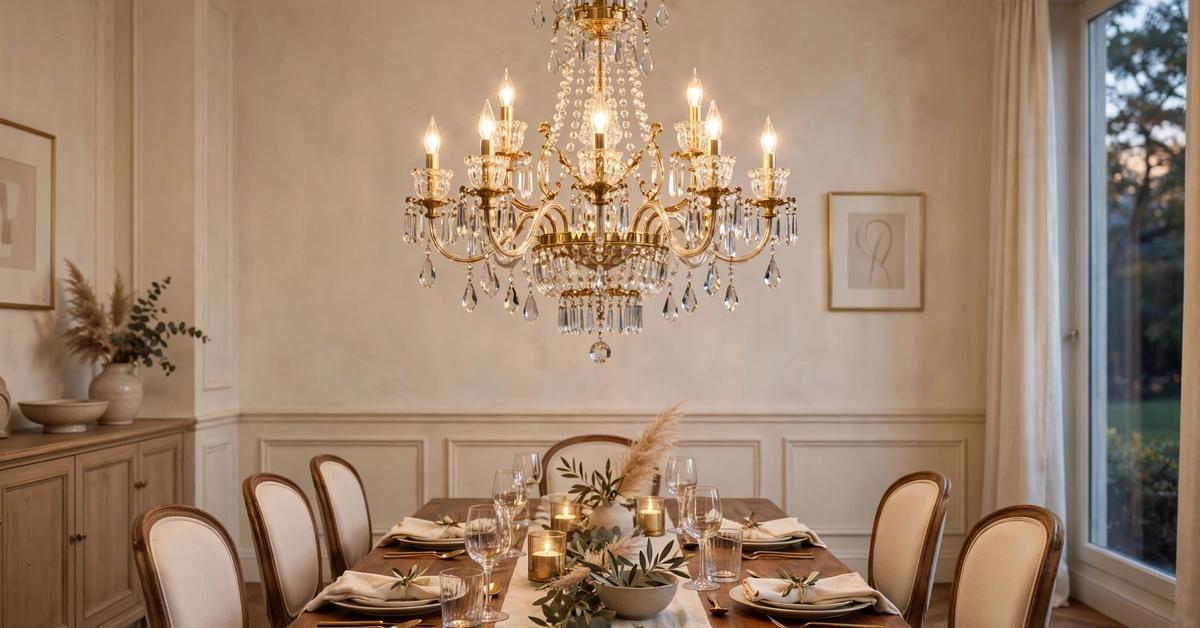
Every dining room has two centres: the room’s, which the architect chose, and the table’s, which is where life actually happens. A chandelier belongs to the second one. Hung over the middle of the table, at the height where its light pools on the wood and leaves faces clear across it, it turns furniture into a destination — and hung anywhere else, at any other height, the most beautiful fitting in the world looks like a mistake the room keeps apologising for.
This collection of seventy-five ideas stays deliberately narrow: the chandelier above a dining table, and nothing else. Placement, height and scale come first, stated in general terms throughout; the styles follow, each judged by how it hangs over a table. The broader subject — chandeliers and pendants across the whole room — belongs to the companion post linked below; here, everything is over the table.
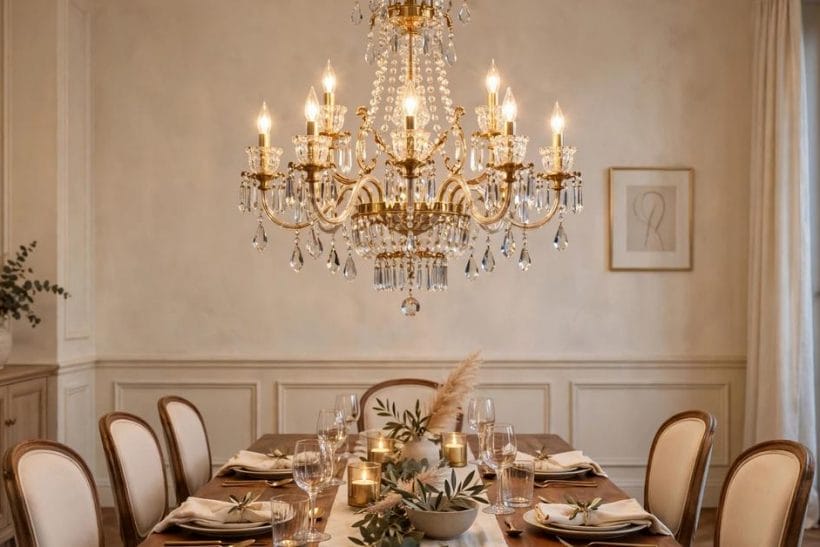
1. Chandeliers Above Dining Tables at a Glance
Scope first. This post owns one arrangement: a chandelier centred over a dining table. The wider reading lives elsewhere: dining room chandeliers for the whole room, dining room ideas for the room itself, ceiling designs for the living room for overhead, tiny dining room ideas for small spaces, tiny house interior lighting ideas for layered light, and kitchen ideas for open-plan dining. Here, everything hangs over the table.
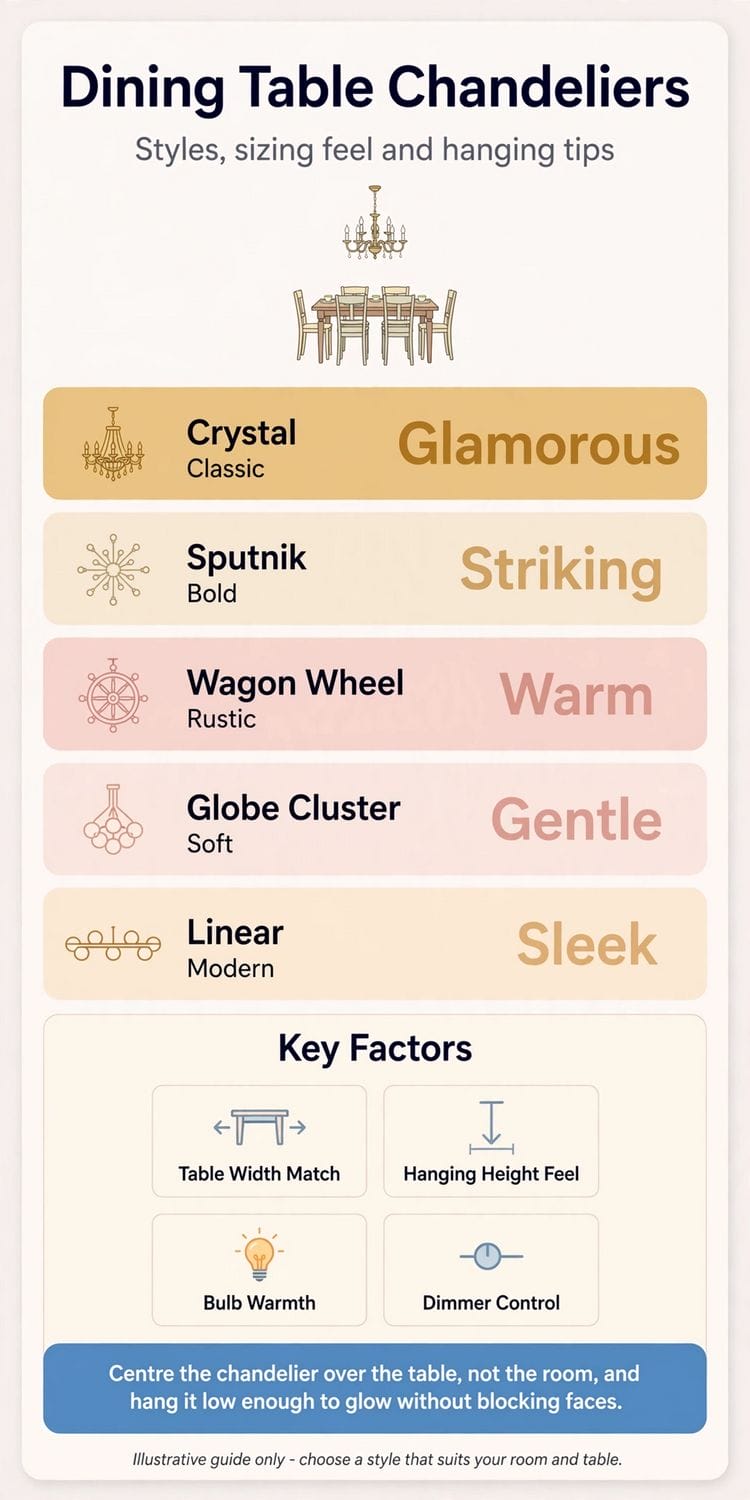
One rule governs the whole collection, and it is the infographic’s tip: centre the chandelier over the table, not the room, and hang it low enough to glow without blocking faces. Every idea below unfolds that sentence.
| Decision | General guidance | Why it matters |
|---|---|---|
| Position | Centred on the table, always | The light and the eye both gather there |
| Height | Low enough to pool light, high enough to see faces | Intimacy without obstruction |
| Width | Clearly narrower than the table | Proportion, and heads when leaning in |
| Length | Answer the table’s length | Even light end to end |
| Light quality | Warm, dimmable, glare-free | Food and faces flatter warm |
| Fixing | Into structure, by a professional | Chandeliers are heavy and electrical |
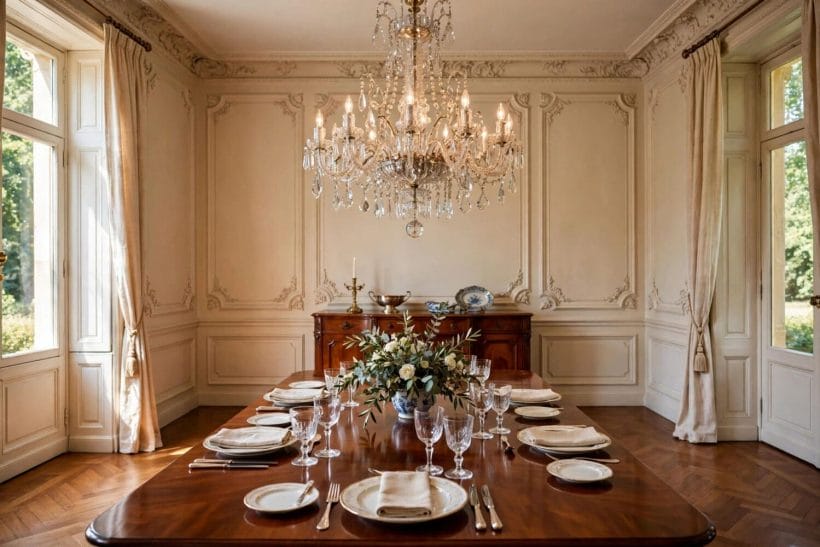
2. Hanging Height Above the Table
1. The classic low hang over the tabletop
The traditional dining chandelier hangs lower than any other light in the house — close enough that its light forms a visible pool on the table and the fitting becomes part of the setting. That lowness gathers the diners into a lit circle and lets the room fall gently away.
2. High enough for faces across the table
The counterweight to lowness is sightlines: seated diners should see each other comfortably under or through the fitting. Test it from the chairs, not standing — most height mistakes are made on feet.
3. Higher hangs for tall centrepieces
If the table regularly carries tall flowers or candelabra, the chandelier must clear them or share the centreline awkwardly. Raise the hang a little, or keep centrepieces low and wide. Decide which owns the table’s centre; they cannot both.
4. Low ceilings: the shallow hang
In a low-ceilinged room the chandelier hugs the ceiling: a wide, shallow fitting hung as short as its design allows, still centred on the table. The pool of light survives at reduced drama, and width does the decorative work drop does in taller rooms.
5. High ceilings: using the drop
Tall rooms let the chandelier descend on a long chain or rod into the diners’ world, the extra height absorbed above it. Resist hanging it high because the ceiling allows it; the table, not the ceiling, sets the height.
6. Matching height to the fitting’s tiers
A tiered chandelier reads best when its widest tier sits in the pool-of-light zone and its lowest drop clears the setting. Judge the hang by its silhouette against seated eye lines, tier by tier.
7. Two people, one ladder: setting the height
Set the height socially: one person adjusts, the other sits at the table judging faces, glare and pool. Move in small increments. Heights chosen from the chairs, in company, are never adjusted again.
8. Adjustable drops for extendable tables
Tables that extend for guests change the geometry twice a year. An adjustable chain or rod — a drop that re-sets when the table grows — keeps the composition right in both arrangements.
3. Size and Scale Against the Table
9. Narrower than the table, clearly
The infographic’s first Key Factor is table width match. In general terms, the fitting should be noticeably narrower than the table — around half to two-thirds of its width is the usual starting point — crowning it without overhanging diners’ heads at the edges.
10. Too small: the lost chandelier
An undersized chandelier over a generous table reads as an apology: a pendant’s presence doing a chandelier’s job. The pool shrinks and the table’s ends leave the composition. When in doubt between two sizes, the larger is usually the honest answer.
11. Too large: the looming chandelier
The opposite error looms: a fitting so wide and low that diners feel it rather than see it. A chandelier should fill the view above the table like a picture fills a frame, with air around it. Air is not emptiness; it is proportion.
12. Length on long tables: the linear answer
On a long table, one round chandelier lights the middle and abandons the ends. The linear chandelier — lights on a bar or frame, the infographic’s “Sleek” form — answers the length directly, spreading the pool end to end while keeping idea 9’s width relationship.
13. Two smaller chandeliers over one long table
The alternative is a pair: two modest chandeliers evenly spaced along the centreline, each centred on its half. The light is even, but the pair must match exactly and hang at exactly the same height — a pair out of level is the fault every guest notices.
14. Round tables want round fittings
A round table composes best under a round chandelier of answering diameter: the geometry rhymes, the light pools in a circle, and every seat is equidistant from the centre. Idea 9’s relationship applies as diameter — clearly narrower than the top, centred on its middle.
15. Square tables and centred squares
Square tables take square, round or lantern-form chandeliers happily, provided the centring is exact — a square composition exposes an off-centre fitting mercilessly. The smaller the table, the more the chandelier is the room’s whole statement: choose the fitting you’d choose as art.
16. Judging scale with a cardboard template
Before buying, cut the fitting’s diameter in cardboard and hold it at the intended height over the table. Scale that is hard to imagine is easy to see, and five minutes with a template has saved more dining rooms than any rule of thumb.
4. Centring and Alignment
17. Centre on the table, not the room
The tip again, because it is dining lighting’s most disobeyed rule: centre on the table, even when the table is not centred in the room. Rooms are walked through; tables are sat at. A fitting centred on the architecture lights the floor beautifully and the dinner not at all.
18. Moving the ceiling point to the table
When the ceiling outlet sits over the room’s centre and the table elsewhere, the honest fixes are moving the outlet — a professional’s job — or swagging the chain across the ceiling on a hook to the table’s centre, a respectable traditional solution. The wrong centre is no solution.
19. Aligning with the table’s centreline
On rectangular tables the fitting centres on both axes: the middle of the length and of the width. With linear fittings and pairs, the centreline is the line the composition hangs from — measure it, mark it with a runner, align everything to it.
20. Centring where the table moves
Tables shift: leaves come out, the table turns for a party, the room rearranges. Choose the arrangement the table lives in most of the year, centre the chandelier on that, and let exceptional layouts borrow light from elsewhere.
21. Sightlines from the doorway
Check the composition from where the room is entered: table, chandelier and any window beyond should compose into one picture. A chandelier in the doorway’s sightline is the room’s portrait; choose its style accordingly.
22. Ceiling roses and medallions as anchors
A ceiling rose or medallion at the fixing point finishes the hang and anchors the fitting to the ceiling plane — the composition’s full stop. Choose one in proportion: grand enough to hold it, quiet enough not to compete.
23. Exposed chains, rods and cords
The drop is part of the design: chain for traditional and adjustable hangs, rod for fixed modern ones, cord where the style is relaxed. Keep it vertical and centred, its length set by section 2, not by what came in the box.
24. The table setting as part of the composition
Runner, centrepiece, candlesticks and chandelier compose as one vertical arrangement: a low, wide centrepiece under a low fitting; tall candles flanking rather than under it; nothing competing at the centre. Dress the table with the chandelier lit, as it will be seen.
5. Crystal and Candle-Style Chandeliers
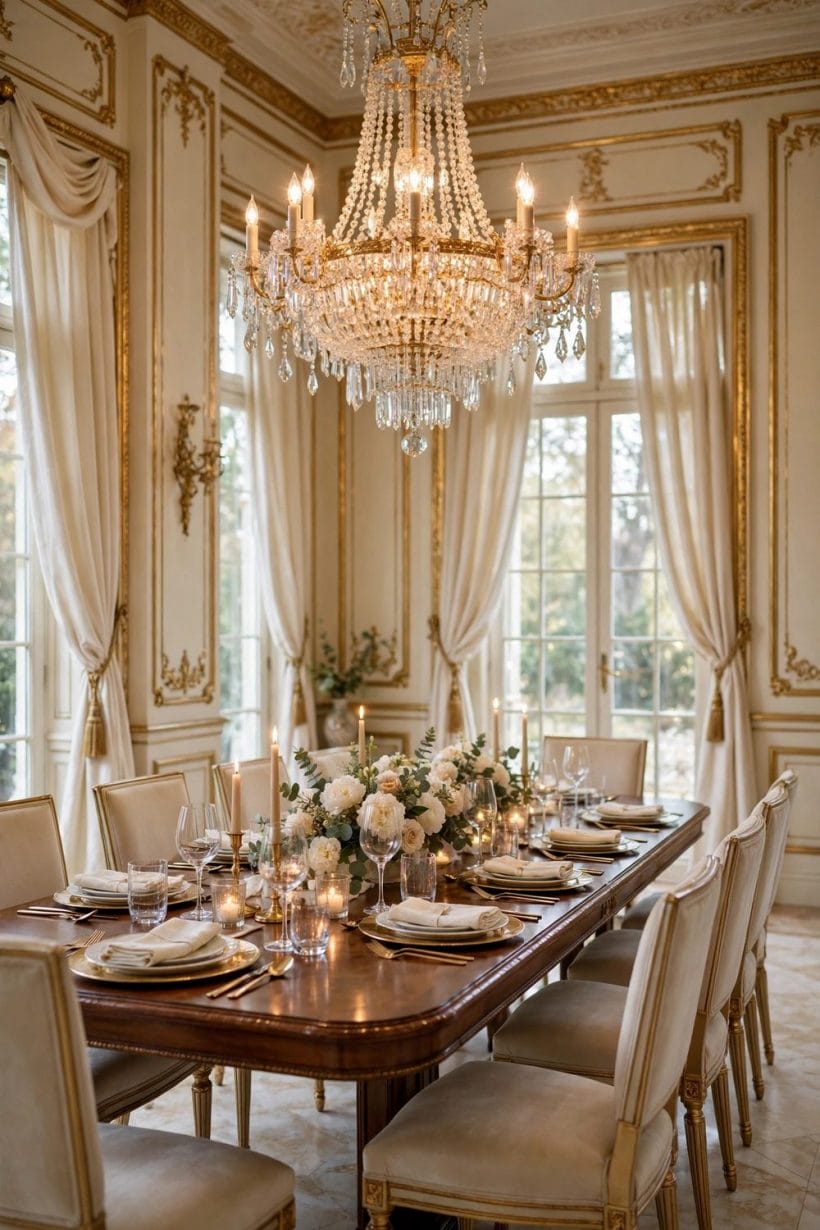
25. The classic crystal chandelier
The infographic’s “Glamorous”: crystal drops and candle bulbs scattering light into the room’s corners. Crystal over a dining table is the historical arrangement — candlelight through cut glass above food and faces — and it demands sections 3 and 4’s discipline most, because it draws every eye.
26. Candle-style fittings without the crystal
The candle chandelier’s simpler cousin — bare candle bulbs on a metal frame, no drops — keeps the warm flame-points and drops the formality. It suits rooms wanting tradition without ceremony, and its open structure never blocks idea 2’s faces test.
27. Tiered chandeliers over generous tables
Two or three tiers of lights widen a crystal chandelier’s pool and give tall rooms their fitting. Judge it by its widest tier for width and its lowest drop for height, composed centred and level above the table’s middle.
28. Glass shades that soften candle glare
Small glass or fabric shades on candle bulbs trade a little sparkle for much comfort: the light still reads as candlelight, but seated eyes meet no bare filaments. On dimmers (section 9), shaded fittings range widest, from bright family supper to low dinner-party glow.
29. Empire and tent-and-bag forms
The Empire chandelier — a tent of crystal strands gathered to a bag below — hangs as a single jewel over the table, its silhouette inside the width rules. It suits formal rooms and round tables, and its mostly downward light pools beautifully on polished wood.
30. Crystal in a modern room
A traditional crystal chandelier over a contemporary table is a deliberate, often wonderful tension — the one antique note in a minimal room. The discipline matters more, not less: centred exactly, hung at the classic height, left as the room’s single ornament.
31. Cleaning and care over a table
Crystal over a dining table gathers cooking air and dust faster than anywhere else, and sparkle is the first casualty. Choose drops that wipe in place, a hang reachable safely on a step, and a gentle cleaning rhythm rather than an annual archaeology.
32. Inherited and antique chandeliers
An inherited chandelier brings what new fittings cannot: history at the table. Have an antique rewired and checked by a professional before it hangs over people, keep its drops and proportions intact, and let the table’s size arbitrate where it belongs.
6. Modern, Linear and Globe Forms
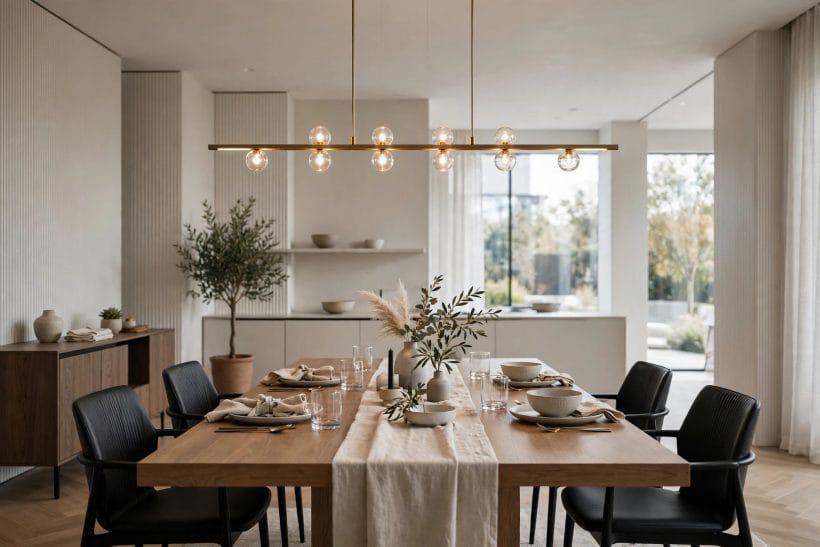
33. Linear chandeliers over long tables
The linear form — lights in a row on a frame or bar — is the modern answer to the long table, the infographic’s “Sleek” entry. Its low horizontal silhouette suits lower ceilings and open-plan rooms, and its length should answer the table’s as idea 9 answers width.
34. Sputnik and starburst forms
The infographic’s “Striking”: a Sputnik chandelier explodes light in every direction from a central core — sculpture first, fitting second. Its diameter is its widest spike, not its core, so judge width by the full starburst, and hang it where its drama is the intended centrepiece.
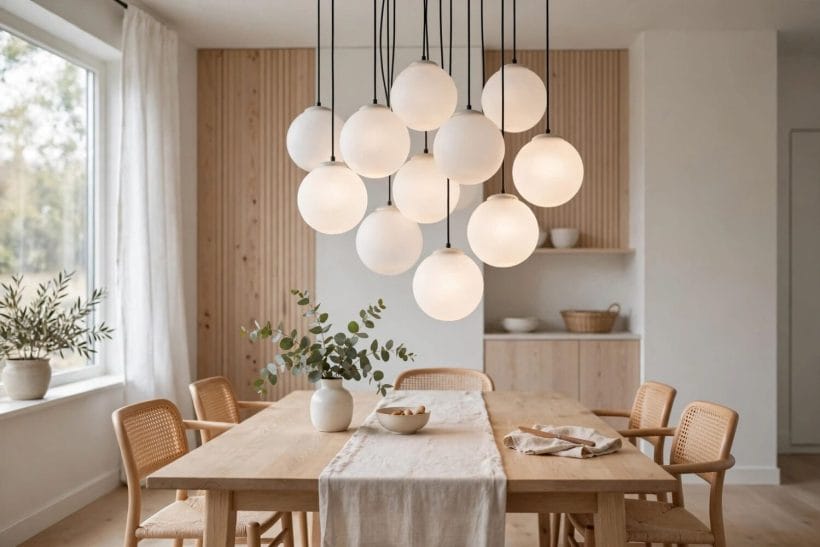
35. Globe clusters
The infographic’s “Gentle”: clusters of opal glass globes at staggered heights soften modern light into something almost candle-like. A globe cluster pools light kindly, never glares at seated eyes, and suits round and square tables. Keep the lowest globe above the faces test.
36. A single large globe as the modern chandelier
One oversized globe centred over the table is the minimalist’s chandelier: the classical arrangement’s centring and proportion with none of the ornament. Its diameter follows the same width rule, its light should be warm and dimmable, and its simplicity makes exact centring non-negotiable.
37. Ring and halo chandeliers
A horizontal ring of light — the halo form — hangs over round and square tables like a crown: open in the middle, so sightlines pass through, and wide without weight. It is the friendliest modern form for the faces test, in contemporary and traditional rooms alike.
38. Branch and organic modern forms
Branching fittings spread their lights like a bough — asymmetric, sculptural, happiest over long tables where the spread answers the length. Compose them like a centrepiece: the branch’s visual centre, not its fixing point, should sit over the table’s middle.
39. Exposed-bulb industrial fittings
Industrial chandeliers — blackened metal, exposed filament bulbs — bring a workshop honesty that suits casual dining rooms and kitchen-diners. They demand section 9’s glare conversation most: warm filaments, dimmers, and a hang that keeps bare bulbs out of the direct sightline.
40. Mixing a modern fitting with a traditional room
A sleek modern chandelier in a panelled traditional room works like idea 30 in reverse: one clear contrast, classically placed — centred, at the traditional height, the room’s single modern sentence. Two or three competing notes dissolve the effect; one sharpens everything.
7. Rustic and Wagon-Wheel Chandeliers
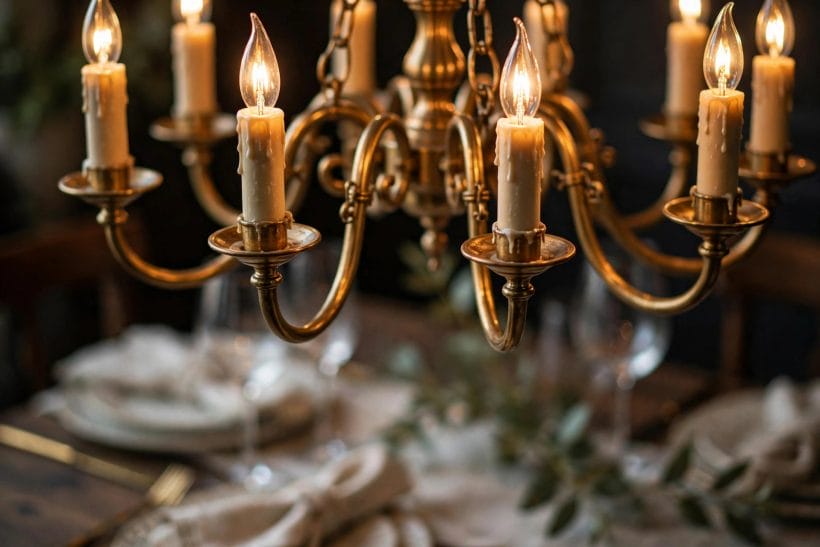
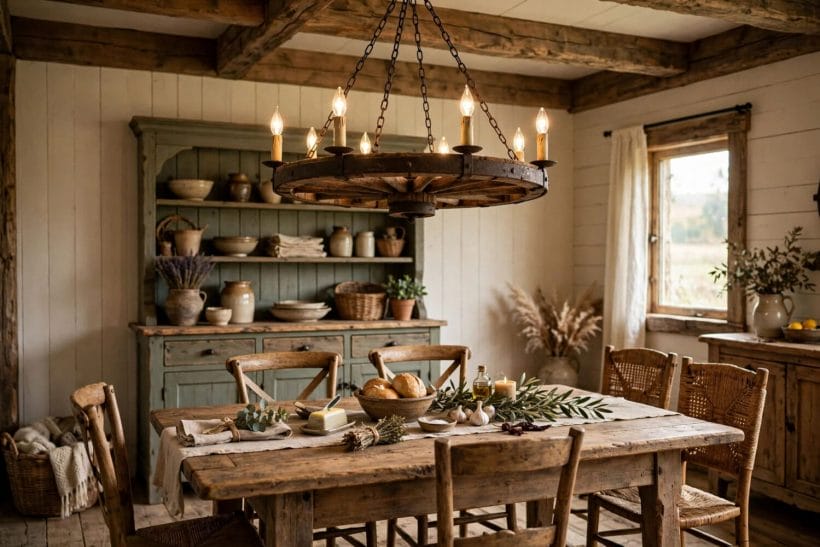
41. The wagon wheel chandelier
The infographic’s “Warm”: a wheel rimmed with candle bulbs, hung flat over a farmhouse or rustic table. Its wide, shallow disc suits lower ceilings and long or round tables, and over a scrubbed pine table in a beamed room it looks less installed than inevitable.
42. Antler and branch rustic forms
Antler chandeliers — real in old lodges, moulded in most modern rooms — spread a wide, irregular silhouette needing the width rules applied generously and a table sturdy in character to answer them. They belong in rustic and country rooms, where their scale is the whole point.
43. Wooden beam chandeliers
A single reclaimed beam, hung horizontally with candle bulbs along it, is the rustic linear chandelier: massive in material, simple in form, at home over a long farmhouse table. Its weight makes professional fixing essential, and its length follows the table’s proportion rules.
44. Iron ring chandeliers
The forged-iron ring — candles or candle bulbs around a suspended hoop — is the wagon wheel’s medieval cousin: darker, narrower in feel, at home over round tables in stone and timber rooms. Its open centre keeps faces visible; from the doorway it reads as a drawn circle.
45. Lantern-style chandeliers
A lantern form — lights inside a glazed or open frame — hangs over a table like a piece of the porch brought indoors: protected flames and a friendly scale for smaller rooms. Pairs or trios along a long table follow idea 13’s logic, hangs matched exactly.
46. Rustic fittings in non-rustic rooms
A wagon wheel or beam chandelier in an otherwise plain contemporary room is idea 40’s single contrast in rustic form: it works when it is the room’s only rustic sentence and its placement is classical. Rustic form, disciplined hang, reads as confidence rather than theme.
47. Candles, bulbs and fire honesty
Some rustic chandeliers burn real candles; most use candle bulbs. Over a table the considerations are general: real flame asks supervision, clearance from anything combustible and a fitting designed for it; bulbs ask warmth and dimming. Choose by the household’s habits, not its fantasies.
48. Scale in beamed and vaulted rooms
Beams and vaults complicate the rustic hang: the fitting must clear or honour the beams, and its drop is judged from the table through real sightlines, not from the ridge. A wagon wheel centred between beams, over the table’s centre, composes the whole ceiling.
8. Small Dining Rooms and Low Ceilings
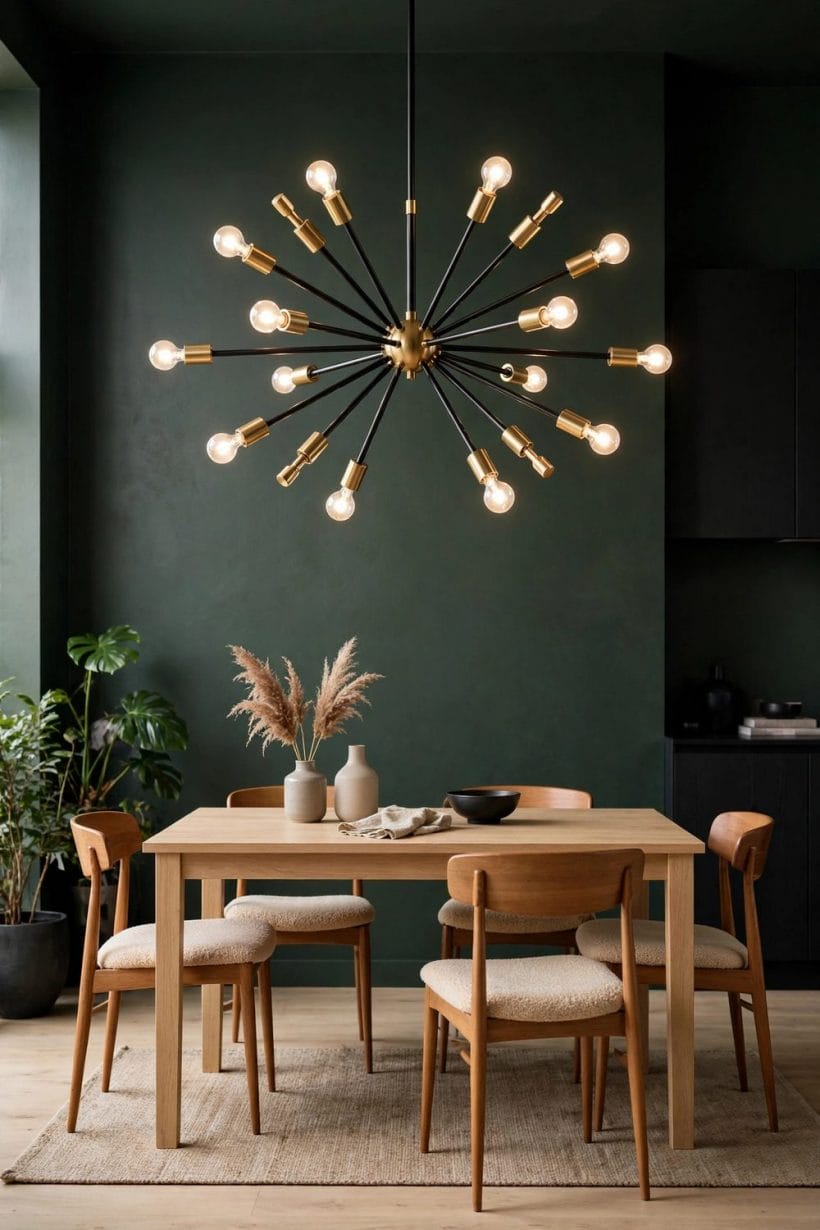
49. Semi-flush chandeliers for low ceilings
Where ceiling height forbids a drop, the semi-flush chandelier — a real chandelier’s silhouette on a short stem — keeps the arrangement’s dignity at reduced depth. Centred over the table, wide rather than deep, it still pools light where the dinner is.
50. Wide and shallow beats tall and narrow
In a small room, spread the fitting sideways: width gives presence and light-spread without consuming vertical space the room lacks. A wide, shallow chandelier reads as generous; a tall, narrow one as a stalactite. The width rules still apply against the table.
51. Clear glass that takes no visual space
Glass chandeliers — clear arms, clear shades, minimal metal — hang over small tables almost invisibly until lit, then sparkle without having crowded the room all day. In a small dining room that doubles as a passage or workspace, transparency is the kindest quality.
52. One statement over a small table
A small dining room can carry exactly one piece of jewellery, and the chandelier over its table is the natural candidate: everything else quiet, the fitting chosen like art. A beautiful chandelier over a four-person table out-remembers a grand one diluted across twelve seats.
53. Open-plan dining: defining the zone
In open-plan space, the chandelier makes the dining area a room: a pool of low light in a larger, brighter volume. Centre it on the table wherever the table lives, hang it at dining height rather than the volume’s height, and let the contrast of levels do the zoning.
54. Kitchen-diners and the shared ceiling
Where the table shares a ceiling with a working kitchen, the chandelier still belongs to the table alone — centred and hung for it — while the kitchen keeps its task lighting. The two coexist happily if the chandelier dims enough to withdraw while cooking is bright.
55. Breakfast nooks and small round tables
A small round nook table under a single modest chandelier — or its close cousin, a lantern — is the small-space arrangement at its most charming: exact centring, a fitting in the table’s scale, morning light doing half the work. Modesty of size, not of care.
56. Renters and reversible hangs
Where the ceiling cannot be altered, plug-in and swagged fittings carry the chandelier to the table’s centre on hooks. The placement rules do not bend for tenure — centred, right height, right scale — and a renter’s chandelier, properly placed, looks no different from an owner’s.
9. Light Quality, Bulbs and Dimming
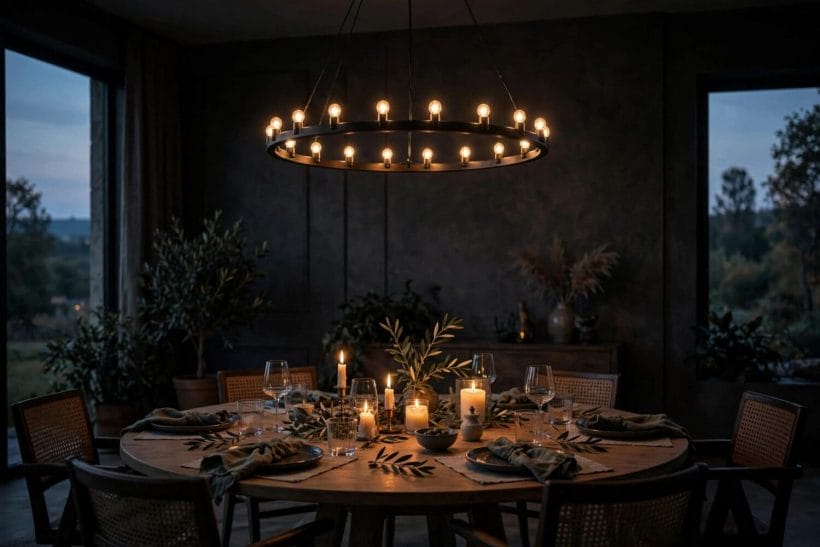
57. Warm light over food
The infographic’s “Bulb Warmth” is non-negotiable over a dining table: food, wood and faces flatter in warm light and sicken in cold. Bulbs should be warm-toned, consistent with each other, and chosen for their colour at the dimmer’s working levels, not at full brightness in the shop.
58. The dimmer is half the fitting
The infographic’s fourth factor: dimmer control. A chandelier over a table lives most of its life dimmed — full light for setting and clearing, low glow for the meal. A fitting without a dimmer has one mood, and dining needs at least three. If you change nothing else, add the dimmer.
59. Glare: the seated eye’s complaint
Bare bulbs at seated eye level, across a table, for two hours: glare is the fault guests remember and hosts never notice. Shades, frosted bulbs, globes or a hang that lifts filaments from the direct line all cure it. Sit in every chair, at night, before declaring the fitting finished.
60. Layering with wall and candle light
The chandelier need not light the room — only the table. Wall lights, a sideboard lamp and candles on the table layer the rest, letting the chandelier hang low and dim as the composition’s crown. Layers are what make a dimmed dining room feel rich rather than dark.
61. Bulb consistency and spares
Every bulb in a chandelier should match its neighbours in tone and output; one cold replacement in a warm set announces itself at every meal. Keep spares of the exact bulb when fitting new ones — chandeliers outlive bulb models, and one stranger among five is a nightly irritation.
62. Daylight hours: the fitting unlit
A dining chandelier spends its days as sculpture, often against a window. Judge candidates unlit as well as lit: silhouettes, crystal and glass all have a daylight character, and the fitting beautiful dark at noon and warm at eight is the one to hang.
63. Light on the table, not the ceiling
Fittings that throw most light upward light the ceiling and silhouette the diners; over a table, the pool should fall downward onto the setting. Shades directing light down, open-bottomed lanterns and all-scattering crystal manage it differently — check where the light lands, seated, before the ladder goes away.
64. Smart bulbs and scenes
Tunable bulbs let one chandelier serve bright breakfasts and candlelit dinners — warm and low for evening, clearer for a working lunch. Used with restraint, a couple of saved scenes rather than an app’s worth, they solve the dining table’s two lives without touching the fitting.
65. When the table is also a desk
Tables doubling as desks — homework, laptops, sewing — need the chandelier to rise to the occasion: brighter, clearer light at full power, the dimmer restoring the dining mood after hours. A fitting chosen only for dinner glow frustrates the day job; choose for both.
10. Buying and Hanging Checks
66. Measure the table first
Every check here starts with the table: its width, length, usual position, and extended size if it has leaves. Buy the fitting against those numbers — never against the room’s dimensions, and never against the old fitting whose sins this purchase corrects.
67. Check the ceiling’s structure
Chandeliers are heavy, and their fixing must land in structure — a joist, a beam, a rated ceiling box — not in plasterboard optimism. What the ceiling can carry, and where, is a professional’s assessment, and it should shape the shortlist before style does.
68. Professional installation, always
Hanging a chandelier is electrical work at height involving weight, ladders and the mains. It belongs to a qualified electrician, who will also set the drop, level the fitting and test dimmer compatibility. The cost is small against the fitting.
69. Dimmer and bulb compatibility
Modern bulbs and older dimmers do not always agree — flicker and buzz are the symptoms. Have the pairing confirmed at installation, with the actual bulbs you will use, and solve it then rather than at the first dinner party: a five-minute check that protects every evening after.
70. Weight, chain and the drop kit
Confirm the chain or rod can be set to the drop your ceiling and section 2 require — some fittings arrive with drops suited to one ceiling only. Keep spare links, the ceiling rose and any spare crystals in a labelled box, where the future can find them.
71. Cost drivers, stated generally
A chandelier’s cost is driven by its materials — crystal, glass, metalwork — its size, complexity and maker, and the installation it needs, including ceiling work to centre it. Against the years it serves: buy the placement first and the fitting second.
72. Buying second-hand and vintage
Vintage chandeliers offer craftsmanship and character at kind prices, balanced against rewiring, missing drops and unknown fixings. Budget the rewire into the purchase, count the crystals before falling in love, and remember idea 32: an old fitting is a joy when its electrics are new.
73. The doorway test before you commit
Hold the candidate — or its template, per idea 16 — at the hang, and look from the doorway and from every chair. A chandelier is a dining room’s most looked-at object; ten minutes of looking before purchase is this collection’s cheapest consultation.
74. If the table will move house
Fittings bought for one table often serve the next; fittings bought for one ceiling rarely do. If a move is likely, favour adjustable drops and styles that travel — sections 5’s classical forms, section 6’s clean ones — and keep every spare link and crystal for the re-hang.
75. The arrangement that disappears
The final check is the subtlest: a perfectly placed chandelier stops being noticed as an object and starts being felt as the room’s warmth. Centred, at the faces-friendly height, scaled to the table it crowns — the fitting works invisibly, which is how you know the other seventy-four ideas have done their work.
Final Considerations
A chandelier over a dining table succeeds on three decisions: it hangs over the table’s centre rather than the room’s, at a height where light pools on the wood and faces stay clear, and at a scale the table itself dictates. Style — crystal, Sputnik, wagon wheel or globe — is the fourth decision and the least important, which is why this collection put placement first.
Get those three right and almost any fitting you love will look inevitable above your table; get them wrong and no fitting, however beautiful, survives the first dinner. Centre it on the table, hang it for the people seated there, and let the meals do the rest.


0 Comments