

A gable roof turns a front porch into a picture: a pitched, open frame above the door that throws the rain, shades the step and gives the whole house a face. It is the most architectural welcome a home can offer — a roof, a room and a greeting composed in a single gesture.
These seventy-five ideas work through the open gable porch roof and everything it shelters — posts and beams, floors and steps, swings, furniture, lamplight and planting — with structure kept, as it should be, in professional hands. Whether the porch is a wide craftsman veranda or a mini gable over a cottage door, the same elements do the work; only their scale changes.
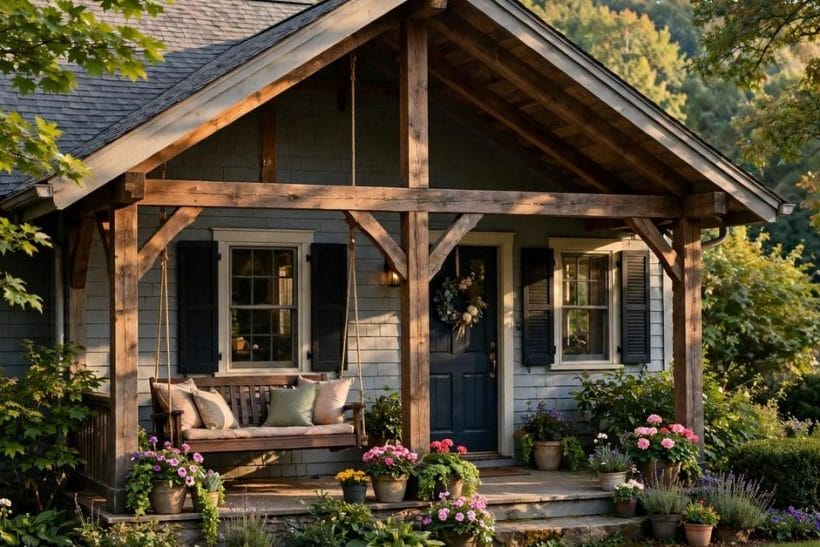
1. Gable Roof Front Porch Ideas at a Glance
The gable porch is five decisions wearing one roof: the gable’s own shape and finish, the open front it frames, the swing that anchors the sitting, the furniture that fills the floor without crowding it, and the lighting that carries the welcome after dark. Get those five in sympathy and the porch does the house’s greeting for it.
For the whole porch family, start with porch ideas.
| Family | Character | What it means |
|---|---|---|
| The Gable | A pitched roof over the door | Classic |
| Open Front | Sky and garden framed | Airy |
| Swings | A seat that moves gently | Relaxed |
| Furniture | Chairs that invite a pause | Welcoming |
| Lighting | Warm light after dark | Glowing |
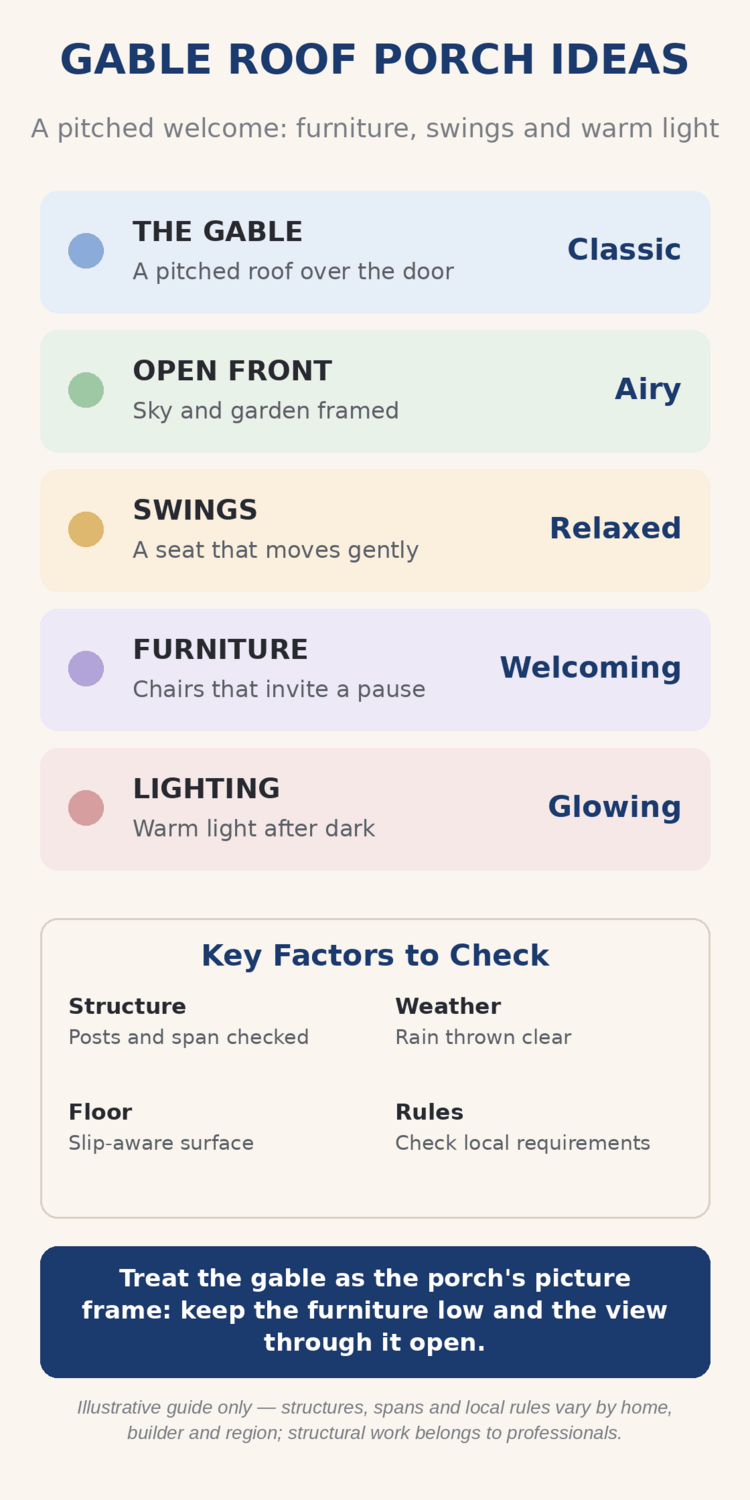
Scope, so the lanes stay clear: this post owns the gable-roof form only. The wider survey belongs to front porch ideas, and the roofed, columned entry that stays at the door belongs to portico ideas — the gable porch is the pitched, sit-able room between those two ideas. Its roof is the point: where other porches wear a flat or shed roof quietly, the gable porch makes the roof itself the welcome.
2. The Gable Itself: Shapes and Finishes
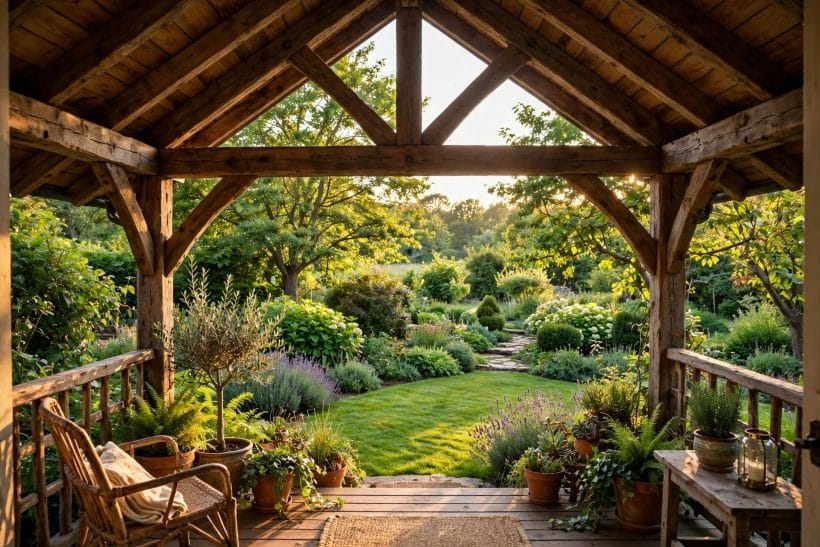
Everything on a gable porch takes its cue from the peak above it. Pitch, finish and detailing up there decide whether the porch reads cottage, craftsman or classic — and they are worth deciding before anything below them.
1. The Classic Front-Facing Gable
The gable end turned to the street is the form’s original: a triangle of wall above a rectangle of porch, echoing the house’s own face. It suits almost any house that has a gable anywhere else in its roofline.
2. A Cross Gable over a Wide Porch
Where the porch runs wide, a cross gable breaks its roof into a rhythm — a pitched centre over the door, lower spans to the sides — so a long porch reads as architecture rather than awning.
3. Exposed Rafters under the Eaves
Rafer tails left visible under the gable’s eaves give the porch its crafted, built-by-hand character. Painted to match the trim they read classic; left in timber they lean craftsman and cottage.
4. A Decorative Gable Truss
A simple king-post or curved-brace truss in the gable’s open triangle is the form’s jewellery: structure made visible and beautiful at once. One truss, well drawn, outshines any amount of applied trim.
5. Cedar Shake in the Gable Peak
Shingles in the gable triangle — left to silver or stained to match — give the peak texture that plain siding cannot. The shake’s small scale suits the gable’s size and weathers in sympathy with a garden.
6. Board-and-Batten Gable Siding
Vertical board-and-batten in the gable pulls the eye upward and suits farmhouse and cottage porches. Its lines contrast the porch’s horizontal floor and rail, and the triangle reads taller for it.
7. A Gable Vented with a Louvre
A small louvred vent in the peak is both honest ventilation for the roof space and a traditional detail with real charm. Painted the trim colour, it finishes the triangle the way a finial finishes a newel.
8. A Painted Gable in the House’s Trim Colour
Painting the gable field in the trim colour — rather than the wall colour — lifts the porch’s face off the house and frames the door below it. The porch becomes the portrait; the house, the wall it hangs on.
3. Posts, Beams and Timber Details
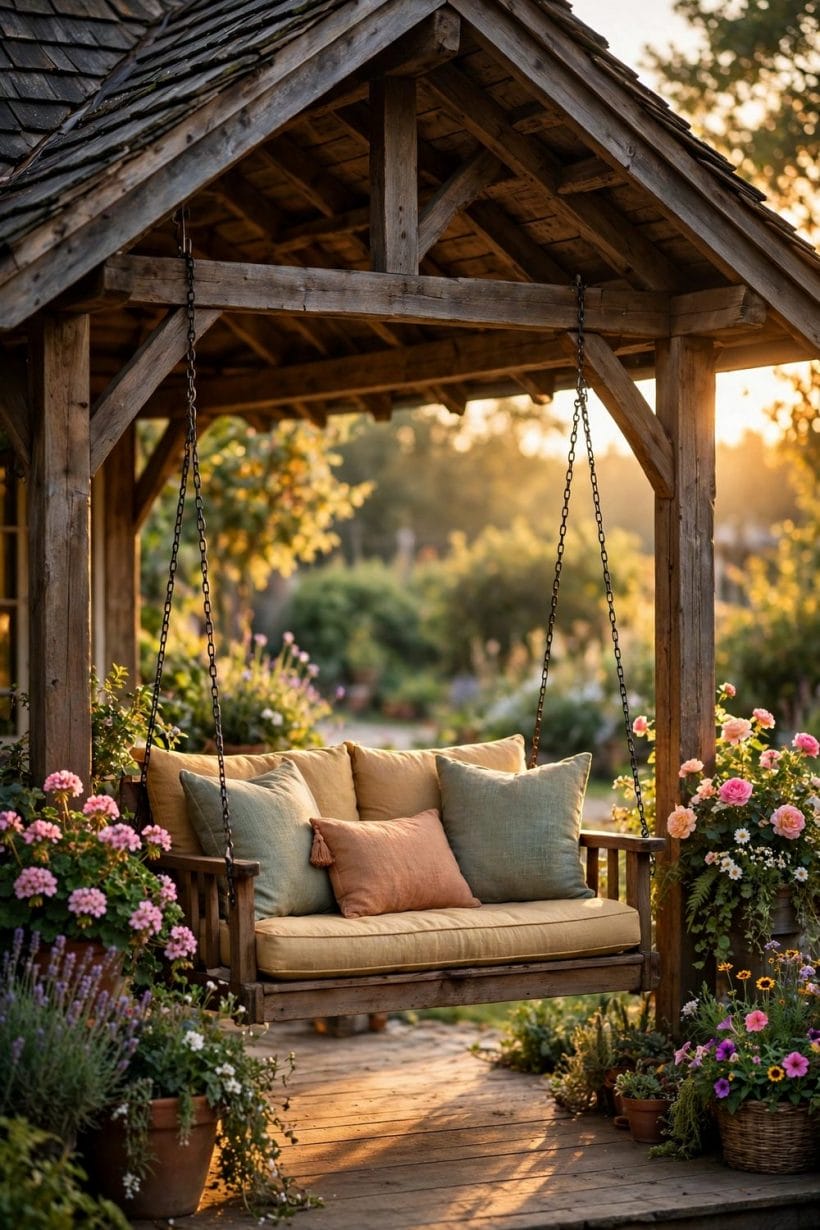
The gable’s weight lands on the posts, and their character sets the porch’s register. The all-timber sibling, wooden porch ideas, goes deeper into the material; the rustic porch ideas take the same bones rougher.
9. Chunky Timber Posts on Stone Bases
Substantial timber posts standing on stone or brick bases are the craftsman signature: the masonry lifts the wood clear of wet ground, and the combination reads solid from the street to the step.
10. Turned Porch Posts for a Classic House
Turned posts, kin to the stair’s spindles, belong to classic and older houses. Slender, shapely and usually painted, they make the porch a piece of furniture the house is wearing.
11. Tapered Craftsman Columns
Columns that taper as they rise — wide at the base, narrower at the beam — have a planted, deliberate stance. Boxed or solid, they suit bungalows and cottages and pair naturally with stone bases.
12. Brick Piers under Timber Posts
A short brick pier carrying a timber post splits the post’s job: masonry where the weather hits, timber where the eye rests. It also ties the porch to a brick house’s own material, stitching new to old.
13. Decorative Corner Brackets
Curved or fret-cut brackets where post meets beam soften the porch’s corners and cast pretty shadows. Keep the pattern in the house’s own period language and they read as original joinery.
14. A Beam Left Honestly Exposed
The beam that carries the gable across the porch’s open front can hide in a ceiling or show itself. Shown — sized generously, finished plainly — it is the porch’s strongest horizontal and its structural truth told aloud.
15. Twin Posts at the Porch Corners
Pairing the posts at each corner widens the porch’s stance visually and frames the opening between them like a proscenium. The gap between the pair is also a natural home for a hanging basket or a lantern.
16. Posts Painted to Match the Trim
Posts in the trim colour disappear politely into the house’s scheme; posts in a contrasting stain stand forward. Either is right — what fails is the post that matches nothing, in a finish nobody chose.
4. Porch Floors and Steps
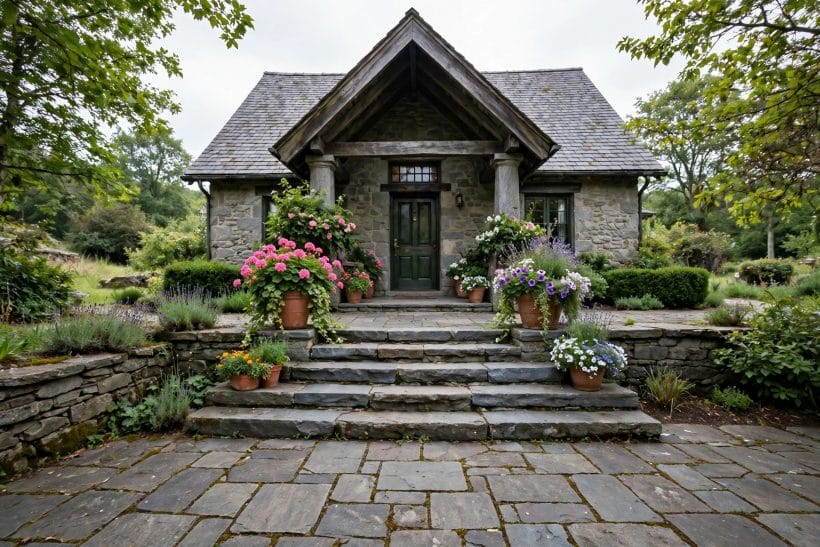
The porch floor is walked on, rained on and seen from above by everyone who sits there. Choose for weather and bare feet as much as for looks.
17. Timber Decking Running Front to Back
Boards running from house to edge lengthen the porch visually and shed water along their length. Timber is warm underfoot, kind to dropped cups, and renews with oil or stain on a gentle cycle.
18. A Stone Slab Porch Floor
Stone flags give a gable porch a foundation’s gravity: cool in summer, indifferent to weather, and better-looking with every year of moss in the joints. They suit stone and brick houses especially.
19. Brick Pavers in a Herringbone Lay
Brick pavers laid herringbone bring pattern and warmth to the floor and marry the porch to brick piers, steps and paths. The lay hides a multitude of stains in its own busy geometry.
20. Wide, Shallow Steps
Steps to a porch should feel like a stroll, not a stair: wide treads, gentle rises, room for a pot on each side. Generous steps are also the porch’s bleachers — the seat every gathering eventually uses.
21. A Chequerboard Tile Entry
Black-and-white or stone-and-slate chequerboard at the porch’s centre is a classic welcome mat that never needs shaking. It dresses the doorway like a hall floor and suits classic and cottage houses alike.
22. Painted Floorboards in a Deep Colour
Porch floor paint in a deep grey, green or blue-grey is the tradition’s economical elegance: it unifies old boards, hides their history, and renews in an afternoon when the season turns.
23. A Doormat Recess and a Boot Scraper
A recessed coir mat at the door and a boot scraper by the step are the porch’s working manners: mud stays at the threshold, and the details tell guests the house is cared for before they reach the door.
24. Slip-Aware Surfaces for Wet Weather
Porch floors are walked on wet. Textured stone, brushed timber and matt tiles keep their footing where polished surfaces will not; test any finish with a wet shoe before committing the whole floor to it.
5. Swings and Hanging Seats
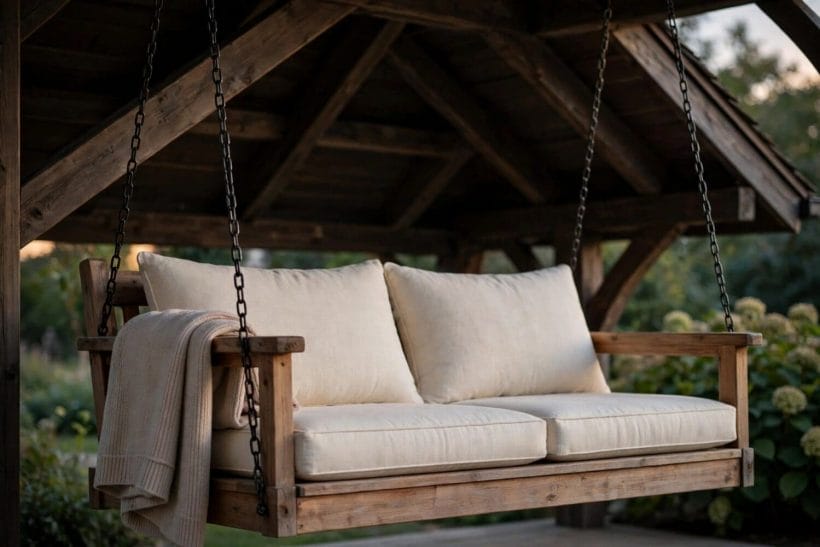
The porch swing is the gable’s reason for being: a seat that moves, hung in the framed opening, facing the world going by. It is furniture, metronome and invitation in one.
25. The Classic Two-Seat Porch Swing
A slatted timber two-seater, hung level with the porch’s opening, is the form’s icon. Sized for two adults and a child between them, it turns the porch from a route into a destination.
26. A Swing Hung to Face the Garden
Hang the swing to face outward — toward the garden, the street, the view — rather than at the house wall. The porch’s whole pleasure is watching the world from inside its frame.
27. A Daybed Swing for Long Evenings
A deeper, daybed-style swing with a mattress and bolsters upgrades the seat to a siesta: reading, napping and storm-watching all improve. It asks a wider porch and rewards it completely.
28. Cushions and a Throw on the Swing
Seat cushions in outdoor fabric and a throw for the evening turn the swing’s timber kindness into upholstery. Choose colours from the garden — greens, flower tones, cream — and the swing belongs to its view.
29. A Single Hanging Chair by the Post
Where a full swing crowds the porch, a single hanging chair by one post keeps the motion and loses the bulk. It also gives the porch a second, more private seat for one reader at a time.
30. Chains Dressed with Rope
Swing chains wrapped or replaced with rope soften the hardware’s look and its sound. The coastal version of the porch swing wears rope the way the classic wears brass — as its native accent.
31. A Swing Painted the Door’s Colour
Paint the swing to match the front door and the two become one composition: the colour you arrive at, repeated in the seat you arrive into. It is the simplest coordinating trick the porch owns.
32. Space to Swing Safely
A swing needs its arc: clear floor behind and before it, no furniture in the swing’s path, and fixings — chains, eyelets, the beam they hang from — checked sound, with a professional’s eyes on the structure if there is any doubt at all.
6. Furniture for a Front Porch
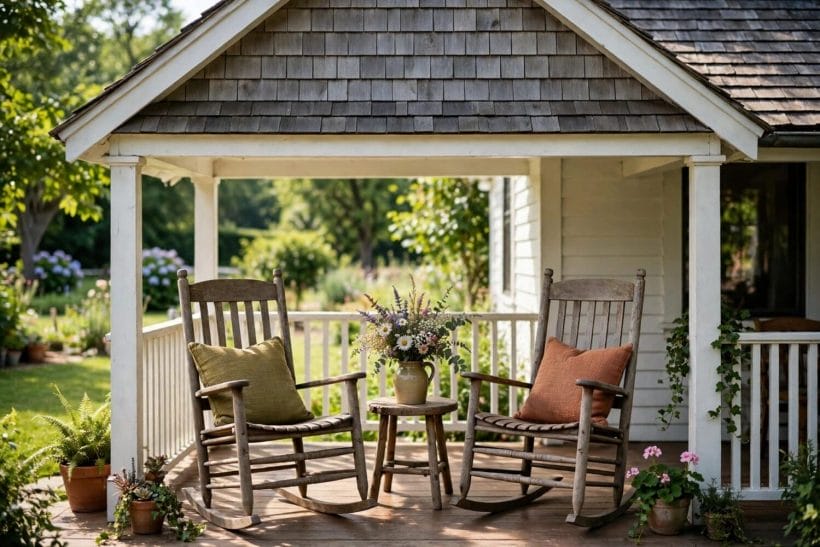
Porch furniture lives outdoors and performs indoors’ manners. The test of every piece is double: will it weather, and will a guest settle into it without thinking?
33. A Pair of Rocking Chairs
Rockers are the swing’s stationary cousins: sociable, rhythmic and right at almost any scale of porch. A matched pair with a table between them is the front porch’s complete conversation set.
34. A Small Table between the Chairs
Every porch seat needs a surface at elbow height — for the cup, the book, the bowl of whatever the garden is giving. A weatherproof side table is small money for the porch’s whole usability.
35. A Bench Built into the Porch Rail
A bench built along the porch’s edge, where a rail would run, seats a crowd without a single chair to store. Cushions come out in spring; the bench itself is architecture.
36. Wicker Seats with Washable Cushions
Wicker and rattan-look seats bring the garden’s texture onto the porch and stay light enough to rearrange. Washable cushion covers are the detail that keeps them pretty past their first summer.
37. A Console Shelf for Plants and Post
A narrow console or shelf against the house wall holds the porch’s small traffic: letters, keys, a jug of garden flowers, the watering can. It gives the porch a working surface without taking its floor.
38. A Storage Bench for Cushions
Cushions live longer out of the rain, and a storage bench gives them a home that is itself a seat. The porch dresses and undresses in a minute, and the cushions survive to be sat on for years.
39. Folding Chairs for Extra Guests
A pair of folding chairs, handsome enough to hang on the wall as decoration, solves the porch’s feast days. Good porches seat four daily and eight occasionally; folders are how.
40. A Porch Sofa in Outdoor Fabric
On a wide porch, a proper small sofa in weatherproof fabric brings the living room outside — with the gable for its ceiling and the garden for its view. Keep its colours quieter than the garden’s.
41. Keep the Furniture Low under the Gable
The gable’s opening is a frame and the view through it is the picture. Low furniture — swings, rockers, benches — keeps sightlines open from the street and from the seats, so the porch stays a frame and never becomes a fence.
7. Lighting the Gable Porch
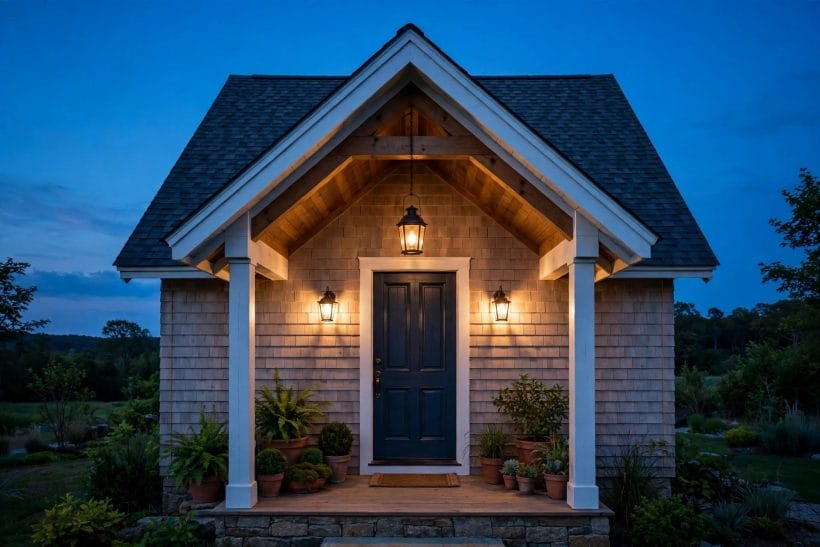
A porch is used at the day’s two golden edges, and after dark it is the house’s lantern to the street. Layer the light: one for the gable, one for the door, one for the seats.
42. A Lantern at the Gable’s Peak
A lantern hung from the gable’s peak or truss is the porch’s crowning fitting: it lights the whole triangle, throws the truss into silhouette, and is visible from the end of the street.
43. Twin Sconces Flanking the Door
A sconce each side of the front door is the classic welcome doubled: faces are lit kindly, the step is safe, and the door itself becomes the composition’s centre. Symmetry suits classic porches best.
44. A Pendant over the Swing
A low pendant or a pair of them over the swing’s end of the porch makes an evening room of it: light for reading, a glow for talking, and the swing’s gentle motion moving the shadows.
45. Warm Bulbs after Dark
Warm light is the porch’s native colour temperature — it flatters timber, brick and faces, and matches the hour porches are used. Cool white light on a porch reads as a yard, not a welcome.
46. Step Lights for Safe Feet
Small lights washing the steps — from the posts, the risers or the planting edge — make the porch’s arrivals safe without flooding its mood. Fitted low and warm, they read as fireflies with a purpose.
47. Candles and Hurricane Lamps
Real flame in hurricane glasses on the porch table is the oldest porch light of all: portable, forgiving and flattering. Keep it in glass, keep it attended, and it will out-charm every fitting in this section.
48. A Lit House Number
A gently lit house number near the door is hospitality to strangers: deliveries, guests and emergency services all find the house faster. Lit by the door’s own sconce is enough — it needs no spotlight of its own.
49. String Lights for High Summer Only
A strand of warm festoon lights along the gable’s edge can crown a summer party — and should come down with the season. Their charm is their occasionalness; permanent strings make every evening look like an event that ended.
8. Planting, Pots and Kerb Appeal
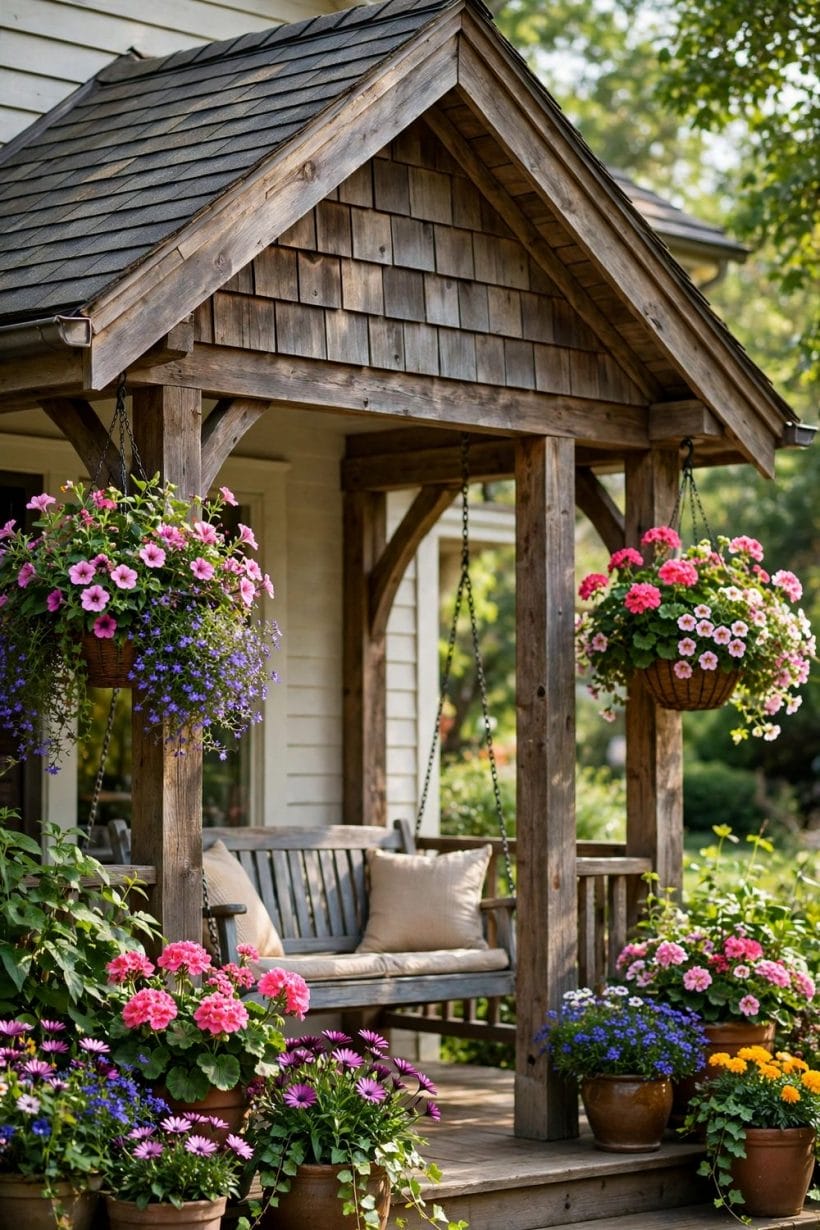
Planting is what marries the porch to the garden: green climbing its posts, pots flanking its steps, and the front path dressed like the porch’s own red carpet.
50. Matching Pots Flanking the Steps
A pair of generous pots at the steps’ foot is the porch’s punctuation: two green exclamation marks that tell the street where the welcome begins. Match them to each other, not necessarily to anything else.
51. A Climber Trained up One Post
A rose, jasmine or clematis trained up a single post softens the porch’s geometry with flower and scent. One post, not all — the gable’s frame should stay visible behind the green.
52. Hanging Baskets under the Eaves
Baskets hung along the porch’s open edge bring the planting to eye level and flower the frame itself. Keep them above head height, water them faithfully, and they will out-bloom the border.
53. A Window Box on the Porch Rail
A box of herbs or flowers on the porch rail puts the garden within arm’s reach of the swing. It is also the easiest planting on the porch to change with the seasons, and the quickest to refresh.
54. Foundation Planting that Frames the Porch
Shrubs and perennials planted against the porch’s base hide its undercroft, soften its meeting with the ground, and frame the steps like a proscenium’s planting in a theatre garden.
55. Herbs in Pots by the Door
Rosemary, lavender and mint in pots by the door greet arrivals with scent every time a coat brushes them. A porch you can smell from the path is remembered like a porch you can see from the street.
56. A Small Tree Planted to Frame the Gable
One small tree planted off the porch’s corner — framing, never blocking, the gable — gives the composition its third dimension and its summer shade. Choose for the mature size, not the nursery pot.
57. Seasonal Swaps: Bulbs to Evergreens
The porch’s pots are its calendar: bulbs for spring, flowers for summer, berries and grasses for autumn, evergreens and lights for winter. Four honest swaps a year keep the welcome permanently in season.
9. Small Gable Porches and Tight Frontages
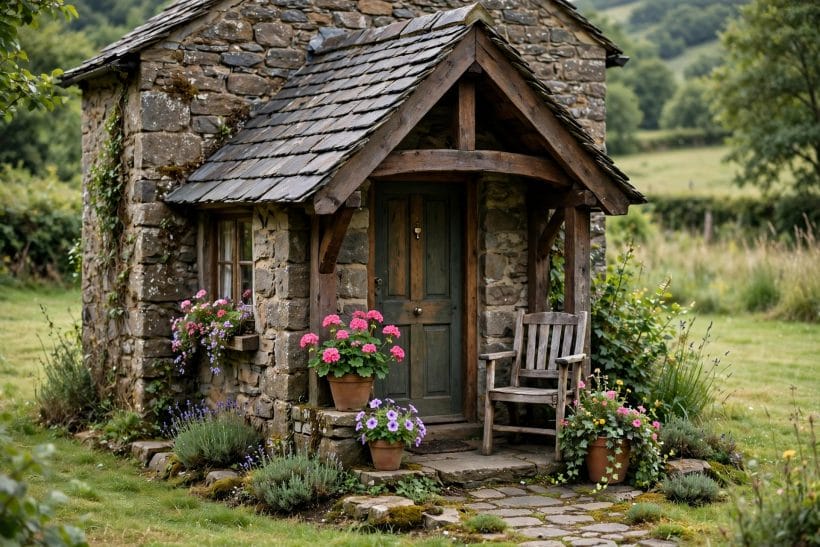
A small frontage shares its few metres between the porch, the path and the brick mailbox at the kerb — and a mini gable, pitched steep and dressed with discipline, gives even the tightest of them a face.
58. A Mini Gable over a Cottage Door
The gable scales down beautifully: a steep little pitch on two brackets or short posts over a cottage door gives shelter, shadow and instant character to the smallest frontage in the street.
59. One Chair and a Tiny Table
A small porch needs one good seat, not three cramped ones: a single comfortable chair and a table that holds a cup make a porch for one reader — which is a complete porch, honestly furnished.
60. A Narrow Bench instead of Chairs
A bench against the house wall seats two in the floor space of one chair and tucks under the window. On tight porches the bench is the swing’s space-saving heir.
61. Pale Paint to Lift a Small Porch
Pale posts, a light ceiling and a bright door make a small gable porch feel twice its footprint. The gable’s underside painted pale — the classic porch-ceiling trick — borrows sky for the ceiling.
62. Hooks and a Shelf instead of Furniture
Where there is no floor for furniture, dress the wall: hooks for coats and baskets, a shelf for plants and post. A small porch furnished vertically still welcomes; it just does it standing up.
63. A Slim Swing for a Narrow Porch
Single-width swings exist for narrow porches and keep the form’s whole pleasure in half the arc. Hung at one end of the porch, a slim swing leaves the door’s path clear and the ritual intact.
64. Vertical Planting on a Tight Frontage
When the ground is all path, plant upward: a climber on the post, baskets under the eaves, a box on the rail. The tight frontage goes green in the air it owns rather than the ground it lacks.
65. The Path that Makes the Porch Feel Bigger
The path is the porch’s front garden: straight, edged and planted, it lengthens the approach and lends the porch its scale — the same frontage thinking that shapes front yard patio ideas. A well-kept path makes a small porch feel like a destination.
66. A Bold Door Colour under a Small Gable
The smaller the porch, the harder its door should work: one confident colour — red, teal, sunflower — under the little gable gives the whole frontage its memory. Everything else can stay quiet.
10. Costs and Practical Details
A gable porch is a small building, and its practicalities are a small building’s: structure, weather and rules first, decoration after. Costs are kept in general terms here, because spans, materials, labour and local requirements vary by house, by builder and by place.
67. Structure First: Posts, Spans and a Professional
The gable is a roof, and roofs are structure: spans, loads, fixings and footings belong to a builder or structural professional, designed for the house and its weather. Everything decorative in this post hangs — sometimes literally — on that professional foundation.
68. Check Local Rules before Building
Porches sit at the house’s most regulated edge: boundaries, setbacks, conservation rules and permits can all apply. Check your local requirements before a single post is ordered; the porch that argues with the rules is an expensive ornament.
69. Roofing the Gable to Match the House
The gable’s covering should marry the main roof — the same tile, slate, shingle or metal, at a sympathetic pitch — so the porch reads as the house’s own face rather than an apologetic lean-to.
70. Weatherproofing Timber Ends
Porch timber dies at its ends: post feet, beam ends, the swing’s hangers. Keep end grain off the wet ground, sealed and inspectable, and the structure’s quiet enemies — standing water and trapped damp — stay rumours.
71. Repainting the Gable on a Cycle
The gable’s paint takes the weather for the whole porch. A inspection each spring and paint on a steady cycle — before it fails, not after — is the cheapest structural maintenance a house owns.
72. Furniture that Can Live Outside
Porch furniture should be honestly outdoor: materials and fabrics made for weather, cushions that dry fast and store small. Indoor furniture on a porch looks borrowed and ages like it.
73. Gutters and Rain at the Porch Edge
The gable throws its rain at the porch’s edge — decide where it lands. A gutter and a downpipe at the eaves keep the steps dry, the planting unbattered and the welcome un-dripped-upon.
74. Keeping the Swing’s Fixings Sound
Chains, eyelets and the beam a swing hangs from carry people, not cushions. Check them each season for wear and corrosion, and have anything doubtful looked at professionally — a swing’s failure is never a small one.
75. The Welcome Test at the Gate
Judge the finished porch from the gate, at dusk, as a stranger: a pitched frame, a lit door, a seat that invites, a path that guides. If the picture welcomes you home, the gable has done the job it was drawn for.
Final Considerations
The gable roof front porch is the house’s handshake and its portrait in one: a small pitched roof that shelters a seat, frames a door and tells the street the house is cared for. Build its structure with professionals, dress it with restraint, and light it warmly — the seventy-five ideas above are mostly variations on those three loyalties.
Begin at the gate with a stranger’s eyes, fix the welcome in that order — frame, door, seat, light — and the porch will greet your household and your guests with the same face for decades. A porch is the one room of the house the whole street gets to enjoy; the gable makes sure it is enjoyed at its best.

0 Comments