

The front of the house is the most public room you own and, in most homes, the least used. A front yard patio changes that: a proper surface by the door, a bench in the shade, planting between you and the street — the house gains a room that greets guests and gives the evenings back.
These seventy-five ideas build the front patio as a welcome court: surfaces that suit the house, shade and seating that invite a pause, planting that softens the street line, and the practical details — paths, lighting, drainage, local rules — stated in general terms throughout, in a design that respects how public the space is.
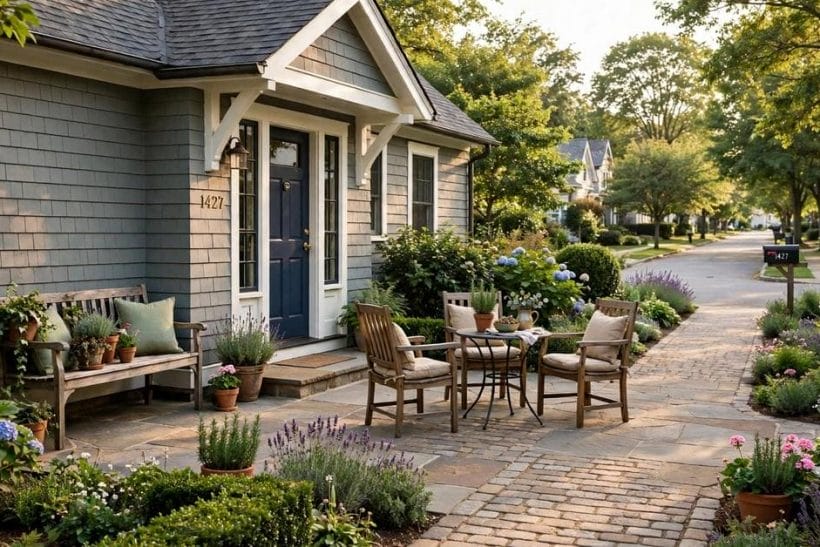
1. Front Yard Patio Ideas at a Glance
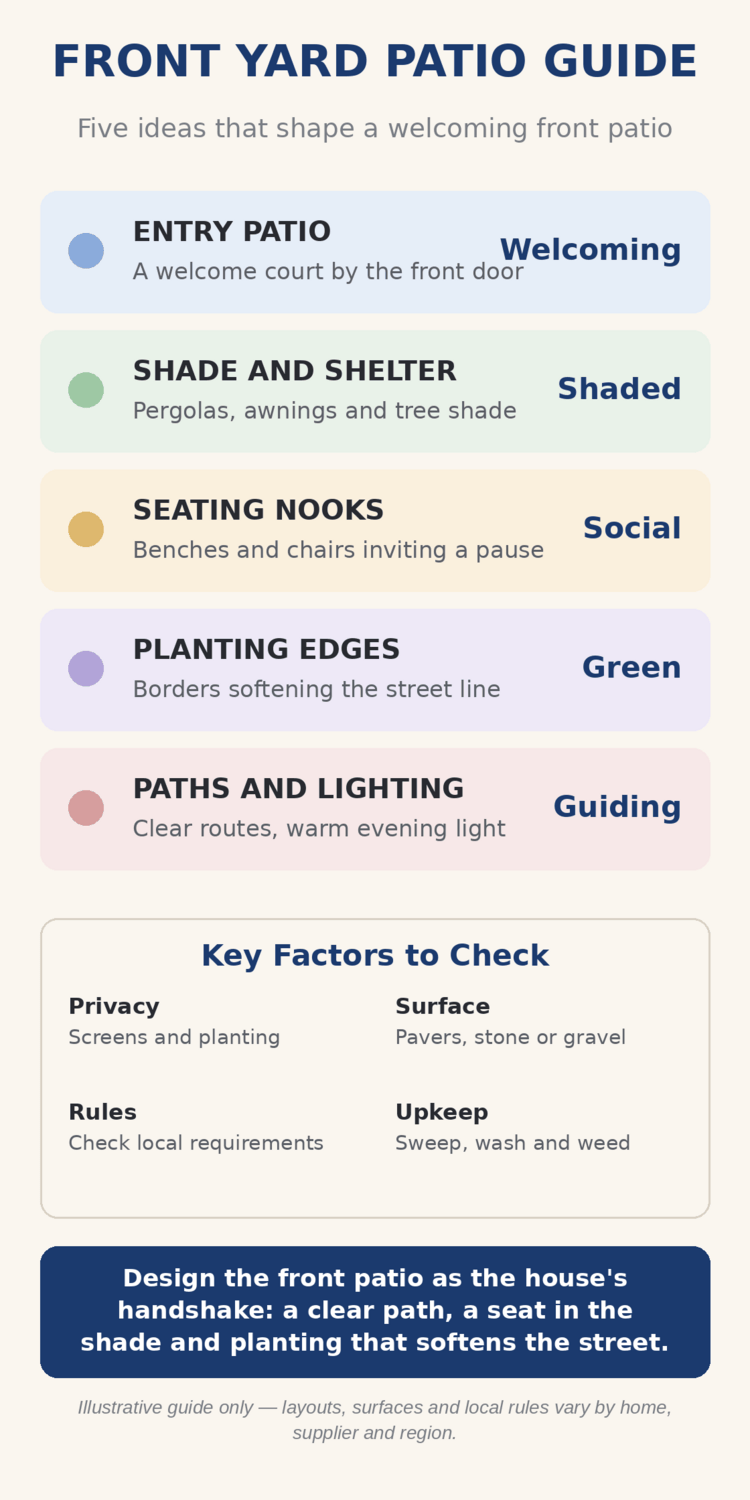
Five families shape a successful front patio: an entry court by the door, shade and shelter for the sunny hours, seating nooks that invite neighbours to pause, planting edges that soften the street, and clear paths with warm evening light to guide everyone home. Every lane of the front — the path, the drive, the boundary — negotiates with the patio, so the design works best planned as one composition rather than a square of paving dropped by the door.
For the whole patio cluster, start with patio ideas.
| Family | Character | What it means |
|---|---|---|
| Entry Patio | A welcome court by the front door | Welcoming |
| Shade and Shelter | Pergolas, awnings and tree shade | Shaded |
| Seating Nooks | Benches and chairs inviting a pause | Social |
| Planting Edges | Borders softening the street line | Green |
| Paths and Lighting | Clear routes, warm evening light | Guiding |
Scope, so the lanes stay clear: this post is the FRONT patio — the open, ground-level court at the face of the house. paver patio ideas owns the paving material itself wherever the patio sits, and the roofed, attached structures linked later — porches and porticoes — are different buildings for different jobs. Here, the sky is the roof and the street is the view. Back patios, fenced and private, are a different room for a different hour; the front patio’s pleasure is precisely its place in the street’s life.
2. Entry Patios and Welcome Courts
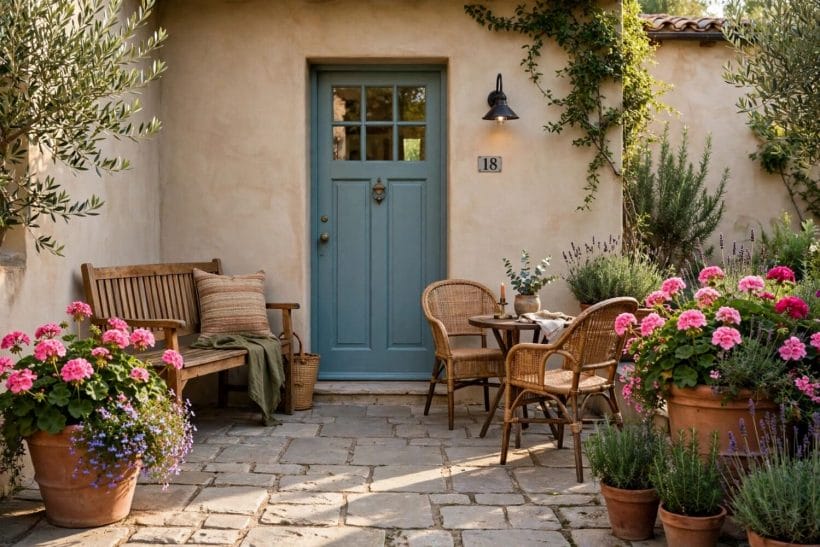
The entry patio turns an arrival into a welcome: room to pause, a seat while the kettle boils, pots by the door. It starts, of course, at the door itself — the front door sets the tone the patio then extends. Arrivals should feel the house has been expecting them.
1. A Court, Not a Doorstep
Give the front door a court, not a slab: a paved area wide enough for two chairs and a gathering of arrivals. The step up in scale from doorstep to court is what turns passing space into living space.
2. The Bench by the Door
One bench beside the door earns its keep daily — parcels, laces, a minute of morning sun. Choose a design that suits the house’s face and it becomes the front elevation’s friendliest detail.
3. Chairs That Face the Street
Front patios are sociable by nature: chairs angled outward greet neighbours, watch the street’s theatre and make the house feel lived in. Privacy is handled at the edges, not by turning your back.
4. A Table for Morning Coffee
A small table between two chairs upgrades the court from waiting room to cafe. It holds the coffee, the post, the plant you just bought — the small cargo of an ordinary good morning.
5. Pots Flanking the Entrance
A pair of generous pots at the door frames the arrival and carries colour in every season: evergreen bones, bulbs, then summer flowers. Pots are the front patio’s quickest transformation and its easiest refresh.
6. A Mat, a Light, a Welcome
The tiny trio that says the house is glad you came: a good mat, a warm light by the door, a door that opens without a fight. Details this small are read instantly by every arrival.
7. Space for Parcels, Shoes and the Post
Plan the unglamorous corner: a lidded box or bench where parcels land, shoes pause and the post waits. A court that swallows the daily clutter calmly keeps its welcome unrumpled.
8. Room to Gather at the Door
Leave a clear standing circle where the path meets the patio — hellos and goodbyes happen there. Furniture pushed to the edges keeps the threshold sociable instead of negotiated.
3. Shade and Shelter
A front patio without shade is a morning-only room. The shade can be built, planted or borrowed — and the portico ideas lane covers the smallest formal version: a roof over the door alone, sheltering a step rather than seating a court.
9. A Pergola Over the Patio
A simple pergola frames the court, carries climbers and turns glare into dappled, moving shade. It also gives the open patio a ceiling line, which makes the space read as a room from the street.
10. Awnings Over Sun-Facing Windows
A retractable or fixed awning over the patio’s windows shades the seating below and the rooms behind in one gesture. Canvas in a colour drawn from the house keeps it architecture, not accessory.
11. A Shade Sail for Modern Fronts
A taut sail on three posts gives crisp, light shade that suits modern houses and lifts off for winter. It is the fastest shade structure to install and the easiest to change your mind about.
12. The Street Tree’s Borrowed Shade
If a street tree already shades the plot, arrange the patio to spend its afternoons in that gift. Borrowed shade costs nothing, arrives mature, and ties the house kindly into its street.
13. A Climbing Rose Over a Frame
A rose or jasmine over a simple frame perfumes the court and softens the house’s face. Planted shade takes seasons to arrive, so plant it first and let the patio grow into its own roof.
14. An Umbrella Where Budgets Are Small
A good parasol on a heavy base shades a table and two chairs honestly and stores away in a storm. For renters and first attempts, it is the shade that asks permission from no one.
15. Shade That Moves With the Season
Deciduous climbers and trees shade the summer court and drop their leaves to admit winter sun. Seasonal shade is the old, clever answer for fronts that face the light all year.
16. A Roofed Niche by the Door
Even a shallow roof or recessed porch niche over the bench gives the court one all-weather seat. It shelters the wait for a taxi, the parcel, and the cat, in every month.
4. Surfaces: Pavers, Stone, Brick and Gravel
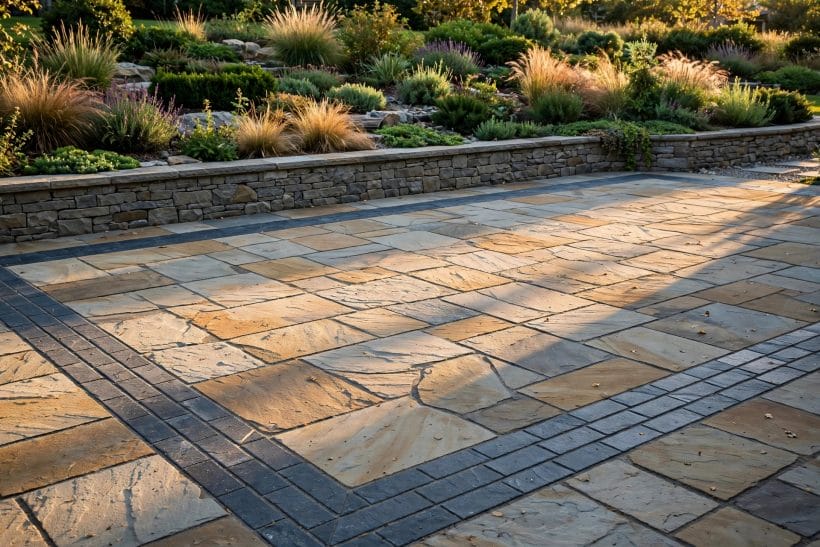
The surface is the patio’s floor and its largest visible decision. Choose for the house’s character first and the street’s second — the right material makes the court look inevitable, as if the house had always meant to have it. It is also the decision the street sees most, so it carries the house’s character into the public realm.
17. Pavers in a Calm Grid
Concrete or porcelain pavers laid in a calm grid give the front court a composed, contemporary floor. Large formats read tidier on small plots; a darker border course can mark the court’s edge without a wall.
18. Natural Stone for Cottage Fronts
Sandstone, slate or granite setts suit older and cottage-fronted houses, ageing into the planting around them. Stone’s variation forgives the marks of daily arrivals better than any uniform surface.
19. Brick to Match the House
Where the house is brick, a brick patio in a herringbone or basket pattern ties court to wall in one material. Match the tone, not necessarily the exact brick, and the front reads as one composition.
20. Gravel for Informal Courts
Compacted gravel over a firm base gives a soft, informal court that drains freely and suits planted, cottage-style fronts. Edge it firmly in stone or steel so the surface stays in its territory.
21. A Border Course That Frames the Field
One contrasting row around the patio’s edge — darker pavers, a soldier course of brick — finishes the floor like a picture frame. It is the cheapest formality a patio can buy.
22. Mixed Surfaces: Hard Centre, Soft Edges
Pave the working centre and let gravel or planting take the margins: the court feels larger, drains better and costs its money where feet actually fall. Mixed floors suit long, narrow fronts especially.
23. Steps and Levels in the Same Material
Carry the patio’s material up any steps and across any level change, and the front reads as one designed piece. A change of material at every step makes small fronts feel patched together.
24. Joints Planted With Creeping Herbs
Wide joints planted with creeping thyme or chamomile soften stone courts, scent the air when brushed by feet, and green the floor between the flags. Keep the planting to the edges of the traffic lines.
5. Seating Nooks and Conversation Corners
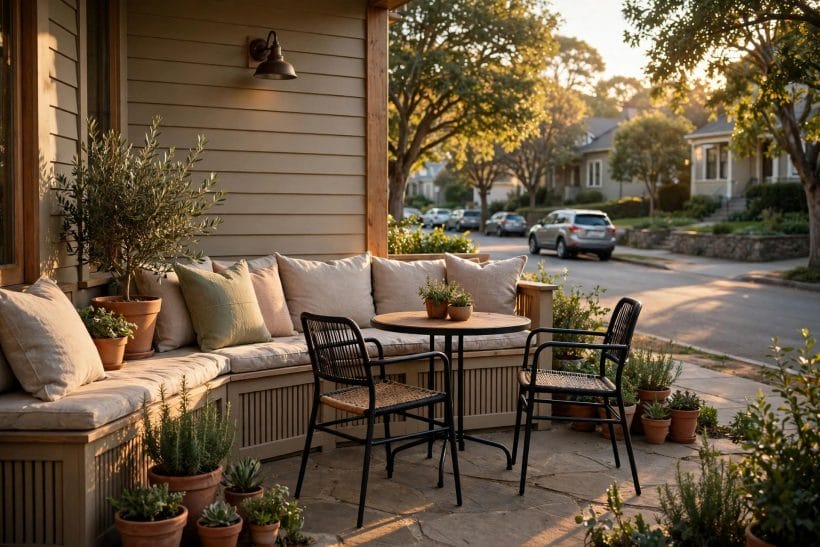
A front patio seats differently from a back garden: closer to the world, readier for company, happier with an audience. Arrange the seats for conversation with each other and with the street in comfortable balance.
25. A Bench Built Into the Edge
A low wall or timber bench built along the patio’s edge seats the crowd without furniture sprawl. It doubles as the court’s boundary, a perch for plant pots, and a step for small gardeners.
26. Two Chairs and a Side Table
The classic front-porch formula translated to open ground: two good chairs, a table between, the day’s drinks within reach. It is the arrangement every other nook in this section varies.
27. A Swing Seat Facing the Garden
A porch swing or hanging bench under the pergola gives the court its slow heartbeat. Face it down the garden or along the street and it becomes the seat every visitor asks about.
28. Cushions That Live Outdoors
Outdoor fabrics on the bench and chairs mean the nook is always dressed and never carried in and out. Choose colours borrowed from the planting and the door, and the court composes itself.
29. A Fire Bowl for Cool Evenings
A small fire bowl extends the patio’s season into autumn nights, used considerately and within local rules. Its circle of warmth and light turns the front court into the evening’s destination.
30. Seating That Watches the World Go By
Angle one seat purely for the view out: the street’s comings and goings are the front patio’s cinema. A house that watches its street kindly is a house the street watches over.
31. A Reading Chair in the Morning Sun
Where the front catches early light, give it the reading chair and let the back garden have the afternoon. Matching seats to the sun’s timetable doubles the use of both spaces.
32. A Table That Seats the Street’s Friends
One slightly larger table — four chairs, room for a board game or a shared supper — makes the front court the neighbourhood’s natural meeting point on long evenings.
6. Planting Edges and Street Softening
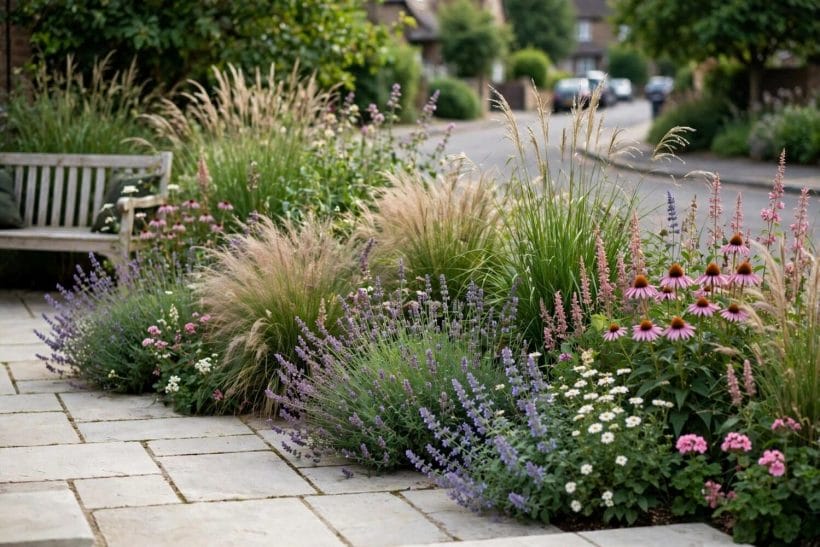
Planting is what makes a front patio feel like a garden room rather than a car park: borders between the court and the street, green at the house wall, scent at the door. The wider stone-and-garden thinking in stone landscaping ideas extends the same palette beyond the patio’s edge.
33. Borders Between Patio and Street
A planted border along the street edge softens the boundary without closing it: the court feels held, the street feels gardened, and arrivals understand exactly where the welcome begins.
34. Grasses for Movement and Privacy
Ornamental grasses give the front border height, movement and a soft screen that never reads as a barrier. They catch evening light beautifully and ask for one cut a year in return.
35. Lavender and Herbs by the Path
Lavender, rosemary and thyme along the path brush every arrival with scent and suit sunny, dry front plots. Herbs at the door also earn their place in the kitchen, which front gardens rarely manage.
36. Evergreen Bones, Seasonal Flowers
Structure the borders with evergreen shrubs and let perennials and bulbs run the seasonal show between them. The court looks composed in January and celebratory in June on the same bones.
37. Pots Where Soil Runs Out
Where the front is all hard surface, plant in pots grouped at different heights along the edges. Big pots hold shrubs and small trees; small ones run with the seasons and the sales.
38. A Low Hedge Instead of a Fence
A clipped low hedge marks the boundary greenly, softens the street and seats birds instead of arguments. It takes patience to grow and repays it by improving every single year.
39. Climbing Plants on the House Wall
Roses, jasmine or a vine trained on wires up the house wall knit the patio to the building. Keep growth clear of gutters and woodwork with a seasonal tidy, and the wall becomes the garden.
40. Planting That Hides the Bins and Meters
Screen the necessary ugliness — bins, meters, the hose — with a shrub, a slatted panel or a pot group. A court that hides its clutter keeps its welcome composed at every hour.
41. Scent at the Door
Finish the planting where the nose arrives: jasmine by the door, a rose over the bench, herbs by the step. A front patio remembered by scent is a homecoming every single day.
7. Privacy Without a Fortress
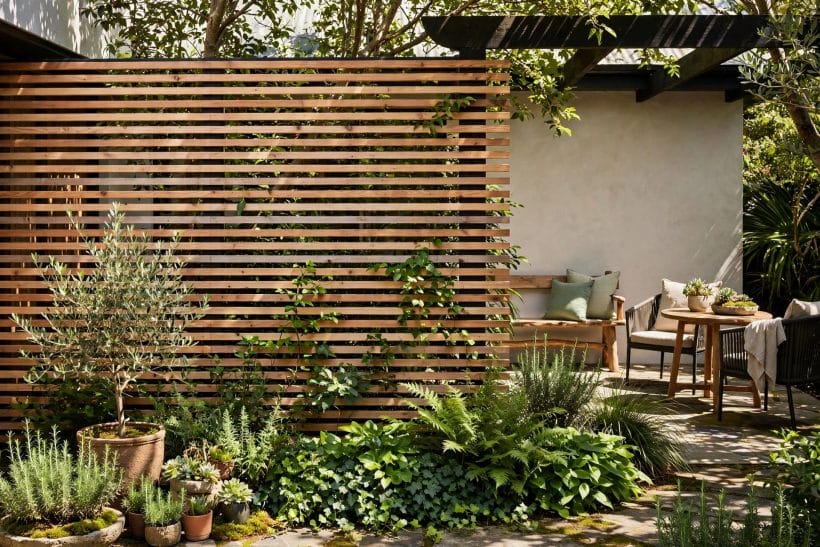
The front patio’s balance is delicate: private enough to relax in, open enough to stay part of the street. The trick is layers — heights, planting, angles — rather than barriers, and a clear-eyed sense of which seats need screening and which do not. Done well, the front patio becomes the most neighbourly spot in the house precisely because it never fully closes.
42. Layered Planting, Not a Wall
Stagger shrubs, grasses and a small tree so sightlines break gently at several depths. Layered green privacy feels like a garden from both sides; a single tall barrier feels like a dispute.
43. A Slatted Screen Section
One run of horizontal slats behind the main seating screens the chairs without fencing the plot. Keep it to the seating zone, stain it to the house palette, and plant its feet generously.
44. Pergola Sides With Climbers
Let the pergola’s sides carry climbers where the neighbours’ windows overlook: the shade structure becomes the privacy structure too, green and light-filtering rather than solid.
45. Staggered Heights Break Sightlines
Privacy is geometry: a seated eye level needs screening only where eyes actually meet. A shrub here, a pot group there, placed by sitting down and looking, solves most of it.
46. A Gate That Says Welcome, Slowly
A low gate on the path slows the approach, marks the threshold and keeps dogs and toddlers in gentle check — while saying welcome in its design rather than keep out.
47. Privacy for Seats, Openness at the Path
Screen where people sit still; stay open where people pass. The path and door remain legible and friendly, the bench feels held — the front patio’s exact social contract.
48. Leaves and Water for Sound
A small water feature or rustling bamboo near the seats softens street sound more kindly than height ever will. Gentle noise is privacy for the ears, and it needs no permission from the view.
49. Neighbourly Lines, Checked First
Before building screens or raising levels near a boundary, check the local rules and talk to the neighbours — in general terms, front boundaries are the most rule-bound part of most plots. A court everyone likes survives.
8. Paths, Steps and Evening Lighting
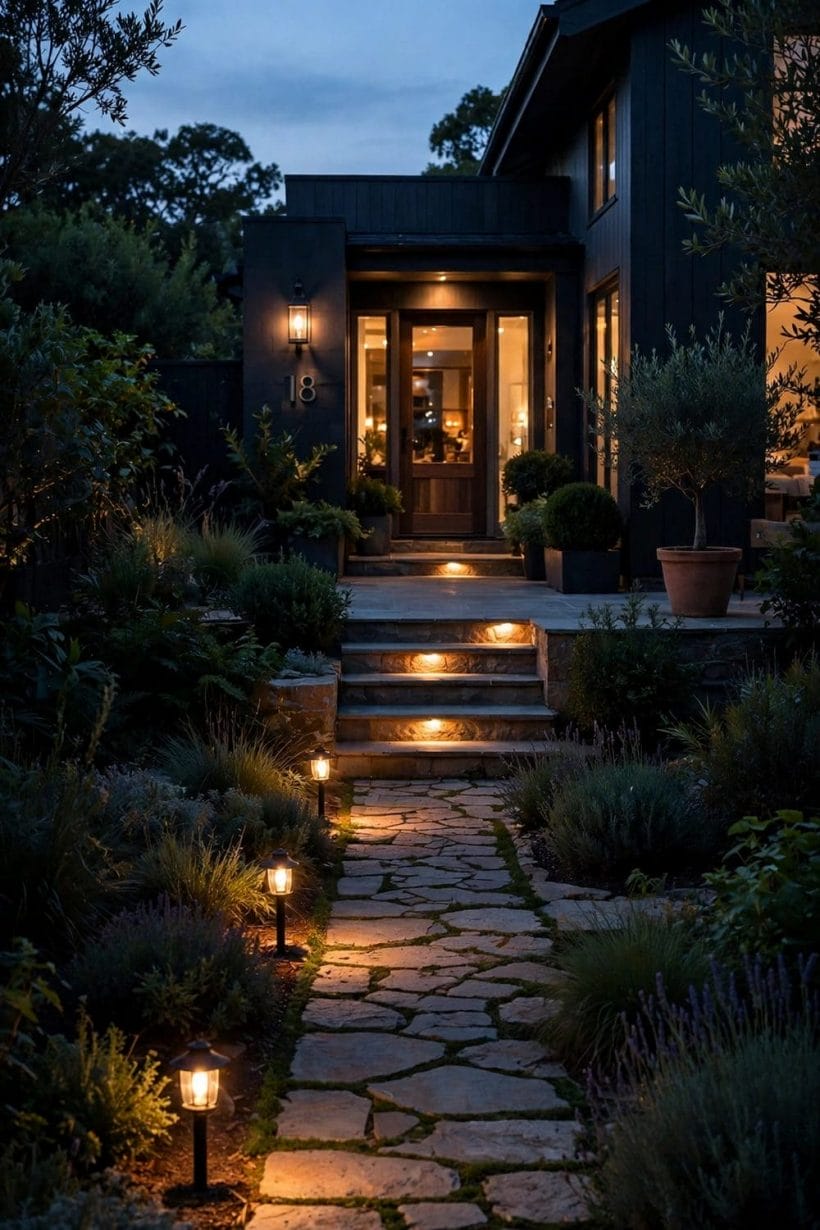
The front patio is used after dark more than any back garden — every arrival home crosses it. Lighting and the path’s clarity matter here as function first and atmosphere second; the roofed cousin of this space, the front porch, solves the same welcome under cover.
50. A Path That Reads Clearly
The route from gate to door should read at a glance and in the dark: one material, one clear line, no furniture drifting into it. Guests should never have to guess where the house wants them.
51. Steps Lit From the Side
Light steps from the side or the riser, low and glare-free, so feet read them confidently. A lit step is a safety fitting that happens to look like pure welcome.
52. Lanterns at the Door and Gate
A lantern at each threshold — gate and door — brackets the journey with warmth. Matched fittings tie the plot together and make the house findable and friendly in one gesture.
53. Low Lights Along the Path Edge
Low, shielded lights along the path’s edge guide without dazzling and pick out the planting’s silhouettes. Keep them few, warm and pointed down; the stars also have rights here.
54. A Door Light That Flatters
The fitting by the door should glow warmly at face height, kind to arrivals and to the house’s face. Harsh white security light belongs at the side gate, not on the welcome.
55. Numbers Guests Can Actually Find
House numbers lit, large enough and placed where a stranger looks for them end the era of deliveries to the wrong door. It is the smallest front-patio upgrade with the largest daily return.
56. The Drive Apron Meets the Patio
Where the drive meets the court, let the materials shake hands — a shared border course or a flush threshold — and where the drive itself is the design, circular driveway ideas takes the approach further.
57. The Patio After Dark
Judge the front patio at night before calling it finished: seats still usable, steps safe, the planting lit in silhouette. A court that works after dark doubles the house’s public life.
9. Small Front Yards and Narrow Plots
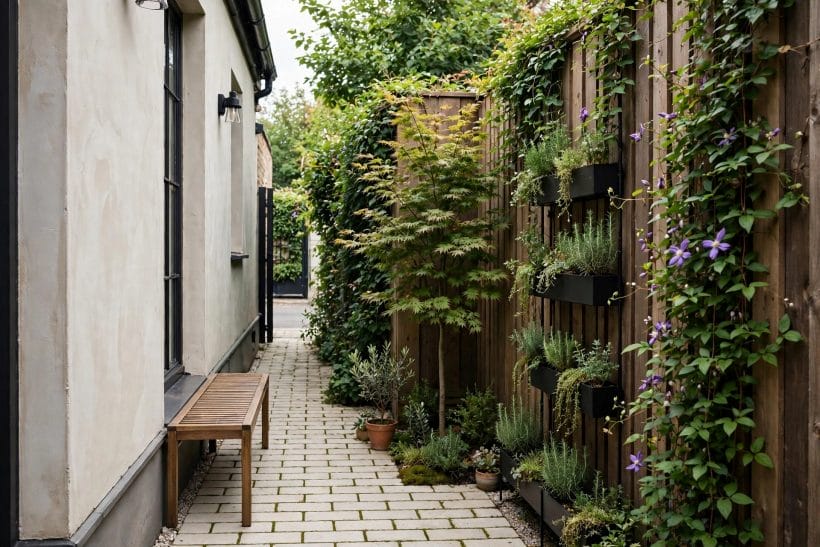
Most front yards are small, and the front patio is their redemption: a designed court uses the plot harder than a strip of lawn ever did. Smallness is no obstacle — the same rules apply, with every choice earning its place twice.
58. One Great Chair Beats Four Small Ones
In a tiny court, scale up the few pieces you choose rather than shrinking many: one generous bench, one big pot, one good light. Small plots read as mean only when everything in them is small.
59. A Narrow Bench Along the Wall
A slim bench against the house wall gives a narrow front its seat without blocking the path. Add cushions, a pot at each end, and the wall itself becomes the seating zone’s backrest.
60. Vertical Planting on Fences and Walls
When floor space is scarce, garden upward: climbers, wall planters, a green trellis panel. Vertical planting gives the small court its green room feeling without spending a single paving slab.
61. The Corner Plot Used Diagonally
On corner and wedge plots, set the patio on the diagonal: the court gains depth, the path shortens, and the awkward geometry becomes the design. Diagonal layouts flatter almost every irregular front.
62. Fold-Away Furniture for Tiny Courts
Folding chairs and a drop-leaf table let a tiny patio host four on Saturday and vanish on Sunday. Store them in the bench or a wall cabinet and the court stays calm between parties.
63. A Single Tree in a Square of Soil
One small tree in an open square of soil gives a paved front its ceiling, its shade and its seasons. Choose a kind suited to small plots and let it be the court’s one vertical event.
64. Pale Surfaces to Borrow Light
On shaded or north-facing fronts, pale pavers and light gravel bounce what light there is and keep the court cheerful. The planting then supplies the depth the surfaces politely decline.
65. Skip the Lawn, Keep the Green
A tiny lawn is mostly work and little pleasure; give the whole front to court and borders instead. The plot becomes greener in effect — more plants, more life — with no mower invited.
66. Storage in the Bench for Cushions
The small court’s bench must store: cushions, the hose, the door mat’s winter twin. Storage designed into the one big piece keeps a small patio permanently ready to sit in.
10. Costs and Practical Details
In general terms, a front patio’s cost follows its groundworks more than its surface: what lies beneath, how levels and drainage are handled, and how much is built versus planted. The practical notes below stay general — fronts vary by house, plot and local rule. Front plots also answer to the street’s eye, which is one more reason the honest, simple build usually wins.
67. What Drives the Cost of a Front Patio
In general terms: excavation and the base beneath the surface, the surface material itself, any walls, steps and lighting, and the planting. The visible layer is often the smaller half of the story.
68. Groundworks: the Hidden Half
A patio is only as good as its base — properly prepared and compacted ground in general terms is what keeps surfaces level and puddle-free for years. Money spent below ground is the least visible and most remembered.
69. Drainage Away From the House
Front surfaces should shed water away from the house and toward the garden or the plot’s drainage, in general principle. Falls are set when the base is built; they cannot be styled in afterwards.
70. Slopes and Levels Dealt With Honestly
Sloping fronts want terraces, steps or a honestly graded court — not a patio pretending to be flat. Levels handled openly become the design’s steps and edges; levels fought become puddles and trips.
71. Boundaries and Local Rules in General Terms
Front gardens often carry local rules — about surfaces, boundaries, drainage to the street — that vary from place to place. A quick check before building starts is the cheapest step in the whole project.
72. Access for the Build Itself
Plan how materials arrive: through the hall, down the side, or over the wall by arrangement. Front patios enjoy the easiest access of any garden project, which is part of their practical charm.
73. Lighting and Power Planned Early
Sockets and cable routes for the path lights and door lantern are easiest before the surface goes down. Any new outdoor electrical work belongs to a qualified electrician; the layout plan is yours to draw first.
74. Upkeep: Sweeping, Washing, Weeding
A front court asks a light rhythm: a sweep weekly, a wash when the season turns, joints weeded before they root. Hard surfaces near the street also catch the street’s litter — a minute at the gate keeps the welcome clean.
75. Planting That Matures Gracefully
Choose the borders’ permanent plants for their mature size, not their nursery size, and the court will improve as they grow into it. A front patio planted for year five looks wise by year two.
Final Considerations
A front yard patio turns the house’s public face into its most generous room: a court to arrive in, a bench to pause on, planting between the chairs and the street. Build the surface honestly, shade the seats, light the path warmly, and the front of the house starts giving evenings back. It is the one upgrade that improves the house for its owners, its guests and its street at the same time.
Begin with the door and work outward — court, shade, seats, green edges — and let the neighbouring lanes keep their own jobs. This one belongs to the front: the handshake of the house, offered to the street every day.

0 Comments