

The traditional staircase is the house’s handshake: turned spindles, honest timber, a handrail polished by generations of palms. It asks for no novelty — only for its own details to be done properly and in proportion.
These seventy-five ideas stay inside that classic language: layouts, timber, balusters, runners, panelled walls and lamplight, with the practical checks an old stairway asks of its owners woven through. Nothing here needs a new staircase — the tradition is a way of dressing, lighting and keeping the flight a house already has, and most of it can be done a weekend at a time.
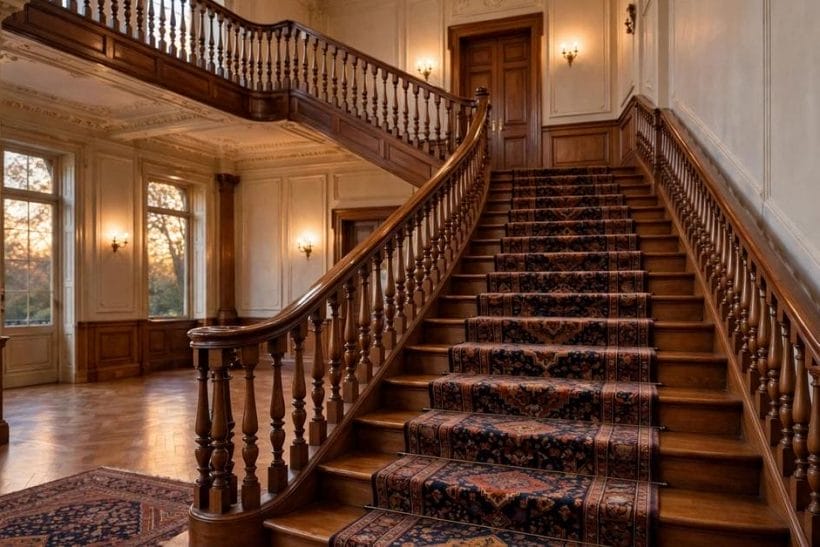
1. Traditional Staircase Ideas at a Glance
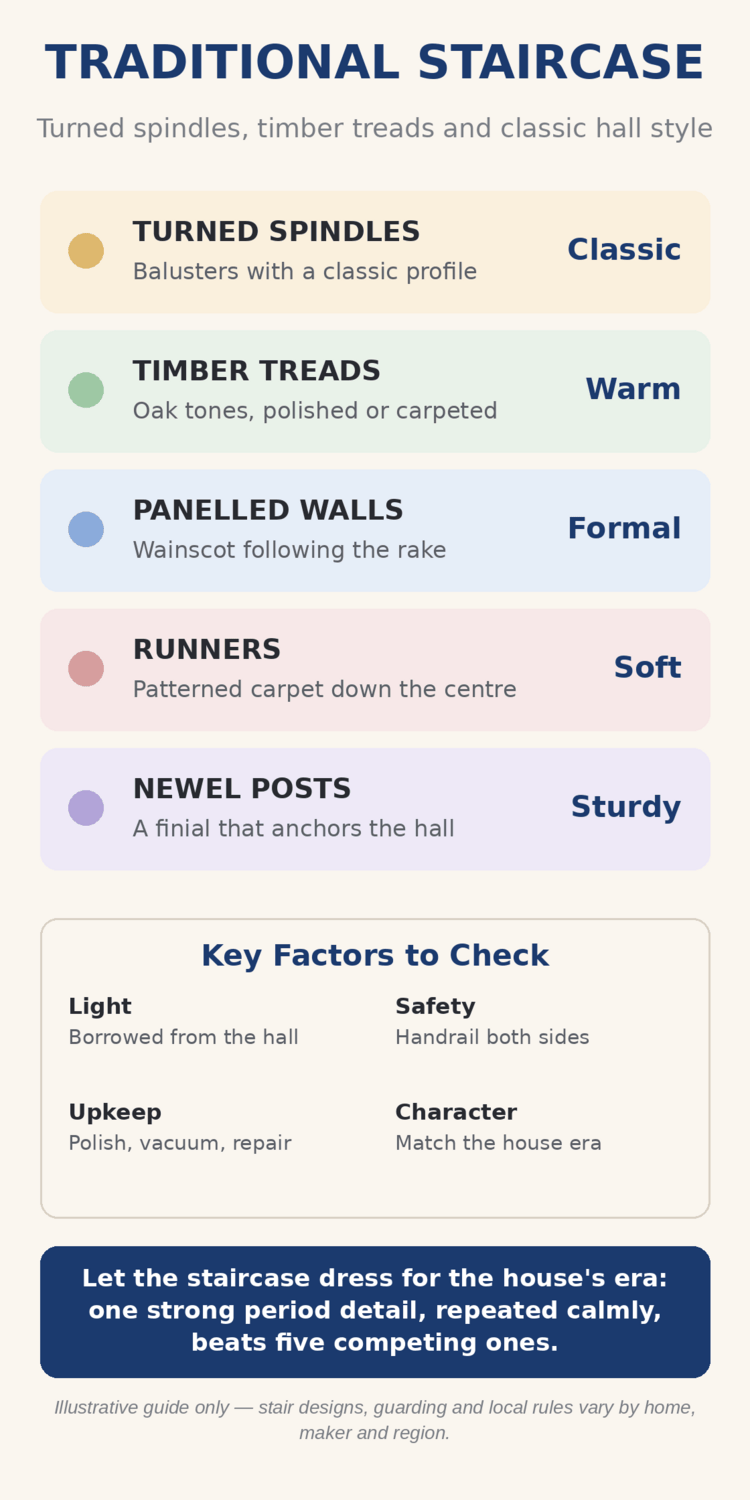
A traditional stair is a system of five parts, each with its own classic vocabulary: the spindles, the treads, the panelling that follows the rake, the runner that softens the centre, and the newel that anchors the whole flight in the hall. Change any one and the stair’s character moves; change them in sympathy and the stair looks inevitable.
For the whole staircase family, start with staircase ideas.
| Family | Character | What it means |
|---|---|---|
| Turned Spindles | Balusters with a classic profile | Classic |
| Timber Treads | Oak tones, polished or carpeted | Warm |
| Panelled Walls | Wainscot following the rake | Formal |
| Runners | Patterned carpet down the centre | Soft |
| Newel Posts | A finial that anchors the hall | Sturdy |
Scope, so the lanes stay clear: this post owns the traditional style only. The material lane belongs to marble staircase ideas and the sweeping form to curved staircase ideas — a traditional stair may borrow a curve or a stone step, but its language stays timber, turnings and proportion. The keyword for this post is the old stairway itself: not a repair manual for old stairs, but the style those stairs created, kept in full working order.
2. Classic Layouts and Shapes
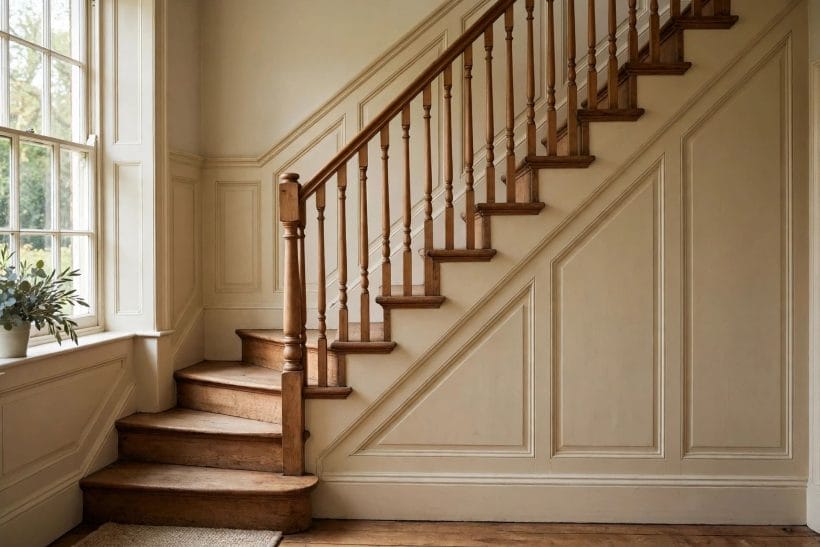
Traditional layouts were settled long ago by hall shapes and habits. The classics below cover most houses ever built — the art is in choosing the one your hall was drawn for, unlike the modern staircase ideas, which start from the opposite instinct.
1. The Straight Flight Against the Wall
The oldest arrangement of all: one flight rising along the hall wall, spindles guarding the open side. It wastes no floor, reads clearly from the front door, and gives the panelling and runner a long, calm field to work on.
2. The L-Shaped Stair with a Quarter Landing
A turn at a small square landing breaks a long climb into two civilised halves and lets the stair change direction in a tight hall. The landing is a gift: a window, a picture, a pause.
3. The U-Shaped Return Flight
Two parallel flights joined by a half-landing fold the stair into the depth of one room. Grand in a tall hall, practical in a modest one, and the classic setting for a lantern hung in the well between flights.
4. The Hall-Centre Statement Stair
In larger halls the flight rises from the middle of the room like furniture. It asks for presence — a wide bottom step, a serious newel — and rewards it by making the hall a room rather than a passage.
5. The Dog-Leg Stair in a Modest Hall
Flights that double back with no gap between them are the terraced house’s answer to everything: compact, private, and easily panelled. Dressed well, its modesty reads as neatness rather than compromise.
6. The Stair that Turns on Winders
Tapered winder treads turn a corner without a landing, saving space the traditional way. Keep the turn gentle and the handrail continuous, and the winders feel like choreography rather than economy.
7. A Wide Bottom Step that Invites
The flared, bullnose bottom step is the traditional stair’s welcome: it widens the flight’s foot, carries the newel’s scroll, and signals from the door that this stair is the house’s pride, not its plumbing.
8. The Closed String, Neat and Formal
A closed string — the board that hides the treads’ ends — gives the flight a smooth, tailored side. Paired with panelling below, it is the most formal of the traditional profiles and the easiest to keep painted and crisp.
3. Timber, Treads and Finishes
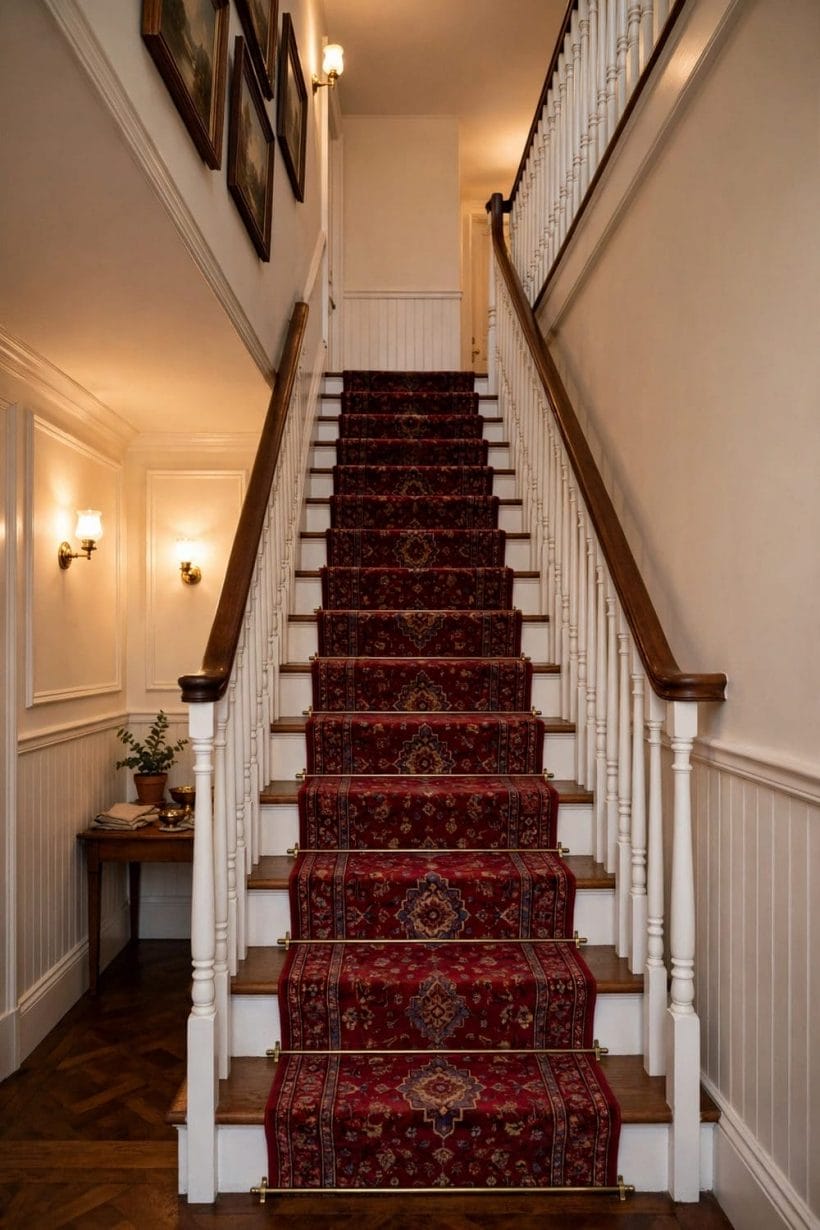
Timber is the traditional stair’s material and its finish is its complexion: polished, painted or carpeted by thirds. The all-timber sibling post, wooden staircase, takes the material further; here it serves the style.
9. Oak Treads with a Polished Sheen
Polished oak treads are the tradition’s default for a reason: the grain carries the eye upward, the sheen deepens with years, and a waxed tread sounds — satisfyingly — like a staircase should.
10. Dark-Stained Treads, Pale Risers
The two-tone tread: dark nosing and tread, riser painted cream or white. It sharpens every step’s edge visually, lightens the flight’s mass, and is forgiving of both dust and restoration budgets.
11. Painted Risers in a Heritage Colour
A deep green, oxblood or slate riser under a timber tread gives the stair a period pulse without touching its structure. Riser paint is the cheapest experiment in this whole post — and the easiest to reverse.
12. A Bullnose Bottom Tread
The rounded, projecting first tread is a small sculpture: it softens the flight’s foot, carries the newel’s volute, and turns a plain stair’s arrival into an event. Worth restoring wherever one survives.
13. Treads with a Carpet-Ready Centre
Many traditional stairs were built expecting a runner: the centre worn smooth, the edges polished. Honour the intention — finish the margins beautifully and let the runner own the middle.
14. Pine Treads Under a Runner
Pale pine, the humbler timber, takes paint and stain willingly and suits cottages and farmhouse halls. Under a runner only its edges show, so its softness hardly matters and its price is a kindness.
15. An Ebonised Handrail over Pale Woodwork
A near-black handrail above white spindles is the tradition’s most elegant contrast: the rail reads as a single drawn line up the flight, and hands polish it darker and richer every year.
16. Waxed Timber that Shows the Grain
Where varnish shouts, wax murmurs. A waxed finish keeps the grain open and the colour honest, repairs invisibly with another coat, and suits the oldest stairs best of all.
4. Balusters, Newels and Handrails
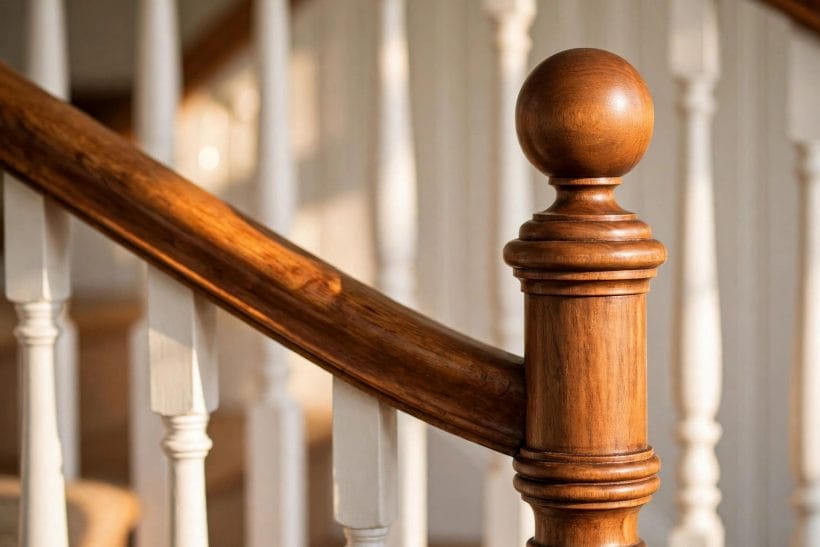
The balustrade is the stair’s face. Its vocabulary is old and precise — and the stair railing ideas post covers the wider family, while modern metal railing ideas shows the metal counterpoint to all this timber.
17. Turned Spindles in a Classic Profile
The turned baluster — vase, bulb and collar cut on a lathe — is the traditional stair’s signature. Two or three per tread, evenly spaced, they make the rhythm the whole flight marches to.
18. A Chunky Turned Newel with a Ball Finial
The newel is the full stop at the stair’s foot and its handshake with the hall. A generous turned post with a ball or cap finial anchors the flight; undersized newels make grand stairs look apologetic.
19. Square Balusters for a Quieter Look
Not every traditional stair turns its spindles: plain square balusters with a chamfered edge belong to plainer, earlier houses and cottage stairs, and their restraint suits small halls beautifully.
20. A Volute where the Rail Begins
The scroll that curls the handrail over the bottom newel is the joiner’s flourish — hard to make, impossible to fake, and the first thing a knowledgeable eye looks for on a fine traditional flight.
21. The Handrail that Swells over the Newel
A wreath or easing where the rail passes over each newel keeps the hand’s journey unbroken up the flight. Continuous comfort is a safety feature wearing a decorative face.
22. Spindles Painted White against Dark Treads
White balusters against dark treads and a dark rail is the crispest traditional scheme: the spindles lighten the flight’s side, the treads keep their gravity, the rail draws its dark line through both.
23. A Continuous Rail around the Landing
Carrying the handrail around the landing balustrade at the stair’s height makes the whole upper hall feel designed rather than fenced. Guarding heights and gaps follow your local rules — check them before altering any rail.
24. Box Newels on a Panelled Hall Stair
Square box newels with panelled faces and a flat cap belong to the more architectural end of the tradition — Georgian halls and panelled staircases — and pair naturally with wainscot following the rake.
5. Runners, Carpet and Bare Wood
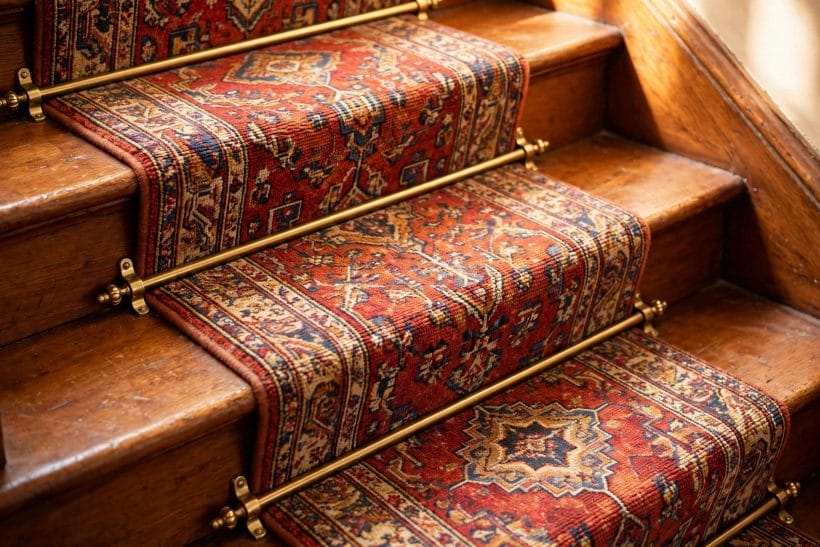
The centre of the tread is where the stair meets the foot. Runner, full carpet or bare polished wood is a decision about sound and ceremony as much as colour.
25. A Patterned Runner down the Centre
A patterned runner — small motif, deep ground — is the traditional centre-piece: it hides a decade of footprints in its pattern, warms the treads’ look, and leaves the polished margins to frame it.
26. A Plain Wool Runner with a Border
Plain wool with a woven border line is the quieter classic: all texture, no motif. Choose the border to echo the hall’s other colours and the runner behaves like part of the architecture.
27. Brass Stair Rods over a Deep Runner
Stair rods are jewellery with a job: they hold the runner’s corners honest and catch the light at every step. Brass suits the tradition best; keep them polished or let them mellow with the house.
28. Bare Wood with a Painted Edge
No runner at all — just polished treads with the outer edge painted or stained darker — is the farmhouse answer: hard-wearing, honest, and the stair’s sound becomes part of the house’s music.
29. A Striped Runner that Lengthens the Stair
Stripes running up the flight pull the eye with them and make a short stair feel taller and a narrow one feel deliberate. Keep the palette inside the hall’s existing colours and the trick stays invisible.
30. The Fully Carpeted Traditional Flight
Wall-to-wall carpet over the whole flight is the softest, quietest traditional finish — kind to children, kind to acoustics, and the right choice where the treads beneath are too worn or too plain to show.
31. A Runner that Turns the Landing Corner
Carrying the runner around a landing or a winder turn, mitred and continuous, is the mark of a considered stair. The pattern’s flow around the corner does more for the flight than any single flight-length could.
32. Tread Rugs on Worn Steps
Individual tread rugs — one per step, in a matched set — are the cottage solution: they protect the worn centres, lift off for shaking and washing, and let the timber margins stay the stair’s frame.
6. Walls, Panelling and Colour
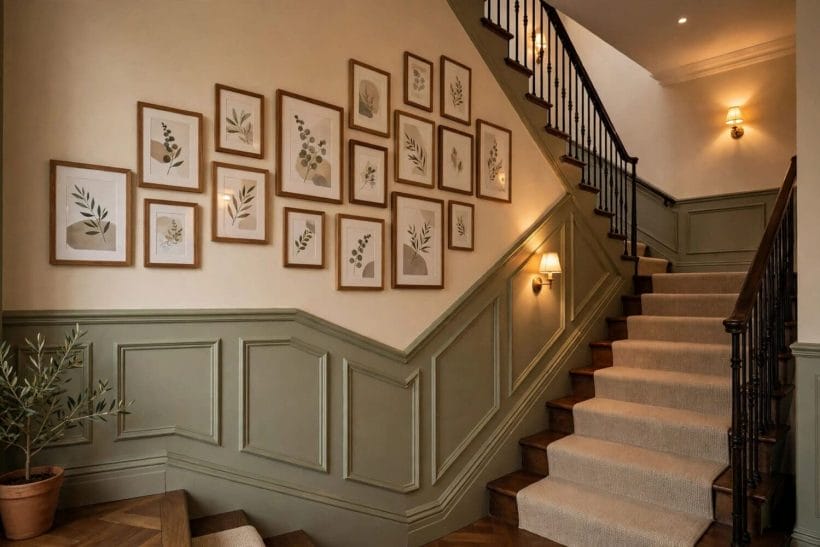
The stair wall is the largest picture in the house and the one seen in slices. Traditional treatments divide it horizontally — panelling below, colour or paper above — and let the rake of the flight draw the diagonal.
33. Wainscot Panelling Following the Rake
Panelling that climbs the wall at the stair’s angle is the traditional wall treatment: it protects the plaster from a thousand passing shoulders, and its rising line is the flight’s second handrail, drawn in timber.
34. A Gallery of Framed Prints up the Stair
The stair wall gallery — prints, engravings or maps in matched frames, hung in a line that climbs with the flight — turns a climb into a slow exhibition. Keep frames one family and the hang line disciplined.
35. Deep Green Walls with Pale Woodwork
Deep green above pale panelling is the library version of the traditional stair: moody, bookish, and flattering to every timber tone. It asks for warm light and rewards it.
36. A Chair Rail and a Two-Tone Wall
A simple chair rail dividing two close tones of the same colour is the modest house’s panelling: all of the proportion, a fraction of the joinery, and a natural stop line for the stair’s rake.
37. Wallpaper above the Dado
A small-pattern paper above a painted dado gives the stairwell texture that flat paint cannot, and the pattern’s scale reads well in the slices the balustrade cuts. Choose patterns that survive being seen thirty seconds at a time.
38. Family Photographs in Matched Frames
The stair is the family’s own gallery: photographs in one frame style, hung to the rake, tell the house’s story at climbing pace. Mixing frame styles dissolves the effect; consistency is the whole trick.
39. A Plate Rail with Ceramics
A narrow plate rail along the landing wall, holding plates and jugs, belongs to cottage and farmhouse stairs. It gives the landing a collected, generational feel no single picture can manufacture.
40. Limewash for an Older House Feel
Limewash or a soft distemper finish gives stair walls the cloudy, breathing surface old houses wear naturally. Imperfect by design, it flatters uneven plaster that modern paint would expose.
41. Mirrors that Borrow Hall Light
A mirror — or a disciplined row of them — on the stair wall doubles whatever light the hall owns and widens narrow flights visually. Frame them like the pictures they replace and the trick stays tasteful.
7. Lighting the Traditional Stair
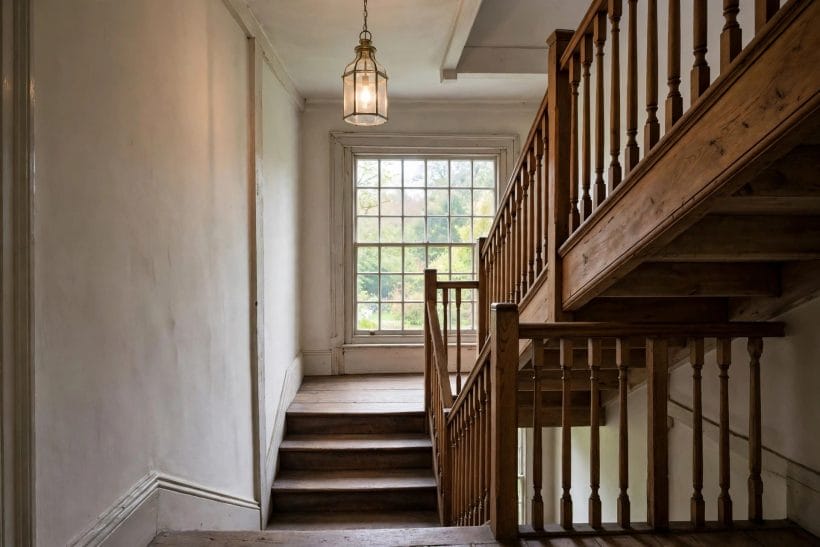
Stairs are climbed at dawn and midnight as often as at noon. Traditional lighting is layered and warm — a lantern for the well, sconces for the flight, and never a bare bulb to meet on the turn.
42. A Lantern Pendant in the Stairwell
The glass lantern hung in the stairwell’s well is the tradition’s centrepiece: it lights flights above and below at once and gives the void between them a heart. Scale it bravely; stairwells swallow small fittings.
43. Wall Sconces up the Flight
Sconces climbing the wall at the flight’s pace light each landing like punctuation. Candle-style fittings suit the language; whatever the style, warm lamps keep timber tones honest after dark.
44. A Window Dressed Simply on the Half-Landing
A landing window is the stair’s daylight engine. Dress it simply — a half curtain, a plain blind — and let it light the turn, the pictures and the panelling for free, all day.
45. Picture Lights over the Gallery
Small picture lights above the stair-wall gallery turn the evening climb into a private viewing. They also model the panelling with shadow, which flat ceiling light never does.
46. A Candle-Style Chandelier
In a tall, formal stairwell, a candle-style chandelier carries the lantern’s idea further: tiers of small warm lights that flatter gilding, polished rails and deep wall colours alike.
47. Low Lights at the Skirting
Discreet low-level lights near the skirting answer the stair’s real night work: safe feet at 2 a.m. without waking the house. Fitted warm and dim, they read as moonlight rather than equipment.
48. A Glass Panel in the Hall Door
Borrowed light is the oldest lighting trick in the book: a glazed hall door lends its daylight to the stair’s foot, and a fanlight above it lends more. Keep the glass simple and the gain is pure architecture.
49. Warm Bulbs for Timber Tones
Whatever the fittings, the lamp colour decides the stair’s evening character. Warm light deepens oak, flatters dark stain and keeps white spindles creamy; cold light greys them all. Choose warm, everywhere, without exception.
8. Landings and the Under-Stair
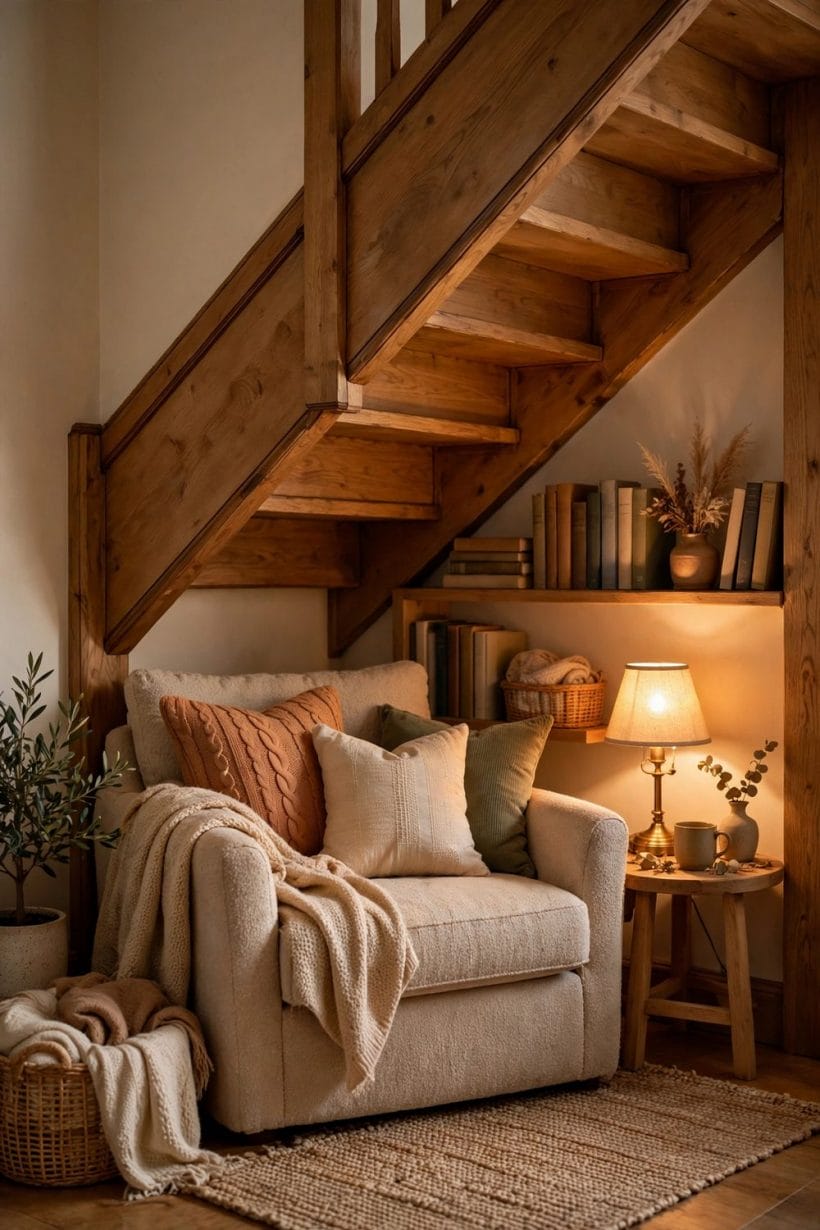
The traditional stair wastes nothing: its landing is a room in miniature and the void beneath it is the hall’s hardest-working cupboard — or its cosiest seat.
50. A Window Seat on the Half-Landing
Where a landing meets a window, a low seat with cushions turns a pause in the climb into the house’s quietest reading place — and stores blankets in its base, in the traditional way.
51. A Bookcase Built into the Landing
Landing walls are deep enough for books where they are too shallow for furniture. A built-in bookcase at the turn makes the stair a library’s staircase and gives the climb a destination.
52. The Under-Stair Cupboard with Panelled Doors
Panelled doors under the flight, matching the hall’s woodwork, hide the vacuum, the coats and the board games behind the stair’s own architecture. The neater the panelling, the grander the hall feels.
53. A Reading Nook under the Flight
The tall end of the under-stair void fits an armchair, a lamp and a child-sized kingdom. Lined in the hall’s colours, it is the traditional house’s smallest and most-loved room.
54. Drawers Built into the Stair’s Side
Deep drawers in the stair’s flank — one per household member, in the old boarding-school manner — swallow gloves, torches and leads at the exact point of departure. Joinery with a sense of humour.
55. A Console and Mirror at the Stair’s Foot
A narrow console beneath a mirror at the flight’s foot gives the hall its dressing table: keys, letters and the last look before the door. It also reflects the stair, doubling its presence for free.
56. The Coat and Boot Corner by the Bottom Step
Hooks, a boot tray and a bench in the angle by the bottom step make the stair’s foot the house’s airlock. Traditional halls were built for mud; honouring that is both pretty and practical.
57. A Tall Plant where the Stair Turns
A tall plant at the turn softens the stair’s geometry and marks the landing like a flag. Choose for the light the landing actually gets and the composition needs nothing else.
9. Traditional Stairs in Small Halls
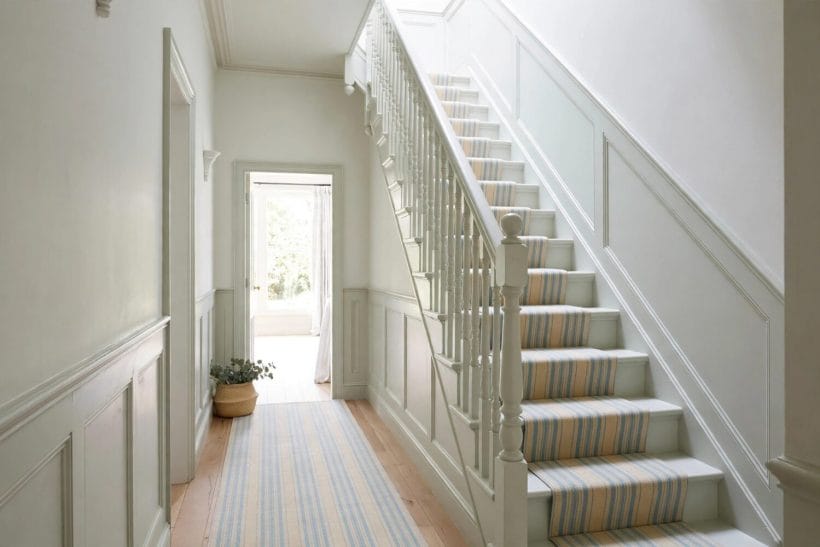
A small hall does not excuse a mean stair. The traditional language scales down gracefully — paler, slimmer, simpler — and a modest flight dressed with discipline looks grander than a large one dressed carelessly.
58. Pale Paint to Widen a Narrow Flight
White or cream spindles, pale walls and a light runner widen a narrow stair without moving a wall. The traditional details are all still there — they are simply wearing their lightest clothes.
59. A Slim Handrail in a Tight Hall
A slimmer, rounded handrail profile suits a tight hall better than the grand section: it keeps the hand’s comfort, gives shoulders back their centimetres, and matches the flight’s scale honestly.
60. The Runner that Makes a Small Stair Feel Grand
A deep-coloured, well-bordered runner on a small stair is concentrated luxury: every step is dressed, and the narrowness reads as intimacy. Brass rods complete the full-size illusion.
61. Open Space under a Short Flight
In a small hall, leave the under-stair open as a plant-and-basket corner rather than walling it into a mean cupboard. Air and light under the flight keep the whole hall breathing.
62. A Mirror at the Turn to Steal Light
One well-placed mirror at a small stair’s turn borrows the landing window’s light and returns it down the flight. It is the oldest small-hall trick and still the cheapest square metre in the house.
63. Keeping the Balusters Slender
Slender spindles, honestly spaced to the local guarding rules, keep a small flight’s side light and lacy where chunky turnings would crowd it. Scale the tradition to the stair, never the other way round.
64. One Strong Colour on the Stair Wall Only
A single deep colour — green, slate, oxblood — on the stair wall alone gives a small hall a drawn-in, jewel-box intensity while the rest stays pale. The flight becomes the room’s one deliberate drama.
65. A Compact Newel that Suits the Scale
A modest newel with a simple cap finial suits a small stair as a ball-turned giant never could. Proportion is the tradition’s first law; the newel is where small stairs most often break it.
66. Storage Treads in a Tiny Hall
Where a tiny hall has no cupboard at all, drawers built into the lowest treads — a joiner’s classic — give the flight a second job. Shoes, tools and winter gloves disappear into the architecture itself.
10. Costs and Practical Details
Traditional stairs ask for stewardship rather than spending: most of their practical work is maintenance, honest repair and knowing which jobs belong to a professional. Costs stay in general terms here, because timber, joinery and rules vary by house and place.
67. Restoring before Replacing
Almost every element of a traditional stair — spindles, rails, treads, panelling — can be repaired, matched or refinished by a joiner for less than the cost and upheaval of replacement. The first practical question is always what can be kept.
68. Squeaks, Wobbles and Honest Wear
Squeaks usually mean movement where a tread meets its riser, and a loose newel or rail means fixings have tired. Both are joinery jobs with known remedies — but a rail that moves is a safety item, not a cosmetic one; have it made sound promptly.
69. A Handrail on Both Sides for Safety
On any flight used by children, grandparents or guests in the dark, a handrail on both sides is the tradition’s quiet wisdom. Match the second rail’s profile to the first and it looks as though it was always there.
70. Checking the Guarding against Local Rules
Heights of rails, gaps between balusters and the guarding of landings are set by local building rules, and older stairs often predate them. Before altering any balustrade, check the current rules for your area — a joiner or surveyor can confirm what compliance asks.
71. Repainting the Woodwork in Stages
Spindles are the stair’s slow job: dozens of turnings to sand, prime and paint. Work flight by flight, keep the handrail for a separate weekend, and the whole balustrade renews itself without the house ever losing its stair.
72. When the Stair Needs a Professional
Structural questions — a sagging flight, a rotten string, alterations to the stair’s shape or its supporting walls — belong to a joiner, carpenter or structural professional, not to enthusiasm. The traditional stair rewards expert hands precisely because it was built by them.
73. Matching New Timber to Old
Replacement spindles and treads should match the originals’ timber, profile and finish as closely as a good turner can manage — and then be allowed to age toward them. A near match ages into invisibility; a bold contrast stays a scar.
74. Caring for Runners and Bare Treads
Runners want regular lifting at the edges, a vacuum’s beater kept gentle, and a shuffle of position yearly so the pile wears evenly. Bare treads want wax or polish little and often. Both are cheaper than the replacements they postpone.
75. The One Detail that Dates the Whole Stair
Every traditional stair has a weakest detail — a modern light fitting, a tired runner, a newel lamp from the wrong decade. Find yours and fix it first: the stair’s whole period character returns for the price of its smallest part.
Final Considerations
A traditional staircase is maintained, not renovated: keep its timber sound, its rails firm, its runner honest and its light warm, and it will carry the house’s daily life with the same grace it was built with. The seventy-five ideas above are mostly small acts of sympathy toward an old design that has already solved most of its problems.
Start where the stair asks loudest — the loose rail, the worn runner, the dark turn — and let each fix be in the stair’s own language. Traditional stairs forgive almost everything except being modernised by halves. Kept in sympathy, a flight built generations ago will outlast every fashion that has ever been suggested for it, and still be the first thing a visitor admires.

0 Comments