

Marble turns a staircase from a way upstairs into the hall’s main event: cool stone, soft light on the veining, and a flight that feels calm and permanent from the first step.
These 75 marble staircase ideas stay with the stone itself — its types, veining, finishes, treads and care — so you can choose a marble look that suits your hall, your light and your household.
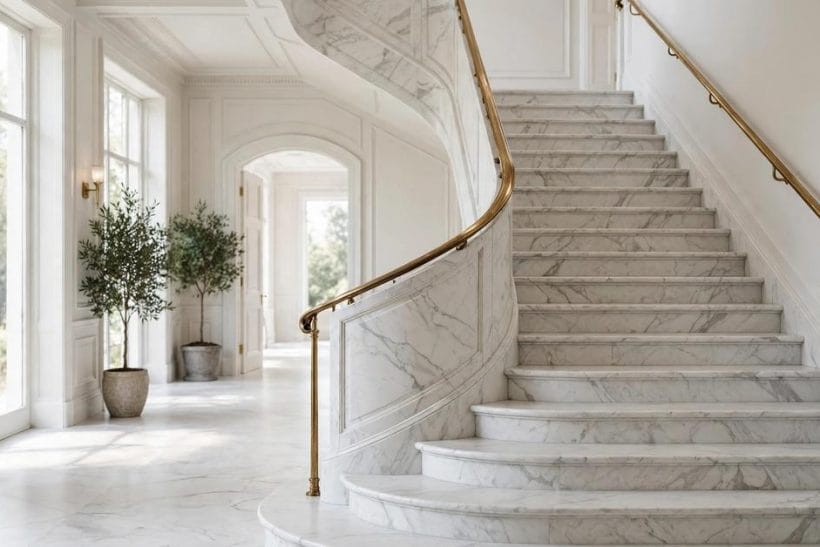
1. Marble Staircases at a Glance
Scope first. This post owns the marble material: the stone types, veining, finishes, treads, risers and railings that suit marble, and the care it needs. The wider staircase cluster is split elsewhere, and the pillar guide to staircase ideas owns shapes, layouts and stairs in every other material.
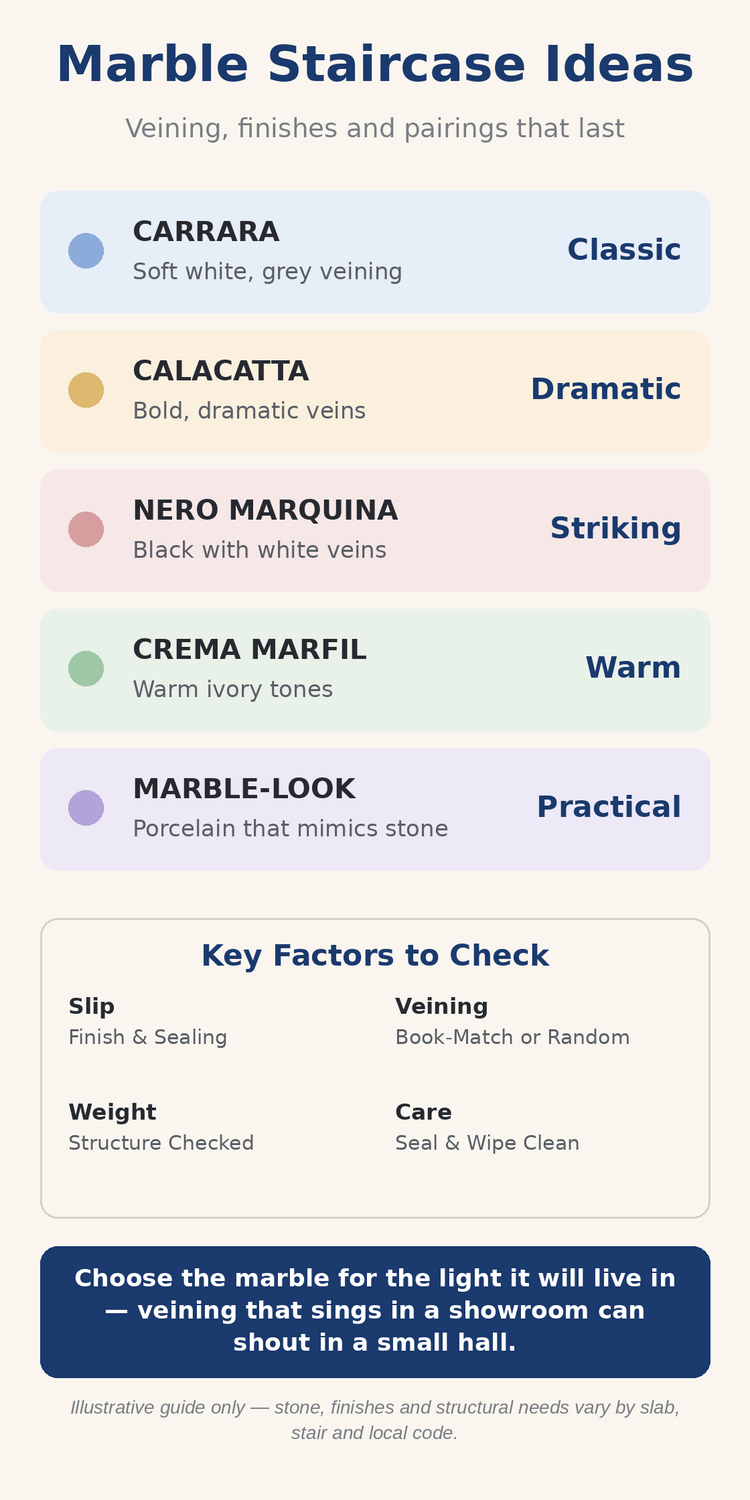
Read the stone before the shape. Veining, colour and finish decide how a marble flight feels, how it handles daily use, and how much care it asks for — so start with the slab, then let the layout follow. The table below names the five stones and looks this post returns to, so the later sections can speak plainly about each one by name.
| Type | Character | What it means |
|---|---|---|
| Carrara | Classic | Soft white marble with gentle grey veining, the quiet default |
| Calacatta | Dramatic | Bolder, wider veins that make the stair the room’s artwork |
| Nero Marquina | Striking | Black marble cut by white veins for halls that want contrast |
| Crema Marfil | Warm | Ivory-toned marble that flatters timber and warm light |
| Marble-Look Porcelain | Practical | Porcelain that mimics marble where budget or weight rules stone out |
2. White Marble Staircases
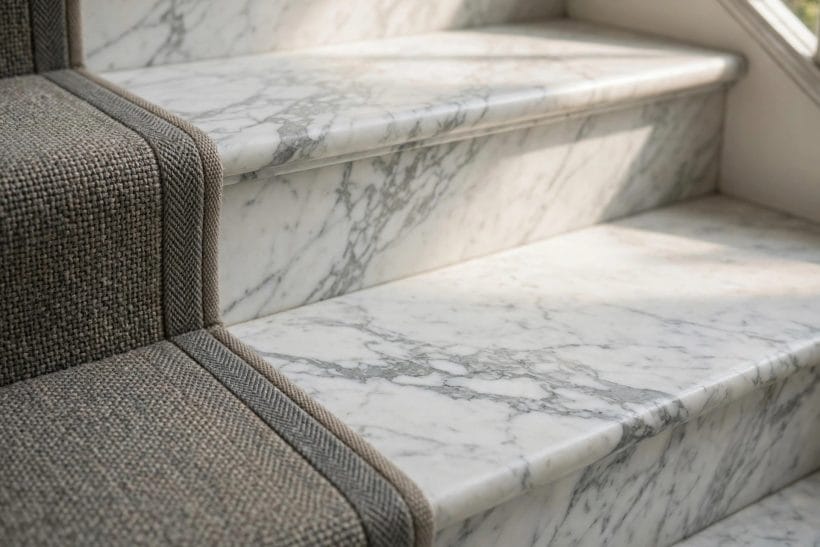
White marble is the classic choice for a reason: it lifts a hall, reflects light up the flight, and lets the veining do the decorating. Keep the walls and railings quiet and the stone stays the whole story. It is also the most forgiving starting point for a first marble stair, since its palette suits almost every hall.
1. Classic Carrara flight in a bright hall
Carrara is the quiet default for a white flight: soft white stone, gentle grey veining, and a calm surface that suits both period and modern halls. It flatters daylight and never fights the furniture around it.
2. Polished white treads with soft veining
A polished white tread catches light along each edge, so even a modest flight feels generous. Pair it with pale walls and simple detailing, and check the finish suits your household with a professional before committing.
3. White marble with a warm timber handrail
Timber warms white marble beautifully. A wooden handrail over cool stone treads gives hands something welcoming to hold and stops an all-white flight feeling cold, especially in halls that face away from the sun.
4. All-white stair with pale painted walls
White marble against pale walls makes a narrow or shaded hall feel wider and calmer. The interest comes from shadow, veining and the play of light rather than colour, so keep clutter and contrast low.
5. White marble softened by a runner edge
A runner down the centre of a white marble flight adds colour, softens sound underfoot, and leaves the stone visible at both edges. It suits busy family halls where bare stone would feel formal.
6. Matt white marble for a calm entry
A honed, matt finish takes the shine off white marble and gives an entry a softer, quieter mood. It shows the veining gently and suits homes that prefer understatement over a grand, glossy welcome.
7. White treads lit from tall windows
Daylight is white marble’s best partner. A flight beside tall windows glows as the light moves, the veining shifting from silver to warm grey through the day, and the hall needs little other decoration.
8. White marble turning stair in a corner
A turning flight in white marble makes a corner feel deliberate rather than leftover. The pale stone carries light around the turn, and a simple railing keeps the change of direction clear and elegant.
9. White marble with fine brass detailing
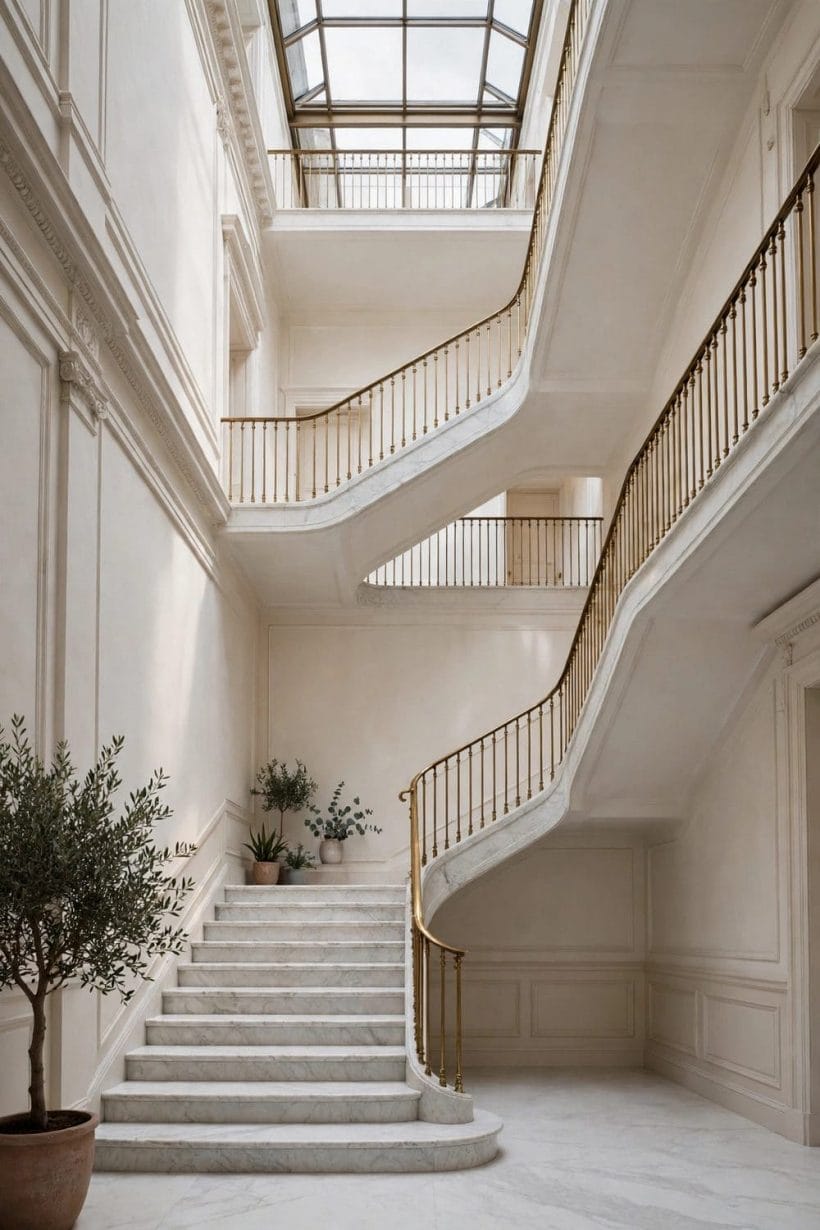
Brass and white marble are old friends. Slim brass inlay, brackets or a handrail add warmth without colour, and the pairing suits formal halls where the stair is meant to be noticed on entry.
3. Veined and Book-Matched Marble
Veining is marble’s signature — no two slabs match, and the pattern you choose sets the flight’s character more than its colour does. Bold veins perform; soft veins soothe. Decide which job your hall needs before you fall for a particular slab, because the pattern, once cut and fitted, is the staircase you will live with.
10. Calacatta flights with bold wide veins
Calacatta brings bolder, wider veins than Carrara, and a flight in it becomes the room’s artwork. Keep everything around it plain, let the pattern run uninterrupted, and view the actual slab before you commit.
11. Book-matched risers that mirror the pattern
Book-matching opens two slabs like pages, so the veining mirrors across the join. On risers and landings it creates a calm symmetry that feels designed rather than accidental, and it rewards careful slab selection.
12. Softly veined marble for a quiet scheme
Not every hall wants drama. Softly veined marble gives you the depth and movement of real stone at a whisper, pairing happily with patterned rugs, artwork and busy family life around the stairs all year round.
13. Veins following the direction of travel
When the veining runs with the flight rather than across it, the eye travels up the stairs and the hall feels taller. Ask how the slabs will be cut so the pattern flows step to step.
14. Dramatic veining on a single feature flight
Save the boldest stone for the flight everyone sees. A dramatic vein on the main stair, with quieter materials elsewhere, concentrates the effect, and the budget, where it earns the most attention each day.
15. Grey-veined marble in cool daylight
Grey veining loves cool, even light: north-facing halls and shaded entries keep its tones true and silvery. Pair it with soft white paint and pale timber for a calm, collected staircase scheme in any season of the year.
16. Gold-touched veining in warm halls
Some marbles carry warm, gold-touched veins that glow under evening light. In a hall lit by lamps and warm bulbs, that veining feels rich rather than busy, especially beside timber and brass details.
17. Random veining for a natural feel
Letting the veins fall as they come gives a flight an organic, unforced character. It suits relaxed homes and older houses, where a perfectly matched pattern would feel too formal for daily life and entertaining.
18. Veined marble paired with plain walls
Busy stone needs quiet company. Plain walls, a simple railing and unpatterned flooring let veined marble hold the eye alone, and the hall feels composed instead of competing with itself at every surface.
4. Dark Marble: Black and Deep Tones
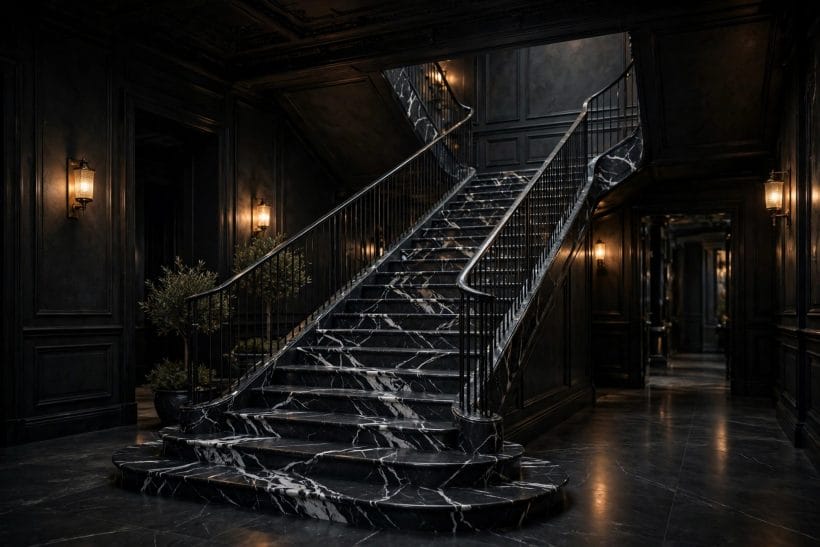
Dark marble reverses the usual recipe: instead of lifting a hall, it grounds it. Black and deep-toned flights bring contrast, mood and a sense of ceremony, and they ask for good light to show their veining. Planned well, they feel intimate rather than heavy, even in quite modest halls.
19. Nero Marquina with crisp white veins
Nero Marquina is the striking choice: black marble cut by bright white veins, graphic and confident. It suits halls that want contrast, and it looks best where daylight or well-placed lamps can strike the pattern.
20. Deep charcoal marble in soft light
Charcoal marble sits between black drama and grey calm. It hides the mood of a dark flight without the starkness, pairs well with pale walls, and feels modern in homes that avoid pure black.
21. Black marble treads with pale risers
Black treads over pale risers give each step a clear, readable edge and a strong rhythm up the flight. The contrast is practical as well as handsome, since every tread line stays easy to see.
22. Dark marble with warm timber accents
Dark stone can feel distant until timber joins it. A wooden handrail, warm flooring or a timber door nearby softens a deep-toned flight and keeps a moody hall welcoming rather than severe at night.
23. Moody dark flight in a compact hall
A small hall can carry dark marble if the light is planned: pale walls, a light ceiling and good lamps keep the flight dramatic rather than gloomy, and the veining becomes the room’s texture.
24. Dark marble with fine brass details
Brass warms dark marble the way it warms black paint. A brass handrail or slim brass nosing catches lamplight against the stone, and the combination suits dining halls and formal entries especially well.
25. Near-black marble under picture lighting
A near-black flight lit like artwork — a picture light, a sconce, a lamp on the landing — turns the staircase into the hall’s evening feature, with veining appearing and fading as you climb.
26. Dark veined marble as the room focus
In an open hall, a dark marble flight can anchor the whole ground floor. Keep other surfaces pale and plain, let the stone hold the centre of the room, and furnish around it rather than against it.
5. Marble Treads with Contrasting Risers
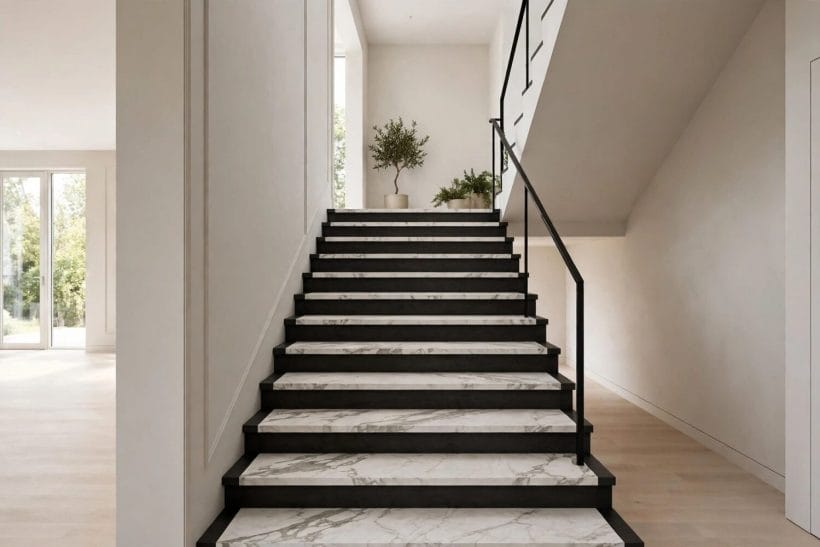
Splitting tread from riser is marble’s neatest trick: the horizontal stone catches the light, the vertical face carries colour or contrast, and the flight gains rhythm. It also lets one material do two jobs, and it gives a plain straight flight a designed quality without changing its shape at all.
27. Pale treads over deep-coloured risers
Pale marble treads above deep-coloured risers read crisp and tailored. The dark vertical faces ground the flight, show fewer scuffs, and let the stone on top stay the light, luxurious part of the picture.
28. White treads with black risers
The strongest version of the contrast: white marble above, black below. It suits graphic, modern halls and period houses alike, and it makes the geometry of the stair — every step, every turn — unmistakable.
29. Marble treads above timber risers
Marble on top, timber below: the stone gives the wearing surface its cool elegance, while wooden risers bring warmth and link the stair to floors and doors elsewhere in the house. A balanced, liveable pairing.
30. Dark treads over clean white risers
Reverse the usual order and the flight feels grounded and calm. Dark marble treads hide daily marks well, white risers keep the stairwell bright, and the contrast outlines each step clearly in dim halls.
31. Stone treads with a soft shadow line
A slight shadow line between tread and riser makes each step read as a separate, floating layer. It is a quiet detail, but it gives a marble flight a crafted, architectural quality throughout.
32. Marble treads only, risers left plain
Using marble only where feet land keeps the luxury and trims the commitment. Plain painted risers are easier to refresh over the years, and the eye still reads the flight as marble from every normal viewpoint.
33. Contrasting nosing that defines each step
A nosing in a contrasting tone or metal defines the front edge of every tread. On marble, where veining can blur edges, that clear line helps the stair read cleanly and climb confidently.
34. Two-tone flight in a neutral hall
In a neutral hall, a two-tone marble flight supplies all the pattern the room needs. Tread one tone, riser another, walls quiet — the stair becomes a composed piece of design rather than decoration.
6. Railings That Suit Marble
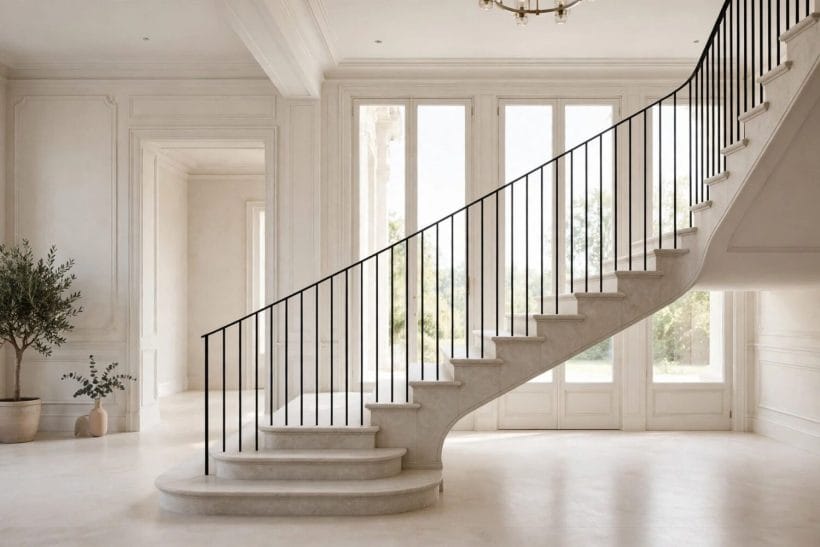
A railing on marble has to hold its own against stone without shouting over it. The guide to stair railing ideas covers railings in full; here the focus stays on the pairings that flatter marble flights.
35. Slim black metal railing on white marble
A slim black metal railing draws a clean line against white marble — enough contrast to define the flight, never enough to compete with the veining. It suits modern and period halls equally well.
36. Brass handrail for a classic marble flight
Brass is marble’s traditional partner: warm, weighty and happy beside formal stone. A brass handrail over Carrara or Calacatta reads classic rather than dated, and it deepens in character as the years pass.
37. Frameless glass beside pale marble
Glass keeps a pale marble flight feeling open and lets light pass through the stairwell. It suits bright, contemporary halls where the stone should be seen from every angle, including through the railing itself.
38. Timber handrail softening cool stone
A timber handrail is the warmest thing a hand meets on a marble stair. It softens the stone’s formality, links the flight to wooden floors, and suits family halls that want marble without ceremony.
39. White metal railing for a light look
White-painted metal nearly disappears against pale marble and bright walls, leaving the flight’s shape and veining to speak. It is the quietest railing choice, and often the kindest to a small, light-hungry hall.
40. Minimal wall rail on a closed stair
Where a stair runs between walls, a single minimal wall rail keeps the marble clear and the profile simple. Choose a finish that echoes something nearby — brass, black or timber — for a composed feel.
41. Traditional balusters paired with marble
Turned or simple balusters give a marble flight its period manners. Painted white or black, they frame the stone without hiding it, and they suit older houses where a glass panel would feel abrupt.
42. Dark railing tracing a curved flight
On a curved marble stair, a dark railing traces the sweep like a drawn line. The contrast makes the curve legible from the hall below, and turns the flight’s shape into its main decoration.
7. Marble Stairs by Shape
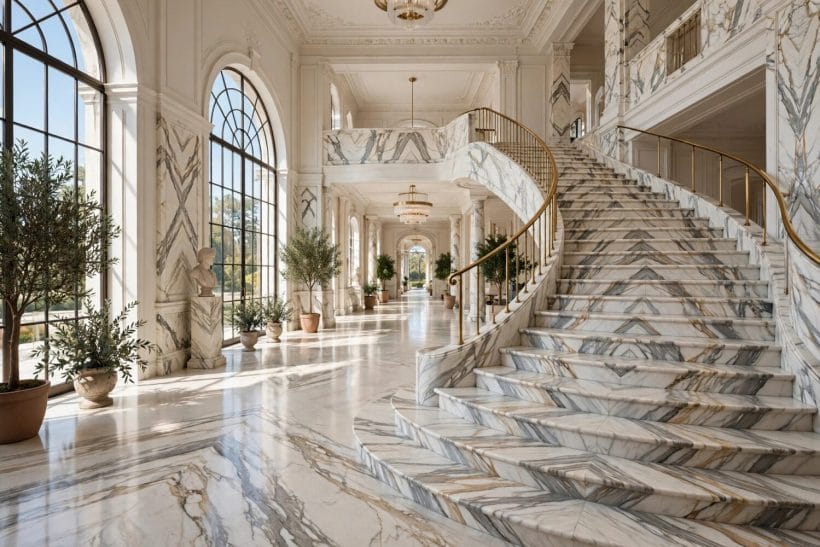
Shape changes how marble behaves: curves let veining flow, straight flights show pattern in rhythm, and turns test the slab cutting. Neighbouring guides cover spiral staircase ideas, open staircase ideas and modern staircase ideas in full; here each shape is judged in marble.
43. Straight marble flight in a long hall
A straight flight is marble’s clearest stage: tread after tread of repeating pattern, easy to read and calm to climb. It suits long halls, where the rhythm of the veining carries the eye forward.
44. Gentle dog-leg with a half landing
A dog-leg flight turns back on itself at a half landing, and marble makes that pause feel generous. Use the landing slab to show the stone at its best, lit by a window if possible.
45. Sweeping curved marble staircase
The curve is marble’s grand gesture: veining flows around the sweep, and the flight becomes sculpture. It belongs in halls with room to admire it, and it rewards the plainest walls and railings.
46. Compact spiral in marble tones
A compact spiral in marble or marble-look finishes brings the material into tight corners. Keep the palette pale, the detailing minimal, and take professional advice on structure and suitability before choosing real stone here.
47. Open-riser marble treads, carefully judged
Open risers lighten a marble flight visually, letting light fall through the steps. They change how a stair feels underfoot, so weigh openness against household needs, and check local code with a professional first.
48. Wide ceremonial flight at an entry
A wide flight at the front door is marble at its most welcoming: generous treads, calm veining, and room for two to pass. It sets the tone for the whole house from the threshold.
49. L-shaped turn saving hall space
An L-shaped turn folds a marble flight into a shorter hall without losing its presence. The corner landing is a natural place for the best-cut slab, where the veining turns with the stair.
50. Floating-look marble treads on a spine
Marble treads carried on a central spine give the stone a lighter, floating feel while keeping its cool surface. The engineering belongs to professionals; the effect belongs in calm, contemporary halls with room to breathe.
51. Split-level marble steps linking rooms
A few marble steps between split levels link rooms with a shared material language. Matching the stone to a hall or kitchen floor nearby makes the change of level feel intentional and composed.
8. Marble in Small and Narrow Halls
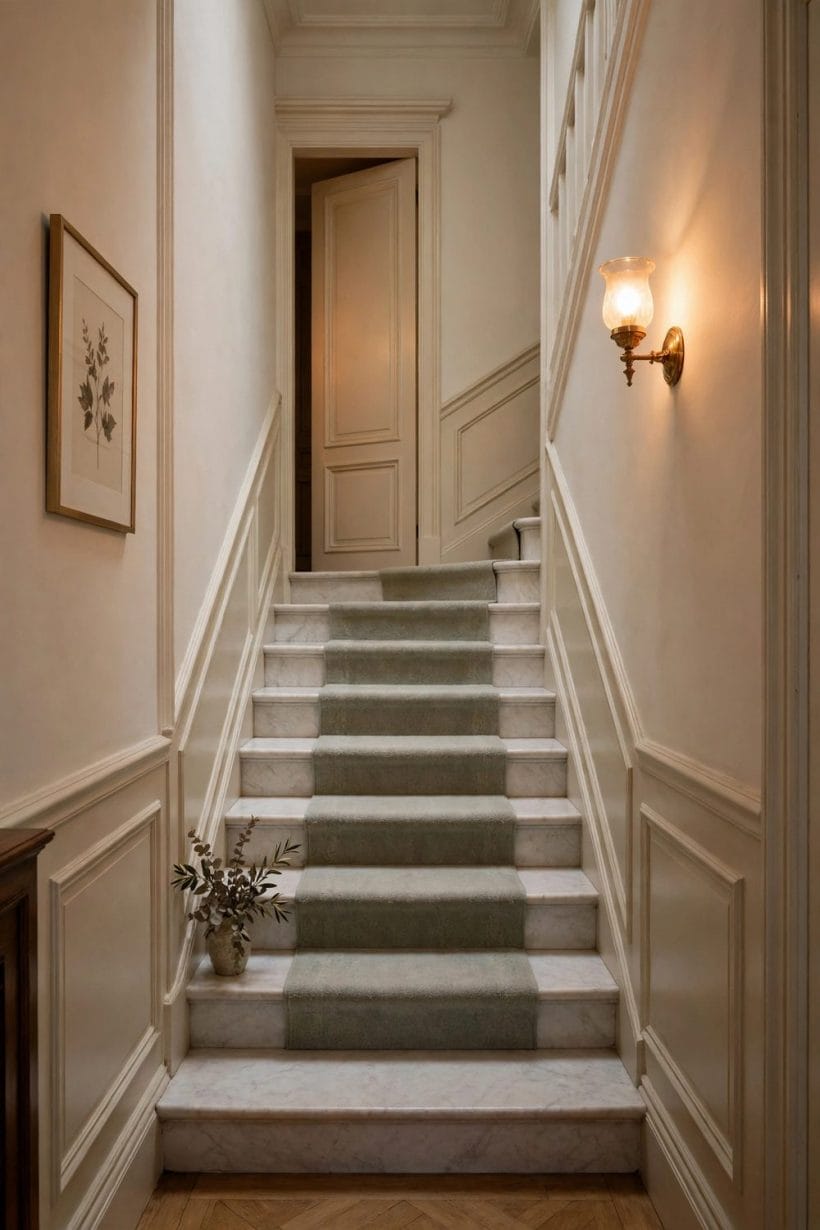
Small halls are where marble earns its reputation for light. The dedicated guide to small staircase ideas covers compact layouts; here the question is how the stone itself behaves when space is tight.
52. Pale marble brightening a narrow hall
Pale marble reflects what little light a narrow hall has and bounces it up the flight. Choose gentle veining, keep walls pale, and the corridor stair feels like a feature rather than a squeeze.
53. Short flight in marble-look porcelain
Where weight, budget or a tight structure rules out stone, marble-look porcelain gives a short flight the same calm pattern with an easier brief. It is the practical route to the look in small homes.
54. Slim-profile treads in a tight turn
In a tight turn, slim-profile treads keep the stair feeling light and leave the veining unbroken by heavy detailing. Keep the railing minimal and the palette pale, and confirm suitability with a professional.
55. Light veining in a compact entry
A compact entry needs pattern at a small scale. Light, fine veining gives marble’s depth without overwhelming a short flight, and it pairs well with a mirror, a slim console and pale paint.
56. Mirror and marble in a small stairwell
A mirror opposite a pale marble flight doubles the light and the stone in one move. It is the oldest small-hall trick, and marble’s reflective finish makes it work harder than most materials.
57. Closed risers keeping a hall tidy
Closed risers give a small marble stair a neat, contained profile and hide the under-stair clutter zone completely. In a compact hall, that clean face is worth more than visual lightness on its own.
58. One accent wall beside pale marble
Let one wall beside a pale marble flight carry a deeper colour, and leave the rest quiet. The contrast frames the stone, gives a small hall a focal point, and costs nothing in space.
9. Finishes, Slip and Sealing
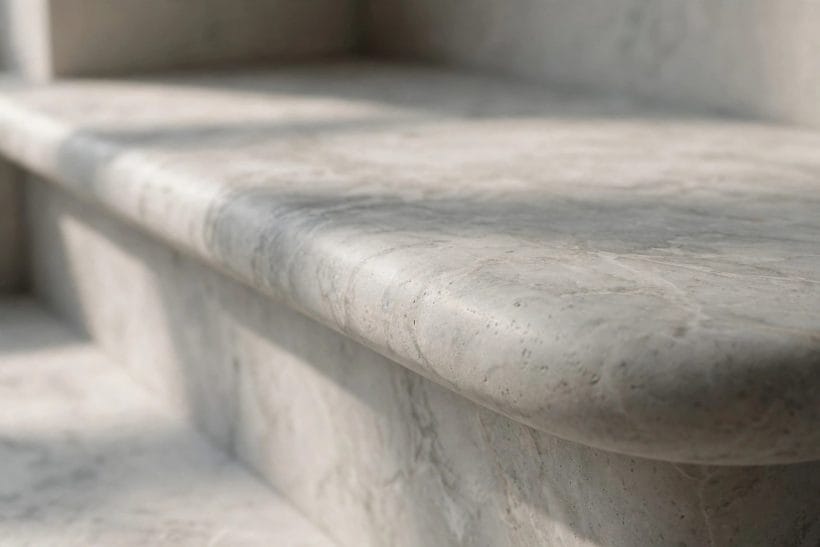
Finish decides how marble feels underfoot as much as how it looks. The wooden staircase makes the warm, forgiving contrast; marble asks for clearer choices about sheen, slip and sealing, always checked against professional advice and local code.
59. Honed finish for a softer sheen
A honed finish gives marble a smooth, low-sheen surface that feels calm and contemporary. It softens reflections, shows veining gently, and is often the finish households choose for stairs used all day, every day of the week.
60. Polished marble in formal halls
Polished marble is the glossy classic: deep colour, sharp reflections, a formal welcome. It can feel slicker underfoot than honed stone, so weigh the look against your household and take professional advice first.
61. Matt finish helping everyday confidence
A matt or lightly textured finish takes the shine — and some of the visual slipperiness — off a marble tread. On busy family stairs, that quieter surface helps the flight feel steadier day to day.
62. Sealed treads against household marks
Marble is porous, and a suitable sealer helps treads resist everyday marks from shoes, spills and hall traffic. Sealing is maintenance, not armour: follow product guidance and refresh it as advised over time.
63. Brushed texture on busy family stairs
A brushed finish adds a faint texture to the stone’s surface, softening its look and its feel underfoot. It suits family stairs where a polished surface would feel too formal and too demanding.
64. Nosing detail that catches the light
The nosing — the front edge of each tread — catches light and defines every step. On marble, a clean, well-finished nosing helps the flight read clearly, especially on turns and in dimmer halls.
65. Runners softening sound and feel
A runner over marble treads softens sound, adds colour and gives feet a warmer surface in winter. It also protects the centre of each tread, where a flight naturally takes its heaviest wear.
66. Finish matched to the hall’s light
Glossy stone in a dark hall can glare under lamps, while matt stone in bright sun can look flat and dull. Match the finish to the light the stair actually gets, and test samples on site.
67. Sealing refresh as routine care
Sealing fades quietly, so build its refresh into routine care rather than waiting for marks to prove it has gone. A professional can confirm the right product and timing for your particular stone.
10. Care, Costs and Choosing the Slab
Costs follow the slab, the finish and the fitting, in that order — and care decides how long the result stays beautiful. Choose the stone in real light, keep the records of what was fitted and sealed, and treat a marble flight as a long-term piece of the house rather than a quick finish. Honest planning at this stage protects both the stone and the budget.
68. Choosing the slab in natural light
Marble changes with the light, so judge a slab where daylight, not showroom spots, does the work. Veining that looks gentle at noon can look bold at dusk — choose for the hall it will live in.
69. Viewing the full slab before committing
A small sample hides marble’s real pattern. View the full slab, note where bold veins will land on the flight, and agree the layout before cutting, so the finished stair holds no unwelcome surprises.
70. Matching batches across a whole flight
Stone from one batch keeps colour and veining consistent step to step. Mixing batches can leave a flight looking patched, so confirm the whole stair comes from matched material before the order is placed.
71. Wiping spills promptly on marble
Marble marks more readily than harder surfaces, and prompt wiping is its simplest protection. Keep a soft cloth in the hall, deal with spills as they happen, and the treads keep their finish longer.
72. Gentle cleaners suited to stone
Use cleaners made for natural stone and avoid harsh or acidic products on marble, which can dull its surface. Follow the maker’s guidance, test in a quiet corner first, and keep the routine gentle and regular.
73. Re-sealing when water stops beading
A simple sign that sealing is fading is water sitting flat instead of beading on the surface of the tread. Note it, and arrange a refresh in good time — a professional can confirm what your stone needs.
74. Weighing marble against the porcelain look
Real marble brings unmatched depth and coolness; marble-look porcelain brings easier care and a lighter brief. Weigh both honestly against your budget, structure and appetite for maintenance, and choose without regret either way.
75. Budgeting for stone, fitting and care
Budget for the whole life of the flight: the slab, the fitting, the sealing and the gentle care after. Marble rewards that honesty — planned properly, it is a stair you choose once and keep.
Final Considerations
Choose the marble for the light it will live in, the finish for the household it will serve, and the shape for the hall it must fit — in that order. Check structural, slip and fixing questions with a qualified professional and against local code, and a marble flight stops being a risk and becomes what it should be: the calm, permanent centre of the hall.
Whether the result is a quiet Carrara flight in a narrow entry or a bold veined sweep in a wide hall, the principle holds: let the stone lead, keep everything around it honest and plain, and the staircase will repay the care for as long as the house stands.

0 Comments