
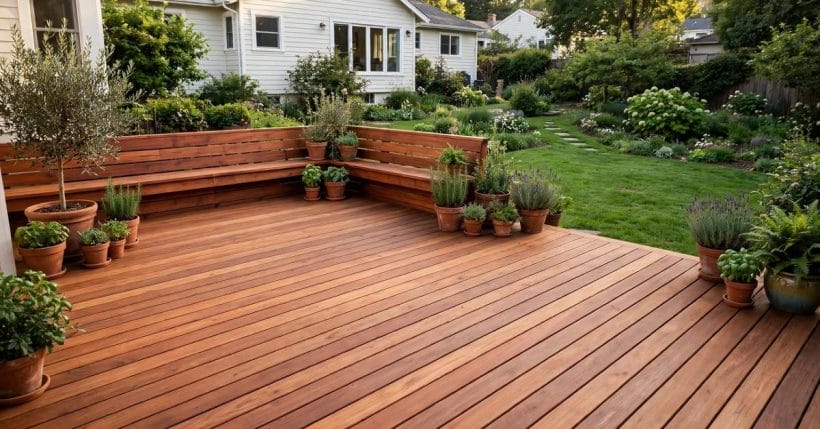
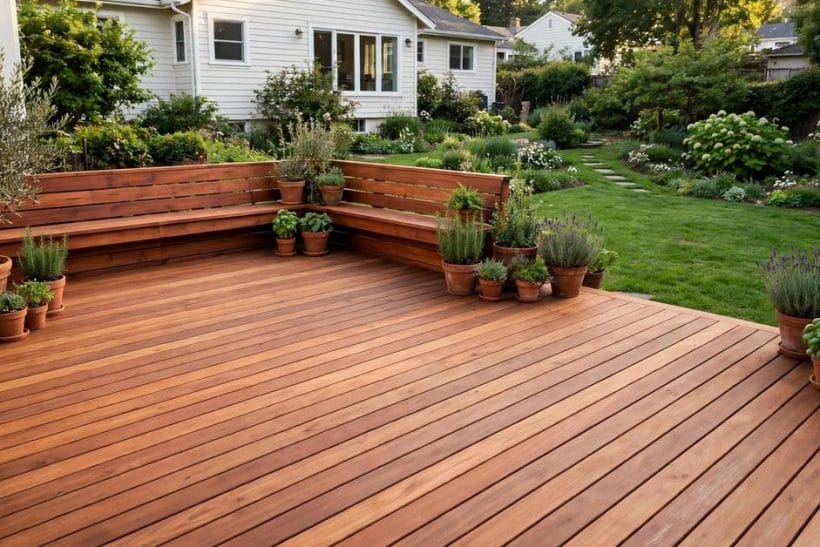
Some decking timbers are chosen because they are cheap, some because they are fashionable, and a few because nothing else looks like them. Redwood belongs to the last group: a warm red-brown board with a straight, even grain that deepens in its first seasons, then — if you let it — silvers slowly into the soft grey of driftwood. It is a deck material with two lives, and both of them are beautiful.
This post stays with the material itself: layouts that suit redwood, railings that respect it, furniture that lives well on it, and the care it honestly needs. Structure, spans and fixings belong to your local code and your builder; here, everything is the timber and what to build with it.
1. Redwood Decks at a Glance
Scope first. This post owns one material: the redwood deck. The neighbouring reading lives elsewhere on the site: ground level deck ideas for low decks of any material, decks with a fire pit for the fire-on-deck question, and fire pit ideas for the wider outdoor set. Here, everything is redwood — its colour, its grain and its famous silvering.
One rule governs the whole post: redwood rewards a decision made early. Choose heartwood for the parts that matter, decide whether you will hold the red or let it silver, and let every later choice — railing, furniture, finish — follow from those two.
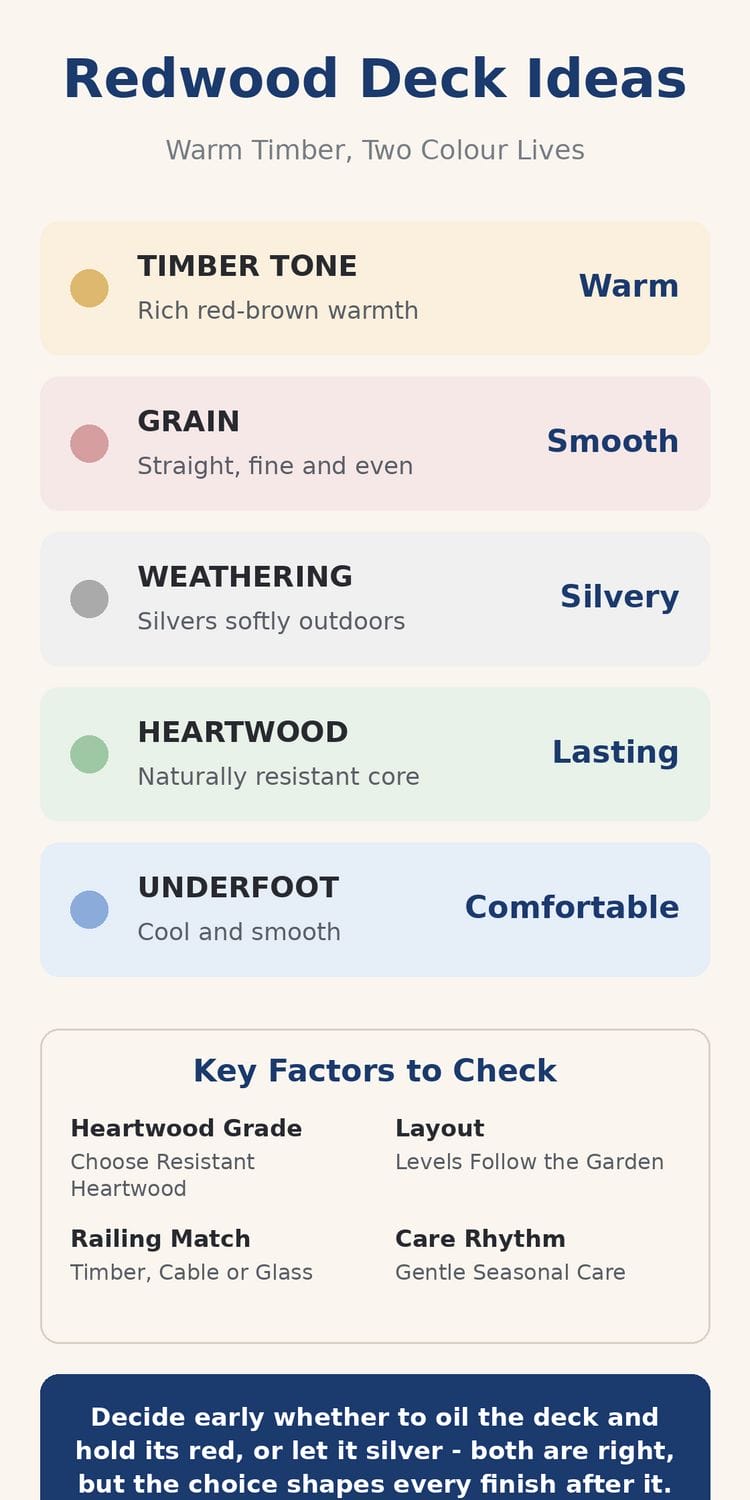
| Element | Character | What it means |
|---|---|---|
| Timber Tone | Warm | A rich red-brown colour no stain quite imitates |
| Grain | Smooth | Straight, fine and even under hand and foot |
| Weathering | Silvery | Left alone, the red softens to a driftwood grey |
| Heartwood | Lasting | The darker core is naturally resistant to decay and insects |
| Underfoot Feel | Comfortable | Cool, smooth and kind to bare feet in summer |
2. Why Redwood: The Timber Itself
1. The colour nothing else has
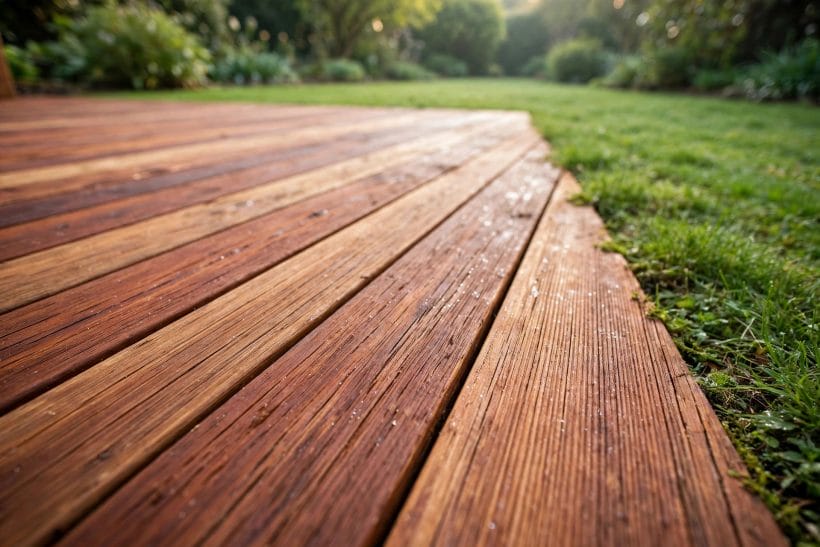
Redwood’s red is in the wood, not on it. Fresh boards run from pale rose to deep russet, often in the same pack, and the variation is part of the pleasure — a redwood deck is a mosaic of warm tones that no uniform stain can fake.
2. Heartwood where it counts
The darker heartwood at the tree’s core is the naturally resistant part — the grade to specify for boards, posts and anything near soil or standing water. Sapwood is paler and softer; use it, if at all, up high and out of the weather’s worst.
3. A grain that reads calm
Redwood grows straight and cuts even, so long deck runs look composed rather than busy. Lay the boards to show it: consistent direction, tidy butt joints, and the grain itself becomes the deck’s pattern without a single decorative extra.
4. Light for its strength
Builders prize redwood partly because it is easy to handle — light to carry, kind to tools, stable once down. For the homeowner that translates to clean cuts, tight joints and a deck that feels crafted rather than assembled.
5. Cool under bare feet
On a hot afternoon a redwood deck stays noticeably kinder underfoot than dark composites or stone. Around pools, paddling toes and sunbathing spots, that comfort is a genuine design feature, not a footnote.
6. Sourcing it honestly
Redwood is a regional timber with a conservation story, so buy it the way you would want it sold: from certified, responsibly managed sources, with the grade and origin stated plainly. Ask the yard where the boards grew and what the grade means — a good yard answers happily.
7. New growth and old growth
Most redwood sold today is second growth — faster grown, paler, a little softer than the legendary old growth. It is still a fine decking timber; simply choose the better grades for the surface and set your expectations by what is actually in the pack.
8. Redwood against its rivals
Against cedar it is warmer and finer-grained; against pressure-treated pine it is prettier and pleasanter to touch; against composite it is real, repairable and ages by silvering rather than fading. Its honest costs are price and availability — this is a premium, regional board.
9. The two-lives promise
Hold the red with regular oiling, or let the deck silver and spend nothing on colour at all. Few materials offer both a maintained look and a graceful no-maintenance look; redwood’s whole design conversation starts from choosing which life your deck will live.
A word about where this timber’s reputation was made: redwood built the porches, fences and garden structures of the American West for a century, and the gardens where those structures survive — silvered, sound, a hundred summers old — are the material’s true portfolio. When you choose redwood you are not experimenting; you are joining the longest-running field test in decking. The layouts that follow are the ones that century of garden-building settled on.
3. Layouts and Shapes
10. The classic rectangle
A simple rectangle of long redwood boards is the material at its best — the grain runs unbroken, the colour does the decorating, and the shape suits almost every house. Save the complexity for the edges and the furniture.
11. The wraparound deck
Redwood’s warmth flatters a wraparound, following a house from front sun to side shade. Keep the board direction turning cleanly at the corner — mitred or picture-framed — so the wrap reads as one crafted surface.
12. The garden-room deck
Build the deck as an outdoor room at garden level: boards running toward the view, planting at the edges, a pergola’s shadow as the ceiling. Redwood’s natural tone sits easily among greens, gravel and stone.
13. The pool deck
Redwood is a traditional pool timber for good reasons: smooth underfoot, cool in sun, and unbothered by splashing when the heartwood grades are used. Keep the layout simple and the board gaps consistent so water sheds cleanly.
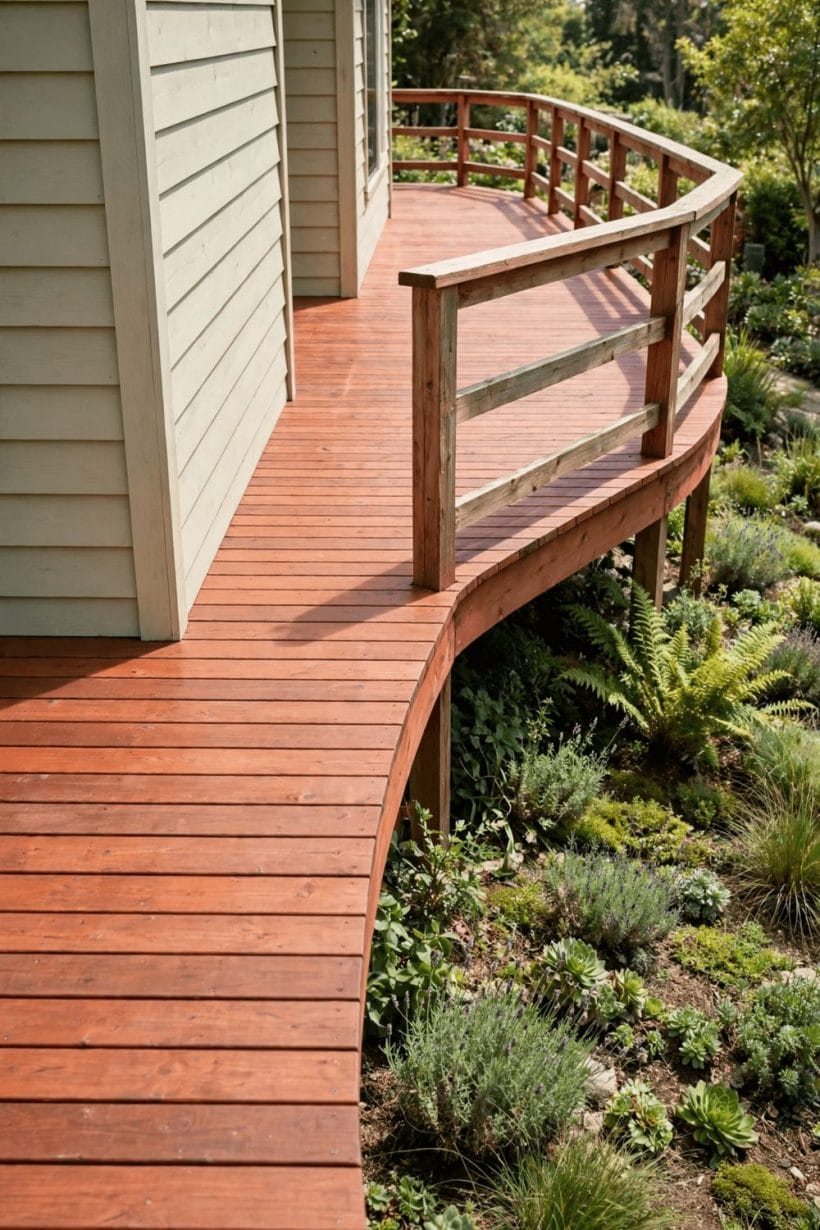
14. The hillside platform
On a slope, a redwood platform deck steps out over the fall of the ground, its warm boards floating above planting. The engineering belongs to professionals and local rules — the design point is the contrast: crafted timber against wild slope.
15. The courtyard deck
In an enclosed courtyard, redwood boards warm up walls and stone that might otherwise feel hard. Run the grain toward the door you use most, and let one bench or planter in the same timber tie the square together.
16. Picture-frame borders
A border of boards laid at right angles — or a single darker-toned frame — gives a redwood deck a tailored edge without changing materials. It is the classic way to make a plain rectangle look designed.
17. Diagonal drama
Boards at forty-five degrees add energy and can make a small deck feel larger, at the honest cost of more cutting and more offcuts. On redwood, use the diagonal on a feature zone rather than the whole field, and let the border keep the calm.
18. The deck that meets the lawn
Where the deck sits low, let redwood run almost to grass level with a single shallow step. The red-brown against green is one of the great colour pairings in the garden, and the low profile keeps the house grounded.
4. Levels, Steps and Built-In Edges
19. Two levels, two moods
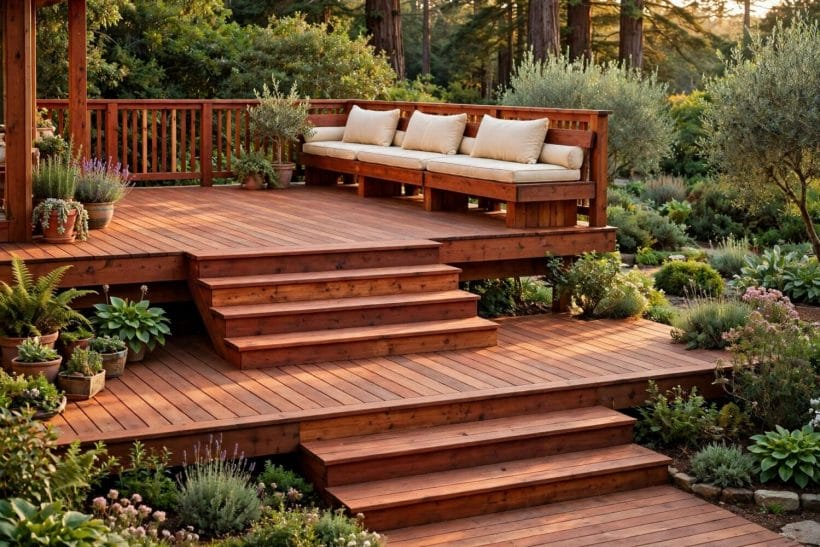
A step up or down divides a deck into dining and lounging without a single wall. Redwood makes the division gentle — same timber, same colour, just a change of height and of light.
20. The wide, shallow step
Steps on a redwood deck should feel like terraces, not stairs: broad treads in the same boards, laid to catch the sun. A wide step doubles as seating at parties and as a shelf for pots in between.
21. Built-in benches in matching timber
A bench built from the deck’s own boards disappears into the design and seats a crowd. Back it with cushions in the deck’s colour story — cream, sage, rust — and it becomes the most-used seat in the garden.
22. Planter boxes as edges
Redwood planters lining the deck’s edge soften the drop, hold herbs near the kitchen door and echo the boards’ colour in their construction. Line them properly, keep soil off the deck boards, and plant generously.
23. The sunken conversation step
One corner dropped a level, ringed with built-in seating, makes an intimate fire-side or coffee spot. In redwood the sunken corner feels carved rather than constructed — a room within the room.
24. Fascia that finishes the edge
The board that closes the deck’s edge is the one every visitor sees. Use a clean, full-width redwood fascia, set the boards’ ends behind it, and the whole structure looks intentional from the garden.
25. Skirting the underside
Where the deck stands tall, skirt the gap beneath with vertical redwood boards or simple lattice in the same tone. It tidies the silhouette, shelters storage and keeps the under-deck from reading as an afterthought.
26. A ramp kept graceful
Where step-free access matters, a gentle redwood ramp in the deck’s own boards can be genuinely handsome — broad, well-lit and edged with the same railing as the steps, so access is part of the design, not an apology for it.
27. Edges that meet stone
Redwood meeting a stone step, a gravel band or a brick path is a meeting of two honest materials. Keep the junction simple and level, and let each material end cleanly against the other.
Transitions deserve a paragraph of their own, because decks meet the house and the garden at their edges and most deck awkwardness lives there. Where boards meet a threshold, keep the top of the deck a comfortable single step below the interior floor and let the same timber form the threshold itself. Where the deck meets planting, a gravel margin or a single course of stone stops soil and mulch migrating across the boards and gives the mower a clean line to follow. None of this is glamorous — all of it is the difference between a deck that feels finished and one that merely feels built.
5. Railings and Balustrades
28. All-redwood railings
The traditional answer: posts, a broad top rail and balusters all in redwood. It is warm, repairable and ages with the deck. Make the top rail wide enough to rest a mug — it will be used for exactly that.
29. Cable railings that disappear
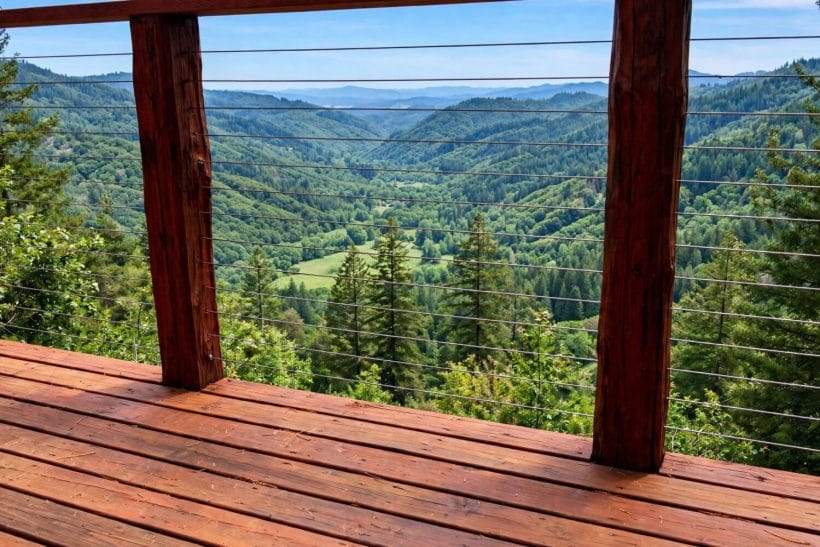
Stainless cables between redwood posts keep the view and let the timber star. The modern pairing suits redwood particularly well: warm wood, cool steel, and the landscape framed rather than fenced.
30. Glass for the wind and the view
Where wind or a great view argues for glass, redwood posts and a timber handrail keep the balustrade in the deck’s family. Choose the pairing deliberately — it reads contemporary, and the whole deck should agree with it.
31. Black metal, warm wood
Slim black metal balusters under a redwood handrail give strong contrast and a crafted, almost Japanese calm. The handrail carries the warmth to the hand; the metal carries the rhythm.
32. The wide handrail as a shelf
A broad top rail earns its keep all summer — drinks, books, small pots, a row of lanterns at dusk. Build it from the best board in the pack; it is the part of the railing everyone touches.
33. Privacy screens in slatted redwood
Horizontal or vertical slats in redwood screen a neighbour’s window without walling the deck in. The slats silver with the deck, filter the light beautifully and keep the material story to a single timber.
34. Planter-topped rails
Where the code allows the height, a railing capped with a shallow planter turns the boundary into a garden — herbs by the dining end, trailing plants where the deck meets the view. Keep the planting light and the drainage thoughtful.
35. Gates that match
A gate in the railing — for children, dogs or the garden path — should be built like the railing itself: same boards, same rhythm, honest hardware. A matching gate disappears; a bought one always announces itself.
36. No railing at all
Where the deck is low and local rules allow, skipping the railing altogether gives redwood its cleanest look — a platform in the garden. Keep the edge deliberate: a border board, a step, a planting line, so the openness reads as design.
6. Pergolas, Shade and Structure
37. The redwood pergola
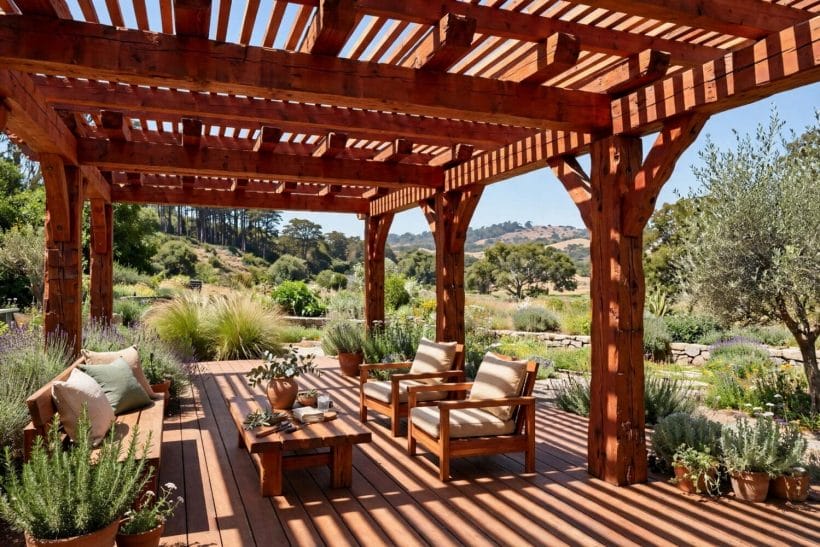
A pergola in the deck’s own timber is the natural crown: posts and rafters in redwood, shadow striping the boards below. Build it stout and simple — the material’s colour is ornament enough.
38. A sail over timber
A cream shade sail above redwood boards gives soft, modern shade and a lovely colour triangle — cream, red-brown, green. It is also the honest budget answer where a full pergola is too much structure.
39. Vines on the rafters
Grow a vine over a redwood pergola and the deck gains a living ceiling that changes with the seasons. Keep the vine off the deck boards themselves, prune it back from the timber, and let the shade deepen year by year.
40. The covered corner
Roof just one corner — over the dining table, say — and the deck gains an all-weather room while the rest stays open to the sky. Redwood under a roof keeps its red longest, which makes the covered corner the colour anchor of the whole deck.
41. An outdoor kitchen edge
A cooking counter along one edge, fronted in redwood to match the deck, turns the platform into a summer kitchen. Keep heat and grease on the counter’s own hard surface, and the timber where hands and eyes enjoy it.
42. The fireplace wall
A masonry fireplace or fire feature at the deck’s end pairs stone’s permanence with redwood’s warmth. Clearances and construction are professional, local-rule territory — the design idea is the pairing, and it is a classic for a reason. For the fire questions themselves, see the site’s fire pit deck reading.
43. Lighting the timber
Warm light low over redwood — step lights, lantern light, a string of bulbs under the pergola — brings the red up richly after dark. Avoid cold white light on this timber; it greys the colour you paid for.
44. A hot tub set into the boards
Redwood and cedar-toned spas are old partners. Set the tub beside or partly into the deck with a proper independent structure beneath — the engineering is professional work — and let the boards run up to it in one warm field.
45. Storage within the structure
Benches that lift, a hatch to the under-deck, a slim store built into the pergola post line — redwood’s workability makes fitted storage easy to build beautifully, and a deck with storage stays uncluttered enough to show its boards.
7. Furniture and Outdoor Living
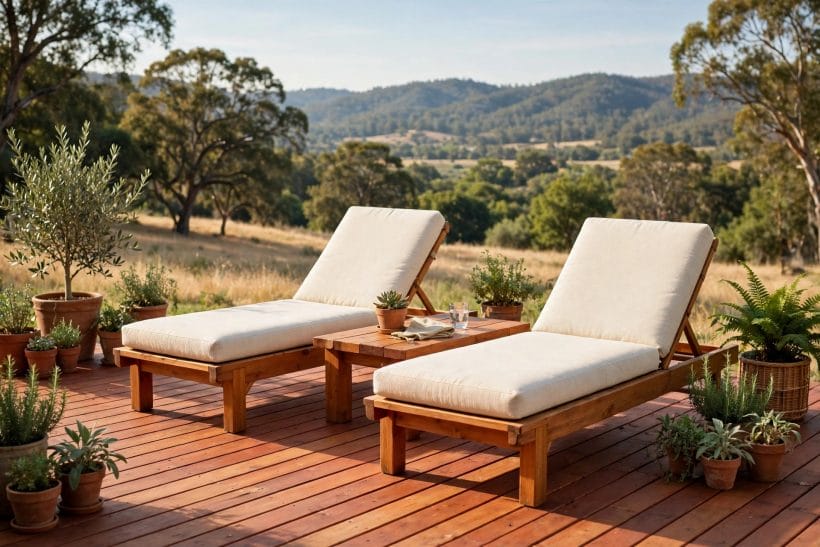
46. Teak and redwood, the warm pair
Teak furniture silvering beside redwood silvering is the classic Pacific pairing — two great timbers aging together. Keep the cushions pale and the scheme calm, and the deck needs no other colour at all.
47. A long table in the same spirit
A big dining table — in redwood, teak or any honest timber — centred on the deck’s long axis makes the platform a dining room. Seat both sides and both ends, and leave the board run visible at the margins.
48. Loungers facing the view
Two loungers, a low table and nothing else: the minimal deck, and often the best used. On redwood the furniture can be quiet because the floor itself is the decoration.
49. Cream and linen cushions
Pale cushions lift redwood’s warmth and keep a sunny deck feeling cool. Natural fabrics suit the material’s honesty; add one rust or sage accent and the scheme is finished.
50. The hammock corner
Between two pergola posts or a stand at the deck’s quiet end, a hammock makes the corner everyone argues for. The redwood below and the canvas above — a summer afternoon in one image.
51. A rug under the seating
An outdoor rug defines the living zone on a big deck and softens the boards underfoot. Choose flat weaves in the deck’s own palette — rust, cream, charcoal — and lift it through winter so the boards beneath weather evenly.
52. Pots in families
Group pots in threes at the deck’s edges and steps: terracotta for warmth, black for drama, weathered zinc for the silvered deck. Repeat the deck’s colour logic — warm with warm, grey with grey.
53. The reading chair
Every deck deserves one deep chair in its best corner, turned to the morning or evening light. On redwood, a single well-placed chair says the deck is for lingering, not just for gatherings.
54. Dining under strings of light
Festoon lights over the table end of a redwood deck give the cheapest, happiest transformation in this post. The boards take the warm light beautifully, and dinner outside becomes the house’s default summer plan.
8. Colour, Finish and the Silvering Choice
55. Keeping the red
To hold redwood’s colour, the routine is a penetrating oil with UV protection, renewed on the maker’s schedule — stated generally, that is the deal: the red is kept by habit, not by a single heroic coating. Shaded decks hold colour far longer than scorched ones.
56. Letting it silver
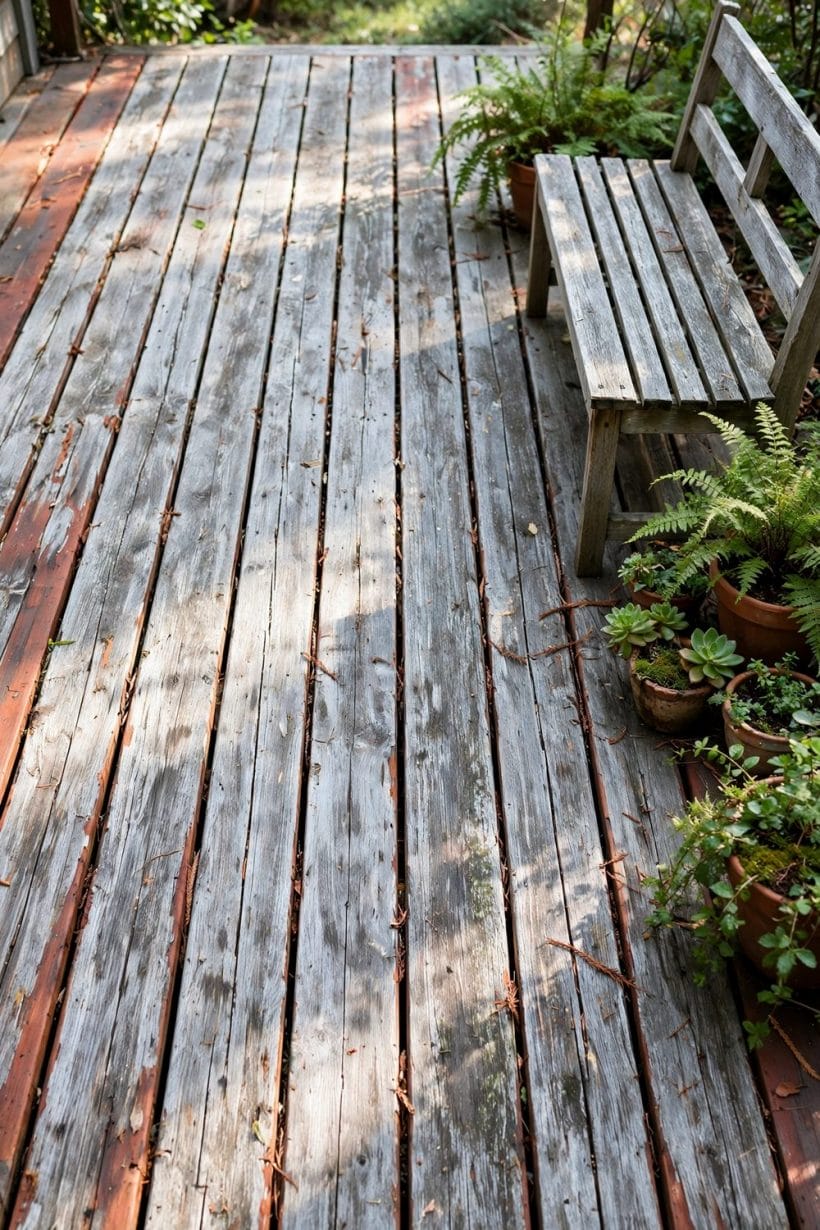
Do nothing, and within a season or two the red softens through russet to a silvery grey, even and driftwood-calm. It is not neglect — it is one of the two classic redwood finishes, and the one that asks nothing of you but an annual clean.
57. The halfway house
Some owners oil the covered and high-traffic zones and let the open field silver. Done deliberately — with the boundary at a step or a border board — the two-tone deck looks designed; done accidentally, it just looks patchy.
58. Toners and tints
A lightly tinted finish can even out a deck whose boards vary strongly in tone, at the honest cost of a little of the wood’s natural variation. Test on offcuts first; redwood’s own colour is strong enough to fight a tint that ignores it.
59. What to avoid on redwood
Film-forming finishes that sit on the surface tend to peel on deck boards and are hard to renew gracefully; penetrating products that soak in are the general wisdom for this timber. Whatever you choose, follow its maker’s guidance rather than folklore. The broader question is covered in the site’s paint versus stain for exterior wood explainer.
60. New boards beside old
Replacement boards shout for their first season. Feather them in by choosing the closest tones in the pack, and know that sun and weather will close most of the gap — redwood blends its repairs better than most timbers.
61. Colour partners: stone and metal
Grey stone cools redwood’s warmth into balance; black metal sharpens it; cream render and pale gravel set it off like a frame. When you plan the deck, plan its neighbours — the red reads differently against each.
62. Colour partners: planting
Green is redwood’s oldest partner — the forest’s own scheme. Silver foliage echoes the silvered deck; rust-toned grasses echo the red one. Choose the planting to agree with whichever life your deck is living.
63. The front-of-house deck
A redwood porch deck at the front door makes an entrance warm before the door even opens. Keep it swept and simply furnished — a bench, a pot, a lantern — and let the timber do the welcoming.
9. Care, Cleaning and Honest Maintenance
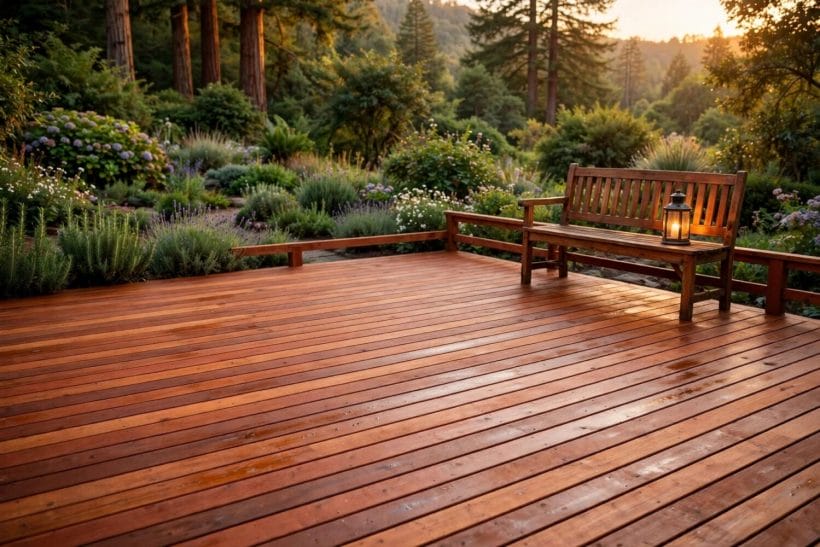
64. The annual clean
Once a year, sweep, wash with a deck cleaner suited to the timber, rinse and let it dry — that is the whole liturgy for a silvered deck, and the preparation for oiling a red one. Gentle tools only; redwood’s surface is softer than the aggressive jets sold to clean it.
65. Sweeping as a habit
Leaves and grit left sitting hold moisture against the boards and grind underfoot. A weekly sweep in autumn, an occasional one otherwise, is the cheapest maintenance any deck ever gets.
66. Moving the pots
Pots and rugs trap moisture and shade in patches. Shift them a few times a season so the deck weathers evenly, and stand pots on small feet so air passes beneath.
67. Checking the boards
Walk the deck slowly once a year and look: a lifted board end, a soft spot near a post, a screw head standing proud. Redwood repairs easily while problems are small — a board lifts, a matching one drops in, the deck goes on.
68. Snow, leaves and standing water
Clear snow with a plastic shovel, never let leaf drifts winter against the railing, and keep the board gaps free so water leaves the deck the way it was designed to. Standing water is the one weather redwood cannot argue with.
69. Refreshing a tired deck
A greyed deck that was meant to stay red can usually be brought back: clean, brighten with a product made for the purpose, re-oil. A deck too far gone in patches may be happier converted honestly to the silvered life.
70. Furniture feet and hot metal
Fit pads to furniture feet — redwood dents more readily than the dense hardwoods — and keep planters, fire bowls and barbecue feet on mats or stands so heat and rust never mark the boards.
71. The under-deck matters
Airflow beneath the boards is the deck’s quiet guardian. Keep vents and edges unblocked by soil and planting, and the underside stays dry — most deck decay begins in the dark, not in the sun.
72. Knowing the honest lifespan
Good heartwood, kept clean and dry beneath, serves for decades; sapwood edges and neglected corners go sooner. That is the honest bargain of a natural material — it lasts in proportion to ordinary, unglamorous care.
10. Costs and Practical Details
73. What actually drives the cost
Grade first: clear heartwood boards cost more than knotty, sapwood-mixed packs, and the difference shows for the deck’s whole life. Then area, levels and railings, the structure beneath, delivery distance from a regional timber, and the finish you choose — the maintained red costs time every year, the silver costs almost nothing.
74. Permits, structure and sourcing checks
Decks are regulated structures: footings, heights, railings and stairs all answer to local rules, and a raised redwood deck is professional work with permits, not a weekend improvisation. Before ordering, check the timber’s certified sourcing, the grade stamps on offer, and your local availability — redwood is regional, and freight can quietly become the largest line in the budget.
75. The redwood deck that lasts
Buy the best heartwood you can, decide its colour life on day one, keep it swept and breathing, and a redwood deck will be the warm heart of the garden for a generation — red as a hearth or silver as driftwood, and entirely itself either way. For the rest of the house’s timber skin, clapboard exterior ideas and the site’s tiny house deck ideas carry the story on.
Final Considerations
Redwood asks two things of you — a grade chosen with care and a colour decision made honestly — and gives back a deck that feels warm in every sense: underfoot, in photographs, and on the grey Tuesday evenings when the garden is only looked at through glass. Choose its red life or its silver one; both are the real thing.
One seasonal thought to end on: a redwood deck has a rhythm to its year. Spring brings the wash and, for red-keepers, the oil; summer is bare feet and long evenings; autumn asks for the sweep and the leaf-clearing; winter shows the silvered boards at their most beautiful against frost and low sun. Build it well and the deck stops being a project and becomes a calendar — the garden’s own way of telling you what season you are in.

0 Comments