

Alabama can put a tiny home on a Gulf shoreline, in a Tennessee Valley town, or down a quiet county road under pine trees, and each of those settings changes what the build involves.
Choosing among tiny house builders alabama is therefore less about showroom floor plans and more about fit: which builder type suits your land, your local rules and the amount of work you want to do yourself.
1. Alabama Builders at a Glance
The infographic for this guide compares four builder types rather than naming companies, because that comparison is the honest starting point for any search in this state. Some firms design and build the whole home with you. Some start from an existing plan and let you adjust it. Some stop at a weather-tight shell and hand the inside work over to you. Others sell a kit or a set of plans and never build anything at all. None of those routes is automatically best. The right one depends on your parcel, your timeline, your confidence with tools, and how much responsibility you want a single business to carry from the first sketch to the day the home is set on your land.
| Builder type | What they deliver | What the infographic highlights |
|---|---|---|
| Custom builders | Full design-build | Most control over layout, size and finishes |
| Semi-custom builders | Plans plus options | Mid-range, with proven floor plans you can personalise |
| Shell builders | Weather-tight shell | DIY finish, so the interior work becomes yours |
| Kit and plan sellers | You build | Lowest cost, with the building work in your hands |
Underneath the four types, the infographic names the same four key factors for every candidate: certification, contract, delivery and warranty. Treat those as the shared checklist behind this whole guide. A beautiful floor plan means little if the certification route is unclear, the contract is vague about what the price covers, delivery to your county has never actually been done by that firm, or the warranty turns out to be a handshake. The tip printed at the bottom of the graphic is worth repeating in plain words: ask every builder what the price includes, because delivery and setup change the real total, sometimes by more than the upgrades buyers spend weeks choosing between.
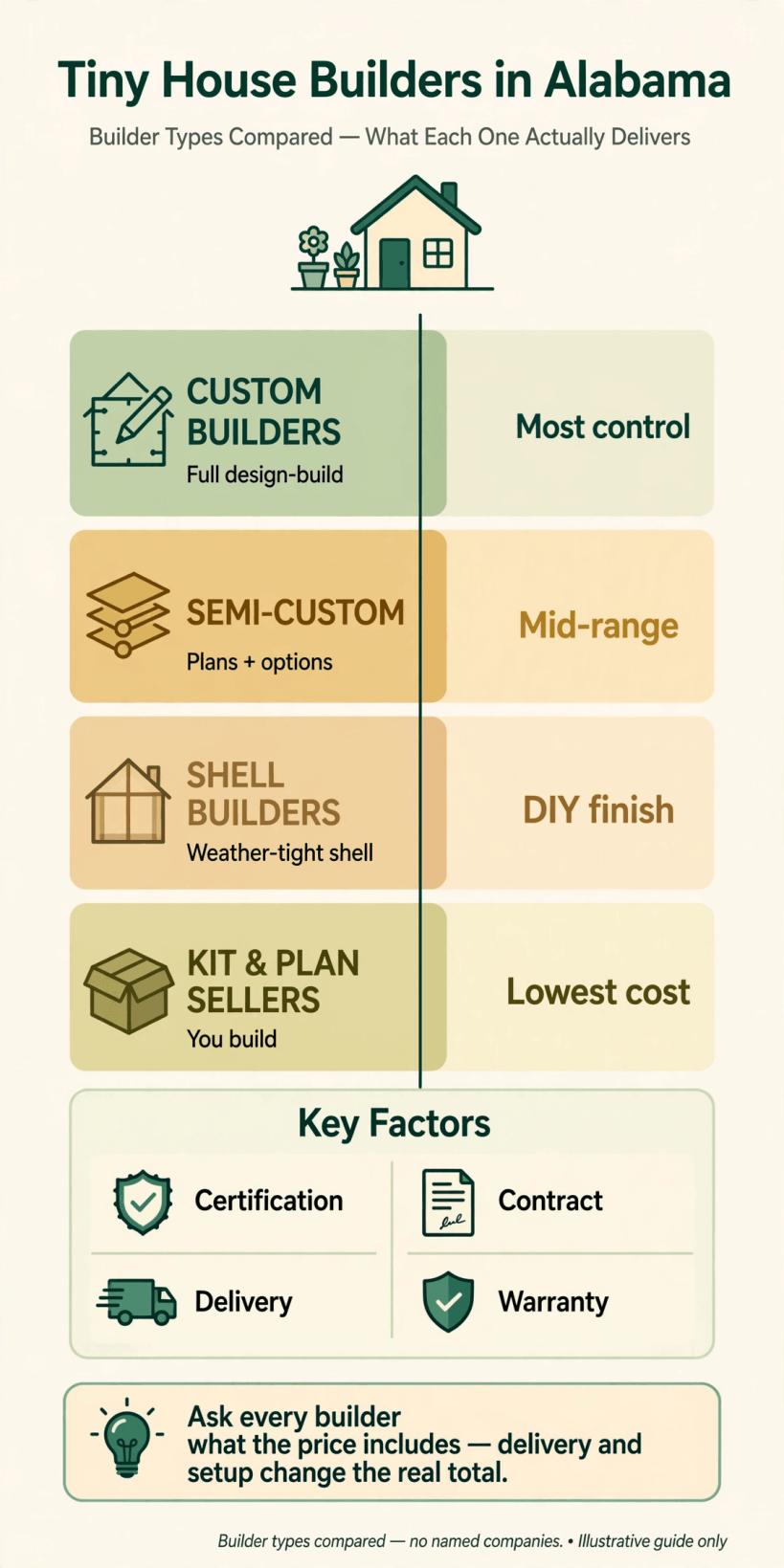
Alabama at a glance: four builder types compared, and the four key factors — certification, contract, delivery and warranty — to test every candidate against.
2. Start With Land and Local Rules, Not Floor Plans
Alabama has no single tiny house answer that covers the whole state. Whether a small home is welcome on a parcel, what it may sit on, and how it is classified are questions answered locally, and the answers can differ between an incorporated city, a town with its own zoning office, and unincorporated county land a short drive away. Before you compare builders, settle what you are allowed to place: the minimum size a dwelling must reach, the setbacks from property lines and roads, whether a home on wheels is treated as a dwelling, a recreational vehicle or something else entirely, and whether a second small home behind an existing house is permitted as an accessory dwelling.
Work through that homework in a fixed order. Start with the county or city planning and zoning office that covers your exact parcel, and ask for the relevant answers in writing rather than relying on a phone summary. Then check the practical layers that sit underneath zoning: septic approval and soil suitability on rural land, well and water service, power access, flood maps if your land sits near the coast, a river or a creek, and any subdivision or homeowners association rules that add their own limits. Our building a tiny house checklist, from first questions to move-in day orders those steps, and our overview of how to get a tiny house built, from first sketch to finished home shows the normal sequence a project follows once the land questions are settled.
Only then does builder fluency become easy to judge. Ask each candidate what they have actually placed in your county or a neighbouring one, which office issued the approvals, and what surprised them last time. A builder who knows the local counter, the local forms and the local inspectors by habit will usually give straighter answers than one who promises to figure it out after your deposit clears. That local knowledge is worth real money in a state where a project can look simple in one jurisdiction and complicated twenty minutes down the road.
3. Check Licensing, Certification and Insurance
Start with the business itself, not the brochure. Ask for the builder’s licence or registration details where they apply, confirm they are current, and check that the legal name on those documents is the legal name that will appear on your contract and your invoices. Ask who carries insurance during the build and during transport, what that cover actually protects, and whether subcontractors are insured while they work on your home. Gaps in those answers are not small print. They decide who pays when something goes wrong on a wet Tuesday in the middle of the job.
Then look at how the finished home is certified and inspected. A tiny home may be built to a residential code, inspected as a manufactured or modular unit, or certified as a recreational vehicle, and each route carries different consequences for placement, financing, insurance and resale. Our explainer on how building codes treat unconventional small homes walks through why the label matters long after build day. Ask the builder which standard your home will be built and inspected to, who performs the inspections at each stage, what documentation you receive at handover, and whether that paperwork is the paperwork your county, your lender and your insurer expect to see.
Finish this stage by verifying like a sceptic. Look the business up independently rather than through links the builder sends you. Read reviews for patterns about communication and aftercare rather than star ratings alone. Ask for two or three past customers you may contact, ideally including one whose home was delivered to a similar kind of site. A sound builder expects these questions, answers them without drama, and puts the answers in writing. A builder who treats basic verification as an insult is telling you something important about how problems will be handled later, when the stakes are higher and the money has already moved.
4. Build for Alabama Weather, Not a Catalogue Photo
Alabama asks a lot of a small house. Summers are hot and humid across most of the state, so cooling, ventilation and moisture control are structural concerns, not comfort extras. A tiny volume heats and cools quickly, which is a gift when insulation and shading are done well and a misery when they are not. Ask how the builder insulates walls, floor and roof, how the home is ventilated in humid weather, and what stops condensation building up inside wall cavities and around windows through a long, damp season. The answers should sound specific to this climate, not copied from a build that was designed for a dry or a cold one.
Severe weather is the second design test. Thunderstorms can bring damaging wind and heavy rain anywhere in the state, tornado risk is a real planning consideration, and homes near the Gulf also face coastal wind and flood exposure that inland counties do not. That does not mean every Alabama tiny home needs the same specification. It means the conversation about anchoring, tie-downs, roof fixing, window protection, drainage around the base of the home and safe shelter during a storm warning should happen with your county and your builder before the design is frozen. Ask what the builder recommends for your specific site and why, and be wary of anyone who waves the whole topic away.
Ground conditions complete the picture. Heavy rain and clay-heavy soils in parts of the state make drainage and base preparation matter more than buyers expect. A home set on a poorly drained pad can suffer moisture problems from below even when the roof is perfect. Discuss grading, gravel or slab preparation, skirting and access for plumbing with the same seriousness you give the kitchen layout. In a small home, the unglamorous layers underneath and around the structure decide how the glamorous layers inside it age.
5. Questions to Ask Every Builder
Interviews go better with a written list, because friendly conversations drift towards finishes and away from the subjects that decide outcomes. Put the same questions to every candidate, write the answers down on the day, and compare the notes rather than your memories of who seemed most enthusiastic. A builder’s answers to awkward questions are a better predictor of your experience than the quality of their display model.
- What exactly does the quoted price include, and what does it leave out?
- Who handles permits and inspections, and what proof will I hold at the end?
- What certification will the finished home carry, and is it right for my land and my lender?
- How are change orders priced and approved once the build has started?
- What is the payment schedule, and what milestone triggers each payment?
- How will the home reach my site, and who is responsible if access turns out to be difficult?
- What warranty covers structure, systems and appliances, and who honours each part?
- What happens, in writing, if the build runs late or a defect appears after delivery?
Listen for how answers are given as much as for what they say. Precise answers with documents behind them are a good sign. So is a builder who says they need to check something and then actually comes back with the answer. Vague reassurance, pressure to sign before you have compared quotes, and hostility to putting promises in writing are all information too. You are not being difficult by asking. You are doing the normal diligence that protects both sides of a fair contract, and the builders worth hiring are the ones who recognise that.
6. Delivery, Access and Setting the Home
A tiny home is only finished when it is sitting level, connected and legal on your land, and the journey between the workshop and that moment deserves its own section of your planning. Ask early how the finished home will travel: what vehicle moves it, what route the driver expects to take, and what could complicate that route. Rural Alabama deliveries can involve narrow county roads, low branches, soft shoulders after rain, tight gates, long unmade driveways and slopes that look harmless in a photograph and feel very different under a loaded trailer. A site visit, or at minimum a detailed video and measurements shared with the builder and the driver, is cheaper than a failed delivery day.
Agree in advance who prepares the site and to what standard: the base or foundation, the exact position and orientation, utility stub-ups, and clear working room around the placement spot. Then agree who does what on the day itself. Who levels and anchors the home, who connects water, sewer or septic and power, who seals and skirts the base, and who checks doors, windows and systems once the home has settled onto its supports. Small homes can shift slightly as they are set, and a builder or installer who plans a settling check is showing you experience rather than pessimism.
Put delivery in the contract as a described event, not a single word. The agreement should name who pays for transport, what happens if weather postpones the move, who carries insurance while the home is on the road, and what condition the home must be in when you accept it. Photograph everything on arrival, walk through it with the delivery team before they leave, and record snags in writing while everyone is still standing there. That half hour of care is the easiest quality control in the whole project.
7. Warranty, Aftercare and Distance
Every new home, however small, produces a snag list. A door settles, a seal needs attention, an appliance misbehaves, a joint opens as materials dry. The question is never whether small issues appear, but how they are logged, who fixes them, and how quickly. Before you sign anything, ask each builder to explain their warranty in plain language: what is covered for the structure, what for the roof and the exterior skin, what for plumbing, electrical and heating or cooling equipment, and what belongs to appliance manufacturers rather than to the builder.
Distance shapes aftercare in a state where your builder may be several counties away. Ask where warranty work is actually performed, whether the builder travels to your home or expects the home to travel to them, what response time they aim for, and whether local tradespeople can be authorised to do warranty repairs when that is quicker. Get the claim process in writing, including how you report a problem, what evidence to send, and how urgent faults like water leaks are prioritised over cosmetic ones. A modest warranty honoured promptly is worth more than a grand promise that dissolves into unanswered messages.
Also ask what documentation arrives with the home: manuals, appliance warranties, inspection and certification paperwork, paint and finish details, and guidance for maintaining seals, filters and ventilation. In a tiny home, systems are compact and often hidden behind fitted joinery, so knowing where shut-offs, panels and access points are matters. Good builders treat handover as a teaching session, not a goodbye. If the handover on offer is a wave from the workshop door, adjust your expectations of everything that follows an issue, and price that risk into your decision.
8. What Drives the Cost in Alabama
This guide deliberately avoids quoting prices, because a number without its inclusions misleads more than it helps. What can be compared honestly is what drives cost from one route to another. The builder type is the first driver: a full custom design-build carries design time, one-off problem solving and the widest choice of finishes, a semi-custom build spreads proven plans across many homes, a shell stops paying the builder at the point your own labour begins, and a kit or plan moves most of the labour cost onto you entirely. None of those is the cheap or the expensive option in the abstract. Each is a different answer to the question of whose time and skill the project runs on.
The second driver is specification. Insulation and windows suited to humid heat, a roof and anchoring approach suited to your wind exposure, the heating and cooling system, the kitchen and bathroom specification, and any off-grid equipment all move the total before a single decorative choice is made. The third driver is the site, and Alabama buyers underestimate it regularly: clearing and grading, a driveway that survives wet weather, septic or sewer connection, water and power runs, the base or foundation, delivery distance and difficulty, and permits and inspections can together rival a large slice of the build itself.
Compare costs the way an accountant would, on a single sheet with the same rows for every candidate: home as specified, certification and inspection, transport, site preparation, connections, taxes or fees where they apply, and a contingency you control. When a quote looks dramatically lighter than the others, find the empty rows before you celebrate. In this market, a low number usually means something has been left out, assumed to be yours to arrange, or specified more thinly — and it is far better to discover which of those it is while you are still comparing, rather than after the home is built.
9. Warning Signs That Should Slow You Down
Most builder problems announce themselves early, in small ways that buyers explain away because they have fallen for a floor plan. Treat this section as permission to pause. A price that can only be explained verbally, a contract that does not name the certification or the specification, or a payment schedule that runs far ahead of visible progress are all reasons to stop and ask harder questions. So is a builder who cannot say which county offices they have worked with, or who promises that rules and permits will somehow not apply to your project.
Watch for pressure as a technique. Discounts that expire this week, slots that will vanish if you take time to compare, and reluctance to let you speak with past customers are sales tools, not building skills. Be equally careful with the opposite problem: a builder so informal that everything feels like friendship. Friendly is good. Undocumented is not. Deposits, change orders, specification swaps and delivery promises belong in writing whoever you hire, and a professional will already work that way without being asked.
Finally, test communication before you need it. Send an email with three specific questions and note how long a useful answer takes and whether it actually answers what you asked. Visit the workshop if you can, look at homes in progress rather than only finished showpieces, and pay attention to how organised the work and the paperwork appear. The builder who will guide your project through a storm delay, a failed inspection or a supplier problem is the same person you are dealing with now, on an easy day, with nothing yet at stake. Judge that person on the evidence in front of you.
10. Compare Final Quotes Side by Side
By the final stage you should be holding a small number of serious quotes, and the temptation is to rank them by the headline number. Resist it until the quotes have been made genuinely comparable. Build one sheet with a row for every element this guide has covered — builder type, specification, certification, contract terms, payment schedule, delivery and setup, site works, warranty and aftercare — and a column for each builder. Where a cell is empty, that is not a saving. It is an unknown, and unknowns belong in follow-up questions, not in your budget as zero.
Score the intangibles beside the money. How clearly did each builder explain your county’s position? How convincing is their weather specification for your part of Alabama? How reachable will they be in year two, and how did past customers describe the months after handover? A slightly higher quote from a builder whose answers were documented, local and verifiable is often the cheaper decision across the life of the home, because the expensive problems in tiny building are rarely the visible ones. They are the re-done connection, the unpermitted placement, the warranty argument and the delivery that nobody planned properly.
Readers comparing neighbouring states will find the same method travels well. Our guide to tiny house builders in Maryland and how to choose between them applies a similar checking routine in a very different regulatory setting, and the sibling guides in this series for tiny house builders in Alaska, tiny house builders in Arizona, tiny house builders in Arkansas and tiny house builders in Delaware each adapt the builder-type comparison to their own state’s land, weather and rules. Whichever state your land is in, the order of operations stays the same: land and rules first, credentials second, quotes last.
Final Considerations
Choosing a builder in Alabama is a matching exercise, not a talent contest. The best partner for your project is the one whose builder type fits how you want to live and work, whose certification and contract paperwork survive scrutiny, whose delivery plan respects your actual site, and whose answers about this state’s heat, storms and local rules sound like experience rather than optimism. Take the checks in this guide in order, keep everything important in writing, and let a builder earn your deposit step by step. Do that, and the small home that arrives on your land is far more likely to be the home you thought you were buying.


0 Comments