

Delaware is small enough to cross in a morning, yet a tiny home near Wilmington, one in Kent County farmland and one near the Sussex beaches face three different sets of rules, weather and ground.
Choosing among tiny house builders delaware is about matching the builder type and the coastal specification to your county, your lot and your flood and wind exposure — not about finding a statewide winner.
1. Delaware Builders at a Glance
This guide’s infographic compares four builder types and names no companies, because in a state this small, buyers routinely shop regionally and the type decision matters more than any individual name. Custom builders provide full design-build and the most control. Semi-custom builders adapt plans plus options, in the mid-range. Shell builders hand over a weather-tight shell for a DIY finish. Kit and plan sellers supply the package or the plans, you build, and the cost is lowest. Each step down the ladder transfers work and responsibility — design, finishing, project management — from the builder to you, and the honest question is how much of that transfer your time, skills and site can absorb.
| Builder type | What they deliver | What the infographic highlights |
|---|---|---|
| Custom builders | Full design-build | Most control over design, siting and coastal detail |
| Semi-custom builders | Plans plus options | Mid-range, adapting proven floor plans |
| Shell builders | Weather-tight shell | DIY finish, with the interior work yours |
| Kit and plan sellers | You build | Lowest cost, with construction in your hands |
The four key factors on the graphic are coastal specification, contract, delivery and warranty. Coastal specification earns its place at the top: salt air, wind exposure and flood considerations follow Delaware homes much further inland than many buyers expect, and they reach the hardware, fixings and finishes as surely as the structure. The tip printed on the infographic is the section in miniature — near the coast, ask about corrosion protection and wind ratings before finishes. A Delaware search that starts with those four factors will sort builders more honestly than weeks spent comparing kitchen photographs.
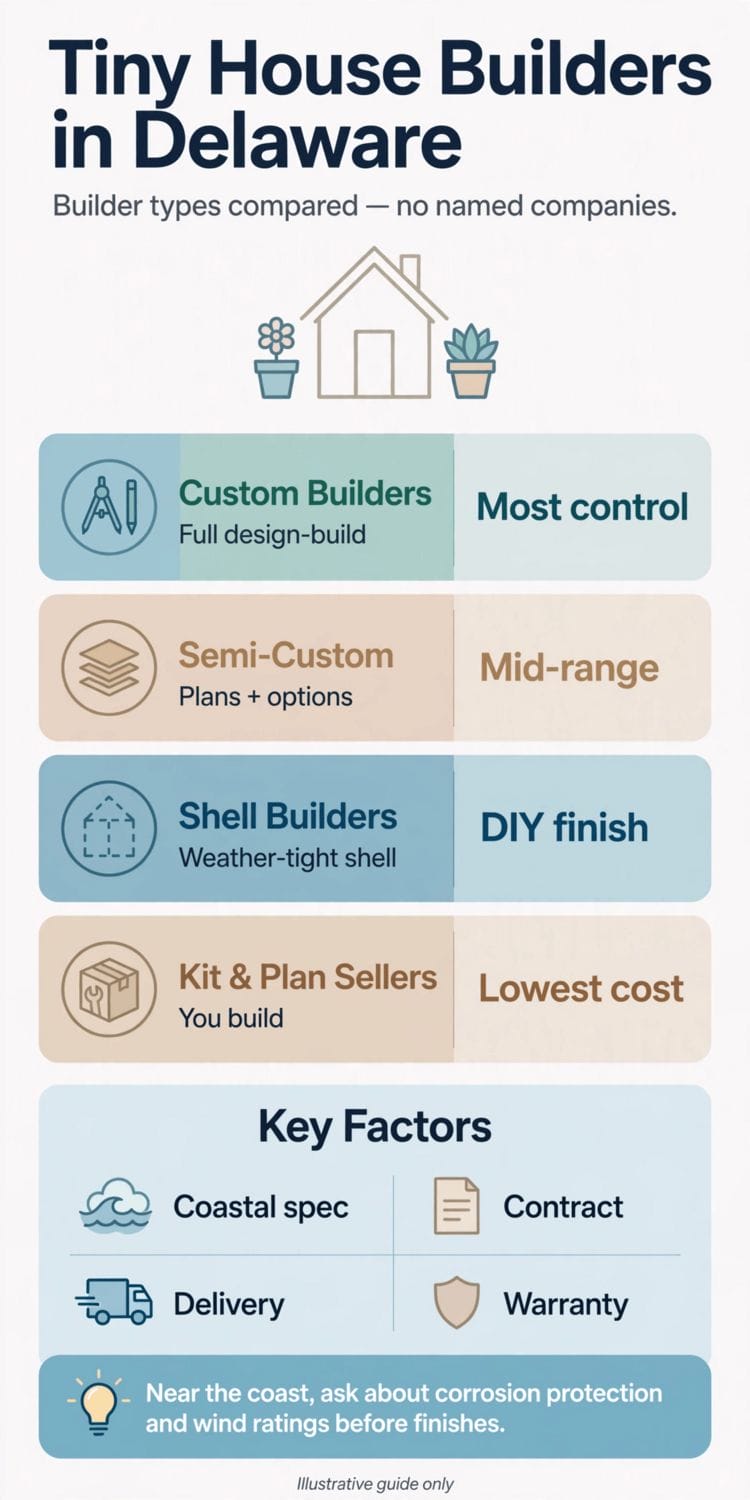
Delaware at a glance: four builder types compared, and the four key factors — coastal specification, contract, delivery and warranty — to test every candidate against.
2. Start With Your County and Your Town, Not Floor Plans
Delaware has just three counties — New Castle, Kent and Sussex — but do not let that short list suggest one rulebook. County zoning carries much of the weight for unincorporated land, incorporated towns and cities apply their own codes and ordinances, and the questions that decide a tiny project are the usual decisive ones: minimum dwelling size, setbacks, foundation expectations, whether a home on wheels is treated as a dwelling or as a recreational vehicle, and whether a small second home is permitted behind an existing house. Homeowners associations and recorded community restrictions add a further layer on many lots, especially in newer developments and near the beaches. Put the questions to the office that covers your exact parcel and get the classification in writing first.
Add the services layer before you fall for a design. Much of Delaware’s decision-making hides underground: whether the lot connects to public sewer or needs a septic system suited to its soil and water table, what the well or public water position is, and — critically near the coast and along the state’s many low-lying waterways — where the parcel sits relative to flood maps and what that means for elevation, foundation and insurability. Our building a tiny house checklist, from first questions to move-in day sequences those checks, and our overview of how to get a tiny house built, from first sketch to finished home shows the order a project follows once the land’s answers are known.
Then judge builders against your county, not the state outline. Ask what each candidate has placed in New Castle, Kent or Sussex respectively, which office approved it, and what the lot taught them. Delaware’s scale cuts both ways: a builder from a neighbouring state may be closer to your land than one at the other end of Delaware, which is fine — provided their certification, delivery and permit experience genuinely extends to your parcel. Geography on a map is not the same as fluency at your county counter.
3. Check Licensing, Certification and Insurance
Start with the business in documents. Ask for licence or registration details where they apply, verify they are current, and make sure the legal name on them is the name that will appear on your contract. Because so many Delaware buyers will consider builders based across a state line, ask explicitly which jurisdictions the builder is set up to work and deliver in, and who takes responsibility for the Delaware end of the paperwork. Ask what insurance covers the build, the transport and any subcontractors, at each stage, and treat any reluctance to answer in writing as an answer in itself.
Certification decides what your home legally is, and in Delaware that label interacts directly with county placement. A tiny home may be built and inspected to a residential code, produced as a manufactured or modular unit, or certified as a recreational vehicle — each with different consequences for where it may sit, how it is financed and insured, and what a future buyer can do with it. Our explainer on how building codes treat unconventional small homes sets out those consequences. Ask the builder which standard your home will meet, who inspects it at each stage, and what documentation you receive at handover — then check that documentation against what your county, lender and insurer expect.
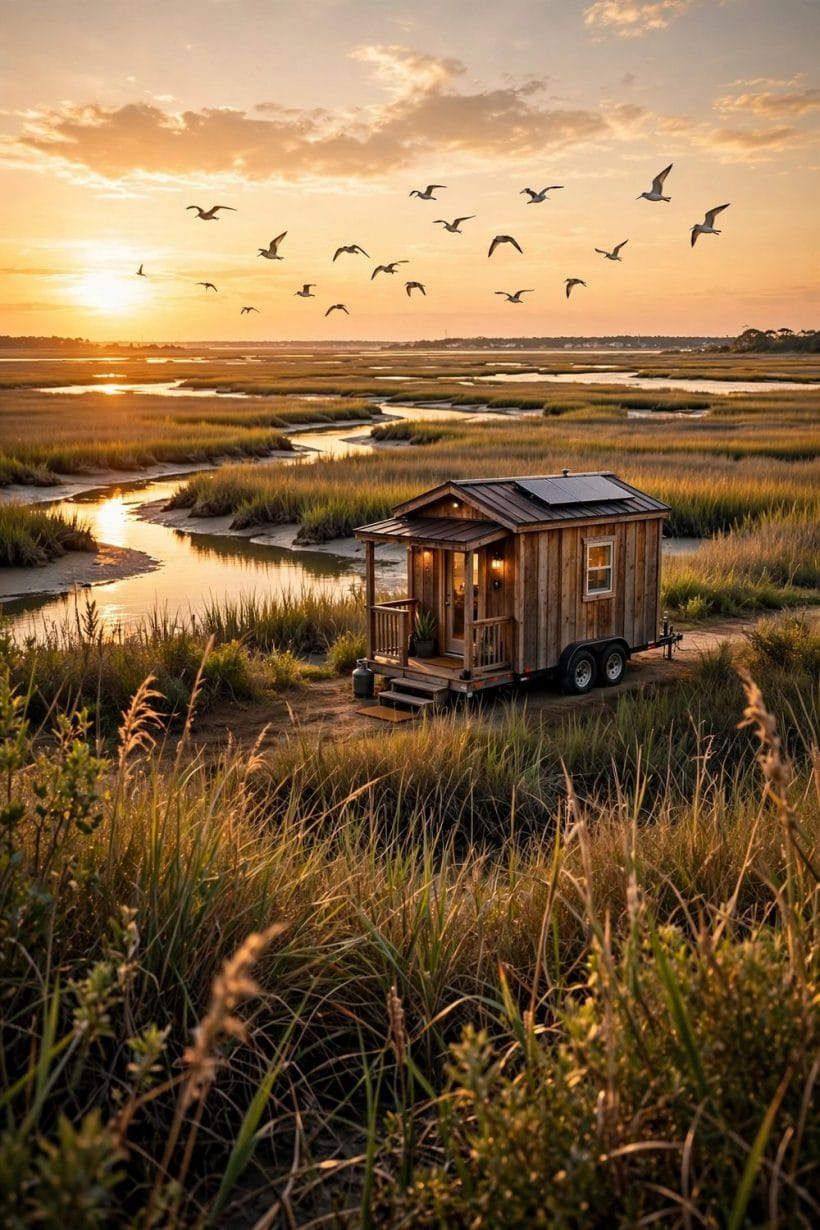
Verify like a sceptic, especially across state lines. Look the business up independently, read owner feedback for patterns about communication, weather performance and aftercare, and ask for past customers you may contact — ideally including one in Delaware or in a comparable coastal setting. Ask those customers the two questions that matter here: did the placement paperwork go as promised, and how has the home handled salt air, storms and seasons since? Evidence from a home that has already sat through Delaware weather outvalues any promise made in a showroom.
4. Build for the Coast, Even When You Cannot See It
The infographic’s tip is this state’s specification in one line: near the coast, corrosion protection and wind performance come before finishes. Salt-laden air travels, and it works quietly on hinges, fixings, fasteners, exterior metals and mechanical equipment. Ask each builder what materials and protections they specify for a coastal Delaware site — for the frame fixings, the roof and cladding hardware, exterior fittings and any outdoor equipment — and how that specification changes between an inland Kent County field and a Sussex lot within sight of the dunes. A builder with real coastal experience will have a list ready, because this is the question their previous customers’ homes answer every year.
Wind and water complete the coastal conversation. Delaware’s storms include coastal systems that push wind and rain hard against a small, light structure, so anchoring, roof fixing and window and door performance deserve explicit discussion, proportionate to your exposure and your county’s expectations. Flood thinking belongs in placement, not in a later insurance argument: where does your lot sit relative to mapped flood risk, what elevation or foundation approach follows from that, how does water drain away from the home in extreme rain, and will access to the property survive the same event? These are check-with-your-county and check-your-parcel questions, and this guide deliberately gives no blanket answer, because the honest answer is written on your specific lot.
Do not let the coast monopolise the specification, though. Northern Delaware buyers in suburban settings face a different emphasis — lot size, setbacks, association rules, shading from mature trees and the etiquette of a small home in a close neighbourhood — while inland buyers trade salt for open-field wind and summer heat and humidity. The pattern to insist on is the same everywhere: the builder should be specifying for your parcel’s exposure, not for a generic Delaware that exists only in their brochure.
5. Questions to Ask Every Builder
Put one written list to every candidate, record the answers on the day, and compare documents afterwards rather than showroom impressions. Delaware’s list leans on county classification, coastal specification and cross-border logistics, because those are the subjects that decide projects in a small state where half the market may arrive from somewhere else.
- What certification will the home carry, and is it right for my county and my intended use?
- What exactly does the quoted price include, and what does it leave out — delivery and setting above all?
- What coastal specification — corrosion protection, wind, elevation — do you recommend for my lot, and why?
- What have you placed in my county before, and which office approved it?
- Who arranges septic or sewer, water and power connections for my parcel?
- How will the home be delivered and set, and what could my street, lot or season complicate?
- What is the payment schedule, and what verified milestone triggers each payment?
- What warranty covers structure, envelope and systems, and how is a claim handled at my distance?
Listen to how answers travel. A builder who asks for your parcel’s county, flood position and access before quoting, and who distinguishes clearly between what they arrange and what remains yours, is demonstrating the habits that carry a project. Confidence that needs no paperwork, county answers offered without having asked where the land is, and hurry to take a deposit before specification is discussed should all count against a candidate exactly as a poor reference would.
6. Delivery and Setting on Small Delaware Lots
Delaware’s distances are mercifully short, and its delivery challenges are correspondingly specific. The final approach is usually the problem, not the highway: narrow streets in older towns, tight suburban lots with fences, trees and neighbours’ cars, beach-area roads that clog in season, and soft or low ground after wet weather. Establish early how the finished home reaches your parcel — vehicle, route, turning room, and what happens at the gate — and insist that someone assesses the access, in person or from thorough video and measurements, before a delivery date is promised as confidently as a build date.
Agree the site works ahead of the truck: the base or foundation suited to your ground and, where relevant, your flood position; the home’s exact position and orientation within setbacks and utility reach; and clear working space for the setting crew. Agree who levels and anchors the home, who connects water, sewer or septic and power, who skirts and seals the base, and who rechecks doors, windows and systems once the home has settled. On small lots, also agree the courtesies in advance — timing, temporary access, making good any disturbed ground — because in Delaware your delivery day is often performed in full view of the neighbours you will live beside.
Write transport into the contract as a described operation: who pays, who insures the home in transit and during setting, what weather or ground conditions justify a postponement and who decides, and the condition the home must be in when you sign for it. Photograph everything on arrival, walk through with the crew before they leave, test systems on the spot and record snags in writing the same day. Delaware’s short distances make a return visit feasible in a way Alaska’s never could be — but the time to secure that visit is in the contract, not in a hopeful phone call afterwards.
7. Warranty, Aftercare and Salt Air
Every new home produces a snag list, and Delaware adds its own items to the usual ones: seals and exterior metals living in salt air, fixings that reward inspection, drainage that must keep working around the base. Before signing, have each builder explain the warranty plainly — what covers structure and roof, what covers the envelope and its coastal hardware, what covers plumbing, electrical and heating and cooling systems, and what belongs to equipment manufacturers — together with the periods, the exclusions and the exact process for making a claim.
Distance in Delaware is measured in relationships more than miles. Many builders serving the state are based outside it, so ask how warranty work is actually delivered to a Delaware home: who travels, whether a local tradesperson can be authorised at the builder’s cost, how parts are shipped, and how urgent faults — a leak, a failed system in a storm’s aftermath — are prioritised over cosmetic items. Then ask past customers whether the promise matched the practice. A modest warranty that arrives promptly beats a sweeping one that must be chased across a state line.
Ask, too, what arrives with the home: manuals, appliance warranties, certification and inspection documents, finish and material details, and a maintenance schedule written for a coastal Mid-Atlantic climate — rinsing or inspecting salt-exposed fittings, checking seals, keeping drainage clear, and the seasonal checks a small home expects. In compact construction, systems hide behind fitted joinery, so a handover that locates every shut-off, panel and drain is practical value, not ceremony. Builders who hand over knowledge as carefully as keys are usually the ones whose warranty lines stay quiet.
8. What Drives the Cost in Delaware
This guide quotes no prices, deliberately: in a market where many quotes arrive from out of state with different inclusions, a bare number misleads faster than almost anywhere. Compare the drivers. Builder type is the first — full custom design-build pays for design and one-off problem-solving; semi-custom spreads proven plans; a shell ends the builder’s labour where yours begins; a kit or plan transfers the build itself to you, along with the need to source coastal-grade materials and details that a distant supplier may not default to.
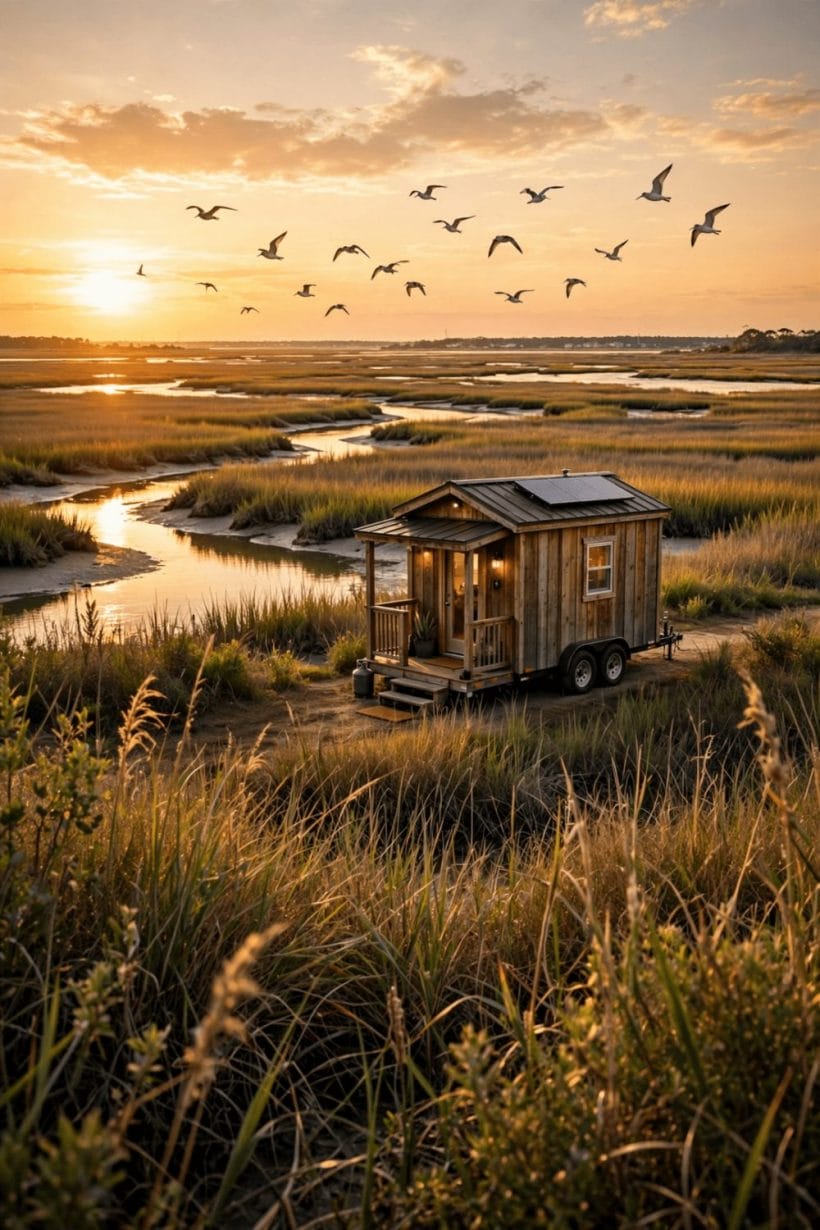
Coastal specification is the second driver, and it reaches further than buyers expect: corrosion-resistant fixings and hardware, wind-appropriate roof and anchoring work, flood-informed elevation or foundation choices where your parcel calls for them, and the windows, doors and seals to match your exposure. The third driver is the lot itself — clearing and grading, driveway and access work, septic or sewer connection, water and power, permits and inspections, and, in established neighbourhoods, the careful, sometimes slower work of building and delivering within an occupied street. None of those rows appears in a floor-plan photograph, and together they routinely decide which quote is actually cheaper.
So build one sheet with identical rows for every candidate — home as specified, certification and inspections, delivery and setting, site preparation, utility connections, and a contingency you hold — and complete every cell before comparing totals. When a quote undercuts the field dramatically, look for the empty rows. In Delaware they are usually coastal specification quietly thinned, delivery quoted to the state line rather than to your street, or site and connection works assumed to be someone else’s. Discovering which, while you are still comparing, costs an email. Discovering it later costs a season.
9. Warning Signs That Should Slow You Down
Pause for any builder who cannot name your home’s certification in writing, who offers county answers without asking which county — let alone which parcel — or who treats flood position, coastal specification and association rules as details to be sorted out after the deposit. In a three-county state, those details are the project. Pause equally for contracts that leave scope, timeline or delivery as friendly understandings, and for payment schedules that run far ahead of verified progress.
Treat pressure as information. Expiring discounts, reluctance to provide past customers, and discouragement from comparing quotes are techniques for closing your diligence down early. So, in the opposite direction, is charm without documents: deposits, specification changes, delivery responsibilities and warranty promises belong in a contract whoever builds for you and whichever state they are based in. If the paperwork is thin, imagine resolving a corrosion failure or a setting dispute armed only with that paperwork, because that is precisely what you would hold.
Run the small tests first. Send three specific questions — about your county’s classification, about coastal specification for a lot like yours, about warranty logistics to a Delaware address — and judge the replies for speed and substance. Visit a finished home in a comparable setting, ideally one that has weathered at least a full year of coastal seasons, and ask its owner about salt, storms and aftercare. The builder who emerges from these easy enquiries is the builder who will handle your failed inspection or your storm-delayed delivery. Choose on that evidence.
10. Compare Final Quotes Side by Side
Close with one sheet, a column per serious candidate, and a row for every subject this guide has covered: builder type, certification and inspection, coastal specification, contract scope and timeline, payment schedule, delivery and setting, site and utility works, and warranty handling to a Delaware address. No empty cells at decision time: an empty cell is an unasked question, and unasked questions in coastal building have a habit of returning as invoices. Only when the rows genuinely match do the totals at the bottom mean anything worth comparing.
Weigh behaviour beside arithmetic. Who asked for your parcel before your preferences? Whose specification changed when the conversation moved from an inland lot to a Sussex one? Whose references described paperwork that sailed through the county and a home that shrugged off its first storm season? A somewhat higher quote from a builder whose answers were parcel-specific, documented and verifiable is very often the cheaper decision over the home’s life, because Delaware’s expensive failures — an unplaceable unit, corroded hardware, a foundation decision made without the flood conversation — are failures of homework, and homework is visible in a quote if you read it properly.
The same method serves readers whose search crosses Delaware’s borders, as many will. Our guide to tiny house builders in Maryland and how to choose between them covers the neighbouring market in depth, while the sibling guides for tiny house builders in Alabama, tiny house builders in Alaska, tiny house builders in Arizona and tiny house builders in Arkansas each adapt the builder-type comparison to very different land and weather. Wherever the home is bound, keep the order this guide has kept: parcel and county first, credentials and specification second, quotes last.
Final Considerations
Delaware rewards the buyer who treats a small state as three counties, several exposures and one coastline rather than a single market. Choose the builder whose type fits the work you want to own, whose certification satisfies your county, whose coastal specification is argued from your lot rather than asserted from a brochure, whose delivery plan ends at your street and not at the state line, and whose warranty reaches your address without an argument. Take the checks in order, keep the important answers in writing, and let the builder earn your commitment step by step. A home chosen that way will suit its parcel — and in Delaware, suiting the parcel is most of what a home is for.


0 Comments