

In Arkansas, a tiny home might settle on an Ozark hillside, a wooded Ouachita lot, a Delta farm road or a backyard in Little Rock — and the drive in, the drainage and the county office all shape the project.
Working through tiny house builders arkansas means matching the builder type to that reality: your land, your access, your local rules and how much of the finish work you want to carry yourself.
1. Arkansas Builders at a Glance
The infographic for this guide compares four builder types and names no companies, because the type decision comes before any company decision and it quietly determines most of what follows. Custom builders offer full design-build and the most control. Semi-custom builders work from plans plus options, in the mid-range. Shell builders deliver a weather-tight shell for a DIY finish. Kit and plan sellers supply the package or the drawings, you build, and the headline cost is lowest. Read the ladder as a transfer of responsibility: every step down moves design decisions, project management, finishing labour and problem-solving from a professional onto your own weekends.
| Builder type | What they deliver | What the infographic highlights |
|---|---|---|
| Custom builders | Full design-build | Most control over layout, hillside siting and finishes |
| Semi-custom builders | Plans plus options | Mid-range, adapting proven floor plans |
| Shell builders | Weather-tight shell | DIY finish, with the interior left to you |
| Kit and plan sellers | You build | Lowest cost, with construction in your hands |
Four key factors sit under the ladder: certification, with licensing and insurance behind it; the contract, covering scope and timeline; delivery, meaning site access and logistics; and the warranty, meaning coverage and support. The tip at the foot of the graphic deserves to be underlined for this state in particular: get the delivery plan in writing, because hill country roads decide what can reach your land. A builder can promise any home in the workshop. Whether that home can climb, turn and arrive on your lane in the Ozarks or the Ouachitas is a different question, and Arkansas buyers should ask it before they ask about countertops.
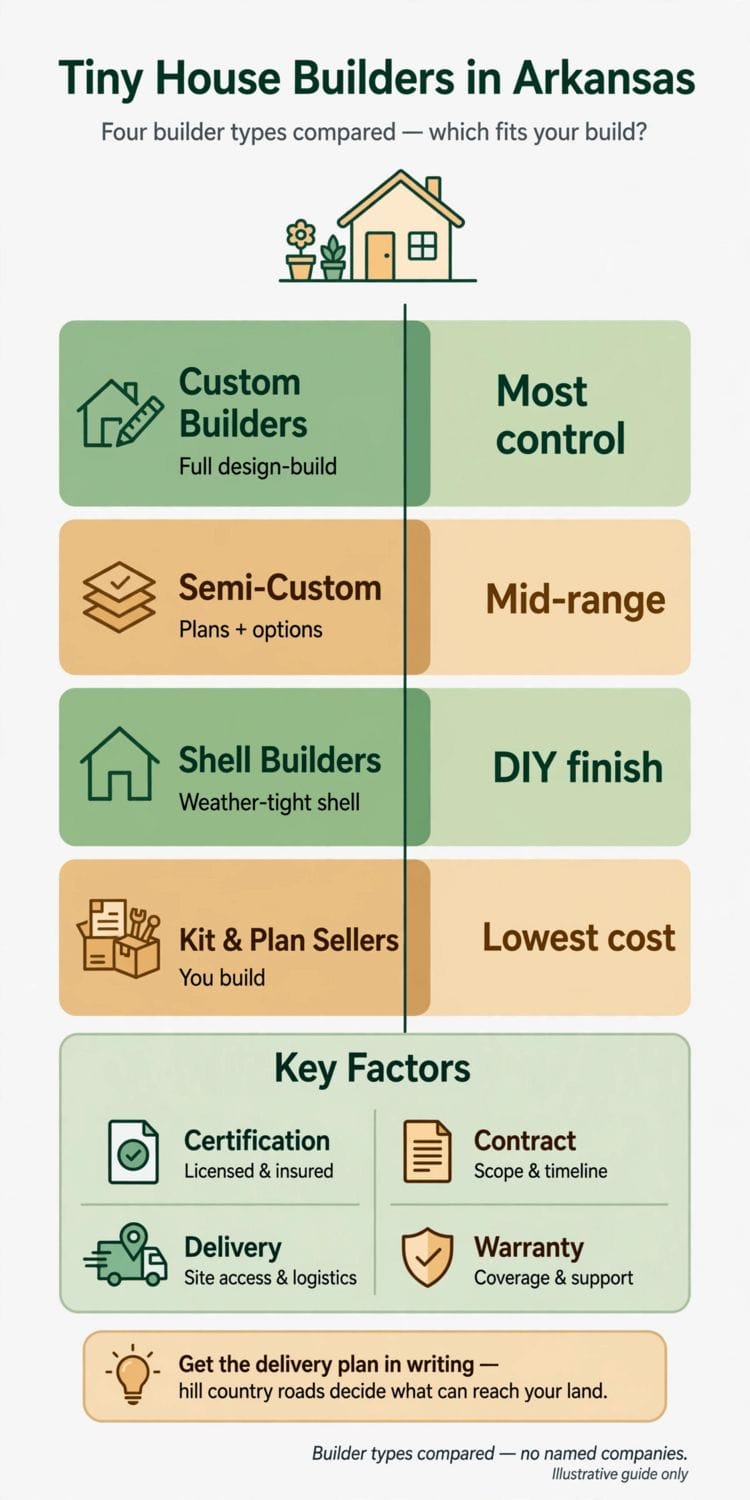
Arkansas at a glance: four builder types compared, and the four key factors — certification, contract, delivery and warranty — to test every candidate against.
2. Start With County and City Answers, Not Floor Plans
Arkansas placement rules are local, and the state contains both ends of the spectrum: cities and towns with their own zoning and permitting, and rural county land where formal zoning can be light. Light is not the same as none. Minimum dwelling sizes where they exist, setbacks, whether a home on wheels counts as a dwelling or a recreational vehicle, and whether a second small home may sit behind an existing house are questions for the city or county office covering your parcel — and for any homeowners association or recorded subdivision rules, which bind plenty of lots that look unrestricted from the road. Get the classification of your intended home and the permit path in writing while changing your mind is still free.
Underneath the legal layer sit the physical permits and services that decide daily life: septic approval and suitable soil, well or public water, power access, and drainage and flood questions that matter enormously in low-lying eastern land and along rivers and creeks, and hardly at all on a high, rocky Ozark ridge — which is precisely why statewide generalities fail here. Our building a tiny house checklist, from first questions to move-in day puts those checks in order, and our overview of how to get a tiny house built, from first sketch to finished home shows the build sequence they feed into.
With your parcel’s answers in hand, interview builders against them. Ask what each firm has placed in your county or a similar one, which office approved it, and what the access and the ground taught them. A builder who starts asking about your road, your slope and your septic before discussing layouts is behaving like someone who has actually delivered in Arkansas hill country. Treasure that instinct: in this state, local fluency is not a bonus feature. It is most of the job.
3. Check Licensing, Certification and Insurance
Paperwork first, product second. Ask for the builder’s licence or registration details where they apply, confirm they are current, and match the legal name on them to the name that will sign your contract and receive your payments. Ask what insurance covers the home in the workshop, on the road and during setting, and what covers subcontractors on your land. On a delivery that may end with a loaded trailer on a steep, wet lane, the transport and setting answers are not boilerplate. They are the clauses you will be glad you read.
Certification determines what the finished home is in the eyes of every office and institution that follows. It might be built and inspected to a residential code, produced as a manufactured or modular unit, or certified as a recreational vehicle — and each label carries different consequences for placement, financing, insurance and resale. Our explainer on how building codes treat unconventional small homes covers why the label outlives the build. Ask which standard your home will meet, who inspects it and at what stages, what documents you receive at handover, and whether those documents are the ones your city or county, lender and insurer want for the use you intend.
Complete the check like a sceptic. Find the business through independent channels, scan owner feedback for patterns about communication and aftercare rather than opening-week delight, and ask for past customers you may call — ideally one whose home was delivered to land something like yours, hills and all. Ask those customers about the delivery day and the first storm season. A builder whose access planning and anchoring survive Arkansas weather, and whose warranty calls were answered, has given you the most useful reference this process offers.
4. Weather, Water and Arkansas Ground
Arkansas weather asks several different things of a small house. Summers are hot and humid across most of the state, so insulation, shading, ventilation and moisture control matter: a tiny volume cools quickly when the envelope is good and turns stifling when it is not, and humid air will find every poorly ventilated cavity. Ask builders how they handle cooling loads, condensation and bathroom and kitchen moisture in this climate, and expect answers that mention the envelope and ventilation as a system rather than a single appliance.
Severe storms are the second test. Thunderstorms with damaging wind, heavy rain and tornado risk are part of Arkansas life in most regions, and the design conversation should cover anchoring and tie-downs, roof fixing, drainage around the base and where the household goes when warnings are issued — all discussed with your builder and your local guidance before the design is fixed, in the terms that fit your county and your site. Homes in low eastern ground and near rivers add flood awareness to the same list: elevation, access during high water and where water goes in an extreme rain event are placement questions, not afterthoughts.
Then there is the ground itself, which in much of Arkansas means slope, rock and trees. Hillside lots need honest thought about the pad or foundation, retaining and drainage, erosion after clearing, and plumbing runs on a gradient. Wooded lots need clearing decisions that keep shade where it helps and remove risk where a limb over the roof does not. None of these items photographs as well as a cedar porch, but together they decide whether the home sits dry, level and reachable in year five — and a builder fluent in your terrain will raise every one of them without being prompted.
5. Questions to Ask Every Builder
Bring one written list to every interview, note the answers on the day, and compare the documents afterwards. Friendly showroom conversations drift towards finishes; your list should keep dragging them back to access, certification and the contract, because those are the subjects that decide Arkansas projects.
- What certification will the home carry, who inspects it, and what paperwork do I receive?
- What exactly does the quoted price include, and where do delivery and site works sit?
- Have you assessed access to land like mine — and will the delivery plan be written into the contract?
- How are the home and its base designed for my slope, soil and drainage?
- What anchoring and storm specification do you recommend for my county, and why?
- Who arranges septic, water and power connections, and what do you need from me?
- What is the payment schedule, and what verified milestone triggers each stage?
- What does the warranty cover, and how is a claim handled at my distance from you?
Mark the manner of the answers as carefully as the answers themselves. Specifics, documents and questions back about your land are good signs. A builder who wants to see photographs or a video of your access road before quoting delivery understands this state. Vagueness about certification, irritation at written follow-ups, and confidence that permits and access will somehow take care of themselves are all information too — and in hill country, access optimism is the most expensive kind there is.
6. Delivery Is the Arkansas Question
The infographic’s tip earns its own section here, because in Arkansas delivery is not the epilogue to the build; it is one of its central engineering problems. Hill country roads can be narrow, winding, steep and soft after rain, with tight bends, low branches, creek crossings and gates designed for pickups rather than loaded trailers carrying a house. Ask at the very first serious meeting how the finished home travels: the route, the vehicle, the turning points, and what happens at the final approach to your pad. Require a site assessment — in person, or at minimum from detailed video and measurements — before any delivery promise is treated as real.
Agree the site works that delivery depends on, in writing and in advance: the prepared pad or foundation suited to your slope and soil, a cleared and firm access track, tree work where the route needs it, and utility positions ready to meet the home. Agree also who does what on the day — levelling, anchoring, sealing, skirting and connecting water, waste and power — and who returns to check the home after it has settled, since a house set on prepared ground can shift a little as it beds in, and doors and seals will tell you about it.
Contract the delivery like the operation it is. The written plan should name who pays for transport, who insures the home in transit and during setting, what weather or ground conditions postpone the move and who decides, and the condition the home must be in when you accept it. Photograph the home on arrival, walk it with the crew before they leave, test every system while help is still on site, and record snags in writing the same day. In rural Arkansas, the delivery crew may not pass your way again soon, which makes that hour the best-value quality control in the project.
7. Warranty, Aftercare and Distance
Small homes settle, seals age and appliances misbehave, so every buyer’s real question is how problems get fixed. Have each builder explain the warranty plainly before you sign: what covers structure and roof, what covers the envelope and windows, what covers plumbing, electrical and heating and cooling systems, and what sits with equipment manufacturers instead. Ask for the periods, the exclusions and the claim process in writing, including how you report a fault and what response you should expect.
Distance gives those answers their Arkansas weight. Builders may be based across the state from your land, so ask where warranty work happens: does a technician travel to you, can a local tradesperson be authorised at the builder’s cost, are parts shipped for you to fit, and how are urgent faults — a leak, a failed system in a heatwave — prioritised against cosmetic snags? A warranty is only as good as its logistics, and the time to learn its logistics is before you need them, not during the first emergency.
Finally, value the handover itself. Ask what documentation arrives with the home — manuals, appliance warranties, inspection and certification papers, finish details — and what maintenance guidance comes with it: seal checks, filter changes, drainage upkeep around the base, and the care a hillside installation needs after heavy rain. In a compact home, systems hide behind joinery, so a builder who walks you to every shut-off, drain and access panel is leaving you competence as well as a house. That thoroughness, or its absence, predicts the aftercare relationship better than any brochure phrase.
8. What Drives the Cost in Arkansas
No prices appear in this guide, on purpose: a figure stripped of its specification, delivery and site inclusions would mislead more than it informs. Compare drivers instead. Builder type leads. Full custom design-build pays for design time and one-off solutions, including siting a home properly on a difficult lot. Semi-custom spreads proven plans across many buyers. A shell ends the builder’s labour where yours begins. A kit or plan moves nearly all labour — and the need for genuine building skill, tools and time — onto you, which is only a saving if those things are honestly accounted.
The site is the second driver, and Arkansas sites are rarely free. Clearing and grading on wooded or sloping land, a driveway or access track that survives wet weather, the pad or foundation system, septic and water arrangements, power runs across distance, and drainage and erosion control can together form a major share of the whole project — on a hard hillside, potentially rivalling the difference between two builder types. Delivery distance and difficulty sit in the same ledger, which is why the quote that ignores access is not cheaper; it is unfinished.
So compare on one sheet with identical rows for every candidate: home as specified, certification and inspections, transport and setting, site preparation, utility connections, and a contingency under your control. Interrogate the outlier quote by finding its missing rows. In Arkansas the missing items are remarkably consistent — delivery assumed easy, site works assumed yours, specification assumed thin — and every one of them is cheaper to discover at the comparison stage than on a muddy lane with a house on a trailer and a crew watching the sky.
9. Warning Signs That Should Slow You Down
Let this section be a brake pedal. Pause for any builder who will not name the home’s certification in writing, whose contract leaves scope, timeline or delivery as understandings rather than terms, or who promises your permits and your access will be fine without having seen either. Pause for payment schedules that run well ahead of verified progress. In a state where distance and terrain complicate everything, undocumented confidence is not a personality trait. It is a risk transfer, from the builder’s ledger to yours.
Watch the sales pattern too. Discounts that expire this week, reluctance to provide past customers, and discouragement from comparing quotes are techniques for ending your diligence early, and diligence is the only protection a buyer in a lightly regulated corner of the market really has. Be equally careful with excessive informality: friendship is welcome, but deposits, change orders, specification swaps and delivery promises belong in writing, and a professional operation will already insist on exactly that.
Test before you commit. Send three specific questions — about certification, about access to land like yours, about warranty logistics at your distance — and weigh the replies for speed and substance. Ask to see a home that has weathered at least one full year of Arkansas seasons, and ask its owner about storms, settling and aftercare. Walk a workshop and look at how work in progress is organised. The builder revealed by these small, easy tests is the builder who will handle your delivery-day rain and your first-year snag list. Hire that evidence, not the showroom version.
10. Compare Final Quotes Side by Side
End the search with a single sheet and no empty cells. Give each serious candidate a column and each subject in this guide a row: builder type, certification and inspection, contract scope and timeline, payment schedule, delivery plan and site works, storm and drainage specification, and warranty handling at your distance. An empty cell is an unknown, and it should be resolved into either a price, a written responsibility or a deliberate decision before deposits move. Totals only mean something once the rows beneath them match.
Then judge the pattern of behaviour the quotes reveal. Who asked about your road before your kitchen? Who wrote the delivery plan down, priced the site honestly, and explained your county’s position without being asked twice? In Arkansas those habits are quality itself, because the expensive failures in this state — the undeliverable home, the unpermitted placement, the pad that washes, the warranty that cannot reach you — are nearly all failures of preparation, and preparation is exactly what a thorough quote displays.
The method travels across the region and beyond it. Our guide to tiny house builders in Alabama and the checks that matter there applies the same routine under Gulf-influenced weather, while the sibling guides for tiny house builders in Alaska, tiny house builders in Arizona and tiny house builders in Delaware, and our earlier guide to tiny house builders in Maryland and how to choose between them, each adapt the builder-type comparison to their own terrain and rules. In every case the order is the same: land and access first, credentials second, quotes last.
Final Considerations
The best Arkansas builder for your project is the one whose type fits your appetite for work, whose certification and contract paperwork withstands a careful read, whose storm, drainage and hillside thinking sounds like experience, and whose delivery plan is written down because it has genuinely been thought through. Take the checks in order, keep the important answers in writing, and let a builder earn your deposit one verified step at a time. Do that, and the home that finally settles onto your land — ridge, woods or Delta — is far more likely to be the home you believed you were buying.

0 Comments